-
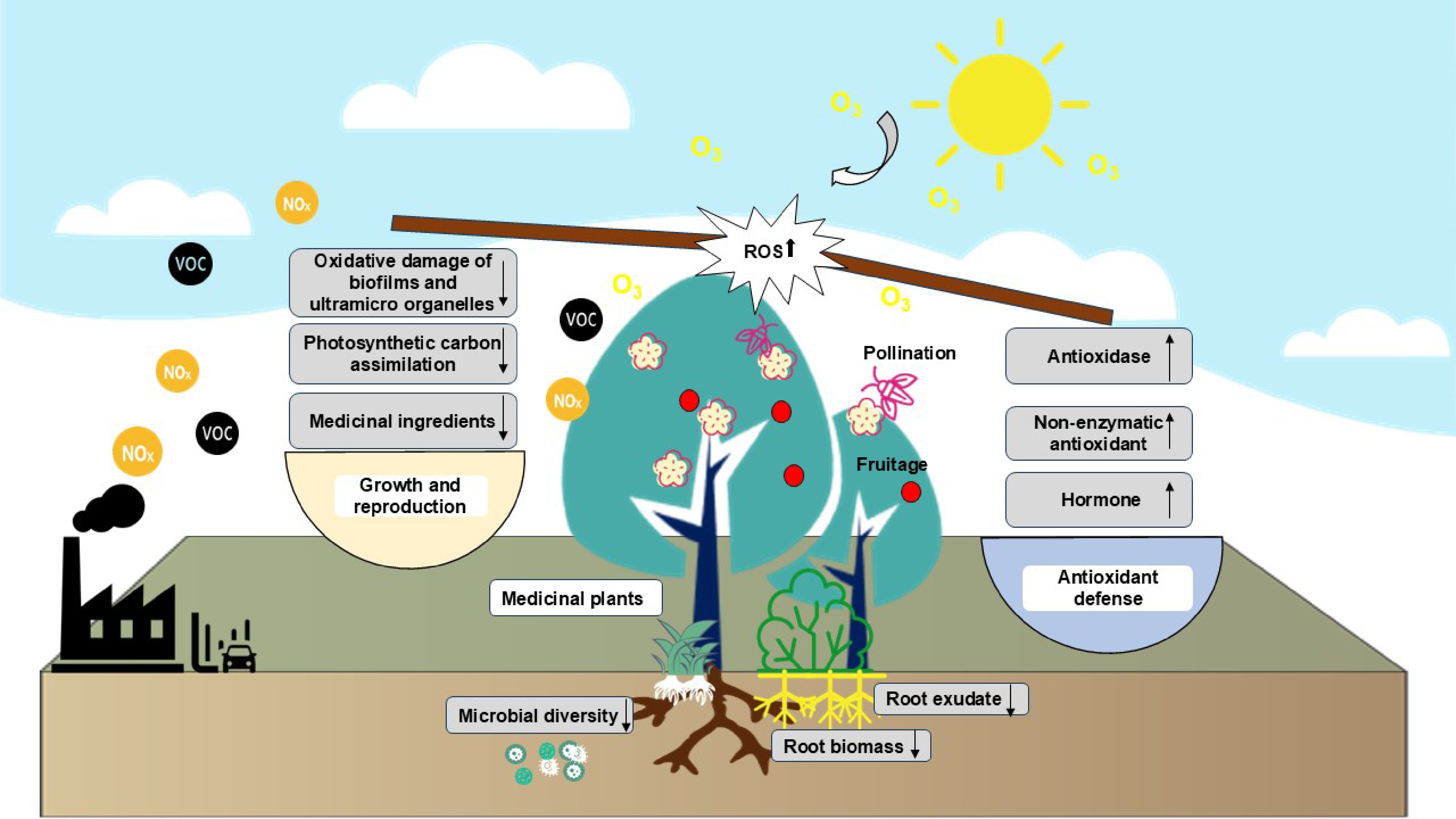
Figure 1.
Effects of ozone stress on the aboveground-underground ecosystem of medicinal plants.
-
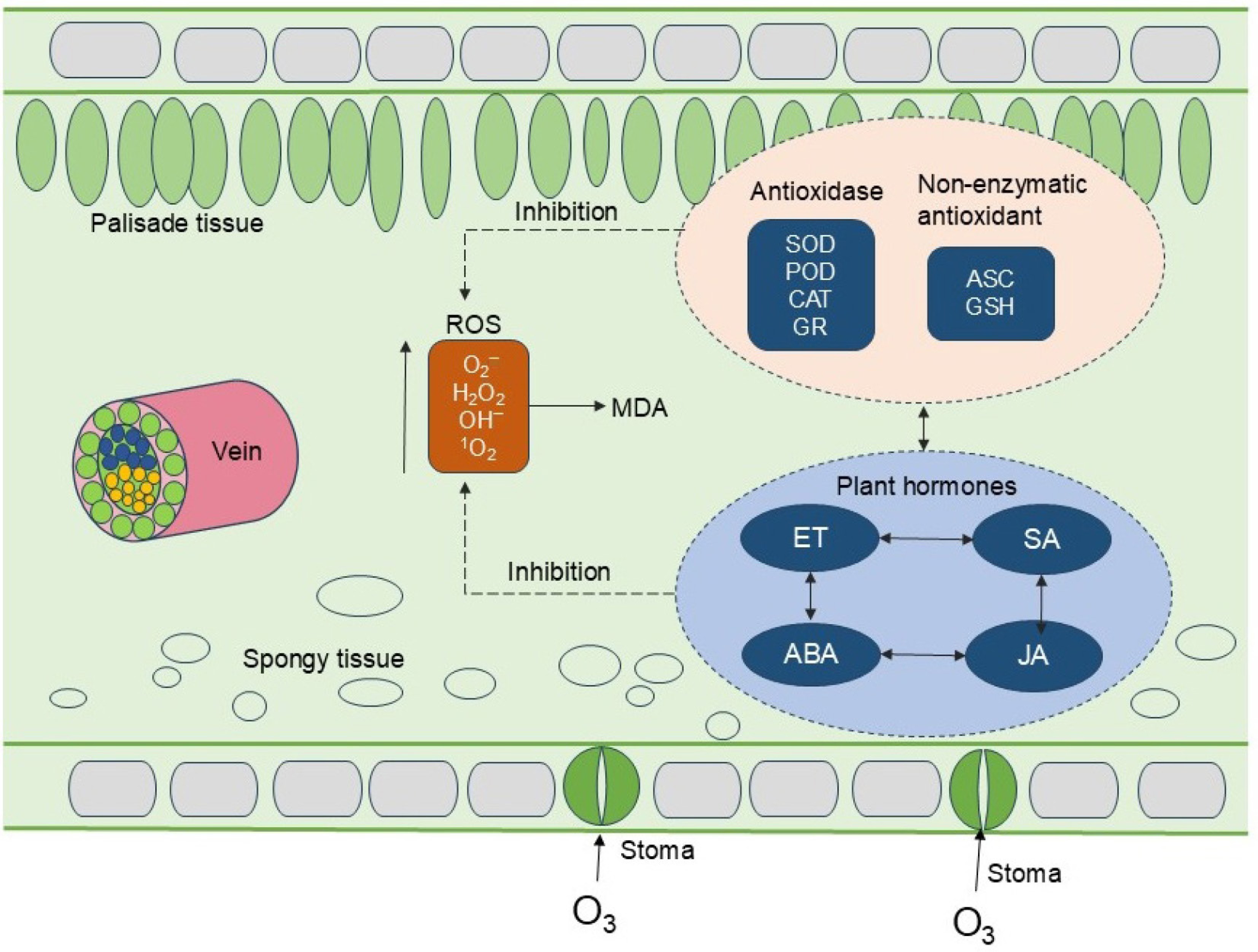
Figure 2.
Antioxidant defense mechanism of medicinal plant leaves under ozone stress. ROS, reactive oxygen species; O2−, superoxide anion; OH−, hydroxide ion; 1O2, singlet oxygen; H2O2, hydrogen peroxide content; MDA, malondialdehyde content; SOD, superoxide dismutase activity; POD, peroxidase activity; CAT, catalase activity; GR, glutathione reductase activity; ASC, apoptosis-associated speck-like protein containing a CARD; GSH, glutathione reduced; ET, ethylene; SA, salicylic acid; ABA, abscisic acid; JA, jasmonic acid.
-
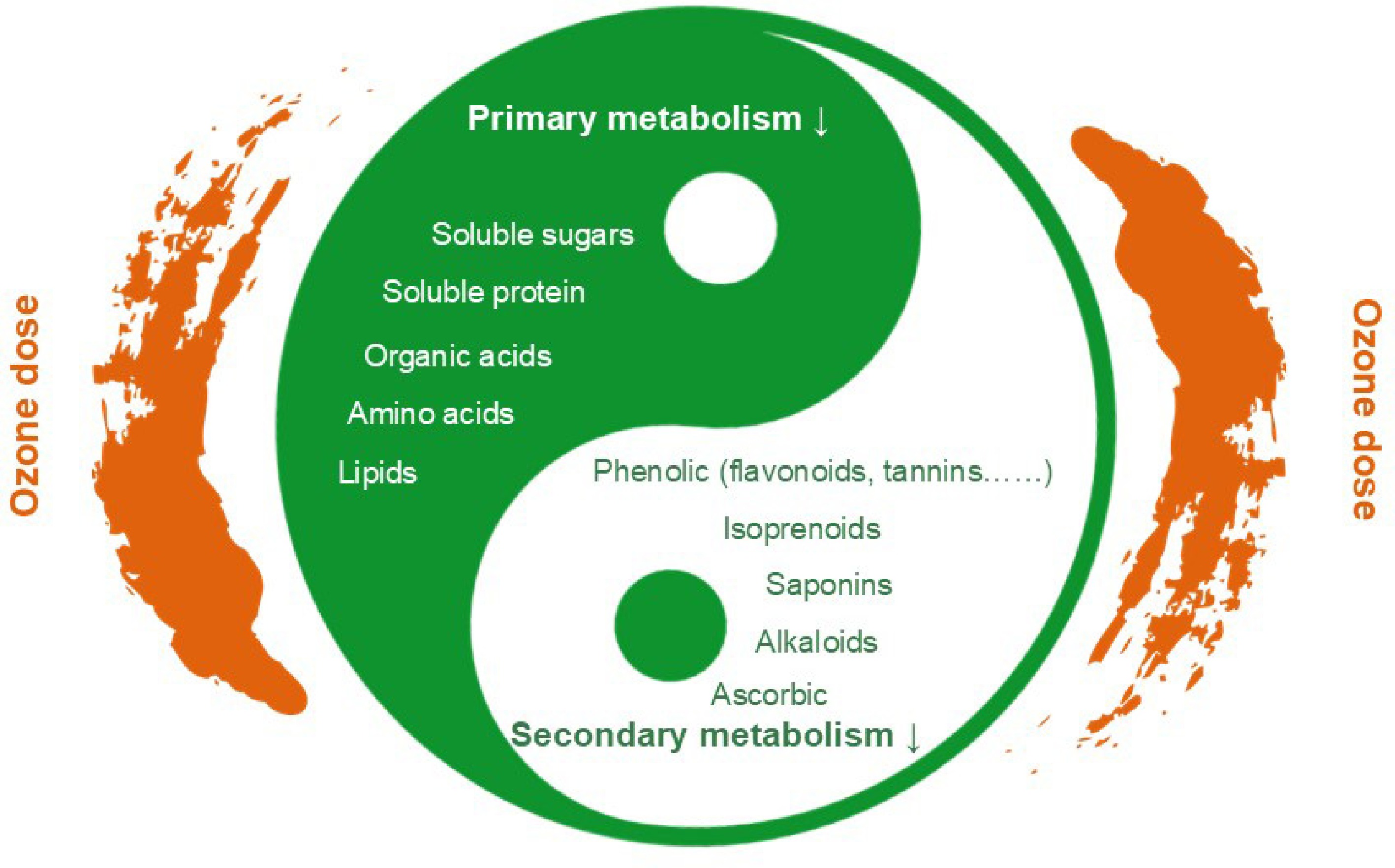
Figure 3.
Effects of ozone stress on medicinal plant metabolites. Note: ozone dose, the cumulative value of hourly O3 concentrations greater than 40 ppb.
-
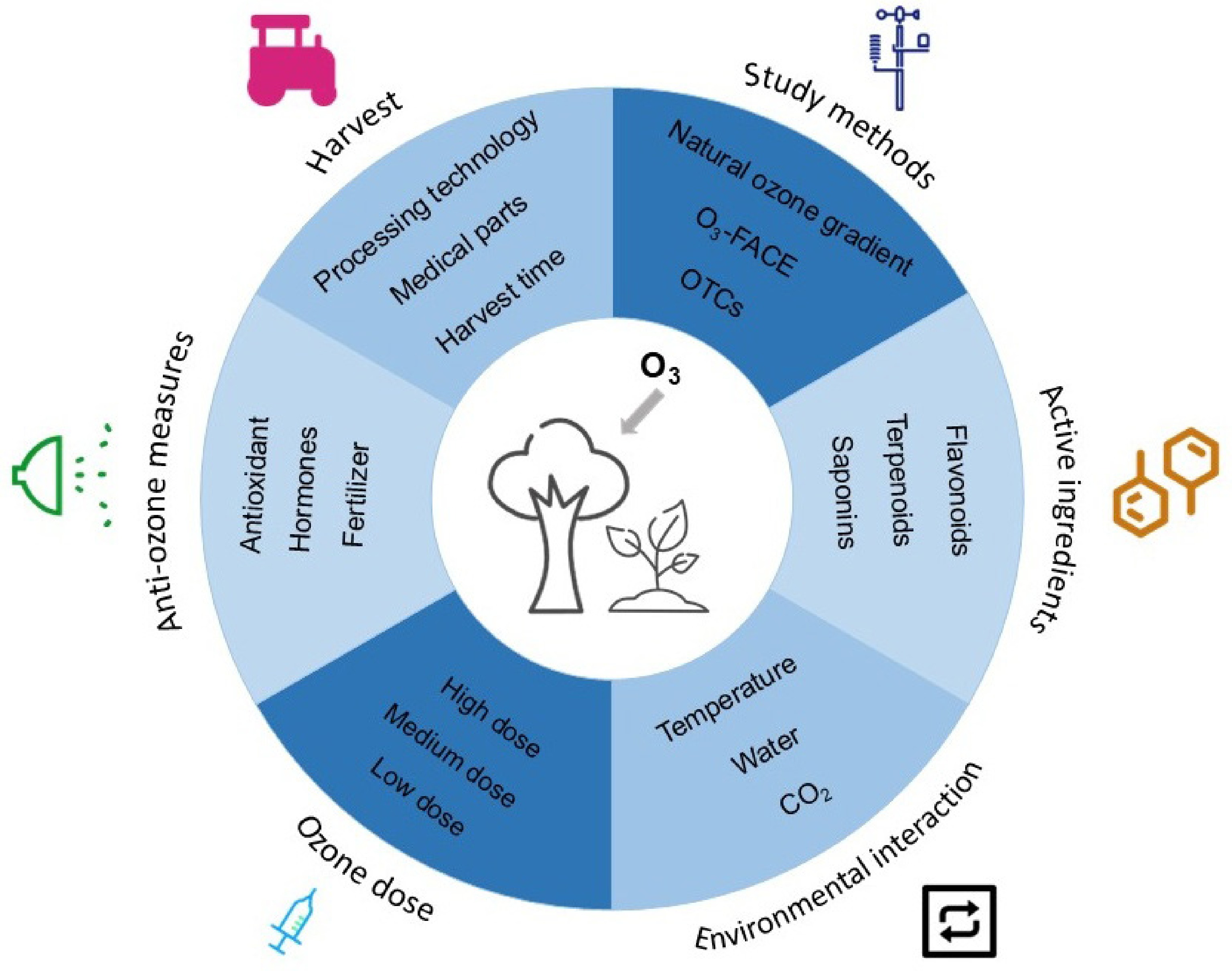
Figure 4.
Future work on medicinal plants under ozone stress.
-
Country Plants Medicinal parts Fumigation method Ozone treatment Leaves symptom Ref. Brazil Tibouchina pulchra (Cham.) Cogn. Leaves OTCs Ambient, no-filtered air + 40 ppb for 8 h, 25 d Interveinal red stippling da Rosa Santos et al.[95] China Ginkgo biloba L. Leaves OTCs 80 ppb for 9 h, 110 d Leaf blades turning yellow with yellow spots, leaf margins curling He et al.[58] China Monarda didyma L. Leaves OTCs 160 ppb for 10 h, 14 d Localized yellow‒brown spots Wang et al.[26] China Ziziphus jujuba Mill. Var. spinosa (Bunge) Hu ex H. F. Chou Leaves OTCs 95 ppb for 8 h, 60 d Yellow spots Fu et al.[46] Egypt Mesembryanthemum crystallinum L. Leaves, root OTCs Ambient + 20 ppb for 8 h, 120 d Red pigmented leaves appeared; nonsignificant reductions Mohamed et al.[33] Germany Melissa officinalis L. Leaves Growth chambers 80 ppb for 5 h Chlorotic spots Döring et al.[96] Germany Melissa officinalis L. Leaves OTCs 80 ppb for 5 h Small chlorotic spots on the adaxial leaf surfaces Döring et al.[97] Italy Melissa officinalis L. Leaves Growth chambers 200 ppb for 5 h Roundish and dark-blackish necrosis in the interveinal adaxial areas Pellegrini et al.[43] Italy Hypericum perforatum D. Don Apical shoots OTCs 110 ppb for 5 h No visible symptoms Pellegrini et al.[39] Italy Salvia officinalis L. Leaves OTCs 200 ppb for 5 h No visible symptoms Marchica et al.[36] Italy Salvia officinalis L. Leaves OTCs 200 ppb for 5 h, 36 d Interveinal stippling and chlorotic spots Marchica et al.[38] India Sida cordifolia L. Leaves, floral OTCs Ambient + 20 ppb, 90 d Chlorosis and necrotic spots; the lengths of calyx, corolla, and stamen decreased Ansari et al.[30] India Costus pictus D.Don Leaves OTCs 57 ppb for 5 h, 120 d Interveinal stippling and chlorotic spots Ansari et al.[54] India Sida cordifolia L. Leaves OTCs 63 ppb for 5 h, 90 d Trichome density increased Ansari et al.[4] India Cymbopogon flexuosus (Steud.) (Wats.) Leaves OTCs 76.3 ppb for 5 h, 90 d Shoot and root length, leaf area decreased Madheshiya et al.[37] India Andrographis paniculata (Burm. f.) Nees Leaves OTCs Ambient + 20 ppb for
8 h, 90 dChlorosis and necrotic spots Ansari et al.[98] Table 1.
Phenotypic changes in medicinal plants under elevated levels of ozone.
-
Country Plants Medicinal parts Fumigation method Ozone treatment Secondary metabolite change Ref. Brazil Tibouchina pulchra (Cham.) Cogn. Leaves OTCs Ambient no-filtered air + 40 ppb for 8 h, 25 d, Anthocyanins (↑), total tannins (↓), total phenolics (↓), flavones/flavonols (↑) da Rosa Santos et al.[95] Brazil Capsicum baccatum Pericarps and seeds OTCs 80 ppb for 5 h, 62 d Pericarp: capsaicinoid (↓); dihydrocapsaicin (↓);
lutein (↓); β-Carotene (↑); total phenolics (↑);
Seed: capsaicinoid (↓); dihydrocapsaicin (↓); total phenolics (↑)Bortolin et al.[57] China Ginkgo biloba L. Leaves OTCs 80 ppb for 9 h, 110 d Condensed tannins (↓), isorhamnetin (↓), quercetin (↑), keampferol (↑), bilobalide (↑), ginkgolides C (↑), ginkgolides A (↑), ginkgolides B (↑) He et al.[58] China Monarda didyma L. Leaves OTCs 80, 120, and 160 ppb for 10 h, 14 d Abscisic acid (↑) Wang et al.[26] China Ziziphus jujuba Mill. Var. spinosa (Bunge) Hu ex H. F. Chou Leaves OTCs 95 ppb for 8 h, 60 d Organic acids (↑), nucleoside acids (↑), glycerophosphocholines (↓), lipids (↓), tiliroside (↓), kaempferitrin (↓), spinosin (↓), swertisin (↓) Fu et al.[46] Germany Melissa officinalis L. Leaves Growth chambers 80 ppb for 5 h Rosmarinic acid (↓) Döring et al.[97] Italy Melissa officinalis L. Leaves Growth chambers 200 ppb for 5 h Salicylic acid (↑), jasmonic acid (↑),
dehydroascorbate (↓), β-Carotene (↓), lutein (↓), violaxanthin (↑), total carotenoids (↓)Pellegrini et al.[45] Italy Salvia officinalis L. Leaves OTCs 120 ppb for 5 h, 90 d Lutein (↓), β-Carotene (↓), gallic acid (↑),
catechinic acid (↑), rosmarinic acid (↑), caffeic acid (↑)Marchica et al.[38] Italy Hypericum perforatum D. Don Apical shoots OTCs 110 ppb for 5 h Total phenols (↓), flavonoids (↑), anthocyanins (↑), condensed tannins (↓), quercetin (↑), hyperoside (↓), rutin(↑) Pellegrini et al.[39] Italy Salvia officinalis L. Leaves OTCs 200 ppb for 5 h Ethylene (↑), aalicylic (↓), jasmonic (↓), abscisic acid (↑) Marchica et al.[36] India Sida cordifolia L. Leaves, roots OTCs Ambient + 20 ppb, 90 d Leaves: α-thujene (↑), ar-turmerone (↓),
neophytadiene (↑), palmitic acid (↑), cis-linoleic acid (↑), e-phytol (↑), monopalmitin (↑), squalene (↑), tetracosane (↑), vitamin E (↑), phytyl palmitate (↑);
Roots: 1-decyne (↓), pelargonic acid (↓), calcium pelargonate (↓), tetradecane (↑), clonitazene (↑), n-hexadecanoic acid (↓), cholesterol (↑), cholesterol (↑)…Ansari et al.[30] Italy Salvia officinalis L. Leaves OTCs 200 ppb for 5 h, 36 d Coumaric acid (↓), caffeic acid (↓), danshensu (↑), rosmarinic acid (↑), salvianolic acid (↓), gallic acid (↑), vanillic (↑), syringic acids (↑), apigenin (↑), luteolin (↑), quercetin (↑) Marchica et al.[38] India Costus pictus D. Don Leaves, rhizomes OTCs 57 ppb for 5 h,120 d Leaves: thiols (↓), anthocyanins (↑), flavonoids (↓), ascorbic acid (↑), total phenolics (↑), phytosterol (↓), tannin (↑), lignin (↑), saponins (↑), alkaloids (↑);
Rhizomes: phytosterol (↑), tannin (↑), lignin (↑), saponins (↑), alkaloids (↑)Ansari et al.[54] India Sida cordifolia L. Leaves, roots OTCs 63 ppb for 5 h, 90 d Leaves: total phenolics (↑), thiols (↑), ascorbic acid (↓), phytosterol (↑), tannin (↓), alkaloids (↑), lignin (↑), saponins (↑);
Roots: phytosterol (↑), tannin (↑), alkaloids (↑), lignin (↑), saponins (↑)Ansari et al.[4] India Cymbopogon flexuosus (Steud.) (Wats.) Leaves OTCs 76.3 ppb for 5 h, 90 d Total phenolics (↑), anthocyanins (↑), flavonoids (↑), alkaloids (↑), ascorbic acid (↑) Madheshiya et al.[37] India Andrographis paniculata (Burm. f.) Nees Leaves OTCs Ambient + 20 ppb for
8 h, 135 dLignin (↓), saponins (↓), tannin (↑), phytosterol (↑), alkaloids (↑), andrographolide (↑) Ansari et al.[98] Note: '↑' indicates that the secondary metabolite content increased, and '↓' indicates that the secondary metabolite content decreased. Table 2.
Changes in secondary metabolites of medicinal plants under elevated levels of ozone.
Figures
(4)
Tables
(2)