-

Figure 1.
Transmission of Antibiotic Resistance Genes (ARG) from livestock to humans through agricultural ecosystems. This figure illustrates how the use of antibiotics in livestock leads to the emergence and enrichment of ARGs in animal manure. The subsequent application of this manure as fertilizer facilitates the dissemination and persistence of ARGs in agricultural soils and crops. Ultimately, these ARGs can be transferred to human gut bacteria, completing the transmission chain and underscoring the associated ecological and public health risks.
-
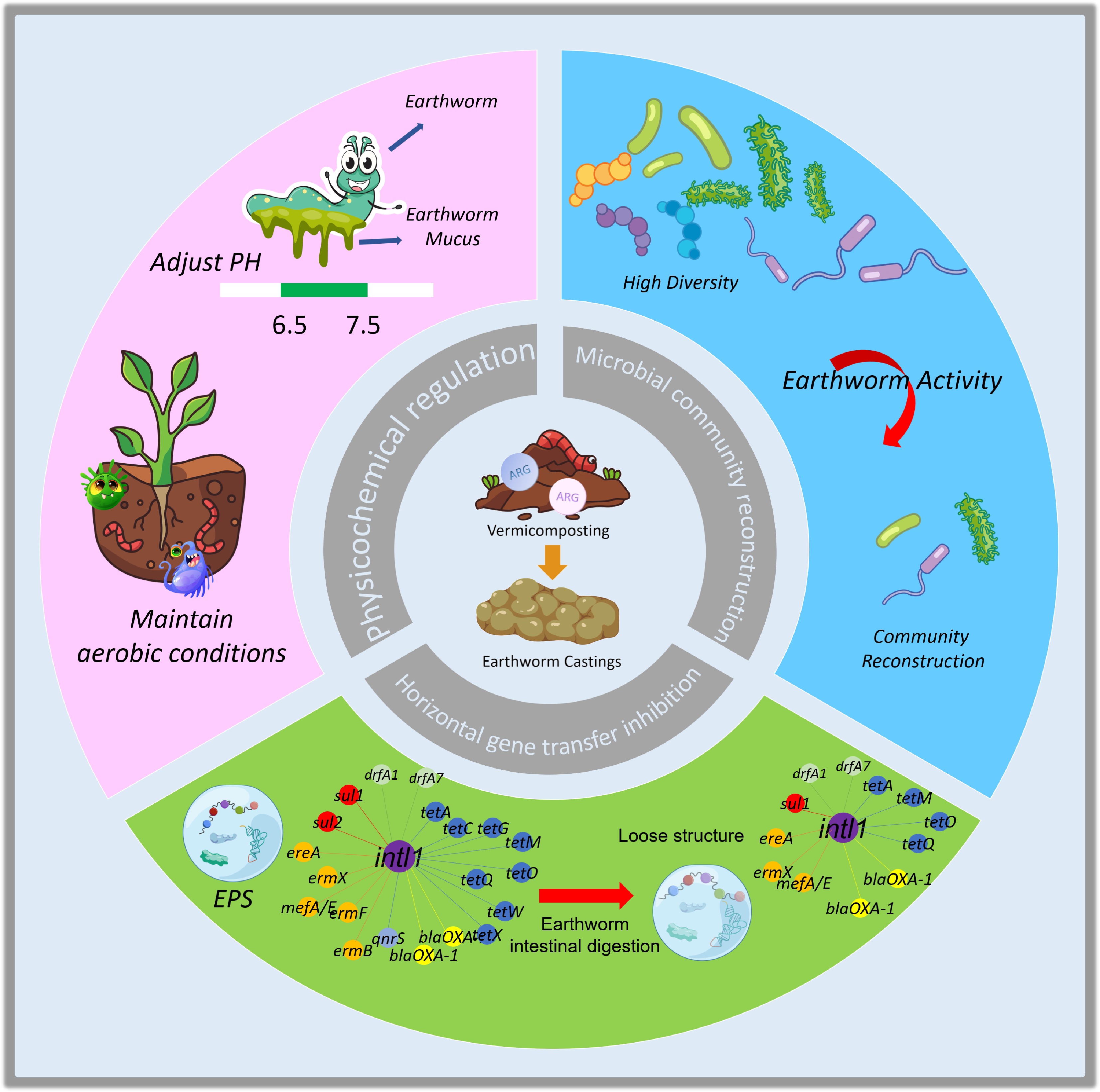
Figure 2.
Interconnected mechanisms of vermicomposting in suppressing ARGs. This schematic demonstrates the role of earthworms in mitigating risks posed by antibiotic resistance genes (ARGs) through a series of physicochemical mechanisms that improve substrate conditions and disrupt the habitats of ARG hosts. Concurrently, earthworms drive the restructuring of microbial communities, transitioning the system from a state of high diversity to a stable, reconstructed condition that limits the availability of potential hosts for ARGs. Furthermore, they play a significant role in inhibiting horizontal gene transfer by suppressing mobile genetic elements and degrading extracellular DNA, thus obstructing critical pathways for ARG dissemination. Collectively, these integrated mechanisms establish a multi-tiered barrier against the propagation of ARGs.
-
Strategies Effects Merits Limitations Removal rate Ref. Traditional compost Degrading effect on some ARGs Mature process, simple operation, low cost Efficiency depends on temperature and aeration; potential for HGT during cooling 50%–90% [14−16] Vermicomposting Significant removal of various ARGs, primarily via gut digestion by earthworms Mild process, high-quality product; effective gut-mediated suppression Slower process; limited effect on some persistent ARGs 70%–95% [17,18] Microbial agents compost Enhanced removal of specific ARGs via competitive inhibition by functional strains Targeted approach; can accelerate composting and improve maturity Efficacy depends on inoculant survival; potential risk from exogenous microbes 80%–95% [19−21] High-temperature pretreatment compost Drastically reduces initial ARG load
by eliminating host bacteriaHighly effective at initial pathogen and ARG inactivation High energy consumption does not prevent subsequent HGT during composting > 90% [22,23] Table 1.
The effects (advantages and disadvantages) of livestock manure composting technology on the ARGs degradation through various strategies
-
Genes Vermicomposting removal Conventional composting removal Ref. Total ARGs 53% reduction 34%–41.7% reduction [27−29] tet-, sul-, erm- genes tet-genes 82% reduction tet-genes 73.4% reduction [16,29,30] sul-genes 4% reduction sul-genes 45.1% reduction erm-genes 78% reduction erm-genes 56% reduction MGEs 68% reduction 25% reduction [12,31] Table 2.
Removal of key ARGs and MGEs: vermicomposting versus conventional composting
Figures
(2)
Tables
(2)