-
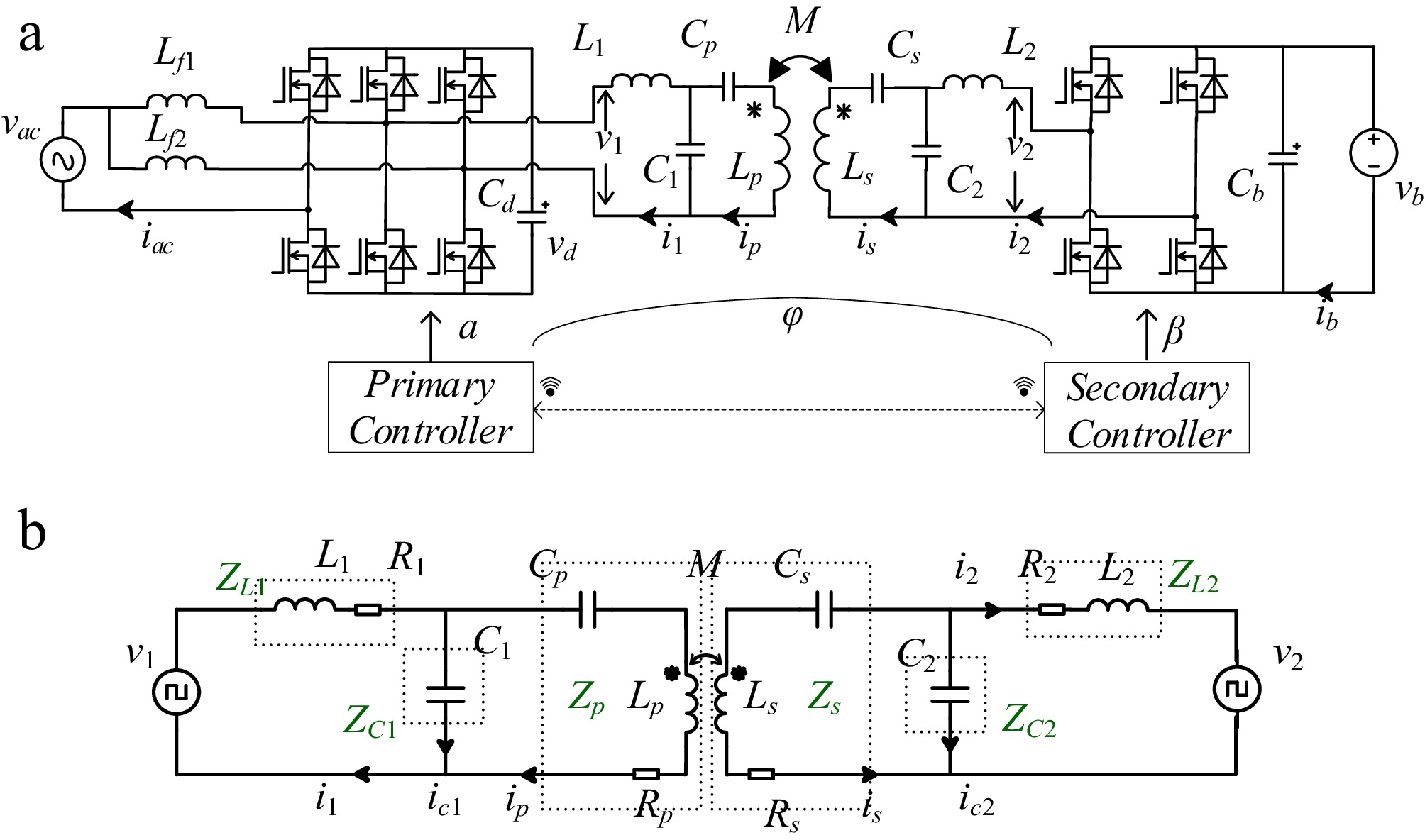
Figure 1.
Schematic of BWPT system. (a) BWPT circuit with totem converter. (b) Equivalent circuit with linear elements.
-
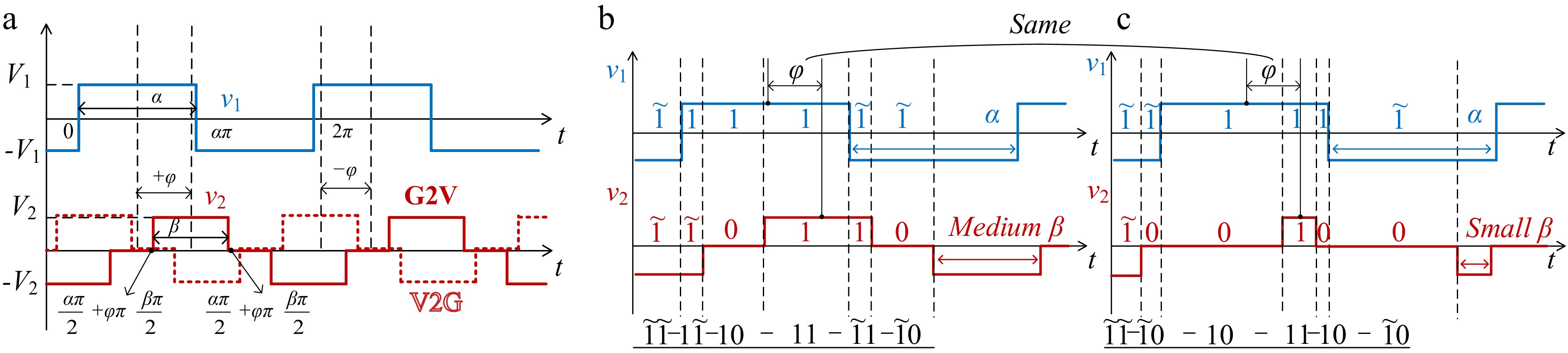
Figure 2.
Schematic of transmitter and receiver side voltage phase shift. (a) Bidirectional voltage phase delay schematic. (b) Medium β for the system. (c) Small β for the system.
-
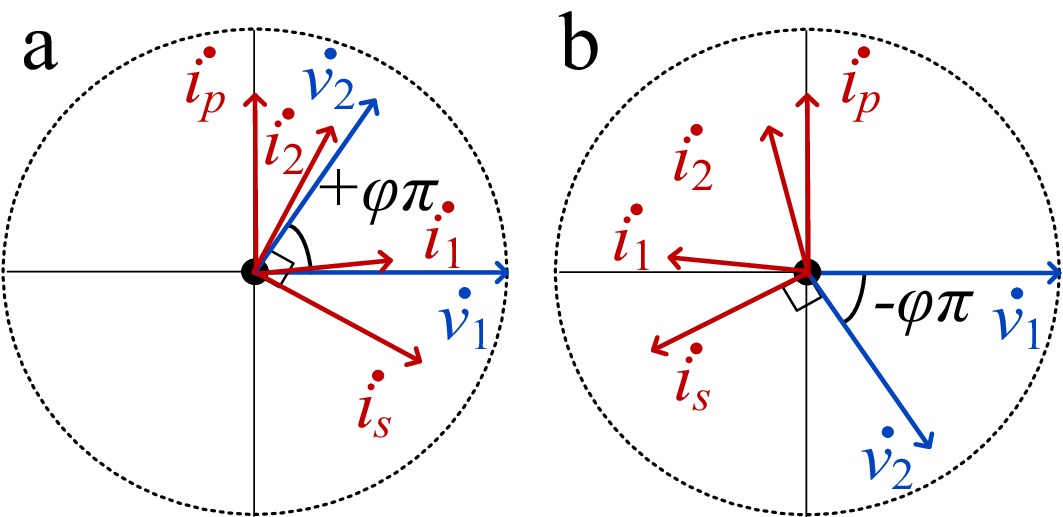
Figure 3.
Schematic diagram of voltage and current phases in a passive network. (a) G2V. (b) V2G.
-
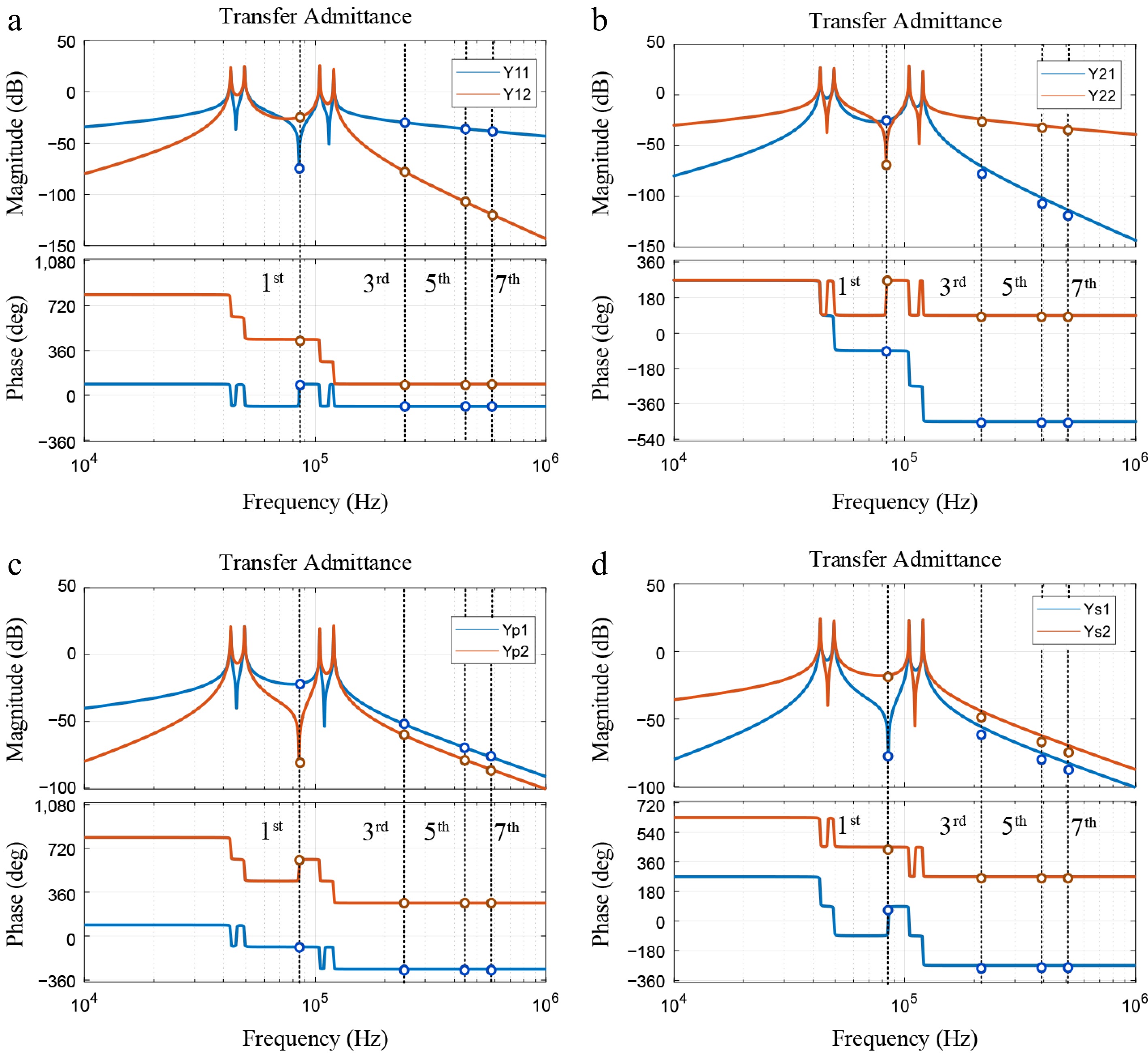
Figure 4.
Coefficient admittance matrix amplitude-phase characteristic diagram. (a) Y11 and Y12. (b) Y21 and Y22. (c) Yp1 and Yp2. (d) Ys1 and Ys2.
-
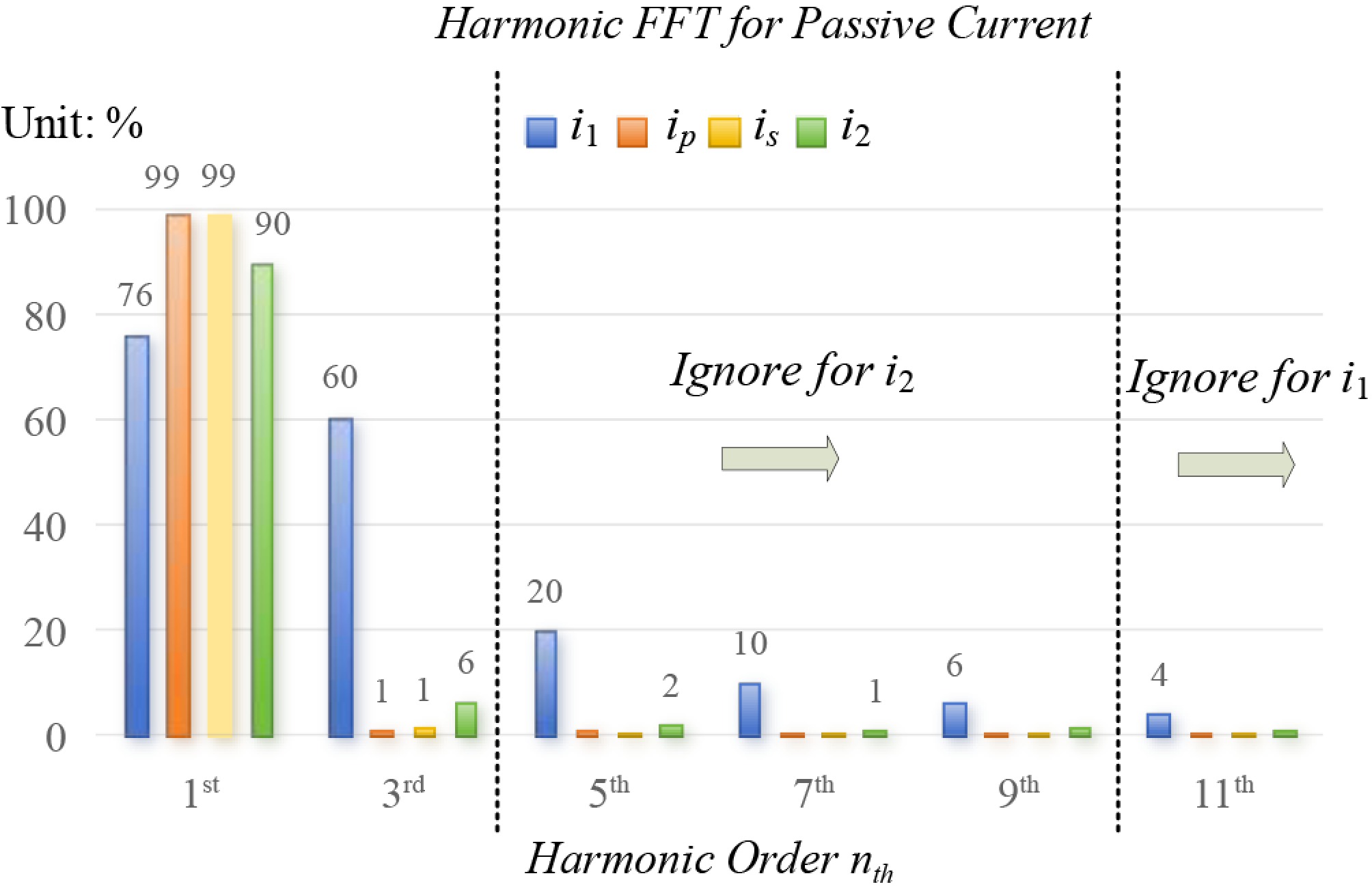
Figure 5.
Schematic diagram of the harmonics composition of each current.
-
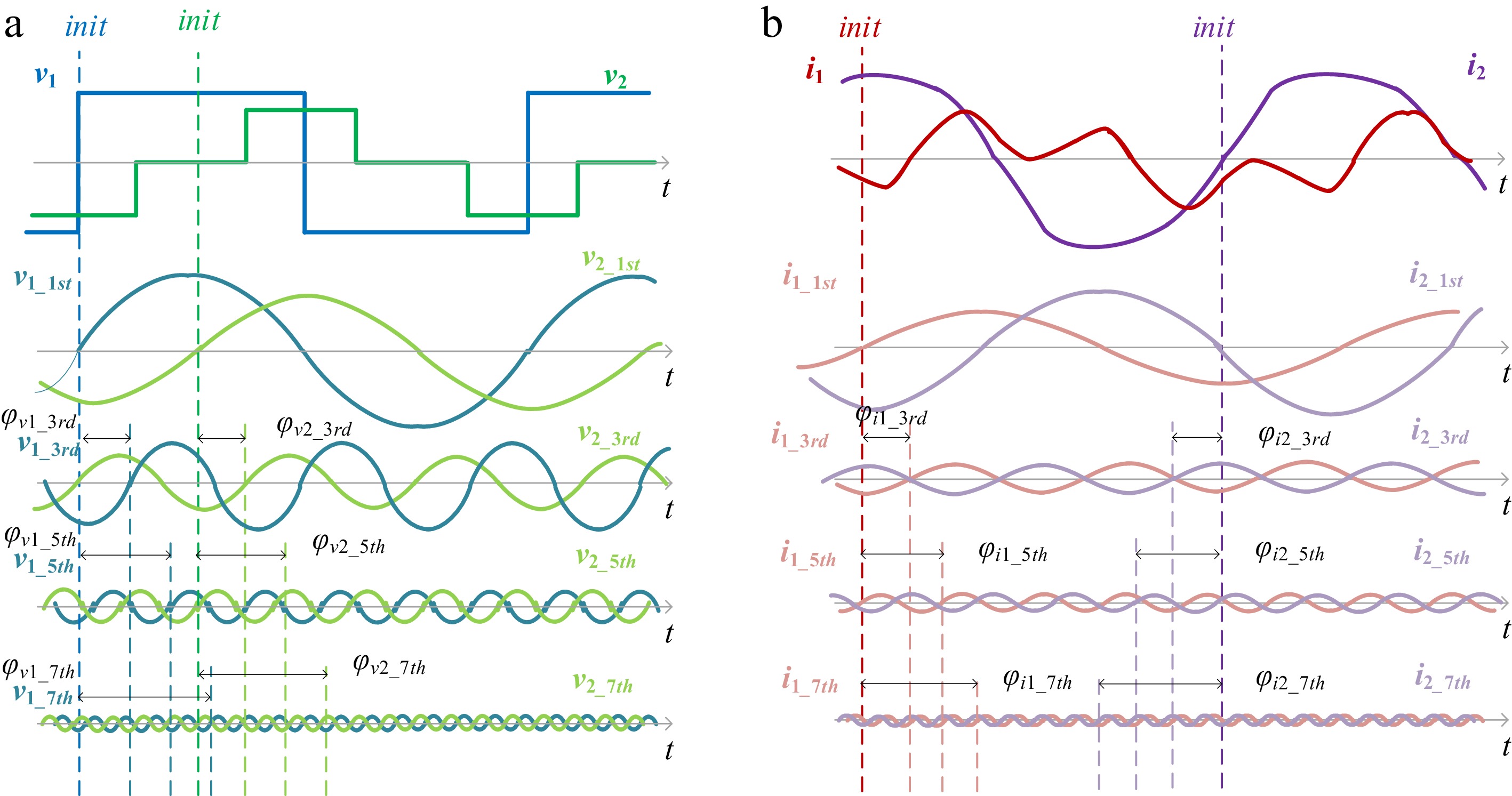
Figure 6.
Phase correction for passive network voltage and current. (a) Voltage v1 and v2. (b) Current i1 and i2.
-
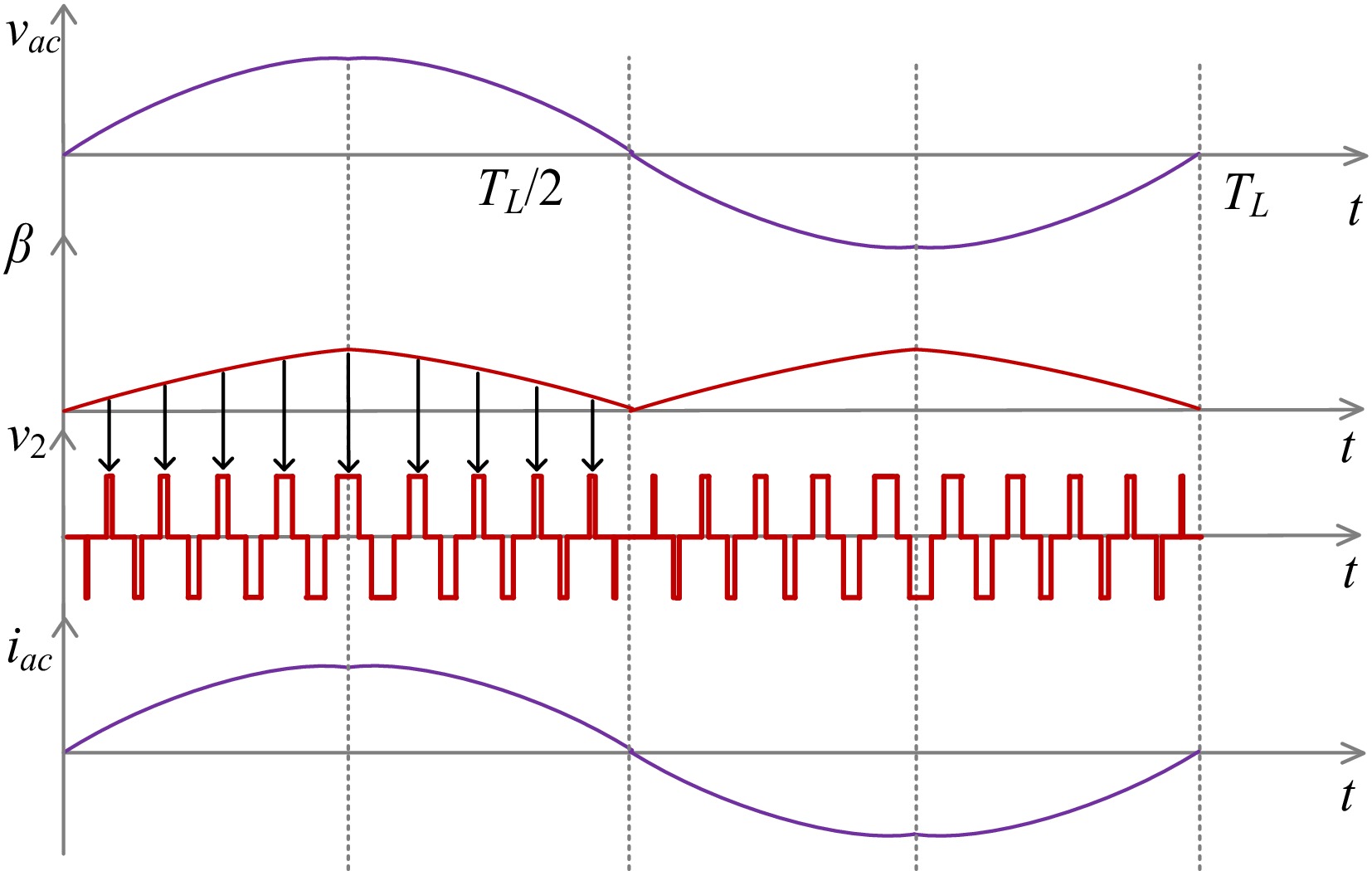
Figure 7.
Waveforms of PFC control using the β regulation method.
-
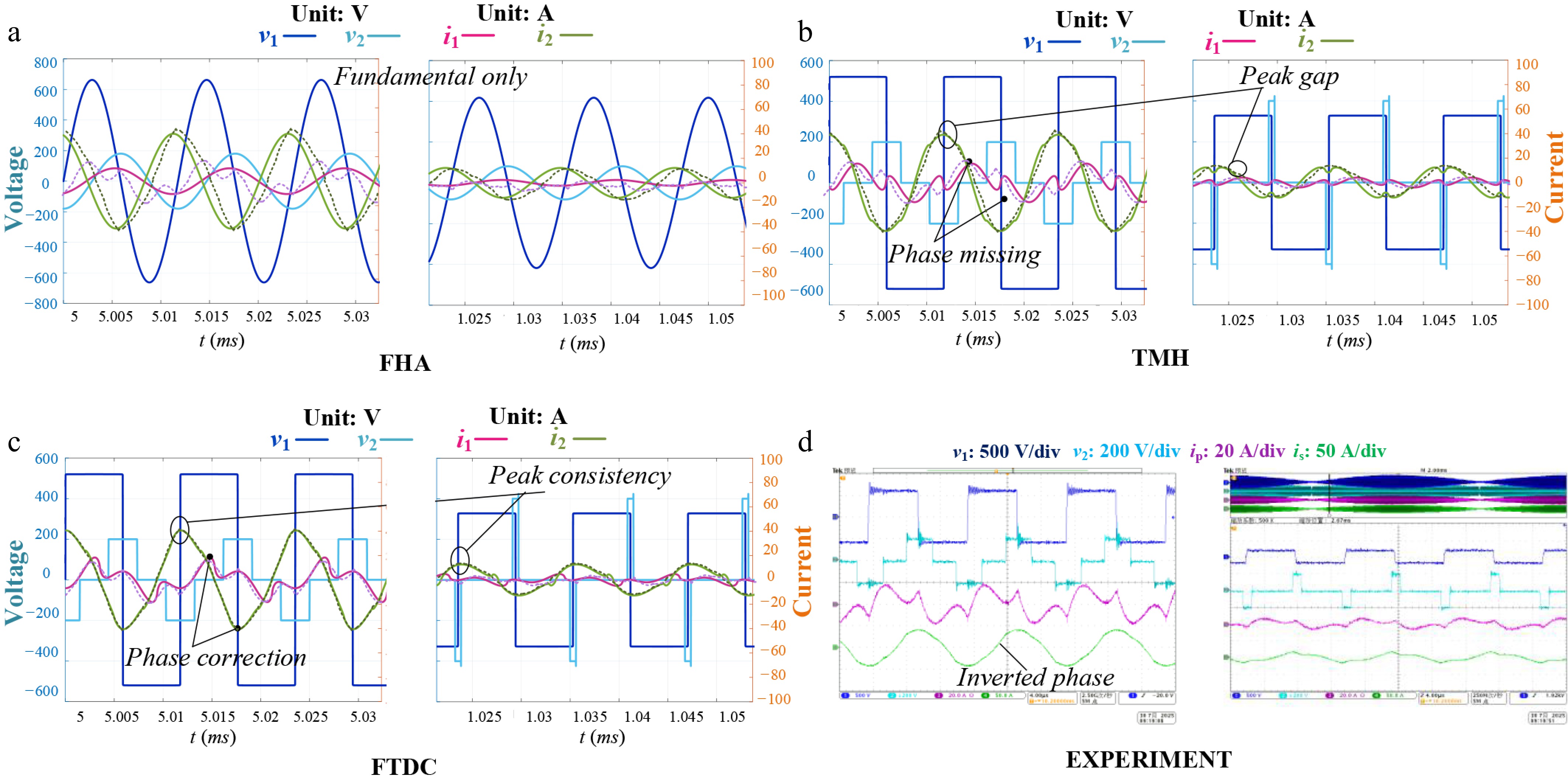
Figure 8.
Theory derivation comparison under φ = 0.5 for G2V (left: max grid voltage vac; right: low grid voltage vac). (a) FHA. (b) TMH. (c) FTDC. (d) Experiment.
-
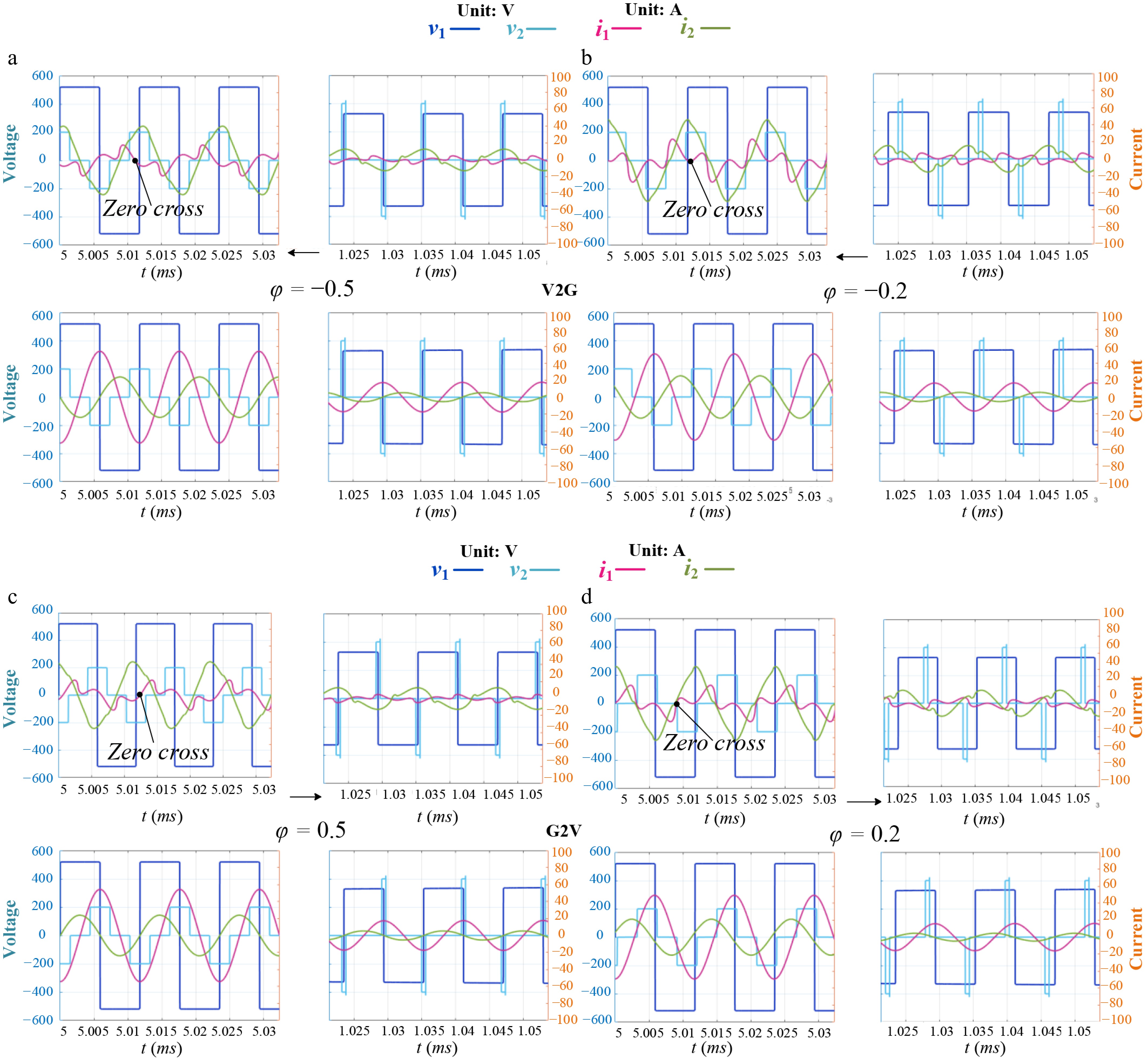
Figure 9.
Theory derivation of voltage and current in steady state (left: max vac; right: low vac). (a) φ = −0.5 for V2G. (b) φ = −0.2 for V2G. (c) φ = 0.5 for G2V. (d) φ = 0.2 for G2V.
-
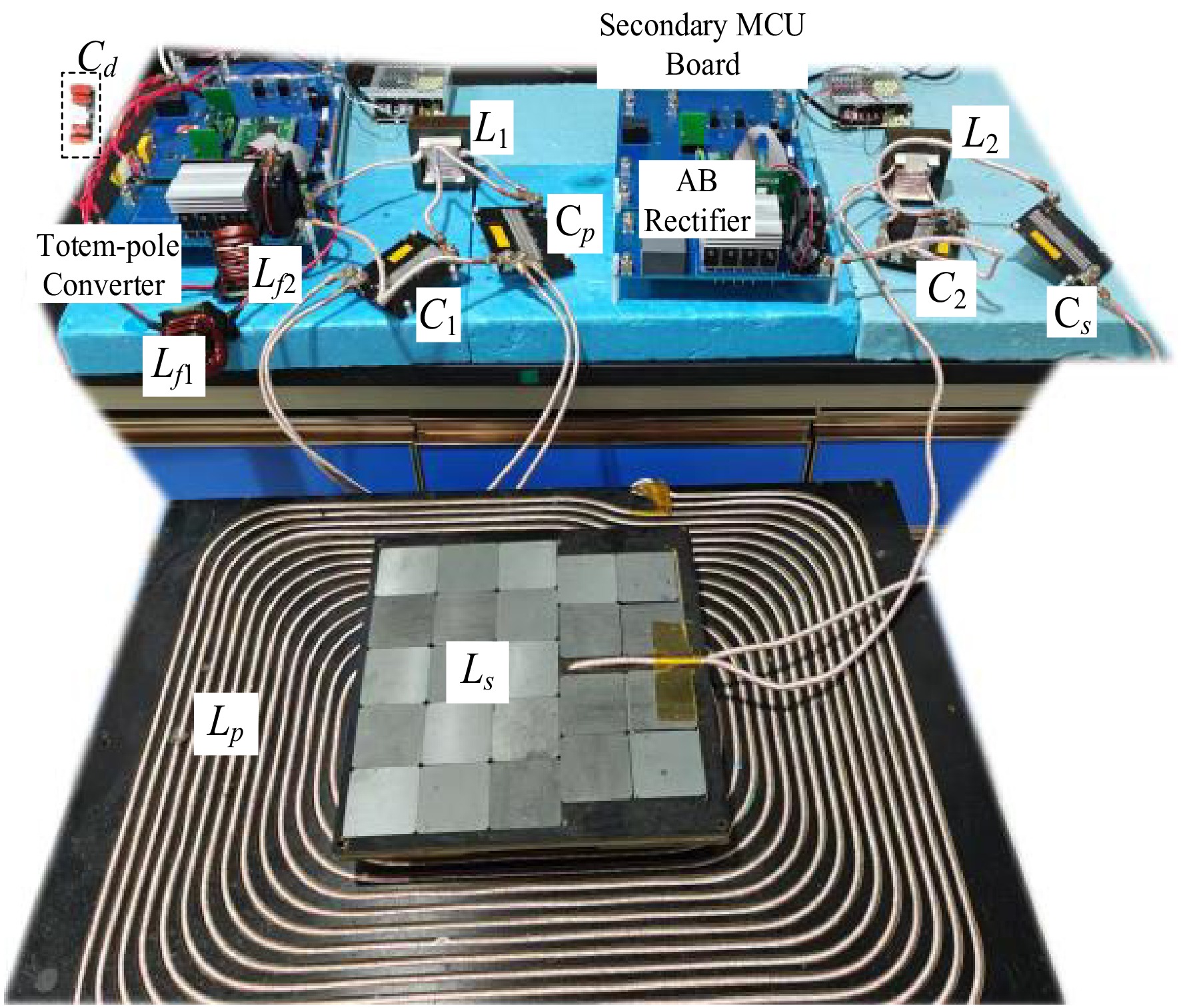
Figure 10.
BWPT system experiment test bench.
-
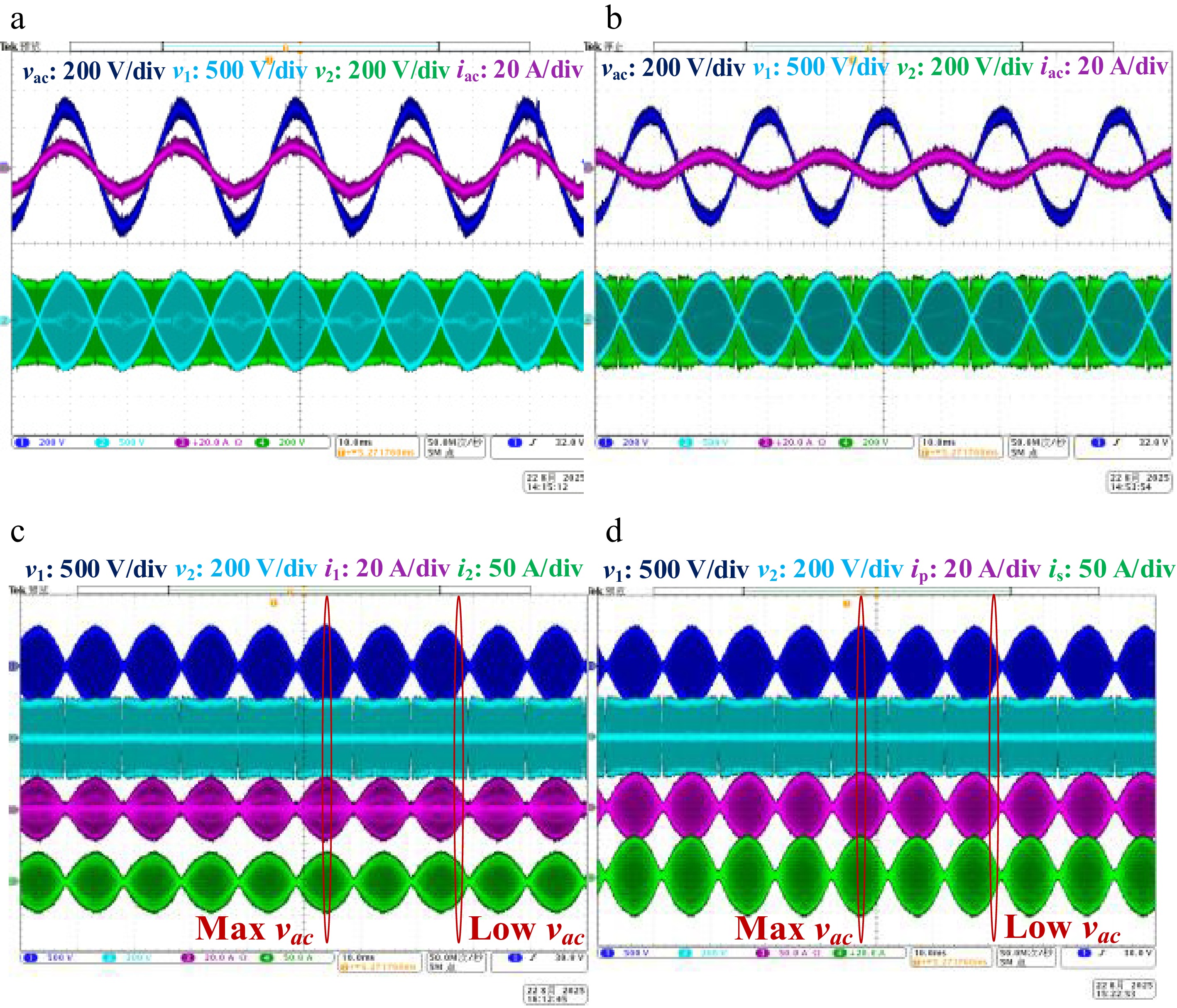
Figure 11.
Specific experiment waveforms of BWPT system. (a) φ = 0.5 for G2V. (b) φ = −0.3 for V2G. (c) Steady-state waveforms with i1 and i2. (d) Steady-state waveforms with ip and is.
-
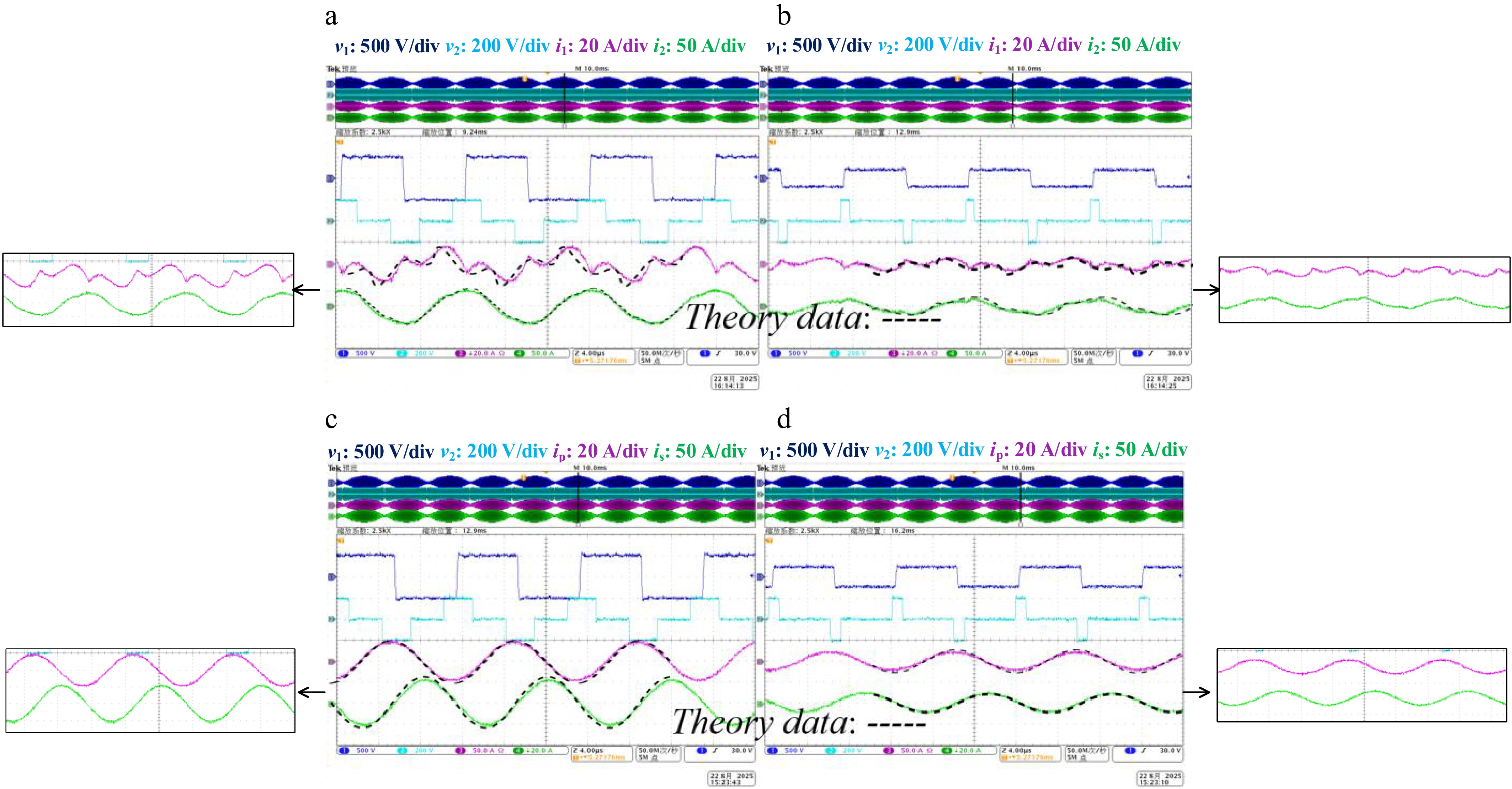
Figure 12.
Experiment validation of φ = −0.5 for V2G. (a) Maximum vac with i1 and i2. (b) Low vac with i1 and i2. (c) Steady-state waveforms with ip and is. (d) Low vac with ip and is.
-
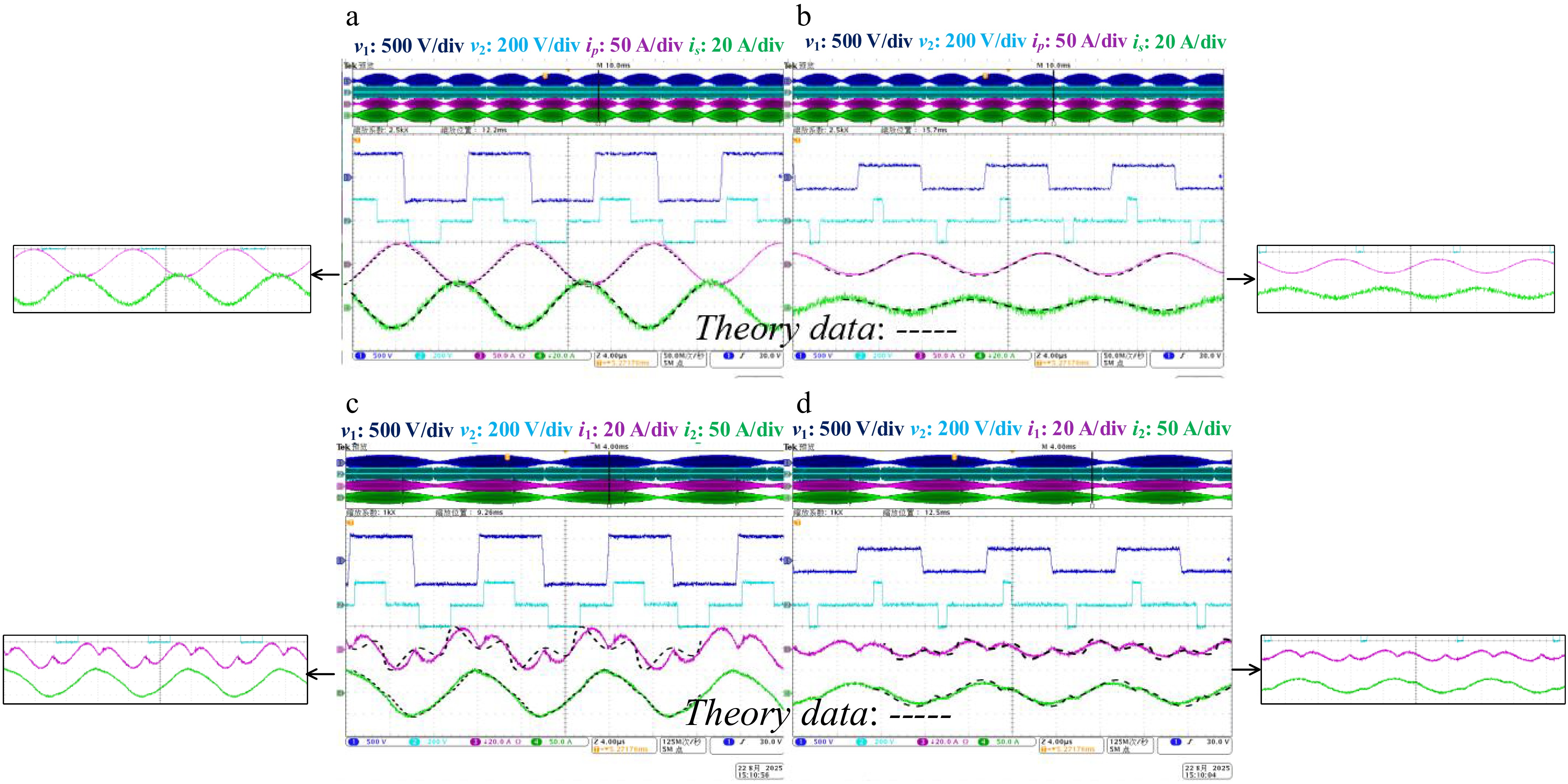
Figure 13.
Experiment validation of φ = −0.2 for V2G. (a) Maximum vac with i1 and i2. (b) Low vac with i1 and i2. (c) Maximum vac with ip and is. (d) Low vac with ip and is
-
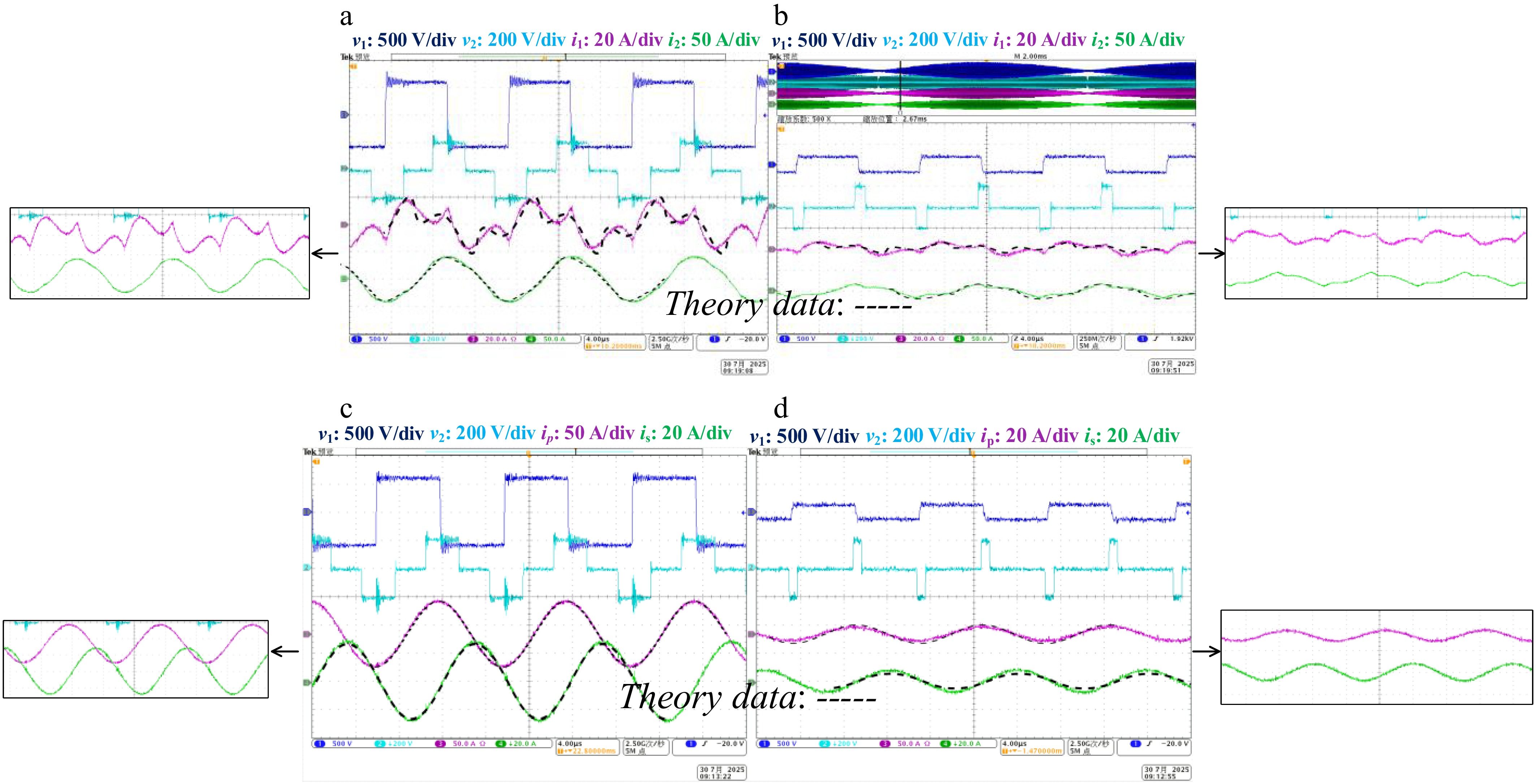
Figure 14.
Experiment validation of φ = 0.5 for G2V. (a) Maximum vac with i1 and i2. (b) Low vac with i1 and i2. (c) Maximum vac with ip and is. (d) Low vac with ip and is.
-
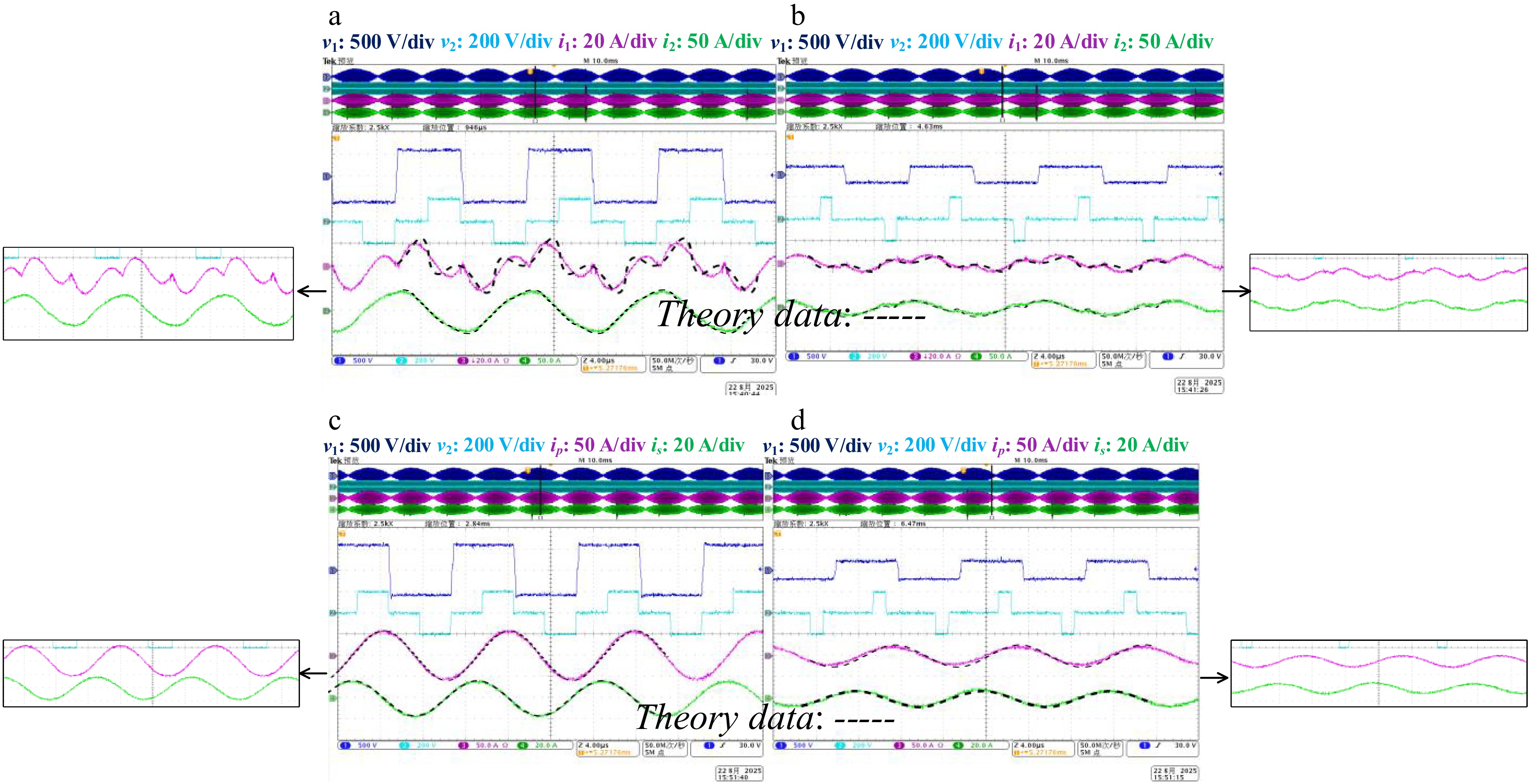
Figure 15.
Experiment validation of φ = 0.2 for G2V. (a) Maximum vac with i1 and i2. (b) Low vac with i1 and i2. (c) Maximum vac with ip and is. (d) Low vac with ip and is.
-
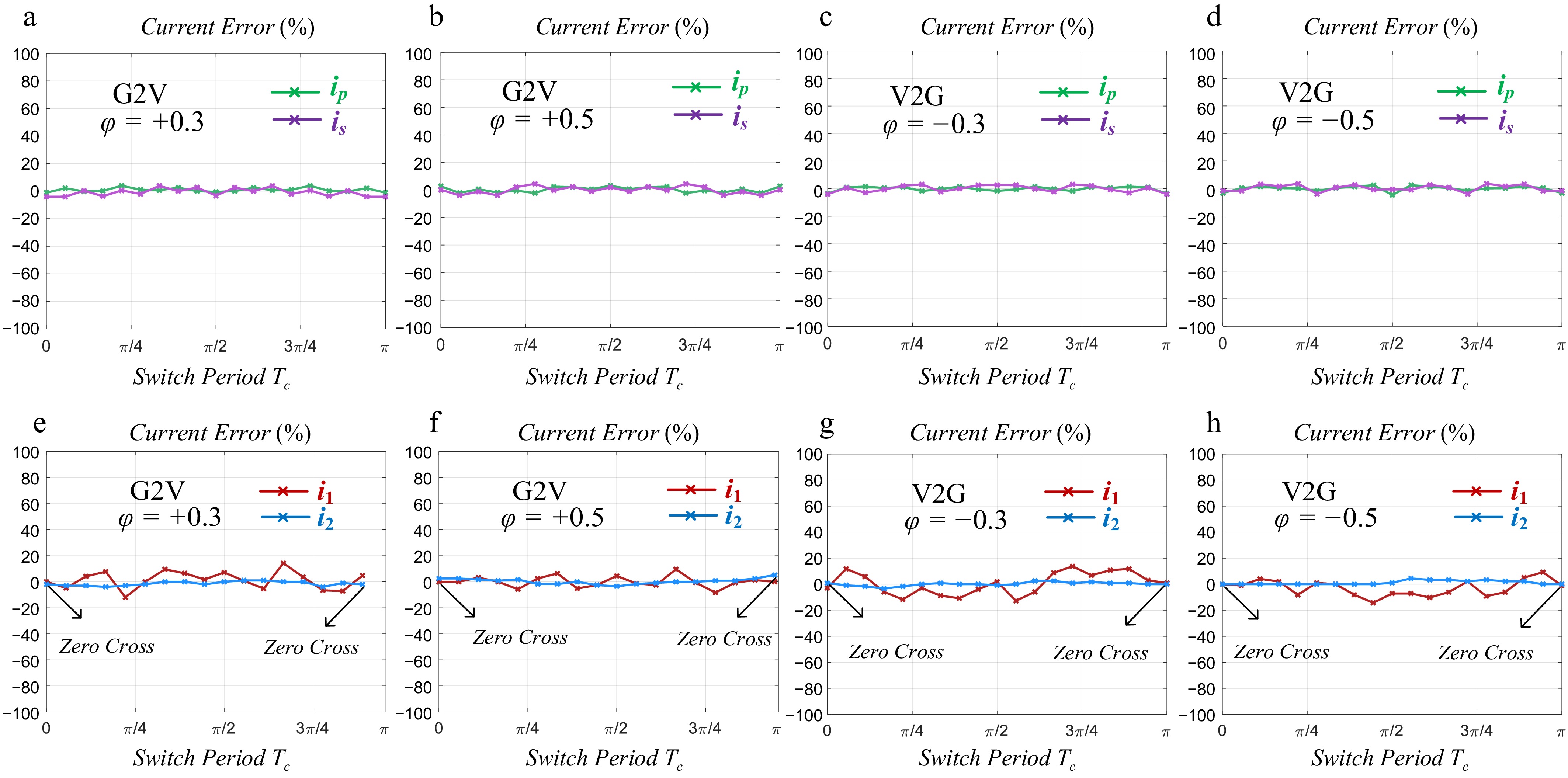
Figure 16.
The error of passive network currents under different phase shifts and different power transfer directions. (a) ip and is for φ = +0.3. (b) ip and is for φ = +0.5. (c) ip and is for φ = −0.3. (d) ip and is for φ = −0.5. (e) i1 and i2 for φ = +0.3. (f) i1 and i2 for φ = +0.5. (g) i1 and i2 for φ = −0.3. (h) i1 and i2 for φ = −0.5.
-
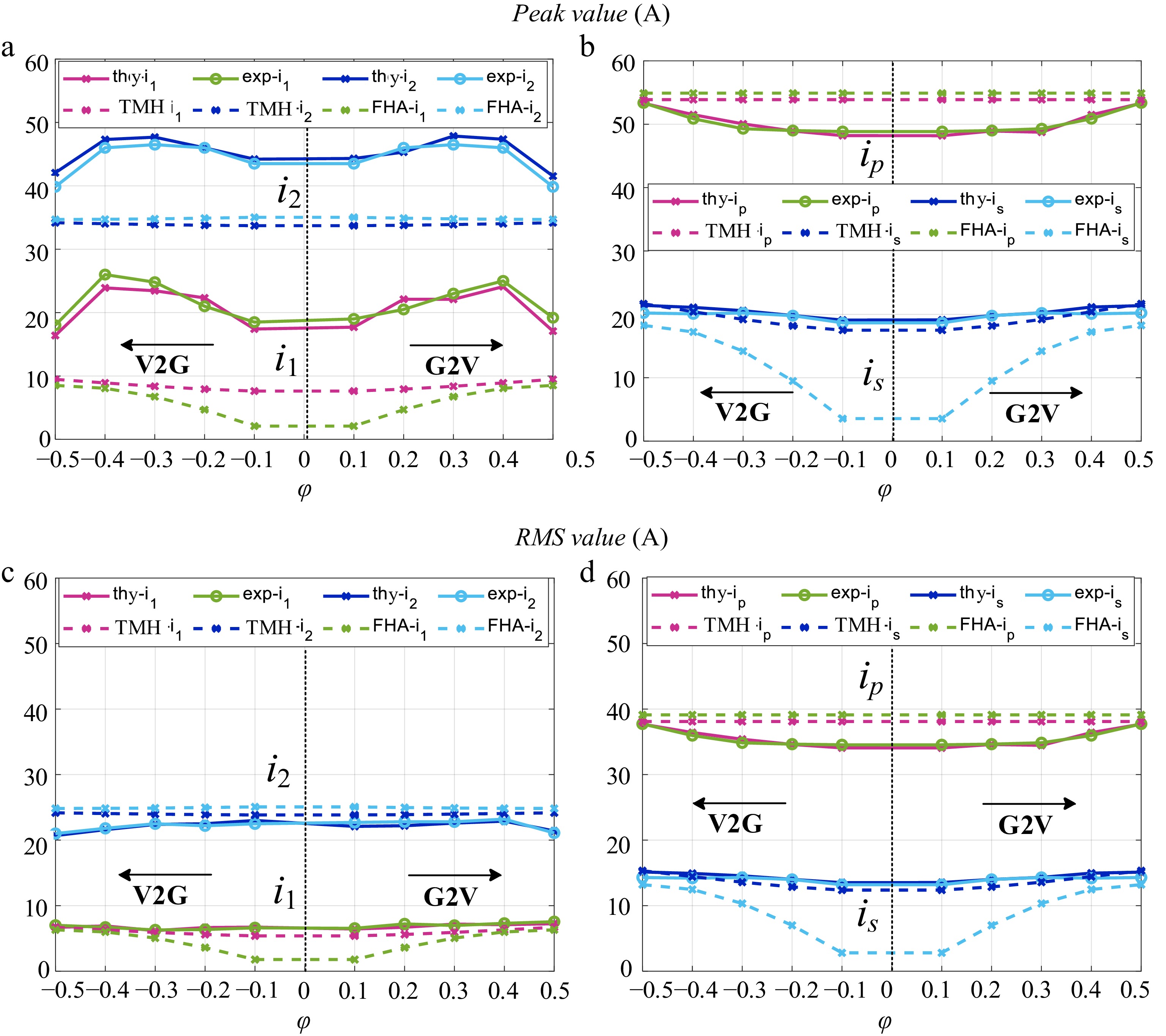
Figure 17.
Experiment validation data ('thy' for 'theory', 'exp' for 'experiment'). (a) i1 and i2 for amplitude. (b) ip and is for amplitude. (c) i1 and i2 for RMS value. (d) ip and is for RMS value.
-
Symbol Concept Expression ZL1 Transmitter side filter inductor impedance $ {R_1} + j\omega M{L_1} $ ZC1 Transmitter side filter capacitor impedance $ {1 \mathord{\left/ {\vphantom {1 {j\omega {C_1}}}} \right. } {j\omega {C_1}}} $ Zp Transmitter side series impedance $ {R_p} + j\omega {L_p} + {1/{j\omega {C_p}}} $ Zs Receiver side series impedance $ {R_s} + j\omega {L_s} + {1 \mathord{\left/ {\vphantom {1 {j\omega {C_s}}}} \right. } {j\omega {C_s}}} $ ZL2 Receiver side filter inductor impedance $ {R_2} + j\omega M{L_2} $ ZC2 Receiver side filter capacitor impedance $ {1 \mathord{\left/ {\vphantom {1 {j\omega {C_2}}}} \right. } {j\omega {C_2}}} $ Table 1.
Expression of impedance in passive network.
-
Symbol Concept Expression L1/R1 Transmitter side filter inductor impedance / internal resistance 23 μH/0.02 Ω C1 Transmitter side filter capacitor impedance 152.43 nF Cp Transmitter side series capacitor 149.19 nF Lp/Rp Transmitter side series inductor / internal resistance 46.49 μH/0.02 Ω L2/R2 Receiver side filter inductor impedance / internal resistance 14 μH/0.02 Ω C2 Receiver side filter capacitor impedance 250.42 nF Cs Receiver side series capacitor 246.55 nF Ls/Rs Receiver side series inductor / internal resistance 29.73 μH/0.02 Ω fc Resonant frequency 85 kHz fl Grid frequency 50 Hz M Mutual Inductor 10.04 μH Table 2.
Example parameters of BWPT system.
-
Method type Peak value (A) RMS value (A) Mean value of current error i1 i2 ip is i1 i2 ip is i1 i2 ip is FHA 9.1 34.8 55.8 17.6 7.6 25.1 39.8 13.3 / / / / TMH 9.8 34.4 55.5 20.9 8.2 24.6 38.5 15.6 / / / / thy(FTDC) 17.7 42.0 55.3 20.9 8.3 20.6 38.4 15.5 7.8% 2.1% 1.2% 1.9% exp(Experiment) 19.6 39.9 55.3 20.0 8.3 20.6 38.4 14.7 Table 3.
Detailed data of FTDC calculation and experiment with φ = +0.5.
-
Method type Peak value (A) RMS value (A) Mean value of current error i1 i2 ip is i1 i2 ip is i1 i2 ip is FHA 4.8 35 55.8 14.2 5.8 24.9 39.8 10.2 / / / / TMH 9.2 34.7 54.9 19.3 6.2 23.6 37.9 13.6 / / / / thy(FTDC) 23.3 47.9 50.0 20.3 6.3 22.8 35.5 14.8 12.2% 2.3% 1.7% 1.8% exp(Experiment) 24.8 46.1 49.7 20.2 6.2 22.8 35.3 14.7 Table 4.
Detailed data of FTDC calculation and experiment with φ = −0.3.
-
Method type Amount of calculation Number of order n BWPT
supportComputational complexity Compensation network Three feature outputs Accuracy (for
feature outputs)FHA Small 1 Yes Simple Unrestricted Average only Low GSSA Large Infinite Yes Very complex Unrestricted Average only High TMH analysis[18−20] Medium Not mentioned No Medium Unrestricted All Medium Sample-data model[21] Large Infinite No Complex SS Average only Very high harmonics-considered
time-domain model[22]Small Not mentioned No Medium Unrestricted All Medium Discrete-time model[23] Very large 9 No Complex DLCC All Very high Proposed FTDC Medium 3, 9 Yes Medium Unrestricted All High Table 5.
Comparison between various methods in WPT application.
Figures
(17)
Tables
(5)