-
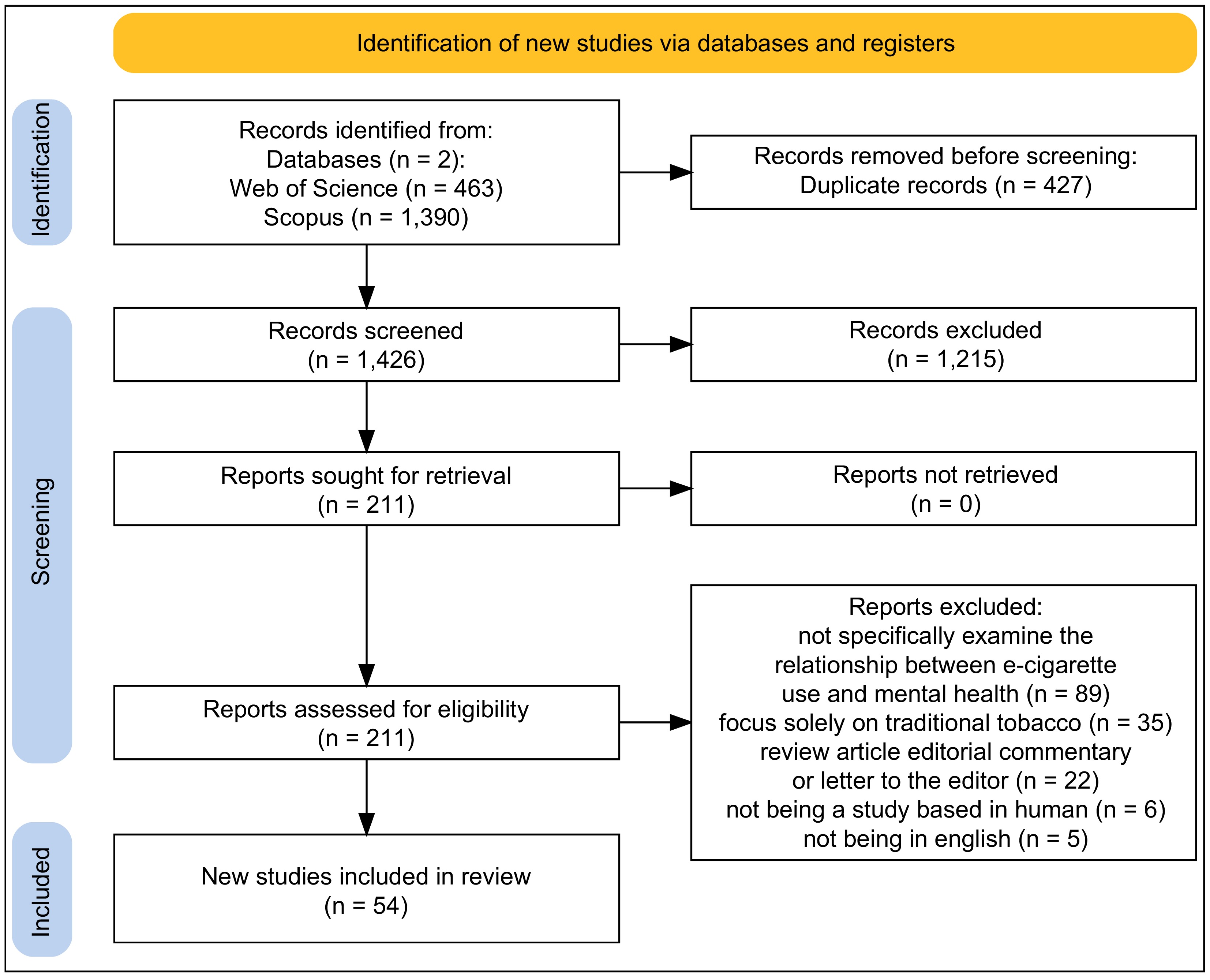
Figure 1.
PRISMA flow diagram.
-
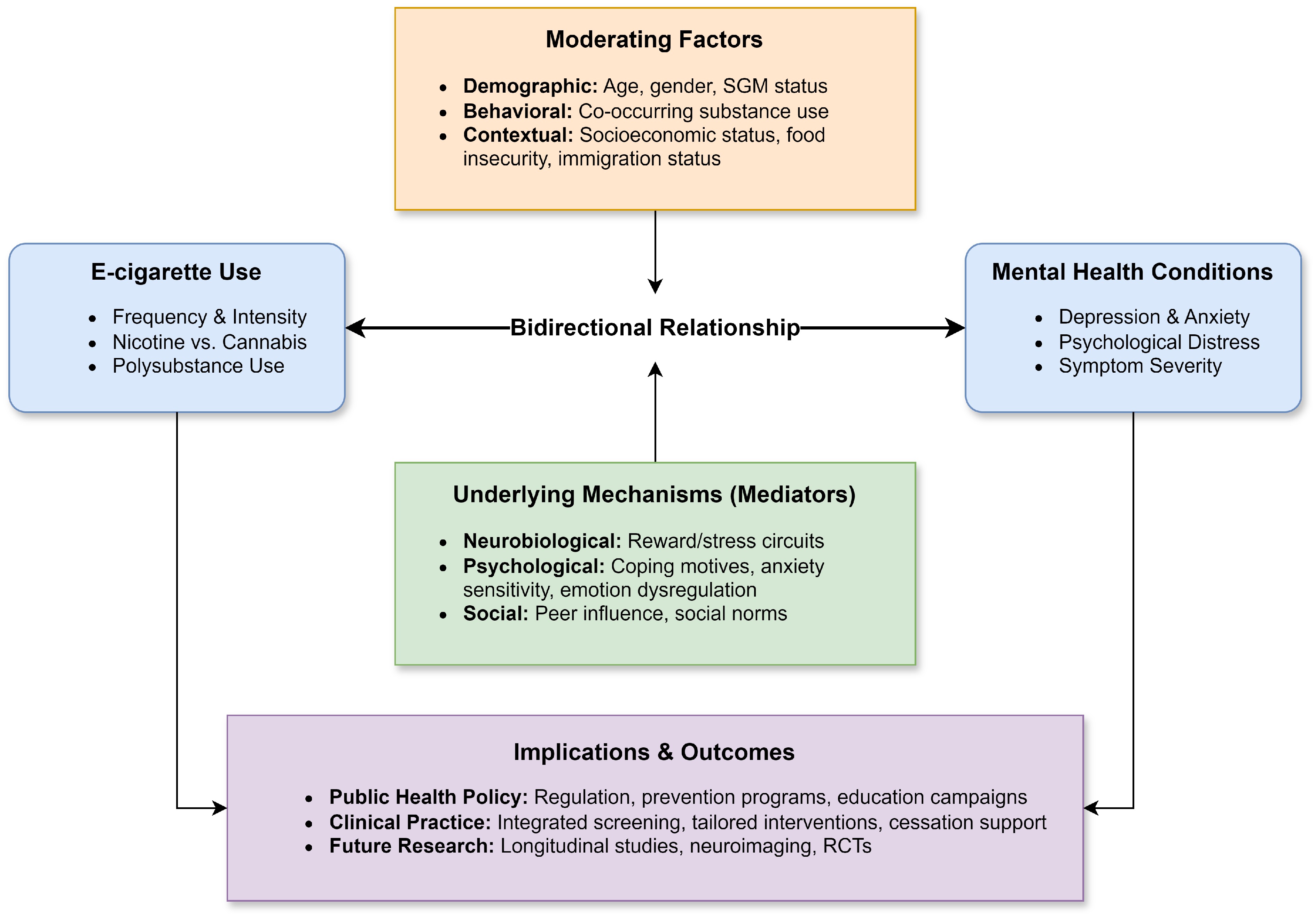
Figure 2.
Conceptual framework of the interplay between e-cigarette use and mental health.
-
Study (year) Country Design Sample size Population Measures of e-cigarette use Measures of mental health Key findings related to e-cigarette use and mental health Lilly et al. (2024)[55] USA Longitudinal 1,349 Middle and high school students Past-year e-cigarette use School as a Protective Factor-Brief (SPF-Brief) survey (school climate, anxiety, depression, quality of life) A school environment perceived as more positive as indicated by higher SPF-Brief scores was associated with fewer reported symptoms of anxiety and depression and this climate appeared to function as a protective element against substance use including e-cigarettes. Ormiston et al. (2024)[28] USA Longitudinal 1,060 Alternative high school students Past-year e-cigarette and other substance use Depression Anxiety Stress Scale-21 (DASS-21) A more pronounced association between psychosocial distress and the use of substances like e-cigarettes was observed in first- and second-generation immigrant students when compared to their third-generation counterparts. Liu et al. (2024)[16] USA Cross-sectional 1,547 Adults reporting past 30-d tobacco use Past 30-d vaping of nicotine, cannabis, CBD, or other substances Self-rated anxiety The concurrent vaping of nicotine with cannabis or CBD in the preceding month was a behavior reported by 26.1% of participants and its likelihood was significantly greater among males and individuals reporting higher anxiety. Thepthien et al. (2024)[20] Thailand Cross-sectional 5,740 High school students Past 12-month prevalence of conventional cigarette (CC), electronic cigarette (EC), and dual use Adverse childhood experiences (ACEs), psychological distress (PD), depression, anxiety, and problem gambling (PG) scales Other substance use mental health difficulties and peer or family smoking were correlates for CC EC and dual use with exclusive EC and dual use being linked to more depressive symptoms and exclusive EC use also associated with greater anxiety. Yimsaard et al. (2024)[21] International Longitudinal 3,709 Daily smokers Vaping status at follow-up, quit attempts, 1-month quit success Validated screening tools for depression, anxiety, and regular alcohol use (baseline) Smokers who reported depressive symptoms were found to be more likely to make a quit attempt but had lower rates of success while successful quitters with depression or anxiety had a higher likelihood of vaping at the follow-up assessment. Mantey et al. (2024)[40] USA Longitudinal 2,605 Youth and young adults Transitions in cannabis vaping (never, ever, current) Patient Health Questionnaire-9 (PHQ-9) for depression; Generalized Anxiety Disorder-7 (GAD-7) for anxiety Alcohol use was predictive of cannabis vaping across all racial and ethnic groups and depression was a predictor for the initiation of cannabis vaping among Hispanics and for experimentation among non-Hispanic Black participants. Pitman et al. (2024)[29] USA Cross-sectional 1,024 Young adults Current cigarette, ENDS, cannabis, and alcohol use; binge drinking Food insecurity measure (Hunger Vital Signs), perceived stress, anxiety, depressive symptoms, and insomnia After accounting for demographics economic factors mental health and discrimination food insecurity remained associated with elevated odds for all types of substance use which included ENDS. Klein et al. (2024)[39] USA RCT 981 Young adult exclusive e-cigarette users E-cigarette use behaviors, previous quit attempts, nicotine dependence Self-reported stress, anxiety, and depression Among young adults who were seeking treatment to stop vaping a high prevalence of nicotine dependence a history of unsuccessful quit attempts and co-occurring stress anxiety and depression was observed. Cai & Bidulescu (2024)[12] USA Cross-sectional 56,734 US adults Current, former, and never e-cigarette use; dual use with cigarettes National Health Interview Survey measures for anxiety, depression, serious psychological distress (SPD), and cognitive impairment Compared to never-use current e-cigarette use former use and dual use were each associated with greater odds of experiencing anxiety depression SPD and cognitive impairment. Vaziri et al. (2024)[36] USA Cross-sectional 226 People with cystic fibrosis (pwCF) Past 12-month use of marijuana, CBD, e-cigarettes, and cigarettes Abnormal mental health screen In this population substance use including e-cigarettes was found to be more common than previously documented and those who used e-cigarettes were significantly more likely to have an abnormal mental health screening outcome. Phetphum et al. (2024)[5] Thailand Cross-sectional 3,424 Youth Past 30-d cigarette, e-cigarette, and dual use Depression and anxiety symptoms scales Both current e-cigarette users and dual users showed higher odds of depression and e-cigarette users also had higher odds of anxiety whereas smokers of only cigarettes had lower odds of anxiety compared to non-users. Kang & Malvaso (2024)[42] UK Longitudinal 19,706 UK general sample E-cigarette use status (at two time points) General Health Questionnaire (GHQ-12) measuring general mental health, social dysfunction & anhedonia, depression & anxiety, and loss of confidence Participants who took up e-cigarette use between the two waves showed poorer mental health greater social dysfunction and anhedonia and more loss of confidence when compared to their own status from a year earlier. Adzrago et al. (2024)[1] USA Cross-sectional 4,766 Adults Exclusive e-cigarette use, exclusive cannabis use, and dual use Anxiety/depression While anxiety/depression was correlated with a higher risk for exclusive cannabis use and dual use irrespective of immigration status its link to exclusive e-cigarette use was only significant for the immigrant population. Zvolensky et al. (2024)[13] USA Cross-sectional 297 Latinx adult daily cigarette smokers Current dual use of e-cigarettes with combustible cigarettes A battery of scales measuring anxiety, depression, emotional dysregulation, anxiety sensitivity, and distress tolerance. When compared with those who exclusively smoked combustible cigarettes Latinx adults who were dual users showed significantly higher levels of anxiety depression and emotional dysregulation which was also coupled with lower distress tolerance. Evans et al. (2024)[14] USA Cross-sectional 316 Young adults Vape use (unspecified) Five Facet Mindfulness Questionnaire (FFMQ), Rumination scale, reduced Morningness-Eveningness Questionnaire (rMEQ), Self-compassion scale, Hospital Anxiety and Depression Scale (HADS), Pittsburgh Sleep Quality Index (PSQI) In comparison to non-users individuals who vaped reported lower mindfulness and self-compassion alongside higher rumination and anxiety poorer sleep quality and a stronger inclination toward an evening chronotype. Trigg et al. (2024)[18] Australia Cross-sectional 3,002 South Australian adults (+15 years) Vaping, smoking Patient Health Questionnaire-4 (PHQ-4) for anxiety and depression Individuals with depression who also vaped tended to perceive greater health risk barriers related to accessing nicotine vaping products (NVPs) through a prescription for the purpose of smoking cessation. Han et al. (2024)[15] USA Longitudinal 5,114 Young adolescents E-cigarette use Internalizing problems (Profile of Mood States anxiety subscale; Centers for Epidemiology Studies of Depression (CES-D) scale) and externalizing problems (Current Symptoms Scale for ADHD; Brief Sensation Seeking Scale) The availability of tobacco in the home increased the odds of e-cigarette use whereas home rules against non-combustibles decreased them and the protective effect of these rules was stronger for adolescents with internalizing problems but weaker for those with externalizing problems. Dabravolskaj et al. (2023)[6] Canada Longitudinal 24,274 High school students Adherence to substance use recommendations (including e-cigarettes) Center for Epidemiologic Studies Depression Scale Revised (CESD-R-10); Generalized Anxiety Disorder-7 (GAD-7) Following healthy lifestyle recommendations which included abstaining from e-cigarettes was associated with lower depression and anxiety scores at a one-year follow-up point. Salinas et al. (2024)[17] USA Cross-sectional 492 Adults who vape nicotine, cannabis, or both Nicotine, cannabis, and dual vape use behaviors Patient Health Questionnaire (PHQ-9) for depression; Generalized Anxiety Disorder Scale (GAD-7); Perceived Stress Scale (PSS-10) Those who engaged in dual use of cannabis and nicotine vapes reported a greater severity of mental health symptoms when compared to individuals who vaped only one of the substances. Azagba et al. (2024)[54] USA Cross-sectional 23,445 Youth Past-30-d e-cigarette use Patient Health Questionnaire-4 (PHQ-4) for anxiety and depression; time on social media The association between the amount of time spent on social media and the likelihood of past-30-d e-cigarette use was mediated by symptoms of anxiety and depression. Leung et al. (2024)[2] Australia Cross-sectional 716 University students Lifetime and past-month vaping (flavor, nicotine, other drugs) Patient Health Questionnaire-9 (PHQ-9) for depression; Generalized Anxiety Disorder-7 (GAD-7) Vaping was found to be correlated with being male smoking cigarettes binge drinking and using cannabis and it was also noted that a significant percentage of students were not informed about the legal status or potential health risks of vaping. Bataineh et al. (2023)[7] USA Longitudinal 60,072 Adolescents and young adults Lifetime cigarette, e-cigarette, and cannabis use Depressive and anxiety symptoms Based on the observed associations it was recommended that mental health screening should occur earlier for tobacco and cannabis users especially for individuals aged 18 and younger. Arterberry et al. (2023)[52] USA Cross-sectional 1,244 Young adults Increased vaping, drinking, and marijuana use to cope with COVID-19 isolation Depression and anxiety symptoms Stress related to social distancing during the COVID-19 period was associated with an increase in vaping to cope for those with higher depression symptoms and an increase in drinking to cope for those with higher anxiety symptoms. Tildy et al. (2023)[45] International Cross-sectional 11,040 Adults Discussing and receiving recommendations for NVPs from a health professional (HP) Self-reported current depression and/or anxiety Individuals with anxiety and/or depression who smoked were more likely to visit an HP but it was only those with depression who were more likely to get advice to quit. Adzrago et al. (2023)[26] USA Cross-sectional 6,267 Black/African American Adults E-cigarette use status (never, former, current) Symptoms of anxiety/depression (Patient Health Questionnaire-4, PHQ-4) Within sexual minorities lesbian/gay individuals showed higher rates of former e-cigarette use whereas bisexual individuals reported higher rates of current e-cigarette use. Oliver et al. (2023)[57] USA Cross-sectional 474 Adolescents and Young Adults Prior 12-month substance use, including vaping Symptoms of depression (Patient Health Questionnaire – 2 item, PHQ-2) In the context of the COVID-19 pandemic vaping was linked to depressive symptoms and lower adherence to non-pharmaceutical mitigation measures among adolescents and young adults. Keum et al. (2023)[43] USA Cross-sectional 338 Racially Minoritized Emerging Adults Recent cigarette smoking, marijuana use, and vaping Depressive (PHQ-9) and anxiety (GAD-7) symptoms Experiences of racism both online and offline were indirectly associated with recent marijuana use a relationship that was mediated by depressive and anxiety symptoms. Leung et al. (2023)[4] Australia Cross-sectional 855 High School Students E-cigarette use (flavor-only and nicotine) Depression and anxiety Risky drinking and smoking cigarettes were identified as strong predictors of concurrent e-cigarette use which points to a high-risk polysubstance use profile. Hanafin et al. (2023)[3] Ireland Cross-sectional 5,190 Young adults Ever and current smoking; ever and current e-cigarette use Self-reported professional diagnosis of a mental health problem (MHP) The association between mental health problems and the use of e-cigarettes was found to be similar in its nature and magnitude to the well-documented association between MHP and smoking. Hahn et al. (2023)[35] USA Cross-sectional 7,431 People with HIV Vaporized Nicotine (VN) and Combustible Cigarette (CC) use Depression (PHQ-9 score ≥ 10) and Panic Symptoms (Panic Symptomatology) The observed associations between VN/CC use and symptoms of depression or panic suggest that VN may play a potential role in both self-medication and as a substitute for CC in this specific population. Clendennen et al. (2023)[22] USA Longitudinal 2,148 Youth and young adults Cigarette, e-cigarette, and marijuana use Anxiety symptoms, depressive symptoms, perceived stress The study's findings indicated a bidirectional relationship where elevated mental health symptoms were predictive of future increases in the use of cigarettes e-cigarettes and marijuana. Oyapero et al. (2023)[23] Nigeria Cross-sectional 898 Residents E-cigarette (EC) use Generalized Anxiety Disorder-7 (GAD-7); Patient Health Questionnaire-9 (PHQ-9) Smoking cigarettes consuming alcohol being susceptible to future smoking and depression were all identified as strong predictors of e-cigarette use. Salazar-Londoño et al. (2023)[49] Colombia Cross-sectional 3,850 Young Colombians Consumption of Electronic Nicotine/Non-nicotine Delivery Systems (ENDS/ENNDS) Self-reported history of mental/emotional pathology; symptoms of depression, anxiety, stress, and loneliness Symptoms of anxiety and loneliness were found to be more common among participants who had risky ENDS/ENNDS consumption patterns when compared to those who did not. Adzrago et al. (2023)[26] USA Cross-sectional 6,268 Black/African American Adults E-cigarette use behaviors (never, former, current) Anxiety/depression symptoms (Patient Health Questionnaire-4, PHQ-4); perceived harmfulness of e-cigarettes E-cigarette use behaviors were found to be significantly associated with anxiety/depression the perceived harmfulness of the product and the interaction between these two variables. Bista et al. (2023)[53] USA Cross-sectional 4,634 Students Cigarette or e-cigarette use Psychological distress An observable increase in nicotine use which included e-cigarettes was noted in the period immediately after the implementation of campus closures for public health safety reasons. Adzrago et al. (2022)[60] USA Cross-sectional 5,065 Adults Past 30-day frequent use of e-cigarettes Anxiety/depression, alcohol use, cannabis use, COVID-19 impact The probability of frequent e-cigarette use was higher among individuals with certain risk factors which included frequent consumption of alcohol or cannabis a diagnosis of depression or anxiety and stress related to social distancing. Azagba et al. (2022)[27] USA Cross-sectional 16,065 Youth Current e-cigarette use Self-reported anxiety and depression It appears that sexual minority males who have co-occurring mental health conditions represent a particularly vulnerable population with respect to e-cigarette use. Striley et al. (2022)[19] USA Cross-sectional 47,016 College students Past 30-day use of a vaping product (nicotine or marijuana) Non-suicidal self-injury (NSSI) A positive association between past 30-d vaping and NSSI was identified although more research is needed to confirm this finding and to examine any potential confounding variables. Wade et al. (2022)[50] USA Cross-sectional 201 Emerging Adults Past 6-month nicotine and tobacco product (NTP) use patterns Depression and stress symptoms Users of combustible tobacco seem to be qualitatively different from non-combustible users when considering mental health correlates which suggests the existence of distinct user profiles. Schuler et al. (2022)[37] USA Cross-sectional 16,699 Armed forces active duty service members Current e-cigarette use, smoking, and other substance use Probable post-traumatic stress disorder (PTSD), depression, and anxiety The differences observed in substance use and mental health between the various service branches were not fully accounted for by demographic or deployment/combat experience variables. Adzrago et al. (2021)[24] USA/Texas Cross-sectional 1,103 Sexual and gender minorities Recent tobacco use, including e-cigarettes Diagnosis of depression, anxiety, or PTSD; hazardous alcohol use; illicit substance use There is an existing need for tailored tobacco cessation interventions to be implemented within substance use treatment facilities to address the high rates of use among SGM individuals. Williams et al. (2021a)[25] Canada Cross-sectional 51,767 Secondary school students Alcohol, cannabis, cigarette, and e-cigarette use Anxiety and depression symptoms Dual and polysubstance use were found to be common among Canadian secondary students and anxiety and depression were significantly associated with these use patterns. Williams et al. (2021b)[44] Canada Longitudinal 738 Secondary school students Alcohol, cannabis, cigarette, and e-cigarette use Anxiety and depression The findings highlight the need for comprehensive programming that addresses multiple substance uses and is also aware of co-occurring mental illness symptoms particularly depression. Mayorga et al. (2021)[48] USA Cross-sectional 566 Adult e-cigarette users Electronic Nicotine Delivery System (ENDS) use patterns Anxiety sensitivity, anxious arousal, general distress, and anhedonia The results underscore the necessity of incorporating anxiety-related constructs into etiological models to achieve a better understanding of e-cigarette use patterns and behavior. Wattick et al. (2021)[51] USA Cross-sectional 3398 College students E-cigarette use and motivations for use Adverse Childhood Experiences (ACEs), mental health Efforts aimed at reducing e-cigarette use should also address the co-use of alcohol co-occurring mental health disorders and the social motivations for use. Jones et al. (2021)[56] USA Cross-sectional 872 College Students E-cigarette use Self-efficacy, knowledge, depression, and anxiety symptoms Modifiable factors such as knowledge about harmful effects and having the self-confidence to refuse use were associated with a lower prevalence of e-cigarette use. Spears et al. (2020)[47] USA Cross-sectional 5878 Adults Electronic Nicotine Delivery System (ENDS) use patterns Serious psychological distress (SPD), mental health conditions (MHC), reasons for use It seems that individuals with pre-existing mental health conditions may be particularly inclined to use ENDS for the purposes of relaxation and managing stress. Wamamili et al. (2021)[38] New Zealand Cross-sectional 1293 University Students Vaping and smoking History of mental illness (HMI): diagnosis/treatment for depression, anxiety, or other mental health condition in past 12 months A strong association was found where students who reported a history of mental illness also showed significantly higher prevalence rates for both smoking and vaping. Pham et al. (2020)[58] Canada Cross-sectional 53,050 General population E-cigarette use PHQ-9, self-reported mood/anxiety disorders, perceived mental health, suicidality E-cigarette use is associated with adverse mental health outcomes and this association was observed to be particularly strong among non-smokers and women. Bianco et al. (2019)[34] USA Cross-sectional 631 Adults Lifetime and current e-cigarette use Chronic mental illness (depression, anxiety, emotional disorder, ADD, bipolar, schizophrenia, etc.) The findings lend support to previous research by indicating an increased likelihood of both lifetime and current e-cigarette use among individuals who have a chronic mental illness. Hefner et al. (2019)[59] USA Cross-sectional 631 College Students Past 30-day e-cigarette and other tobacco use Self-reported diagnosis of psychiatric and substance use disorders Additional research is needed to clarify the relationships between risky alcohol and nicotine use and mental illness in order to guide intervention efforts for college students. Versella et al. (2019)[41] USA Cross-sectional 264 Adult ENDS Users ENDS and Combustible Cigarette use Internalizing symptoms (stress, anxiety) and vulnerabilities (Anxiety Sensitivity Index-3, Distress Intolerance Index, Difficulties in Emotion Regulation Scale) The way internalizing pathology and vulnerabilities present among nicotine users appears to be influenced by both their current use and their past history of nicotine product use. Li Lin et al. (2019)[46] International Cross-sectional 11,344 Smokers and Quitters Vaping activities and use as a quitting strategy Medical diagnosis for nine health conditions, including depression, anxiety, and alcohol problems The study did not find any systematic evidence to suggest that having a poor health condition related to smoking increased the probability that an individual would turn to vaping as a method for cessation. Source: Developed by the authors based on data extracted from the included studies. Table 1.
Characteristics and Key Findings of Included Studies.
Figures
(2)
Tables
(1)