-
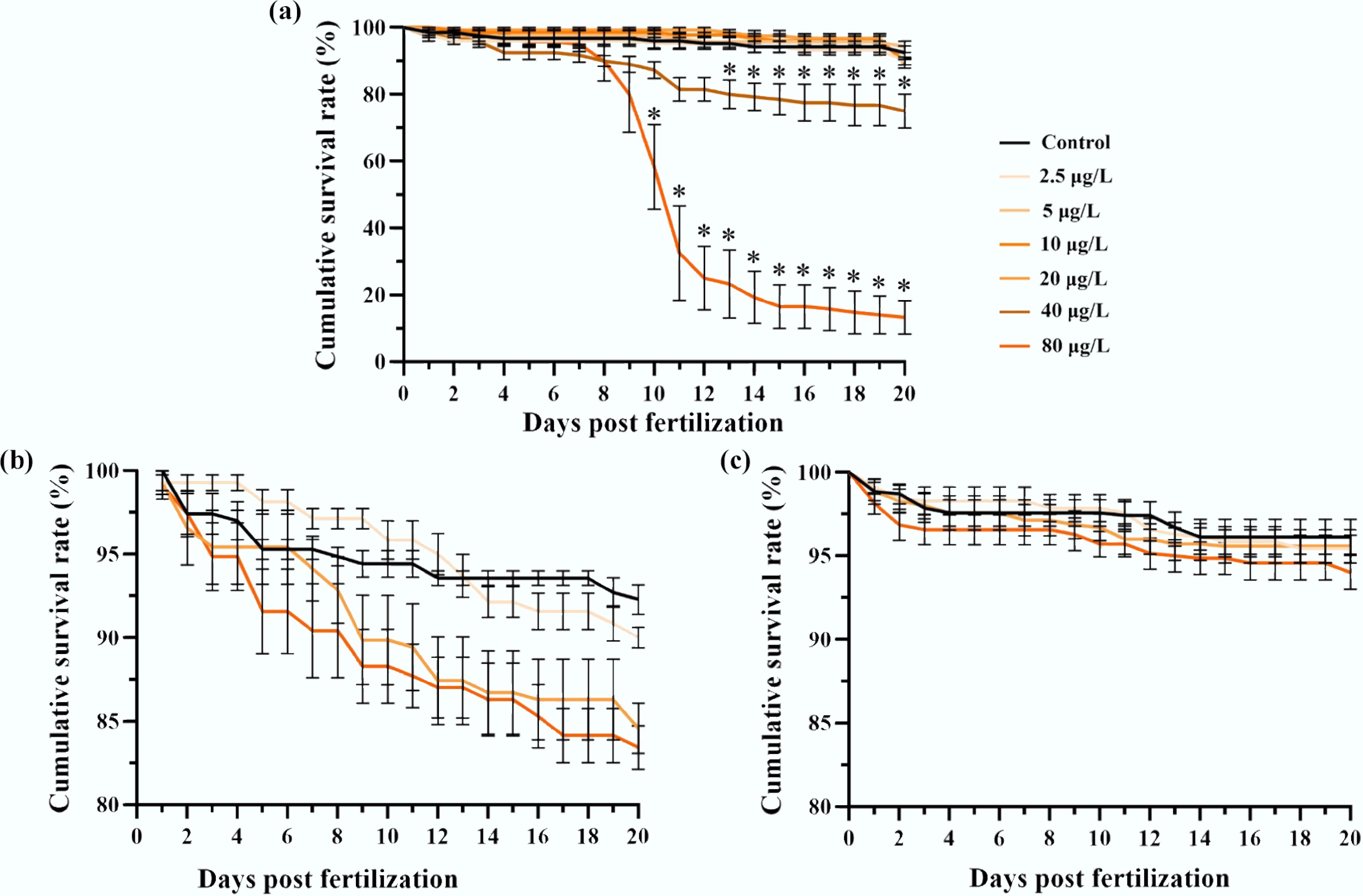
Figure 1.
Multigenerational survivorship of medaka embryos affected by F0 embryonic benzo[a]pyrene exposure. The exposure lasted for 8 d, after which all individuals of F0–F2 generations were reared in clean water. Cumulative survival rates are shown for the (a) F0, (b) F1, and (c) F2 embryos with or without ancestral benzo[a]pyrene exposure (n = 4; data are presented as mean ± SEM). A comparison of the mean values is provided, and * indicates p < 0.05, according to a χ2 test.
-
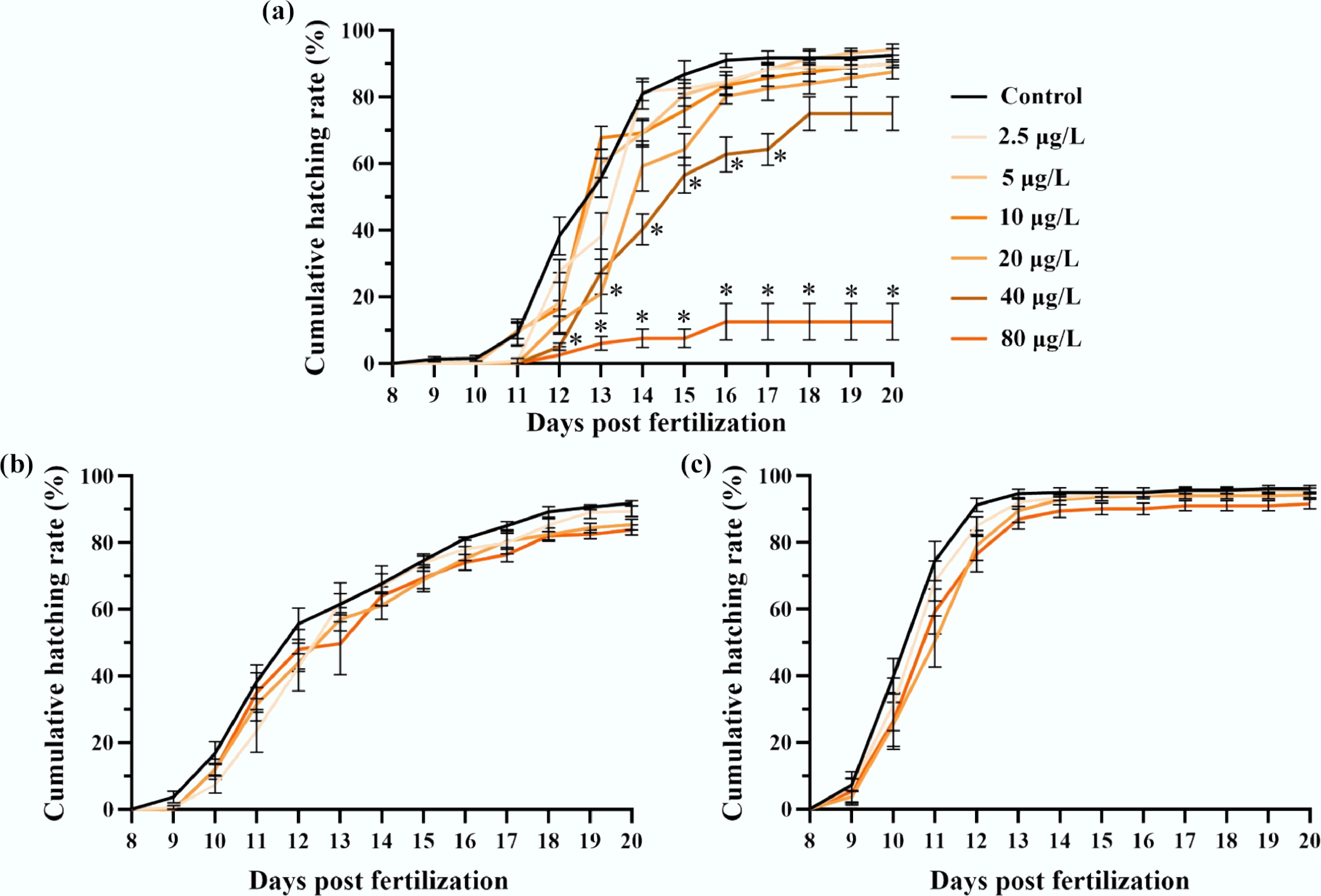
Figure 2.
Multigenerational hatching success of medaka embryos affected by F0 embryonic benzo[a]pyrene exposure. The exposure lasted for 8 d, after which all individuals of F0–F2 generations were reared in clean water. Cumulative hatching rates are presented for the (a) F0, (b) F1, and (c) F2 medaka embryos with or without ancestral benzo[a]pyrene exposure (n = 4; data are presented as mean ± SEM). A comparison of the mean values is provided, * indicates p < 0.05, according to a χ2 test.
-
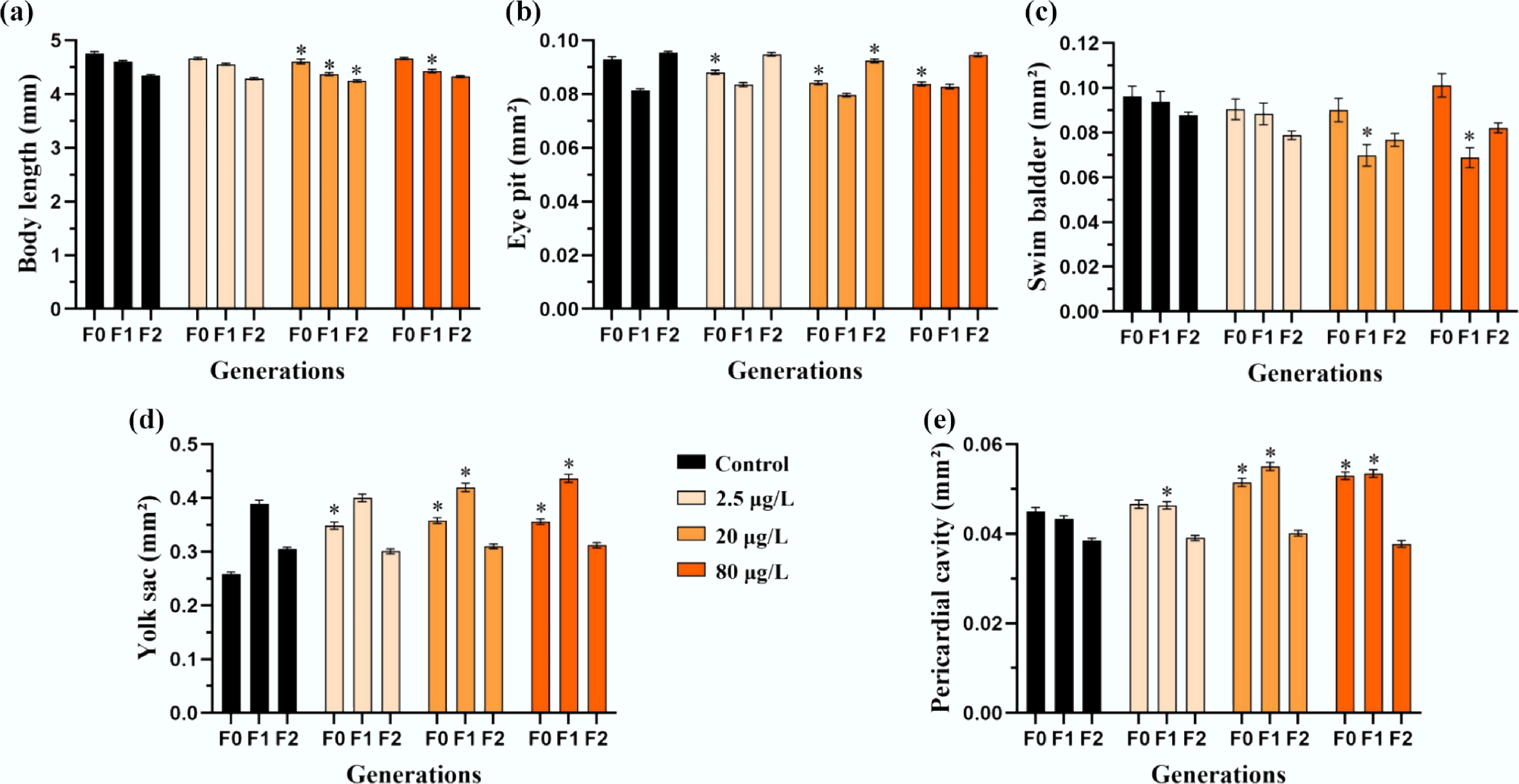
Figure 3.
Multigenerational developmental toxicity of freshly hatched medaka larvae induced by F0 embryonic benzo[a]pyrene exposure. Morphometric parameters including (a) total body length, (b) eye pit, (c) swim bladder, (d) yolk sac, and (e) pericardial cavity are presented for freshly hatched larvae from the F0–F2 generations (n = 4; data are presented as mean ± SEM). A comparison between each benzo[a]pyrene treatment and the corresponding control is provided, and * indicates p < 0.05, according to a two-way ANOVA followed by Tukey's post hoc test.
-
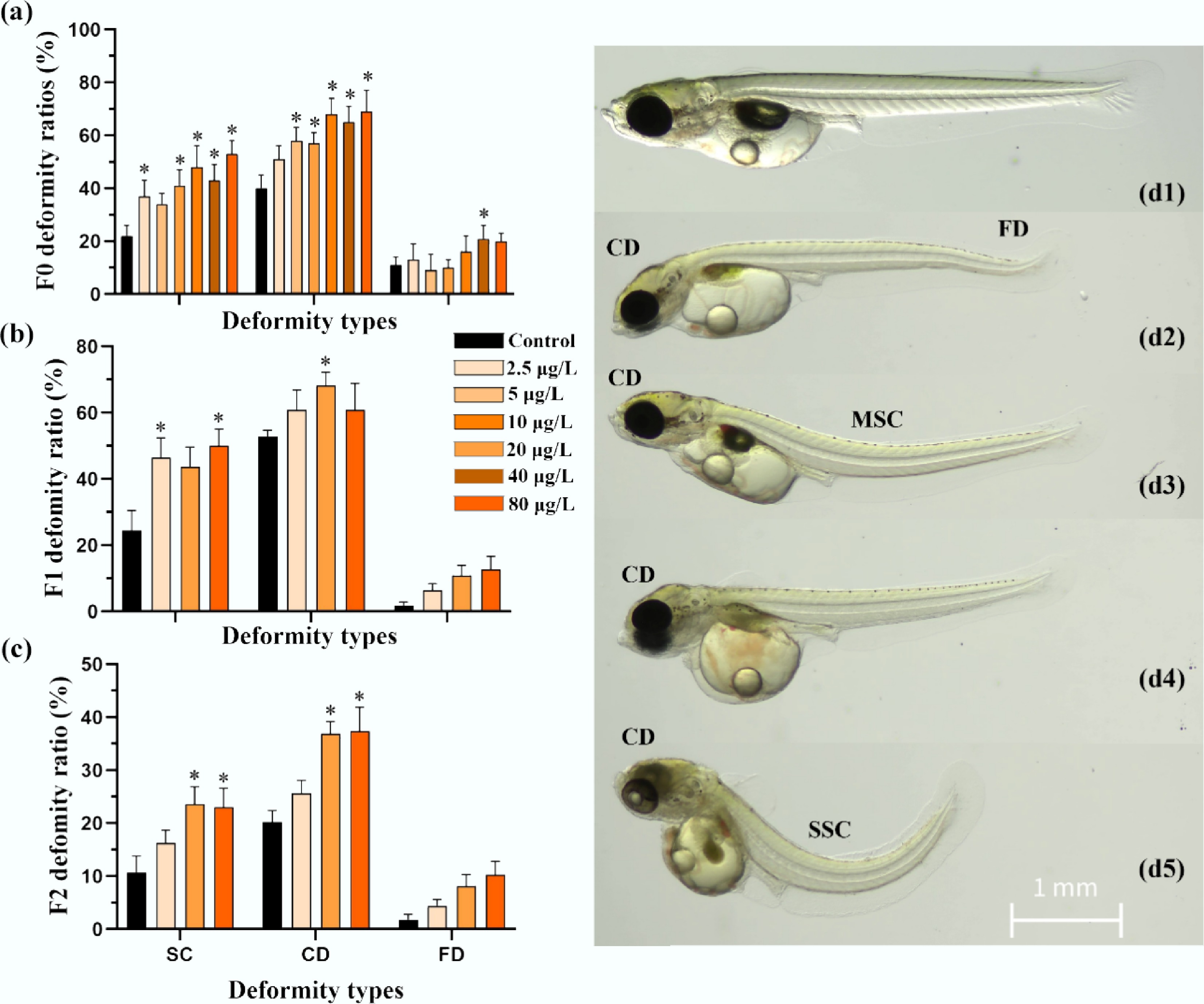
Figure 4.
Multigenerational osteotoxicity of medaka freshly hatched larvae induced by F0 embryonic benzo[a]pyrene exposure. Skeletal deformities in craniofacial, trunk, and tail fin are presented for medaka freshly hatched larvae from the (a) F0, (b) F1, and (c) F2 generations with and without ancestral benzo[a]pyrene exposure (n = 4; data are presented as mean ± SEM). A comparison of the mean values is provided, and * indicates p < 0.05, according to a χ2 test. Representative images of control fish with (d1) normal body shape, and (d2–d5) larvae with craniofacial deformity (CD), spinal curvature (mild and severe spinal curvature are labeled using MSC and SSC, respectively), and fin deformity (FD) in the benzo[a]pyrene treatment groups are shown.
-
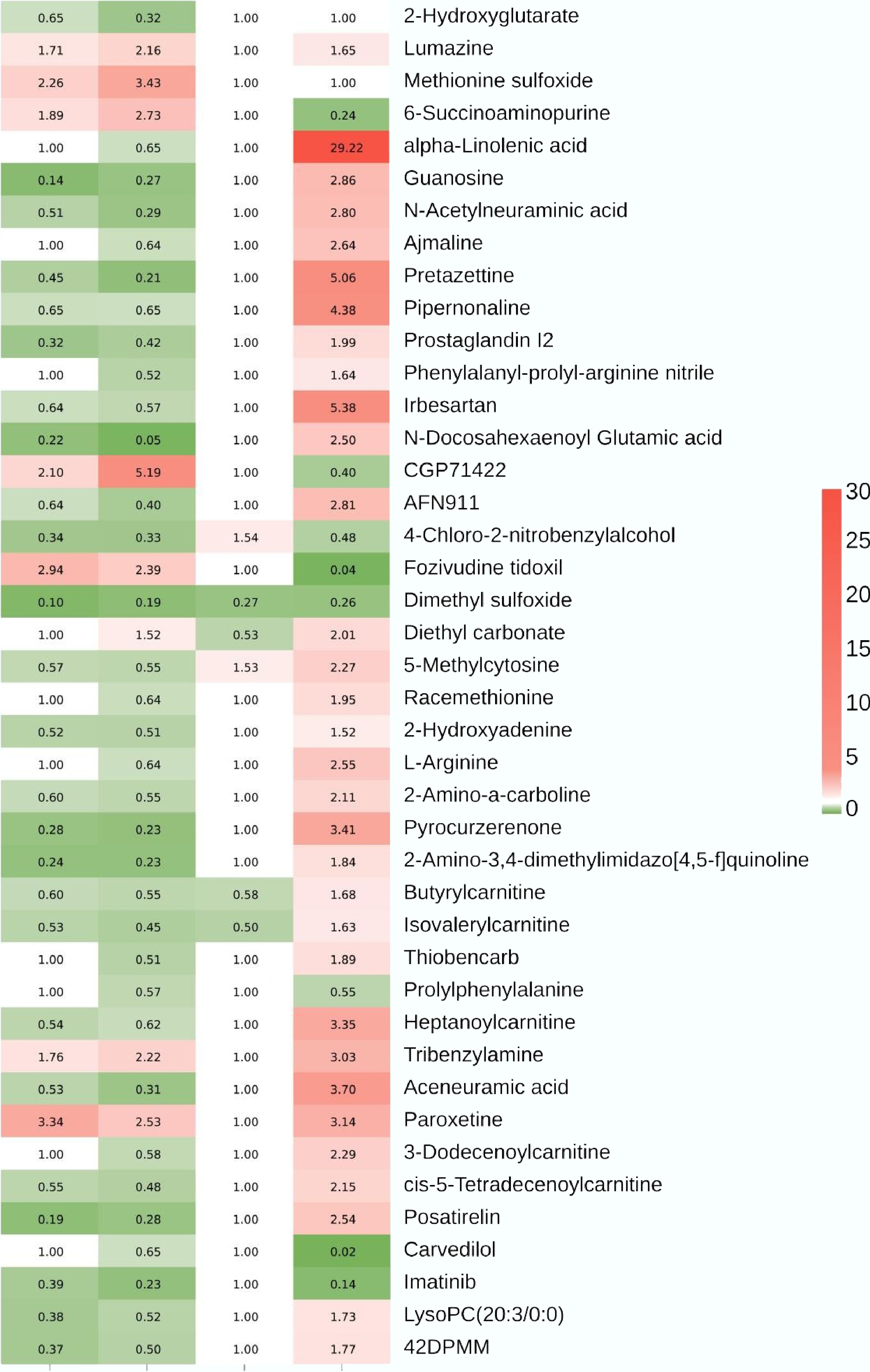
Figure 5.
A heat map showing alterations in metabolomic profiles in F0 and F2 medaka embryos following F0 embryonic benzo[a]pyrene exposure. A total of 42 differentially abundant metabolites are shared by the 20 μg/L benzo[a]pyrene treatment of F0 and F2 generations, alongside their corresponding profiles in the 2.5 μg/L benzo[a]pyrene treatment of F0 and F2 embryos. The column from left to right represents F0 2.5 μg/L treatment, F0 20 μg/L treatment, F2 2.5 μg/L treatment, and F2 20 μg/L treatment, respectively. 42DPMM: 42. 2-(4,4-Difluoro-1-piperidinyl)-6-methoxy-N-[1-(1-methylethyl)-4-piperidinyl]-7-[3-(1-pyrrolidinyl)propoxy]-4-quinazolinamine.
-
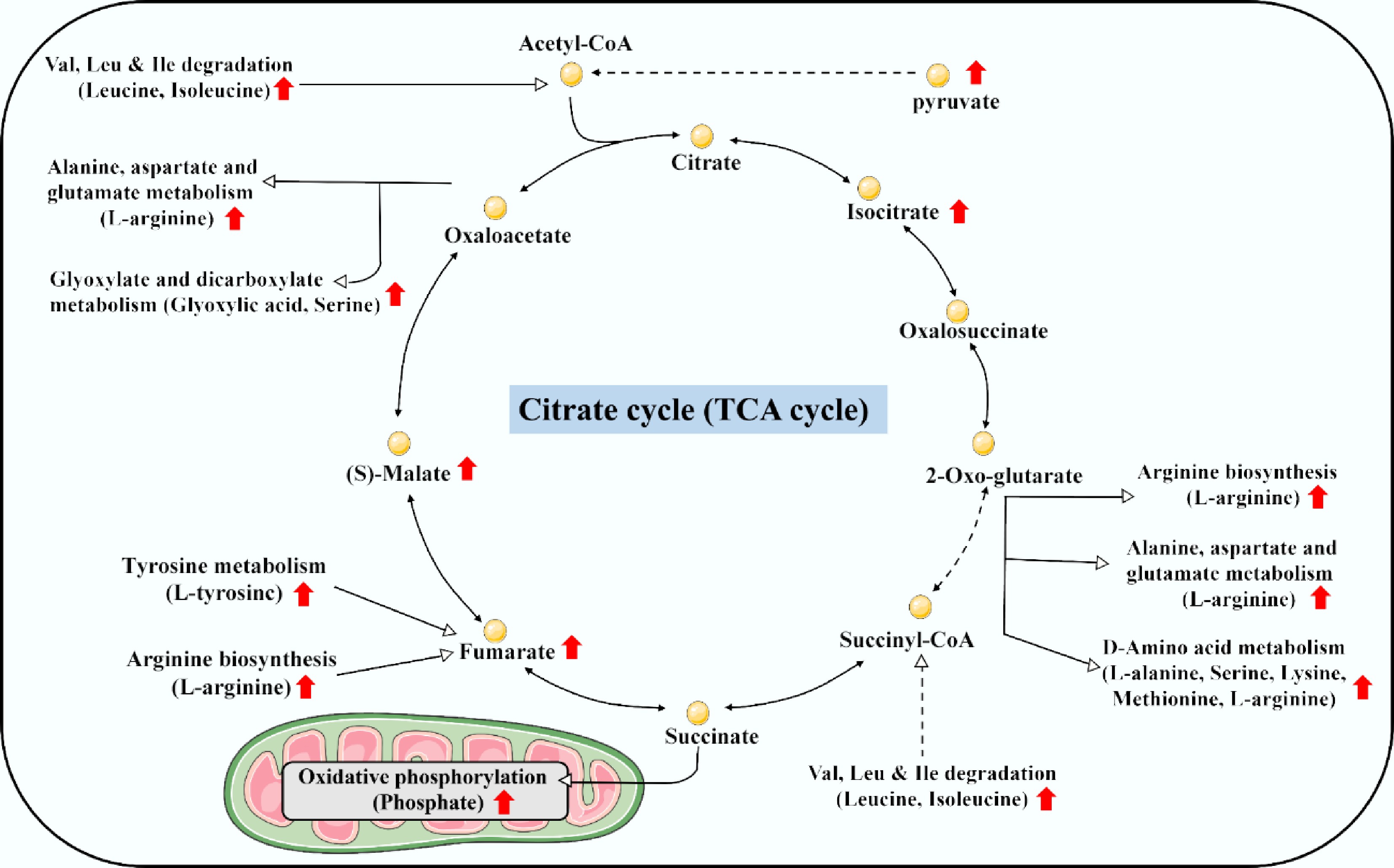
Figure 6.
Schematic diagram showing an overwhelming elevation of energy metabolism and supply in F2 medaka embryos descended from F0 ancestors with embryonic exposure to benzo[a]pyrene at 20 μg/L.
-
Pathway Level 2 Pathway ID p-value Up-DAMs Down-DAMs Central carbon metabolism in cancer Cancer: overview ko05230 1.16E-15 Pyruvic acid; L-Alanine; Serine; Fumaric acid; Leucine; Isocitric acid; Isoleucine; Methionine; Malic acid;
L-Arginine; L-Tyrosine; L-Tryptophan; Lactic acidGlutamine Glycine, serine and threonine metabolism Amino acid metabolism ko00260 7.26E-10 Pyruvaldehyde; Glyoxylic acid; Pyruvic acid; Serine; Phosphoserine; Sarcosine; Choline; Guanidoacetic acid; Ectoine; L-Tryptophan Glyceric acid D-Amino acid metabolism Metabolism of other amino acids ko00470 4.32E-06 Pyruvic acid; L-Alanine; Serine; 5-Aminopentanoic acid; Ornithine; Lysine; Methionine; L-Arginine Glutamine Efferocytosis Transport and catabolism ko04148 3.25E-05 Ornithine; Methionine; L-Arginine; LysoPC
(P-18:1(9Z)/0:0); LysoPC(P-18:0/0:0); LysoPC(18:3(6Z,9Z,12Z)/0:0); LysoPC(22:6(4Z,7Z,10Z,13Z,16Z,19Z)/0:0); Lactic acid− Arginine and proline metabolism Amino acid metabolism ko00330 4.47E-05 Glyoxylic acid; Pyruvic acid; 5-Aminopentanoic acid; Sarcosine; Creatinine; Guanidoacetic acid; Ornithine; L-Arginine − Tyrosine metabolism Amino acid metabolism ko00350 8.84E-05 Pyruvic acid; Fumaric acid; Beta-Tyrosine;
4-Hydroxycinnamic acid; 5,6-Dihydroxyindole;
L-Tyrosine; DOPAHomovanillic
acidGlyoxylate and dicarboxylate metabolism Carbohydrate metabolism ko00630 0.000165 Glyoxylic acid; Pyruvic acid; Serine; Isocitric acid; Malic acid Glyceric acid; Glutamine Cysteine and methionine metabolism Amino acid metabolism ko00270 0.000242 Pyruvic acid; L-Alanine; Serine; Phosphoserine;
5'-Methylthioadenosine; Methionine; S-Adenosylhomocysteine− Pyruvate metabolism Carbohydrate metabolism ko00620 0.000273 Pyruvaldehyde; Pyruvic acid; Lactic acid; Fumaric acid; Malic acid − Citrate cycle (TCA cycle) Carbohydrate metabolism ko00020 0.000434 Pyruvic acid; Fumaric acid; Isocitric acid; Malic acid − Arginine biosynthesis Amino acid metabolism ko00220 0.000759 Fumaric acid; Ornithine; L-Arginine Glutamine Valine, leucine and isoleucine biosynthesis Amino acid metabolism ko00290 0.000759 Pyruvic acid; alpha-Ketoisovaleric acid; Leucine; Isoleucine − Alanine, aspartate and glutamate metabolism Amino acid metabolism ko00250 0.001635 Pyruvic acid; L-Alanine; Fumaric acid Glutamine Lysine degradation Amino acid metabolism ko00310 0.003631 5-Aminopentanoic acid; Glutaric acid; L-Pipecolic acid; Lysine; N6-Acetyl-L-lysine − Valine, leucine and isoleucine degradation Amino acid metabolism ko00280 0.007321 alpha-Ketoisovaleric acid; 3-Hydroxyisovaleric acid; Leucine; Isoleucine − Oxidative phosphorylation Energy metabolism ko00190 0.019938 Phosphate; Fumaric acid − Table 1.
Significantly enriched KEGG metabolic pathways in F2 medaka embryos ancestrally exposed to benzo[a]pyrene at 20 μg/L
Figures
(6)
Tables
(1)