-
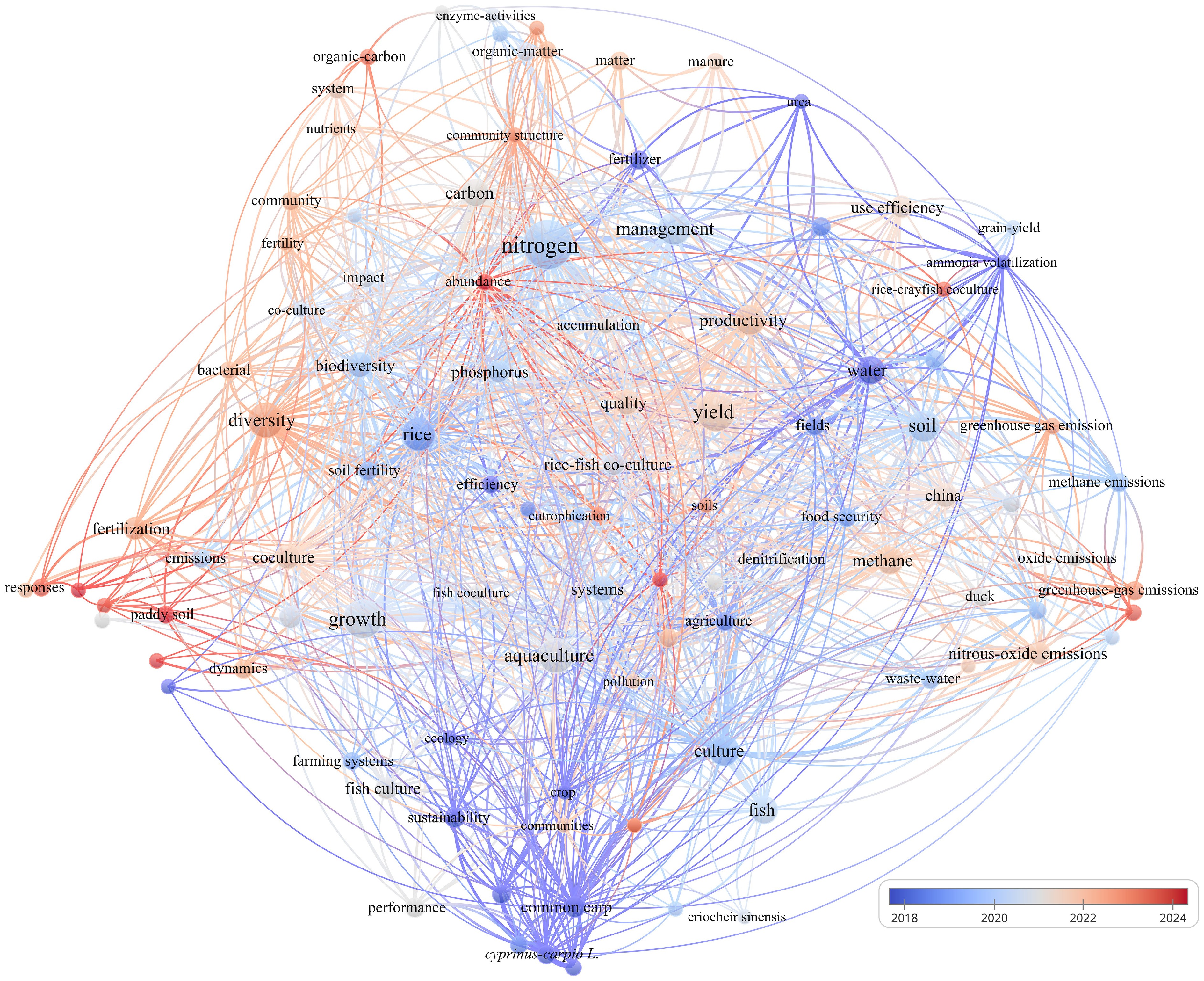
Figure 1.
Network map of keyword co-occurrences and evolution of research themes over time.
-
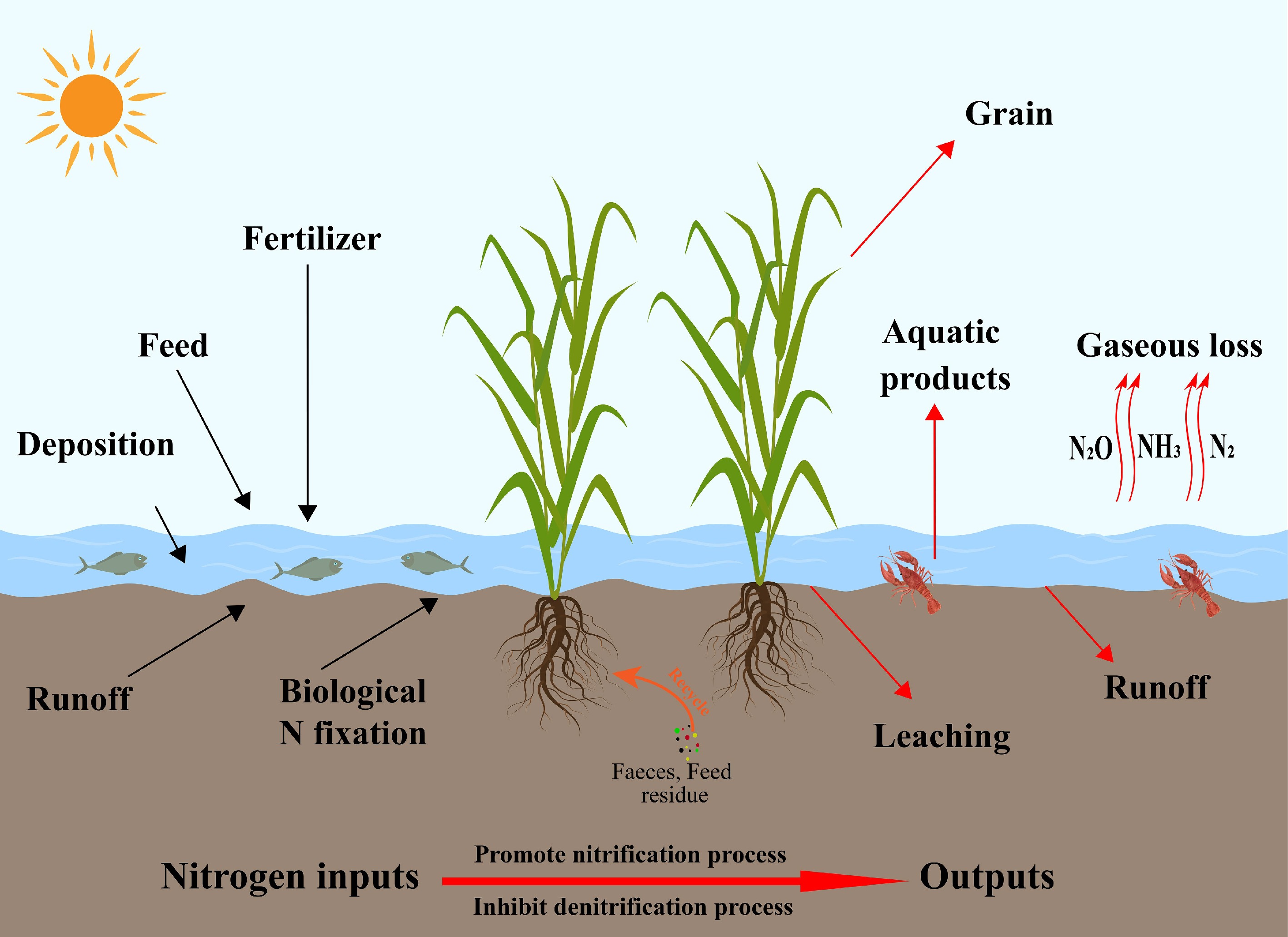
Figure 2.
Schematic diagram of nitrogen cycling pathways in rice-aquatic animal co-culture systems.
-
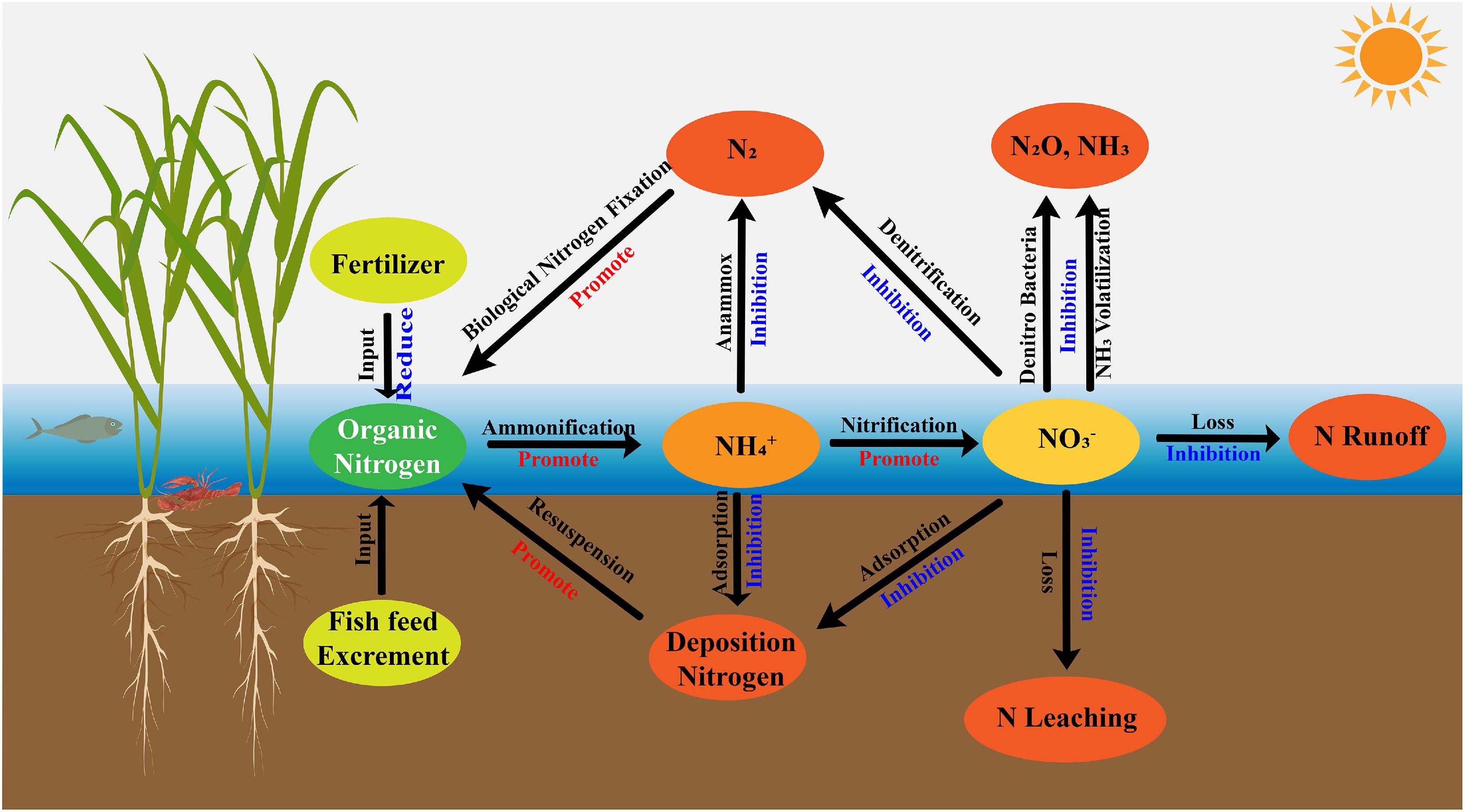
Figure 3.
Schematic diagram of nitrogen losses in rice-aquatic animal co-culture systems.
-
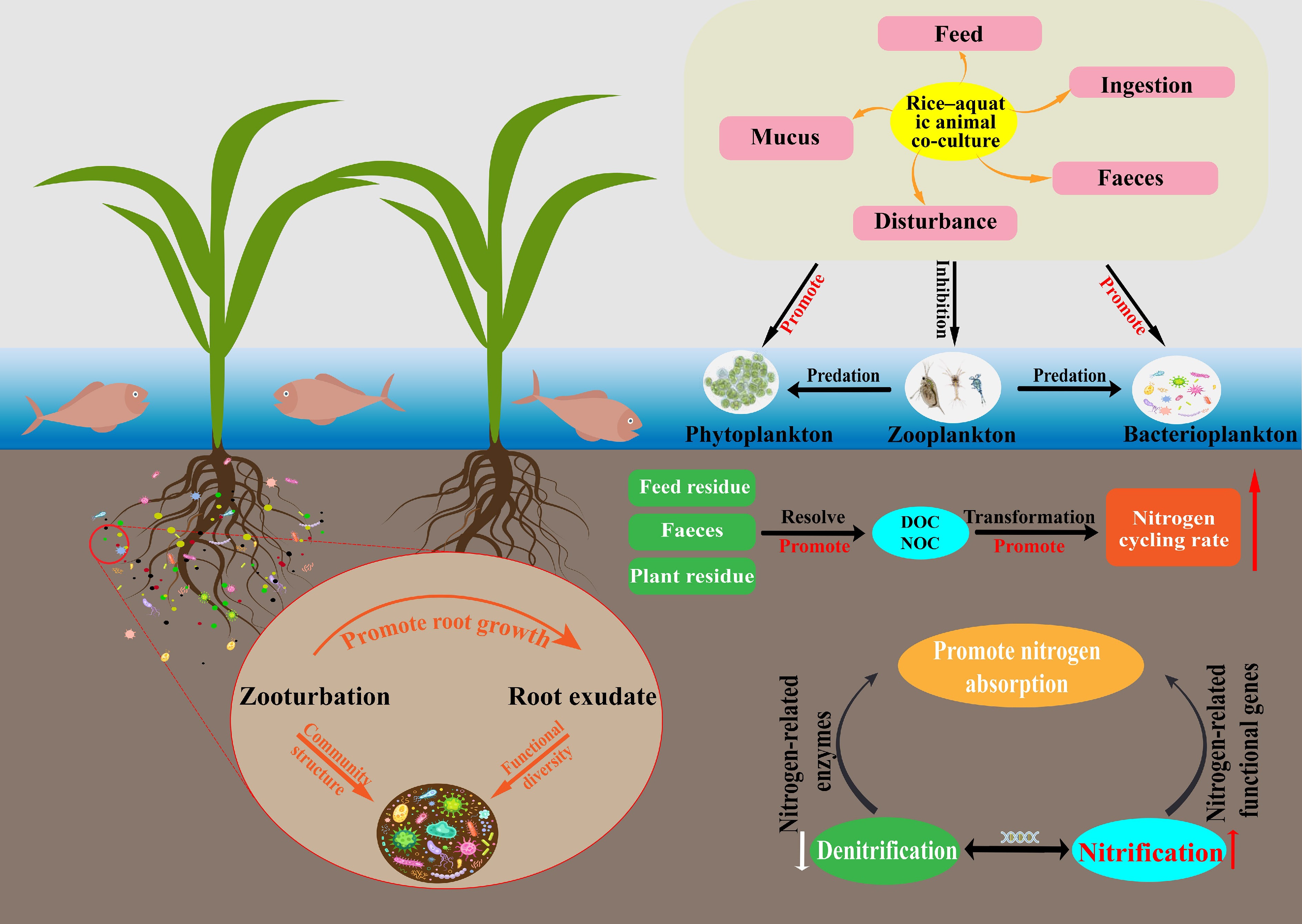
Figure 4.
Schematic of microbial community dynamics, enzyme activities, and nitrogen transformation in rice-aquatic animal co-culture systems.
-
Keyword Total link strength Links Occurrences Nitrogen 272 87 61 Yield 208 80 39 Growth 184 72 39 Aquaculture 164 65 31 Productivity 152 73 22 Diversity 136 64 30 Management 136 70 26 Soil 133 67 24 Culture 132 57 23 Rice 128 68 26 Methane 107 56 19 Water 97 55 19 Table 1.
Top 12 keywords ranked by total link strength
-
Microbial guild Key functional genes Dominant habitat Ecological function Characteristics in rice-aquatic animal co-culture systems Representative references Ammonia-oxidizing archaea amoA Weakly oxidized microzones; surface sediment; rice rhizosphere Carry out ammonia oxidation under low-oxygen conditions and expand the spatial niche of nitrification Stable micro-oxic environments created by rice roots and aquatic animal bioturbation substantially increase the abundance of the amoA gene, making this group the dominant driver of ammonia oxidation and enhancing the conversion of ammonium to nitrite. [99] Ammonia-oxidizing bacteria amoA, hao Oxidized rhizosphere; root oxygen-release patches Initiate nitrification; respond rapidly to oxygen pulses; regulate nitrite supply In rice-crayfish and rice-fish systems, intensified redox gradients caused by root oxygen release and animal disturbance promote the enrichment of ammonia-oxidizing bacteria. Nitrospira-related clusters increase markedly and exhibit strong sensitivity to pH variation. [98] Nitrite-oxidizing bacteria nxrA, nxrB Rhizosphere micro-oxic layers; redox transition zones Oxidize nitrite to nitrate, completing the nitrification pathway and preventing nitrite toxicity In co-culture systems, both the abundance and diversity of nxrA and nxrB increase. Members of the genus Nitrospira accumulate in rhizosphere micro-oxic bands and in paddy-ditch transition areas, accelerating nitrite oxidation and reducing its toxic buildup. [108] Denitrifying bacteria narG, nirS, nirK,
norB, nosZReduced sediment layers; DOC-rich zones Reduce nitrate to nitrogen gas; complete N2O reduction through nosZ, mitigating greenhouse gas emissions Rice-crayfish co-culture systems strongly enhance the abundance of denitrification genes and overall denitrification capacity. Ditch zones show particularly high activity, contributing 40%–70% of system-level nitrate removal and greatly reducing N2O emissions. [115] Anaerobic ammonium-oxidizing bacteria hzsA, hzsB, hzo Deep anoxic sediment Remove nitrogen efficiently by converting ammonium and nitrite directly to nitrogen gas; complement heterotrophic denitrification In rice-crayfish co-culture systems, anaerobic ammonium oxidation constitutes one of the most important nitrogen removal pathways, accounting for 76%–97% of potential ammonium–nitrite conversion within irrigation–drainage units. Activity peaks during transplanting, accounting for approximately 70% of total nitrogen removal. [114] Microorganisms performing dissimilatory nitrate reduction to ammonium nrfA High carbon-to-nitrogen ratio zones; strongly reduced microenvironments Retain nitrate within the system by reducing it to ammonium, sustaining internal nitrogen pools Feed residues and animal excreta stimulate the accumulation of nrfA-harboring microorganisms, promoting nitrate retention as ammonium and reducing dependency on external fertilizer inputs. [90] Nitrogen-fixing bacteria nifH Organic matter-rich hotspots; animal disturbance zones Introduce new reactive nitrogen into the ecosystem and reduce fertilizer dependence Rice-fish, rice-crayfish, and rice-snail co-culture modes consistently enhance the nifH gene abundance and nitrogen fixation potential, increasing endogenous nitrogen inputs, and reducing reliance on synthetic fertilizers. [84] Urea-degrading bacteria ureC Rhizosphere; zones of fecal deposition Accelerate urea hydrolysis and increase the supply of readily available ammonium In rice-fish systems, urease activity is strongly enhanced, and ureC-bearing bacteria become enriched in the rhizosphere and surface sediment, promoting rapid urea decomposition and supplying ammonium for both rice and aquatic animals. [110] Microorganisms responsible for organic nitrogen mineralization chiA, apr, pepA Zones with accumulated residual feed; fecal hotspots; humus layer Degrade organic nitrogen compounds and enhance nitrogen regeneration The continuous input of residual feed and fecal matter increases degradable organic substrates, enriching organic nitrogen-mineralizing microbes and strengthening extracellular enzyme activities, thereby accelerating nitrogen regeneration in co-culture soils. [116] Iron-oxidizing bacteria cyc2 Oxidized rhizosphere layers Modify the structure of oxidized soil layers; influence oxygen diffusion and nitrification kinetics Aquatic animal disturbance enlarges redox transition zones, facilitating the aggregation of iron-oxidizing bacteria. These bacteria form iron plaques that alter micro-scale oxygen diffusion and regulate nitrification efficiency. [43] Multifunctional microbial taxa involved in plant growth promotion, nitrogen fixation, ammonia oxidation, denitrification, and nitrate reduction nif, amo, nirS,
nosZ, nrfA, etc.Rhizosphere hotspots; surface sediment Improve nitrogen availability; promote plant uptake; regulate nitrogen retention and loss Rice-fish and related co-culture systems enhance bacterial diversity and enrich multifunctional microbial groups, strengthening rhizosphere nitrogen fixation and denitrification, promoting plant growth, and enhancing overall nitrogen-cycling multifunctionality. [117] Table 2.
Major nitrogen-cycling microbial guilds in rice-aquatic animal co-culture systems
-
Culture model Nitrogen fertilizer application Nitrogen-use efficiency Economic benefits Environmental benefits Ref. Rice-duck-crayfish system Nitrogen fertilizer reduced by 50% Total nitrogen loss decreased by 24.3%; soil total nitrogen content increased by 8.54% to 28.37%; plant-available nitrogen increased by 6.93% to 22.72% Rice yield increased by 7.9%; net economic profit increased by 136.61% Reduced dependence on chemical fertilizers and pesticides; substantial enhancement of overall ecosystem services [135] Rice-fish system and rice-duck system Same nitrogen fertilizer rate as in rice monoculture The Rice-fish system reduced the total nitrogen loss by 4.3%; rice-duck system reduced total nitrogen loss by 6.5% Rice yield showed no significant difference; additional fish and duck biomass increased by 205.93 and 567.88 kg/ha, respectively Presence of ducks and fish reduced nitrogen loss through ammonia volatilization and nitrogen leaching pathways [136] Rice-fish system (yellow catfish) and rice-shrimp system (freshwater shrimp) Same nitrogen fertilizer rate as in rice monoculture Nitrogen-use efficiency increased relative to monoculture Rice grain yield remained unchanged; fish and shrimp biomass increased Rice-fish system reduced N2O by 85.6% and ammonia emissions by 26.0%; rice-shrimp system reduced N2O by 108.3% and ammonia emissions by 22.6% [126] Rice-crab system No chemical nitrogen fertilizer applied; nitrogen input from feed slightly exceeded fertilizer nitrogen input in monoculture 59.1% of the crab diet originated from naturally occurring organisms in the paddy field; rice plants utilized 7.6% of the nitrogen originating from aquatic animal feed Crab production increased by
730 kg/ha; rice yield slightly
increasedTotal nitrogen concentration in floodwater significantly decreased [118] Rice-carp system, rice-crab system, and rice-soft-shelled turtle system Same nitrogen fertilizer rate as in rice monoculture Apparent nitrogen-use efficiency significantly higher; 16.0% to 52.2% of
the aquatic animal diet originated from natural paddy biota; rice plants utilized13.0% to 35.1% of nitrogen is derived from aquatic animal feedIncreased rice yield; aquatic animal production increased by 520 to
2,570 kg/haReduced risk of agricultural non-point source pollution [137] Rice-carp system (Cyprinus carpio) and rice-shrimp system (Penaeus monodon) Same nitrogen fertilizer rate as in rice monoculture Nitrogen concentration in rice straw increased by 134% Rice yield unaffected; increased fish and shrimp biomass — [138] Rice–fish system (yellow finless eel and loach) Same nitrogen fertilizer rate as in rice monoculture Nitrogen-use efficiency improved compared with monoculture Economic value increased by 10.33% relative to rice monoculture Herbivorous insect abundance decreased by 24.70%; weed abundance, weed species richness, and weed biomass decreased by 67.62%, 62.01%, and 58.8%, respectively; invertebrate predator abundance increased by 19.48%; pesticide use decreased by 23.4% [139] Rice-crayfish system Nitrogen fertilizer reduced by 33.3% Nitrogen-use efficiency and nitrogen accumulation showed no significant difference compared with monoculture Rice yield remained unchanged; crayfish yield increased Reduced nitrogen surplus and lower risk of surface-runoff nitrogen pollution [140] Rice-fish system (Cyprinus carpio and Oreochromis niloticus) and rice-shrimp system (Macrobrachium species) Same nitrogen fertilizer rate as in rice monoculture The presence of aquatic animals enhanced nitrogen cycling processes Rice yield increased by 16%; additional aquatic animal biomass produced Water quality and soil fertility significantly improved [141] Rice-carp system 37% of nitrogen input originated from fertilizer; 63% from feed input Nitrogen-use efficiency showed no significant change Rice yield stable; fish production increased significantly Water nitrogen concentration reduced significantly [142] Rice-carp system and rice-tilapia system Urea application reduced by 220 kg/ha Nitrogen-use efficiency increased relative to monoculture Net economic profit increased by 50% to 60% — [143] Rice-fish system Same nitrogen fertilizer rate as in rice monoculture Nitrogen-use efficiency increased relative to monoculture Rice grain yield increased by 20%; fish biomass produced was 345 ± 92 kg/ha Overall, water quality remained similar to monoculture; however, densities of floating macrophytes, zooplankton, and benthic invertebrates declined [144] Table 3.
Nitrogen utilization in different rice-aquatic animal co-culture systems
Figures
(4)
Tables
(3)