-
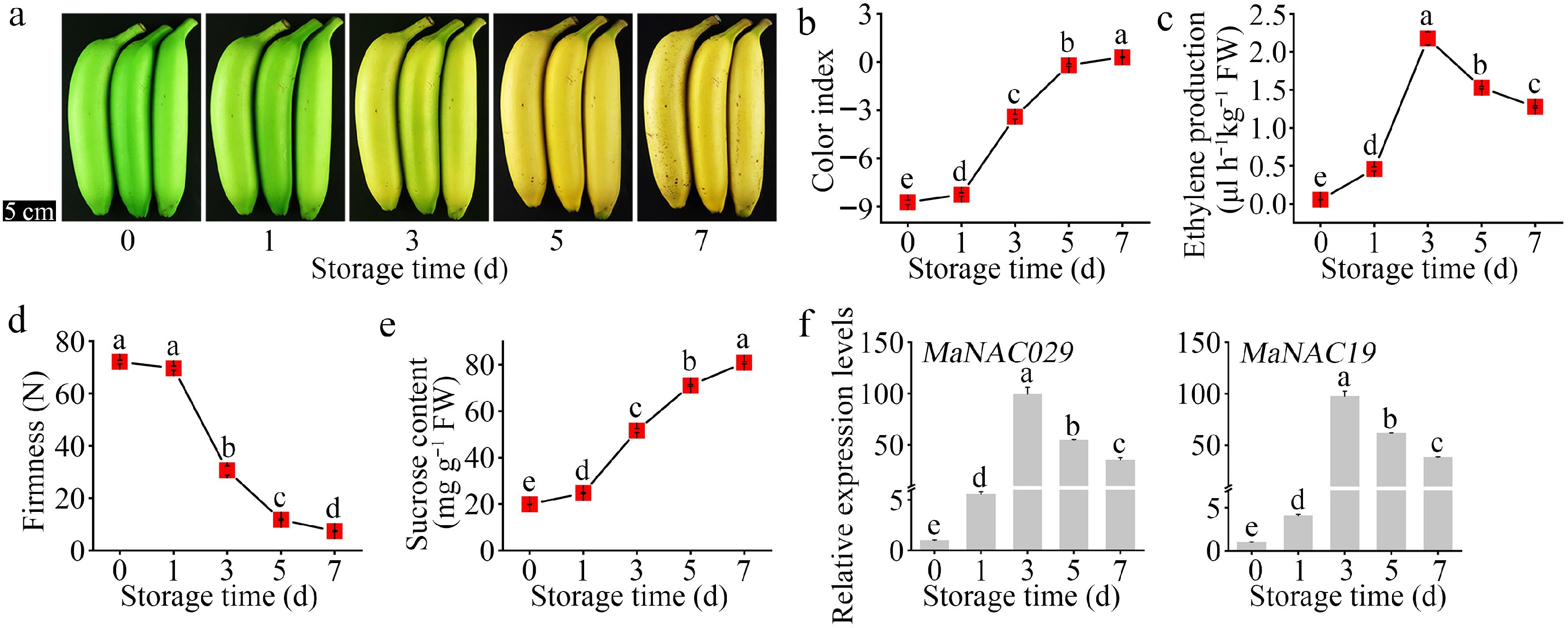
Figure 1.
Expression of MaNAC029 and MaNAC19 during the banana fruit ripening process. (a) Appearance of banana fruit during ethylene-induced ripening. Changes in (b) color index, (c) ethylene production, (d) fruit firmness, and (e) sucrose content during fruit ripening. (f) Expression of MaNAC029 and MaNAC19 in banana fruit during ripening process. The relative expression level is shown as a ratio relative to that on day 0, which was set at 1. Error bars in (b)−(e), and (f) represent SE from six and three replicates, respectively (p < 0.05, Tukey test).
-
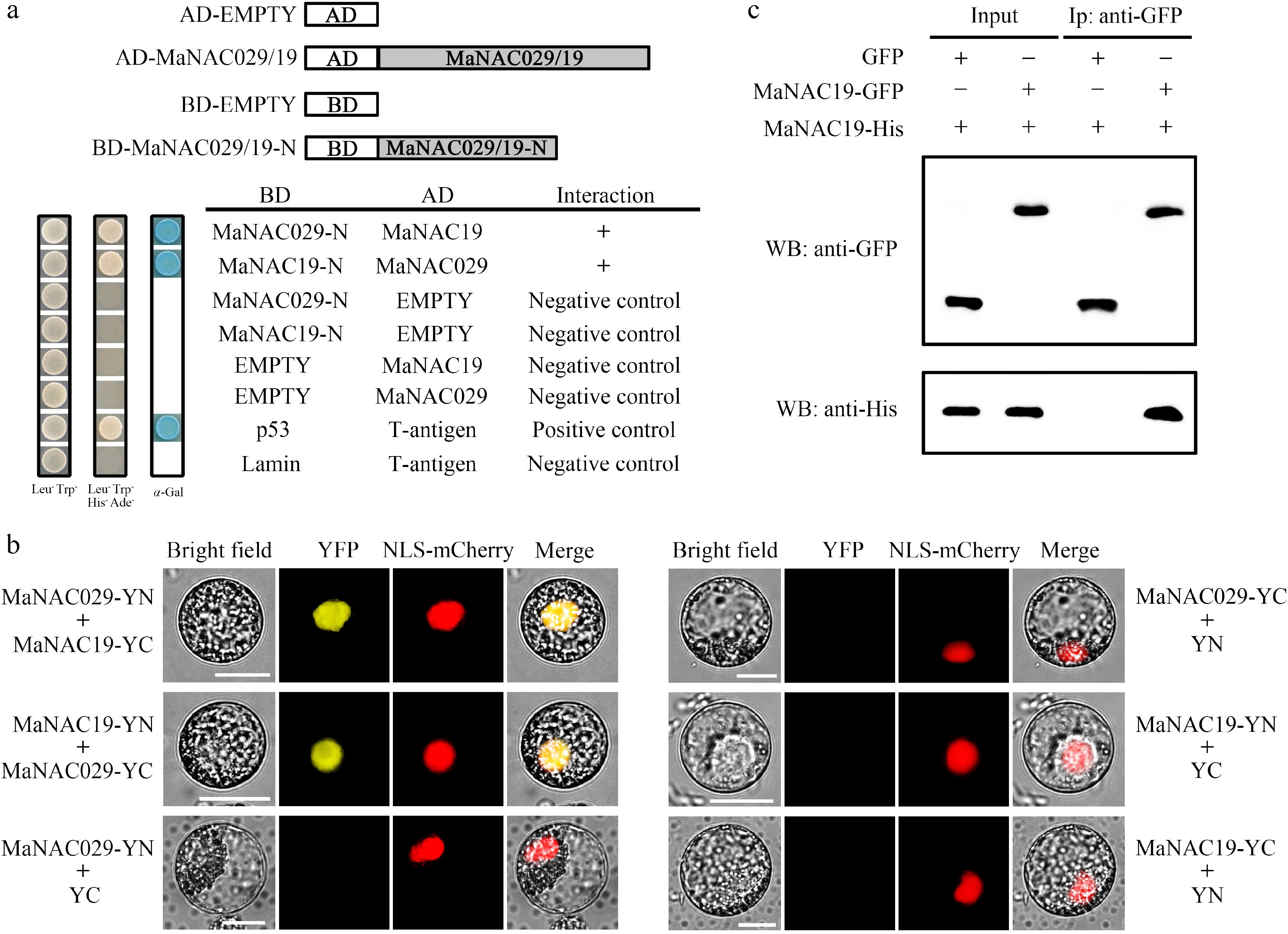
Figure 2.
MaNAC029 interacts with MaNAC19. (a) Y2H assay for the interaction between MaNAC029 and MaNAC19. Yeast cells co-transformed with bait vector and prey vector were grown on selective medium (lacking tryptophan, leucine, histidine, and adenine), and were then stained by X-α-gal. (b) BiFC analysis of the interaction between MaNAC029 and MaNAC19 in tobacco BY-2 protoplasts. MaNAC029/19 were fused with the C terminus of YFP (YC) and the N terminus of YFP (YN), respectively, as indicated, and co-transfected into protoplasts. NLS-mCherry was used as a nuclear marker. Bars, 25 μm. (c) Co-IP assays of MaNAC029-MaNAC19 interaction. MaNAC19-GFP and MaNAC029-His, or empty GFP and MaNAC029-His, were transiently expressed in tobacco leaves and immunoprecipitated with anti-GFP antibody. Immunoprecipitated samples and input controls were detected with anti-GFP and anti-His antibodies, respectively.
-
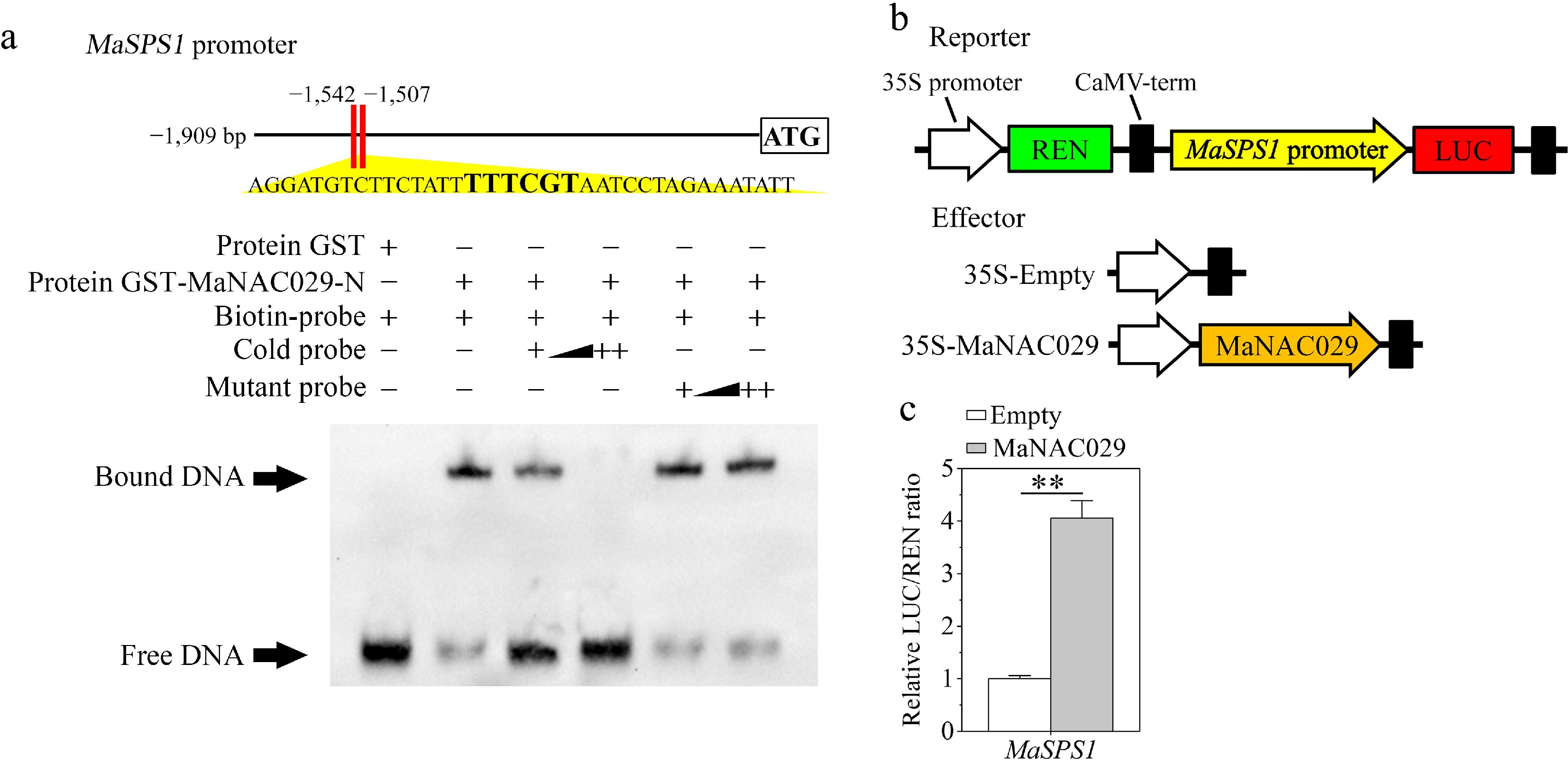
Figure 3.
MaNAC029 induces the expression of MaSPS1 by binding directly to its promoter. (a) EMSA demonstrates the in vitro association of MaNAC029 with the MaSPS1 promoter. A schematic illustration of the MaSPS1 promoter probe is displayed on top, with bold letters denoting NACRS. The negative control, which was the purified GST protein or the recombinant GST-MaNAC029 protein, was subjected to an incubation process along with the probe. Triangles show competing quantities of unlabeled wild-type and mutant probes. MaNAC029 enhances MaSPS1 promoter activity. (b) Schematic representation of reporter and effector constructs. (c) MaNAC029 enhances the MaSPS1 promoter activity in a dual luciferase assay in tobacco leaves. LUC to REN ratio of an empty vector with the MaSPS1 promoter was utilized as a calibrator (deemed 1). Error bars represent SE from six replicates (Student's t-test, ** p < 0.01).
-
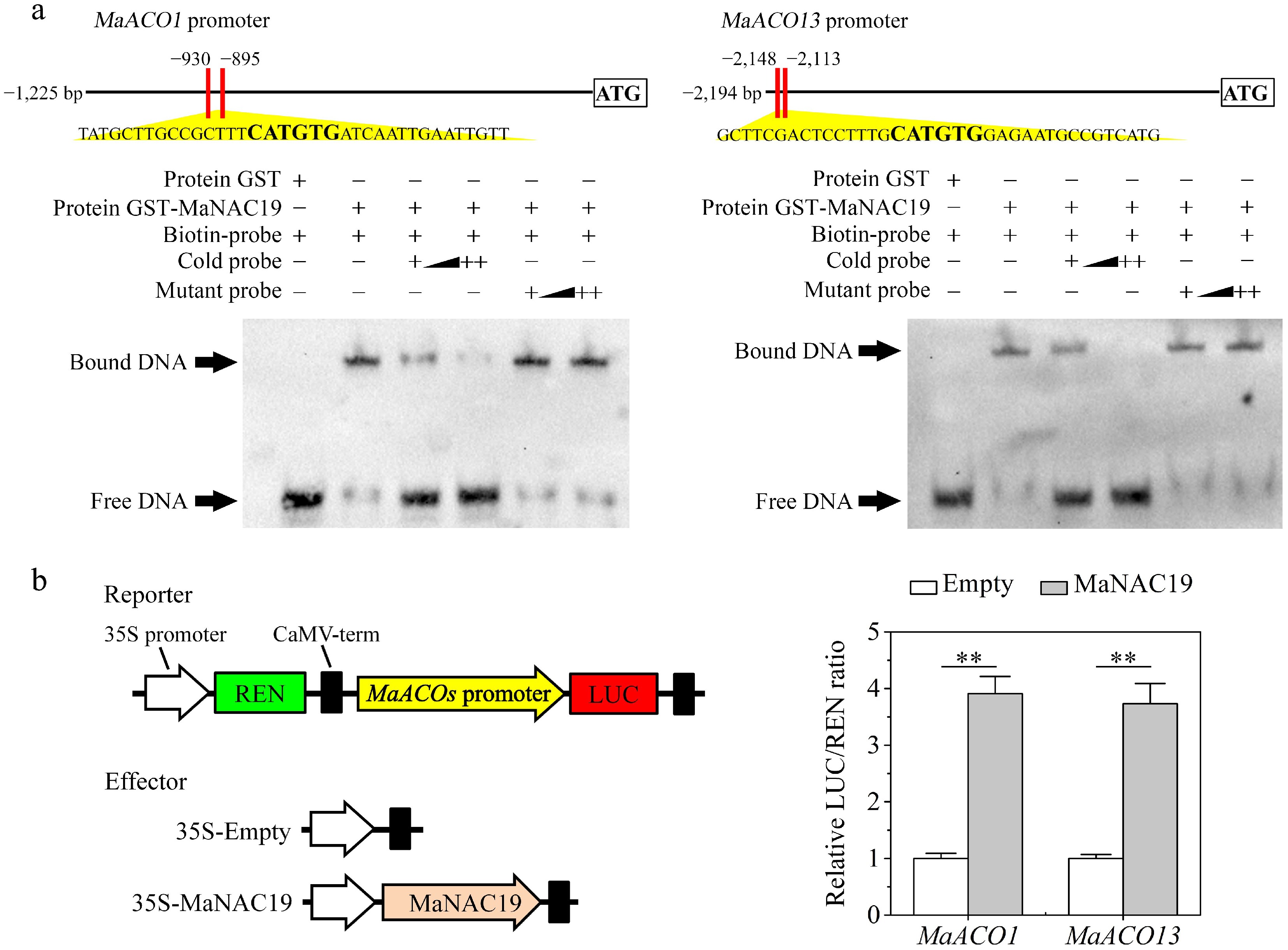
Figure 4.
MaNAC19 directly binds to the promoters of MaACO1 and MaACO13 and enhances their activities. (a) EMSA assay for MaNAC19 binding to MaACO1/13 promoters. The probe sequences corresponding to promoters of ethylene biosynthesis genes are shown at the top of the image, with bold letters representing the NACRs. The purified GST (negative control) or recombinant GST-MaNAC19 protein was subjected to an incubation process along with probes. Triangles indicate increasing amounts of unlabeled wild-type or mutated probes for competition. (b) MaNAC19 enhances the promoter activity of MaACO1/13 in a DLR assay in tobacco leaves. Schematic representation of reporter and effector constructs is shown in the left panel. The value of LUC/REN of the empty vector plus the promoter reporter was used as a calibrator (set as 1). Error bars represent SE from six replicates (Student's t-test, ** p < 0.01).
-
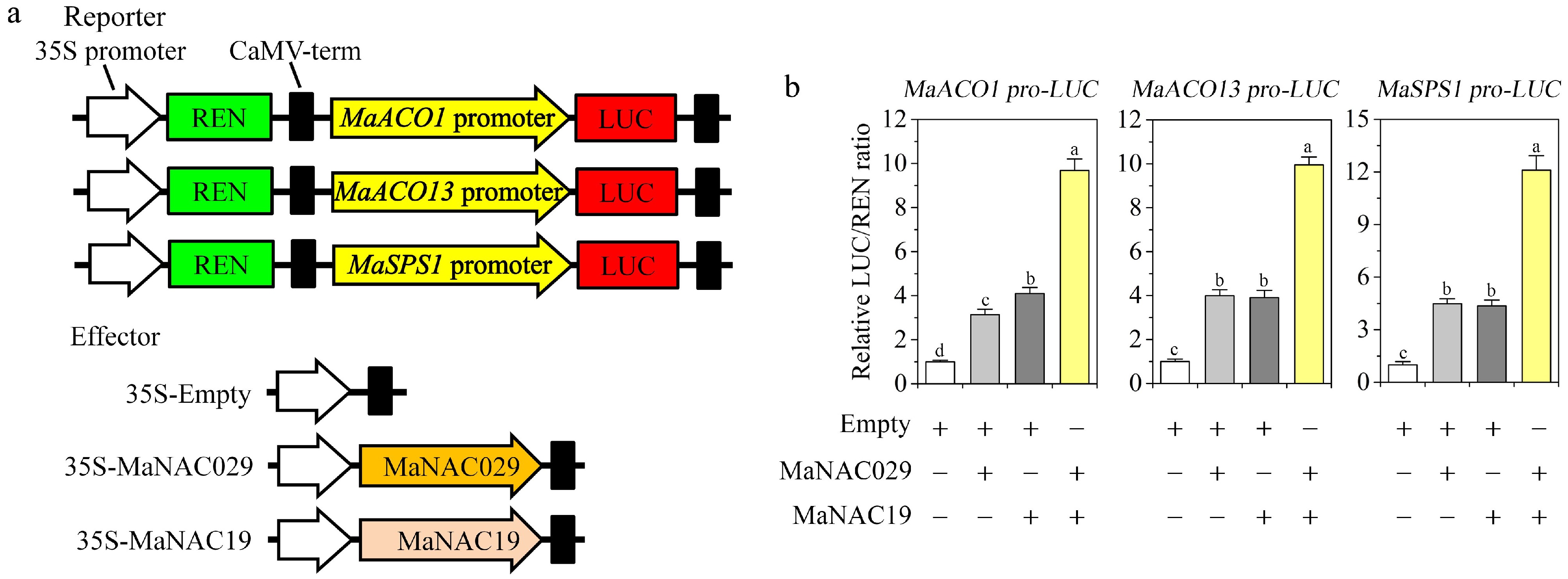
Figure 5.
MaNAC029 and MaNAC19 synergistically trans-activate the ethylene biosynthesis genes (MaACO1/13) and sucrose phosphate synthase gene (MaSPS1) in tobacco leaf dual-luciferase reporter (DLR) assays. (a) Schematic of reporter and effector constructs. (b) Activation ofMaACO1/13 and MaSPS1 promoters by individual or combined expression of MaNAC029 and MaNAC19. LUC/REN ratios of the empty vector control were set to 1.0 for normalization. Data: mean ± SE (n = 6 replicates). Different letters above the bars indicate significant differences (p < 0.05, Tukey test).
-
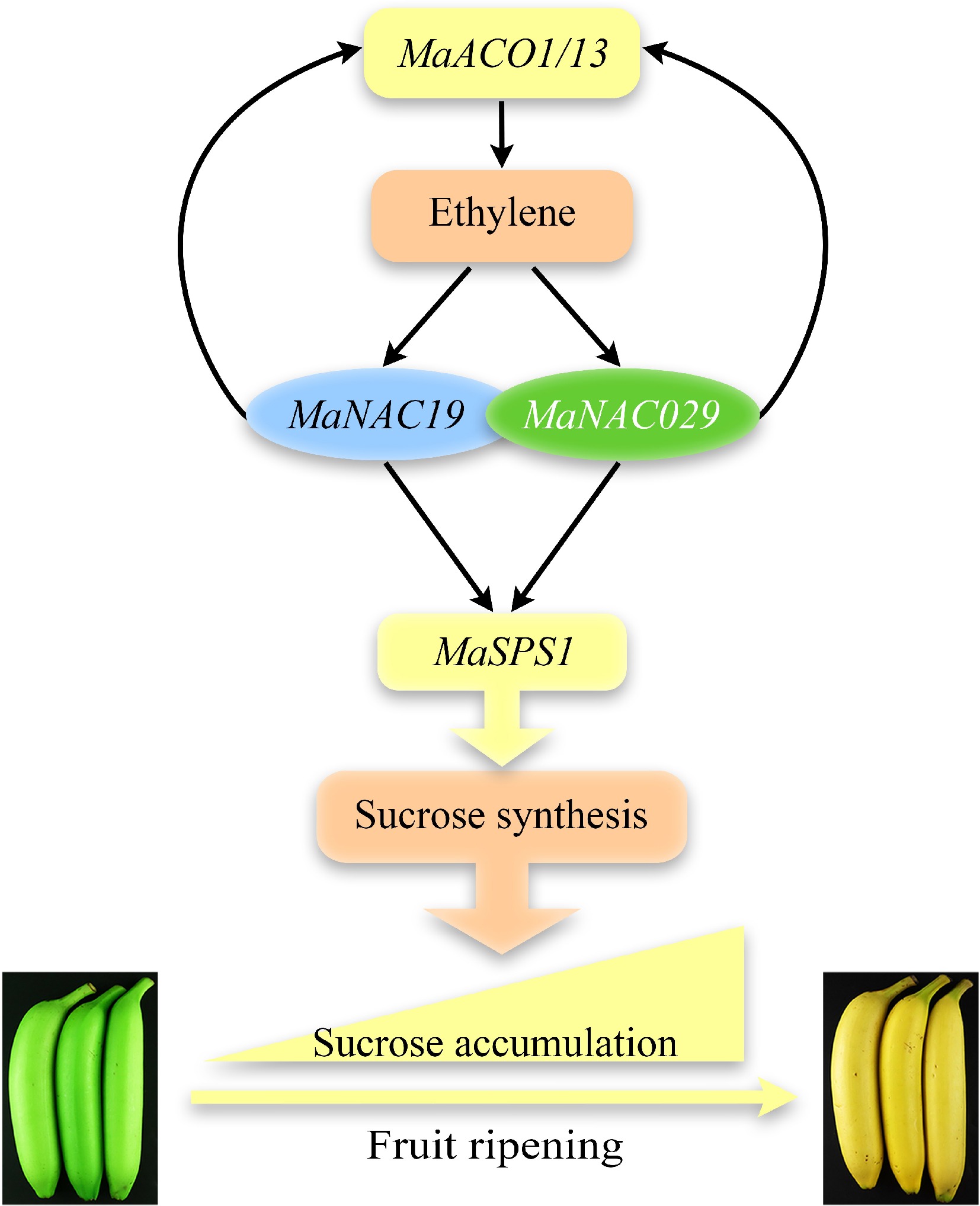
Figure 6.
A proposed model for MaNAC029-MaNAC19 transcriptional module function in banana ripening.
Figures
(6)
Tables
(0)