-
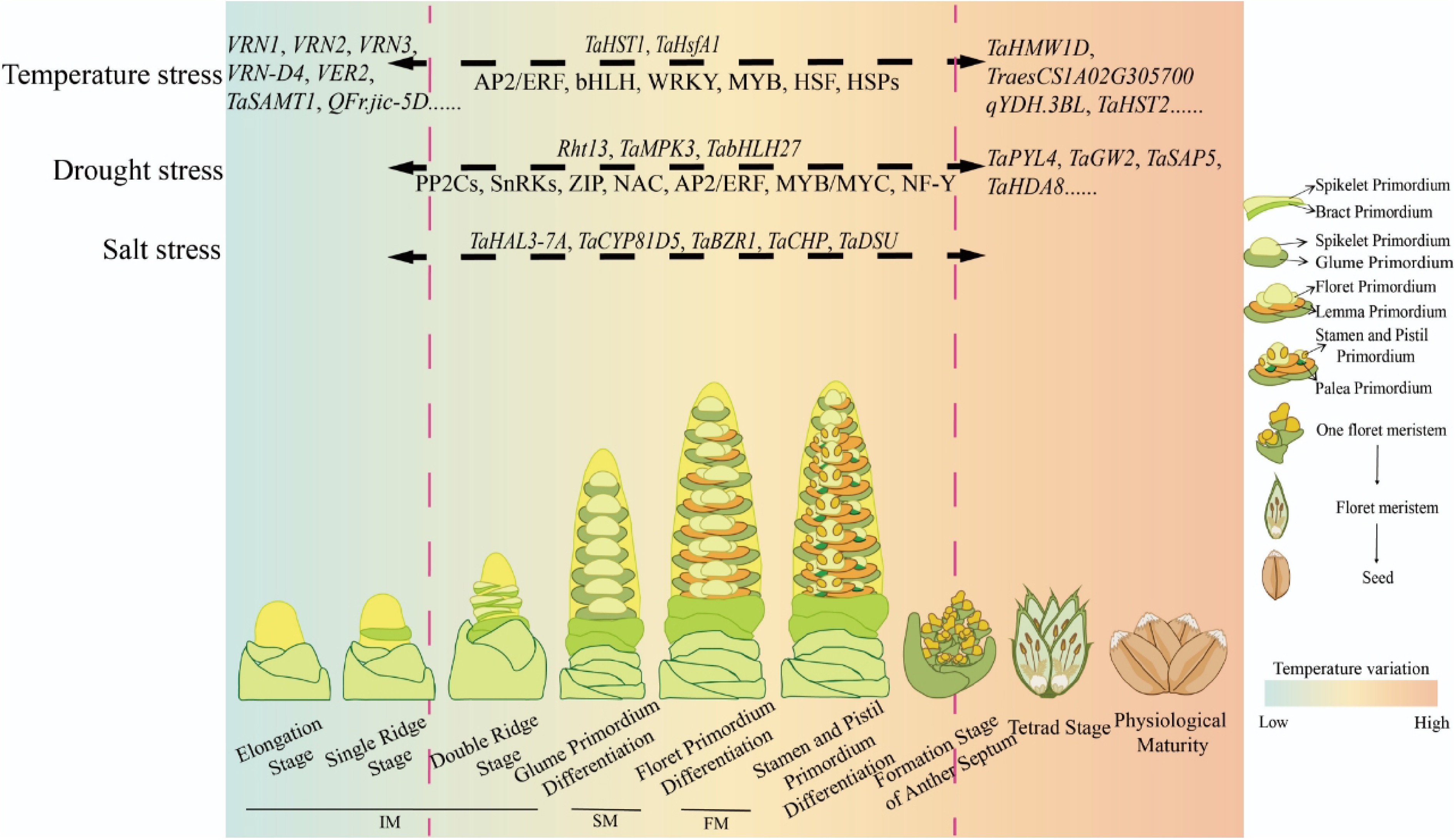
Figure 1.
Spike development and candidate genes involved in the stresses in wheat. Abbreviations: IM, inflorescence meristem; SM, spikelet meristem; FM, floral meristem; Bidirectional dashed arrows indicate functional genes or transcription factor families identified by omics analyses that may influence multiple or all stages of spike development.
-
Stress type QTL/gene Function Temperature Low temperature VRN-1 Enabling the SAM-to-IM transition to initiate flowering while reducing freezing tolerance[26]. QFr.jic-5D Enhancing frost tolerance and reducing winterkill compared with spring-type alleles[27]. TaSAMT1 Increasing MeSA accumulation, reducing SA levels, and markedly improving freezing tolerance[34]. High temperature TraesCS1A02G305700 Conferring higher biomass and spike number under high nighttime temperature[42]. qYDH.3BL Increasing biomass, grain number, and grain weight following heat stress[43]. TaHST1 Increasing GNS, grain weight per spike, TGW, grain length and grain width under either thermo-stressed or control conditions[44]. TaHST2 Enhancing the conversion of soluble sugars into starch during heat-stressed grain filling[45]. TaHsfA1 Knockout mutants reducing seedling survival under high temperature and producing shrunken grains with lower TGW[47]. TaSG-D1 Improving heat tolerance though at a cost to grain yield[54]. Drought TduRuM_contig25432_1377 Maintaining stable association with fertile spike number across favorable and semiarid environments[52]. Rht13 Increasing peduncle length, spike length, grain number per spike, and grain weight under drought stress[56]. TaPYL1-1B, TaPYL4 Enhancing ABA sensitivity to improve drought tolerance and increase grain size and weight[67]. TaMPK3 Reducing drought tolerance and ABA sensitivity, thereby lowering survival rates and decreasing in spikelet number, tiller number, panicle length, and grain yield[68]. TaGW2 Improving drought tolerance and higher yields through increasing grain width and weight yields[75]. TaSAP5 Increasing drought tolerance by maintaining tiller and spike numbers under stress, leading to higher grain weight and grain number without yield penalties under normal conditions[76]. TaHDA8 Knockout lines showing higher yield per plant, mainly due to increased GNS under drought stress[78]. TabHLH27 Coordinating root growth and spike development to affect WUE and yield-related traits, including spikelet and grain number[81]. TaMYB7-A1 Enhancing photosynthesis, WUE, root development, and grain yield under drought condition[82]. Salt TaSPL6-D Knockout of TaSPL6-D enhances Na+ exclusion, preserves spike development, and improves yield under saline conditions[83]. TaHAL3-7A Improving salt stress tolerance while further boosts chlorophyll content, TGW, and overall yield[88]. TaCYP81D5 Promoting ROS scavenging to enhance salinity tolerance and producing larger seeds and higher yields under moderate salinity[151]. TaBZR1 Enhancing salt tolerance while reducing plant height and spike length but slightly increasing grain length[89]. TaCHP Enhancing tolerance to saline–alkaline stress strengthening germination, improving photosynthesis, increasing ROS scavenging, and increasing spike number, grain number per spike, and TGW[91]. TaDSU Enhancing salt tolerance and increasing spike number per plant and thousand-grain weight in overexpression lines[92]. Table 1.
Genes associated with abiotic stress and spike development in wheat.
Figures
(1)
Tables
(1)