-
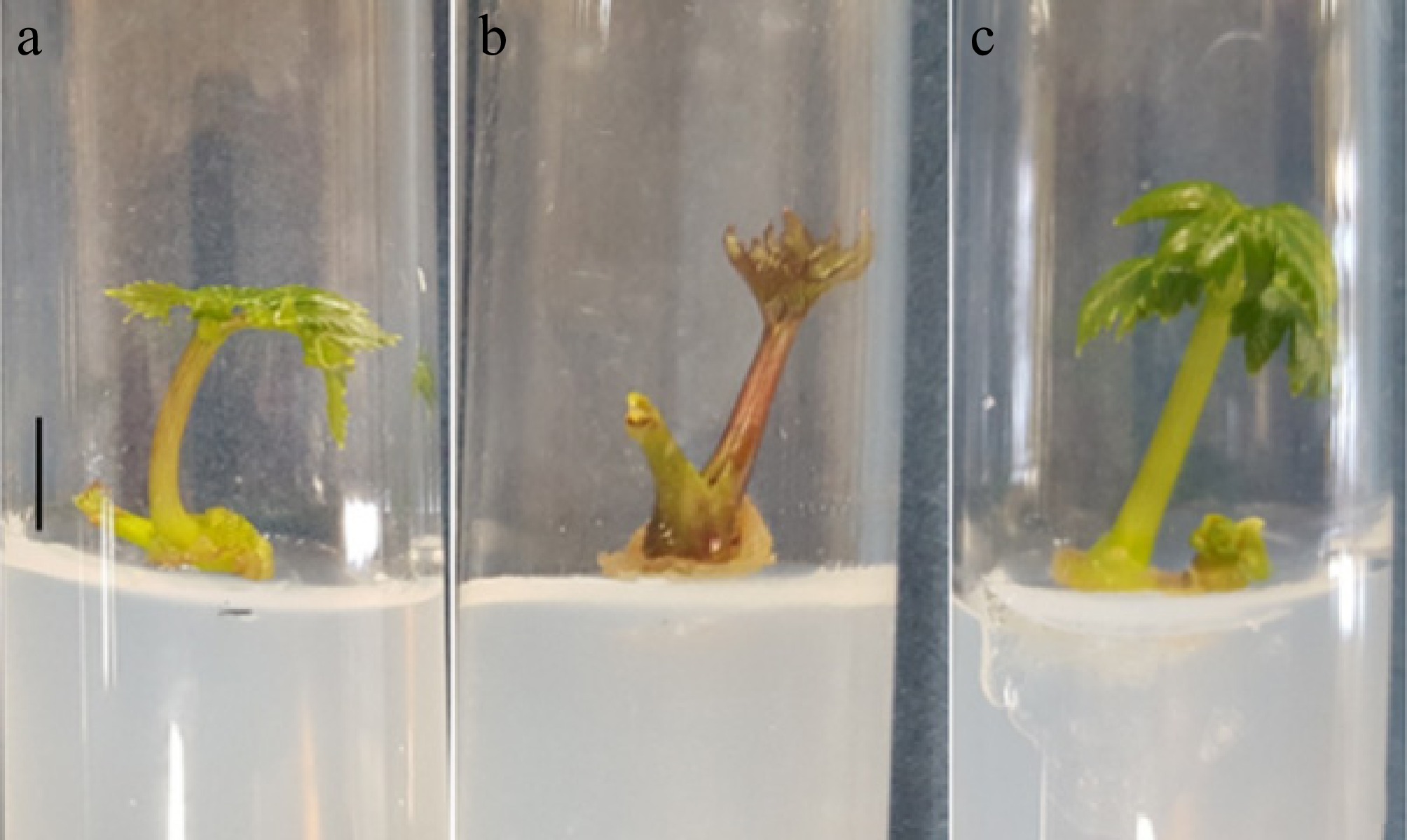
Figure 1.
Seedlings of arracacha (Arracacia xanthorrhiza Bancroft) obtained in vitro from shoot tips grown in B5 medium supplemented with 30 g·L−1 sucrose, 0.3 mg·L−1 BAP, and 0.1 mg·L−1 NAA. (a) Seedlings of ASA. (b) Seedlings of 'BRS Catarina 64'. (c) Seedlings of 'BRS Rubia 41'. Bar = 1 cm.
-
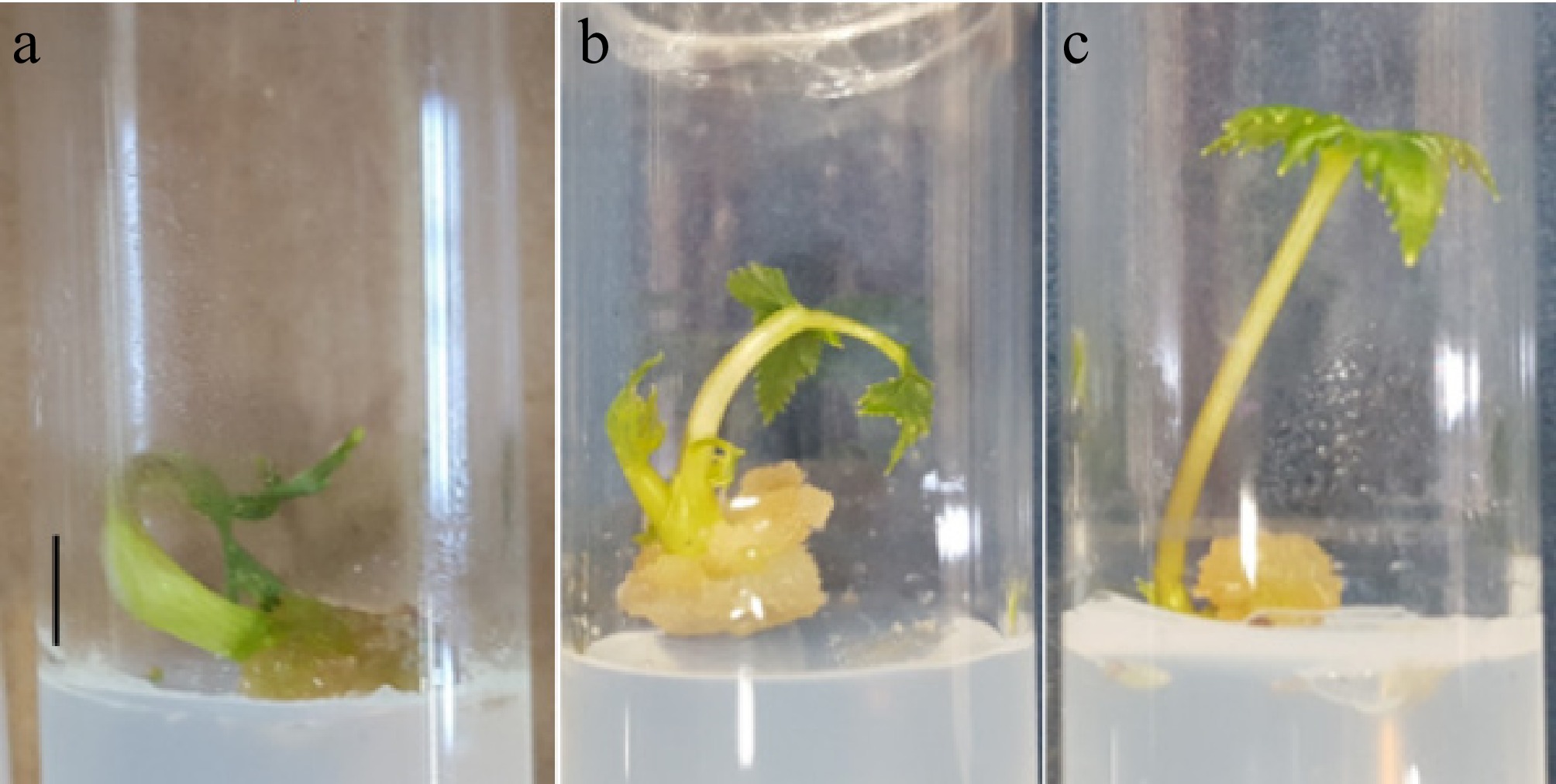
Figure 2.
Presence of callus at the base of arracacha (A. xanthorrhiza) seedlings obtained in vitro from shoot tips grown in B5 medium supplemented with 30 g·L−1 sucrose, 0.3 mg·L−1 BAP, and 0.1 mg·L−1 NAA. (a) Callus on a seedling of ASA. (b) Callus on a seedling of 'BRS Catarina 64'. (c) Callus on a seedling of 'BRS Rubia 41'. Bar = 1 cm.
-

Figure 3.
Arracacha (A. xanthorrhiza) plants rooted and hardened in vitro under the different treatments. (a) Treatment 1: B5 + parafilm; (b) Treatment 2: B5 + gauze; (c) Treatment 3: B5 + PVC; (d) T4: ½ B5 + parafilm; (e) Treatment 5: ½ B5 + gauze; (f) Treatment 6: ½ B5 + PVC.
-
Culture media Shoot regeneration (%) B5 with no PGR 81.67a B5 + 0.2 mg L−1 BAP + 0.01 mg L−1 NAA 61.67b B5 + 0.3 mg L−1 BAP + 0.1 mg L−1 NAA 65.00ab Means followed by the same letter do not differ from each other by the Tukey test at 5% significance. Table 1.
Average shoot regeneration rate of apical buds of arracacha grown on different culture media at 14 DAI.
-
Cultivars Shoot regeneration (%) 'BRS Rubia 41' 58.33ab 'BRS Acarijó 56' 71.67a ASA 43.33b Means followed by the same letter do not differ from each other by the Tukey test at 5% significance. Table 2.
Average values of shoot regeneration rate of apical buds of arracacha of the cultivars at 21 DAI.
-
SV Mean square DF Regeneration rate Number of shoots Number of leaves Callus (%) Cultivar 2 101.6292ns 0.1337ns 0.1433ns 5056.4815* Photoperiod 2 15.1070ns 0.0181ns 0.4300ns 584.2593ns Cultivar × photoperiod 4 49.1237ns 0.0515ns 0.1433ns 547.2037ns Residue 18 83.4774 0.1285 0.1948 236.2222 Total 26 CV (%) 10.3 19.2 41.8 34.6 Overall average 88.6 1.8 1.1 44.4 SV, source of variation; DF, degrees of freedom; CV, coefficient of variation; ns, nonsignificant; *, significant at 5% probability. Table 3.
Summary of the ANOVA for the regeneration rate, number of shoots, number of leaves, number of roots, and percentage of callus in arracacha seedlings according to the combination of different cultivars and photoperiods.
-
SV Mean square DF Number of roots Length of roots Dose 1 5.67* 43.94* Charcoal 4 4.66* 10.60* Dose × charcoal 4 3.87* 2.86* Residue 60 2.43 1.10 CV (%) 28.06 27.11 * Significant at 5% probability of error by the F-test. Table 4.
Summary of the ANOVA for the number of roots and the length of roots as a function of doses of IBA with and without the addition of activated charcoal, in culture media for in vitro cultivation of the A. xanthorrhiza cultivar 'BRS Rubia 41'.
-
Treatment Presence of callus (%) Absence of activated charcoal + 0 mg·L−1 IBA 0b Absence of activated charcoal + 3 mg·L−1 IBA 0b Absence of activated charcoal + 6 mg·L−1 IBA 0b Absence of activated charcoal + 9 mg·L−1 IBA 100a Absence of activated charcoal + 12 mg·L−1 IBA 100a Presence of activated charcoal + 0 mg·L−1 IBA 0b Presence of activated charcoal + 3 mg·L−1 IBA 0b Presence of activated charcoal + 6 mg·L−1 IBA 0b Presence of activated charcoal + 9 mg·L−1 IBA 0b Presence of activated charcoal + 12 mg·L−1 IBA 0b CV (%) 21 Means followed by different letters, ranked by the nonparametric Kruskal–Wallis test, differ from each other at a 5% probability level. Table 5.
Percentage of callus versus the presence or absence of activated charcoal as a function of different doses of IBA in the in vitro cultivation of A. xanthorrhiza cultivar 'BRS Rubia 41'.
-
Treatments Length of the largest root (cm) Number of roots Number of shoots Plant height (cm) Petiole length (cm) Treatment 1: B5 + parafilm 1.64c 2.54ab 2.35bc 5.05b 4.30a Treatment 2: B5 + gauze 0.40d 0.35b 1.86d 0.00d 2.15c Treatment 3: B5 + PVC 3.20ab 6.33ab 2.24a 5.30b 3.95b Treatment 4: ½ B5 + parafilm 1.84bc 2.01a 2.72c 6.15a 4.45a Treatment 5: ½ B5 + gauze 1.48cd 2.96b 1.78bc 3.50c 2.55c Treatment 6: ½ B5 + PVC 4.67a 3.98ab 2.20ab 9.25a 4.45a Means followed by the same letter in the column do not differ from each other by the Tukey test at 5% significance. Table 6.
Average values of the different treatments for traits, including length of the largest root, number of roots, number of shoots, plant height, and petiole length, for the variables evaluated in vitro.
-
Treatments Length of the largest root (cm) Number of roots Number of leaves Plant height (cm) Petiole length (cm) Treatment 1: B5 + parafilm 6.60b 6.30a 2.30c 15.32b 7.87b Treatment 2: B5 + gauze 9.30a 4.15c 2.00c 15.96b 7.71b Treatment 3: B5 + PVC 10.20a 7.85a 3.00b 22.55a 11.81a Treatment 4: ½ B5 + parafilm 6.50b 5.70b 2.60c 16.005b 8.78b Treatement 5: ½ B5 + gauze 6.20b 5.90b 2.30c 13.98b 7.77b Treatment 6: ½ B5 + PVC 11.90a 6.50a 4.50a 23.015a 11.68a Means followed by the same lowercase letter in the column do not differ from each other according to the Tukey test at 5% significance. Table 7.
Average values of the treatments for length of the largest root, number of roots, number of shoots, plant height, and petiole length for the variables evaluated ex vitro.
Figures
(3)
Tables
(7)