-
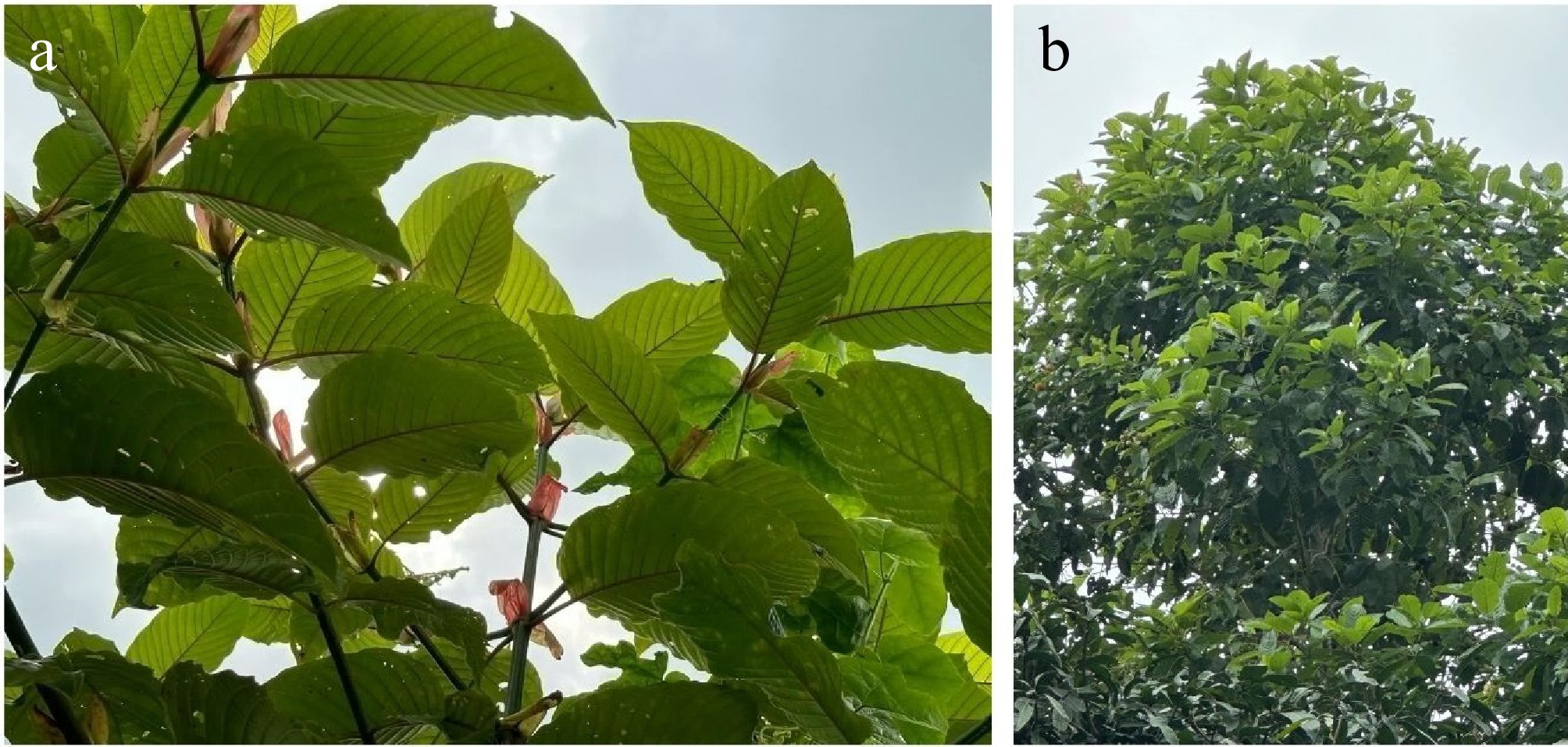
Figure 1.
Tree characteristics of Mitragyna spp. found in southern of Thailand. (a) Close-up view of the leaves showing large, ovate shape and prominent venation. (b) Full grown tree illustrating the overall growth habit.
-
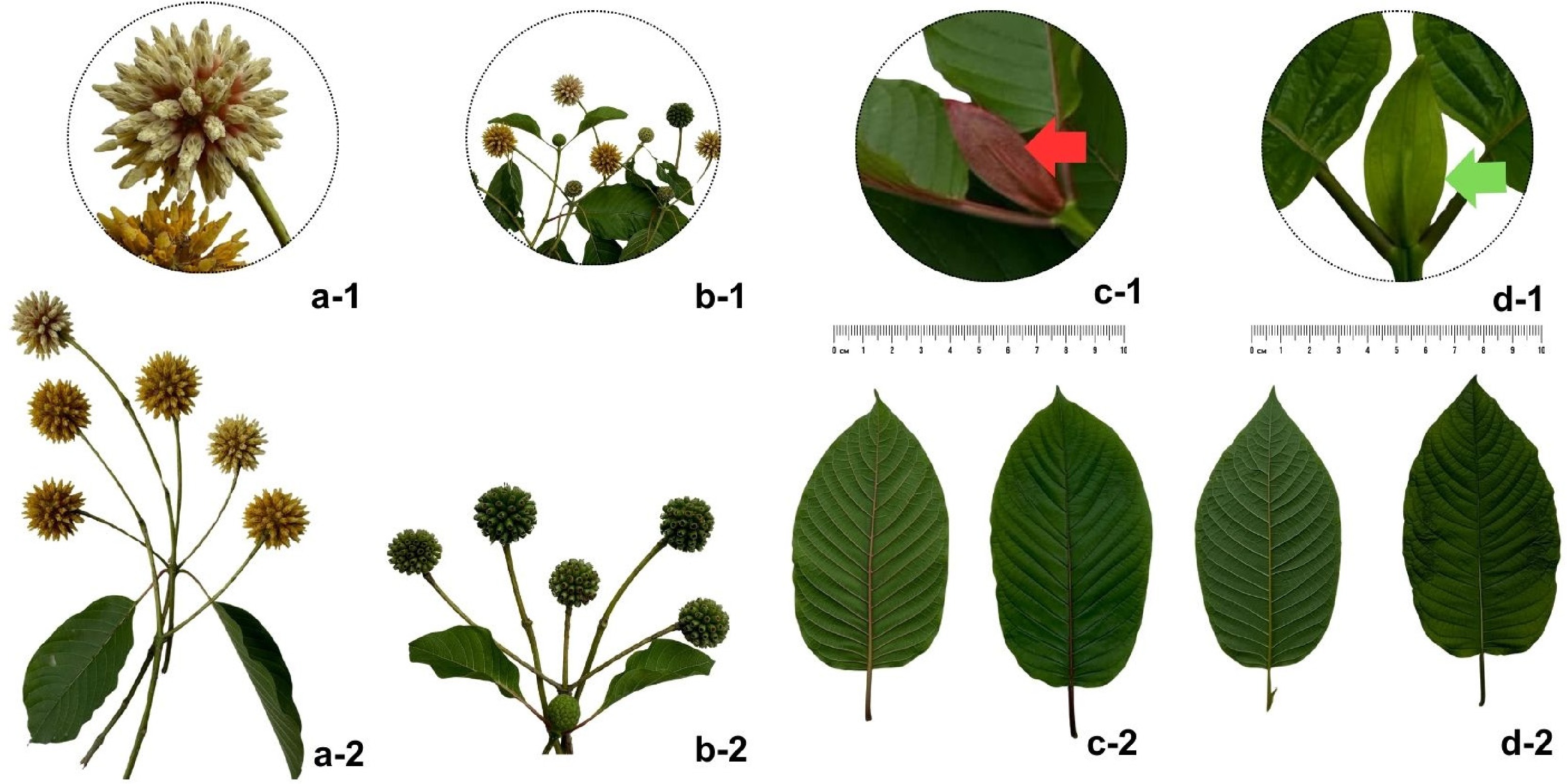
Figure 2.
Kratom's floral and leaf structures exhibit key taxonomical characteristics. Notably, both (2a) male and (2b) female flowers are present on (2b-1) the same branch, indicating a monoecious reproductive system. The dark green leaves are characterized by prominent pinnate venation, where the veins branch off (2c, 2d) a central midrib. This venation can display a variety of colors, including green, white, or red. A primary classification method for kratom varieties relies on the mid-vein color: 'red vein' varieties display colors from (2c-1) orange, red, to pink, while (2c-2) 'green vein' varieties typically exhibit mid-vein hues ranging from yellow to green.
-
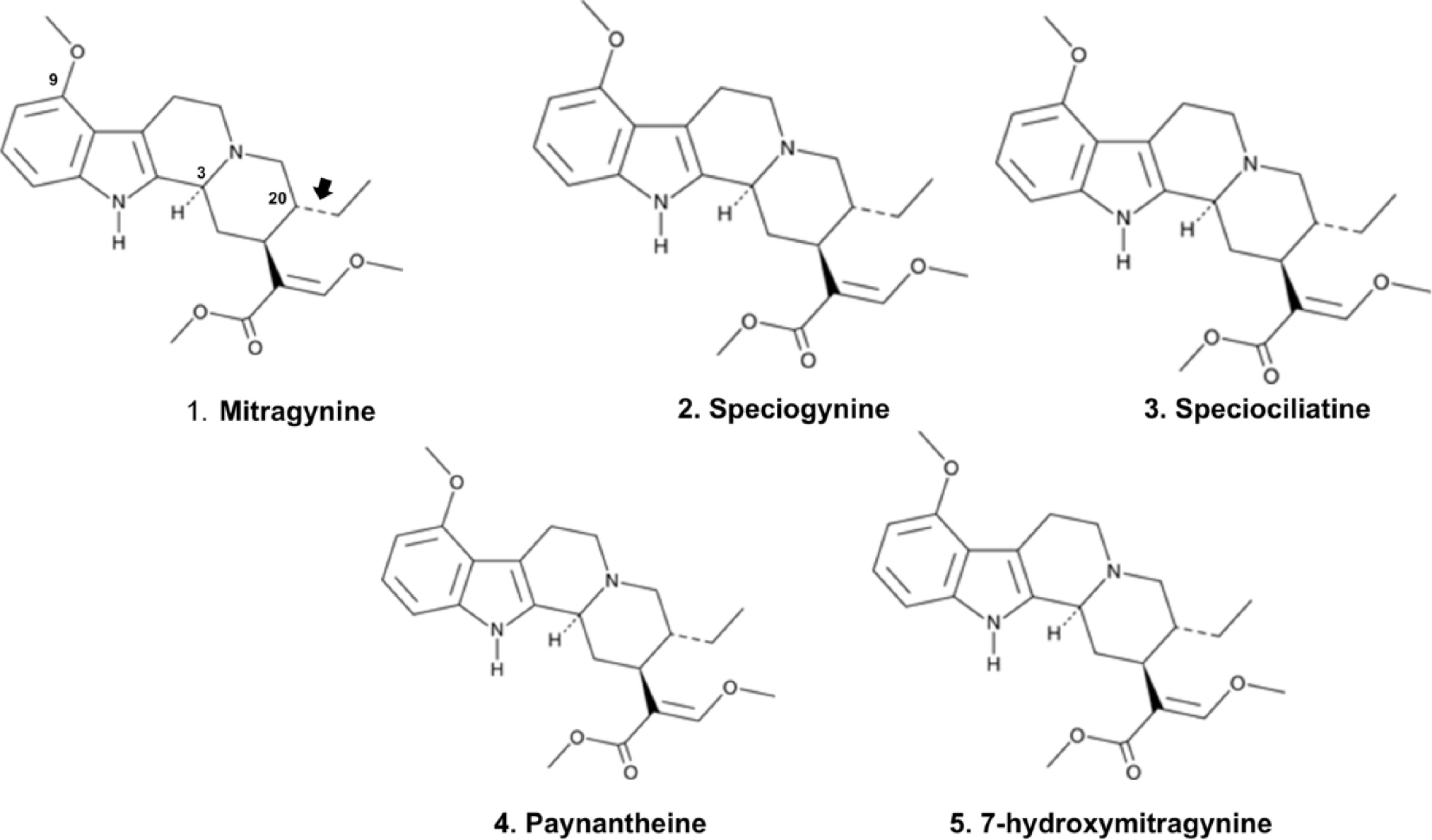
Figure 3.
Chemical structures of the major indole alkaloids isolated from Mitragyna spp., including Mitragynine, Speciogynine, Speciociliatine, Paynantheine, and 7-Hydroxymitragynine.
-
Country Common name Thailand Ithang, Thom, Bai Kratom, Gratom, Kakaum, Katawn, Krathawn, Kratom, Kraton, Katawan, Kratawm, Tawn India Kaim, Guri, Nira Kadamba, Sanna Kadamba, Kayim, Kalam, Vitanah, Kathamamaram, Nichulam Malaysia Biak, Biak-Biak, Ketum, Kutum, Pokok Biak, Pokok Ketum, Sepay Myanmar Beinsa, Bein-Sa-Yawt Lao Nytum Vietnam Giam Indonesia Kadamba, Puri, Keton The Philippines Mambog, Lugub, Polaapupot References: [1,3,14,15]. Table 1.
The common names known for Mitragyna spp.
-
Thai medicinal formula Method of preparation Treatments ยาประกระท่อม (Yā pra krath̀xm) Kratom leaves, combined with other herbs, are the primary ingredient in a decoction prepared with spirits. Reduce pain and stomach cramps Opium withdrawal Combine cannabis with other herbs and boil. Consume the resulting liquid as a tea. ยาหนุมานจองถนนปิดมหาสมุทร (Yā h̄numān cxng t̄hnn pid mh̄ās̄muthr) Dried leaves, ground and combined with other herbs, may be dissolved in drinking water. Relieve severe diarrhea Cramp treatments A decoction prepared with spirit and administered concurrently with opium or boil with opium and other ingredients and patchouli. Reduce menstrual and pregnancy cramps ยาประสะกาฬแดง (Yā pras̄a kāḷ dæng) Mix with spices and ground. Relieve severe diarrhea ยาเหลืองกระท่อม (Yā h̄elụ̄xng krath̀xm) Grind the leaves and other tropical herbs with lime juice and vinegar. Reduce cramps and measles Table 2.
Traditional Thai medicinal recipes using kratom.
-
NTD/condition Targeted Mitragyna species Bioactive constituent/preparation Molecular target or mechanism Therapeutic significance and outcome Malaria M. speciosa (kratom); M. inermis Silver nanoparticles (AgNPs); Crude extracts Nanoparticle stability: AgNPs inhibit parasite growth. Host Modulation: Mechanism for survival extension remains unknown (no clearance). High potential (nano): AgNPs showed potent activity (IC50 < 5 μg/mL). Low potential (extract): Failed to clear parasites. Trypanosomiasis (sleeping sickness) M. ciliata Root extracts (indole alkaloids) Enzymatic/Ca2+ modulation: Affects hepatic enzymes, oxidative stress, and calcium homeostasis in hosts. High efficacy (in vivo): Demonstrated ~76% suppressive activity and 54.24% therapeutic efficacy in models. Leishmaniasis M. inermis; M. speciosa (derivatives) Stem bark and leaf extracts; Synthetic indolo[2,3-a]quinolizidine Antiparasitic action: Direct inhibition of Leishmania donovani. Structural Scaffolds: Synthetic derivatives target parasite viability. Promising lead: Significant inhibitory effects; synthetic scaffolds identified for drug discovery. Dengue fever (vector control) M. speciosa (kratom) Leaf extracts Larvicidal: Toxicity to Aedes aegypti larvae. Repellent: Sensory deterrence against Aedes albopictus. Low viability: Larvicidal activity required impractical concentrations (20 mg/mL); repellent effect lasted < 5 min. Lymphatic filariasis M. parvifolia; M. stipulosa Leaf extracts Macrofilaricidal: Inhibits worm motility and suppresses metabolic function of adult worms. High potential (in vitro): Significant activity against adult worms; no current data for M. speciosa. Schistosomiasis M. stipulosa; M. inermis Bark extracts Ethnomedicinal: Traditional remedy for 'bilharziasis' (parasitic flatworms). Ethnobotanical: Historically used; specific molecular targets require further validation. NTD symptom management (fever/pain) M. speciosa (kratom) Mitragynine; 7-Hydroxymitragynine COX-2 pathway: Downregulates COX-2 mRNA; inhibits PGE2. Opioid receptors: Agonist activity at $\mu $ Supportive therapy: Validated mechanism for managing pain/inflammation in infections (e.g., dengue). Table 3.
Pharmacological mapping of Mitragyna species against neglected tropical diseases (NTDs).
Figures
(3)
Tables
(3)