-
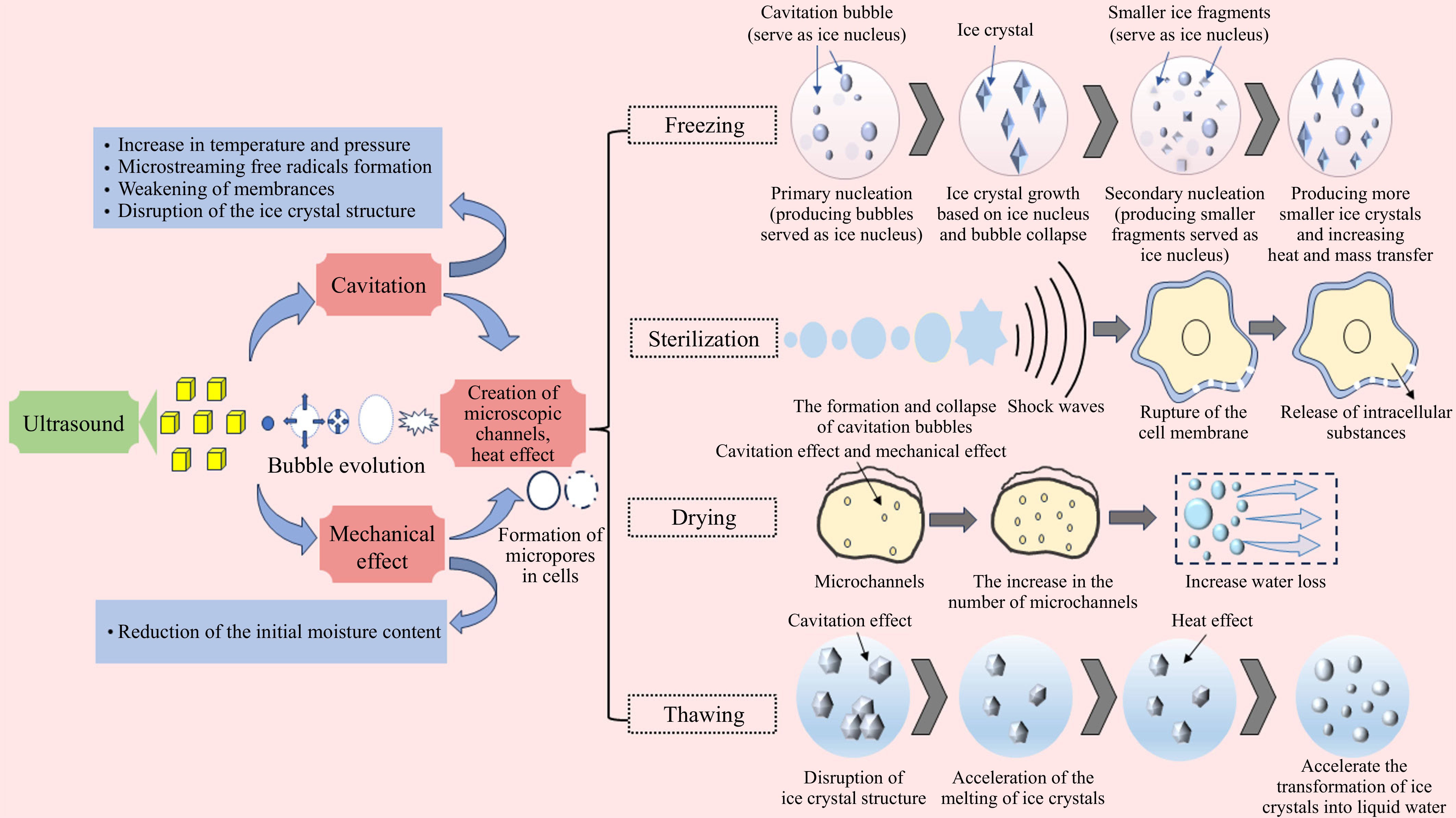
Figure 1.
Possible mechanisms of ultrasonic-assisted processing of berries.
-
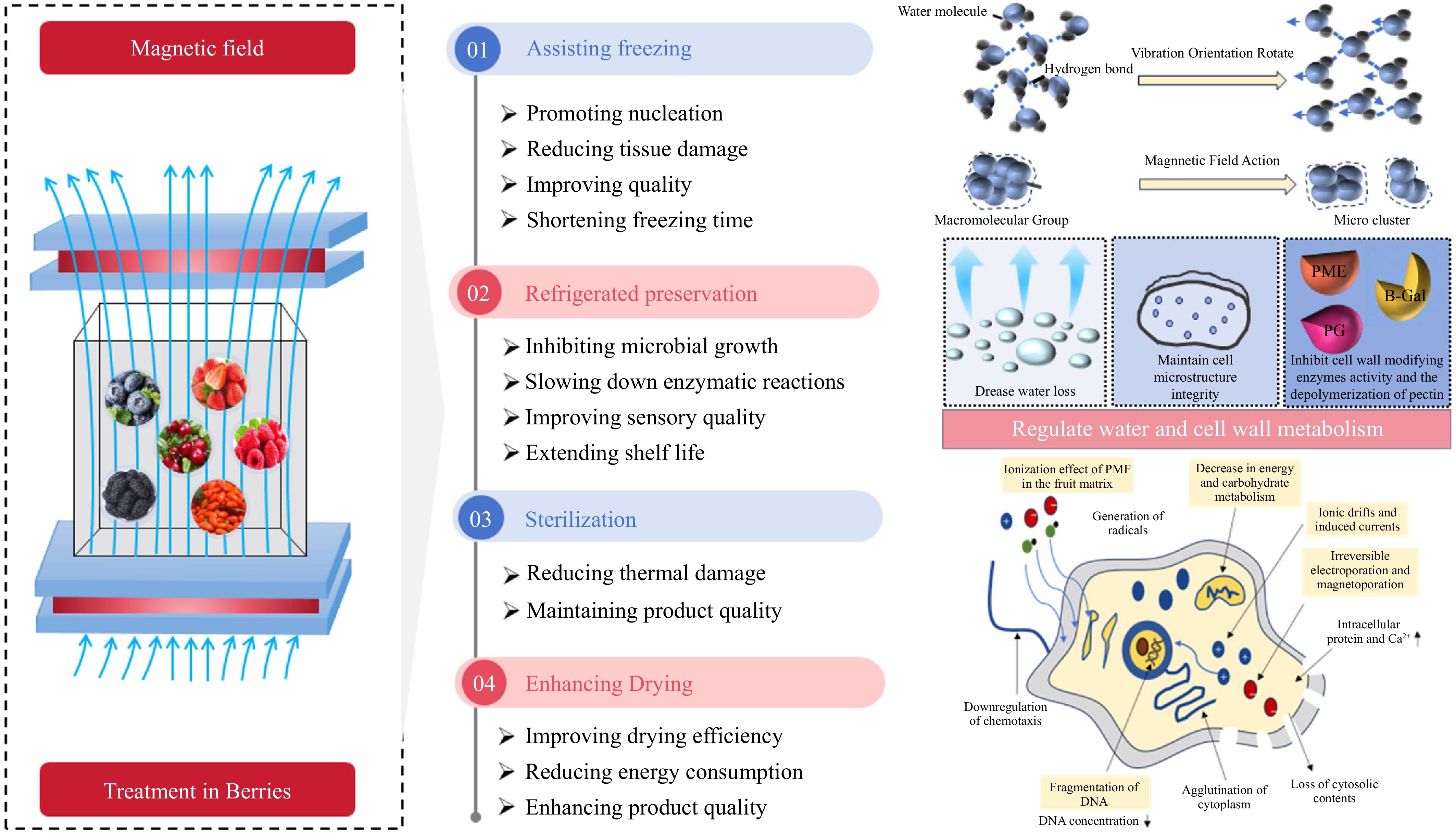
Figure 2.
Possible mechanisms of magnetic field-assisted processing of berries.
-
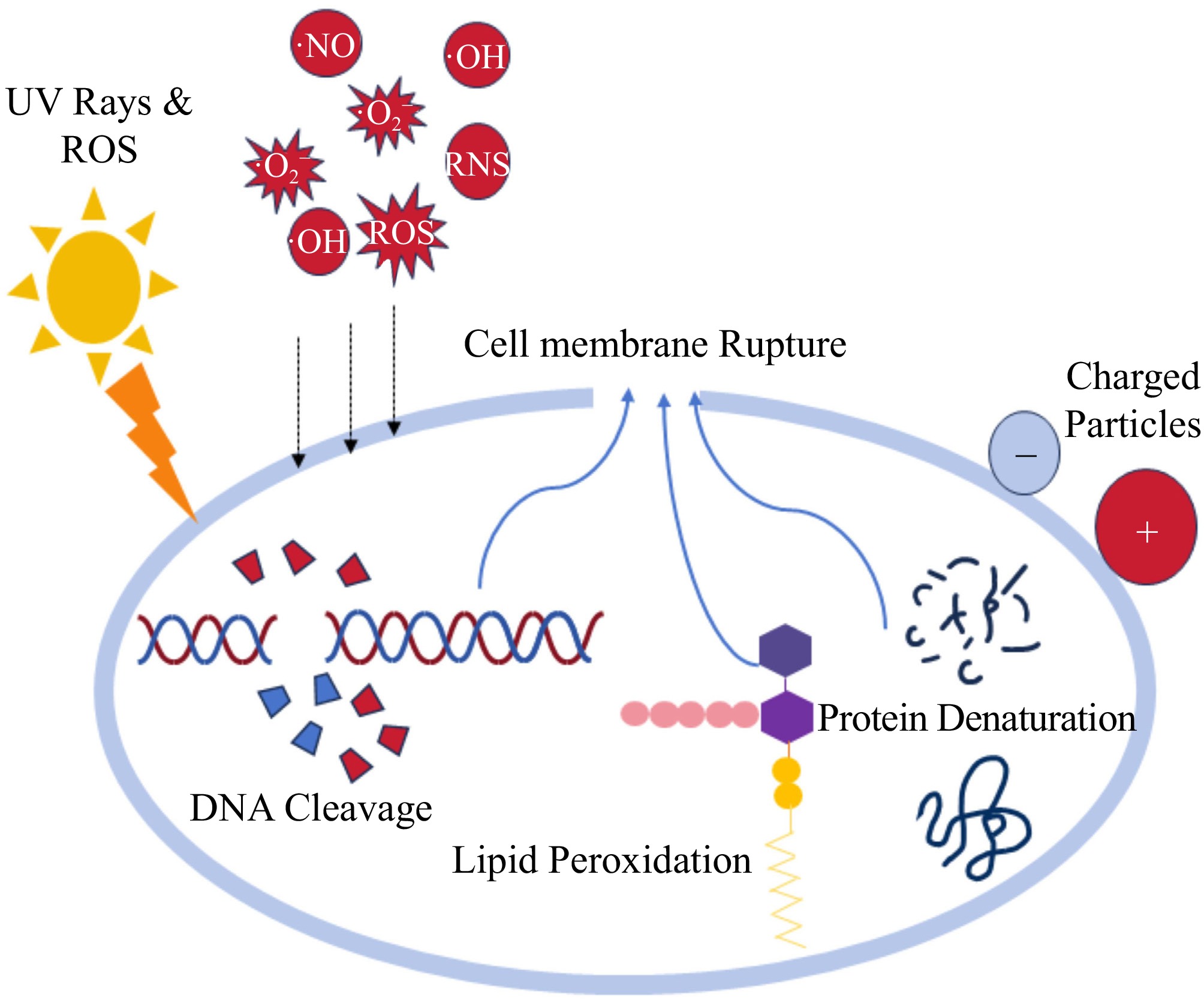
Figure 3.
Schematic diagram of the mechanism of bacterial inactivation by cold plasma[76].
-
Processing technology Berry species Processing method Processing conditions Key findings Ref. Microwave Blackcurrant Drying MVD: 120–480 W; CD: 50–90°C Drying time to 32 min. [41] Electric field Blueberry Drying 10, 20, and 30 kV/cm;
10, 20, and 30 sDrying time is reduced by at least 30%. [38] Microwave Cranberry Drying HACD: 80 °C; 1.5 m/s MWVD: 150 W; 5 ± 1 kPa; 6 rpm The combined MWVD and HACD increased total polyphenol, total flavonoid, and anthocyanin contents by approximately 13.7%–24.2%, 7.3%–25.1%, and up to 44.2%, respectively. The antioxidant activity was enhanced by approximately 8.4%–35.8% [42] Microwave Strawberry Drying 500 ± 10 g; E = 1.0 kV/cm;
100 μs; 1 HzThe hardness decreased by 47.4% to 50.7%. [43] Electric field Strawberry Sterilization 35 kV/cm; 27 μs The anthocyanin content increased by 17%, and the shelf life was extended by at least 28 d. [44] Electric field Blueberry Sterilization 2 kV/cm, 1 μs, and 100 pulses per s; 2, 4, 6 min The production of natural microbial communities, Escherichia coli, and Listeria decreased by 2 to 3 orders of magnitude, while anthocyanins and phenolic compounds increased by 10% and 25% respectively. [45] Electric field Strawberry Sterilization HVEF: 15, 30, 45 kV
SMF: 2, 5, 8 mTThe moldiness rate decreased by more than 50%, the activity of antifungal compounds and related enzymes increased, and the lignin content increased by 72.4%. Shelf life was extended from 6 d to 12 d. [46] Magnetic field Blueberry Freezing 4 °C/min; PMF: –30 °C; 0–10 mT AMF: 0–1.74 mT PMF (10 mT) and AMF (0.05 mT, 50 Hz) reducing average ice crystal size by 33.6% and 53.8%, respectively. [47] Magnetic field Blueberry Freezing 36.8 mT/30–120 Hz; 44.7 mT/30–120 Hz, –35 ± 1 °C Blueberries treated at 44.7 mT and 90 Hz formed smaller ice crystals, thereby effectively preserving cellular structure. Compared with conventional freezing, this treatment increased the retention of anthocyanins and total polyphenols by approximately 12%–18% and 10%–15%, respectively, the antioxidant capacity (DPPH and ABTS assays) was enhanced by approximately 15%–25%, while the activities of PPO and POD were reduced by about 20%–30% and 18%–28%, respectively [48] Magnetic field Blueberry Freezing −20 °C; 0, 2.5, 5.0, 7.5, 10 mT The storage time is extended to 35 d. [49] Electric field Magnetic field Strawberry Freezing MF: 40 kV, 20 °C, 30 min
EF: 10 mTPhase transition time shortened by 27.65%, total freezing time reduced by 21.8%, and average freezing rate increased by 26.9%; accordingly, hardness rose by 19.3%, leakage loss dropped by 32.0%, total anthocyanin content increased by 14.8%, and total ascorbic acid content by 10.2%. The area of the ice crystals has decreased by 26.5%. [50] Magnetic field Blueberry Thawing MAT, MWT: 10 mT; 25 °C. Core temperature reaches 4 °C MATand MWT can reduce thawing time by 15% and 34%, while reducing drip loss by 16% and 28%, respectively [51] Magnetic field Blueberry Thawing MAT, MWT: 10 mT; 25 °C. Core temperature reaches 4 °C MAT and MWT significantly reduced total soluble solids loss (only 11.15% decrease in the MAT group). [52] Magnetic field Blueberry Thawing 100 g; 500 W; Core temperature reaches 4 °C The number of individual anthocyanins detected is the highest
(11 types), with the total anthocyanin content being the highest (62.45 mg/100 g), the total phenol content being 2.27 mg/g, and the antioxidant capacity (46.88 μmol/g) being the highest; the PPO enzyme content (105.99 u/g.min) is the lowest.[53] Magnetic field Blueberry Refrigeration 15 d; 0, 2, 4, 6, 8 mT; 4 °C The total number of microorganisms decreased by approximately 0.90 log CFU/g; the hardness increased by 2.0–3.3 times, weight loss rate decreased by 25%–64%, the soluble solids content increased by 7.5%-14.4%, the glucose content increased by 54%–69%, the key flavor substances, short-chain esters (in the 6 mT group), increased by 10.6 times, C6 aldehydes (in the 4 mT group), increased by 13.9–15.1 times, while inhibiting the formation of odors such as styrene. [54] Magnetic field Strawberry Refrigeration 0, 5 mT; 0, 3, 6, 9, 12, 15 d After 15 d of storage, hardness loss decreased by 55.76%, weight loss rate dropped by 57.14%, color loss reduced by 41.12%, and free water content increased by 17.93%; cell wall matrix loss decreased by 17.76%, water-soluble pectin content decreased by 12.82%, and cellulose loss decreased by 10.83%; simultaneously, it suppressed the expression of FaPG, FaPME, FaPL, and FaEG genes by 23.28%, 36.31%, 14.97%, and 10.84%, respectively. [55] Magnetic field Strawberry Refrigeration 80 J/pulse,12.5 mT, 3 Hz, 5 min The shelf life has been extended by 1.5 d. [56] Note: MVD, Microwave vacuum drying; CD, Convective drying; HACD: Hot air convective drying; MWVD: Microwave vacuum drying; HVEF: High voltage electrostatic field; SMF: Static magnetic field; PMF: Permanent magnetic field; AMF: Alternating magnetic field; MF: Magnetic field freezing; EF: Electric field freezing; RH: Relative Humidity; MAT: Magnetic field-assisted air thawing; MWT: Magnetic field-assisted water immersion thawing; PPO: Polyphenol oxidase; POD: Peroxidase. Table 1.
Application of electromagnetic field technology in berry processing.
-
Berry species Processing method Processing conditions Key findings Ref. Blueberry Sterilization 300 MPa, 1 min Anthocyanin content increased by 15%, shelf life extended by at least 42 d, and at the end of storage, the TMAC was 1.7 ± 0.0 log CFU/mL (p > 0.05), YM count was 1.97 ± 0.1 log CFU/mL. Both values fell below acceptable upper limits (TAMC 4-log CFU/mL, YM 3-log CFU/mL). [44] Aronia melanocarpa Sterilization 500 MPa; 10 min; 25 °C It effectively inactivates microorganisms, preserves color and antioxidant capacity, reduces browning index, and elevates total anthocyanin, polyphenol, and flavonoid contents. [63] Hawthorn berry Sterilization 400, 500, 600 MPa;
10, 15, 20 min;
25, 35, 45 °CThe total colony count decreased from 1,700 CFU/mL to 40 CFU/mL. The gallic acid content reached 11.26 mg per 100 mL of sea buckthorn pulp, with a retention rate of approximately 88.08%. [64] Strawberry Drying 50, 100, 150, 200, and 250 MPa Drying time was reduced by 9%–24%. [65] Strawberry Drying HPP: 100 MPa; 5 min
US: 25 minThe hardness was 707.28 g, the a* value was 31.01, the anthocyanin content was 304.39 mg/kg, the total phenol content was 11.60 mg/100 g, and the flavonoid content was 221.41 mg/100 g. [66] Blueberry Refrigeration 600 MPa; 42 °C; 5 min; 4 °C; 56 d The ascorbic acid loss rate was 31%. [67] Strawberry Refrigeration 300–500 MPa;
store temperature: between 0 and 50 °C for 1, 5, or 15 min; 6 °CThe microbiological shelf life of fruit puree stored at 50 °C under 500 MPa for 15 min is 12 weeks when refrigerated (6 °C). [68] Strawberry Freezing 200 and 600 MPa; 5 min, 15 min The inactivation rate of polyphenol oxidase in strawberries can reach 82% at 600 MPa. [69] Strawberry Thawing 600 MPa; 25, 50 °C; 15 min The absorption of sucrose increased by 21% in strawberry slices and by 140% in whole fruit, reaching maximum contents of 45.6 ± 2.4 °Brix and 34.7 ± 0.9 °Brix, respectively. [70] Strawberry Thawing 200 MPa The hardness of the strawberries was 1/3 higher than that of the conventional thawing group. [71] TMAC: total aerobic microbial count; YM: yeast and mold; HPP: high pressure processing; US: ultrasound. Table 2.
Application of pressure field technology in berry processing.
Figures
(3)
Tables
(2)