-
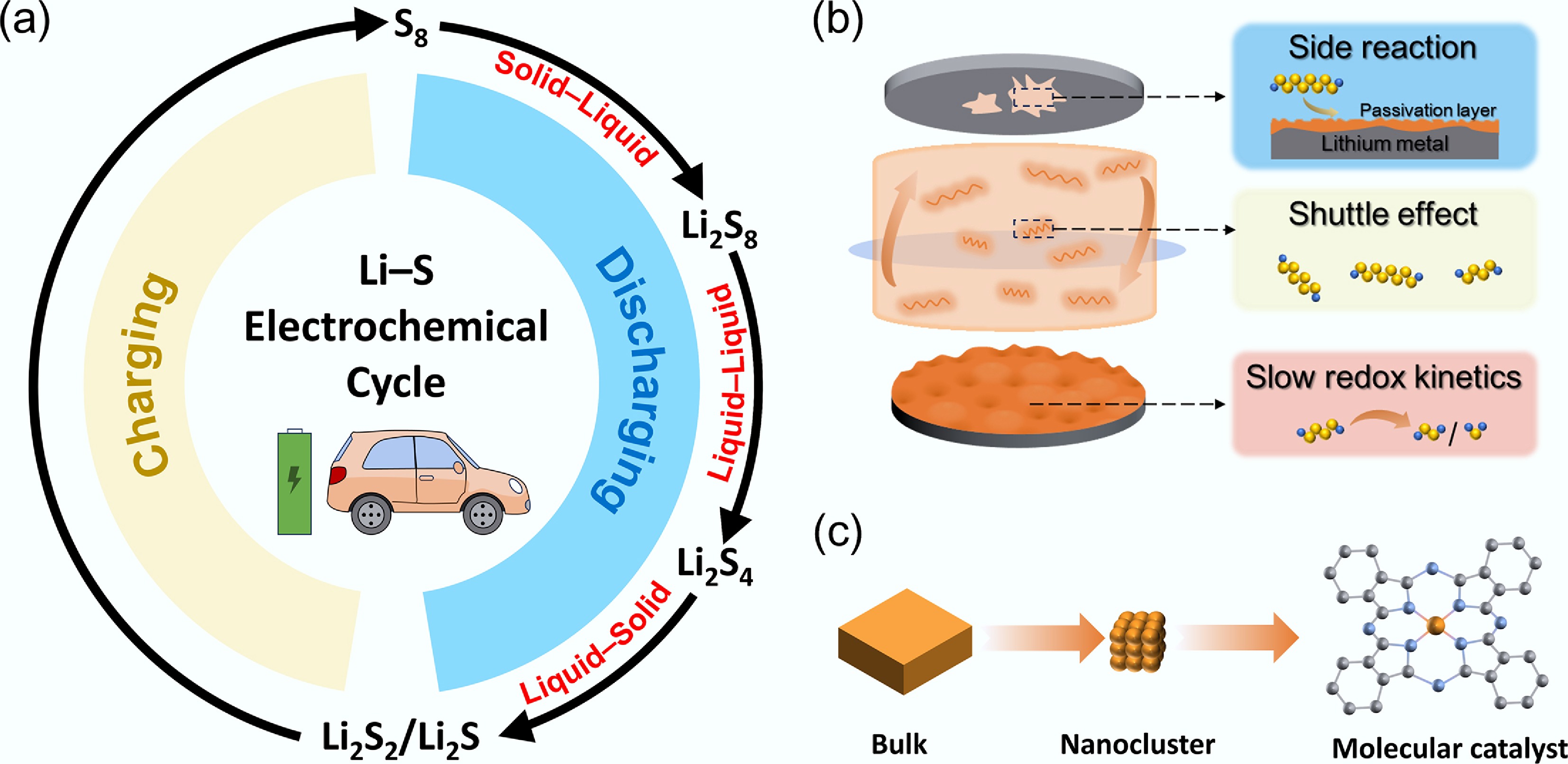
Figure 1.
(a) Electrochemical cycling process of Li–S batteries; (b) challenges of Li–S batteries; (c) the evolution from bulk materials to molecular catalysts.
-
-
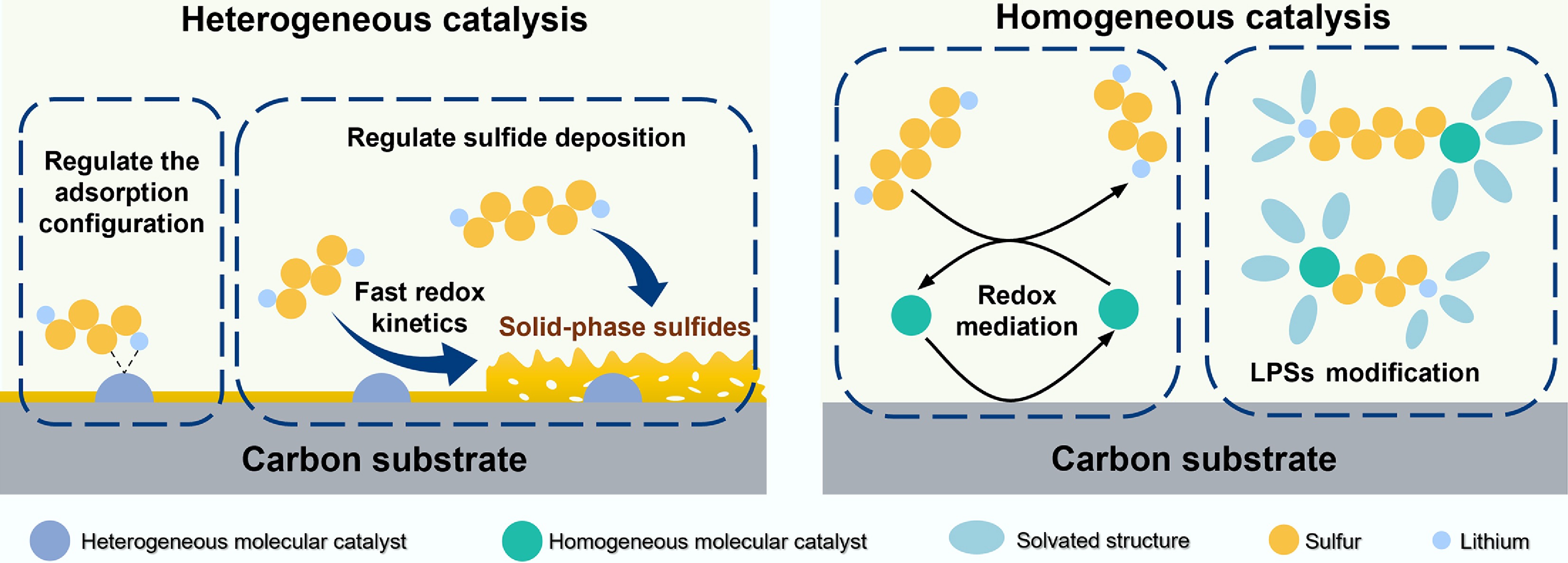
Figure 3.
Homogeneous and heterogeneous molecular catalytic roles in Li–S batteries.
-
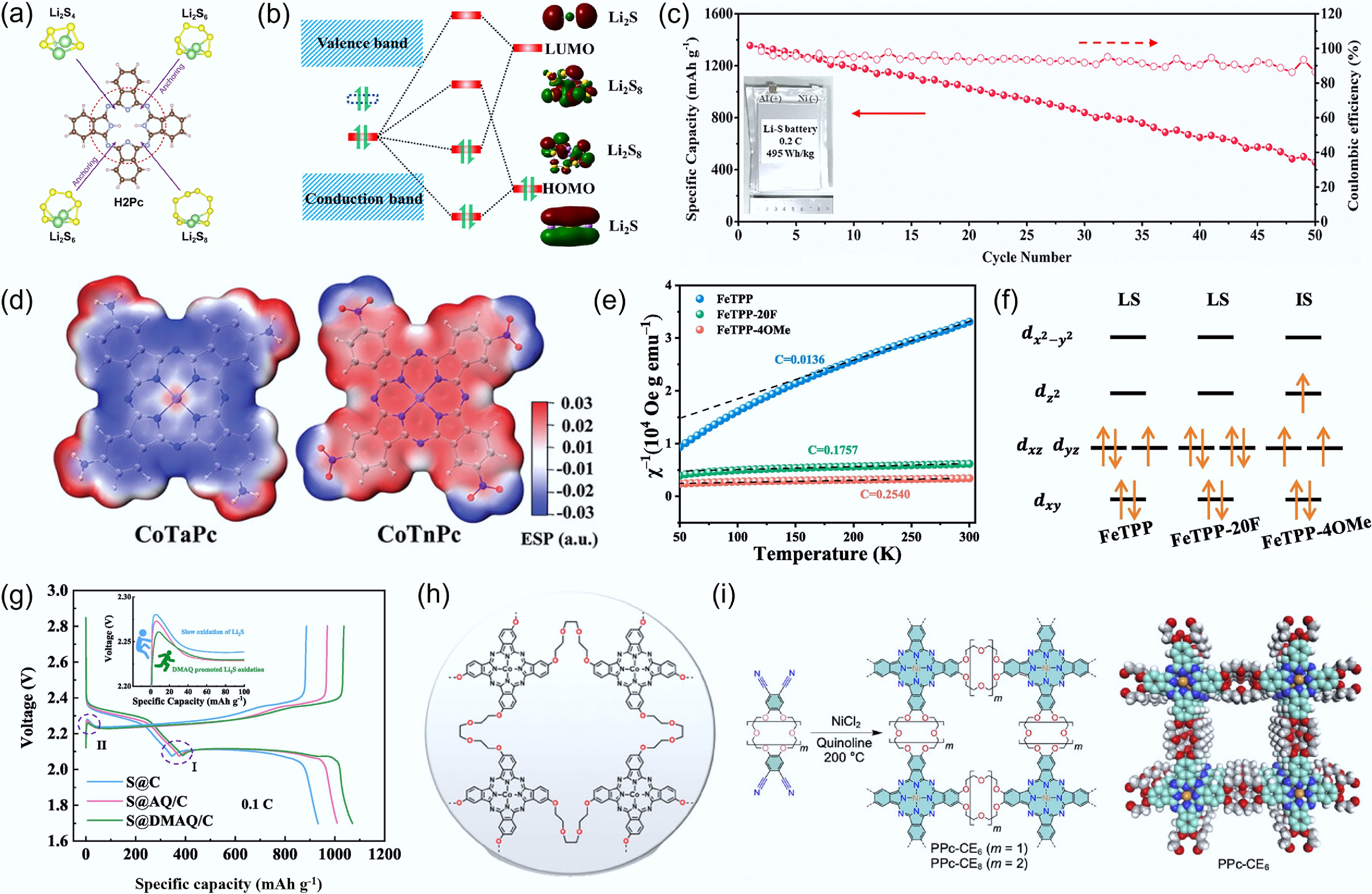
Figure 4.
(a) Anchoring effect of H2Pc on LPSs. Reproduced with permission[31]. Copyright 2019, Elsevier. (b) Fermi level shift induced by the introduction of In. Reproduced with permission[34]. Copyright 2023, John Wiley & Sons. (c) Cycling performance of pouch cells employing separators integrated with SAIn@CNT. Reproduced with permission[35]. Copyright 2023, RSC Publishing. (d) Electrostatic potential plots of CoTaPc and CoTnPc. Reproduced with permission[18]. Copyright 2023, John Wiley & Sons. (e) The temperature dependence inverse susceptibilities, and (f) electronic configurations of FeTPP, FeTPP-4OMe, FeTPP-20F. Reproduced with permission[36]. Copyright 2024, Elsevier. (g) Charge–discharge profiles of S@C, S@AQ/C, and S@DMAQ/C at 1 C. Reproduced with permission[37]. Copyright 2024, Elsevier. (h) Molecular structure of the PCT[38]. Copyright 2023, John Wiley & Sons. (i) Schematic illustration of the synthesis procedure of PPc-CE and the space-filling model of its repeating unit. Reproduced with permission[39]. Copyright 2025, John Wiley & Sons.
-
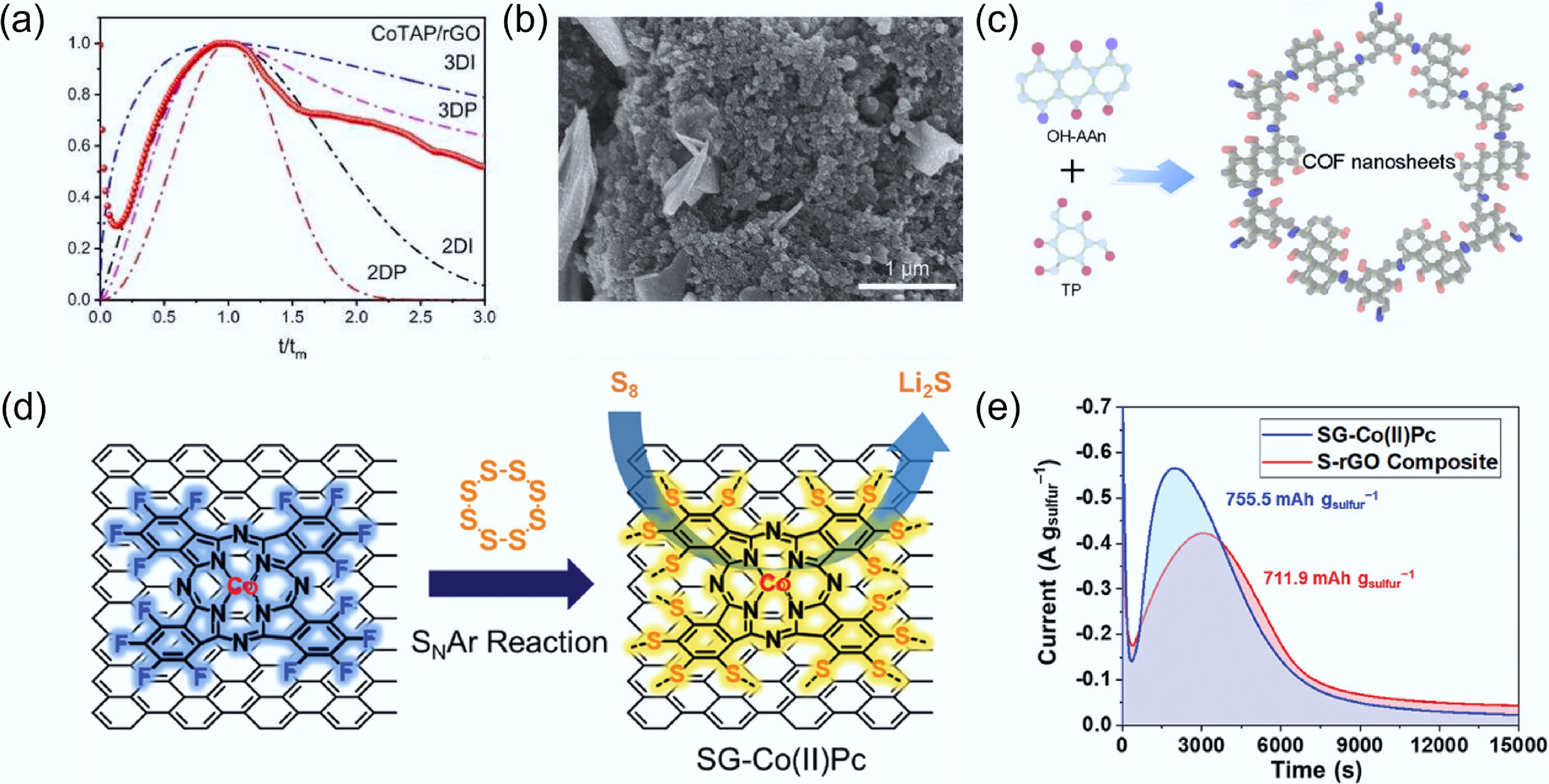
Figure 5.
(a) Comparison between the dimensionless current-time transient curves of the CoTAP/rGO separator and the theoretical model. (b) Final deposited Li2S morphology with the CoTAP/rGO-modified separator. Reproduced with permission[51]. Copyright 2024, Elsevier. (c) Schematic illustration of the OH-AAn-COF structure. Reproduced with permission[53]. Copyright 2025, John Wiley & Sons. (d) Nucleophilic substitution reaction between rGO/F-Co(II)Pc and S8. (e) Potentiostatic discharge curves using SG-Co(II)Pc and S-rGO. Reproduced with permission[54]. Copyright 2021, John Wiley & Sons.
-
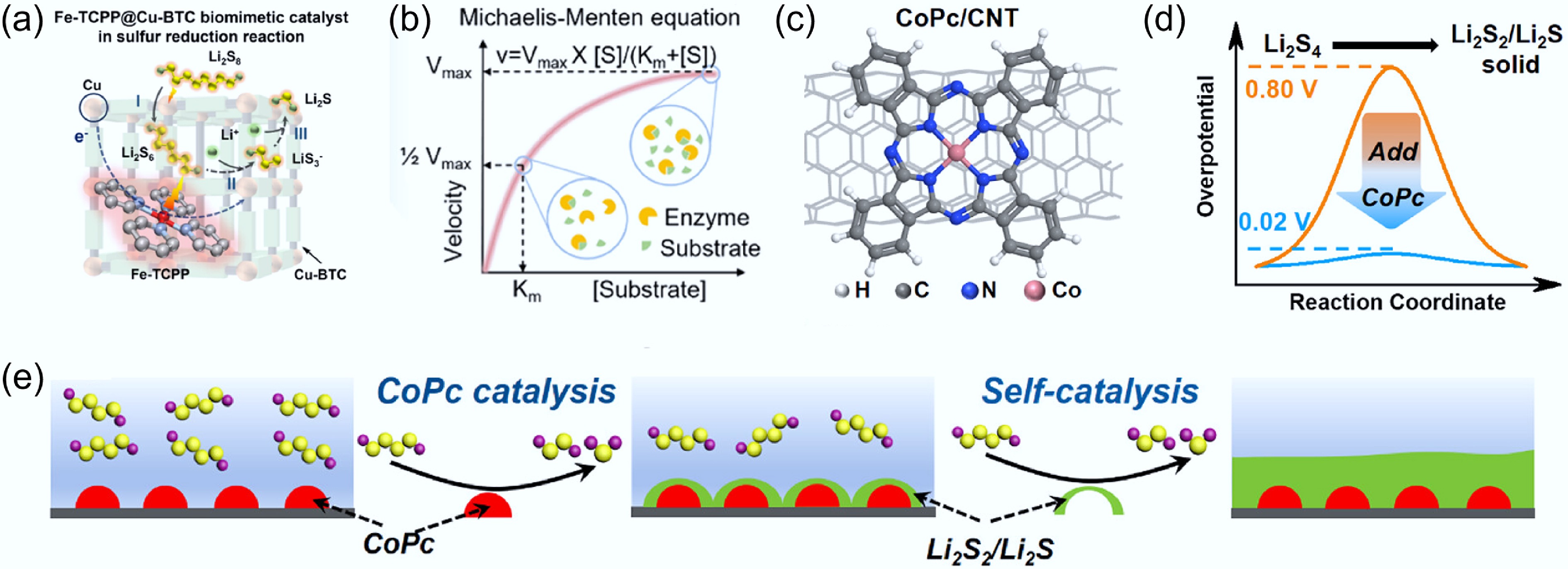
Figure 6.
(a) Pathway diagram for the catalytic conversion of LPSs by Fe-TCPP@Cu-BTC. (b) Schematic illustration of the Michaelis–Menten kinetics equation. Reproduced with permission[57]. Copyright 2025, American Chemical Society. (c) Molecular structure of the CoPc/CNT catalyst. (d) Reduction in reaction energy barrier upon CoPc incorporation. (e) Schematic illustration of solid sulfide deposition on CoPc/CNT. Reproduced with permission[17]. Copyright 2023, American Chemical Society.
-
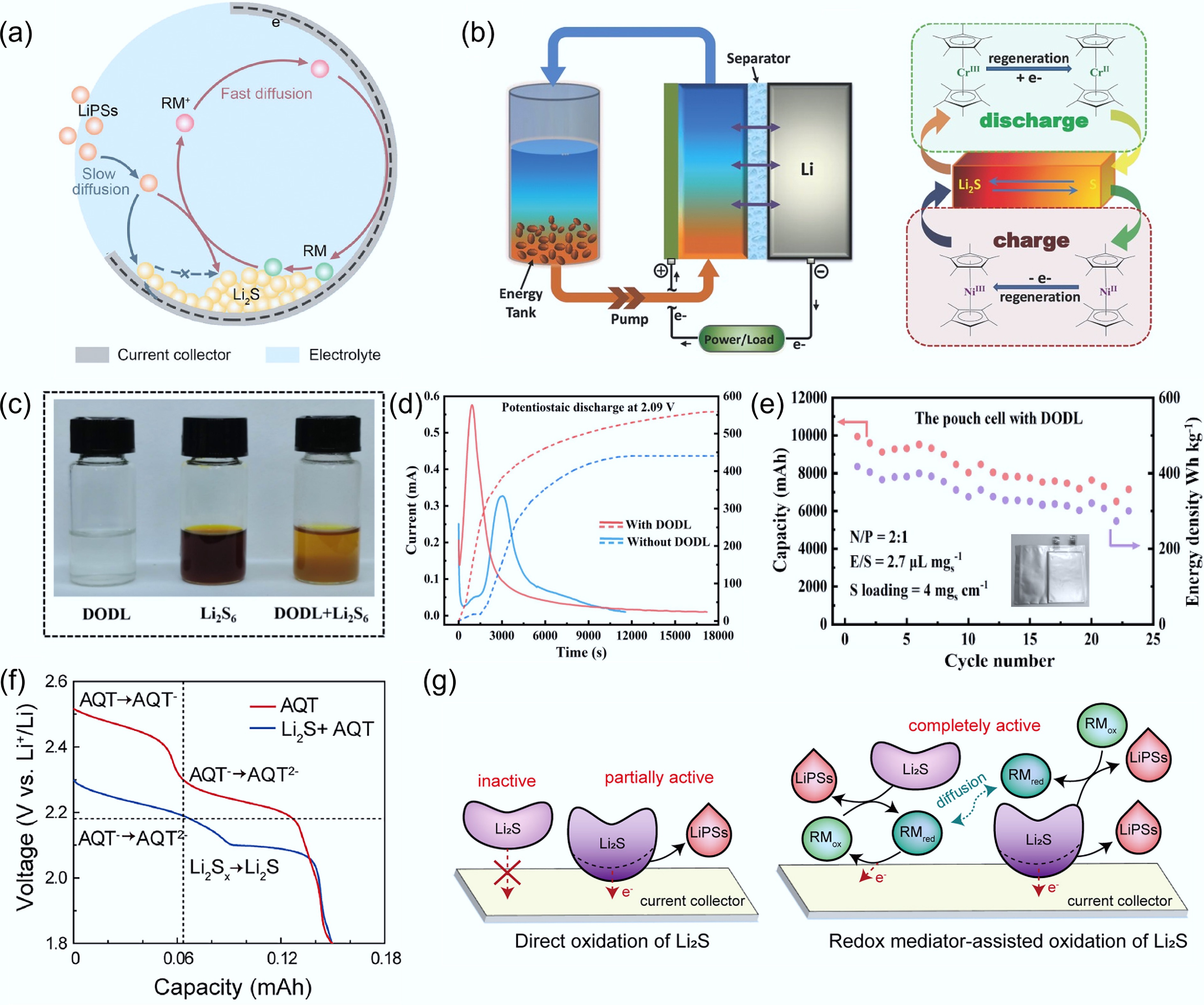
Figure 7.
(a) Schematic illustration of the Li2S nucleation pathway mediated by CoCp2. Reproduced with permission[60]. Copyright 2019, John Wiley & Sons. (b) Schematic illustration of redox reactions in a flow Li–S battery mediated by two metallocenes. Reproduced with permission[63]. Copyright 2015, John Wiley & Sons. (c) Color evolution of the Li2S6 solution after the addition of DODL. (d) Li2S nucleation chronoamperometry curves with, and without DODL addition. (e) Cycling performance of pouch cells with DODL at 0.2 C. Reproduced with permission[64]. Copyright 2022, Elsevier. (f) Discharge voltage profiles of a half-cell with a Li2S electrode and an AQT-containing electrolyte, and a half-cell containing only AQT without Li2S. (g) Schematic illustration of Li2S activation mediated by AQT as a redox mediator. Reproduced with permission[65]. Copyright 2019, Elsevier.
-
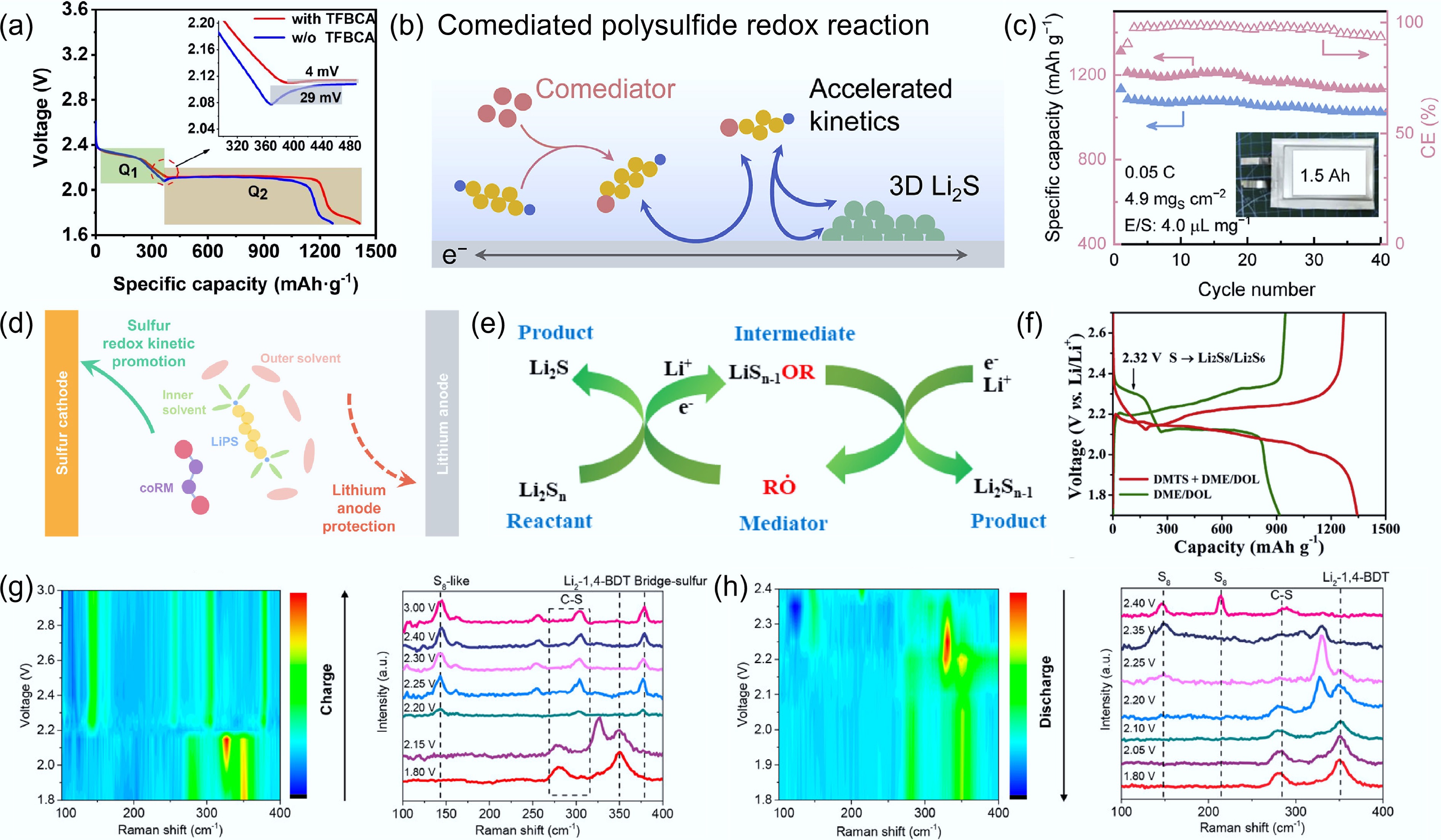
Figure 8.
(a) Charge–discharge curves at a rate of 0.2 C with, and without the incorporation of TFBCA. Reproduced with permission[66]. Copyright 2024, Elsevier. (b) Reaction equation between DtbDS and LPSs. (c) Cycling performance of Li–S pouch cells with the addition of DtbDS. Reproduced with permission[67]. Copyright 2020, Elsevier. (d) Schematic illustration of the mechanism of molecularly modified LPSs under weak solvation conditions. Reproduced with permission[68]. Copyright 2023, John Wiley & Sons. (e) Oxygen radical-mediated cyclic catalytic process. Reproduced with permission[69]. Copyright 2022, American Chemical Society. (f) Charge–discharge curves of Li–S batteries with DMTS-modified and conventional electrolytes. Reproduced with permission[70]. Copyright 2020, Elsevier. (g) In-situ Raman spectra during the initial charge, and (h) discharge processes of the Li–S battery containing 1,4-benzenedithiol (1,4-BDT). Reproduced with permission[71]. Copyright 2021, American Chemical Society.
-
Molecular catalyst Incorporation
locationSulfur loading
(mgS/cm2)Rate performance Cycle performance Ref. Rate (C) Capacity (mAh g−1) Cycle rate Cycle number Retention CoPc Cathode 4 0.12 About 800 − − [17] CoTnPc Cathode 5 0.5 940 0.5 100 84.8 [18] CoPc Cathode 6.6 5 667.9 0.2 200 81.5 [38] F-Co(II)Pc Cathode 12 5 302.2 0.5 700 70 [54] FePc Cathode 4 1.5 915 1 1,000 45 [78] FePc Cathode 9.2 4 600 1 1,500 47.5 [46] InPc Electrolyte 8 1 585.2 0.2 260 75.8 [79] Ni-PCTs Cathode 4.7 − − 0.02 400 48.6 [48] InPc Separator 10 2 854 0.5 450 50 [34] CuPc Electrolyte 3 4 560 0.5 150 82.1 [80] FePc@WS2 Separator 4 2 833.9 2 1,000 74 [81] Li2TaPc Separator 5 3 About 600 0.5 350 88.2 [82] CoPc Electrolyte 5 4 636 0.5 500 81.1 [83] CoTAP Separator 1 5 672.5 2 500 71.5 [51] FeTNPc@ACNT Separator 5.04 3 861.9 2 1,000 62.4 [32] Fe2-Pc Cathode − − − 1 400 62.8 [84] PPc-CE6 Cathode 6.63 2 688 1 100 85.2 [39] NiTnPc Separator 0.9 2 534 1 500 38.9 [85] FePcF16 Separator 1 5 624.9 2 300 87.63 [86] ZnPc@MXene Separator 1.2 1 806.9 1 500 70 [87] NiCuTnPc Separator 0.9 2 564.4 1 500 60.6 [88] TaPcNiCu Cathode 5.3 2 603.65 1 500 75.4 [89] CoPTpz/rGO Cathode 2.75 4 About 800 5 500 45 [90] G@ppy-por Cathode 5 4 649 2 50 95.2 [91] PCN-222(Cu)-NS Separator 5.7 3 718.3 1 500 77 [47] Al-CPP Separator 1 4 812 1 500 61 [92] Por(Co)-POP/GN Separator 4 2 About 830 1 1,000 54 [93] Mn-COP Cathode 8.6 2 748.6 4 1,000 46 [94] NiTPP Electrolyte 3.9 4 634.9 0.5 200 76 [95] CoTPyP-Mn Separator 6.2 4 712.5 2 1,000 65.8 [55] NUST-66-Ni Cathode 4.2 3 728.8 1 500 74 [96] Fe-TCPP@Cu-BTC Cathode 5.6 2 970 1 600 73.9 [57] FeTPP Cathode 5.7 3 616 2 950 55.7 [36] TaTp-COF Separator 1 2 382.1 1 500 48.8 [97] Porphyrin(Cu/Fe)-S-rGO Cathode 7.79 2 502.4 0.5 300 64.9 [98] FeTPP Electrolyte 6.6 2 543.6 1 400 74.5 [99] Li2S-T4PP-GO-CNT Cathode 2 2 307.7 2 200 66 [100] COF-366-Co Cathode − 2 497 0.5 1,000 65.5 [101] EDOT-Por-COF Separator 8.74 5 763.9 1 2,000 36 [50] Mn-TAPP Separator 2 1 850.36 1 500 61.8 [102] Zr-TCPP(Ni) Separator − 5 986.17 3 600 69.7 [103] S/G-AT Cathode 5.7 0.1 1140 1 450 58.9 [104] THPP Separator − 5 734.2 1 200 83.6 [105] DMAQ Electrolyte 5 0.5 708 1 600 80 [37] DHAQ Cathode 5 0.2 643 0.2 120 94.3 [49] AQ/Fe-NC Cathode 0.63 1 715 1 600 43 [56] DFAQ Electrolyte 5.8 0.1 1,656.4 0.1 80 61.2 [69] AQ/Co-N-C Cathode 1.2 0.1 1,290 0.2 120 62 [106] PG-DAAQ Cathode − 2 870 1 200 71.4 [107] DHAQ/Co-C Cathode 1.19 0.1 1,385 1 600 63 [108] Li+TBAQ·− Electrolyte 5 0.1 899.9 0.2 100 80 [109] Table 1.
Electrochemical performance of molecular catalysts in Li–S batteries
Figures
(8)
Tables
(1)