-
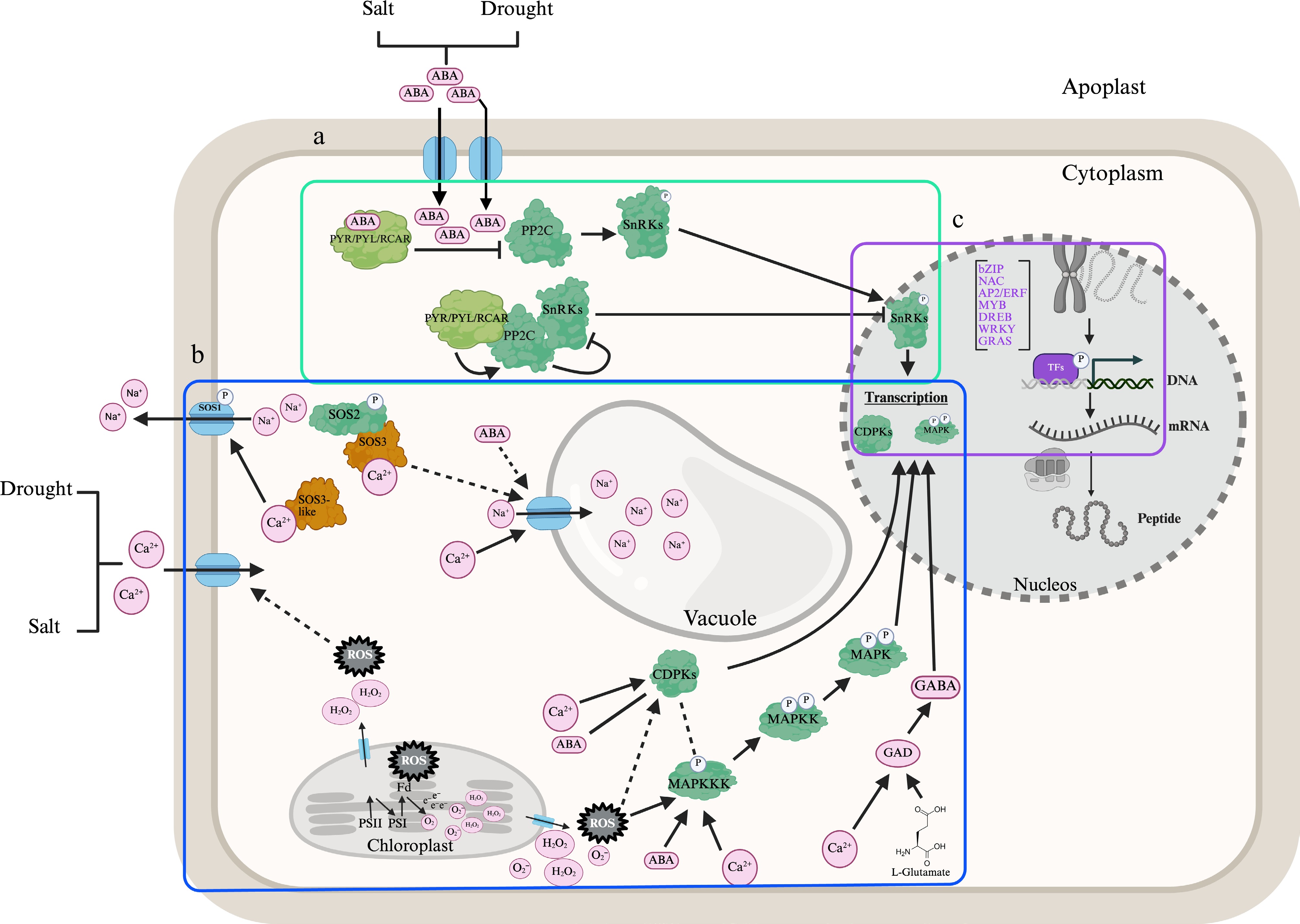
Figure 1.
Schematic representation of ABA and MAPK signaling pathways integrated with CDPK, ROS, and GABA signaling pathways regulating transcriptional responses under salt and drought stress. Stress signaling pathways are divided into three main modules, indicated in the figure. (a) ABA perception and signal initiation (the cyan rectangle). Under drought and/or salinity stress, endogenous ABA levels increase[13,31], which promotes the binding of ABA to PYR/PYL/RCAR receptors[32]. This causes PYR/PYL/RCAR to recruit protein phosphatase 2C (PP2C[17]) and to inhibit PP2C phosphatases, leading to activation of SNF1-related protein kinases (SnRK2s[33,34]). In the presence of ABA, activation of SnRK2s leads to phosphorylation of downstream target proteins[35], which subsequently regulate transcription. (b) MAPK cascade activation, ROS, SOS, Ca2+, and GABA signaling (the blue rectangle). Stress signals (e.g., ABA, Ca2+, H2O2, O2−, GABA) activate a conserved MAPK cascade[35] involving sequential phosphorylation of MAPKKKs, MAPKKs, and MAPKs[11,13,14]. CDPK, MAPKs (e.g., MAPK1), and ion transporters such as SOS1 have been associated with drought and salt stress[1,10,29]. Stress-induced cytosolic Ca2+ signals activate the SOS signaling pathway. ABA induces changes in chloroplast activity and increases ROS production that further contribute to MAPK cascade activation and antioxidant enzyme responses[36]. Low cytosolic pH and high Ca+2 concentration activate glutamate decarboxylase (GAD), which catalyzes GABA biosynthesis from L-glutamate[36]. (c) Transcriptional regulation (the violet rectangle), activated SnRK2s, CDPKs, and MAPKs phosphorylate transcription factors (e.g., bZIP, NAC, AP2/ERF, MYB, DREBs, WRKY, GRAS, and AREBs/ABFs), which bind to cis-regulatory elements in promoters of stress-responsive genes. The target genes mediate protective responses, including osmolyte accumulation, ROS detoxification, and ion homeostasis[37]. Arrows indicate directional signaling. Solid lines represent experimentally established interactions. Dashed lines indicate hypothetical interactions. Arrow connections represent positive regulation, and block connections indicate negative regulation. Different modules of the ABA signaling pathway are color-coded for clarity. Blue: channels and transporters. Pink: signaling molecules. Light green: ABA receptors. Dark green: phosphatases and kinases. Purple: Transcription factors. Orange: Ca2+ receptors. Key interactions and gene functions were compiled from the following studies: (AsCDPK, AsSOS1, MAPKs under salinity[1,21,29,38−40]) (CDPK26 and MAPK1 in drought responses[10,12,13,17]) (SnRK2s in ABA-dependent pathways[33,41]), (PYL/RCAR5 and SnRK2s in ABA signaling under salt and drought stress[19,32,42,43]). The hypothetical interaction between ROS and Ca2+ influx is supported by evidence from model species showing that ROS elevates cytosolic Ca2+ concentration in guard cells[44]. The proposed hypothetical CDPKs-MAPKKKs interaction is inferred from their concurrent transcriptional induction under salt stress in P. nuttalliana and previously reported signaling cross-talk in Arabidopsis[24,45]. The putative link between CDPK-ROS signaling and between SOS3-NHX is based on evidence from wheat[46,47]. At the same time, the hypothetical interaction between ABA and NHX is supported by studies in Brachypodium[48].
-
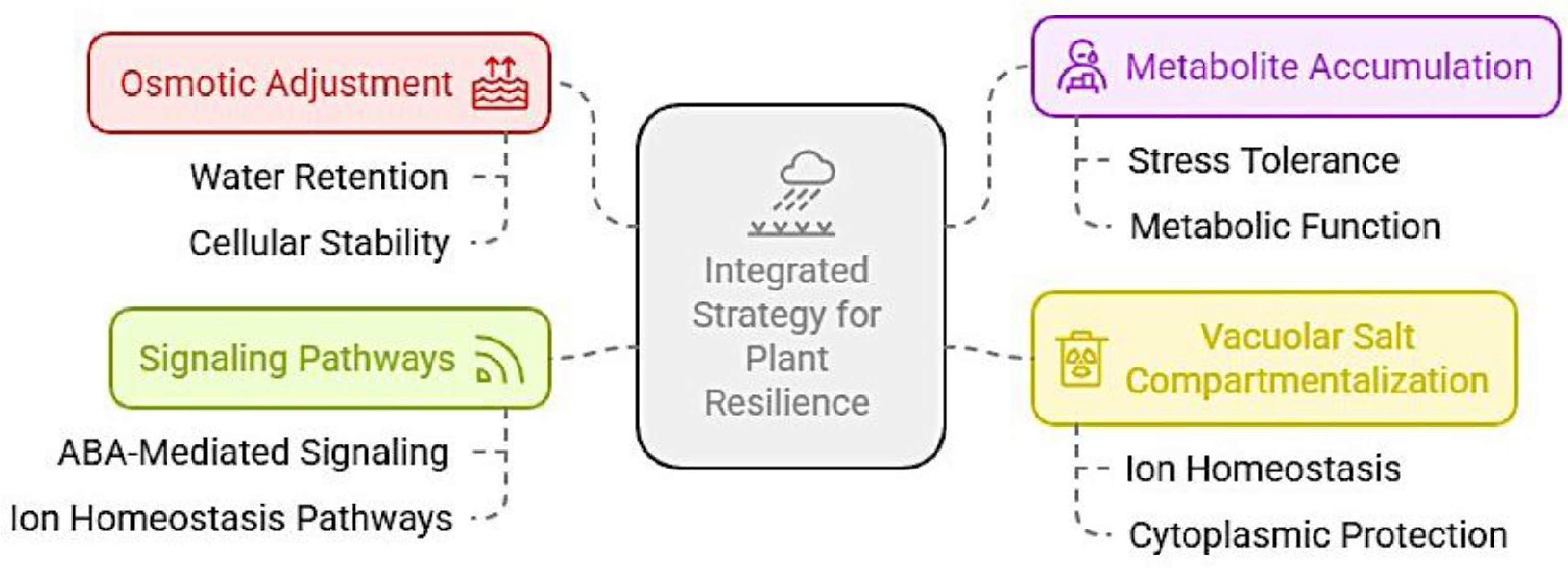
Figure 2.
Integrated strategy for plant tolerance to drought and salinity stresses.
-
Turfgrass species Accession/unigenes number Responsive gene/signal compound Downstream targets Related function/description Up/down regulation Tissue Study Ref. Festuca arundinacea (Schreb.) CL19340.Contig2_All NAC021 AIR3 (Auxin-induced
in root cultures)/DBPRegulating auxin-responsive genes/enhancing root architecture under salinity Up Leaf RNA-seq [15] CL914.Contig6_All ERF1 (Ethylene response factor 1) GSTU5 (Glutathione
S-transferase Tau 5),
PRX34 (peroxidase 34)Regulating ROS signaling CL5384.Contig1_All WRKY20 ABI5 (ABA insensitive 5),
NHX1 (Na+/H+ antiporter 1)Regulating ABA signaling CL12389.Contig1_All WRKY46 P5CS1 (Δ1-pyrroline-5-carboxylate synthetase 1),
ABI5 repressionOsmotic stress response, lateral root development Unigene16967_All NAC67 − Salt tolerance is maintained by maintaining cell membrane stability and chlorophyll content − MYB38 DFR (Dihydroflavonol
4-reductase), ANS (anthocyanidin synthase)Regulating axillary meristem formation qPCR Lolium arundinaceum/Festuca arundinacea − FabZIP69 − Stress response transcription factor Up Leaf qPCR [1] Cynodon dactylon (L.) Pers. − C3H − TF regulates stress response through hormone regulation Up Root RNA-seq [21] − ABFs RD29B, RAB18 (osmoprotectants),
HKT1 (Na+ exclusion)ABA-responsive TFs Agropyron elongatum L. MK203870.1 SnRK2.4 PIP2;1, AREB1, bZIP17 Salt stress response by regulating aquaporins and root hydraulics, ABA signaling Up Leaf and root qPCR [34] KC625489.1 NAC9 LRX1, PIN3, NHX3 Salt stress response by induction of lateral root development, ion sequestration Table 1.
Differentially expressed transcription factors under salt stress.
-
Turfgrass species Accession/unigene number Responsive gene/signal compound Downstream target genes Related function Up/down regulation Tissue Study Ref. Festuca arundinacea (Schreb.) CL21940.Contig3_All ABF LEA (Late embryogenesis abundant) genes (e.g., dehydrins) – protect cellular structures. RD29B (responsive to desiccation) – osmotic adjustment. RAB18 (ABA-responsive) – dehydration tolerance. ABA-responsive element binding factors Up Rhizome/rhizome node RNA-seq [32] CL14001.Contig6_All ARF GH3 (auxin-responsive genes) – balances auxin homeostasis. SAUR (small auxin-up RNA) genes – control cell expansion. PIN (auxin efflux carriers) – adjusts root architecture for water uptake. IAA/auxin response factors Festuca arundinacea (Schreb.) − AP2/EREBP RD29A – osmoprotectant synthesis. COR15A (cold-regulated) – stabilizes membranes. LEA14 – protects macromolecules. Abiotic stress-responsive TFs Up Leaf, pseudostem, root, crown RNA-seq [76] − HSFs HSP70, HSP90, sHSPs Heat shock TFs − NAC TFs ERD1, SAG12, VIN2 Regulation of physiological process-related genes/senescence/stress-resilience genes − bZIP TFs ADH1, P5CS Regulation of physiological process-related genes/ABRE-containing genes − WRKY TFs PR1, GST, POD Regulating stress-responsive genes − 3helix TFs ELIPs, PSBS Triple helix transcription factors − bHLH TFs CHS, FERRITIN Regulation of physiological process-related genes − GARP RBCS, CAB G2-like transcription factor/photosynthesis-related genes Axonopus compressus L. − NAC TFs SAG113, ERD1, P5CS Regulation of physiological process-related genes Up Leaf RNA-seq [25] − ABI5 RD29B, LEA14, GST ABA-dependent transcription factor − MYB3 PAL, C4H, CER1 Stress-responsive TFs − WRKY1 PR1, APX2, HKT1 Abiotic stress-responsive TFs Agrostis stolonifera GR279830.1 MYB13 PAL/C4H/CHS Abiotic stress-responsive TFs qPCR [10] DV867719.1 WRKY75 APX2/HKT1/CAT1 Abiotic stress-responsive TFs Table 2.
Differentially expressed transcription factors under drought stress.
Figures
(2)
Tables
(2)