-
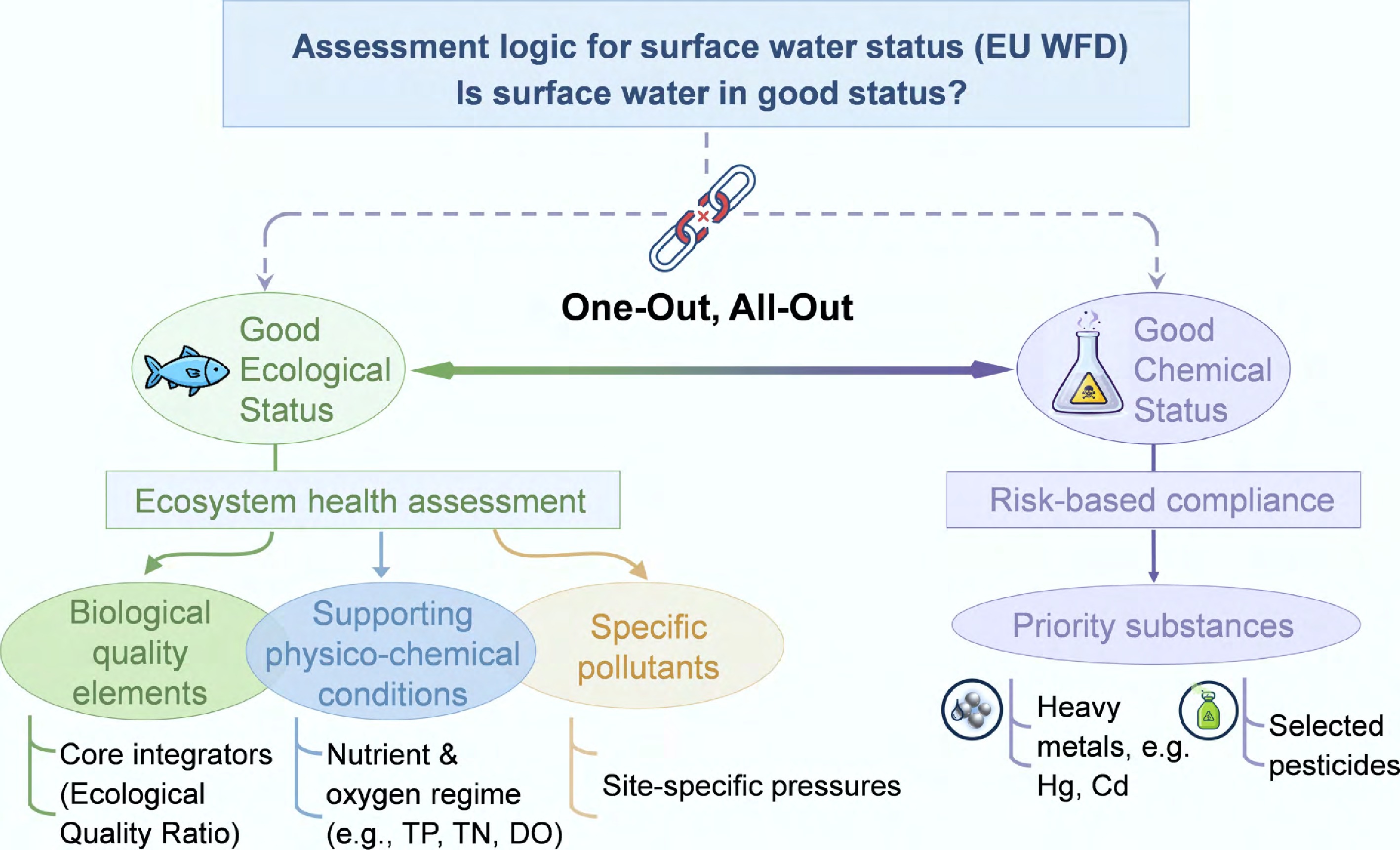
Figure 1.
Assessment logic for surface water status under the WFD.
-
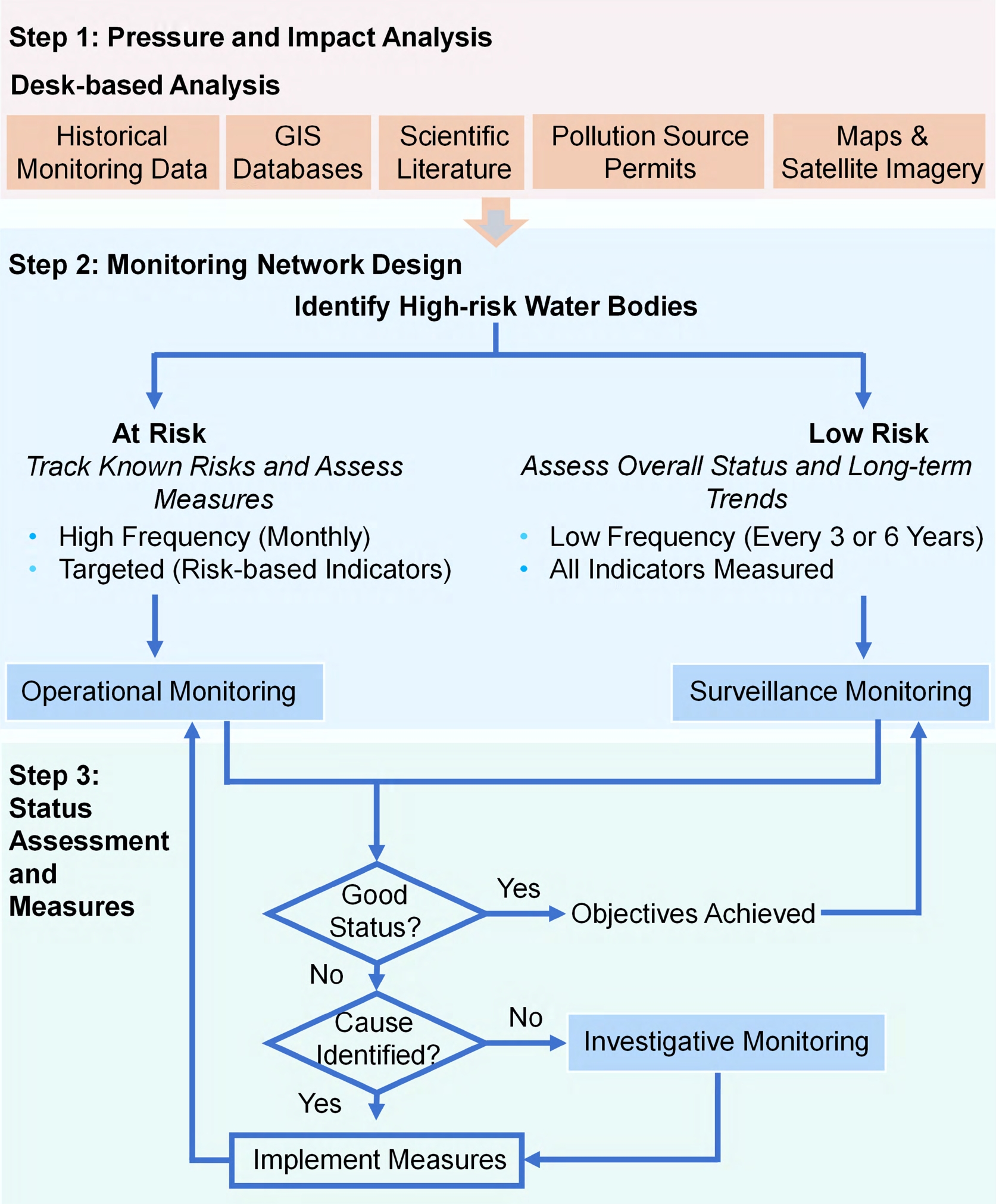
Figure 2.
Execution logic linking surveillance monitoring (SM), operational monitoring (OM), and investigative monitoring (IM) within a six-year management cycle.
-
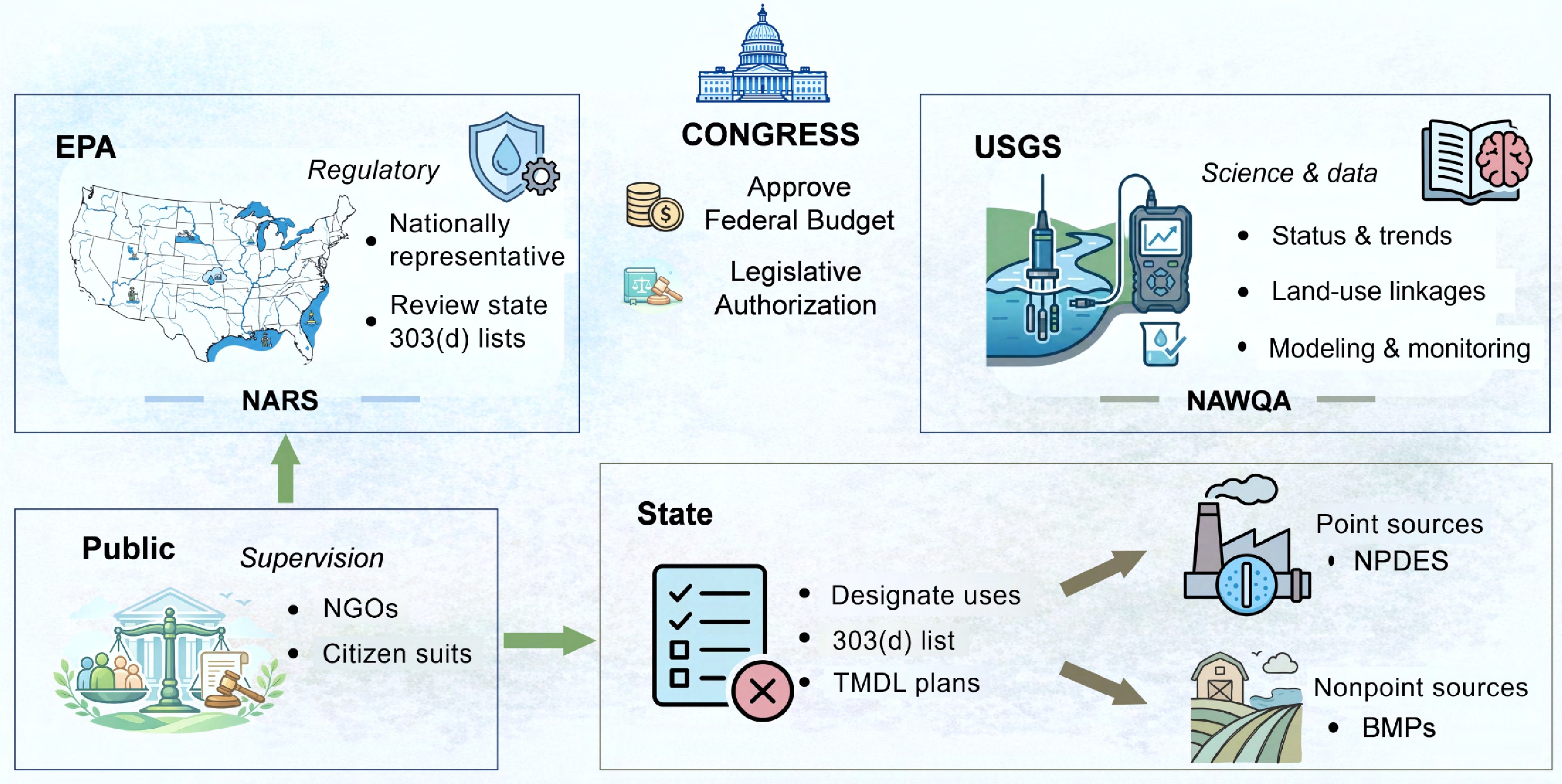
Figure 3.
Institutional architecture of the US water quality governance and monitoring system.
-
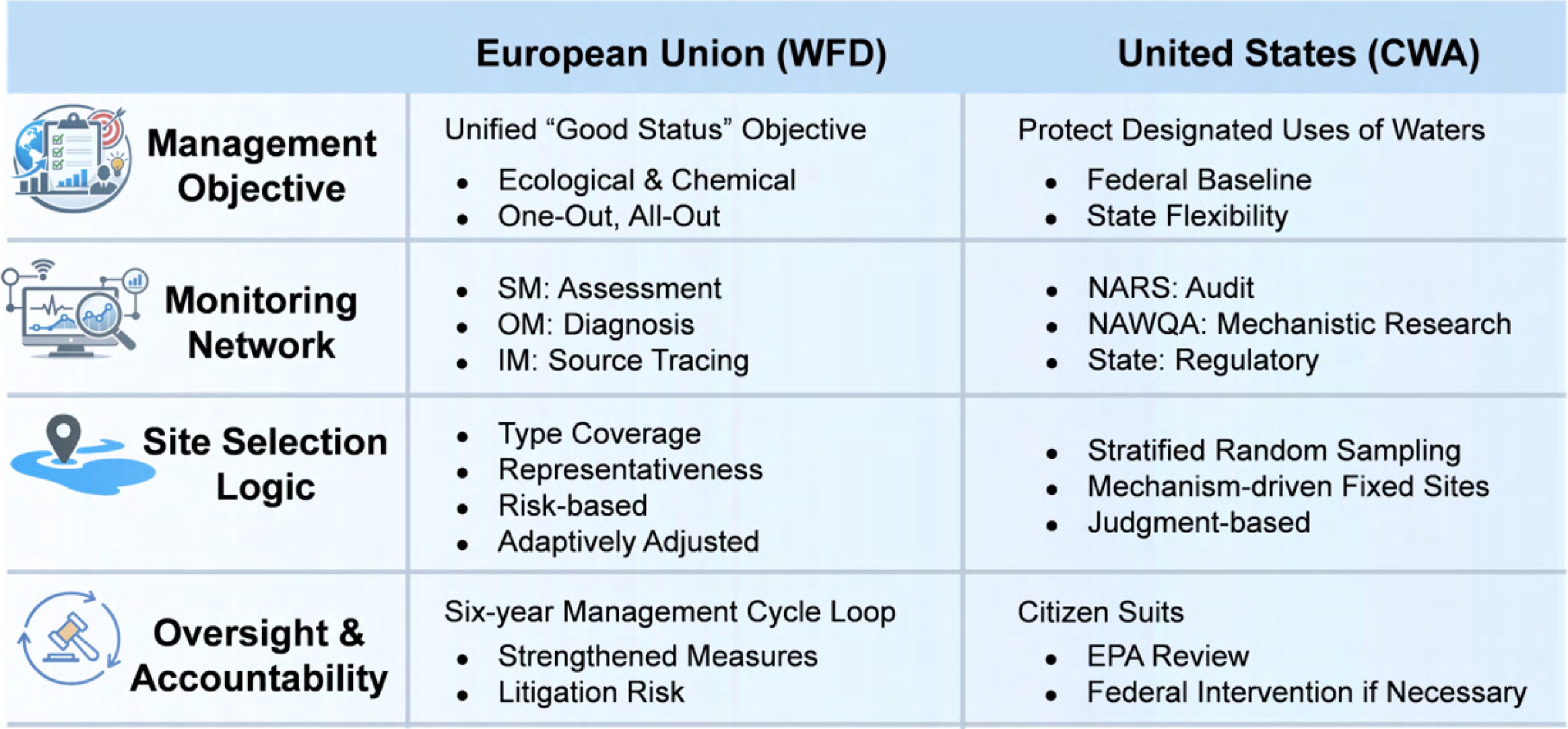
Figure 4.
Comparison of surface water monitoring frameworks under the WFD and the CWA across four dimensions: management objective, monitoring network, site selection, and oversight and accountability.
-
Type Objectives Site selection strategy Key parameters
and elementsFrequency and timing Typical outputs Surveillance monitoring
(SM)Assessment of baseline status and long-term trends; Validation of pressure and impact analyses. Located at the main river stems, key control sections, representative lakes, and estuaries to cover major water body types. EQR; Priority substances and river basin specific pollutants; Multi-media matrices where applicable. Cross-seasonal sampling over multi-year cycles; Integration with automated stations where feasible. Establishment of ecological and chemical baselines; Identification of long-term trends; Risk screening. Operational monitoring
(OM)Compliance diagnosis for at-risk water bodies; Evaluation of the effectiveness of management measures. Targeted deployment at sensitive reaches subject
to dominant pressures; Locations requiring increased temporal resolution.Pressure-specific indicator combinations (e.g., nutrients, dissolved oxygen, salinity, hydromorphology, and specific substances). Frequencies adapted to parameter variability; Intensified sampling during critical periods or for event monitoring. Trajectories of compliance status; Assessment of measure efficacy; Prioritization of management actions. Investigative monitoring
(IM)Diagnosis of causes for status deterioration; Source tracing for anomalies or accidental pollution events. Flexible and intensified deployment; Situated upstream or downstream
of suspected sources, tributaries, or point source perimeters.Expanded screening, including suspended solids, sediments, and biota; Application of source tracing and fingerprinting techniques. Temporary, high-frequency sampling campaigns. Determination of causes; Recommendations for intervention; Evidence base for network optimization. Table 1.
Comparison of the EU surface water monitoring types
Figures
(4)
Tables
(1)