-
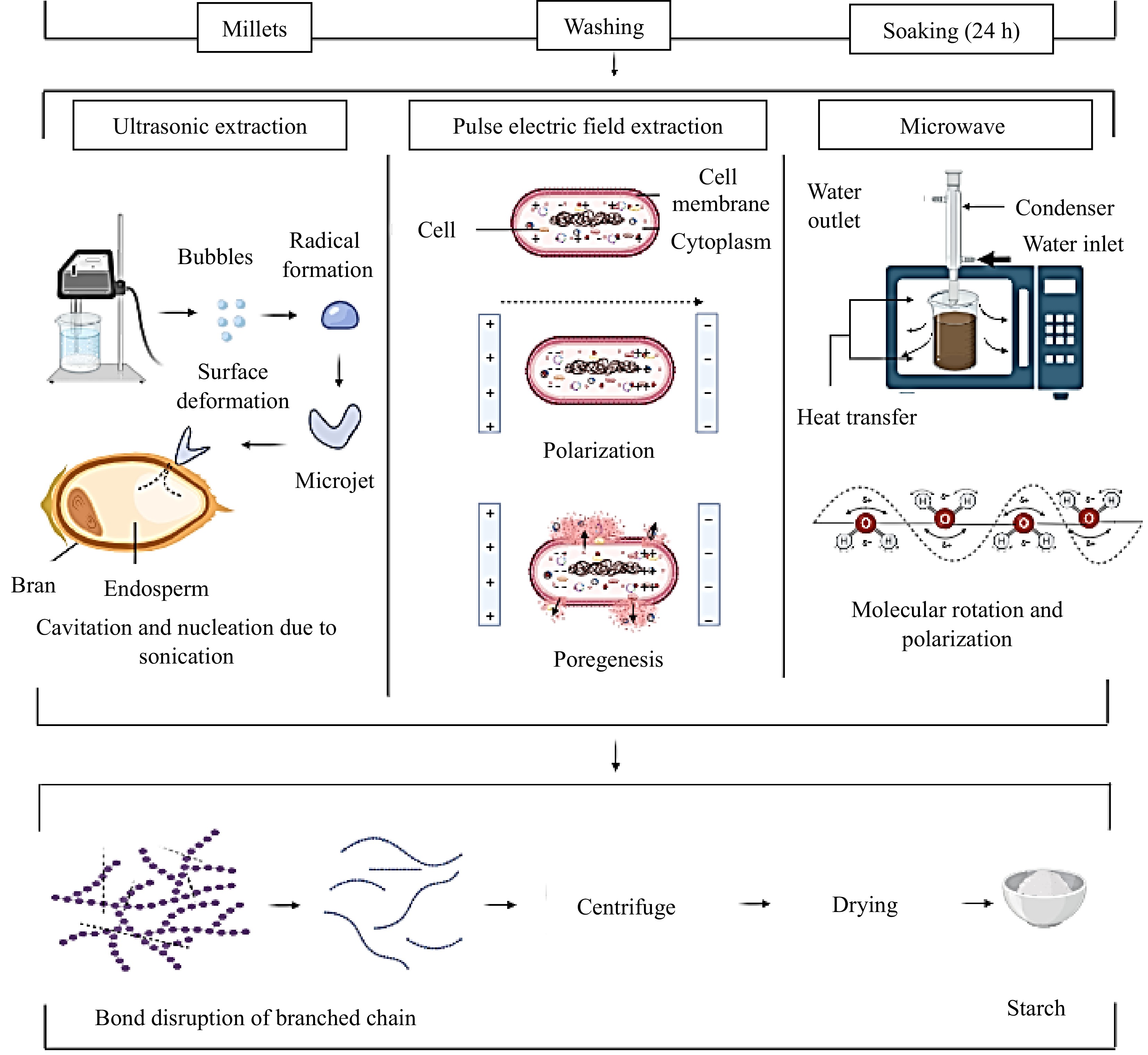
Figure 1.
Illustration of novel starch extraction technique.
-
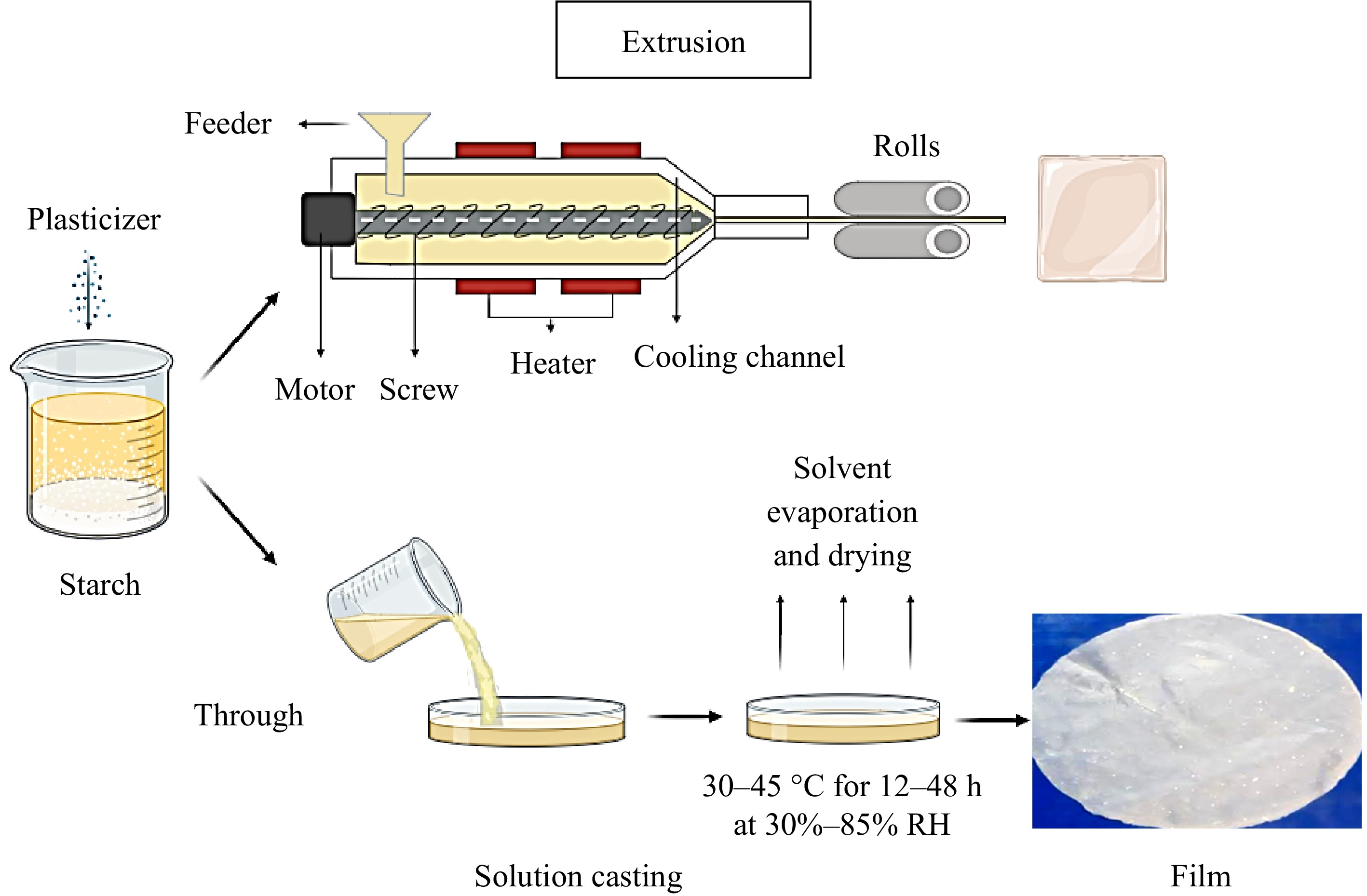
Figure 2.
Illustration of the process of making starch film.
-
Starch source Starch content (%) Treatments Solubility (%) Water absorption (ml/g) Swelling
powerWater binding (%) Gelatinization temperature ( °C) Ref. Finger millet 65–72 Ultra-sonication and annealing 0–34 126–195 − 189–298 − [14] Hydrothermally modified 13.40 − 3.49 ± 0.09 290 ± 14 − [15] Acid-modified starch 10.70 ± 0.42 − 3.45 ± 0.42 282 ± 24 − Enzymatically modified 3.18 ± 0.25 − 3.18 ± 0.25 200 ± 0.41 − Foxtail millet 70–75 Annealed − 2.4–2.6 2.1–3.1 − − [16] ultrasound modified − 1.5–2.5 2.0-3.0 − − Annealing and ultra-sonication − 2.2–2.4 2.0–4.0 − − Ultra-sonication and annealing − 2.3–2.5 2.0–4.0 − − Proso millet 72–78 Native 0–15 − 2–18 − 73.67 ± 0.10 [14,78] hydrothermally modified 0–5 − 2–13 − 84.78 ± 0.09 Ultra-high pressure − − − − 50–77 [31] with proanthocyanidins 5.30–17.30 − 13.30–20.10 − 81.90-87.80 [15,79] Pearl millet 63–70 Native 10.4 ± 0.4 − 14.0 ± 0.6 − 50–62 [80] acetylated 11.3–19.5 − 14.0–18.4 − − Table 1.
Physicochemical properties of millet starch.
-
Properties of millet starch films Methodology Test index Instrument for analysis Ref. Physicochemical properties Iodine binding method by observing absorbance Amylose content Spectrophotometry [47,55] Drying of films after centrifugation at 3,000–6,000 rpm for 10–30 min Swelling power and solubility Spectrophotometry [49] Morphology and structure • Observed smooth, unbroken granules: typical natural behavior, less water absorption
• Higher swelling and solubility on porous or pitted surfaces
• Fissures and cracks: reduced thermal stability
• Granules that are broken up are more vulnerable to enzymatic hydrolysisTexture and surface SEM [40] At 25 °C, diffractograms are assessed throughout a range of 4–40 with a 0.02 step size and at 10 s sample intervals. Observation of semi-crystalline nature Diffractograms XRD [31] The IR region 400–4,000 cm-1. The spectra of the starch and films are captured in natural lighting and at room temperature Spectrum of the transmission infrared FTIR spectrometer [49] Film thickness Film samples are gauged using an electronic digital micrometer at various points Film thickness Electronic digital micrometer [57] Mechanical properties Mechanical characteristics of the film are investigated Tensile strength and % elongation Universal testing machine [16, 56] Studied at an initial grip distance of 5 cm and at a crosshead speed of 50 mm/min Tensile strength and elongation at break (E %) Testometric machine [70] Thermal properties Thermal behaviours are observed from DSC peaks at a rate of 5 °C/min from 40 to 150 °C To, Tp, Tc, and ΔH gel DSC [81] Barrier properties Standard test method for water vapour transmission rate through plastic film and sheeting, with slight modifications WVP Gravimetric modified cup method [81] Standard test method for oxygen gas transmission rate through plastic film and sheeting using coulometric sensor with slight modifications Oxygen permeability Coulometric sensor [57] Antimicrobial activity Inhibition concentration (IC50) is observed after plating for 24 h at (25 ± 2) °C. Zone of inhibition Disc diffusion method [69] DSC: differential scanning calorimetry; XRD: X-ray diffraction; WVP: water vapour permeability; SEM: scanning electron microscopy; To: temperature onset; Tp: peak of gelatinization temperature; Tc: temperature conclusion; ΔH gel: enthalpy of gelatinization. Table 2.
The methodologies for characterizations of millet starch films.
-
Films from treated/non-treated starch Physical properties Mechanical properties Thermal Property Ref. Morphology Solubility
(%)Transparency (%) TS
(Mpa)E (%) WVPR (g/m/s/Pa)* 10−9 Tg (°C) 1 Sorghum (NS) − 13.4 21.4 4.84 4.88 2.45 24.4 [56] AS − 22.1–49.1 53.3–83.3 0.68–3.45 5.99–15.38 1.10–2.50 23.7–24.9 CS − 22.5–26.0 41.6–68.1 3.74–7.17 1.01–9.45 1.22–1.65 27.6–33.4 2 Pearl millet (NP) Rough surface with pores, cracks, ridges, or breaks 14.77–40.54 54.18 3.44–7.05 19.21–64.5 6.98–7.17 47.41 [3, 40] ACT Smooth and homogeneous surface 13.21–16.10 29.74–37.52 2.86–3.69 19.5–31.4 2.20–5.16 33.08–36.42 HPS Smooth and homogeneous surface 29.71–64.14 63.54–81.17 2.54–3.10 57.17–64.81 8.92–9.70 21.21–26.51 CP Smooth surface free from cracks, pores, ridges, or breaks 13.15 − 5.84 51.5 6.01 − EPI Rough surfaces and small cavities on the surface of granules 25.86–41.2 − 7.05–9.74 45.4–60.04 − − 3 Foxtail millet (NF) − 42.01 ± 0.31 73.16–92.81 6.78 ± 0.24 66.26 ±1.60 3.55 − [69] FCO − 33.10–38.62 0.02–91.10 3.64–5.91 79.49–99.48 3.40–3.59 − NS: native starch; AS: acetylated starch; CS: cross linked sodium trimetaphosphate and sodium tripolyphosphate; NP: native pearl millet; ACT: acetylated; HPS: hydroxypropylated starch; CP: cross-linked pearl millet; EPI: epichlorohydrin; NF: native film; FMS: foxtail millet starch; FCO: film with clove, leaf, and oil; TS: tensile strength; E: elongation at break; WVPR: water vapour permeability rate; Tg: glass transition temperature. Table 3.
Properties of millet starch packaging films.
Figures
(2)
Tables
(3)