-
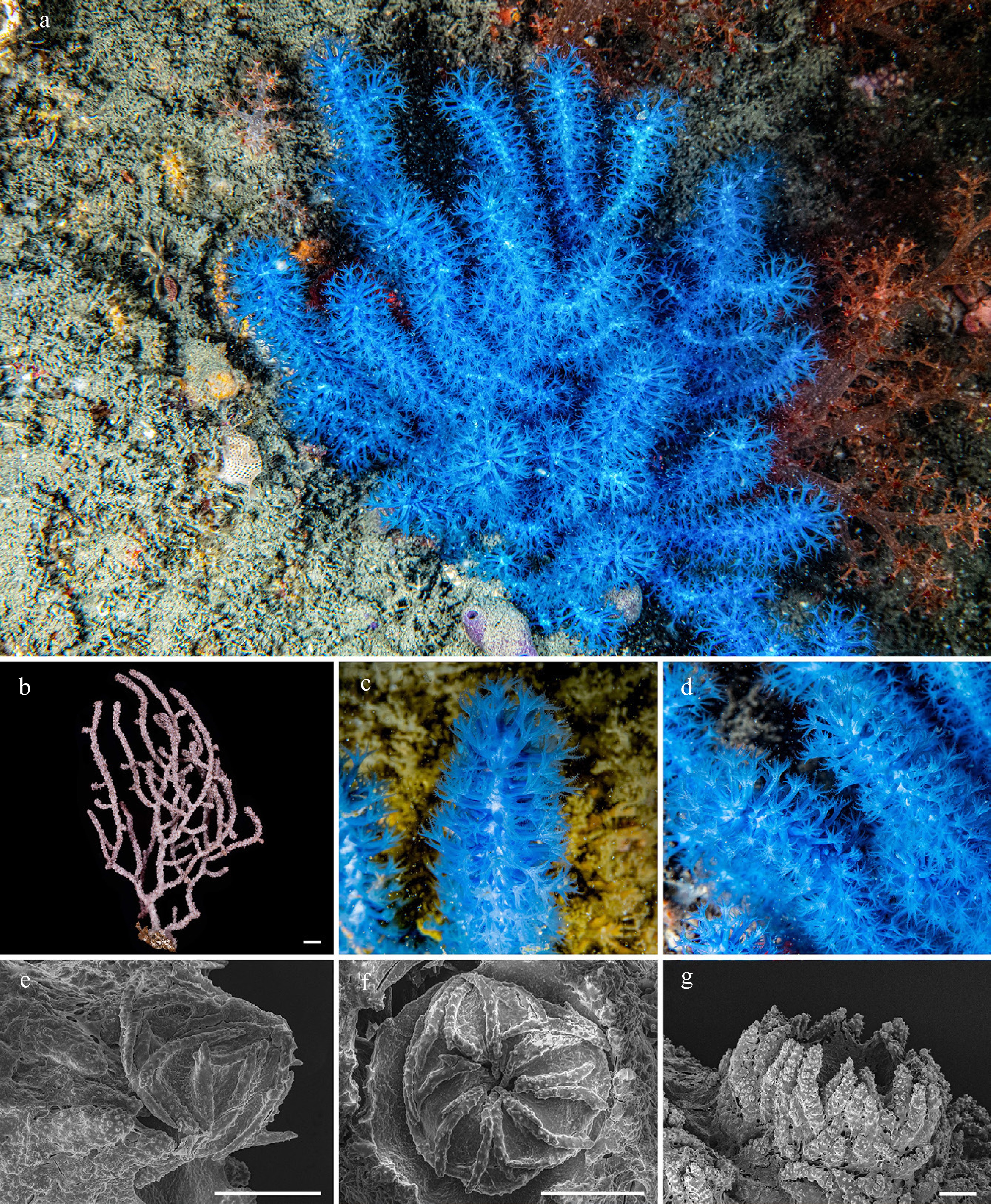
Figure 1.
Curvagorgia caerulea gen. et sp. nov., holotype, GXTCMU–2025–HT006: (a), (c), (d) in situ; (b) colony after collection; (e)–(f) polyps under scanning electron microscopy (SEM); (g) calyces under SEM.
-
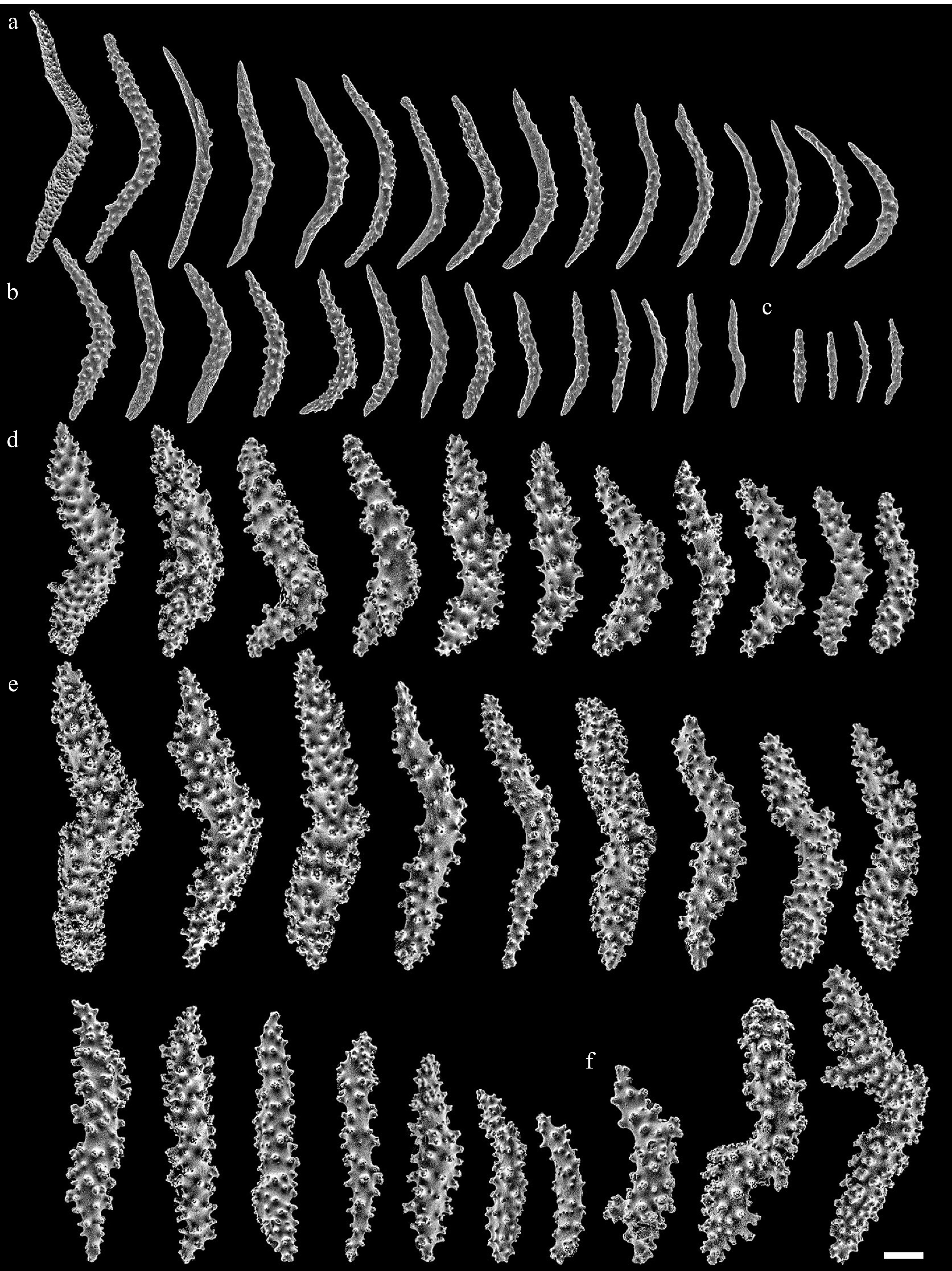
Figure 2.
Curvagorgia caerulea gen. et sp. nov., holotype, GXTCMU–2025–HT006. Anthocodial sclerites: (a) collaret spindles; (b) point spindles; (c) tentacular spindles and rods. Calicular sclerites: (d) curved warty spindles. Coenenchymal sclerites: (e) warty spindles; (f) branched spindles. Scale bars = 0.1 mm.
-
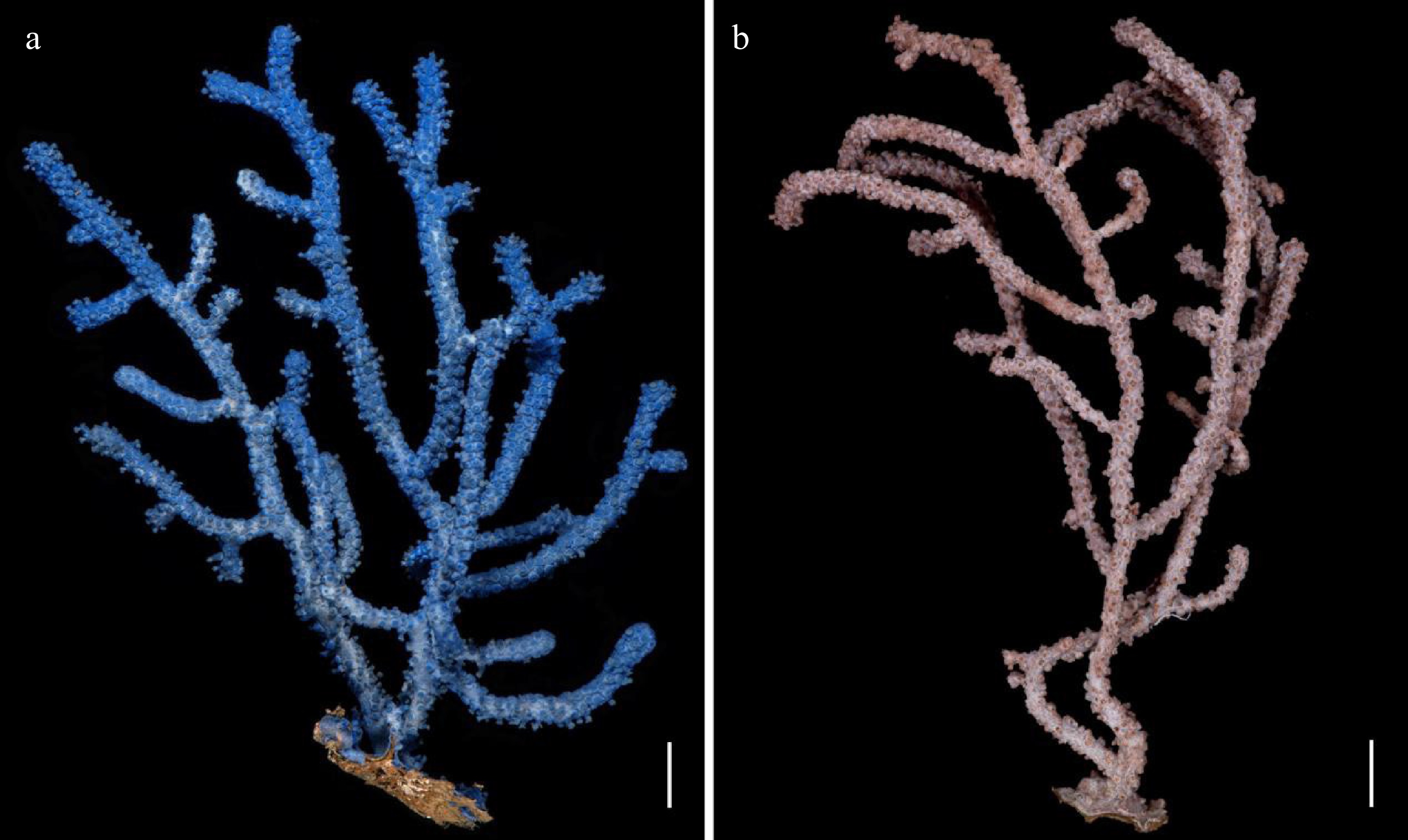
Figure 3.
Curvagorgia caerulea gen. et sp. nov., paratypes. (a) GXTCMU–2025–PT005 after collection; (b) GXTCMU–2025–PT006 after preservation in ethanol. Scale bars = 1 cm.
-
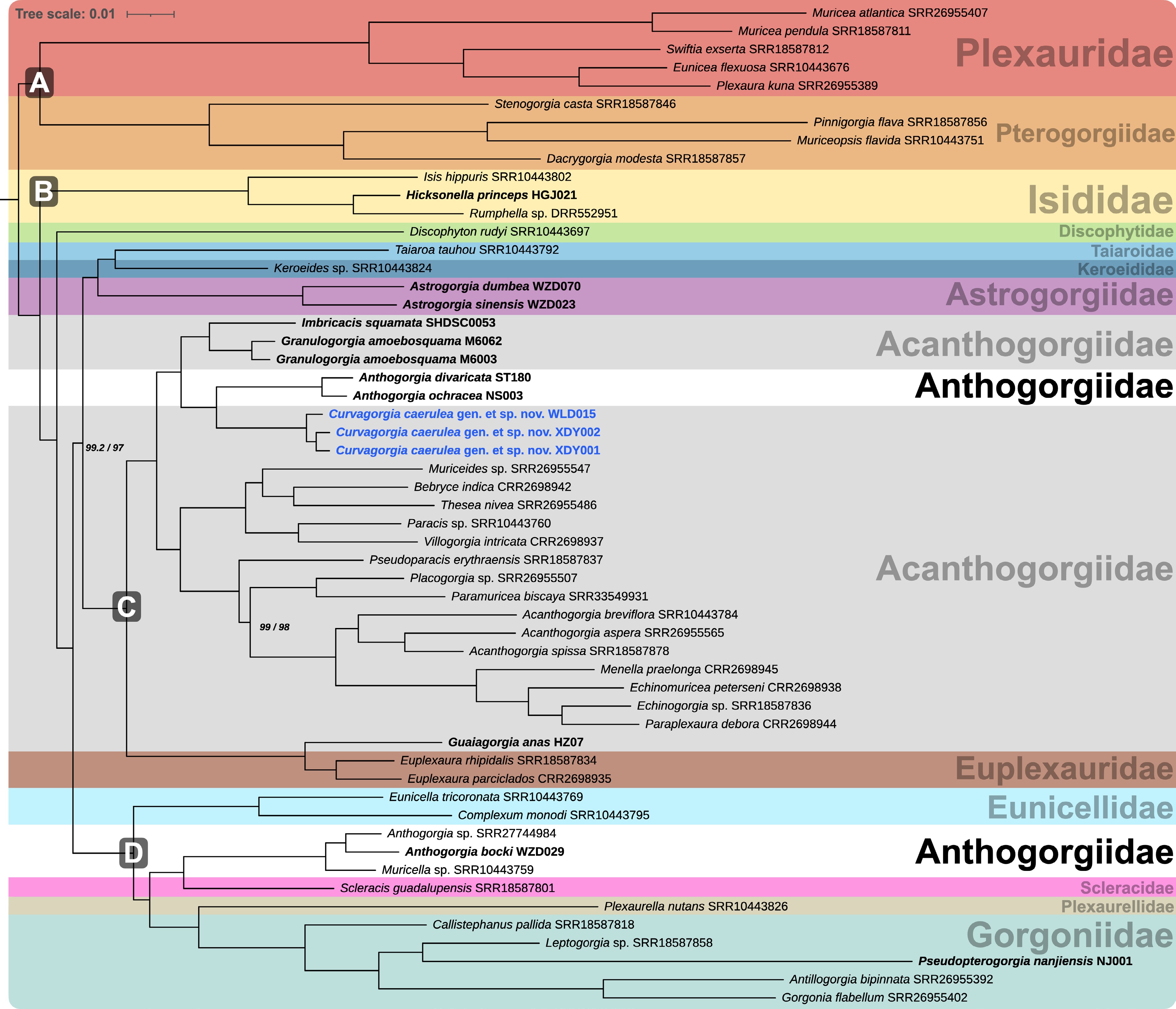
Figure 4.
Maximum likelihood phylogeny of the M8 clade of Malacalcyonacea inferred from the UCE data (60% taxon occupancy). Branch support is reported as the SH-aLRT/ultrafast bootstrap value; values are shown only for nodes where either metric is < 99. Samples labeled with public accession numbers represent datasets downloaded from the SRA or GSA repositories; other comparative samples are labeled by voucher or sample codes. Newly obtained sequences are shown in bold, and newly added taxa are highlighted in blue. Labels (A)–(D) mark the portions of the tree corresponding to M8 Clades A–D.
-
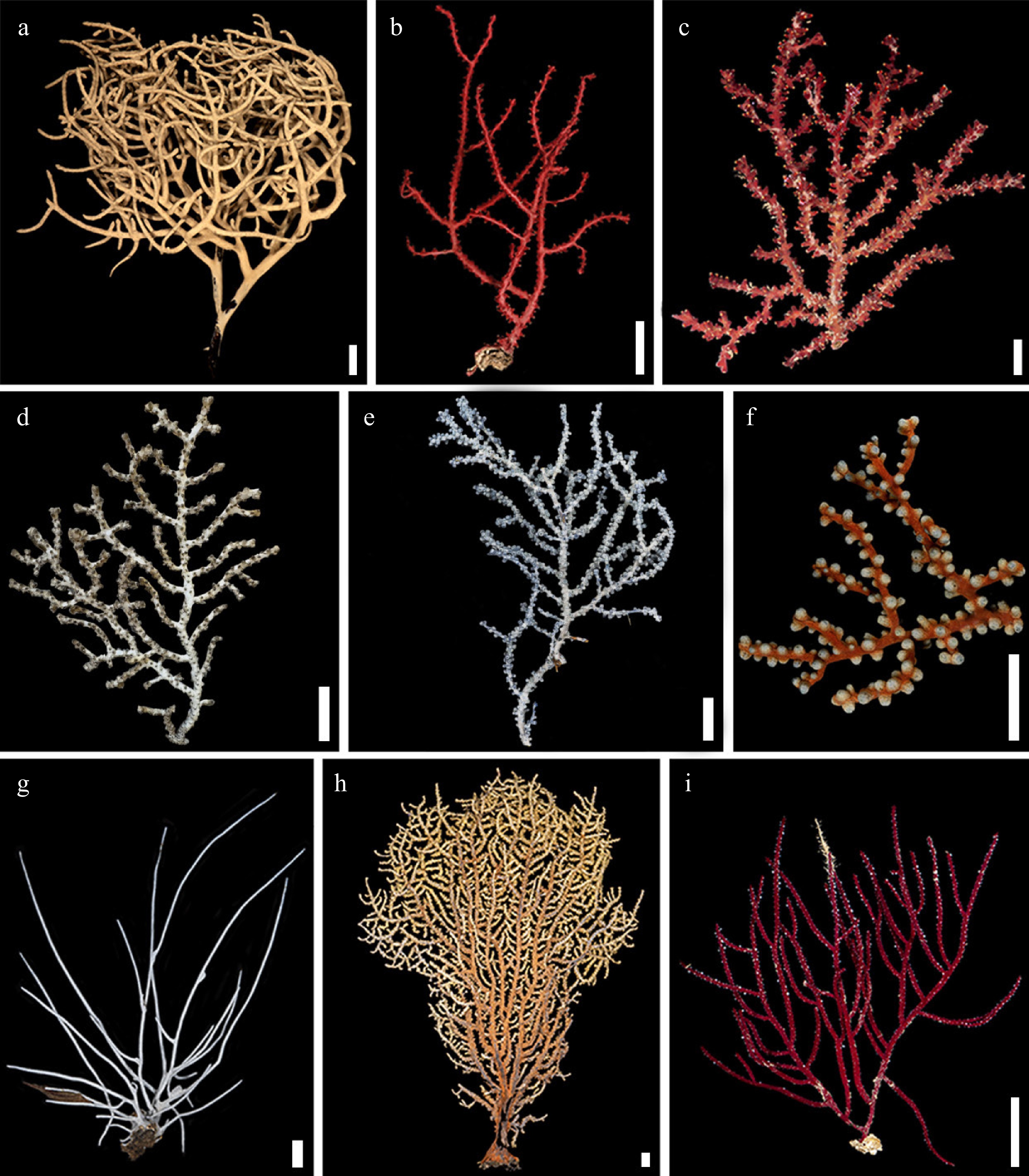
Figure 5.
Photographs of colonies corresponding to boldfaced labels in the UCE phylogenetic tree. (a) Hicksonella princeps Nutting, 1910 (HGJ021); (b) Astrogorgia dumbea Grasshoff, 1999 (WZD070); (c) Astrogorgia sinensis (Verrill, 1865) (WZD023); (d) Imbricacis squamata (Nutting, 1910) (SHDSC0053); (e) Anthogorgia divaricata Verrill, 1865 (ST180); (f) Anthogorgia ochracea Grasshoff, 1999 (NS003); (g) Guaiagorgia anas Grasshoff & Alderslade, 1997 (HZ07); (h) Anthogorgia bocki Aurivillius, 1931 (WZD029); (i) Pseudopterogorgia nanjiensis Sun, Xu & Zhan, 2024 (NJ001). Scale bars = 2 cm.
-
Characters Curvagorgia gen. nov. Calicogorgia Menacella Anthomuricea Astrogorgia Anthogorgia Colony form Arborescent Planar Flabellate Planar Planar to flabellate Planar to flabellate Calyx distribution On all sides Lateral On all sides Lateral or spiral Lateral or on all sides Absent Calyx shape Low conical Conical to dome-shaped Wart-shaped to dome-shaped Cylindrical Low Absent Polyp retractility Fully retractile Retractile Retractile Retractile Retractile Nonretractile Anthocodial armature Well-developed collaret and points Collaret and points present Collaret and points present Collaret and points present Absent Absent Point structure Each point defined by two oppositely arranged bent spindles multiple oppositely arranged spindles multiple spindles, commonly forming a triangular arrangement several rows of sclerites arranged in
a chevronAbsent Absent Calicular sclerite arrangement Eight loose longitudinal
bands, not differentiated
into two distinct rowsEight bands, each composed of two
distinct rowsIrregular Chevron pattern Longitudinal Absent Calyx sclerites Predominantly bent spindles Straight or bent spindles Spindles Spindles and rods Spindles Absent Coenenchymal sclerites Bent and straight spindles, with occasional branched forms Spindles Spindles Spindles Spindles
and rodsSpindles Table 1.
Morphological comparison among similar or phylogenetically relevant genera
Figures
(5)
Tables
(1)