













-
Octocorals are abundant and often structurally dominant components of benthic communities across a broad depth range, from shallow water to deep habitats such as canyons, seamounts, and continental margins[1,2]. They contribute substantially to habitat complexity and support diverse assemblages of associated invertebrates and fishes in both tropical and temperate systems[3]. The relationships among many octocoral lineages nevertheless remain difficult to resolve because of extensive morphological plasticity and widespread homoplasy[4,5]. These features have long complicated gorgonian systematics and continue to hinder stable genus- and family-level classification in several parts of the octocoral phylogeny[6,7]. Phylogenomic studies also show that higher taxa defined primarily by their morphology often do not correspond to monophyletic groups in Octocorallia[7].
Acanthogorgiidae Gray, 1859, illustrates these problems clearly. In current compilations, the family Acanthogorgiidae is species-rich and broadly distributed from shallow reefs to deep-sea habitats[8,9]. The family has traditionally encompassed a heterogeneous assemblage of genera with broadly similar colony and sclerite morphology, in which planar or bushy colony forms and diverse sclerite types, including spindles, thornspindles, and thornscales, occur across several malacalcyonacean lineages, and their generic and family limits have been revised repeatedly[1,10−12]. Early molecular analyses based on mitochondrial markers did not support the traditional circumscription of Acanthogorgiidae[6], and some nominal genera remain unsampled in genome-scale phylogenomic analyses. As a result, the phylogenetic affinities of several genera remain uncertain, and many species descriptions lack the polyp-level detail needed to evaluate their generic limits with confidence[7,12].
The instability of generic limits among acanthogorgiid-like taxa reflects, in part, the evolutionary lability of characters that have traditionally been used to classify them. The colony branching pattern, the degree of polyp prominence, the thin coenenchyme, and the predominance of spindle-shaped sclerites occur in multiple nonsister lineages and therefore have limited value by themselves for diagnosing natural groups. Other characters, especially the degree of polyp retractility, the presence and form of calyces, and the organization of the anthocodial armature, such as the collaret and points, may be more informative within particular clades, even where the colony's overall growth form is variable[7,11,12].
During shallow-reef surveys along the coast of China, we collected three gorgonian colonies from Wailingding Island in the South China Sea and the Xiongdi Islets in the East China Sea that could not be assigned confidently to any described genus on the basis of their comparative morphology. These specimens exhibit a unique combination of anthocodial armature- and calyx-level characters, and sclerite types not captured by current generic concepts of the acanthogorgiid-like taxa. This portion of Malacalcyonacea also includes nominal genera whose current circumscriptions and family assignments are difficult to reconcile with their phylogenomic structure. Recent studies suggest that Anthogorgia may comprise more than one lineage, and that some taxa currently assigned to Acanthogorgiidae fall outside the main acanthogorgiid lineage in M8[7,12], highlighting ongoing taxonomic uncertainty.
Here, we combine colony, polyp, and sclerite morphology with ultraconserved element (UCE) phylogenomics to evaluate the placement of these specimens and their relationship to morphologically similar acanthogorgiid-like taxa. We establish Curvagorgia gen. nov. and describe Curvagorgia caerulea gen. et sp. nov.
-
Three specimens were collected by SCUBA diving from shallow waters (19–27 m depth) along the coast of China. One specimen (WLD015) was collected from Wailingding Island in the South China Sea, and two specimens (XDY001, XDY002) were collected from the Xiongdi Islets in the East China Sea. The colonies were photographed in situ with a Nikon D850 digital camera (Nikon Corporation, Tokyo, Japan) in an underwater housing and preserved in 99% ethanol. Type specimens were deposited in the Institute of Marine Drugs, Guangxi University of Chinese Medicine (
www.gxtcmu.edu.cn/hyywyjy , accessed on 13 March 2026). Specimen information and the voucher deposition for all specimens used in this study are provided in Supplementary Table S1.Morphological examination and analysis
-
Calyces and polyps were examined and photographed with a Leica S9i stereomicroscope (Leica Microsystems, Wetzlar, Germany). Sclerites from the anthocodiae, calyx wall, and coenenchyme were isolated in a commercial sodium hypochlorite solution and rinsed thoroughly in deionized water. For morphometric analysis, 4–20 sclerites from each body region were randomly selected and measured for length and width using LAS X software on a Leica DMi8 inverted microscope (Leica Microsystems, Wetzlar, Germany). The sclerites were then oven-dried and mounted on double-sided carbon adhesive tape. The sclerites were examined and photographed with a FEI Quanta 250 scanning electron microscope. The taxonomic terminology follows Bayer et al.[10].
DNA extraction and sequencing
-
Genomic DNA was extracted from ethanol-preserved tissue using the TIANamp Marine Animals DNA Kit (Tiangen Biotech Co., Ltd., Beijing, China) following the manufacturer's protocol. DNA concentration and quality were assessed with a Qubit fluorometer and a NanoDrop spectrophotometer (Thermo Fisher Scientific, Waltham, MA, USA). Approximately 0.2 µg of genomic DNA per specimen was sheared to an average fragment size of ~350 bp using a Covaris LE220R-plus ultrasonicator (Covaris, Woburn, MA, USA). Libraries were prepared by end repair, A-tailing, adapter ligation, and polymerase chain reaction (PCR) amplification, purified via AMPure XP bead purification, and evaluated on an Agilent 5,400 system. Library concentrations were quantified by real-time PCR. DNA nanoballs were generated by phosphorylation, circularization, and rolling-circle amplification and sequenced as 150-bp paired-end reads on a DNBSEQ-T7 platform at Novogene (Beijing, China). Each specimen yielded approximately 20–40 million paired-end reads.
UCE recovery and phylogenetic analyses
-
Taxon sampling included newly sequenced specimens, publicly available read datasets downloaded from the NCBI Sequence Read Archive (SRA) and CNCB Genome Sequence Archive (GSA), and unpublished sequencing reads for Granulogorgia amoebosquama specimens M6003 and M6062 provided by collaborators. All reads were processed using the same workflow. Representative taxa from M8 Clade A were included to root the tree, following the M8 framework of McFadden et al.[7].
Adapter sequences and low-quality bases were removed with fastp v1.1.0[13] using the default settings. Target loci were recovered using GeneMiner2[14] and the octocoral-specific octo-v2 bait set of Erickson et al.[15], which comprises 29,181 probes targeting 3,023 loci. GeneMiner2 was run with the following settings: filter k-mer size 23 (-kf 23), unlimited soft-boundary extension (-sb unlimited), a minimum acceptable depth of 2 during re-filtering (--min-depth 2), primary assembly sequences used for alignment and concatenation (-cs assembly), and retention of the longest trimmed sequence when multiple sequences were recovered for a locus (-tm longest). Loci were concatenated using Alignment Manipulation And Summary (AMAS)[16]. The final concatenated matrix included loci represented in at least 60% of taxa. This threshold was selected to balance locus retention against missing-data reduction, given that the dataset combined newly generated reads with public datasets that differed in sequencing depth and locus recovery.
Maximum likelihood analyses were conducted in IQ-TREE v3.0.1[17]. The initial partitions were defined by locus, and substitution models were selected for the partitions with ModelFinder (-m MFP)[18]. No partition merging analysis was applied. Node support was assessed with 1,000 ultrafast bootstrap replicates (UFBoot)[19] and the Shimodaira-Hasegawa-like approximate likelihood ratio test (SH-aLRT; 1,000 replicates)[20]. Trees were visualized and annotated in iTOL v6[21]. Dataset information, accession numbers, and sequencing statistics for the newly generated, publicly available, and collaborator-provided datasets used in the phylogenetic analyses are provided in Supplementary Table S2.
-
Class Octocorallia Haeckel, 1866
Order Malacalcyonacea McFadden, van Ofwegen & Quattrini, 2022
Family Acanthogorgiidae Gray, 1859
Genus Curvagorgia You, Xia, Tang, Roeroe, Liu & Liu, gen. nov.
Diagnosis. Colony arborescent, with a horny axis containing a hollow, cross-chambered central core. Polyps fully retractile, seated in low conical calyces distributed on all sides of the branches. Anthocodial armature of a collaret and points, each point formed by two oppositely bent spindles converging laterally into a triangular configuration. Calyces contain spindles arranged in eight loose longitudinal bands. Coenenchyme with warty and occasionally branched spindles, some blunt-ended. The nomenclatural act has been registered in ZooBank under the following LSID: urn:lsid:zoobank.org:act:50854DAB-32CA-45AC-9BF5-59E03C93859C.
Type species. Curvagorgia caerulea gen. et sp. nov. by monotypy.
Etymology. From the Latin adjective curva, referring to the curved warty spindles occurring throughout the colony, combined with the octocoral suffix -gorgia. Gender feminine. The Chinese name of the new genus is "曲柳珊瑚属", also referring to the curved warty spindles characteristic of the genus.
Remarks. Curvagorgia gen. nov. most closely resembles Calicogorgia Thomson & Henderson, 1906, and is also similar to Menacella Gray, 1870 and Anthomuricea Studer, 1887, in having spindle-dominated sclerites in the anthocodiae, calyces, and coenenchyme. It differs from these genera in the combination of an arborescent colony, low conical calyces distributed on all sides of the branches, anthocodial points each formed by two oppositely arranged bent spindles, and calicular sclerites arranged in eight loose longitudinal bands that do not resolve into two distinct rows.
Among these genera, Curvagorgia gen. nov. is most similar to Calicogorgia in the predominance of spindle-shaped sclerites and the general organization of the calicular armature, but cannot be referred to that genus as currently understood. It differs from Calicogorgia in having an arborescent rather than a planar colony, calyces distributed on all sides of the branches rather than laterally within a single plane, and calicular sclerites arranged in eight loose longitudinal bands rather than in eight bands each comprising two distinct rows[22] (Table 1).
Table 1. Morphological comparison among similar or phylogenetically relevant genera
Characters Curvagorgia gen. nov. Calicogorgia Menacella Anthomuricea Astrogorgia Anthogorgia Colony form Arborescent Planar Flabellate Planar Planar to flabellate Planar to flabellate Calyx distribution On all sides Lateral On all sides Lateral or spiral Lateral or on all sides Absent Calyx shape Low conical Conical to dome-shaped Wart-shaped to dome-shaped Cylindrical Low Absent Polyp retractility Fully retractile Retractile Retractile Retractile Retractile Nonretractile Anthocodial armature Well-developed collaret and points Collaret and points present Collaret and points present Collaret and points present Absent Absent Point structure Each point defined by two oppositely arranged bent spindles multiple oppositely arranged spindles multiple spindles, commonly forming a triangular arrangement several rows of sclerites arranged in
a chevronAbsent Absent Calicular sclerite arrangement Eight loose longitudinal
bands, not differentiated
into two distinct rowsEight bands, each composed of two
distinct rowsIrregular Chevron pattern Longitudinal Absent Calyx sclerites Predominantly bent spindles Straight or bent spindles Spindles Spindles and rods Spindles Absent Coenenchymal sclerites Bent and straight spindles, with occasional branched forms Spindles Spindles Spindles Spindles
and rodsSpindles Although recovered as sister to the sampled Anthogorgia lineage in the phylogenomic analyses, Curvagorgia gen. nov. differs markedly from Anthogorgia in morphology. In Curvagorgia gen. nov., the polyps are fully retractile and seated in low conical calyces, and the anthocodial armature is differentiated into a well-developed collaret and points, each point formed by two oppositely arranged bent spindles. In the examined Anthogorgia species, calyces are absent and the anthocodial armature is not differentiated into well-developed collarets and points[23] (Table 1).
Curvagorgia gen. nov. also resembles Menacella in having calyces on all sides of the branches and warty spindle sclerites in the calyx and coenenchyme, but differs in having an arborescent rather than a flabellate colony and calicular sclerites arranged in eight longitudinal bands rather than irregularly[24] (Table 1). It also resembles Anthomuricea in the presence of warty spindle sclerites in the coenenchyme, but differs in its colony form, the shape and distribution of the calyces, and the organization of both the anthocodial and calicular armature. In Curvagorgia gen. nov., the colony is arborescent, the calyces are low and conical, the points are formed by two oppositely arranged bent spindles, and the calicular sclerites form eight loose longitudinal bands; in Anthomuricea, the colony is planar, the calyces are commonly taller and arranged laterally or spirally, the points' sclerites are arranged in several chevron-forming rows, and the calicular sclerites are typically organized in a chevron pattern[25] (Table 1).
The new genus is also similar to Astrogorgia Verrill, 1868, in its predominance of spindle-shaped sclerites, but differs in having a well-developed armature with a collaret and points; in Astrogorgia, the anthocodial spindles and rods are arranged in eight longitudinal groups and are not differentiated into collarets and points[23] (Table 1). The combination of colony form, calyx distribution, anthocodial armature, and calicular sclerite arrangement distinguishes Curvagorgia gen. nov. from all comparable acanthogorgiid-like genera discussed above.
Curvagorgia caerulea You, Xia, Tang, Roeroe, Liu & Liu, gen. et sp. nov. (Figs 1−3)
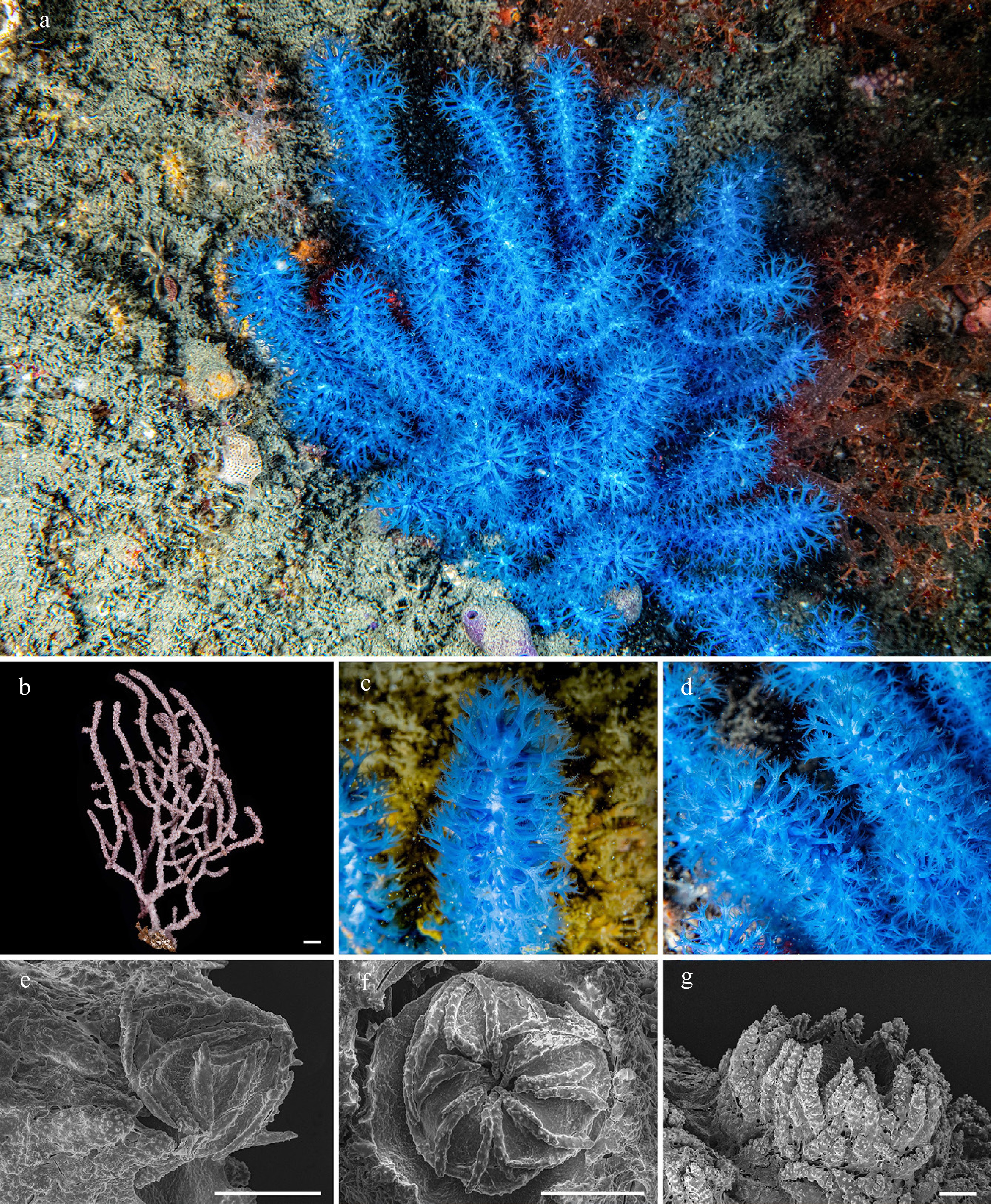
Figure 1.
Curvagorgia caerulea gen. et sp. nov., holotype, GXTCMU–2025–HT006: (a), (c), (d) in situ; (b) colony after collection; (e)–(f) polyps under scanning electron microscopy (SEM); (g) calyces under SEM.
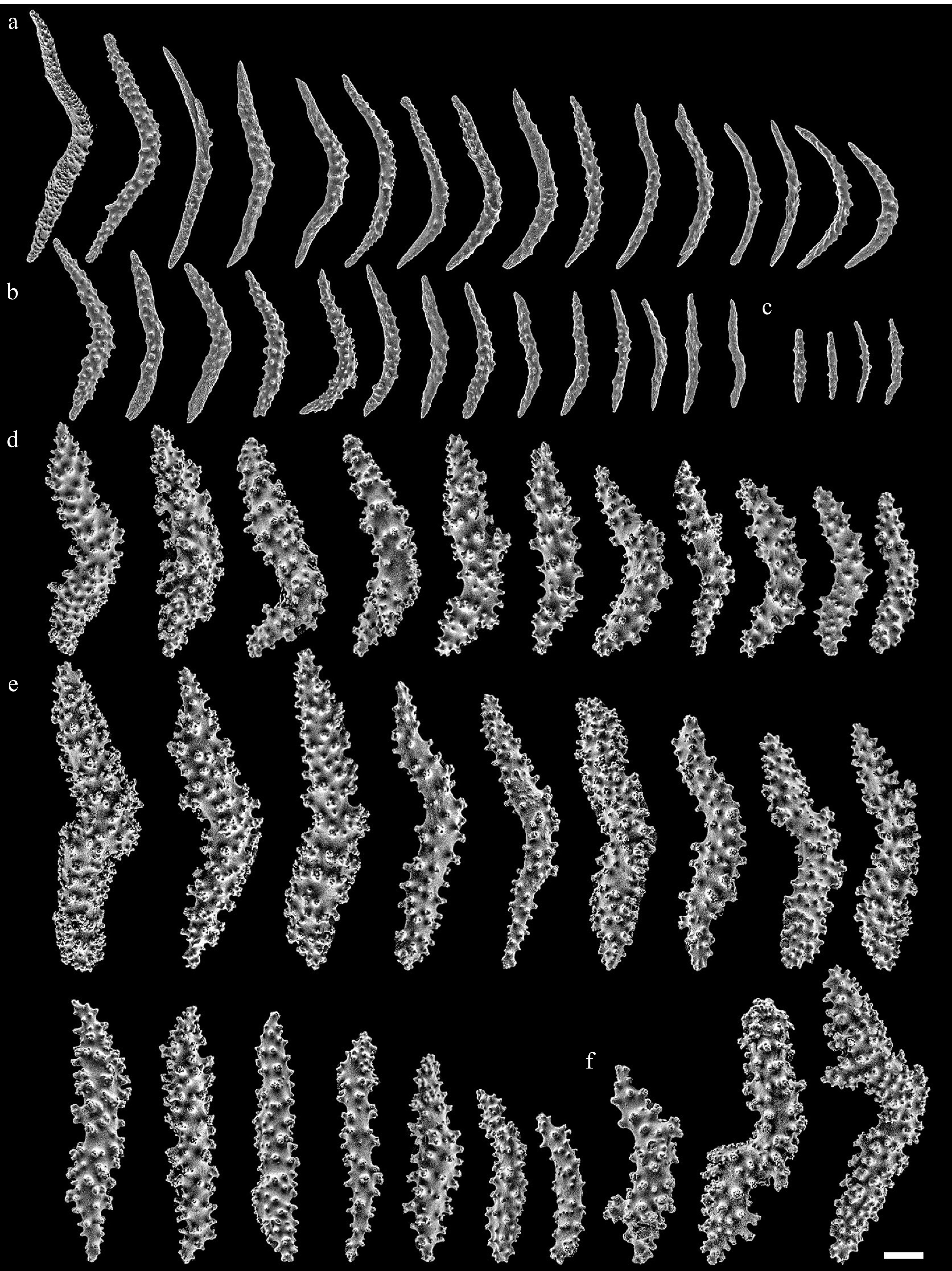
Figure 2.
Curvagorgia caerulea gen. et sp. nov., holotype, GXTCMU–2025–HT006. Anthocodial sclerites: (a) collaret spindles; (b) point spindles; (c) tentacular spindles and rods. Calicular sclerites: (d) curved warty spindles. Coenenchymal sclerites: (e) warty spindles; (f) branched spindles. Scale bars = 0.1 mm.
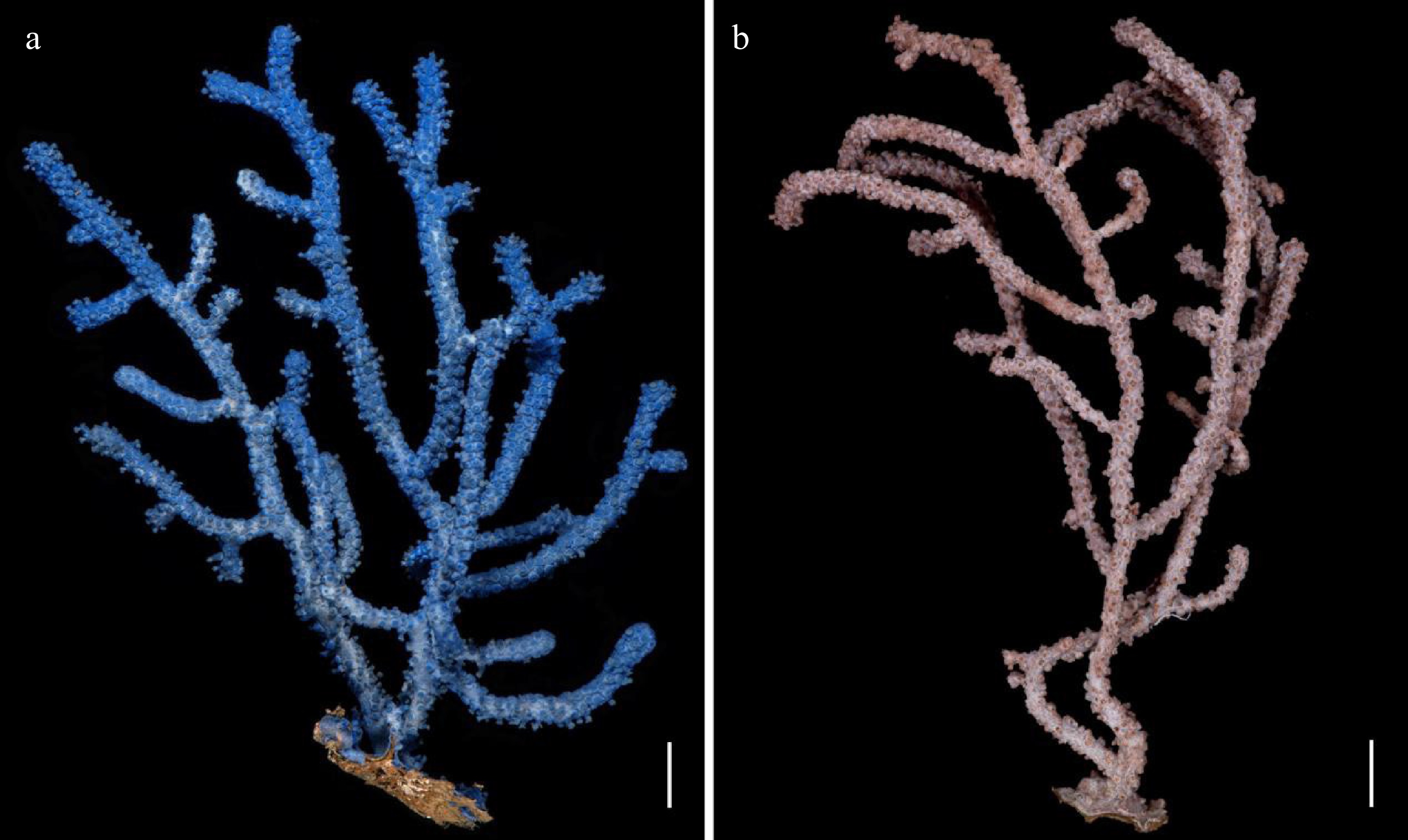
Figure 3.
Curvagorgia caerulea gen. et sp. nov., paratypes. (a) GXTCMU–2025–PT005 after collection; (b) GXTCMU–2025–PT006 after preservation in ethanol. Scale bars = 1 cm.
Material examined. Holotype: GXTCMU–2025–HT006=XDY001, East China Sea. Xiongdi Islets; 27 m; 23°31'27"N, 117°40'30"E; 20 April 2025. Paratypes: GXTCMU–2025–PT005=XDY002, East China Sea. Xiongdi Islets; 27 m; 23°31'27"N, 117°40'30"E; 20 April 2025. GXTCMU–2025–PT006=WLD015, South China Sea. Wailingding Island; 19 m; 22°06'10"N, 114°02'26"E; 22 August 2025.
Diagnosis. Colony arborescent, axis horny with a hollow, cross-chambered core. Polyps fully retractile in low conical calyces on all sides of branches. Anthocodial armature consisting of a collaret and points; each point formed by two oppositely bent spindles converging laterally into a triangular configuration; collaret comprising 2–3 rows of spindles. Tentacles with flattened rods and spindles. Calicular sclerites in eight loose longitudinal bands. Coenenchyme and calyces consisting of curved or straight spindles, often blunt at both ends; all with complex warts. The nomenclatural act has been registered in ZooBank under the following LSID: urn:lsid:zoobank.org:act:7647A9E2-255D-45F4-B75E-5CD85FF3FD38.
Description. The holotype colony is arborescent, 15.8 cm in height and 8.5 cm in width. The holdfast is nearly circular, measuring about 2.6 cm in length and 2.1 cm in maximum width. Two cylindrical stems, each approximately 6 mm in diameter, arise from the base. The axis is horny and encloses a hollow, cross-chambered central core. Branching is irregularly dichotomous. Lateral branches arise at intervals of approximately 11 mm along the main stem. Terminal branchlets are enlarged and curved, 0.7–3.5 cm long and 0.4–0.6 cm wide (Fig. 1a–b).
Most polyps are completely retracted into the calyces, a few are preserved partially exserted, with the anthocodiae visible; these measure approximately 0.7 mm in diameter and 2–3 mm in height. The anthocodial armature consists of a collaret and points composed of large, curved spindles and a few straight spindles. Each point is formed by two oppositely arranged bent spindles, converging in lateral view to form a triangular configuration; the collaret comprises 2–3 transverse rows of sclerites (Fig. 1c–f). Calyces are conical and distributed on all sides of the branches, spaced 0.3–1.5 mm apart. Calyces are relatively sparse on the main stem but become more abundant on smaller branches and towards the branch tips, measuring 0.5–0.7 mm in height and 1.1–1.3 mm in basal diameter (Fig. 1g).
Collaret sclerites are predominantly curved and only rarely straight, with relatively sparse, low-relief warts distributed unevenly over the surface, whereas the terminal portions are usually smoother and only weakly ornamented, measuring 0.3–0.65 mm in length and 0.02–0.07 mm in width (Fig. 2a). Point sclerites are mainly curved spindles with sparse, low surface warts, measuring 0.2–0.5 mm in length and 0.01–0.06 mm in width (Fig. 2b). Tentacles contain small rods and spindles; the rods bear few surface warts and are often blunt at both ends, measuring 0.09–0.20 mm in length and 0.01–0.03 mm in width. These tentacular sclerites are arranged longitudinally and sometimes irregularly (Fig. 2c).
The calicular sclerites are organized into eight loose longitudinal bands. Each band comprises 4–7 spindles arranged longitudinally or slightly obliquely. The spindles are predominantly curved and project vertically above the coenenchymal sclerites. Their surfaces bear dense, complex warts that are larger and more prominent than those on the anthocodial sclerites, measuring 0.3–0.6 mm in length and 0.03–0.15 mm in width, and are often blunt at both ends (Fig. 2d).
Coenenchymal sclerites are dominated by curved spindles similar to those of the calyces, with rare straight spindles and irregularly branched forms also present. The spindles measure 0.3–0.8 mm in length and 0.02–0.21 mm in width, and are often blunt at one or both ends (Fig. 2e). The irregularly branched forms measure 0.4–0.8 mm in length and 0.03–0.27 mm in width. Their surfaces bear coarse, complex warts, some of which are transversely elongate (Fig. 2f).
Variation of paratypes. The two paratypes are highly similar to the holotype in their branching pattern and sclerites, with minor differences in branching density and the spacing between the calyces (Fig. 3).
Type locality. The subtidal zone of Xiongdi Islets with water depth of 27 m.
Etymology. The specific epithet "caerulea" refers to the bright blue color of the living colony. The Chinese name of the new species is "梦之蓝曲柳珊瑚", referring to its dreamlike blue coloration.
Distribution and habitat. Known from the Xiongdi Islets in the East China Sea and Wailingding Island in the South China Sea at depths of 19–27 m. Colonies occur attached to rocky substrates in subtidal habitats.
Color. Colony bright blue in situ (Fig. 1a), grayish white in ethanol (Fig. 1b); all sclerites colorless.
Remarks. Curvagorgia caerulea gen. et sp. nov. most closely resembles Calicogorgia investigatoris Thomson & Henderson, 1906, in having conical calyces and calicular sclerites arranged in eight bands. It differs from C. investigatoris in having an arborescent rather than planar colony; calyces distributed on all sides of the branches rather than laterally within a single plane; calicular sclerites arranged in eight loose longitudinal bands rather than in eight bands, each composed of two distinct rows; and anthocodial points defined by two oppositely arranged spindles rather than by three pairs of spindles. The polyp and calyx sclerites are also smaller in the new species (0.09–0.65 vs 0.16–1.4 mm)[22].
The new species further differs from other species of Calicogorgia in having a well-developed armature with a collaret and points, and calicular sclerites arranged in eight loose longitudinal bands. In C. rubrotincta, C. granulosa, and C. tenuis, the anthocodial armature is poorly differentiated or absent, and the calicular sclerites are irregularly arranged, chevron-shaped, or otherwise organized differently. Coenenchymal sclerites are also markedly smaller in C. caerulea gen. et sp. nov. than in C. rubrotincta and C. tenuis, although they overlap in size with those of C. granulosa[22,26,27].
Among the described species of Menacella, the new species most closely resembles Menacella gracilis Thomson & Simpson, 1909, in having a differentiated armature with collaret and points. It differs from M. gracilis in having an arborescent rather than planar colony, low conical rather than dome-shaped calyces, calyces distributed on all sides of the branches rather than predominantly laterally, points defined by two oppositely arranged spindles rather than by four to five spindles, and calicular sclerites arranged in eight longitudinal bands rather than in a chevron pattern. Coenenchymal sclerites are also smaller in the new species. It differs from other species of Menacella in the combination of an arborescent colony, conical calyces, double-spindle points, and longitudinally banded calicular sclerites[24,27−29].
Within Anthomuricea, the new species is most similar to Anthomuricea aberrans Nutting, 1912, in its general colony architecture, but differs in having low conical calyces, points defined by two oppositely arranged spindles rather than by three spindles, and calicular sclerites arranged in eight longitudinal bands rather than in a chevron pattern. Coenenchymal sclerites are also consistently smaller in the new species[30]. Curvagorgia caerulea gen. et sp. nov. also differs from other species of Anthomuricea (A. argentinae Wright & Studer, 1889; A. brunnea Nutting, 1910; A. divergens Kükenthal, 1919; A. reticulata Nutting, 1910; A. sanguinea Nutting, 1910; A. simplex Whitelegge, 1897; A. tenuispina Nutting, 1908; A. timorensis Nutting, 1910; and A. antillarum Aurivillius, 1931) in the combination of an arborescent colony, calyces distributed on all sides of the branches, a differentiated armature with a collaret and points, and calicular sclerites arranged in longitudinal bands rather than in chevron or converging-row patterns[28,31−35]. Morphological comparisons between Curvagorgia caerulea gen. et sp. nov. and selected species of Calicogorgia, Menacella, and Anthomuricea are provided in Supplementary Table S3.
Although Curvagorgia caerulea gen. et sp. nov. is recovered as a sister to the sampled Anthogorgia lineage in the phylogenomic analyses, it differs markedly from A. divaricata and A. ochracea in having low conical calyces and a well-developed armature with a collaret and points. In A. divaricata and A. ochracea, calyces are absent, the anthocodial armature is not differentiated into well-developed collarets and points, and the coenenchymal sclerites are dominated by nonbranched, highly warty spindles that remain largely within the submillimeter size range[23].
Phylogenomic analysis of the UCE dataset
-
The UCE dataset included 55 specimens: 14 newly sequenced specimens and 41 comparative specimens represented by publicly available datasets from the SRA or GSA or by unpublished resequencing data provided by our collaborators (Figs 4 and 5). The newly sequenced material included three specimens of Curvagorgia caerulea gen. et sp. nov. (WLD015, XDY001, XDY002) (Figs 1 and 3). GeneMiner2 recovered 633–2,789 UCE loci per specimen (mean ± standard deviation [SD] = 2,226 ± 467). Of the 3,020 loci recovered across all specimens, 2,438 were retained in the final 60% taxon occupancy matrix. The concatenated matrix included 55 taxa and 434,787 aligned sites, of which 158,264 sites were parsimony-informative (36.4% of aligned sites).
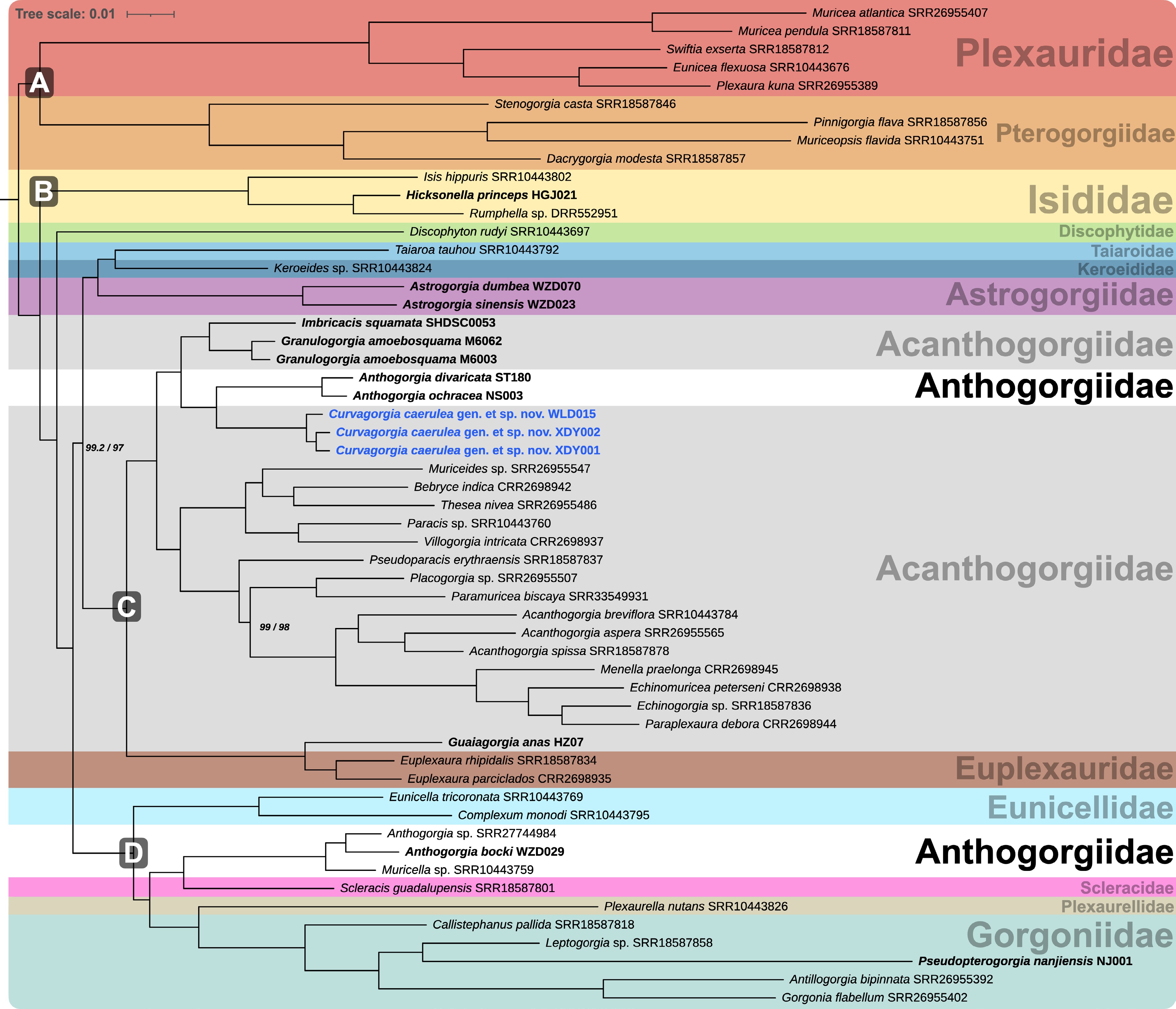
Figure 4.
Maximum likelihood phylogeny of the M8 clade of Malacalcyonacea inferred from the UCE data (60% taxon occupancy). Branch support is reported as the SH-aLRT/ultrafast bootstrap value; values are shown only for nodes where either metric is < 99. Samples labeled with public accession numbers represent datasets downloaded from the SRA or GSA repositories; other comparative samples are labeled by voucher or sample codes. Newly obtained sequences are shown in bold, and newly added taxa are highlighted in blue. Labels (A)–(D) mark the portions of the tree corresponding to M8 Clades A–D.
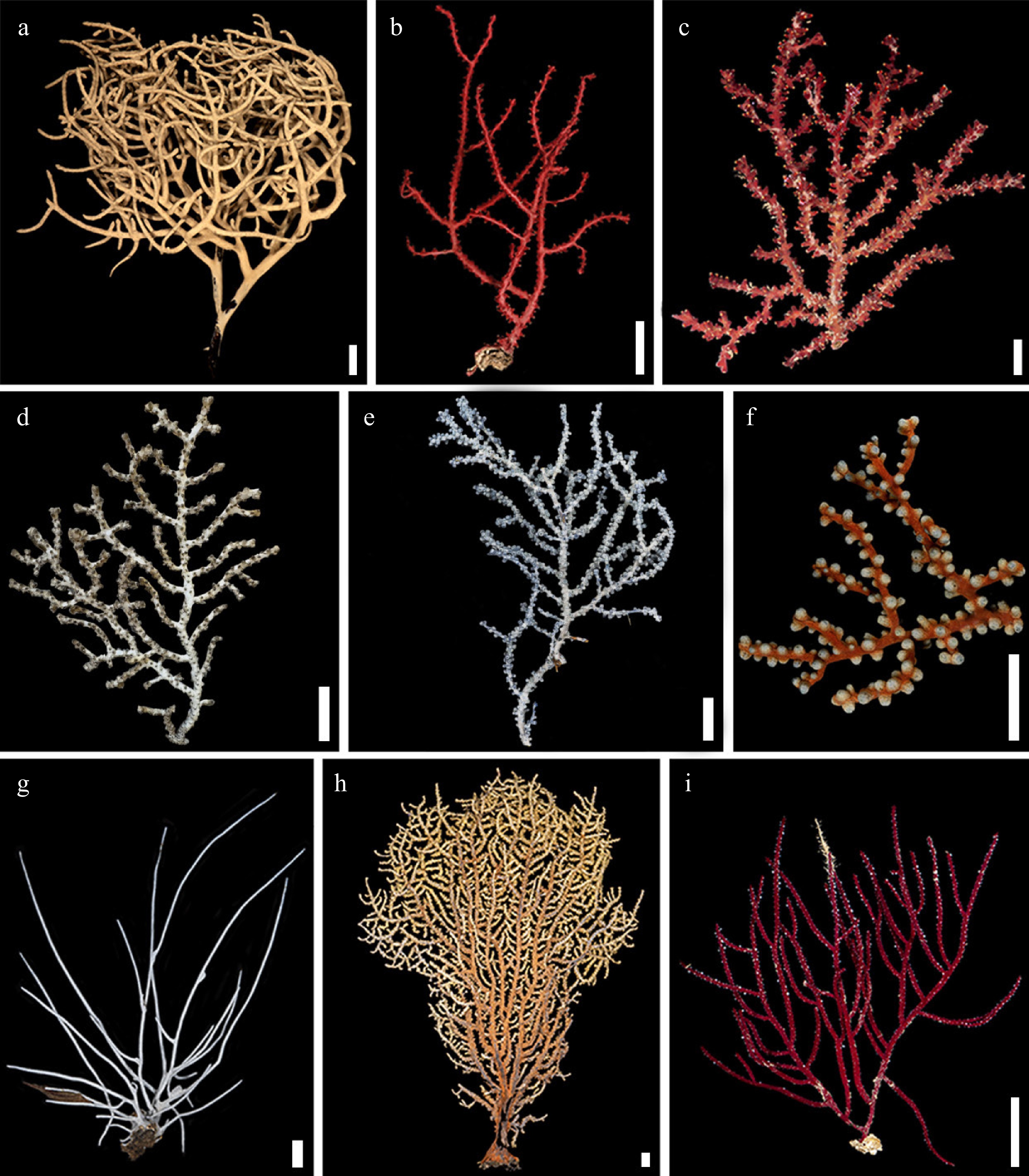
Figure 5.
Photographs of colonies corresponding to boldfaced labels in the UCE phylogenetic tree. (a) Hicksonella princeps Nutting, 1910 (HGJ021); (b) Astrogorgia dumbea Grasshoff, 1999 (WZD070); (c) Astrogorgia sinensis (Verrill, 1865) (WZD023); (d) Imbricacis squamata (Nutting, 1910) (SHDSC0053); (e) Anthogorgia divaricata Verrill, 1865 (ST180); (f) Anthogorgia ochracea Grasshoff, 1999 (NS003); (g) Guaiagorgia anas Grasshoff & Alderslade, 1997 (HZ07); (h) Anthogorgia bocki Aurivillius, 1931 (WZD029); (i) Pseudopterogorgia nanjiensis Sun, Xu & Zhan, 2024 (NJ001). Scale bars = 2 cm.
In the maximum likelihood tree inferred from the 60% taxon occupancy matrix, all sampled taxa were recovered within M8 of Malacalcyonacea (Fig. 4). The backbone topology was consistent with the M8 framework of McFadden et al.[7], with four principal lineages corresponding to Clades A–D. Clade A included plexaurid and pterogorgiid representatives; Muricea spp. formed a lineage with Swiftia, Eunicea, and Plexaura, whereas Stenogorgia was placed with Dacrygorgia, Pinnigorgia, and Muriceopsis. Clade B included Isis hippuris, Hicksonella princeps, Rumphella sp., and Discophyton rudyi, with Hicksonella princeps and Rumphella sp. recovered as sister taxa. Clade D included Eunicella tricoronata, Complexum monodi, Scleracis guadalupensis, Anthogorgia bocki, Anthogorgia sp., Muricella sp., Plexaurella nutans, Callistephanus pallida, Leptogorgia sp., Pseudopterogorgia nanjiensis, Antillogorgia bipinnata, and Gorgonia flabellum (Fig. 4).
Clade C included Curvagorgia gen. nov. and several taxa currently assigned to, or historically associated with, the Acanthogorgiidae. The lineage recovered as sister to Clade C comprised Taiaroa tauhou, Keroeides sp., and the Astrogorgia lineage represented by A. dumbea and A. sinensis. Within Clade C, Imbricacis squamata was sister to the two samples of Granulogorgia amoebosquama (M6003, M6062). The three specimens of Curvagorgia caerulea gen. et sp. nov. formed a fully supported clade, with XDY001 and XDY002 forming a sister pair. This clade was sister to the Anthogorgia divaricata + A. ochracea lineage with maximal support (SH-aLRT/UFBoot = 100/100; Fig. 4).
Within the remainder of Clade C, Muriceides sp. was sister to (Bebryce indica + Thesea nivea), and Paracis sp. was sister to Villogorgia intricata. Pseudoparacis erythraensis was sister to a larger lineage comprising Paramuricea biscaya and Placogorgia sp., and a clade including Acanthogorgia, Menella, Echinomuricea, Echinogorgia, and Paraplexaura. Within the latter clade, Acanthogorgia breviflora, A. aspera, and A. spissa formed a clade, and Menella praelonga was sister to (Echinomuricea peterseni + [Echinogorgia sp. + Paraplexaura debora]) (Fig. 4).
Anthogorgia was not recovered as monophyletic. Anthogorgia divaricata and A. ochracea were placed in Clade C, whereas A. bocki was recovered in Clade D with Anthogorgia sp. and Muricella sp.; A. bocki and Muricella sp. were recovered as sisters (SH-aLRT/UFBoot = 98.9/98). Guaiagorgia anas was recovered within Clade C, but not with the other sampled acanthogorgiid-like taxa; instead, it was sister to Euplexaura rhipidalis and E. parciclados (SH-aLRT/UFBoot = 100/100). These results indicate that, according to the present sampling, taxa currently assigned to Anthogorgia and several acanthogorgiid-like groups are not consistently recovered as single lineages within M8. Curvagorgia caerulea gen. et sp. nov. formed a distinct, fully supported lineage in Clade C, sister to the sampled A. divaricata + A. ochracea lineage, and was clearly separated from all other sampled taxa in the UCE phylogeny. Additional morphological images of comparative taxa are provided in Supplementary Fig. S1, including scanning electron micrographs of the polyps and sclerites of A. divaricata, A. ochracea, and A. bocki, and light micrographs of the sclerites of Hicksonella princeps Nutting, 1910; Astrogorgia dumbea Grasshoff, 1999; Astrogorgia sinensis (Verrill, 1865); Imbricacis squamata (Nutting, 1910); Guaiagorgia anas Grasshoff & Alderslade, 1997; and Pseudopterogorgia nanjiensis Sun, Xu & Zhan, 2024. Light microscopy images are included for specimens for which scanning electron microscopy (SEM) images of the sclerites were not available, except Granulogorgia amoebosquama M6062 and M6003.
-
The UCE phylogeny recovered here is consistent with the M8 framework of Malacalcyonacea proposed by McFadden et al.[7] and does not alter the broader arrangement of the principal lineages. Its contribution is instead at a lower taxonomic level, where the denser sampling in and around Clade C provides a framework for evaluating the generic limits among acanthogorgiid-like taxa. This part of M8 includes several genera whose historical assignments have been based largely on colony form and spindle-dominated sclerite assemblages, characters that are now known to be labile at multiple taxonomic levels. In this context, the placement of Curvagorgia gen. nov. provides an additional example of the mismatch between traditional morphology-based assignments and genome-scale phylogenetic structure.
Phylogenomic position and diagnosis of Curvagorgia
-
Within M8 Clade C, Curvagorgia caerulea gen. et sp. nov. is recovered as a fully supported lineage sister to the sampled Anthogorgia lineage represented by A. divaricata and A. ochracea. This relationship provides the closest phylogenomic comparison currently available for the new genus, but it does not support placement of the new species in Anthogorgia as that genus is currently understood. Curvagorgia has fully retractile polyps seated in low conical calyces, a well-developed armature with a collaret and points, points formed by two oppositely arranged bent spindles, and calicular sclerites arranged in eight loose longitudinal bands that do not resolve into two distinct rows. In the examined Anthogorgia species, calyces are absent, the anthocodial armature is not differentiated into well-developed collarets and points, and the polyps retract only incompletely into the coenenchyme[23].
The closest morphological comparison currently available is with Calicogorgia, but the available morphological evidence does not support the assignment of Curvagorgia gen. nov. to that genus. Curvagorgia differs from Calicogorgia in having an arborescent rather than planar colony, low conical calyces distributed on all sides of the branches rather than laterally within a single plane, and calicular sclerites arranged in eight loose longitudinal bands rather than in eight bands, each composed of two distinct rows. These differences involve character systems commonly used in octocoral generic diagnoses and are not readily interpreted as variation in colony robustness or sclerite size alone. The comparison must remain cautious, however, because Calicogorgia was not included in the present UCE matrix and its relationship to Curvagorgia cannot be tested directly here. Awbrey[12] recovered sampled Calicogorgia species as sister to Discophyton rudyi (Verseveldt & van Ofwegen, 1992) in a UCE phylogeny, and the D. rudyi sequences used here are identical to those in Awbrey's dataset. In the absence of Calicogorgia from our matrix, that result is relevant background information rather than direct evidence for the placement of Curvagorgia.
The conspicuous blue coloration of Curvagorgia caerulea may warrant future attention. In freshly preserved material, the pigment was readily extracted into ethanol, suggesting an alcohol-soluble compound rather than structural coloration alone. Although its chemical identity was not examined here, azulene-related compounds have been reported in other gorgonians, including an unidentified Anthogorgia species and Acanthogorgia laxa, and some show antifouling or antibiotic activity[36,37]. We therefore do not treat the blue coloration as diagnostic for Curvagorgia gen. nov., but note that it may be useful for future chemical, taxonomic, or ecological studies.
Morphological convergence or parallel evolution is common in octocorals, particularly in characteristics such as colony form, calyx development, and spindle-dominated sclerite assemblages[5,7,38]. We therefore base the taxonomic treatment of Curvagorgia gen. nov. on the combined evidence of its phylogenetic placement and morphology. The UCE tree recovers Curvagorgia as a fully supported lineage in M8 Clade C, sister to but distinct from the sampled A. divaricata + A. ochracea lineage, and the new genus is diagnosable by a combination of characteristics not found in Anthogorgia, Calicogorgia, or the other comparable genera discussed above. We therefore recognize Curvagorgia gen. nov. as a distinct genus within M8 Clade C. Following current usage, we provisionally assign Curvagorgia gen. nov. to the Acanthogorgiidae because it falls among the acanthogorgiid-like taxa in M8 Clade C and shares the general morphological features historically used to recognize that assemblage. This placement should be treated as operational, pending broader type-based phylogenomic sampling.
Taxonomic discordance in Anthogorgia and Guaiagorgia
-
Beyond the placement of Curvagorgia gen. nov., the present phylogeny also highlights broader taxonomic discordance among acanthogorgiid-like and anthogorgiid-like taxa in M8 Clades C and D. Anthogorgia is not recovered as monophyletic. In Clade C, A. divaricata and A. ochracea form a maximally supported clade that is sister to Curvagorgia, whereas A. bocki is recovered in Clade D in addition to Anthogorgia sp. and Muricella sp. This result is consistent with recent UCE-based studies that have also questioned the monophyly of nominal Anthogorgia[12]. Although morphology alone does not resolve the genus, the available characteristics are broadly consistent with this split: Clade C species lack calyces, do not possess a well-developed armature with a collaret and points, and have coenenchymal sclerites dominated by mostly unbranched, submillimeter spindles[23], whereas A. bocki has a broader size range of coenenchymal spindles and occasional branched elements[28].
A comparable discordance between current family-level placement and phylogenomic position is observed in Guaiagorgia. Guaiagorgia anas, the type and only described species of Guaiagorgia[39], has been reported in the western Pacific, including Hong Kong's waters[40]. The present record from Sanmen Island, Huizhou, eastern Guangdong, just east of Hong Kong, adds a northern South China Sea locality for the species. McFadden et al.[7] provisionally assigned Guaiagorgia to Paramuriceidae on the basis of mtMutS, noting that phylogenomic data were unavailable and that the genus lacked some characteristics typical of that family. Although Guaiagorgia is currently listed as being in the Acanthogorgiidae in the World List of Octocorallia[9], the present UCE dataset recovers G. anas within M8 Clade C but not with the other sampled acanthogorgiid-like taxa; instead, it is sister to Euplexaura (Fig. 4). This placement provides new phylogenomic evidence bearing on the familial position of Guaiagorgia and supports the reassessment of diagnostic characteristics and family-level assignments among acanthogorgiid-like taxa in M8 Clade C, pending broader sampling.
We are grateful to Prof. Xinqing Zheng, Dr. Jianjia Wang, Mr. Cheng Yang, Mr. Longhuang Chen, and Mr. Xuanzhong Chen for assistance with sample collection; to Ms. Biying Luan and Ms. Meijuan Chen for technical assistance and support during the laboratory work; and to Prof. Kuidong Xu for kindly providing the sequencing data of Granulogorgia amoebosquama used in the phylogenomic analyses of this study. We are especially grateful to Mr. Zizhen Tang for developing GeneMiner2.
-
This work is registered in ZooBank under LSID: urn:lsid:zoobank.org:pub:A4010483-C887-48A7-9F97-B045723F3EED
-
The authors confirm their contributions to the paper as follows: investigation, morphological examination, and taxonomic description: You L; sample collection: Liu X, Liu L, Roeroe KA; specimen photography: Liu X, Liu L; molecular experiments and bioinformatic analyses: Xia F; writing − original draft: You L, Xia F, Liu X; writing − review and editing: Tang R, Xia F, Liu X. All authors reviewed the results and approved the final version of the manuscript.
-
Raw sequencing data generated in this study have been deposited in the Genome Sequence Archive (GSA) of the China National Center for Bioinformation (CNCB) under BioProject PRJCA060560[41,42]. The comparative read datasets for Granulogorgia amoebosquama specimens M6062 and M6003 were provided by Prof. Kuidong Xu and are not publicly available at present because of data release restrictions. Dataset information, accession numbers, and sequencing statistics for newly generated, publicly available, and collaborator-provided datasets used in the phylogenetic analyses are provided in Supplementary Table S2.
-
The authors declare no conflicts of interest.
-
This accompanies this paper online at: https://doi.org/10.48130/jzser-0026-0001.
-
# Authors contributed equally: Li You, Fei Xia
- Supplementary Table S1 Specimen information and voucher deposition for all specimens used in this study.
- Supplementary Table S2 Dataset information, accession numbers, and sequencing statistics for newly generated, publicly available, and collaborator-provided datasets used in the phylogenetic analyses.
- Supplementary Table S3 Morphological comparison between Curvagorgia caerulea gen. et sp. nov. and some species of Calicogorgia, Menacella, and Anthomuricea.
- Supplementary Fig. S1 Additional morphological images of comparative taxa used in the phylogenomic analysis, including SEM images of Anthogorgia divaricata, A. ochracea, and A. bocki, and light-microscope images of specimens lacking SEM sclerite images, except Granulogorgia amoebosquama M6062 and M6003.
- Copyright © 2026 by the author(s). Journal of Zoological Systematics and Evolutionary Research published by Maximum Academic Press on behalf of John Wiley & Sons Ltd. This is an open access article under the terms of the Creative Commons Attribution License, which permits use, distribution and reproduction in any medium, provided the original work is properly cited.
-
About this article
Cite this article
You L, Xia F, Tang R, Roeroe KA, Liu L, et al. 2026. Integrative taxonomy and phylogenomics support a new genus and species of Acanthogorgiidae (Octocorallia: Malacalcyonacea) from China: Curvagorgia caerulea gen. et sp. nov. Journal of Zoological Systematics and Evolutionary Research 2026: e001 doi: 10.48130/jzser-0026-0001 

Integrative taxonomy and phylogenomics support a new genus and species of Acanthogorgiidae (Octocorallia: Malacalcyonacea) from China: Curvagorgia caerulea gen. et sp. nov.
- Received: 31 March 2026
- Revised: 14 May 2026
- Accepted: 10 June 2026
- Published online: 22 July 2026
Journal of Zoological Systematics and Evolutionary Research
2026,
Article number: e001 (2026)
|
Cite this article
Abstract: Recent phylogenomic studies have clarified many higher-level relationships within Octocorallia, but the generic boundaries of many acanthogorgiid-like taxa within Malacalcyonacea remain poorly defined. During shallow-water surveys along the coast of China, we collected three gorgonian colonies that could not be assigned confidently to any described genus on the basis of comparative morphology. Using an integrative approach combining colony, polyp, and sclerite morphology with ultraconserved element (UCE) phylogenomics, we recovered these specimens as a distinct lineage within Malacalcyonacea M8 Clade C, sister to the sampled Anthogorgia lineage comprising A. divaricata and A. ochracea with maximal support (SH-aLRT/UFBoot = 100/100). The new lineage is distinguished from its phylogenomic relatives by the following combination of characters: colony arborescent; polyps fully retractile in low conical calyces on all sides of the branches; anthocodial armature consisting of a collaret and points; calicular sclerites arranged in eight loose longitudinal bands; coenenchyme and calyces with warty or occasionally branched spindles, some blunt-ended. It differs morphologically from the most similar genus, Calicogorgia, in having calyces distributed on all sides of the branches (vs. laterally arranged) and calicular sclerites in eight loose longitudinal bands (vs. eight bands each composed of two distinct rows). We therefore establish Curvagorgia gen. nov. and describe Curvagorgia caerulea gen. et sp. nov. as the type species by monotypy.
-
Key words:
- Acanthogorgiidae /
- Integrative taxonomy /
- Malacalcyonacea /
- Octocorallia /
- Phylogenomics /
- Ultraconserved elements /
- China