-
-
-
Category Conserved coordination motif Representative structure Primary function Ref. C2H2 CX2–4CX3FX5LX2HX3–5H ββα fold DNA-binding activity and transcriptional regulatory function [26−28] CCCH C-X7–8-C-X5-C-X3-H Zinc finger domain RNA-binding activity and nucleocytoplasmic transport function [27,34,35] RING C-X2-C-X9–39-C-X1–3-H... RING finger domain E3 ubiquitin ligase [41,42] Table 1.
Typical structure and function of ZFPs.
-
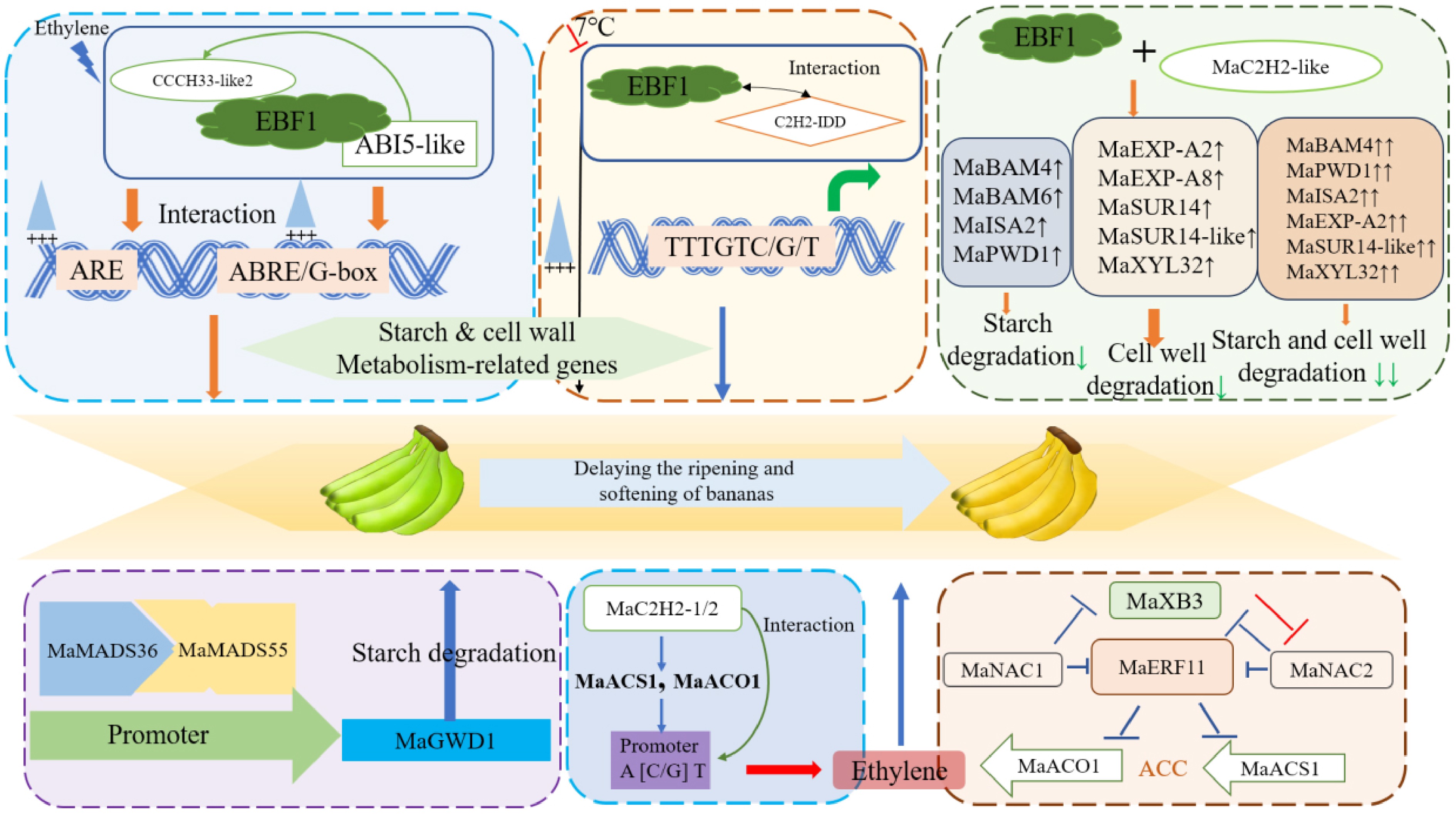
Fruit Zinc finger proteins Regulatory roles/genes Results Ref. Tomato SlCHYR1 NCED1/2↑, ACS2↑, ACO1↑, ET↑, ABA↑ SlCHYR1 promotes tomato fruit ripening through the production and signaling of ABA and ET [18] Pineapple CCCH AcC3H7↑, AcC3H9↑, AcC3H1↓, AcC3H8↓ May contribute to fruit ripening by regulating stress-response metabolism. [20] 'Fenjiao' (Musa ABB Pisang Awak) MaC2H2-like zinc finger protein MaSUR14-like↑, MaBAM4↑, MaISA2↑, MaEXP-A2↑, MaPWD1↑, and MaXYL32↑ Suppress starch degradation and cell wall disassembly [49] 'Fenjiao' (Musa ABB Pisang Awak) MaCCCH33-like2 β-d-xylosidase23 (MaXYL23)↑, sugar transporter14-like (MaSUR14-like)↑, and isoamylase2 (MaISA2)↑ Delay the ripening and softening of bananas [51] Kiwifruit AdDof3 AdBAM3L (β-amylase)↑ Specifically suppress the activity of key starch-degrading enzymes, such as β-amylase, starch phosphorylase, and debranching enzyme, to retard the conversion of starch into soluble sugars [53] Peach fruit PpGATA12 PpSS↑, PpNI↑, PpCCO↑, PpSDH↑ Sustain elevated sucrose accumulation and robust energy metabolism to enhance cold tolerance and suppress postharvest ripening [54] Banana MaZFP6 and MaWLIM2 jointly constitute a transcriptional repression module MaRZF1↓, MaSGR1↓ Alleviate high temperature-induced color abnormalities and concurrently delay fruit ripening [56] Banana MaRZF1 MaSGR1↓ MaRZF1 modulates high temperature-induced green ripening of banana by degrading MaSGR1 [57] 'Xuxiang' kiwifruit AdZAT5 AdPL5↑, Adβ-Gal5↑ Overexpression of the AdZAT5 enhances pectin degradation during kiwifruit ripening, whereas genetic suppression of AdZAT5 delays both ripening progression and textural softening [58] 'Jinguang' apple MdZF-HD11 Mdβ-GAL18↑ Overexpression of the MdZF-HD11 and Mdβ-GAL18 synergistically accelerates postharvest softening in apple fruit [59] Solanum lycopersicum SlZFP2 NOTABILI↓, SITIENS↓, FLACCA↓, SlAO1↓ Pharmacological or genetic inhibition of ABA biosynthesis delays fruit ripening by suppressing key ripening-associated physiological and molecular events [60] Tomato SlPZF1 SlCYCD3;1↑, SlCDKB↑ Delay fruit softening [66] Tomato MdZFP3 MdPG1↓, MdPL5↓ MdZFP3 forms a transcriptional repressor complex with MdTPL4 and MdHDA19, which delays fruit softening [67] Kiwifruit AdBBX32 AdMYB19↓, AdEXP3↓ Fruit maturation and tissue softening exhibited delayed progression [69] Kiwifruit AcZFP3 AcAO9↓ The onset of ripening and textural softening in the fruit was postponed [70] Apple MdZAT10 JA↑ MdZAT10 delays the ripening and senescence of apples by interacting with MdBT2 [71] Apple MdMYB90-like MdCHS↑, MdUFGT↑, MdMYB1↑, MdbHLH3↑ Accelerate apple ripening [72] Solanum lycopersicum SlZAT5 SlACS4↓, SlPL8↓, SlGRAS38↓ Knocking out SlZAT5 can delay fruit ripening and softening [73] Table 2.
Regulatory roles of ZFPs in postharvest ripening and softening of fruits and vegetables.
-
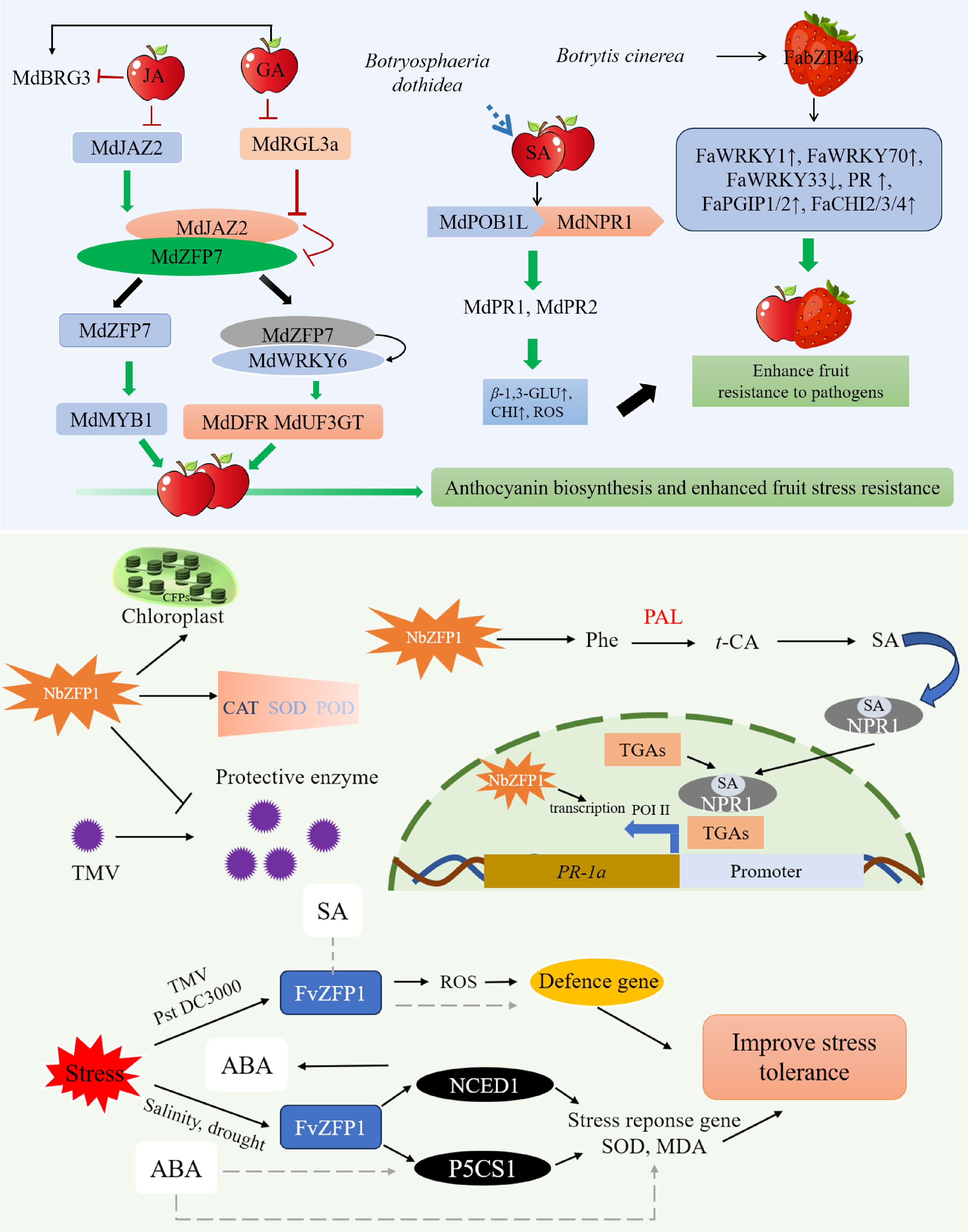
Fruit Zinc finger proteins Regulatory roles/genes Results Ref. Capsicum annuum CAZFP1 protein PR-1↑ Conferring enhanced resistance to Pseudomonas syringae pv. tomato in tomato via heterologous expression [28] Grapes VvZFP11 AtPR1↑, AtPDF1.2↑ Grape plants resist Golovinomyces cichoracearum, and heterologous expression of AtPR1 and AtPDF1.2 upregulates both genes [75] Banana MaC3HC4-1 MaABI5↑, ABA↑ High levels of ABA induce the auto-ubiquitination and degradation of MaC3HC4-1, leading to the accumulation of MaABI5, which in turn activates ABA signaling and regulates fruit cold tolerance [76] Banana MdABI5-like ABA↑ The MaABI5 protein modulates ABA-induced cold tolerance by increasing the levels of unsaturated fatty acids and flavonoids [77] Kiwifruit AcC3H1 SA (TGA-, PR1-, and NPR1-like)↑ Overexpression of AcC3H1 may promote EIN3-mediated disease resistance in the ethylene pathway. Overexpression of AcREM14 and AcC3H1 increases the expression of enzymes associated with the SA pathway, thus enhancing kiwifruit resistance to Pseudomonas syringae pv. [79] Citrus ZFPs ClSUP and ClDOF3.4 ClSUP interacts with the coat protein (CP) of CYVCV ClDOF3.4 enhances ClSUP–CP interaction in vivo and in vitro, and likely regulates ClSUP expression upstream to coordinate ROS accumulation and SA signaling for CYVCV resistance in Eureka lemon [87] Soybean GmZFP03 The stress response element (DSREL) combining the promoters of SOD1-03 and SOD1-19 genes Conferring enhanced resistance to Phytophthora sojae in soybean [92] Potato StZFP2 OE StZFP2, JA↑ StZFP2 overexpression modulates jasmonic acid (JA) accumulation post-infection and suppresses lesion development, thereby enhancing potato resistance to Phytophthora infestans [93] Manihot esculenta Crantz MeZFP67 MeZFP67 physically interacts with MeAHL17 MeZFP67h and MeAHL17 physically interact to directly activate MeRbohD transcription, thereby modulating ROS accumulation and immune responses upon pathogen infection [94] Pepper CsCZFs CsCZF1 physically interacts with CsHOX2 CsHOX2 positively regulates CsCZF1 expression. CsCZF1 directly drives conidiophore-to-conidia differentiation, suppressing Colletotrichum scovillei reproduction and limiting infection [95] Kiwifruit KWSAP5 avrPto5 directly interacts with both KWSAP5 and KWML3 Loss of avrPto5 may impair immune signaling, thereby enhancing pathogenicity [96] Banana MaC2H2s MaICE1 MaC2H2s participates in the cold stress response of banana fruit by inhibiting the transcription of MaICE1 [97] Table 3.
Zinc finger proteins and the role of plant hormones they mediate in the defense against plant diseases in fruits and vegetables.
Figures
(2)
Tables
(3)