-
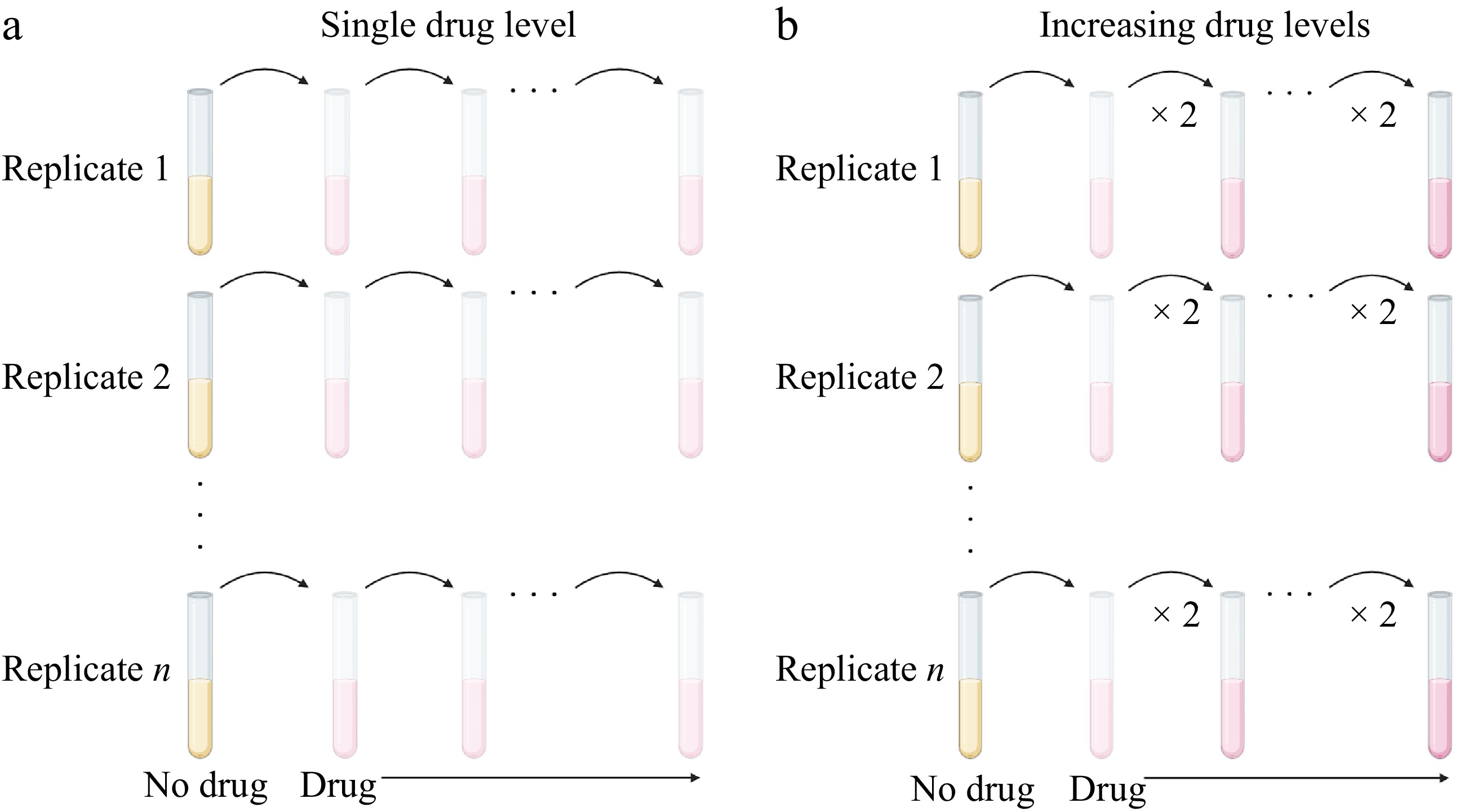
Figure 1.
Common broth microdilution drug exposure protocols for experimental evolution. Note that for both experimental evolution protocols, n represents the total number of replicate populations utilized. (a) The procedure using a single drug level exposes n susceptible fungal replicates to drug solutions with the same concentration over multiple growth periods. (b) The procedure with increasing drug levels exposes n susceptible fungal replicates to increasing concentrations, typically increasing by a factor of two[27].
-
Critical priority group High priority group Medium priority group Cryptococcus neoformans Nakaseomyces glabratus (Candida glabrata) Scedosporium spp. Lomentospora prolificans Candidozyma (Candida) auris Histoplasma spp. Coccidioides spp. Eumycetoma causative
agentsPichia kudriavzeveii (Candida krusei) Aspergillus fumigatus Mucorales Cryptococcus gatti Fusarium spp. Talaromyces (Penicillium) marneffei Candida albicans Candida tropicalis Pneumocystis jirovecii Candida parapsilosis Paracoccidioides spp. The WHO has identified 19 organisms as priority fungal pathogens. These 19 priority pathogens have been grouped into three groups: Critical priority, high priority, and medium priority. Aspergillus fumigatus is listed in the critical priority group, along with Cryptococcus neoformans, Candida albicans, and Candidozyma auris[5]. Table 1.
World Health Organization (WHO) fungal priority pathogen list.
-
Article Key findings Limitations Zhang et al., 2015 [37] Experimentally evolved susceptible A. fumigatus replicates with and without sporulation to five sterol-synthesis-inhibiting agricultural triazoles and found that (i) sporulation accelerates adaptations to triazole stress; (ii) sporulation likely increases the mutation supply because of the number of mitotic divisions which occur during spore production; (iii) resistance with asexual sporulation increases the mycelial growth rate, indicating potential fitness benefits over resistance without asexual sporulation; and (iv) agricultural triazoles select for resistance. This study (i) utilized replicates from only one starting strain and (ii) did not appear to perform sequencing to identify the candidate mutations linked with resistance. Zhang et al., 2017 [28] As follow-up research using the replicates from Zhang et al., 2015, this study demonstrated that
(i) agricultural triazoles can induce cross-resistance to medical triazoles; (ii) strong evidence supports that medical triazole resistance primarily originates from resistance in environmental settings; and (iii) WGS at multiple timepoints determined the mutation acquisition order, revealed 10 genes possibly linked to triazole resistance, and showed that multiple genetic routes to resistance are possible.This study improved on Zhang et al. (2015) by performing WGS on the evolved samples, but is still limited since it utilized replicates from only one starting strain. Handelman
et al., 2026 [40]Experimentally evolved A. fumigatus replicates from a wild-type starting strain and a cyp51A knockout strain with exposure to voriconazole with stepwise concentration increases and (i) generated voriconazole-resistance in the A. fumigatus replicates; (ii) used WGS to identify mutations in the cyp51A, cyp51B, hmg1, abcC, erg25B, ptaB, and srbA genes, and successfully identified an evolutionary acquisition timeline of these mutations by collecting and analyzing evolved isolates at each stage of the experimental evolution procedure; and (iii) determined some novel candidate mutations linked to triazole resistance, such as the G368W and L493P substitutions in the hmg1 gene. The evolved replicates in this study appear to come from the same starting strain, with the exception of some lacking cyp51A, limiting the genetic diversity of the replicates, and it is unclear how long experimental evolution was carried out for, possibly limiting the emergence of other mutations linked to resistance if the timeframe was too short. Kowalski et al., 2016 [58] Instead of triazole stress, this study assesses experimental evolution under low-oxygen stress to mimic host environments and found that (i) A. fumigatus strains which grow better in low-oxygen conditions tend to display increased virulence; (ii) there was a high degree of phenotypic heterogeneity in hypoxic growth and virulence, which was likely possible because of the diversity of starting strains utilized; and (iii) prolonged low-oxygen stress induced via experimental evolution improved hypoxia fitness and virulence in the utilized strains. This study is limited, as it (i) provides no genetic basis for the observed adaptations and (ii) only partially mimics the host environment, which is a step in the right direction, but could be improved in additional studies. Table 2.
Summary of experimental evolution studies on A. fumigatus. The key findings of each article are summarized along with the limitations.
Figures
(1)
Tables
(2)