-
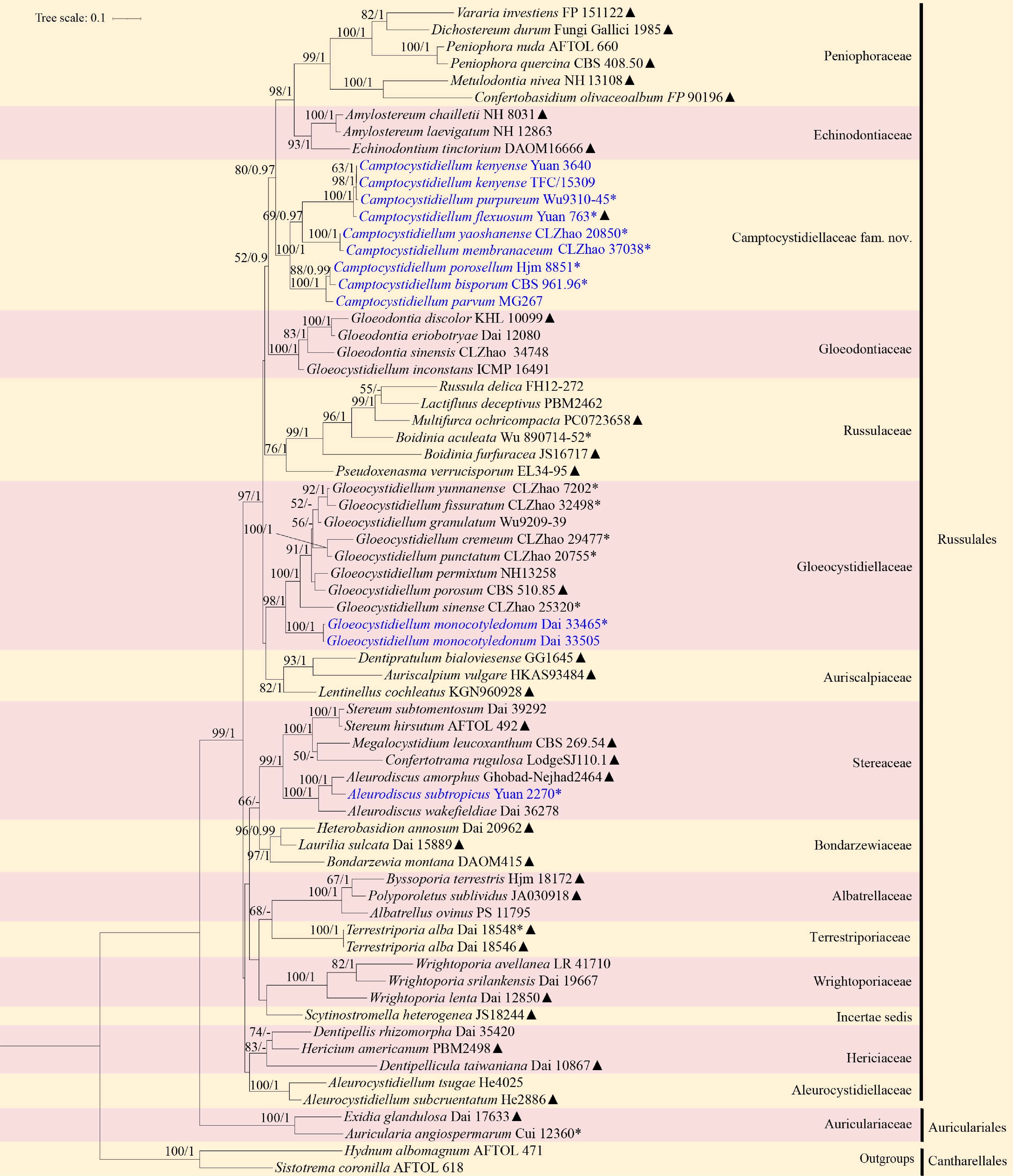
Figure 1.
The phylogeny of Russulales was reconstructed using Maximum Likelihood analysis of combined ITS + nLSU + RPB2 + tef1-α sequences. ML and BI analyses gave similar topologies (ASDSF = 0.008643; all parameters ESS > 200). Branch nodes are annotated with Bootstrap support (≥ 50%) and Bayesian posterior probabilities (≥ 0.9). Black triangle (▲) = type species; blue = new species/combinations; asterisk (*) = holotypes.
-
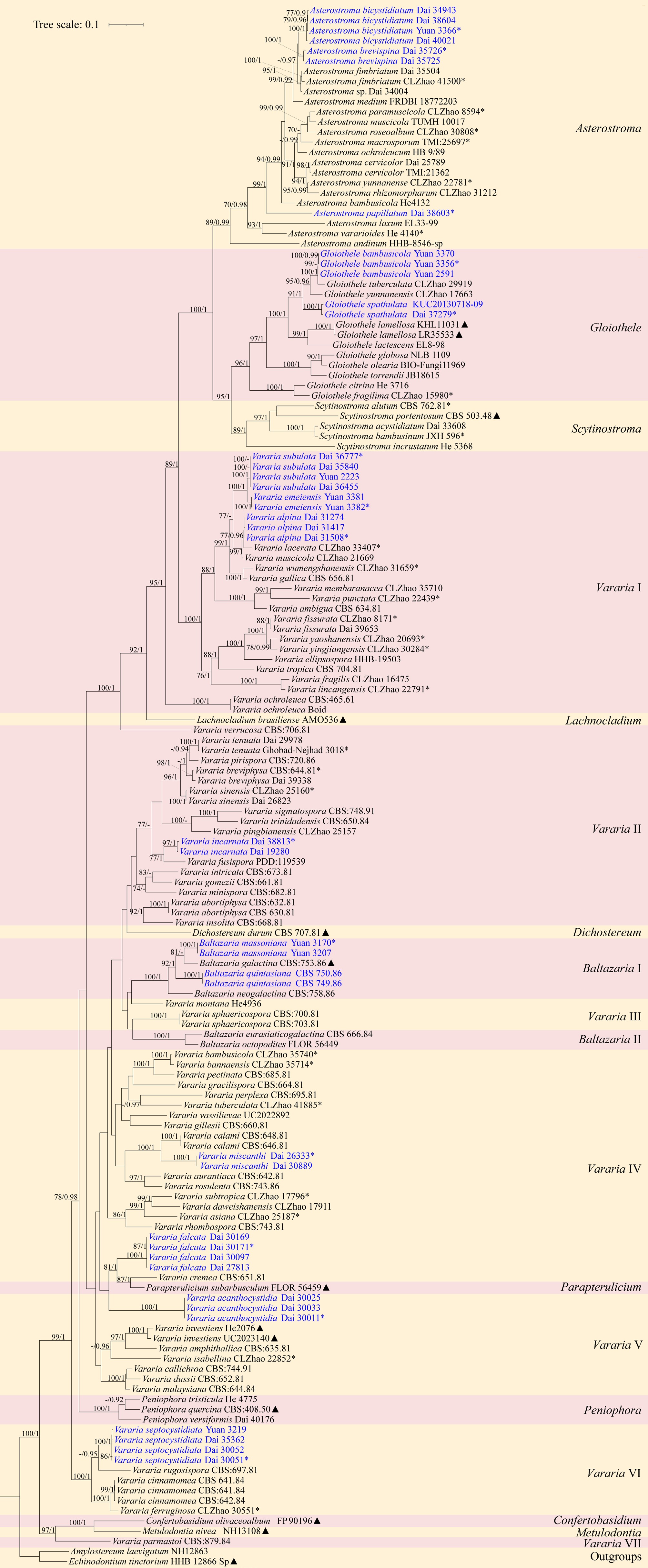
Figure 2.
The phylogeny of Peniophoraceae was reconstructed using Maximum Likelihood analysis of combined ITS + nLSU sequences. ML and BI analyses gave similar topologies (ASDSF = 0.01319; all parameters ESS > 200). Branch nodes are annotated with Bootstrap support (≥ 50%) and Bayesian posterior probabilities (≥ 0.9). Black triangle (▲) = type species; blue = new species/combinations; asterisk (*) = holotypes. Major clades are labelled with roman numerals.
-
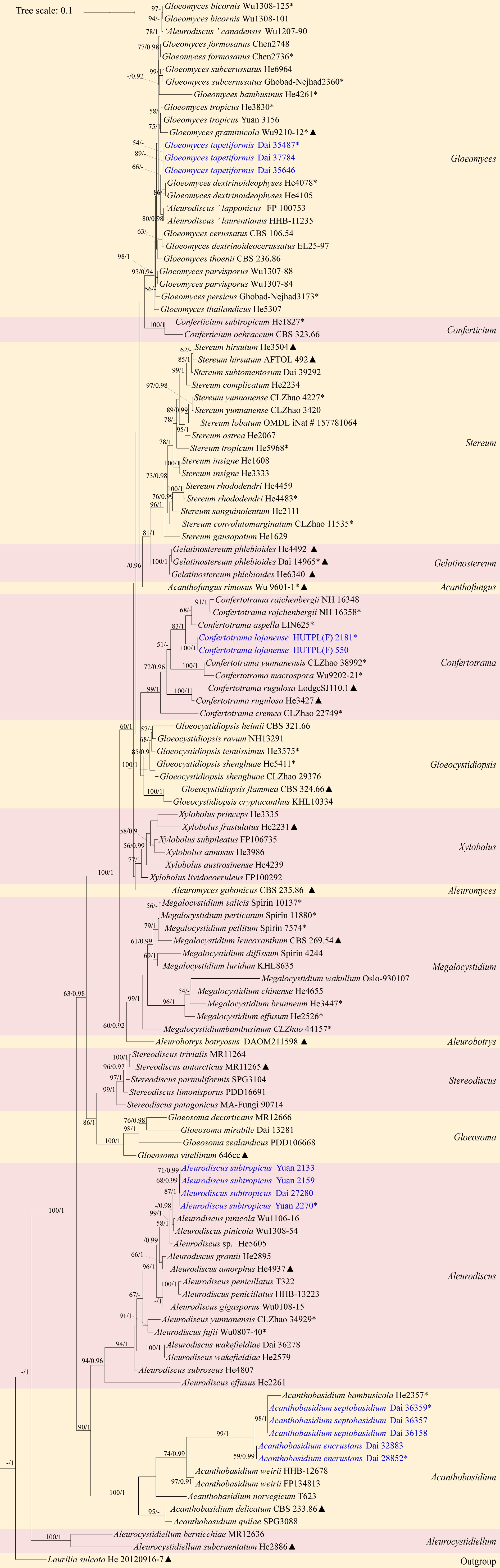
Figure 3.
The phylogeny of Stereaceae was reconstructed using Maximum Likelihood analysis of combined ITS + nLSU sequences. ML and BI analyses produced similar topologies (ASDSF = 0.009606; all parameters ESS > 200). Branch nodes are annotated with Bootstrap support (≥ 50%) and Bayesian posterior probabilities (≥ 0.9). Black triangle (▲) = type species; blue = new species/combinations; asterisk (*) = holotypes.
-
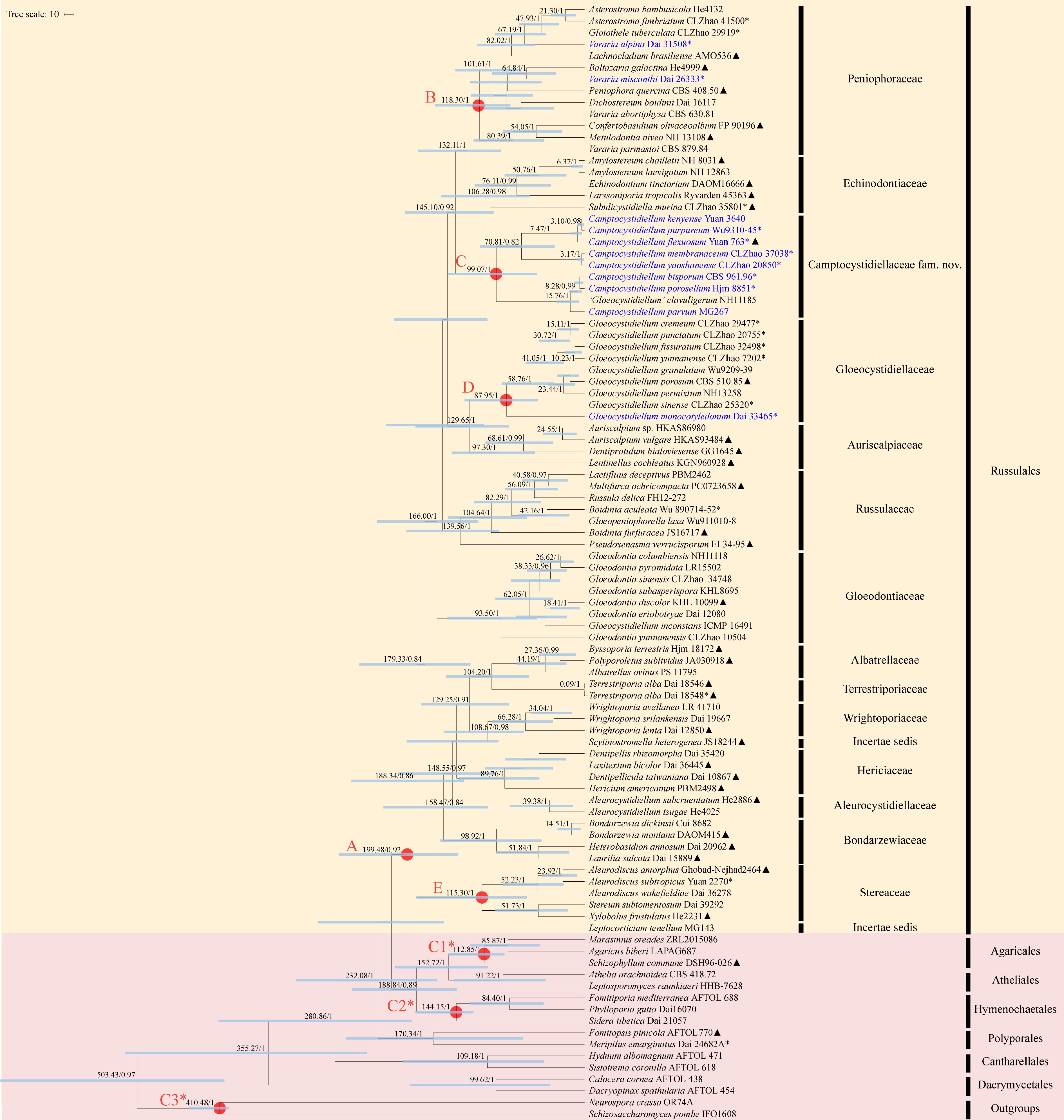
Figure 4.
Estimated divergence times of Russulales families were calculated using a four-gene dataset (ITS + nLSU + RPB2 + tef1-α). Node supports were assessed with Bayesian posterior probabilities (≥ 0.8). Mean ages (Mya) are shown with 95% HPD intervals represented as horizontal bars. Black triangle (▲) = type species; blue = new species/combinations; asterisk (*) = holotypes.
-
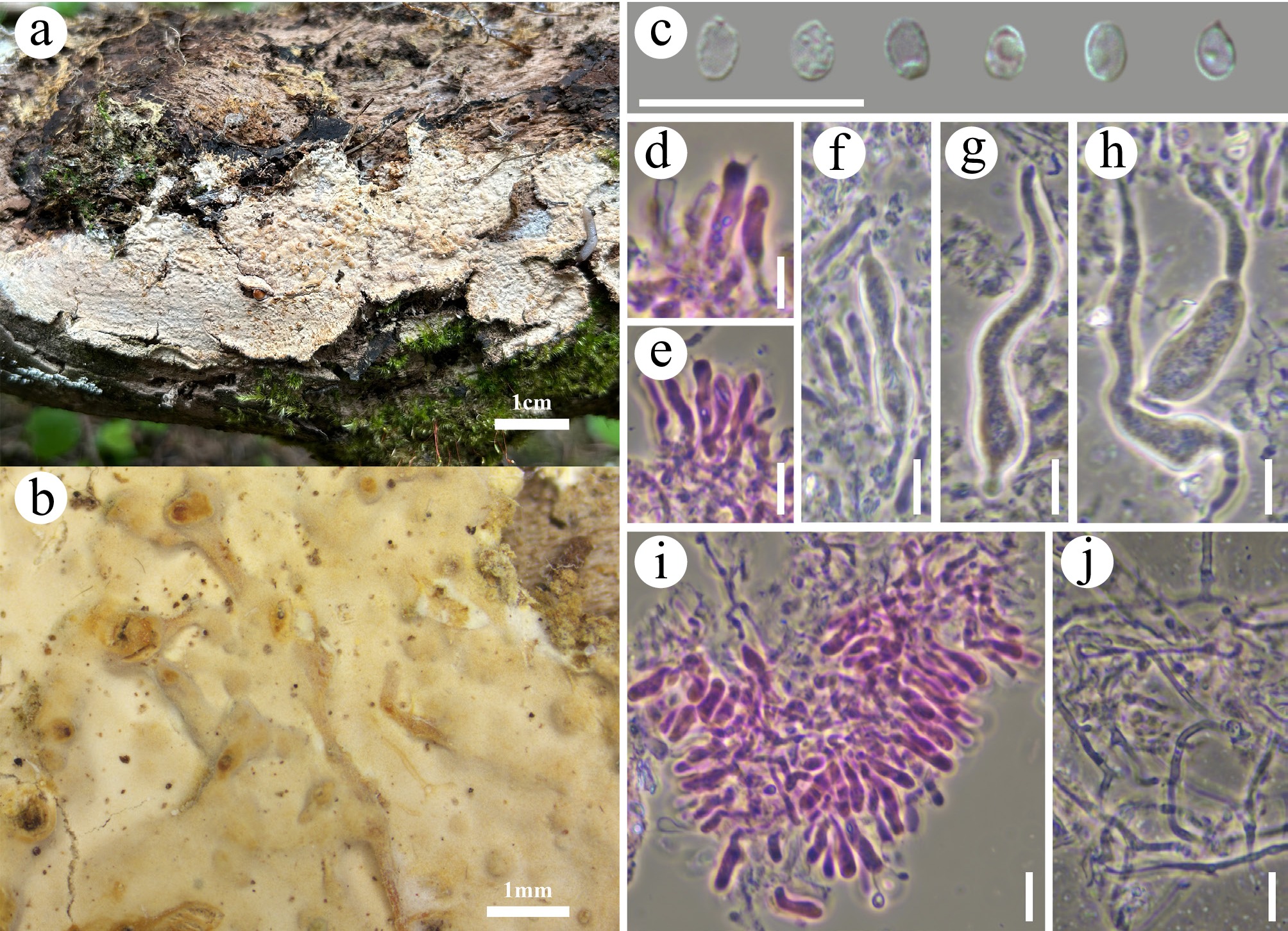
Figure 5.
Camptocystidiellum flexuosum (holotype, Yuan 763). (a), (b) Basidiomata. (c) Basidiospores. (d), (e) Basidia and basidioles. (f)–(h) Gloeocystidia. (i) A section of hymenium. (j) Generative hyphae. Scale bars: (c)–(j) = 10 µm.
-
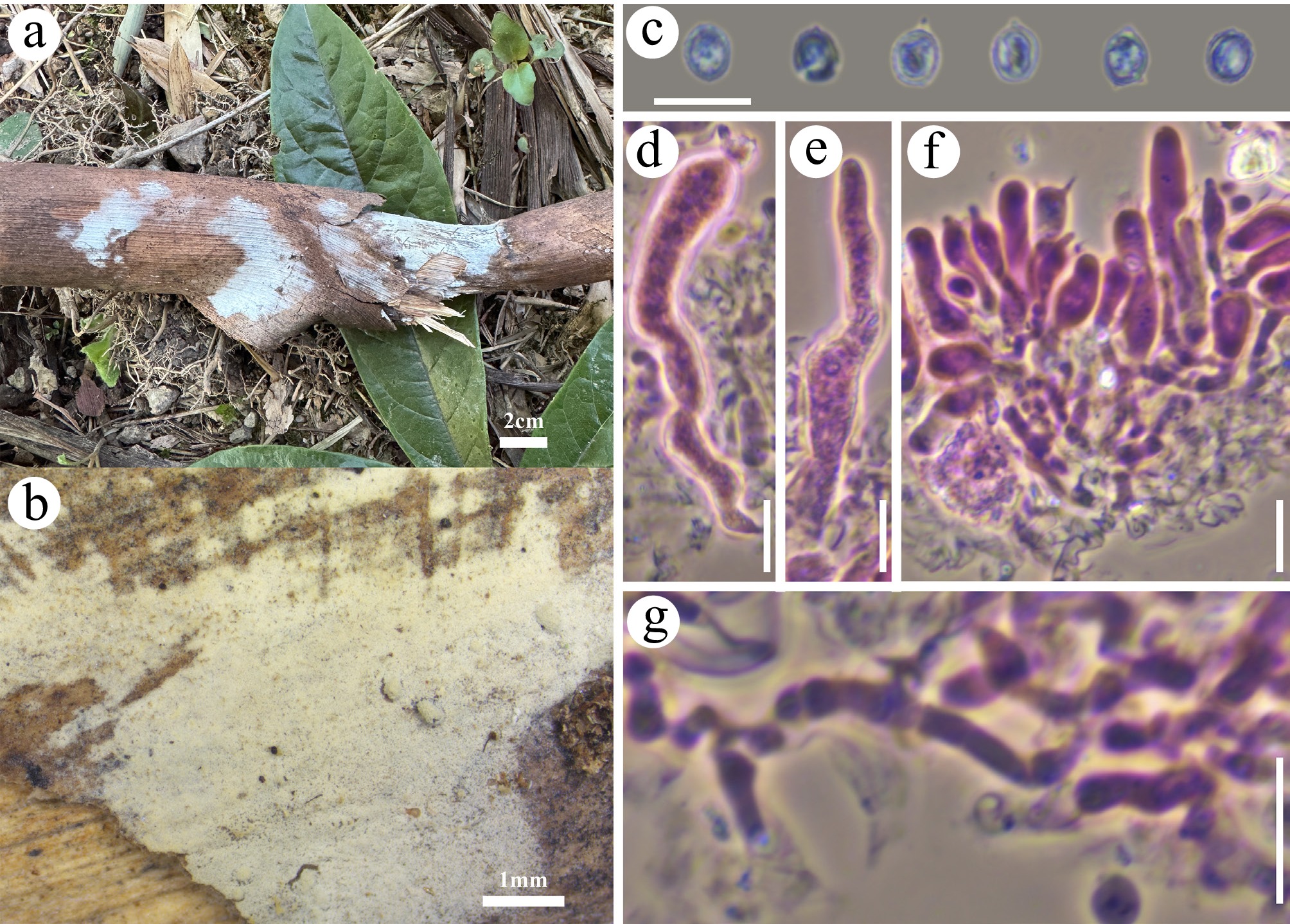
Figure 6.
Gloeocystidiellum monocotyledonum (holotype, Dai 33465). (a), (b) Basidiomata. (c) Basidiospores. (d), (e) Gloeocystidia. (f) A section of hymenium. (g) Generative hyphae. Scale bars: (c)–(g) = 10 µm.
-
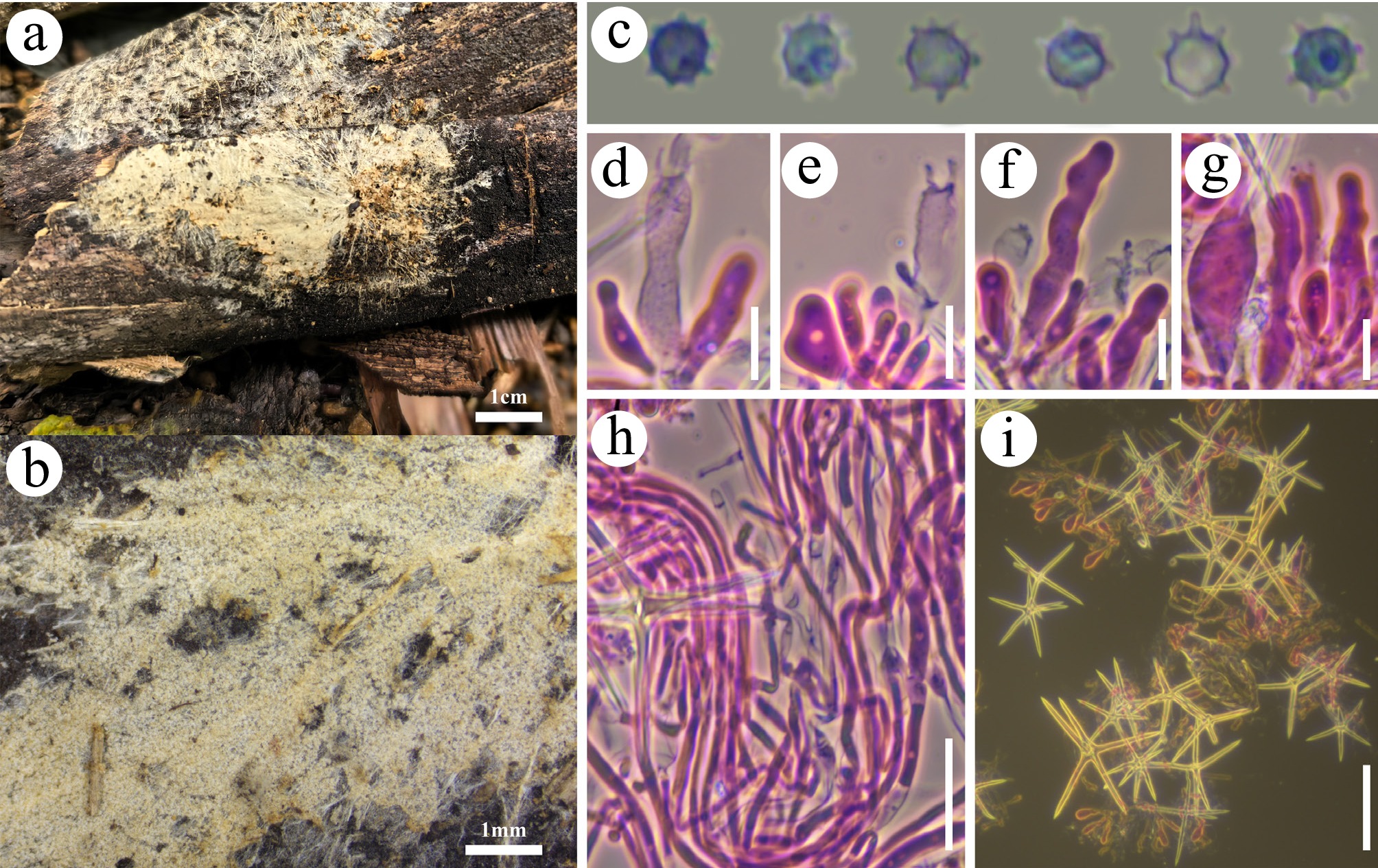
Figure 7.
Asterostroma bicystidiatum (holotype, Yuan 3366). (a), (b) Basidiomata. (c) Basidiospores. (d), (e) Basidia and basidioles. (f), (g) Gloeocystidia. (h) Generative hyphae. (i) Asterosetae and Asterohyphidia. Scale bars: (c)–(h) = 10 µm; (i) = 50 µm.
-
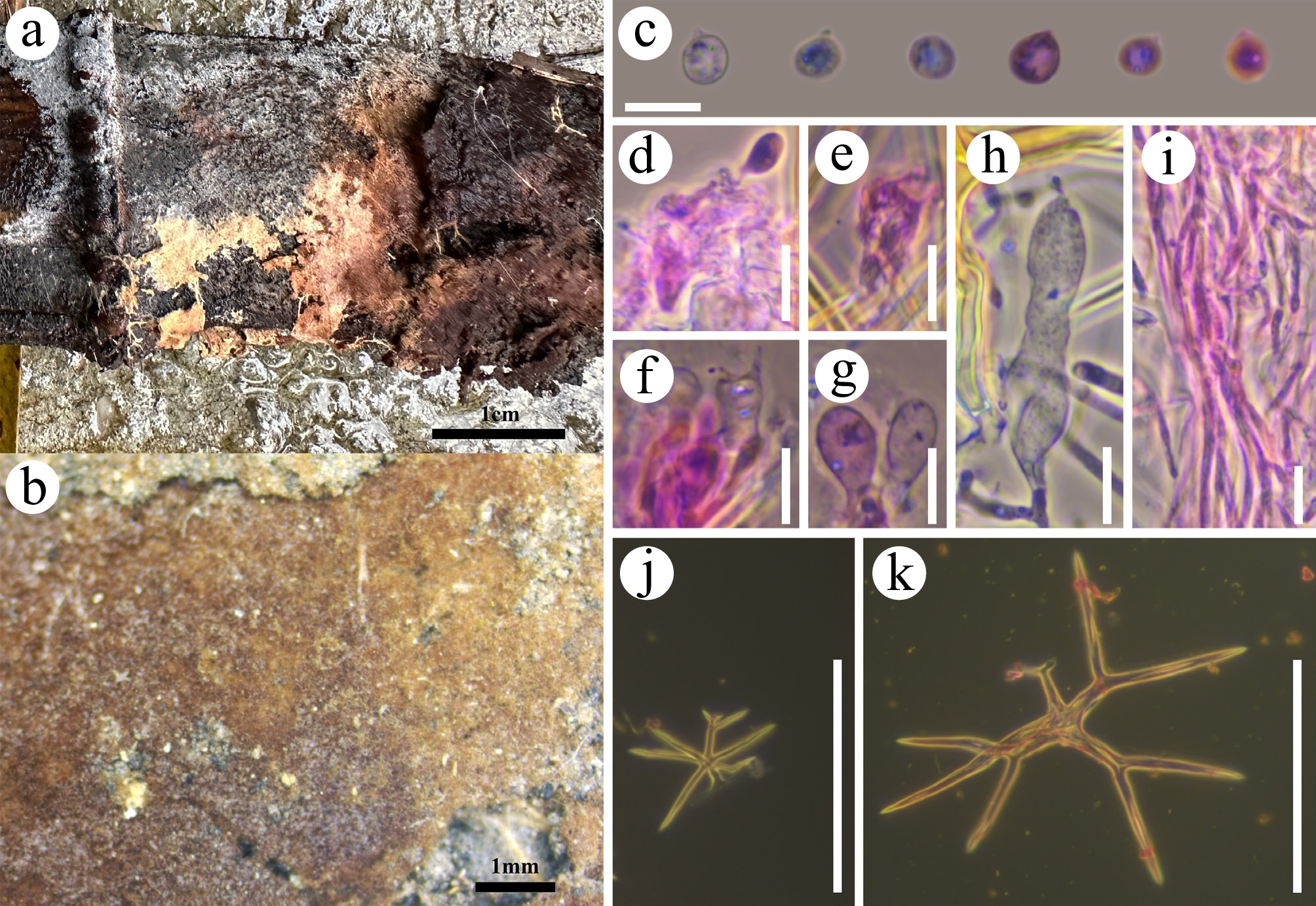
Figure 8.
Asterostroma brevispinum (holotype, Dai 35726). (a), (b) Basidiomata. (c) Basidiospores. (d), (e) Basidia and basidioles. (f) Gloeocystidia and cystidioles. (g) Generative hyphae. (h) Asterosetae and Asterohyphidia. Scale bars: (c)–(g) = 10 µm; (h) = 50 µm.
-
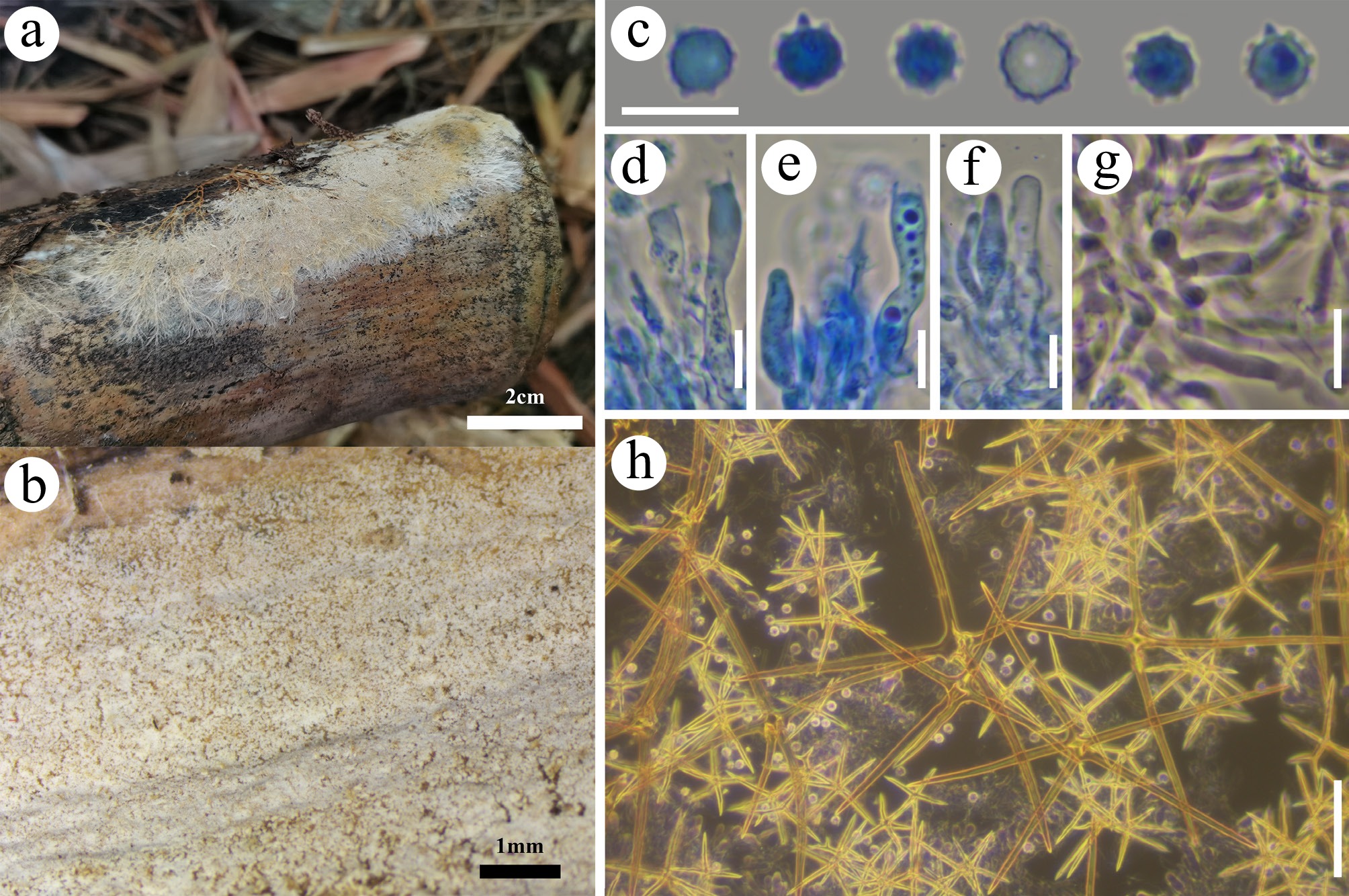
Figure 9.
Asterostroma papillatum (holotype, Dai 38603). (a), (b) Basidiomata. (c) Basidiospores. (d)–(g) Basidia and basidioles. (h) Gloeocystidia. (i) Generative hyphae. (j), (k) Dichohyphae from subiculum. Scale bars: (c)–(i) = 10 µm; (j), (k) = 50 µm.
-
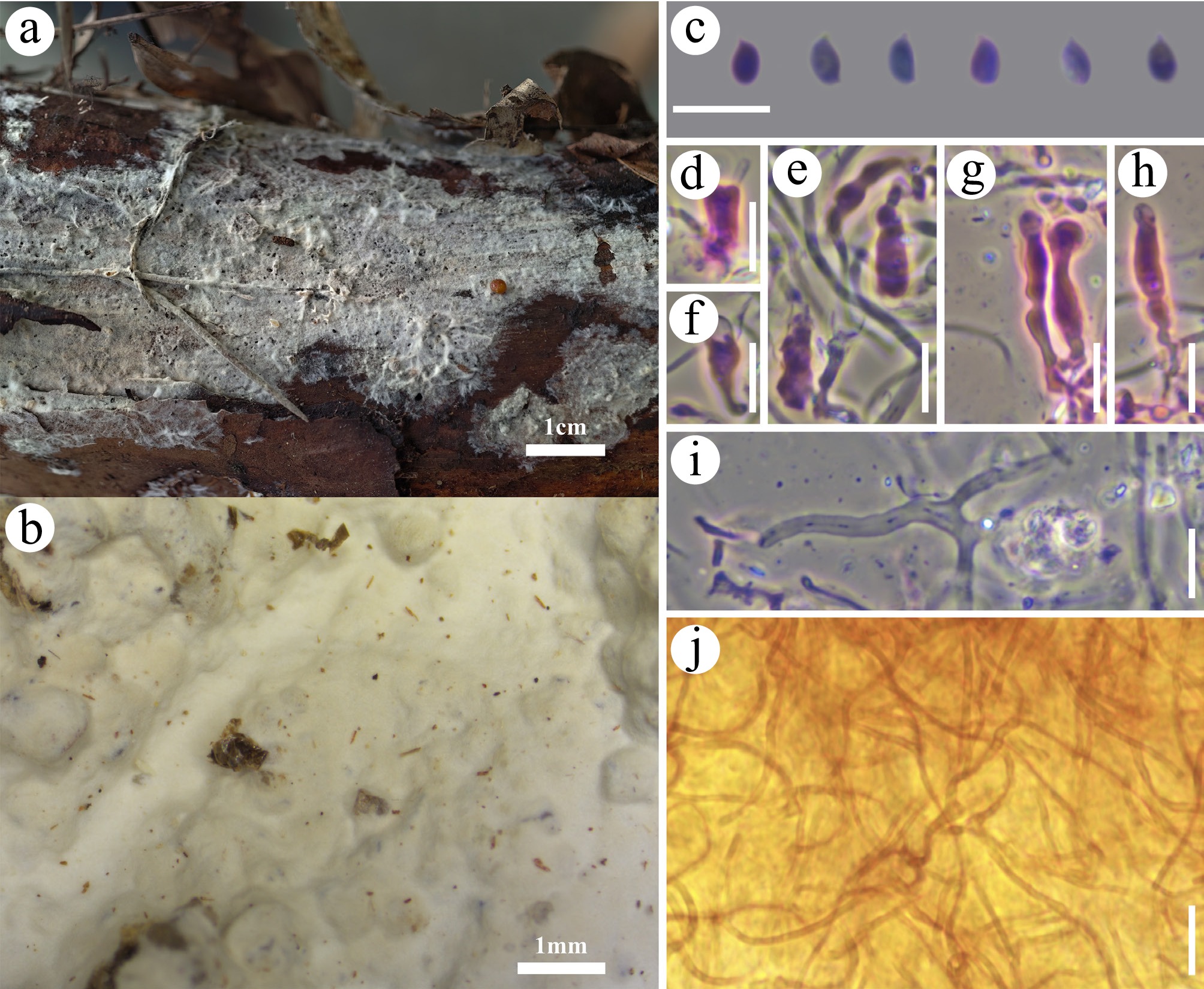
Figure 10.
Baltazaria massonianae (holotype, Yuan 3170). (a), (b) Basidiomata. (c) Basidiospores. (d), (e) Basidia and basidioles. (g), (h) Gloeocystidia. (i) Dichotomously branched hyphae. (j) Hyphal system in Melzer's reagent. Scale bars: (c)–(j) = 10 µm.
-
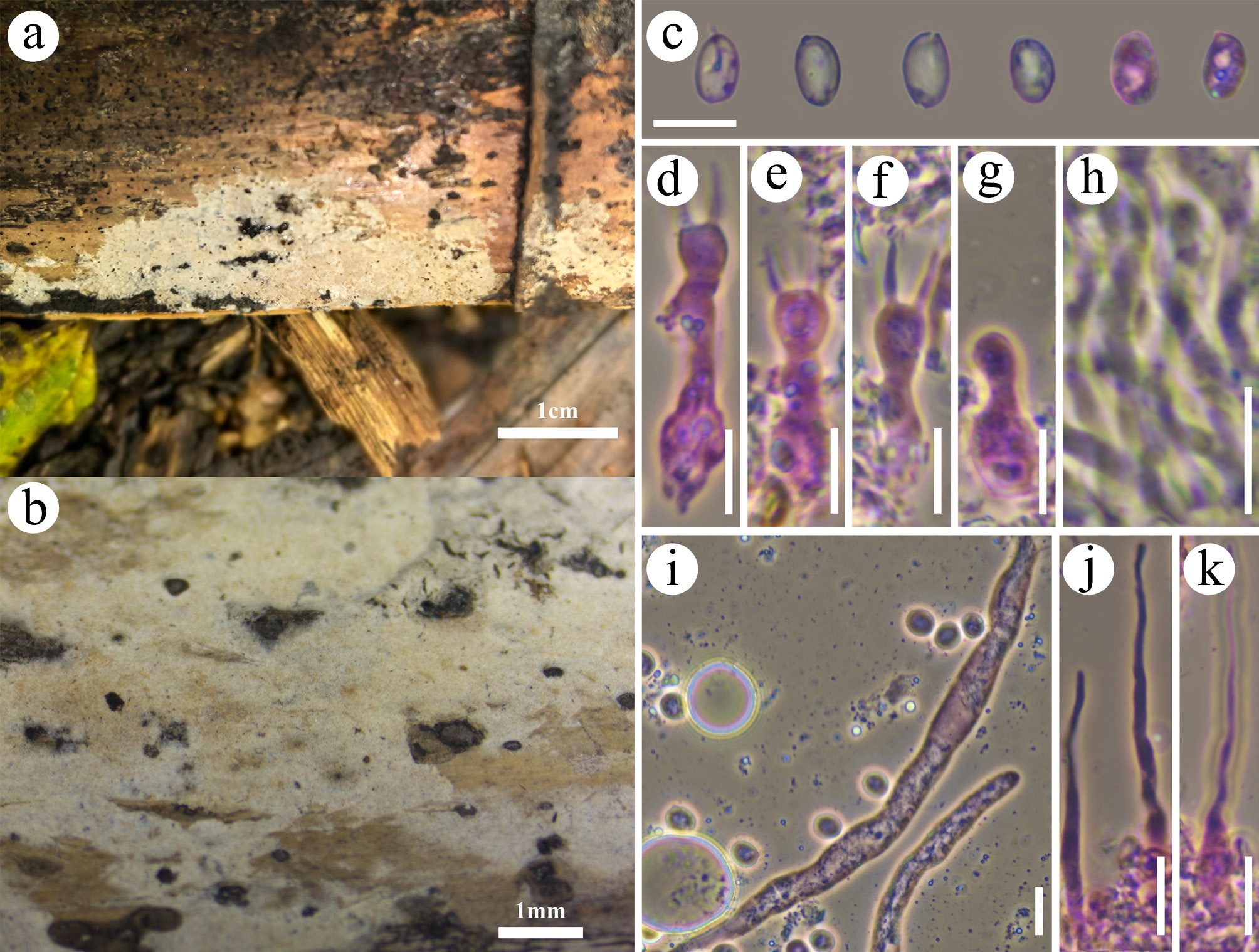
Figure 11.
Gloiothele bambusicola (holotype, Yuan 3356). (a), (b) Basidiomata. (c) Basidiospores. (d)–(g) Basidia and basidioles. (h) Generative hyphae. (i) Gloeocystidia when mature. (j), (k) Gloeocystidia when juvenile. Scale bars: (c)–(k) = 10 µm.
-
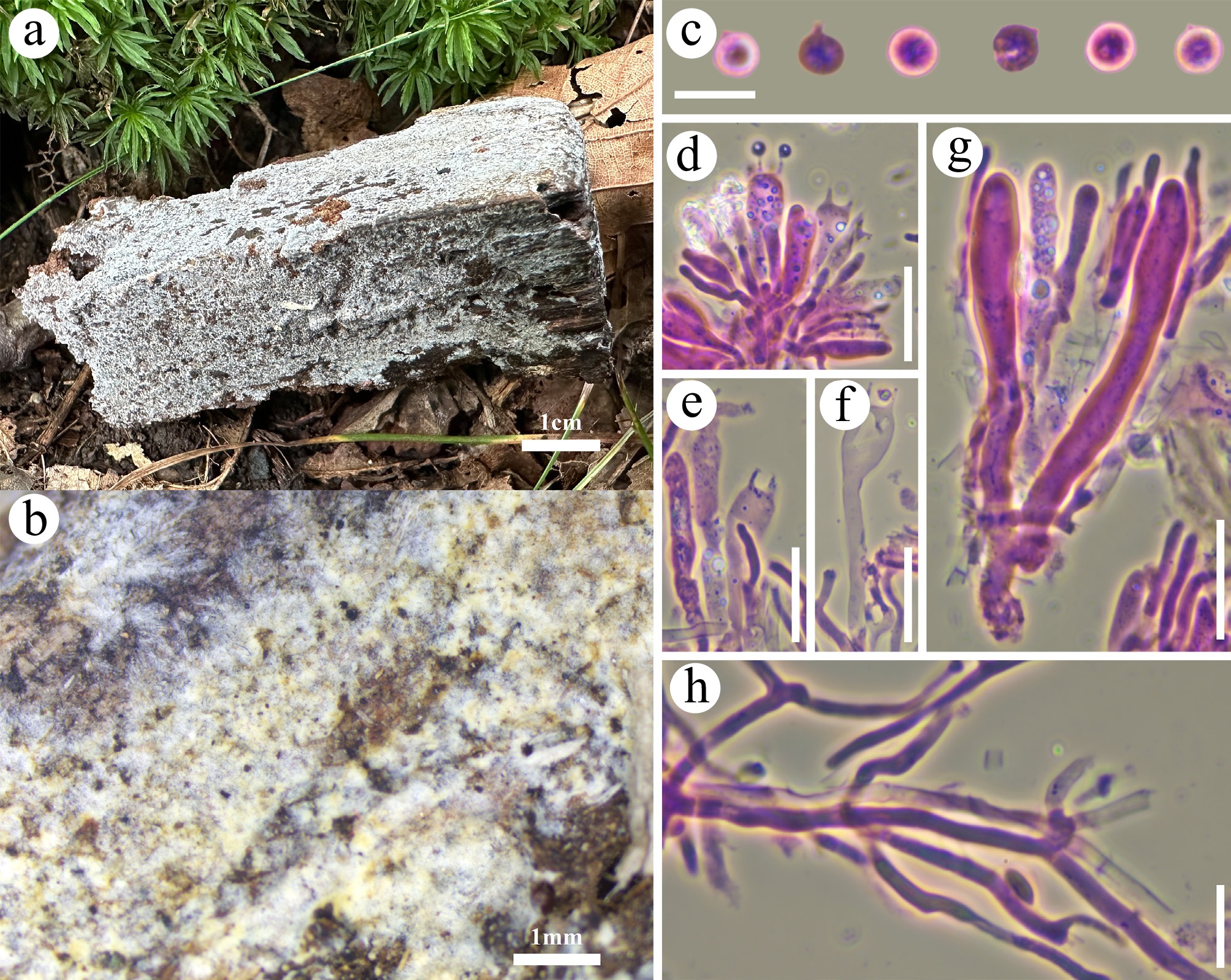
Figure 12.
Gloiothele spathulata (holotype, Dai 37279). (a), (b) Basidiomata. (c) Basidiospores. (d)–(f) Basidia and basidioles. (g) Gloeocystidia. (h) Generative hyphae. Scale bars: (c)–(h) = 10 µm.
-
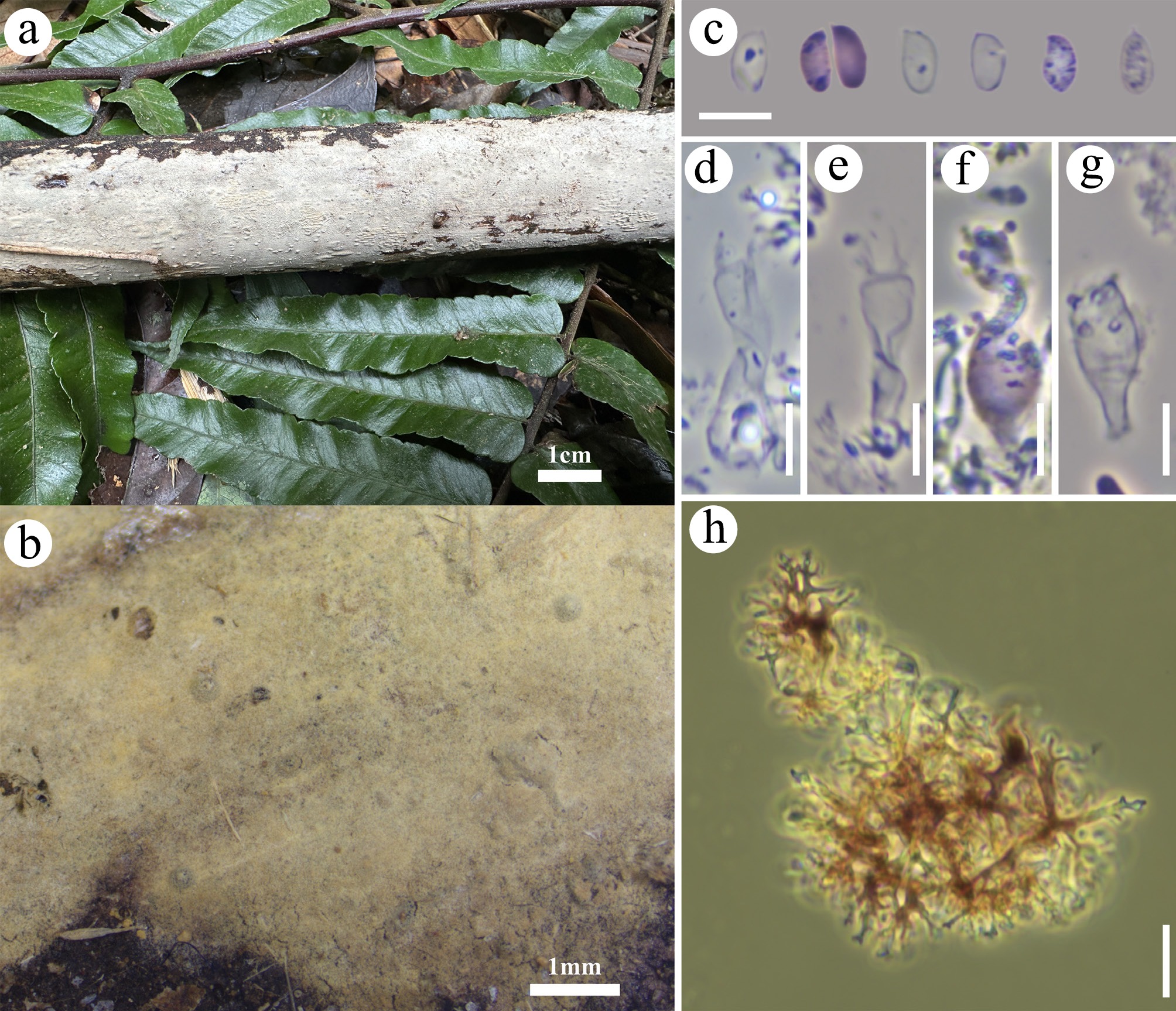
Figure 13.
Vararia acanthocystidia (holotype, Dai 30011). (a), (b) Basidiomata. (c) Basidiospores. (d), (e) Basidia. (f), (g) Acanthocystidia. (h) Dichohyphae in subiculum (Melzer's reagent). Scale bars: (c)–(h) = 10 µm.
-
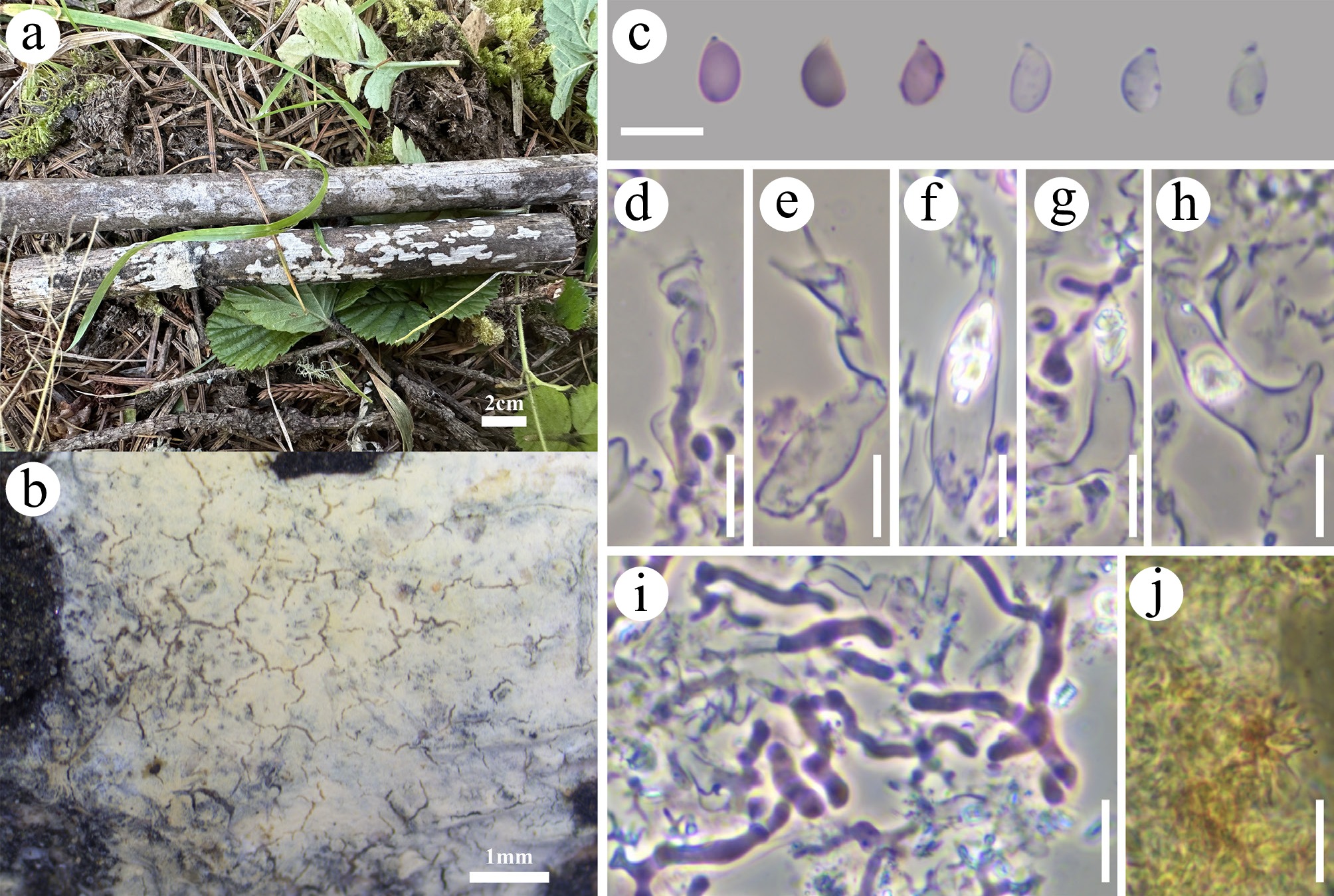
Figure 14.
Vararia alpina (holotype, Dai 31508). (a), (b) Basidiomata. (c) Basidiospores. (d), (e) Basidia. (f)–(h) Gloeocystidia. (i) Generative hyphae. (j) Dichohyphae in subiculum (Melzer's reagent). Scale bars: (c)–(j) = 10 µm.
-
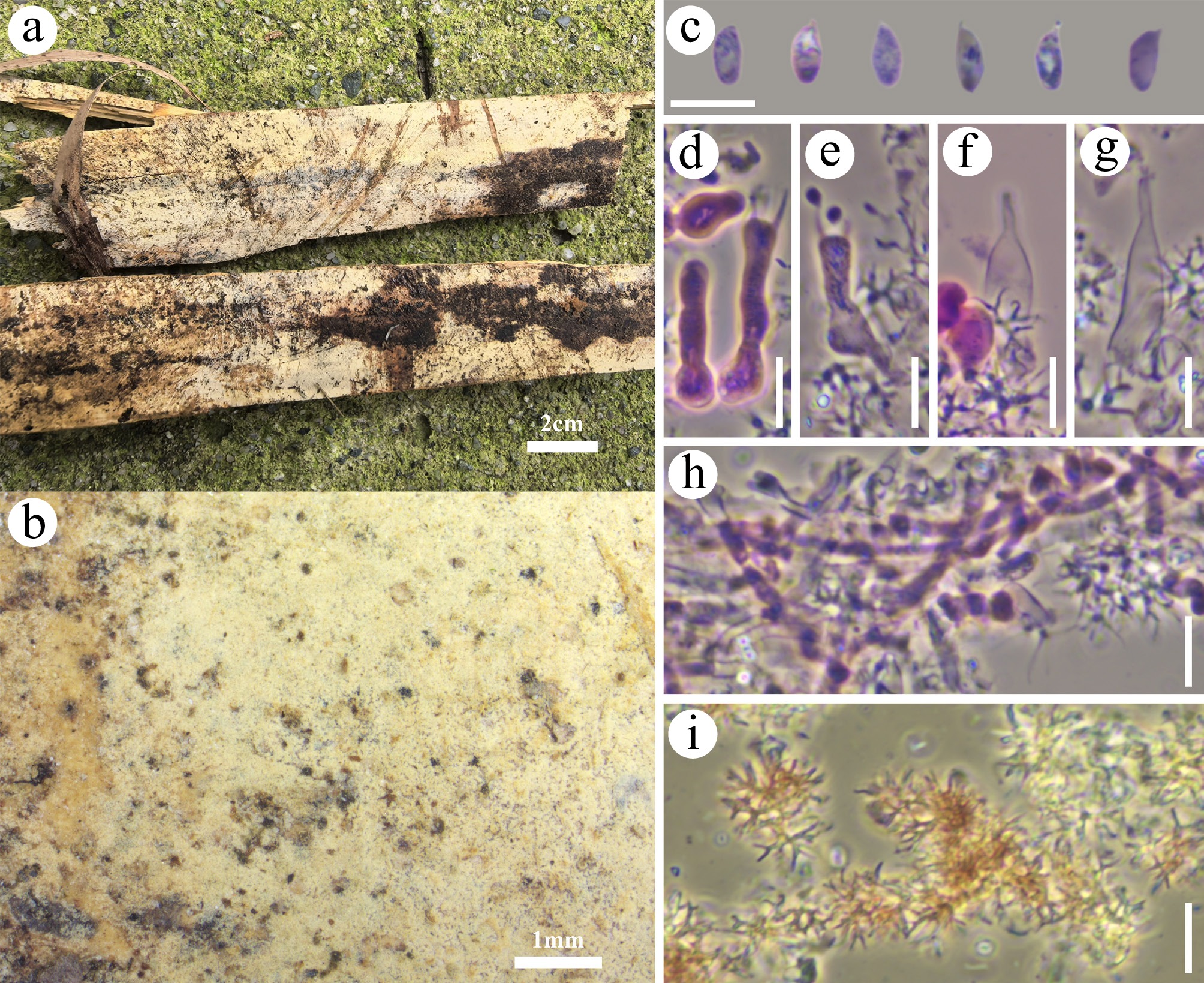
Figure 15.
Vararia emeiensis (holotype, Yuan 3382). (a), (b) Basidiomata. (c) Basidiospores. (d), (e) Basidia and basidioles. (f), (g) Gloeocystidia. (h) Generative hyphae. (i) Dichohyphae in subiculum (Melzer's reagent). Scale bars: (c)–(i)= 10 µm.
-
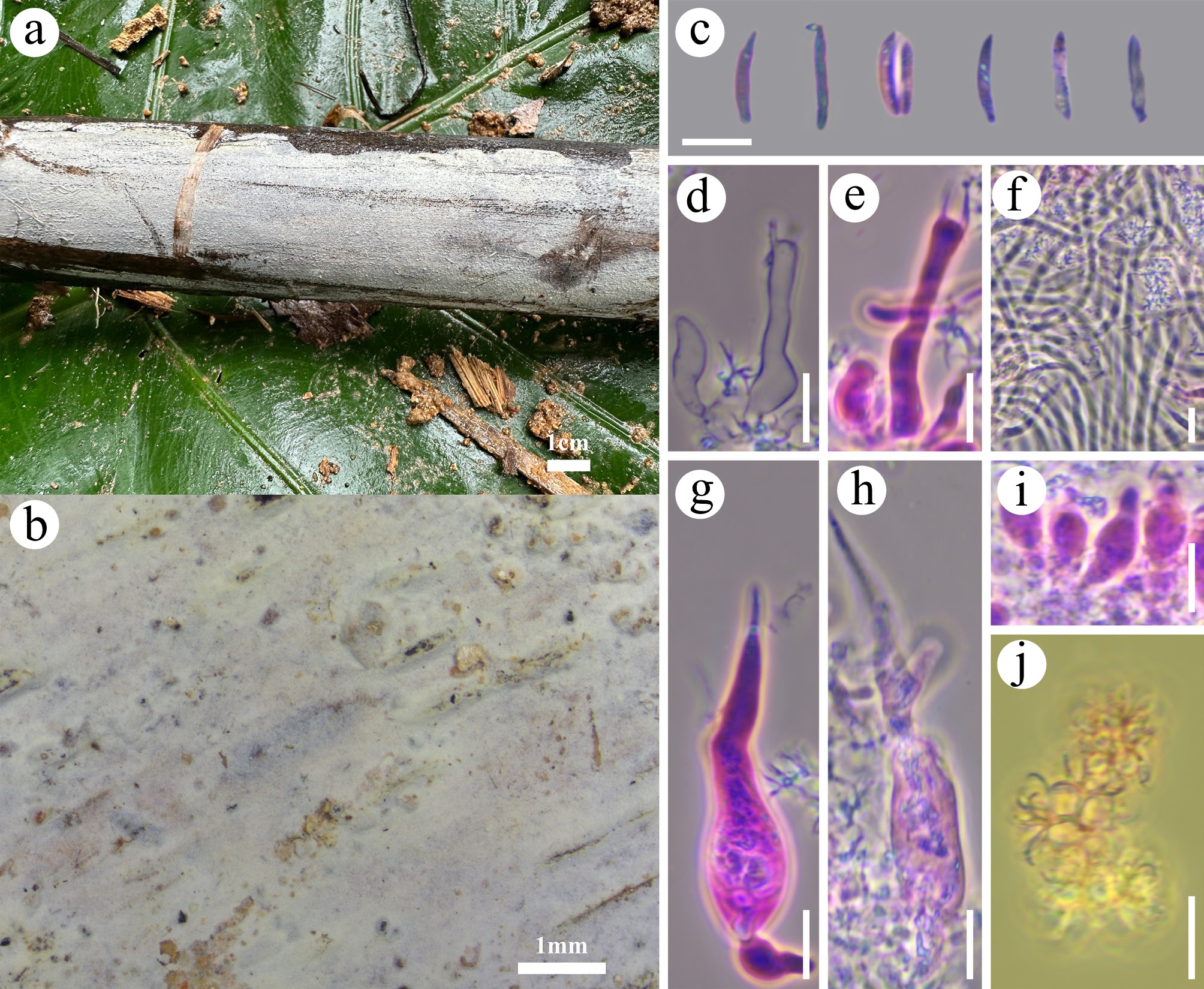
Figure 16.
Vararia falcata (holotype, Dai 30171). (a), (b) Basidiomata. (c) Basidiospores. (d) Basidia and cystidioles. (e) Basidia and basidioles. (f) Generative hyphae. (g), (h) Gloeocystidia. (i) Cystidioles and basidioles. (j) Dichohyphae in subiculum (Melzer's reagent). Scale bars: (c)–(j) = 10 µm.
-
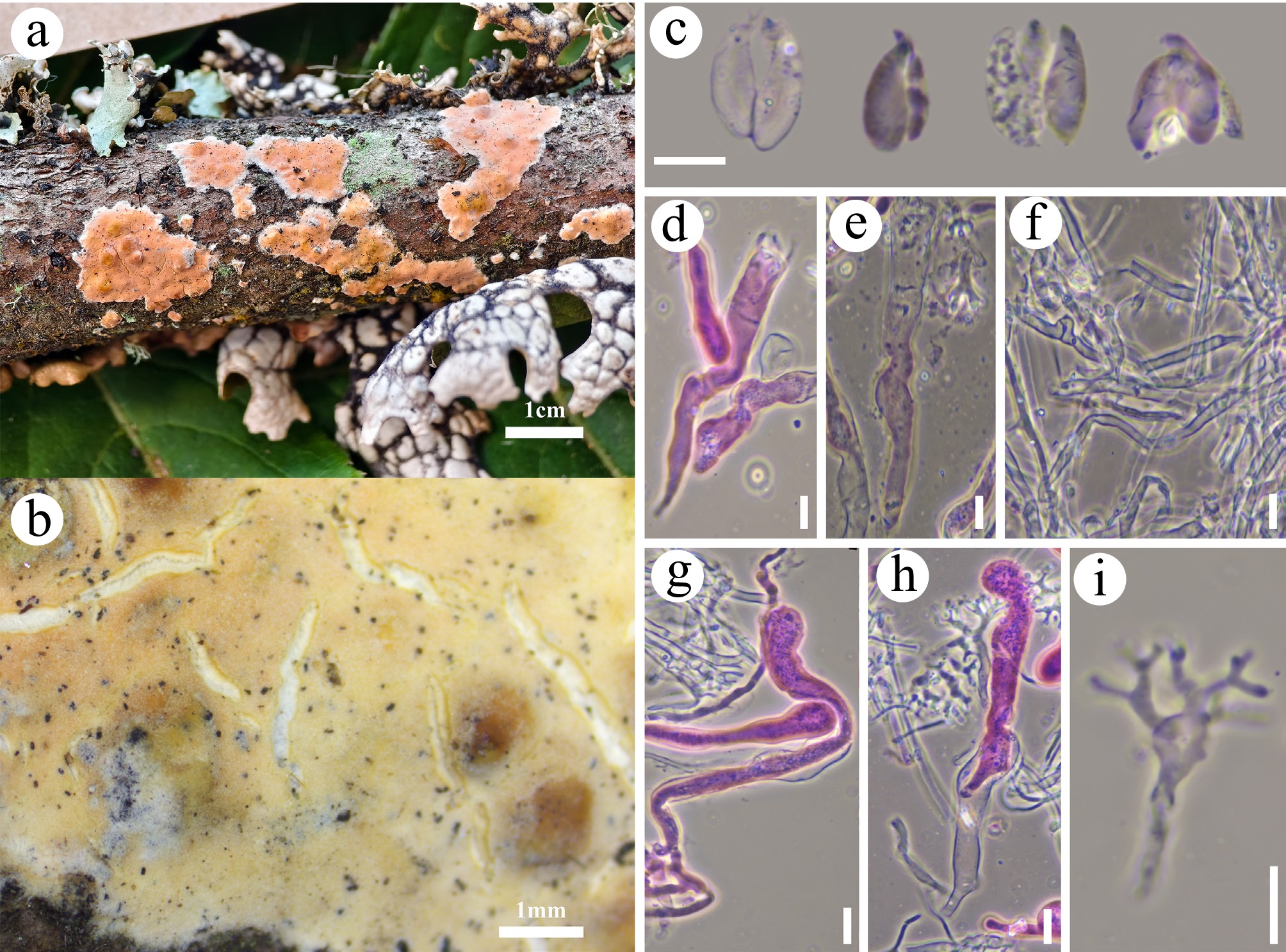
Figure 17.
Vararia incarnata (holotype, Dai 38813). (a), (b) Basidiomata. (c) Basidiospores. (d), (e) Basidia and basidioles. (f) Generative hyphae. (g), (h) Gloeocystidia. (i) Dichohyphidia. Scale bars: (c)–(i) = 10 µm.
-
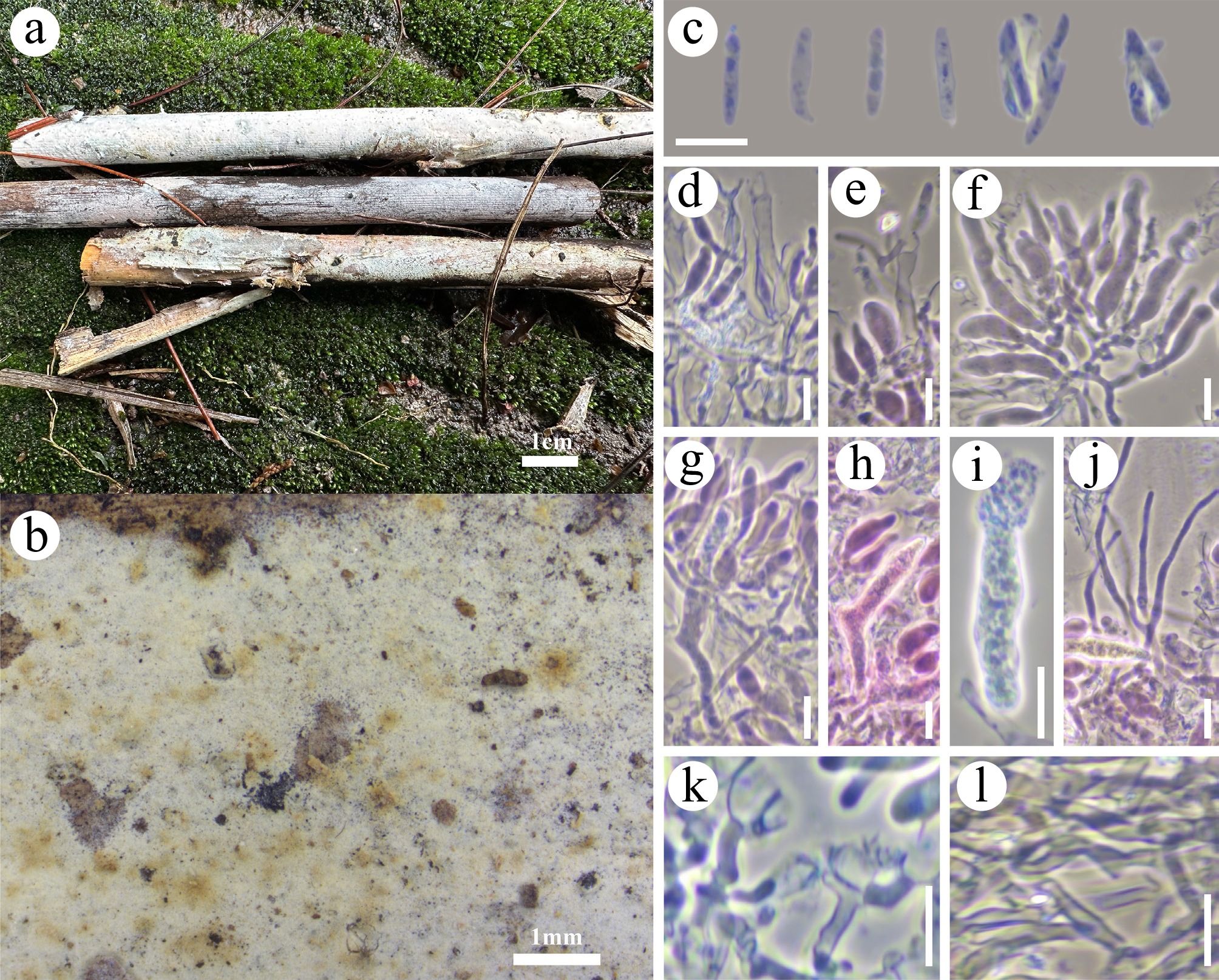
Figure 18.
Vararia miscanthi (holotype, Dai 26333). (a), (b) Basidiomata. (c) Basidiospores. (d), (e) Basidia and basidioles. (f) A section of hymenium. (g)–(i) Gloeocystidia. (j) Paraphyses. (k) Dichohyphae in subiculum. (l) Generative hyphae. Scale bars: (c)–(l) = 10 µm.
-
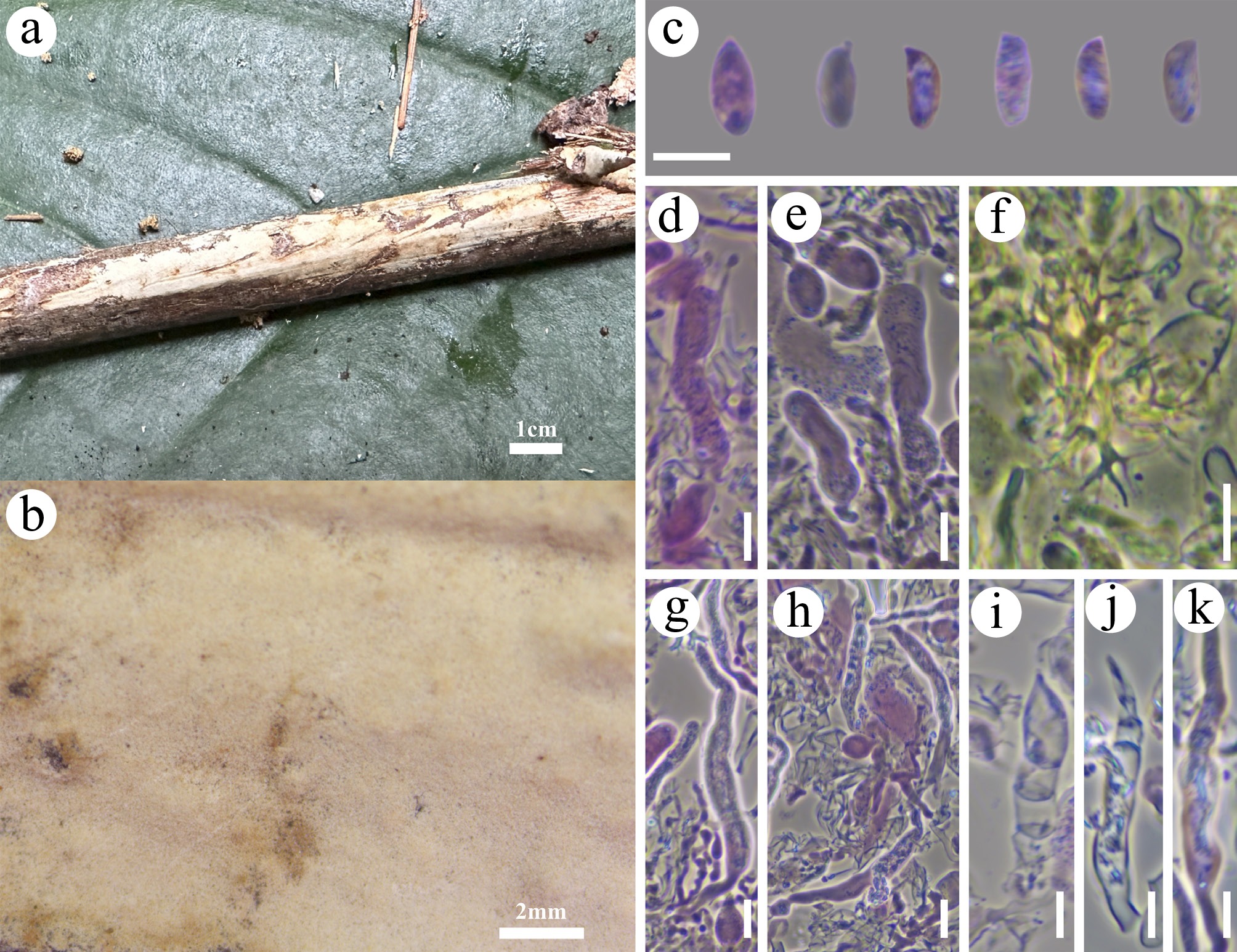
Figure 19.
Vararia septocystidiata (holotype, Dai 30051). (a), (b) Basidiomata. (c) Basidiospores. (d), (e) Basidia and basidioles. (f) Dichohyphae in subiculum (Melzer's reagent). (g), (h) Gloeocystidia. (i)–(k) Septocystidium. Scale bars: (c)–(k) = 10 µm.
-
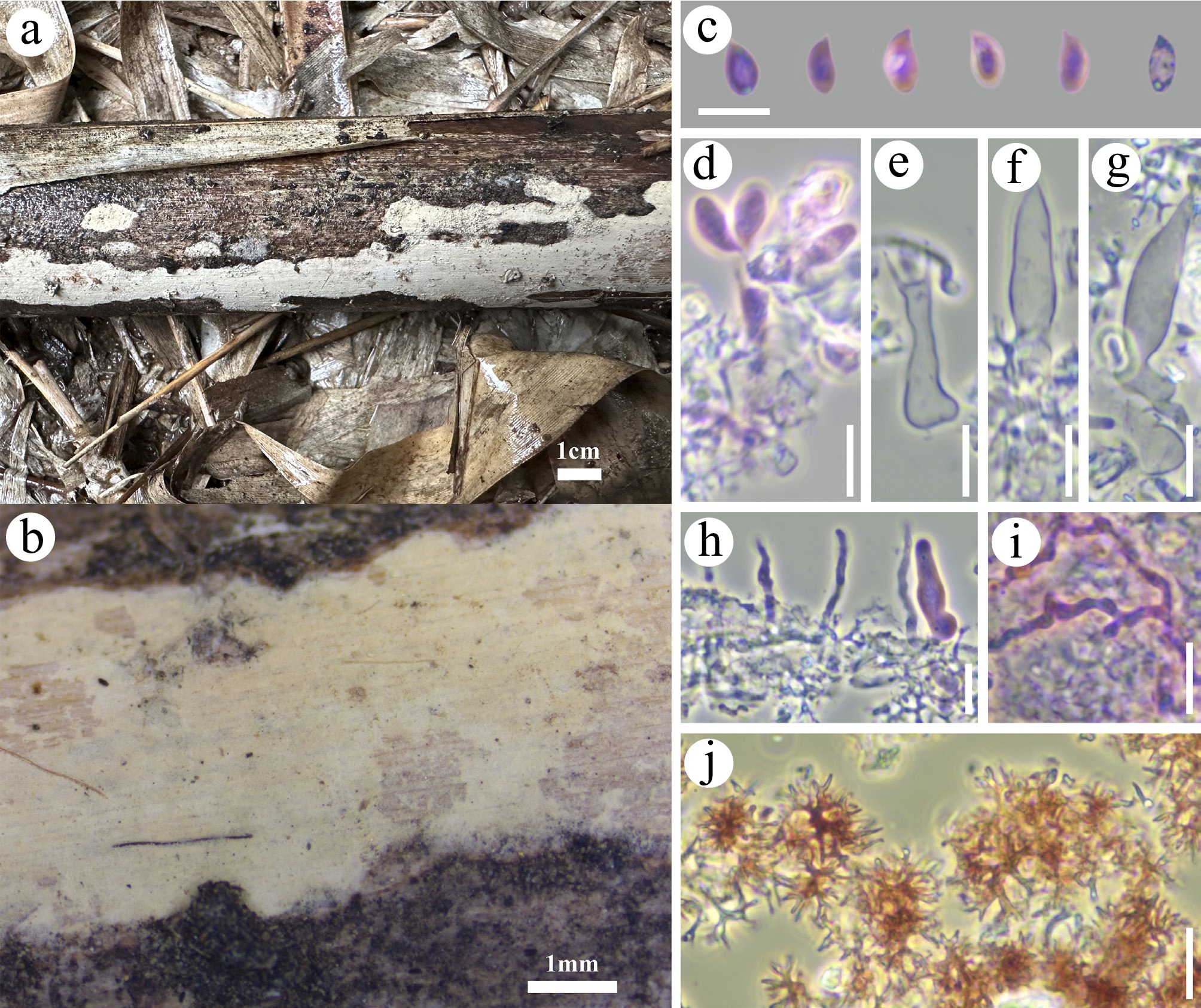
Figure 20.
Vararia subulata (holotype, Dai 36777). (a), (b) Basidiomata. (c) Basidiospores. (d), (e) Basidia. (f), (g) Gloeocystidia. (h) Paraphyses. (i) Generative hyphae. (j) Dichohyphae in subiculum (Melzer's reagent). Scale bars: (c)–(j) = 10 µm.
-
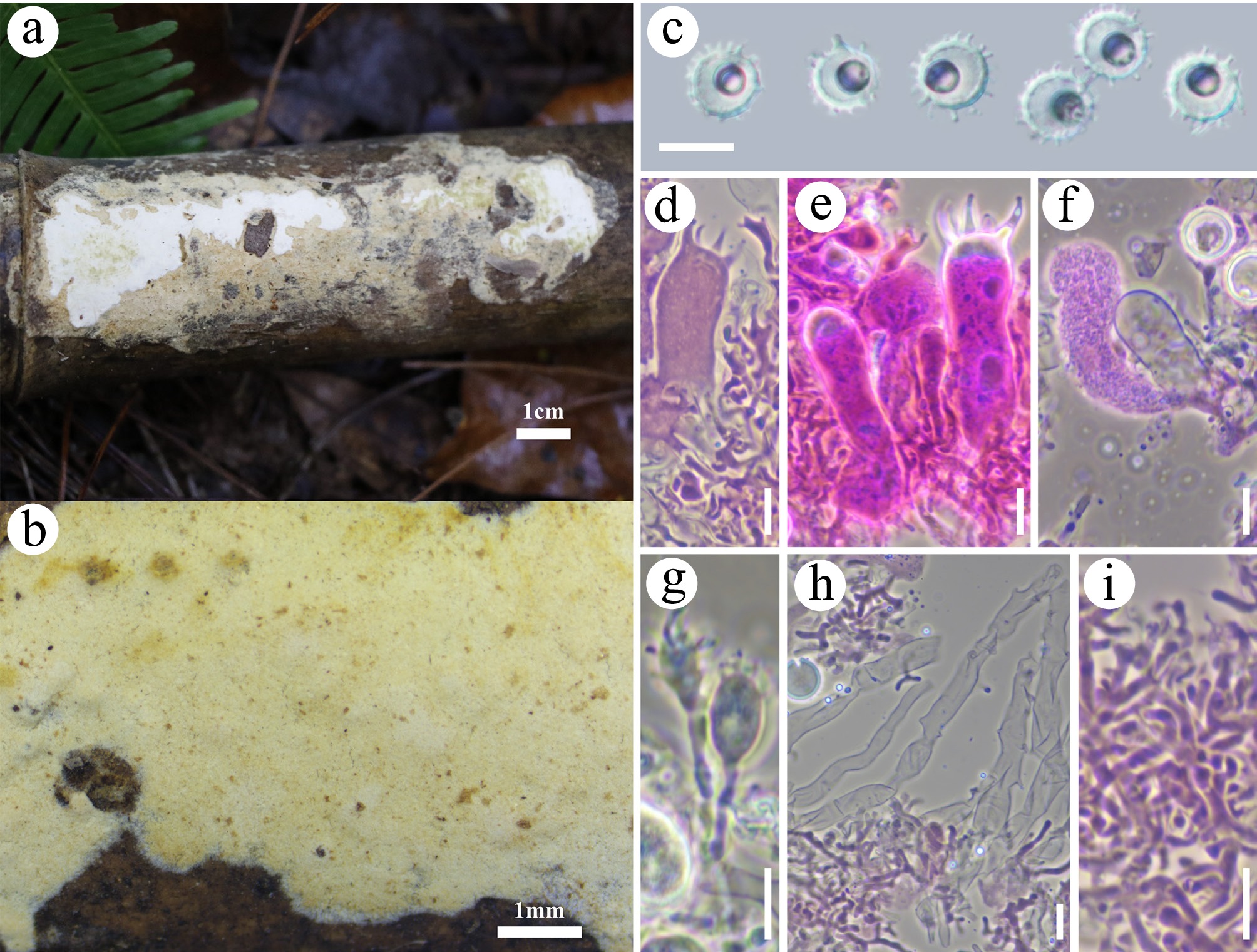
Figure 21.
Acanthobasidium encrustans (holotype, Dai 28852). (a), (b) Basidiomata. (c) Basidiospores. (d), (e) Basidia and basidioles. (f) Gloeocystidia. (g) Acanthophyses. (h) Acanthohyphidia. (i) Dendrohyphidia. Scale bars: (c)–(i) = 10 µm.
-
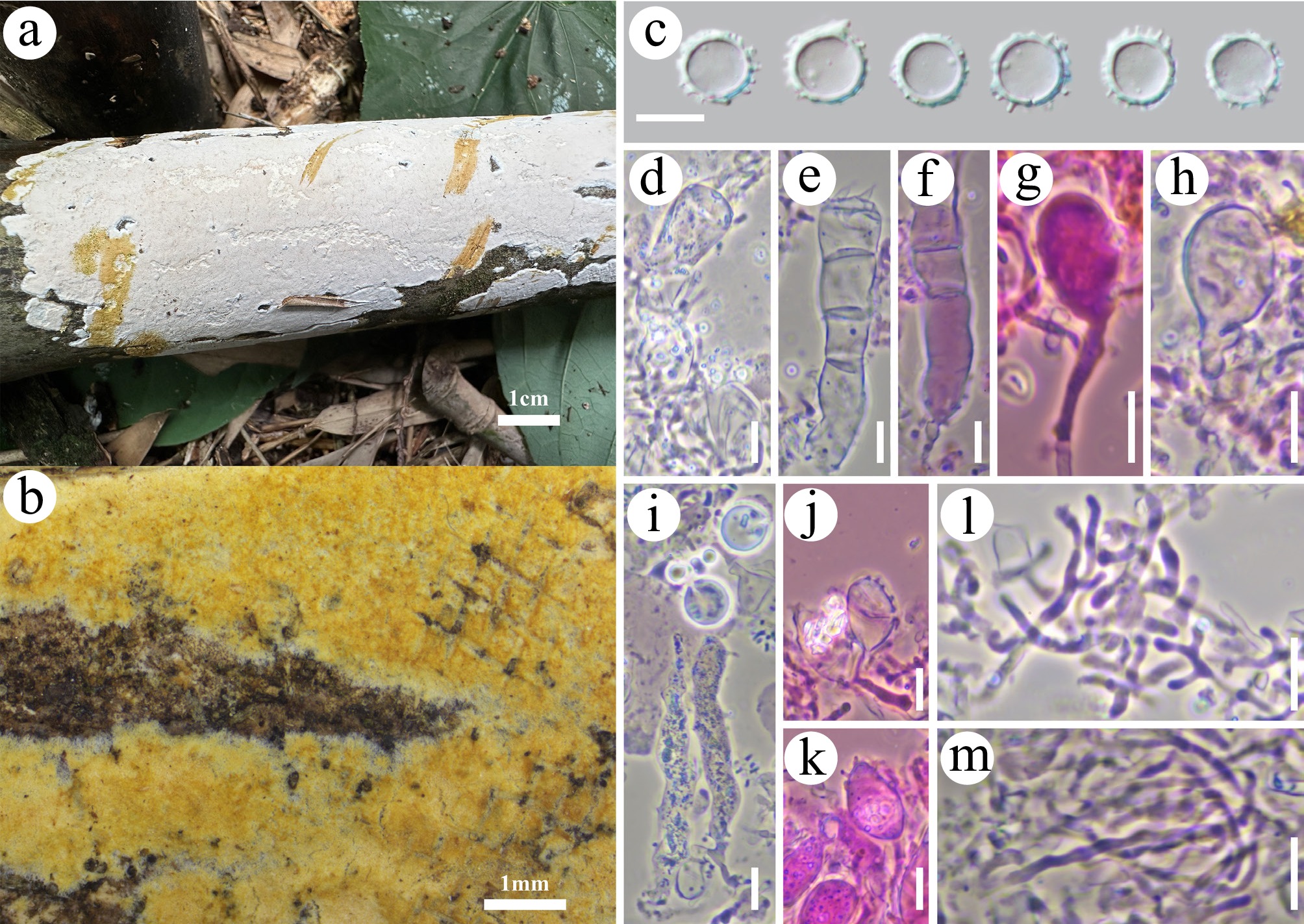
Figure 22.
Acanthobasidium septobasidium (holotype, Dai 36359). (a), (b) Basidiomata. (c) Basidiospores. (d)–(f) Basidia. (g), (h) Gloeocystidia. (i) Acanthohyphidia. (j), (k) Acanthophyses. (l) Dendrohyphidia. (m) Generative hyphae. Scale bars: (c)–(m) = 10 µm.
-
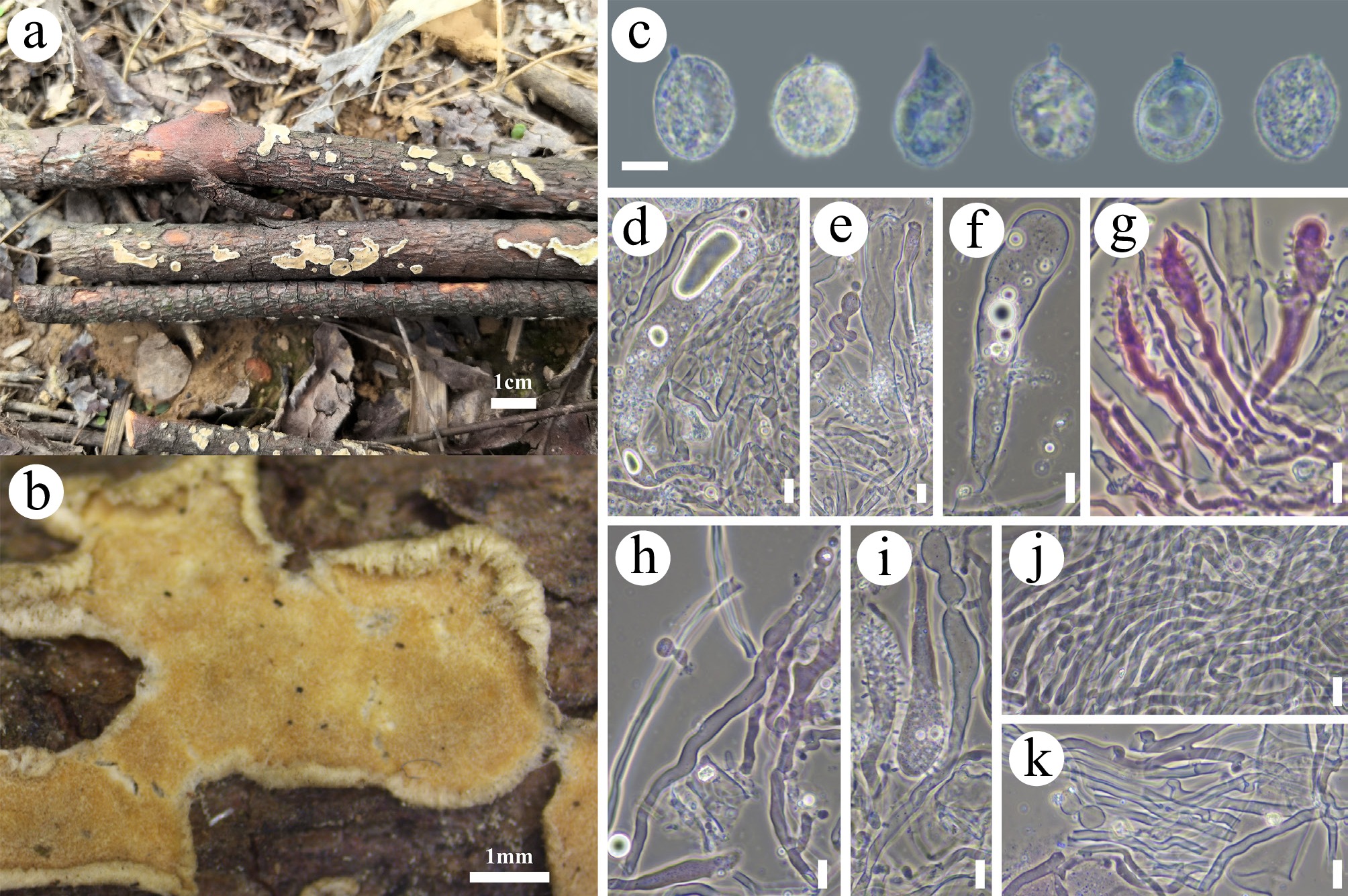
Figure 23.
Aleurodiscus subtropicus (holotype, Yuan 2270). (a), (b) Basidiomata. (c) Basidiospores. (d), (e) Basidia. (f) Basidioles. (g) Acanthophyses. (h), (i) Gloeocystidia. (j), (k) Generative hyphae. Scale bars: (c)–(k) = 10 µm.
-
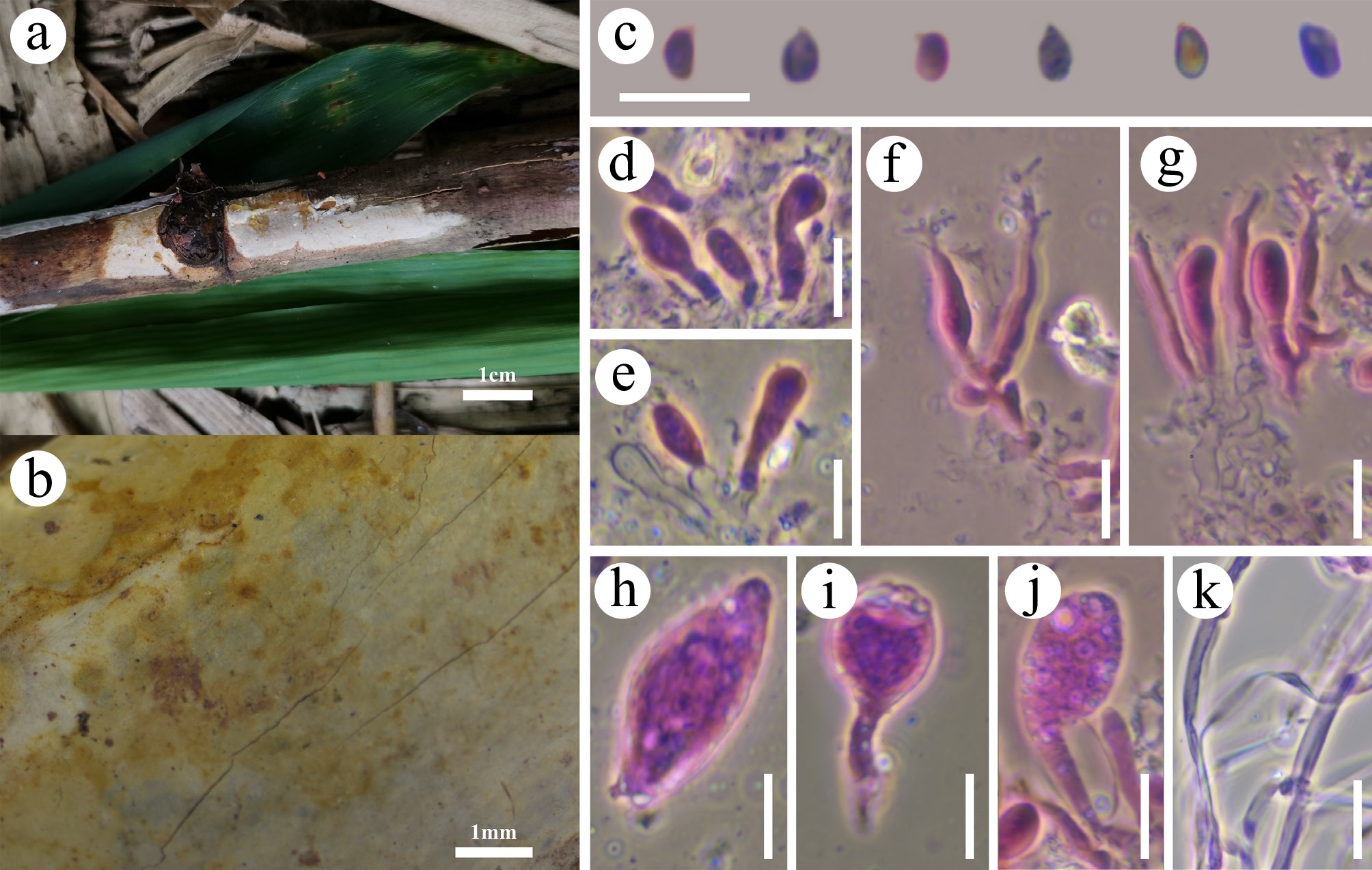
Figure 24.
Gloeomyces tapetiformis (holotype, Dai 35487). (a), (b) Basidiomata. (c) Basidiospores. (d), (e) Basidia and basidioles. (f), (g) Acanthophyses. (h)–(j) Gloeocystidia. (k) Generative hyphae. Scale bars: (c)–(k) = 10 µm.
-
Gene Primer Primer sequence (5'–3') Ref. ITS ITS5 GGA AGT AAA AGT CGT AAC AAG G [69] ITS4 TCC TCC GCT TAT TGA TAT GC nLSU LR0R ACC CGC TGA ACT TAA GC [70] LR7 TAC TAC CAC CAA GAT CT RPB2 fRPB2-5F GAY GAY MGW GAT CAY TTY GG [72] fRPB2-7CR CCC ATR GCT TGY TTR CCC AT tef1-α ef1-983F GCY CCY GGH CAY CGT CAY TTY AT [71] ef1-1567R ACH GTR CCR ATA CCA CCS ATC TT Table 1.
Primers for PCR amplification.
-
Node Mean stem age in MCC tree (Mya) 95% HPD range (Mya) A Russulales 199.48 142.29–276.26 B Peniophoraceae 118.3 83.3–168.41 C Camptocystidiellaceae 99.07 52.84–153.4 D Gloeocystidiellaceae 87.95 51.94–134.78 E Stereaceae 115.3 64.58–189 C1* Agaricales 112.85 90–152.96 C2* Hymenochaetales 144.15 125–190.66 C3* Ascomycota and Basidiomycota 410.48 400–445.29 Table 2.
Summary of estimated divergence times for the key nodes.
-
Character Camptocystidiellaceae Gloeocystidiellaceae Gloeodontiaceae Peniophoraceae Russulaceae* Stereaceae Basidiomata Resupinate, membranous to coriaceous Resupinate, membranous Resupinate to effused-reflexed, membranous to coriaceous Resupinate, orbicular, discoid, effused-reflexed to clavarioid, often waxy or coriaceous Resupinate, arachnoid to ceraceous or membranaceous Resupinate, discoid, cupulate, stereoid, auricularioid, effused-reflexed to pileate-sessile Hymenial surface Smooth to slightly cracked, sometimes grandinioid Smooth, rarely grandinioid or odontioid Smooth to odontioid Smooth, grandinioid, tuberculate or raduloid Smooth, odontoid, to tuberculate Smooth, rugose to tuberculate Hyphal system Monomitic Monomitic Monomitic Monomitic to dimitic Monomitic Monomitic to dimitic Generative hyphae With or without clamp connections Mostly with clamp connections (rarely simple-septate) With clamp connections With or without clamp connections With or without clamp connections (simple-septate in Boidinia; clamped in others) With or without clamp connections Skeletal/binding hyphae None None None Present in many genera, often dextrinoid None Occasionally present Gloeocystidia Abundant, subcylindrical to tubular, straight to strongly flexuous Abundant, straight to slightly curved Present, often with apical projections Present; variable Present, often tubular to clavate Present, often capitate or moniliform Other sterile elements None None None Dendrohyphidia, dichohyphae, asterosetae, acanthophyses Acanthophyses in Gloeopeniophorella; none in others Acanthophyses, acanthobasidia, dendrohyphidia Basidia Subcylindrical to clavate or urniform, 2–4 sterigmata Subcylindrical to clavate, 4 sterigmata Cylindrical to uniform, 4 sterigmata Mostly clavate to subcylindrical, 4 sterigmata Clavate to urniform (or pleurobasidia in Pseudoxenasma), 4 sterigmata Mostly clavate to subcylindrical, 4 sterigmata Basidiospores Ellipsoid to subglobose, verruculose (rarely smooth), strongly IKI+, CB– Ellipsoid to subglobose, verruculose to echinulate (rarely smooth), IKI+, CB– Ellipsoid to globose, asperulate, IKI+, CB– Variable (mostly ellipsoid to subglobose), smooth or ornamented, mostly IKI+, mostly CB– Globose to ellipsoid, verrucose to echinulate, IKI+, CB– Variable (mostly ellipsoid to subglobose), smooth or ornamented, mostly IKI+, mostly CB– Ecology On wood On wood, rarely on monocots On wood On wood and monocots On wood On wood, occasionally on monocots Distribution Africa, Asia, Europe, North America Asia, Europe, North America Asia, Africa, Americas, Europe Widespread Widespread Widespread * Corticioid representatives, e.g., Boidinia Stalpers & Hjortstam, Gloeopeniophorella Rick, Pseudoxenasma K.H. Larss. & Hjortstam. Table 3.
Morphological comparison of Camptocystidiellaceae fam. nov. with related families in Russulales.
-
1. Basidia with 2 sterigmata 2 1. Basidia with 4 sterigmata 3 2. Gloeocystidia ventricose, thick-walled; basidiospores fusiform to cylindrical, 18–22 × 6–7.2 μm V. bispora 2. Gloeocystidia subclavate to subcylindrical, sinuous, thin-walled; basidiospores ellipsoid to cylindrical, 10–13 × 4.2–5.2 μm V. amphithallica 3. Generative hyphae with clamp connections 4 3. Generative hyphae with simple septa 11 4. Basidiospores falcate, allantoid, or subcylindrical to cylindrical 5 4. Basidiospores fusiform to broadly ellipsoid, or subglobose 7 5. Gloeocystidia densely encrusted with crystals V. miscanthi 5. Gloeocystidia without crystals 6 6. Basidiospores falcate; gloeocystidia subulate 35–65 × 8–13 μm V. falcata 6. Basidiospores allantoid; gloeocystidia subcylindrical, elliptical to ovoid, 9–23 × 7–10.5 μm V. daweishanensis 7. Basidiospores with a suprahilar amyloid appendage V. investiens 7. Basidiospores without amyloid appendage 8 8. Basidiospores > 15 μm long 9 8. Basidiospores ≤ 15 μm long 10 9. Basidiospores fusiform to ellipsoid, 15.8–17.5 × 5.9–7 μm; gloeocystidia capitate, 60–120 × 9–15 μm V. incarnata 9. Basidiospores broadly ellipsoid with a beak-like extension, 18–23 × 9.5–13 μm; Gloeocystidia clavate, 50–100 × 4–9 μm V. montana 10. Basidiospores ellipsoid, 7.5–9.5 × 4–5 μm; hymenial surface deeply cracked; gloeocystidia of two types (ventricose and obclavate) V. fissurata 10. Basidiospores subglobose to spherical, 8–10 × 7.5–8.5 μm; gloeocystidia of one type (subcylindrical to fusiform) V. sphaericospora 11. Basidiospores amyloid 12 11. Basidiospores inamyloid 20 12. Basidiospores > 20 μm long V. bambusicola 12. Basidiospores ≤ 20 μm long 13 13. Rhizomorph present V. yunnanensis 13. Rhizomorph absent 14 14. Basidiospores > 5 μm wide 15 14. Basidiospores ≤ 5 μm wide 19 15. Gloeocystidia thin-walled 16 15. Gloeocystidia thick-walled 17 16. Gloeocystidia urniform and fusiform V. membranacea 16. Gloeocystidia subcylindrical to fusiform, and cylindrical to subclavate V. muscicola 17. Gloeocystidia with 1–2 constrictions V. yingjiangensis 17. Gloeocystidia without constrictions 18 18. Gloeocystidia clavate to cylindrical, with oil drops V. punctata 18. Gloeocystidia subglobose and fusiform, without oil drops V. yaoshanensis 19. Hymenial surface cream to buff, cracked; basidiospores broadly ellipsoid, 6–7.5 × 3.5–5 μm V. lacerata 19. Hymenial surface white to cream, smooth; basidiospores subcylindrical to narrowly ellipsoid, 7.5–9.5 × 4–5 µm V. wumengshanensis 20. Gloeocystidia of two or three types 21 20. Gloeocystidia of one type 23 21. Gloeocystidia of three types, cylindrical, subulate, and cylindrical to bottled shape V. tuberculata 21. Gloeocystidia of two types 22 22. Basidiospores fusiform to ellipsoid, 11.8–16.1 × 5.6–7.7 μm V. bannaensis 22. Basidiospores ellipsoid, 3.5–5.5 × 2.5–3.5 µm V. fragilis 23. Acanthocystidia or septocystidia present 24 23. Acanthocystidia or septocystidia absent 25 24. Septocystidia present (with 3–5 transverse septa) V. septocystidiata 24. Acanthocystidia present (densely covered with tuberculate spines) V. acanthocystidia 25. Paraphyses present V. subulata 25. Paraphyses absent 26 26. Basidiospores with a distinct beak-like extension 27 26. Basidiospores without a beak-like extension 28 27. Basidiospores subfusiform to navicular, 9–13 × 5–8 μm; gloeocystidia spindle to subcylindrical, 38–47 × 8–13 μm V. isabellina 27. Basidiospores broadly ellipsoid, 6–11 × 4–6 μm; Gloeocystidia subulate, 17–35 × 6–7 μm V. sinensis 28. Gloeocystidia subulate 29 28. Gloeocystidia not subulate 31 29. Basidiospores ≤ 7.5 μm long V. ambigua 29. Basidiospores > 7.5 μm long 30 30. Basidiospores 7.5–8.1 × 4.6–5 μm; high altitude (ca. 2,600–2,875 m); on bamboo and wood V. alpina 30. Basidiospores 7–7.9 × 3.1–3.6 μm; low altitude (ca. 700 m); strictly on Bambusa emeiensis V. emeiensis 31. Gloeocystidia ≤ 25 μm long 32 31. Gloeocystidia > 25 μm long V. tenuata 32. Basidia clavate or barrel-shaped 33 32. Basidia fusiform to subcylindrical 34 33. Basidia clavate, gloeocystidia subglobose, clavate to fusiform V. lincangensis 33. Basidia barrel-shaped, gloeocystidia pyramidal V. pingbianensis 34. Gloeocystidia fusiform to subcylindrical, basidiospores broadly ellipsoid, 2.5–4 × 1.5–2.5 μm V. asiana 34. Gloeocystidia obclavate, basidiospores ellipsoid, 5.9–8.8 × 3.1–5.1 μm V. ferruginosa
Figures
(24)
Tables
(4)