












-
The corticioid fungi represent a morphologically and phylogenetically heterogeneous assemblage, unified by their resupinate basidiomata and hymenophores that range from smooth to tuberculate or odontioid[1]. Phylogenetically, these fungi are widely distributed across numerous orders within the Agaricomycetes, including Agaricales, Amylocorticiales, Atheliales, Auriculariales, Cantharellales, Corticiales, Gloeophyllales, Hymenochaetales, Polyporales, Russulales, Thelephorales, Trechisporales, and Xenasmatellales[2−15]. Ecologically, they function as essential primary decomposers in forest ecosystems, releasing lignocellulolytic enzymes that promote carbon cycling and nutrient mobilization[16−20].
Within the order Russulales, species exhibiting corticioid morphology are predominantly concentrated in two families: the Stereaceae and Peniophoraceae[21,22]. Members of both families typically possess gloeocystidia, predominantly amyloid basidiospores, and diverse sterile elements, such as acanthophyses, dichohyphae, and skeletocystidia[1,23]. Peniophoraceae, typified by Peniophora Cooke, encompasses genera distinguished by specialized hyphal structures, such as Asterostroma Massee, characterized by stellate asterosetae, Baltazaria Leal-Dutra et al., featuring a dimitic hyphal system and dextrinoid skeletal hyphae, Gloiothele Bres. with gloeocystidia containing guttulate contents, and Vararia P. Karst. with dichotomously branched dichohyphae[24−30]. Stereaceae, typified by Stereum Hill ex Pers., includes genera known for their varied sterile elements and basidial types, such as Acanthobasidium Oberw. with basidia bearing aculeate projections, Aleurodiscus Rabenh. ex J. Schröt. with discoid to resupinate basidiomata bearing various sterile elements, and Gloeomyces Sheng H. Wu with acanthophyses and simple-septate generative hyphae[23,31−34]. The genus Gloeocystidiellum Donk s. lat. was originally placed in Gloeocystidiellaceae[35], but species in the genus were later often assigned to Stereaceae due to morphological resemblances and insufficient molecular systematic sampling[6,36−38]. The polyphyly of this genus has been demonstrated by recent phylogenetic investigations, which further confirmed that the core clade, harboring the generic type species G. porosum (Berk. & M.A. Curtis) Donk, belongs to the resurrected family Gloeocystidiellaceae[21,39]. However, other lineages remain distributed across distinct families within Russulales, reflecting the long-standing complexity of this group.
Recent molecular studies have begun to clarify the generic boundaries within these families. The circumscriptions of Peniophora s. lat. and Scytinostroma Donk s. str. in Peniophoraceae have been revised, with Dendrophora (Parmasto) Chamuris and Duportella Pat. now merged into Peniophora[40], and Michenera Berk. & M.A. Curtis nested within Scytinostroma[41]. Within the Stereaceae, Xu et al.[34] resolved 14 distinct lineages (including two new genera and nine new species from China) based on ITS + nLSU data. In addition, detailed surveys in biodiversity hotspots like Southwestern China have uncovered a surprising diversity of species, particularly within Vararia and Asterostroma[12,28−30,36,39,42−49]. Yet, comprehensive multi-gene phylogenies for both Stereaceae and Peniophoraceae remain limited, and the fungal diversity associated with specialized substrates, such as monocotyledons, is still poorly understood.
Bamboos (Poaceae, Bambusoideae) occupy a unique ecological niche for wood-inhabiting fungi. Unlike typical dicotyledonous woods, bamboo culms have unique anatomical and chemical characteristics, including high silica content, a distinct vascular bundle arrangement, and a specific lignin composition[50,51]. China has the richest bamboo diversity in the world, with over 500 species distributed across tropical, subtropical, and temperate regions[52], providing extensive habitats for bamboo-associated fungi[53,54]. Numerous bambusicolous ascomycetes have been discovered in China recently[54−58], and previous studies have revealed several bamboo-associated basidiomycetes within Russulales (e.g., Acanthobasidium, Asterostroma, Vararia, and Scytinostroma), suggesting that bamboo substrates harbor a distinctive and underexplored fungal community[34,39,59−65].
During extensive field investigations across China, numerous corticioid specimens were collected, primarily from bamboos, many of which represent undescribed species. To determine their phylogenetic placements within Stereaceae and Peniophoraceae, we employed a multi-loci phylogenetic approach. The study aims to: (1) characterize the morphological diversity of these fungi; (2) infer their phylogenetic relationships; (3) formally describe new taxa with comprehensive documentation; and (4) explore host associations with monocots, with an emphasis on bamboo-associated taxa.
-
Fresh basidiomata of corticioid fungi were obtained from 14 provinces (Anhui, Fujian, Guangdong, Guizhou, Hainan, Heilongjiang, Henan, Hunan, Jiangxi, Jilin, Shaanxi, Sichuan, Yunnan, and Zhejiang), three autonomous regions (Guangxi, Xinjiang, and Xizang), and two municipalities (Beijing and Chongqing) in China. Specimens were primarily collected from dead or decaying bamboo culms, including Bambusa emeiensis, B. textilis, B. vulgaris, Dendrocalamus yunnanicus, Dendrocalamus sp., Fargesia spathacea, Indocalamus tessellatus, Indosasa crassiflora, and Phyllostachys heterocycla; from other Poaceae (e.g. Miscanthus sp.); from Arecaceae (palms); from other dicotyledonous angiosperm wood, and from gymnosperm wood (including Abies fabri, Pinus koraiensis, and P. massoniana).
The specimens were photographed in situ, and detailed macroscopic characteristics of the fresh samples were recorded. The specimens were then dried at 38 °C in a mushroom dryer (Evermat, Finland) and sealed in ventilated bags. All examined materials were deposited in the Fungarium of the State Key Laboratory of Efficient Production of Forest Resources, Beijing Forestry University, China (BJFC).
Morphological studies
-
Macromorphological data were derived from field notes and laboratory observation. Color terminology follows Anonymous[66] and Petersen[67]. Microscopic examinations were performed on dried specimens mounted in 5% potassium hydroxide (KOH), 1% Congo Red solution; Melzer's reagent (IKI) and Cotton Blue (CB) were used to test amyloid/dextrinoid reactions and cyanophily, respectively. Sections were observed under a Nikon Eclipse 80i light microscope (Tokyo, Japan) with phase contrast illumination, at magnifications up to 1,000×. For each specimen, at least 30 basidiospores were measured, mostly in CB, with the apiculus excluded; the upper and lower 5% of measurements are given in parentheses. Listed below are the abbreviations used: IKI = Melzer's reagent, IKI+ = amyloid; IKI[+] = dextrinoid; IKI− = neither amyloid nor dextrinoid; CB− = acyanophilous, and CB+ = cyanophilous. For all spores measured, L = mean length, W = mean width, Q = L/W length-to-width ratios (across all studied specimens), and n (a/b) = total spores (a) counted from specimens (b).
DNA extraction, amplification, and sequencing
-
Genomic DNA was isolated from dried specimens using the CTAB plant genomic DNA extraction kit DN14 (Aidlab Biotechnologies Co., Ltd, Beijing, China), according to the supplier's instructions but with minor modifications[9,68]. Four gene regions were amplified for phylogenetic analyses: the internal transcribed spacer region (ITS)[69], the large subunit of nuclear ribosomal RNA gene (nLSU)[70], the translation elongation factor 1-α gene (tef1-α)[71], and the second subunit of RNA polymerase II (RPB2)[72]. Primer pairs employed for each marker are summarized in Table 1.
Table 1. Primers for PCR amplification.
Gene Primer Primer sequence (5'–3') Ref. ITS ITS5 GGA AGT AAA AGT CGT AAC AAG G [69] ITS4 TCC TCC GCT TAT TGA TAT GC nLSU LR0R ACC CGC TGA ACT TAA GC [70] LR7 TAC TAC CAC CAA GAT CT RPB2 fRPB2-5F GAY GAY MGW GAT CAY TTY GG [72] fRPB2-7CR CCC ATR GCT TGY TTR CCC AT tef1-α ef1-983F GCY CCY GGH CAY CGT CAY TTY AT [71] ef1-1567R ACH GTR CCR ATA CCA CCS ATC TT The following temperature and time settings were used for the polymerase chain reaction (PCR):
For ITS and tef1-α: 94 °C for 3 min (initial denaturation); 34 cycles of 94 °C for 40 s, 54 °C annealing for 45 s, 72 °C for 1 min; and a final extension at 72 °C for 10 min.
For nLSU: 94 °C for 1 min (initial denaturation); 35 cycles of 94 °C for 30 s, annealing at 50 °C for 1 min, 72 °C for 1.5 min; and a final extension at 72 °C for 10 min.
For RPB2: 94 °C for 2.5 min (initial denaturation); the first round comprised 10 cycles of 94 °C for 40 s, 60 °C for 40 s, and 72 °C for 1.5 min; a second round followed by 37 cycles of 94 °C for 45 s, 52−55 °C for 1 min, 72 °C for 1.5 min; and a final extension at 72 °C for 10 min.
The same primers were used to purify and sequence the PCR products at the Beijing Genomics Institute, China (BGI). The submission of all newly generated sequences to GenBank resulted in their listing in Supplementary Table S1.
Phylogenetic analysis
-
Newly generated sequences were initially checked using an NCBI BLAST search to verify their identities and to retrieve closely related sequences from GenBank. Additional sequences used were downloaded from GenBank based on recent publications and are listed in Table 2.
Table 2. Summary of estimated divergence times for the key nodes.
Node Mean stem age in MCC tree (Mya) 95% HPD range (Mya) A Russulales 199.48 142.29–276.26 B Peniophoraceae 118.3 83.3–168.41 C Camptocystidiellaceae 99.07 52.84–153.4 D Gloeocystidiellaceae 87.95 51.94–134.78 E Stereaceae 115.3 64.58–189 C1* Agaricales 112.85 90–152.96 C2* Hymenochaetales 144.15 125–190.66 C3* Ascomycota and Basidiomycota 410.48 400–445.29 The assembly of a concatenated four-gene dataset (ITS + nLSU + RPB2 + tef1-α) was used to establish a phylogenetic framework for Russulales and determine the Gloeocystidiellum clade's position, including 103 samples representing 93 species, 47 genera, and 16 families, with Hydnum albomagnum Banker and Sistotrema coronilla (Höhn.) Donk ex D.P. Rogers as outgroups. For Peniophoraceae, a two-gene (ITS + nLSU) dataset was assembled, including 154 samples representing 115 species and 13 genera, with Amylostereum laevigatum (Fr.) Boidin and Echinodontium tinctorium (Ellis & Everh.) Ellis & Everh. as outgroups. Another two-gene (ITS + nLSU) dataset was assembled for Stereaceae, including 124 samples representing 95 species and 16 genera, with Laurilia sulcata (Burt) Pouzar as an outgroup.
Multiple sequence alignments were conducted in MAFFT v7[73] with default parameters, manually adjusted in BioEdit v7.0.9[74], and combined in Mesquite v4.02[75]. For each dataset, the best-fit partitioning scheme and substitution models for Bayesian inference (BI) were determined using ModelFinder[76]. The corrected Akaike Information Criterion (AICc) was utilised for model selection with edge-unlinked partition models.
Maximum Likelihood (ML) phylogenies were inferred with RAxML v8.2.10[77] employing rapid bootstrapping of 1,000 replicates under default parameters. The GTR + F + I + G4 model was applied with parameters estimated from the data.
Bayesian Inference (BI) analyses were performed with MrBayes v3.2.7[78]. For the four-gene dataset, the alignment was partitioned by gene region, with the GTR + F + I + G4 model applied to ITS, nLSU, RPB2, and tef1-α. For these two ITS + nLSU datasets, the GTR + F + I + G4 model was applied to both genes. Two independent runs with four chains each were conducted for 50 (four-gene dataset), 300 (ITS + nLSU datasets for Peniophoraceae), and 10 million generations (ITS + nLSU datasets for Stereaceae), sampling every 1,000 generations. Analyses were run until convergence, evaluated by the average standard deviation of split frequencies (ASDSF) and effective sample sizes (ESS) of model parameters. According to the sampling range, an ASDSF below 0.05 was considered acceptable for the Peniophoraceae and the Vararia single-genus datasets, while for the other datasets the ASDSF dropped below 0.01; all parameters had ESS > 200 after discarding the first 25% of samples as burn-in. A 25% majority consensus tree was then constructed from the post-burn-in trees for all datasets.
-
To provide higher resolution for within-genus relationships, additional datasets were analyzed, and the resulting trees are presented in the Supplementary Material (Supplementary Figs S1–S9). All ML and BI analyses for supplementary datasets followed the same substitution models and partitioning strategies as described for the main analyses.
Single-genus datasets were assembled for Acanthobasidium, Asterostroma, Baltazaria, the Gloeocystidiellum complex, Gloeomyces, and Gloiothele based on ITS + nLSU sequences. For these datasets, both ML (1,000 bootstrap replicates) and Bayesian (1.5–50 million generations) analyses were performed following the same parameter settings as described for the main datasets.
For Vararia, which exhibits extremely high sequence variability and polyphyly, three reduced datasets were constructed: ITS-only, LSU-only, and combined ITS + LSU. For the ITS-only dataset, both Bayesian and maximum likelihood analyses were performed, and the resulting trees are shown in Supplementary Fig. S7. For the LSU-only and combined ITS + LSU datasets, only maximum likelihood analyses were conducted; the resulting trees are shown in Supplementary Figs S8 and S9, respectively.
Visualization and editing of all the phylogenetic trees were carried out using FigTree v1.4.4 and iTOL v6. Branches were regarded as significantly supported if their ML bootstrap value reached ≥ 50% or their Bayesian posterior probability (BPP) reached ≥ 0.9. The alignment files and phylogenetic trees have been deposited in Figshare.
Divergence time estimation
-
Divergence times and their confidence intervals were inferred using BEAST v2.7.7[79] under an uncorrelated lognormal relaxed molecular clock with a Yule speciation prior[80−82], based on another concatenation of ITS, nLSU, RPB2, and tef1-α sequences, including 96 samples representing 95 species, 59 genera, 26 families, and 9 orders. Substitution models were simplified to GTR + G4 + I for all partitions.
Three fossil calibrations were employed as minimum age constraints, each assigned a gamma prior (shape = 1, scale = 20): Archaeomarasmius leggetti Hibbett et al.[83] for the crown age of Agaricales at 90 Mya, Quatsinoporites cranhamii Smith et al.[84] for Hymenochaetales at 125 Mya, and Paleopyrenomycites devonicus Taylor et al.[85,86] for the divergence between Ascomycota and Basidiomycota at 400 Mya. The ucld. mean parameters were set to uniform[7,11,68,87−89].
The Markov chain Monte Carlo (MCMC) analysis was performed over 102 million generations, sampling every 1,000 generations. Convergence was evaluated using Tracer v1.7[90], and all parameters had ESS > 200 following a 10% burn-in. TreeAnnotator v2.7.7 was employed to summarize the maximum clade credibility (MCC) tree, applying median node heights and 95% highest posterior density (HPD) intervals[79,91]. Visualization and editing of all the phylogenetic trees were carried out using FigTree v1.4.4 and iTOL v6.
-
Phylogeny of Russulales derived from combined ITS + nLSU + RPB2 + tef1-α sequence data (Fig. 1)
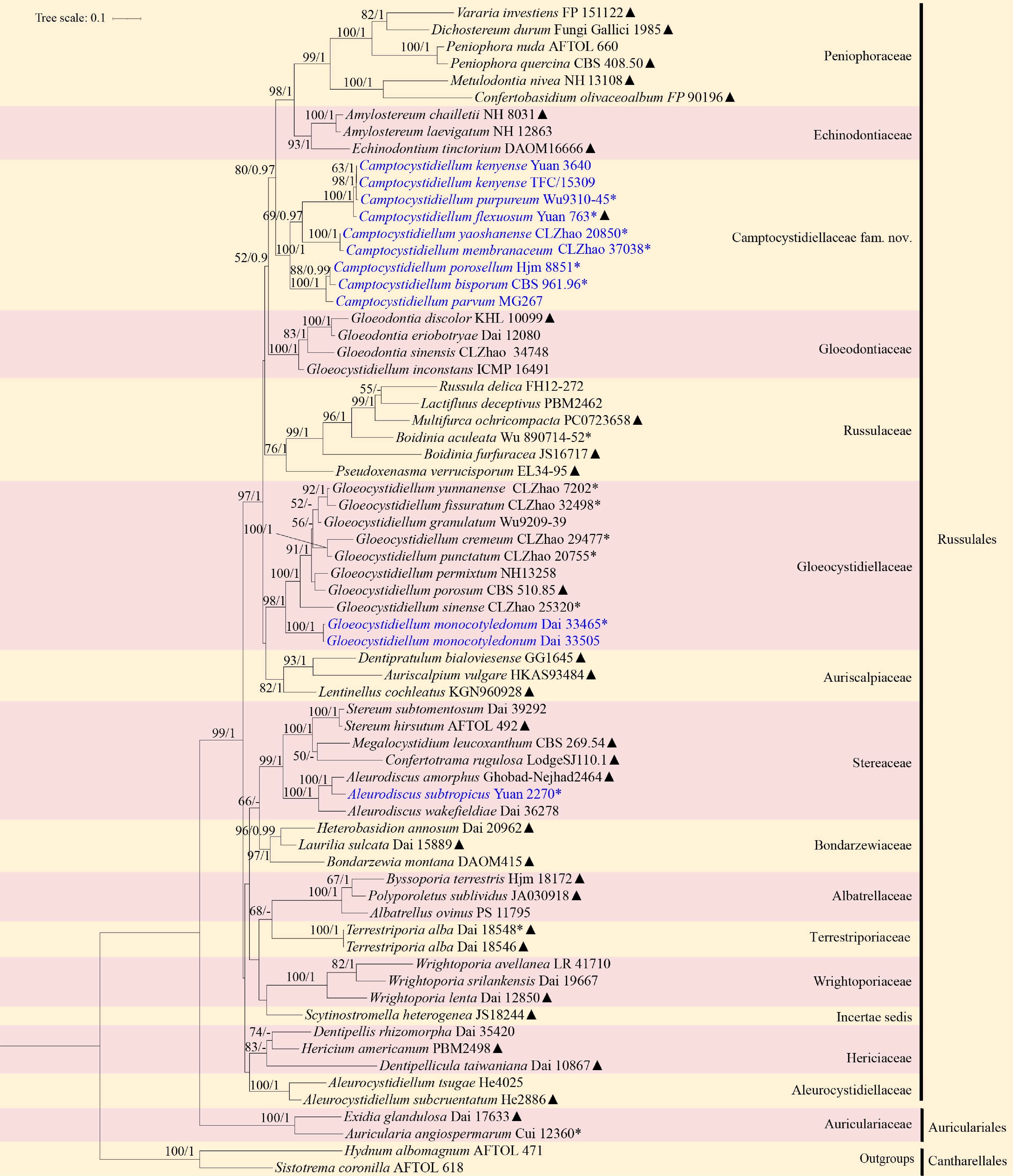
Figure 1.
The phylogeny of Russulales was reconstructed using Maximum Likelihood analysis of combined ITS + nLSU + RPB2 + tef1-α sequences. ML and BI analyses gave similar topologies (ASDSF = 0.008643; all parameters ESS > 200). Branch nodes are annotated with Bootstrap support (≥ 50%) and Bayesian posterior probabilities (≥ 0.9). Black triangle (▲) = type species; blue = new species/combinations; asterisk (*) = holotypes.
The four-gene phylogeny recovered 14 major families within Russulales with strong support. Among these, Peniophoraceae (99% ML, 1 BPP; Fig. 1), Stereaceae (99% ML, 1 BPP; Fig. 1), Gloeocystidiellaceae (98% ML, 1 BPP; Fig. 1), and the newly described Camptocystidiellaceae fam. nov. (100% ML, 1 BPP; Fig. 1) each formed well-supported monophyletic clades.
Phylogeny of Peniophoraceae derived from combined ITS + nLSU sequence data (Fig. 2; Supplementary Figs S2, S3, S6–S9)
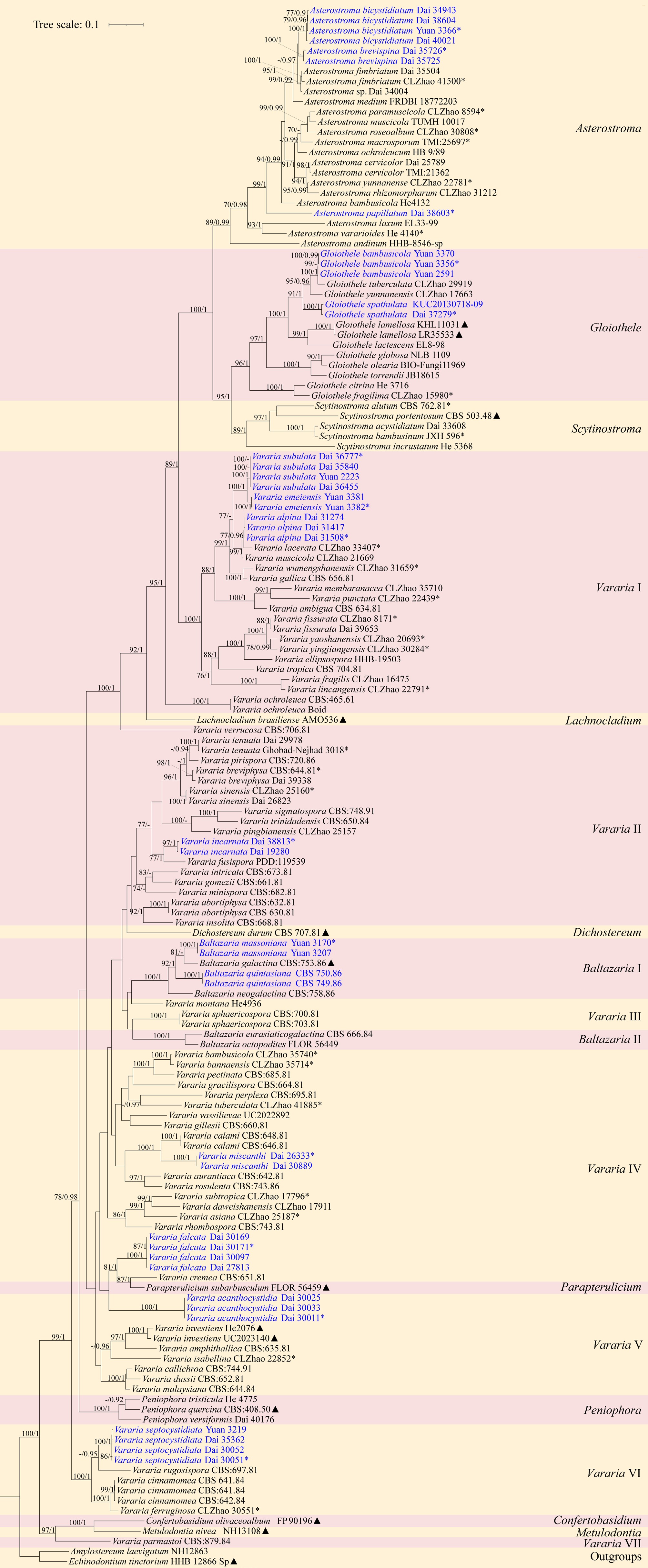
Figure 2.
The phylogeny of Peniophoraceae was reconstructed using Maximum Likelihood analysis of combined ITS + nLSU sequences. ML and BI analyses gave similar topologies (ASDSF = 0.01319; all parameters ESS > 200). Branch nodes are annotated with Bootstrap support (≥ 50%) and Bayesian posterior probabilities (≥ 0.9). Black triangle (▲) = type species; blue = new species/combinations; asterisk (*) = holotypes. Major clades are labelled with roman numerals.
Within Peniophoraceae (Fig. 2), 11 genera were recovered, with the new species distributed across multiple lineages. Among them, Asterostroma and Gloiothele were resolved as monophyletic, while Baltazaria and Vararia appeared to be polyphyletic, with their species distributed across multiple lineages.
In Asterostroma, which formed a well-supported monophyletic group within Peniophoraceae (89% ML, 0.99 BPP; Fig. 2), three new species described below were placed in two infrageneric subclades (Supplementary Fig. S2) corresponding to morphological groups recognized in previous studies[92]. Asterostroma arundinicola Li Wang & K.Y. Luo, A. bicystidiatum sp. nov., A. brevispinum sp. nov., A. fimbriatum Y.L. Deng & C.L. Zhao, and A. medium Bres. formed a well-supported clade within sect. Asterostroma (77% ML; Supplementary Fig. S2). Asterostroma papillatum sp. nov. was nested within sect. Laevispora, and sister to A. andinum Pat. (Supplementary Fig. S2).
In Baltazaria, which appeared polyphyletic, distinct clades were recovered within the genus (Fig. 2; Supplementary Fig. S3). The Baltazaria s. str. clade, containing the type B. galactina (Fr.) Leal-Dutra et al., formed a fully supported clade (100% ML, 1 BPP; Supplementary Fig. S3) together with the new species B. massonianae sp. nov. and two specimens of Scytinostroma quintasianum (Bres. & Roum.) Nakasone (CBS 749.86 and CBS 750.86; proposed as a new combination in Baltazaria below). The second clade, comprising B. eurasiaticogalactina (Boidin & Lanq.) Leal-Dutra et al. and B. octopodites (Corner) Leal-Dutra et al., formed a strongly supported clade (100% ML, 1 BPP; Supplementary Fig. S3). The third clade includes B. pingbianensis Y.L. Deng & C.L. Zhao (100% ML, 1 BPP; Supplementary Fig. S3).
In Gloiothele, also recovered as monophyletic (96% ML, 1 BPP; Fig. 2), two new species were placed in distinct positions. Gloiothele bambusicola sp. nov. formed a well-supported clade with G. tuberculata Y.L. Deng & C.L. Zhao (97% ML, 1 BPP; Supplementary Fig. S6), while G. spathulata sp. nov. grouped with G. lactescens (Berk.) Hjortstam (69% ML, 1 BPP; Supplementary Fig. S6). An additional sequence from South Korea (KUC20130718-09) clustered with G. spathulata with less than 1.5% ITS sequence divergence and was identified as this species.
In Vararia, which was also polyphyletic, eight new species were distributed across multiple lineages within the genus (Fig. 2). Vararia acanthocystidia sp. nov. and V. falcata sp. nov. each formed an independent lineage (100% ML, 1 BPP; Supplementary Fig. S7). Vararia alpina sp. nov. and V. muscicola Y.L. Deng & C.L. Zhao formed a strongly supported clade (70% ML, 0.98 BPP; Supplementary Fig. S7), that was sister to another supported clade containing V. emeiensis sp. nov., V. lacerata Y.L. Deng & C.L. Zhao, and V. subulata sp. nov. (64% ML, 0.97 BPP; Supplementary Fig. S7). Vararia incarnata sp. nov. formed an independent, well-supported lineage (100% ML, 1 BPP; Supplementary Fig. S7) within a larger stable clade (78% ML, 1 BPP; Supplementary Fig. S7) comprising V. breviphysa Boidin & Lanq., V. pirispora Boidin et al., V. sinensis Y.L. Deng & C.L. Zhao, and V. tenuata Ghobad-Nejhad. Vararia miscanthi sp. nov. formed a well-supported clade with the African palm-associated V. calami Boidin & Lanq. (100% ML, 1 BPP; Supplementary Fig. S7). Vararia septocystidiata sp. nov. formed a well-supported clade with V. ferruginosa Y.L. Deng & C.L. Zhao and another African species, V. cinnamomea Boidin et al. (88% ML, 1 BPP; Supplementary Fig. S7). These within-genus relationships are further resolved in the single-genus trees of Vararia (ITS-only, LSU-only, and combined ITS + LSU), which are provided in Supplementary Figs S7–S9.
Phylogeny of Stereaceae derived from combined ITS + nLSU sequence data (Fig. 3; Supplementary Figs S1, S5)
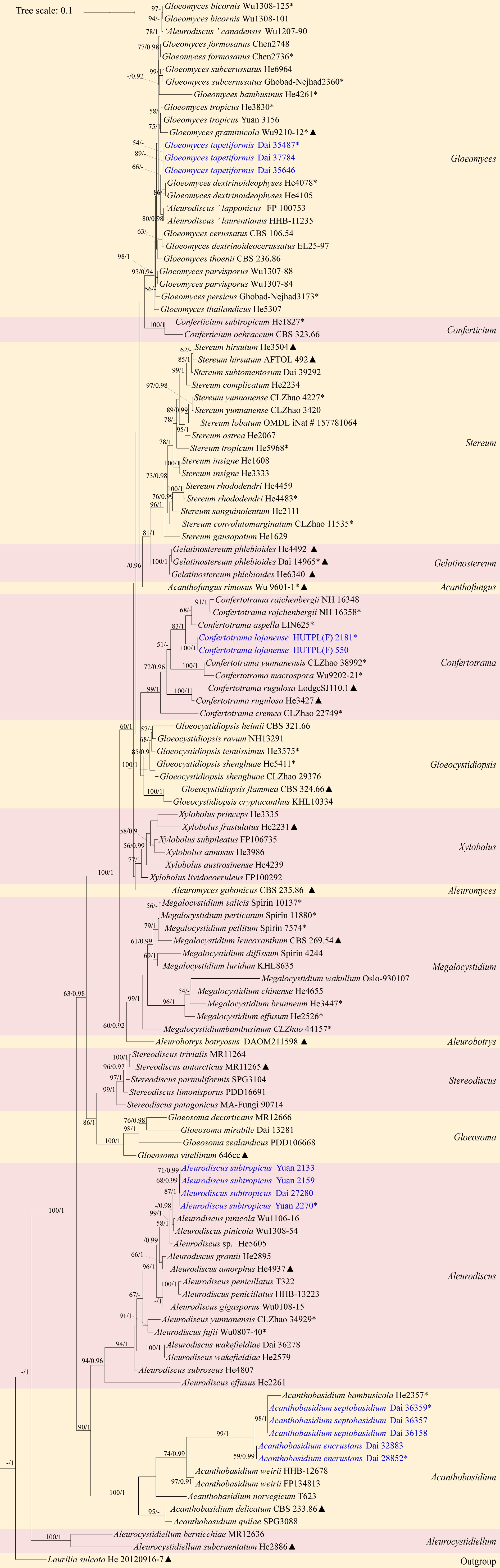
Figure 3.
The phylogeny of Stereaceae was reconstructed using Maximum Likelihood analysis of combined ITS + nLSU sequences. ML and BI analyses produced similar topologies (ASDSF = 0.009606; all parameters ESS > 200). Branch nodes are annotated with Bootstrap support (≥ 50%) and Bayesian posterior probabilities (≥ 0.9). Black triangle (▲) = type species; blue = new species/combinations; asterisk (*) = holotypes.
Within Stereaceae (Fig. 3), 16 genera were recovered, with the new species distributed across multiple lineages. Most genera, such as Acanthobasidium, Aleurodiscus s. str., Confertotrama, and Gloeomyces, were resolved as monophyletic with strong support following previous studies[34].
In Acanthobasidium, which formed a well-supported monophyletic group (100% ML, 1 BPP; Fig. 3), two new species were placed in a well-supported clade with the previously described A. bambusicola L.D. Dai & S.H. He (100% ML, 1 BPP; Supplementary Fig. S1). Acanthobasidium encrustans sp. nov. and A. septobasidium sp. nov. formed a sister relationship within this clade.
Aleurodiscus is represented here by its core Aleurodiscus s. str. clade, which was recovered as monophyletic (94% ML, 0.96 BPP; Fig. 3). Aleurodiscus subtropicus sp. nov. was nested within this clade, sister to A. pinicola Sheng H. Wu (0.98 BPP; Fig. 3).
Gloeomyces was resolved as monophyletic (93% ML, 0.94 BPP; Fig. 3). Gloeomyces tapetiformis sp. nov. was recovered as sister to G. dextrinoideophyses (S.H. He) S.H. He with strong support (52% ML; Supplementary Fig. S5).
Confertotrama formed a monophyletic group (99% ML, 1 BPP; Fig. 3). The type sequence of Gloeocystidiellum lojanense A.C. Jaram. et al. (HUTPL(F) 2181, holotype) was nested within Confertotrama, sister to C. aspella (Hjortstam) Nakasone & S.H. He and C. rajchenbergii (Gorjón & Hallenb.) Nakasone & S.H. He. Based on this phylogenetic evidence, a new combination in Confertotrama is proposed below.
Extensive sampling of the Gloeocystidiellum complex derived from combined ITS + nLSU sequence data (Supplementary Fig. S4)
Gloeocystidiellum was confirmed to be polyphyletic, with species distributed across two distinct clades within Russulales (Fig. 1; Supplementary Fig. S4). The core Gloeocystidiellum s. str. clade formed a well-supported clade (99% ML, 1 BPP; Supplementary Fig. S4) and is recognized here within Gloeocystidiellaceae. This clade contains G. porosum (the type species of Gloeocystidiellum), G. permixtum (Boidin, Lanq. & Gilles) E. Larss. & K.H. Larss, G. sinense Q.Y. Zhang & Yuan Yuan, G. cremeum Lu Wang & C.L. Zhao, G. fissuratum Lu Wang & C.L. Zhao, G. yunnanense Y.L. Zhao & C.L. Zhao, and the new species G. monocotyledonum sp. nov.
The second well-supported clade (90% ML, 1 BPP; Supplementary Fig. S4) is treated here as a single new genus, Camptocystidiellum. This clade includes Boidinia parva Ghobad-Nejhad et al., Gloeocystidiellum bisporum Boidin et al., G. clavuligerum (Höhn. & Litsch.) Nakasone, and G. kenyense Hjortstam, G. membranaceum Y.L. Deng & C.L. Zhao, G. porosellum Hjortstam, G. purpureum Sheng H. Wu, G. yaoshanense Y.J. Zhu & C.L. Zhao, and a new species described below as Camptocystidiellum flexuosum sp. nov. All these species are transferred to Camptocystidiellum as described below, except for G. clavuligerum.
Divergence of Camptocystidiellaceae fam. nov. derived from combined ITS + nLSU + RPB2 + tef1-α sequence data (Fig. 4)
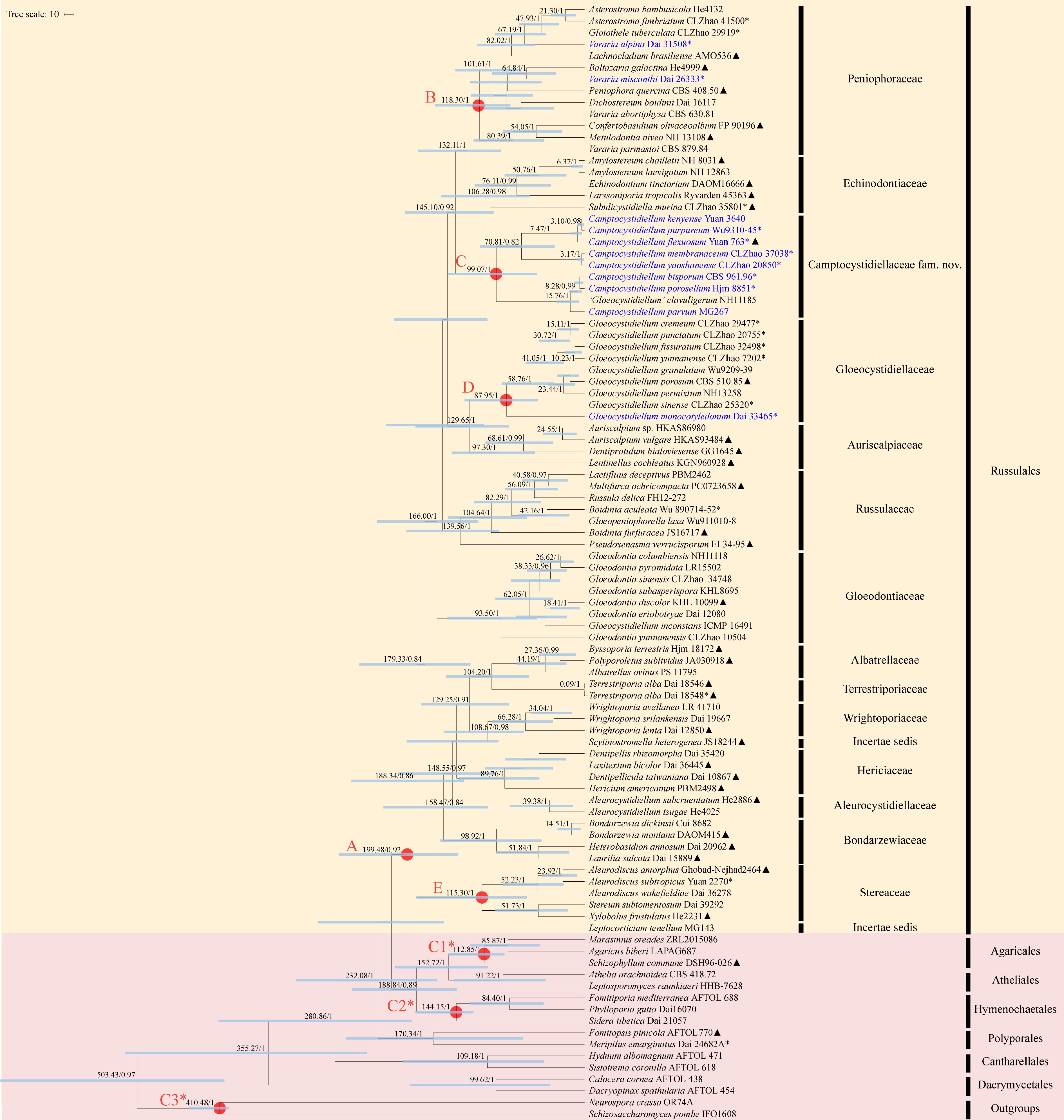
Figure 4.
Estimated divergence times of Russulales families were calculated using a four-gene dataset (ITS + nLSU + RPB2 + tef1-α). Node supports were assessed with Bayesian posterior probabilities (≥ 0.8). Mean ages (Mya) are shown with 95% HPD intervals represented as horizontal bars. Black triangle (▲) = type species; blue = new species/combinations; asterisk (*) = holotypes.
The mean stem age of the new family Camptocystidiellaceae, which contains the single genus Camptocystidiellum, was estimated at 99.07 Mya (52.84–153.4 Mya, 95% HPD) during the Late Cretaceous, distinguished from Gloeocystidiellaceae (87.95 Mya; 51.94–134.78 Mya, 95% HPD) following the initial diversification of Russulales (199.48 Mya; 142.29–276.26 Mya, 95% HPD). The three fossil calibration points used in this analysis (C1* Agaricales: 112.85 Mya, 90–152.96 Mya, 95% HPD; C2* Hymenochaetales: 144.15 Mya, 125–190.66 Mya, 95% HPD; C3* Ascomycota and Basidiomycota: 410.48 Mya, 400–445.29 Mya, 95% HPD) yielded age estimates compatible with previous studies[39,87,93−95]. The estimated divergence times for all major nodes are summarized in Table 2.
Taxonomy
-
Order Russulales Kreisel ex P.M. Kirk, P.F. Cannon & J.C. David
Index Fungorum number: IF90569.
Type family – Russulaceae Lotsy
Family Camptocystidiellaceae Xin Zhang, Y.C. Dai & Yuan Yuan, fam. nov.
Index Fungorum number: IF905320.
Type genus – Camptocystidiellum Xin Zhang, Y.C. Dai & Yuan Yuan, gen. nov.
Etymology – Refers to the type genus Camptocystidiellum.
Description – Basidiomata annual, resupinate, adnate, membranous to coriaceous. Hymenial surface smooth to slightly cracked, yellowish (1A2–4A2) to cream (4A3) or buff (4A4). Hyphal system monomitic; generative hyphae with clamp connections or simple septa, colorless, thin- to slightly thick-walled, IKI–, CB–. Gloeocystidia abundant, mostly subcylindrical to tubular, straight to flexuous, sometimes constricted, moniliform, or with a schizopapillate apex. Basidia subcylindrical to clavate or urniform, with 2–4 sterigmata. Basidiospores ellipsoid to subglobose, mostly verrucose or rarely smooth, strongly IKI+, CB–.
Notes – Gloeocystidiellum has long been recognized as a polyphyletic assemblage within Russulales[21,35,39,96,97]. In the present study, this new family is proposed on the basis of phylogenetic analyses (Fig. 1; Supplementary Fig. S4), which recover it as a well-supported clade (100% ML, 1 BPP; Fig. 1), separated from Gloeocystidiellaceae.
Both Camptocystidiellaceae and Gloeocystidiellaceae contain a single genus, but they differ in several morphological traits. Gloeocystidiellum (type genus of Gloeocystidiellaceae) possesses mostly clamped hyphae and straight to slightly curved gloeocystidia. In contrast, Camptocystidiellum (type genus of Camptocystidiellaceae) exhibits both clamped and simple-septate hyphae, and its gloeocystidia range from straight to strongly flexuous—a feature not found in Gloeocystidiellaceae. The genus Camptocystidiellum currently includes eight species, occurring on gymnosperm and angiosperm wood in montane to lowland forests across Africa, Asia, Europe, and North America[35,38,39,98−102]. In contrast to Gloeocystidiellaceae, no association with monocotyledonous hosts is currently known for Camptocystidiellaceae. A morphological comparison of Camptocystidiellaceae with related families is provided in Table 3.
Table 3. Morphological comparison of Camptocystidiellaceae fam. nov. with related families in Russulales.
Character Camptocystidiellaceae Gloeocystidiellaceae Gloeodontiaceae Peniophoraceae Russulaceae* Stereaceae Basidiomata Resupinate, membranous to coriaceous Resupinate, membranous Resupinate to effused-reflexed, membranous to coriaceous Resupinate, orbicular, discoid, effused-reflexed to clavarioid, often waxy or coriaceous Resupinate, arachnoid to ceraceous or membranaceous Resupinate, discoid, cupulate, stereoid, auricularioid, effused-reflexed to pileate-sessile Hymenial surface Smooth to slightly cracked, sometimes grandinioid Smooth, rarely grandinioid or odontioid Smooth to odontioid Smooth, grandinioid, tuberculate or raduloid Smooth, odontoid, to tuberculate Smooth, rugose to tuberculate Hyphal system Monomitic Monomitic Monomitic Monomitic to dimitic Monomitic Monomitic to dimitic Generative hyphae With or without clamp connections Mostly with clamp connections (rarely simple-septate) With clamp connections With or without clamp connections With or without clamp connections (simple-septate in Boidinia; clamped in others) With or without clamp connections Skeletal/binding hyphae None None None Present in many genera, often dextrinoid None Occasionally present Gloeocystidia Abundant, subcylindrical to tubular, straight to strongly flexuous Abundant, straight to slightly curved Present, often with apical projections Present; variable Present, often tubular to clavate Present, often capitate or moniliform Other sterile elements None None None Dendrohyphidia, dichohyphae, asterosetae, acanthophyses Acanthophyses in Gloeopeniophorella; none in others Acanthophyses, acanthobasidia, dendrohyphidia Basidia Subcylindrical to clavate or urniform, 2–4 sterigmata Subcylindrical to clavate, 4 sterigmata Cylindrical to uniform, 4 sterigmata Mostly clavate to subcylindrical, 4 sterigmata Clavate to urniform (or pleurobasidia in Pseudoxenasma), 4 sterigmata Mostly clavate to subcylindrical, 4 sterigmata Basidiospores Ellipsoid to subglobose, verruculose (rarely smooth), strongly IKI+, CB– Ellipsoid to subglobose, verruculose to echinulate (rarely smooth), IKI+, CB– Ellipsoid to globose, asperulate, IKI+, CB– Variable (mostly ellipsoid to subglobose), smooth or ornamented, mostly IKI+, mostly CB– Globose to ellipsoid, verrucose to echinulate, IKI+, CB– Variable (mostly ellipsoid to subglobose), smooth or ornamented, mostly IKI+, mostly CB– Ecology On wood On wood, rarely on monocots On wood On wood and monocots On wood On wood, occasionally on monocots Distribution Africa, Asia, Europe, North America Asia, Europe, North America Asia, Africa, Americas, Europe Widespread Widespread Widespread * Corticioid representatives, e.g., Boidinia Stalpers & Hjortstam, Gloeopeniophorella Rick, Pseudoxenasma K.H. Larss. & Hjortstam. Camptocystidiellum Xin Zhang, Y.C. Dai & Yuan Yuan, gen. nov.
Index Fungorum number: IF905232.
Type species – Camptocystidiellum flexuosum Xin Zhang, Y.C. Dai & Yuan Yuan
Etymology – Camptocystidiellum (Lat.), from camptos (Greek, bent) + cystidiellum (cystidium), refers to the distinctly flexuous gloeocystidia.
Description – Basidiomata annual, resupinate, adnate, membranous to coriaceous. Hymenial surface smooth to slightly cracked, white (–A1) to cream (4A3) or buff (4A4). Hyphal system monomitic; generative hyphae with clamp connections or simple-septate, colorless, thin- to slightly thick-walled, IKI–, CB–. Gloeocystidia abundant, subulate to tubular, straight to distinctly flexuous (winding), sometimes constricted, moniliform, or with a schizopapillate apex. Basidia subcylindrical to clavate or urniform, with 2–4 sterigmata. Basidiospores ellipsoid to subglobose, mostly verruculose or rarely smooth, strongly IKI+, CB–.
Notes – Camptocystidiellum is established based on phylogenetic and morphological evidence (Fig. 1, Supplementary Fig. S4), including eight species: the new species C. flexuosum (type species) and seven new combinations, C. kenyense (≡ Gloeocystidiellum kenyense), C. purpureum (≡ G. purpureum), C. bisporum (≡ G. bisporum), C. parvum (≡ Boidinia parva), C. porosellum (≡ G. porosellum), C. yaoshanense (≡ G. yaoshanense), and C. membranaceum (≡ G. membranaceum).
The eight species are divided into two groups based on hyphal septation: four with clamped hyphae and four with simple-septate hyphae. Camptocystidiellum flexuosum, C. kenyense, C. purpureum, and C. parvum share a monomitic hyphal system with clamp connections and verruculose basidiospores[99,101,102]. Camptocystidiellum flexuosum (the type species), known only from high-elevation temperate forests of Xinjiang and Xizang (2,158–3,925 m) in Western China on gymnosperm and angiosperm wood. Camptocystidiellum kenyense, originally described from Kenya, is distinguished by subfusiform and generally straight gloeocystidia[99]. It is distributed across high-elevation habitats in East Africa (2,200–2,400 m)[99] and Sichuan, China (2,867 m; on Pinus yunnanensis), contrasting with lower elevations in the Atlantic islands (380–485 m)[100]. Camptocystidiellum purpureum, known only from Taiwan, China (1,950 m), is characterized by flexuous gloeocystidia with a purplish reaction in sulphovanillin, and its transfer is based on the sequence from the type material (Wu 9310-45)[21,101]. Camptocystidiellum parvum, known only from Jilin, China (1,020 m), is distinguished by obclavate gloeocystidia, with its holotype specimen (BJFC012115) and corresponding sequence data available[102].
The remaining four species (Camptocystidiellum bisporum, C. porosellum, C. yaoshanense, and C. membranaceum) have simple-septate hyphae. Camptocystidiellum porosellum and C. bisporum are combined based on sequences derived from their respective type materials (Hjortstam 8851 and CBS 961.96) and morphological compatibility with the generic concept. Camptocystidiellum porosellum, known only from Europe, is characterized by gloeocystidia with a schizopapillate apex[98]. Camptocystidiellum bisporum, known only from France, is unique within the genus by its two-spored basidia and elongated gloeocystidia[35]. Camptocystidiellum yaoshanense and C. membranaceum are combined based on phylogenetic and morphological evidence, both recently described from Yunnan, China, with holotype specimens (CLZhao 20850 and CLZhao 26028) and corresponding sequence data available. Camptocystidiellum yaoshanense grows at high elevation (3,200 m) with a grandinioid hymenophore, tubular gloeocystidia[38], whereas C. membranaceum is found at lower elevations (1,000–1,875 m) with a membranous hymenophore, cylindrical gloeocystidia, and smooth basidiospores—a unique feature within Camptocystidiellum[39].
All species share a preference for montane to high-elevation habitats on gymnosperm and angiosperm wood across Africa, Asia, Europe, and North America, and all new combinations proposed herein are based on sequences derived from type specimens or authenticated reference strains. However, Gloeocystidiellum clavuligerum is retained in Gloeocystidiellum since no sequence data were available from the type material and no further specimens could be obtained. The following combinations are thus proposed:
Camptocystidiellum flexuosum Xin Zhang, Y.C. Dai & Yuan Yuan, sp. nov. Fig. 5
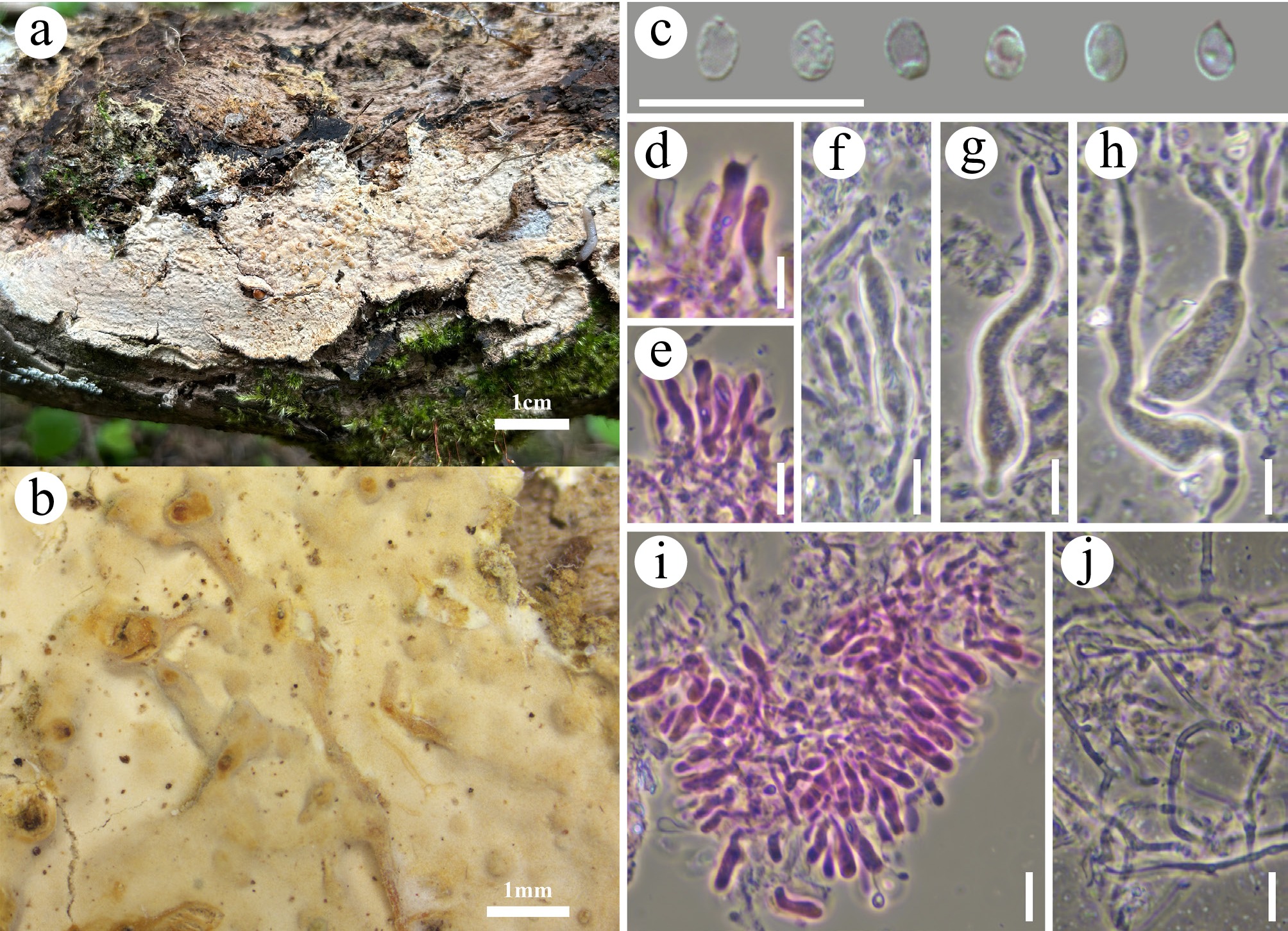
Figure 5.
Camptocystidiellum flexuosum (holotype, Yuan 763). (a), (b) Basidiomata. (c) Basidiospores. (d), (e) Basidia and basidioles. (f)–(h) Gloeocystidia. (i) A section of hymenium. (j) Generative hyphae. Scale bars: (c)–(j) = 10 µm.
Index Fungorum number: IF905231.
Etymology – Flexuosum (Lat.): refers to the species having winding cystidia.
Diagnosis – Characterized by the presence of distinctly flexuous (winding) gloeocystidia with a schizopapillate apex, ellipsoid, verruculose basidiospores measuring 3.7–4 × 2.6–2.9 µm, and growing on gymnosperm and angiosperm wood in high-elevation temperate forests of Western China.
Type – China, Xinjiang Autonomous Region, Yili, Tekes County, Kaladala, Qiongkushitai Village, 42.913632° N, 82.107869° E, elevation 2,158 m, on fallen angiosperm branch, leg. Yuan Yuan, 21 July 2023, Yuan 763 (BJFC041775).
Description – Basidiomata annual, resupinate, soft, membranous, closely adnate, up to 6.1 cm long, 1.7 cm wide, 150 µm thick at center. Hymenial surface smooth to locally tuberculate, slightly cracked, cream (4A3) to buff (4A4) and without odor and taste when fresh, buff (4A4) to olivaceous buff (4C4) when dry; margin white (–A1), thinning out, fimbriate.
Hyphal system monomitic; generative hyphae with clamp connections, hyaline, thin-walled, moderately branched and septate, IKI–, CB–, 1.2–3 μm in diam. Gloeocystidia abundant, subulate, mostly with many bends (or strongly flexuous), with guttulate content and a schizopapillate apex, hyaline, thin-walled, 55–100 × 7–18 µm. Basidia subcylindrical to clavate, thin-walled, with four sterigmata and a basal clamp connection, 17–30 × 3–6 µm; basidioles morphologically resembling basidia, yet slightly smaller in size. Basidiospores ellipsoid, hyaline, thin-walled, verruculose, IKI+, CB–, (3.5–)3.7–4(–4.2) × (2.5–)2.6–2.9(–3.1) µm, L = 3.94 µm, W = 2.82 µm, Q = 1.3–1.5 (n = 60/2).
Additional specimens examined – China, Xizang Autonomous Region, Rikaze, Yadong County, along the road from Yadong Customs to Baxia Waterfall, 27.3172° N, 88.9698° E, elevation 3,925 m, on a fallen branch of Abies fabri, leg. Y.C. Dai, 18 October 2024, Dai 31934 (BJFC052193).
Known distribution – currently known from high-elevation temperate forests in Western China (Xinjiang and Xizang), found on fallen gymnosperm and angiosperm branches.
Notes – phylogenetically, Camptocystidiellum flexuosum formed a well-supported clade with C. kenyense and C. purpureum (99% ML, 1 BPP; Supplementary Fig. S4). Morphologically, C. kenyense is distinguished from C. flexuosum by its subfusiform and generally straight gloeocystidia, larger basidiospores (4–4.5 × 3–3.5 µm vs 3.7–4 × 2.6–2.9 µm), and distribution in Africa[99]. Camptocystidiellum purpureum shares flexuous gloeocystidia with C. flexuosum, but is distinguished by having a purplish reaction of gloeocystidia in sulphovanillin and slightly larger basidiospores (3.8–4.3 × 2.9–3.4 µm vs 3.7–4 × 2.6–2.9 µm)[101]. In addition, C. flexuosum is further distinguished by its distinctly winding gloeocystidia and high-elevation distribution in Western China.
Camptocystidiellum bisporum (Boidin, Lanq. & Gilles) Xin Zhang, Y.C. Dai & Yuan Yuan, comb. nov.
Index Fungorum number: IF905235.
Basionym – Gloeocystidiellum bisporum Boidin, Lanq. & Gilles, Bull. Trimestriel Soc. Mycol. France 113(1): 33 (1997)
Known distribution – currently known from the type locality in France, growing on a fallen, decomposing branch of Quercus robur.
Camptocystidiellum kenyense (Hjortstam) Xin Zhang, Y.C. Dai & Yuan Yuan, comb. nov.
Index Fungorum number: IF905234.
Basionym – Gloeocystidiellum kenyense Hjortstam, Mycotaxon 28(1): 29 (1987)
Specimen examined – China, Sichuan Province, Yajiang County, 318 National Highway near Shangzhongjiu, 30.070603° N, 101.147041° E, elevation 2,867 m, on a fallen branch of Pinus yunnanensis, leg. Yuan Yuan, 6 October 2025, Yuan 3640 (BJFC063186).
Known distribution – originally described from Kenya (Aberdare Mountains, 2,200–2,400 m), also recorded from China (Sichuan, 2,867 m), found on coniferous wood.
Camptocystidiellum membranaceum (Y.L. Deng & C.L. Zhao) Xin Zhang, Y.C. Dai & Yuan Yuan, comb. nov.
Index Fungorum number: IF905239.
Basionym – Gloeocystidiellum membranaceum Y.L. Deng & C.L. Zhao, in Deng, Chen, Zhang, Wang, Liu, Qiu, Dou, Liu, Wijesinghe, Zhou, Jabeen & Zhao, Mycosphere 17: e003. (2026)
Known distribution – currently known from the type locality in Yunnan Province, China (1,000–1,875 m), found on a fallen angiosperm branch.
Camptocystidiellum parvum (Ghobad-Nejhad, S.L. Liu, Y.C. Dai & E. Langer) Xin Zhang, Y.C. Dai & Yuan Yuan, comb. nov.
Index Fungorum number: IF905236.
Basionym – Boidinia parva Ghob.-Nejh., S.L. Liu, Y.C. Dai & Langer, in Adamčík et al., Cryptog. Mycol. 36(2): 126 (2015)
Specimen examined – China, Jilin Province, Antu County, Erdaobaihe, Changbaishan Nature Reserve, Huangsongpu, on a fallen decorticated trunk, leg. Ghobad-Nejhad, Dai, Wu & Sohrabi, 6 September 2011, Ghobad-Nejhad 2236 (holotype of Boidinia parva, BJFC012115).
Known distribution – currently known from the type locality in Jilin Province, China (1,020 m), found on a fallen decorticated trunk.
Camptocystidiellum porosellum (Hjortstam) Xin Zhang, Y.C. Dai & Yuan Yuan, comb. nov.
Index Fungorum number: IF905237.
Basionym – Gloeocystidiellum porosellum Hjortstam, Mycotaxon 19: 505 (1984)
Known distribution – currently known from Europe, found on a fallen trunk and branches of Alnus.
Camptocystidiellum purpureum (Sheng H. Wu) Xin Zhang, Y.C. Dai & Yuan Yuan, comb. nov.
Index Fungorum number: IF905233.
Basionym – Gloeocystidiellum purpureum Sheng H. Wu, Mycotaxon 58: 44 (1996)
Known distribution – currently known only from the type locality in Taiwan, China (1,950 m), found on angiosperm wood.
Camptocystidiellum yaoshanense (Y.J. Zhu & C.L. Zhao) Xin Zhang, Y.C. Dai & Yuan Yuan, comb. nov.
Index Fungorum number: IF905238.
Basionym – Gloeocystidiellum yaoshanense Y.J. Zhu & C.L. Zhao, in Zhu, Dong, Shen, Yang, Zhao & Zhan, Phytotaxa 725(1): 17 (2025)
Known distribution – currently known from the type locality in Yunnan Province, China, found on a fallen angiosperm branch at high elevation (3,200 m).
Family Gloeocystidiellaceae Jülich 1982
Index Fungorum number: IF81775.
Type genus – Gloeocystidiellum Donk
Gloeocystidiellum Donk
Index Fungorum number: IF17041.
Type species – Gloeocystidiellum porosum (Berk. & M.A. Curtis) Donk
Notes – Gloeocystidiellum was traditionally defined as a genus of resupinate corticioid fungi with a monomitic hyphal system, gloeocystidia, and amyloid basidiospores. However, the genus in its broad sense has long been recognized as polyphyletic, with species distributed across multiple clades within the Russulales[21,39,96,97], which is consistent with our phylogenies (Fig. 1; Supplementary Fig. S4). Thus, two distinct Gloeocystidiellum clades are resolved.
The core clade is recognized here as belonging to the family Gloeocystidiellaceae (99% ML, 1 BPP; Supplementary Fig. S4); all species in this restricted genus have mostly clamped hyphae and straight to slightly curved gloeocystidia, with the exception of G. sinense, which has simple septa. The second well-supported clade is here accommodated in the newly described family Camptocystidiellaceae (90% ML, 1 BPP; Supplementary Fig. S4), and exhibits both clamped and simple-septate hyphae and more variable gloeocystidia (straight to strongly flexuous).
Accordingly, Gloeocystidiellum is now restricted to its core clade within Gloeocystidiellaceae, containing the type species G. porosum together with G. cremeum, G. sinense, G. permixtum, G. fissuratum, G. yunnanense, and a new species described below, G. monocotyledonum, which grows on monocotyledonous plants (palms and Miscanthus) in subtropical China. Information on the Gloeocystidiellum complex and the morphological comparison of the resulting families is provided in Table 3.
Gloeocystidiellum monocotyledonum Xin Zhang, Y.C. Dai, Y.L. Zhao & Yuan Yuan, sp. nov. Fig. 6
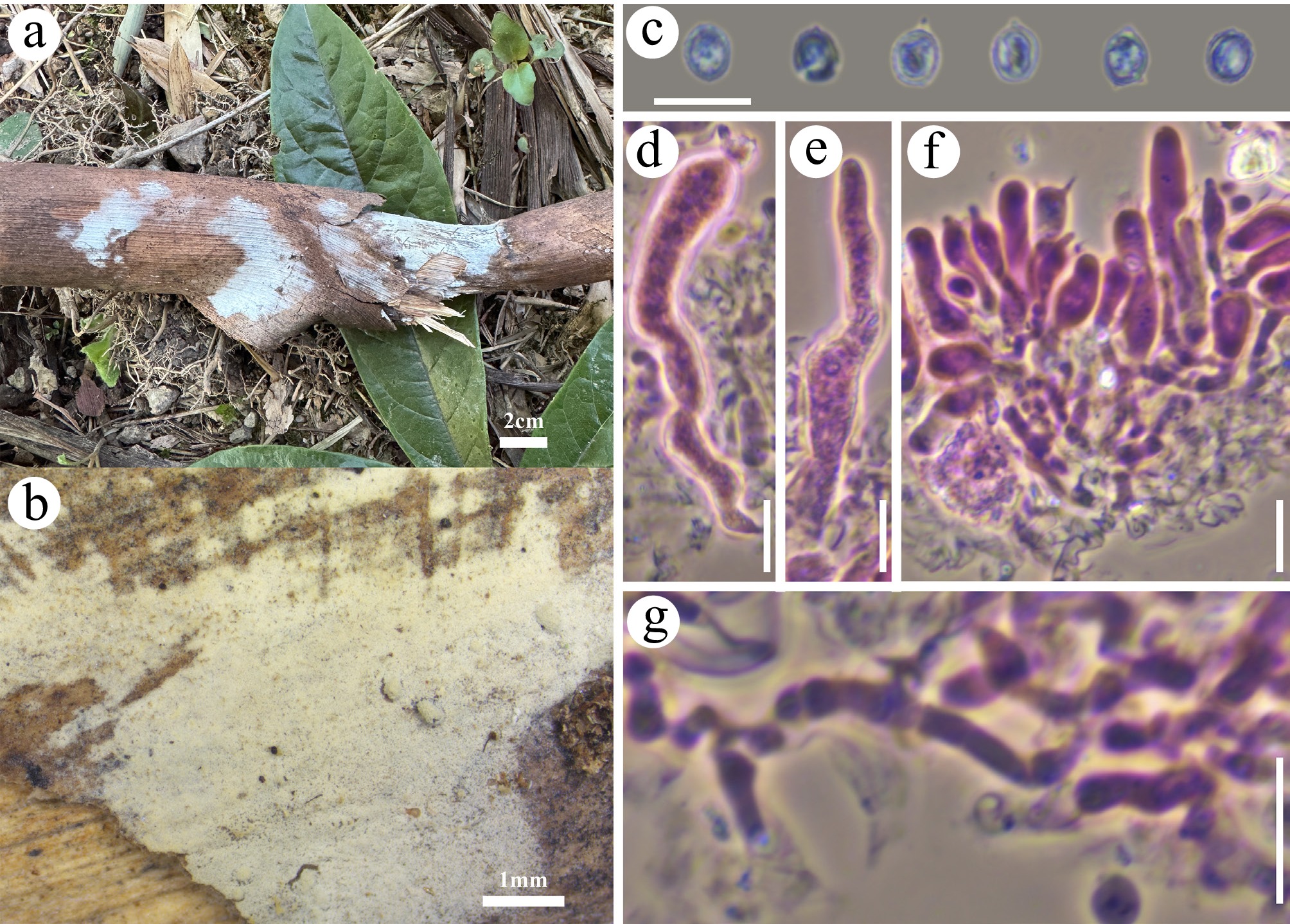
Figure 6.
Gloeocystidiellum monocotyledonum (holotype, Dai 33465). (a), (b) Basidiomata. (c) Basidiospores. (d), (e) Gloeocystidia. (f) A section of hymenium. (g) Generative hyphae. Scale bars: (c)–(g) = 10 µm.
Index Fungorum number: IF905285.
Etymology – Monocotyledonum (Lat.): refers to the species growing on monocotyledonous plants.
Diagnosis – characterized by the presence of subcylindrical to subclavate, flexuous gloeocystidia, fusiform cystidioles, verruculose basidiospores measuring 5.6–6.7 × 4.9–5.2 µm, and growing only on monocotyledonous plants (palms and Miscanthus) in subtropical China.
Type – China, Zhejiang Province, Jinhua, Wuyi County, Qianzhangyan Scenic Spot, 28.766327° N, 119.900587° E, elevation 670 m, on dead palm, leg. Y.C. Dai, 20 March 2025, Dai 33465 (BJFC054457).
Description – basidiomata annual, resupinate, soft, membranous, closely adnate, up to 12 cm long, 3 cm wide, 75 µm thick at center. Hymenial surface smooth, rarely grandinioid, uncracked, white (–A1) to grayish white (1B1) and without odor and taste when fresh, cream (4A3) to buff (4A4) when dry; margin thinning out, indistinct, concolorous with the hymenophore.
Hyphal system monomitic; generative hyphae with clamp connections, hyaline, thin-walled, moderately branched and frequently septate, IKI–, CB–, 1.2–3.5 μm in diam. Gloeocystidia abundant, subcylindrical to subclavate, flexuous, with guttulate content, hyaline, thin-walled, 45–70 × 5–10 µm. Basidia subcylindrical to clavate, thin-walled, with four sterigmata and a basal clamp connection, 18–30 × 4–7 µm; fusiform cystidioles present; basidioles morphologically resembling basidia, yet slightly smaller in size. Basidiospores broadly ellipsoid to subglobose, hyaline, slightly thick-walled, verruculose, IKI+, CB–, (5.4–)5.6–6.7(–6.8) × (4.8–)4.9–5.2(–5.4) µm, L = 6.15 µm, W = 5.04 µm, Q = 1.1–1.3 (n = 90/3).
Additional specimens examined – China, Zhejiang Province, Jinhua, Wuyi County, Hongsi Village, Lengjiang Pond, 28.73127° N, 119.551414° E, elevation 648 m, on dead Miscanthus, leg. Y.C. Dai, 22 March 2025, Dai 33505 (BJFC054497); Lishui, Baiyun National Forest Park, on dead Miscanthus, leg. Y.C. Dai, 27 April 2025, Dai 33840 (BJFC055102).
Known distribution – currently known from subtropical montane forests in Eastern China (Zhejiang), found on dead Miscanthus and palm.
Notes – phylogenetically, Gloeocystidiellum monocotyledonum occupies an independent, well-supported lineage within Gloeocystidiellum (100% ML, 1 BPP; Supplementary Fig. S4), and is sister to G. sinense. Morphologically, G. sinense shares similar basidia with G. monocotyledonum, but is distinguished by simple-septate generative hyphae, smaller basidiospores, and growth on angiosperm wood (3.7–4.4 × 2.8–3.2 µm vs 5.6–6.7 × 4.9–5.2 µm)[37]. The type species G. porosum also resembles G. monocotyledonum in having a monomitic hyphal system with clamp connections, and verrucose basidiospores, but differs by its smaller basidiospores (4.3–5 × 2.8–3.2 µm vs 5.6–6.7 × 4.9–5.2 µm), and occurrence on diverse gymnosperm and angiosperm wood, and occasionally on bamboo[1,35,96,97,101,103,104].
Family Peniophoraceae Lotsy
Index Fungorum number: IF81123.
Type genus – Peniophora Cooke
Asterostroma Massee
Index Fungorum number: IF17113.
Type species – Asterostroma apalum (Berk. & Broome) Massee
Notes – Asterostroma is a well-defined corticoid genus characterized by the presence of distinctive asterosetae (regular star-shaped or dichotomously branched) and amyloid basidiospores[92,105]. This study, incorporating three new species from bamboos in China, supports and further elucidates these morphological groupings: A. bicystidiatum and A. brevispinum (echinulate basidiospores and regular star-shaped asterosetae) belong to sect. Asterostroma clade, while A. papillatum (smooth basidiospores and dichotomously branched asterosetae) represents sect. Laevispora clade.
Asterostroma bicystidiatum Xin Zhang, Y.C. Dai, M.R. Li & Yuan Yuan, sp. nov. Fig. 7
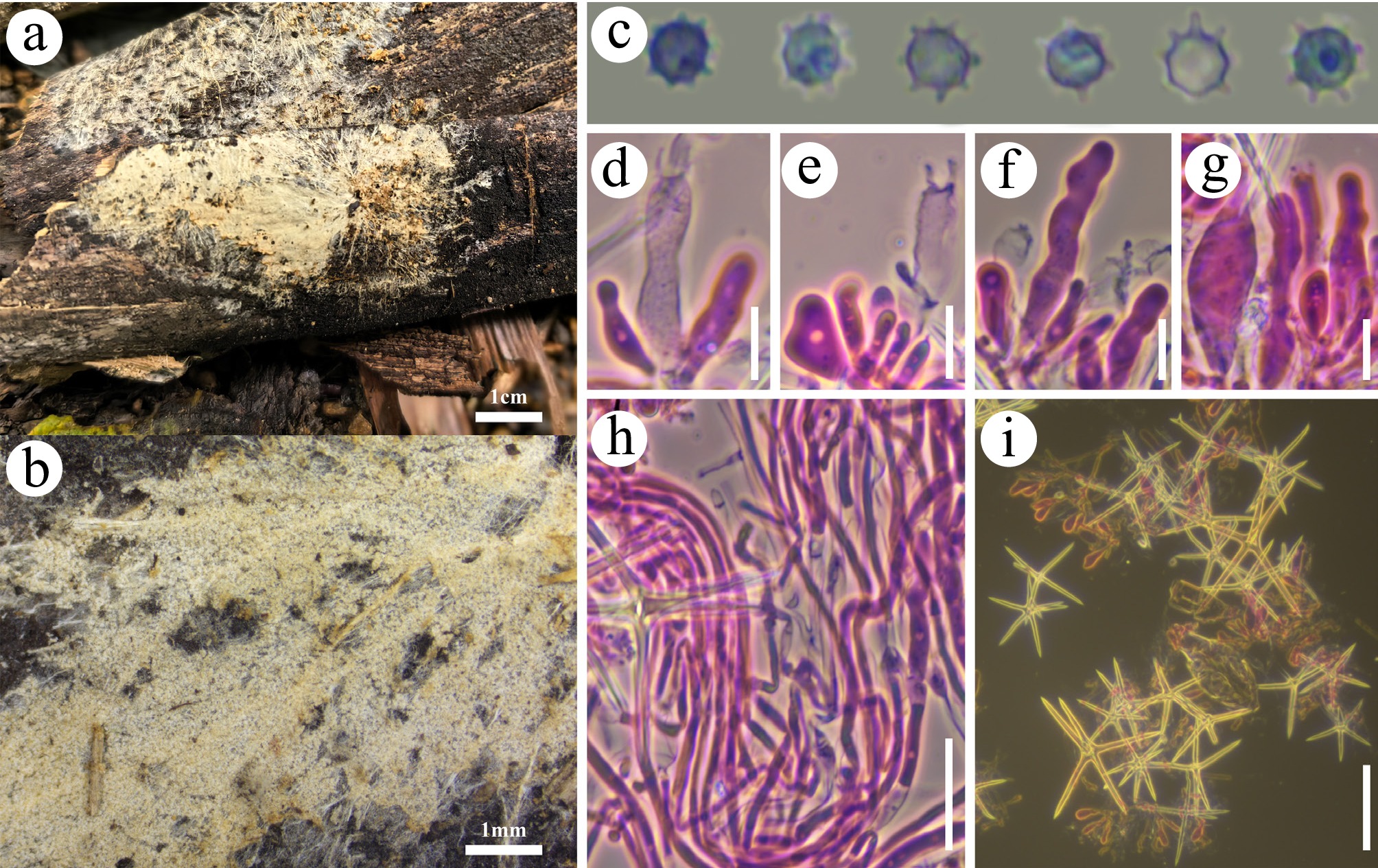
Figure 7.
Asterostroma bicystidiatum (holotype, Yuan 3366). (a), (b) Basidiomata. (c) Basidiospores. (d), (e) Basidia and basidioles. (f), (g) Gloeocystidia. (h) Generative hyphae. (i) Asterosetae and Asterohyphidia. Scale bars: (c)–(h) = 10 µm; (i) = 50 µm.
Index Fungorum number: IF905286.
Etymology – Bicystidiatum (Lat.): refers to the species having two kinds of cystidia.
Diagnosis – characterized by the presence of two kinds of gloeocystidia (fusiform or sinuous), globose, echinulate basidiospores measuring 4.7–4.9 × 4.3–4.7 µm with prominent spines (up to 1.2 µm long), and growing on bamboos in subtropical to warm-temperate China.
Type – China, Sichuan Province, Dujiangyan, Tongmagouzhuhai Park, 31.042187° N, 103.644348° E, elevation 728 m, on dead culm of Bambusa emeiensis, leg. Yuan Yuan, 29 September 2025, Yuan 3366 (BJFC062912).
Description – basidiomata annual, resupinate, soft, membranous, loosely adnate, up to 6 cm long, 3 cm wide, 150 µm thick at center. Hymenial surface smooth, uncracked, cottony to hypochnoid, cream (4A3) to buff (4A4), without odor or taste when fresh and dry; margin white (–A1), with distinct hyphal strands.
Hyphal system monomitic; generative hyphae with simple septa, hyaline, thin-walled, moderately branched and frequently septate, IKI–, CB–, 1.7–5 μm in diam. Asterosetae in subiculum abundant, predominant, dark brown, thick-walled, regularly star-shaped, weakly IKI[+], CB–, 3–6 µm in diam, rays up to 75 µm long, with acute tips; asterohyphidia in hymenium similar to asterosetae in subiculum, but smaller and less regularly shaped, weakly IKI[+], CB–, 3–5 µm in diam, rays up to 35 µm long, with acute tips. Gloeocystidia abundant, two types, one fusiform, another sinuous, both hyaline, thin-walled, with a basal simple septum, 30–60 × 7–15 µm; cystidioles absent. Basidia clavate with constricted middle, hyaline, thin-walled, with four sterigmata and a basal simple septum, 25–41 × 4.2–5.3 μm; basidioles morphologically resembling basidia, yet slightly smaller in size. Basidiospores globose, occasionally with a big oil drop, hyaline, thin-walled, echinulate, IKI+, CB−, (4.5–)4.7–4.9(–5) × (4.2–)4.3–4.7(–4.8) µm, L = 4.71 µm, W = 4.44 µm, Q = 1–1.1 (n = 60/2); spines obtuse, up to 1.2 µm long.
Additional specimens examined – China, Guangxi Autonomous Region, Liuzhou, Rongshui County, Sirong, 25.1411° N, 109.1981° E, elevation 176 m, on dead culm of Indocalamus tessellatus, leg. Y.C. Dai, 27 October 2025, Dai 40021 (BJFC061278); Henan Province, Luoyang, Luanchuan County, Wangfuzhuhai, 33.876175° N, 111.555185° E, elevation 925 m, on rotten bamboo, leg. Y.C. Dai, 20 October 2025, Dai 38604 (BJFC059863); Shaanxi Province, Ankang, Ningshan County, Huoditang, 33.372652° N, 108.337217° E, elevation 907 m, on dead culm of Fargesia spathacea, leg. Y.C. Dai, 7 August 2025, Dai 34943 (BJFC056204); Sichuan Province, Dujiangyan, Tongmagouzhuhai Park, 31.041281° N, 103.649118° E, elevation 708 m, on dead culm of Bambusa vulgaris, leg. Yuan Yuan, 29 September 2025, Yuan 3354 (BJFC062900).
Known distribution – widely distributed in subtropical and warm-temperate regions of Central to Southwestern China (Sichuan, Shaanxi, Henan, and Guangxi), found on dead or decaying culms of various bamboo species.
Notes – phylogenetically, Asterostroma bicystidiatum belongs to the sect. Asterostroma clade and formed a well-supported clade with A. arundinicola, A. brevispinum, A. fimbriatum, and A. medium (77% ML; Supplementary Fig. S2). Morphologically, it is distinguished by the presence of two types of gloeocystidia (fusiform and sinuous)—a feature not observed within this genus. Asterostroma bicystidiatum, A. brevispinum, and A. fimbriatum share a similar macromorphology, globose basidiospores and the growth on bamboo species in China, but A. brevispinum differs from A. bicystidiatum in having subulate gloeocystidia and larger basidiospores (5.6–6 × 5.5–5.8 µm vs 4.7–4.9 × 4.3–4.7 µm) with much shorter spines (up to 0.5 µm long vs up to 1.2 µm long); A. fimbriatum differs from A. bicystidiatum by having only one kind of cystidia and bigger basidiospores with conical echinulae (4.9–6 × 4.8–6 µm vs 4.7–4.9 × 4.3–4.7 µm)[39]. Additionally, A. bicystidiatum is further distinguished by its wide distribution on various bamboos in subtropical to warm-temperate China (Sichuan, Shaanxi, Henan, and Guangxi).
Asterostroma brevispinum Xin Zhang, Y.C. Dai, M.R. Li & Yuan Yuan, sp. nov. Fig. 8
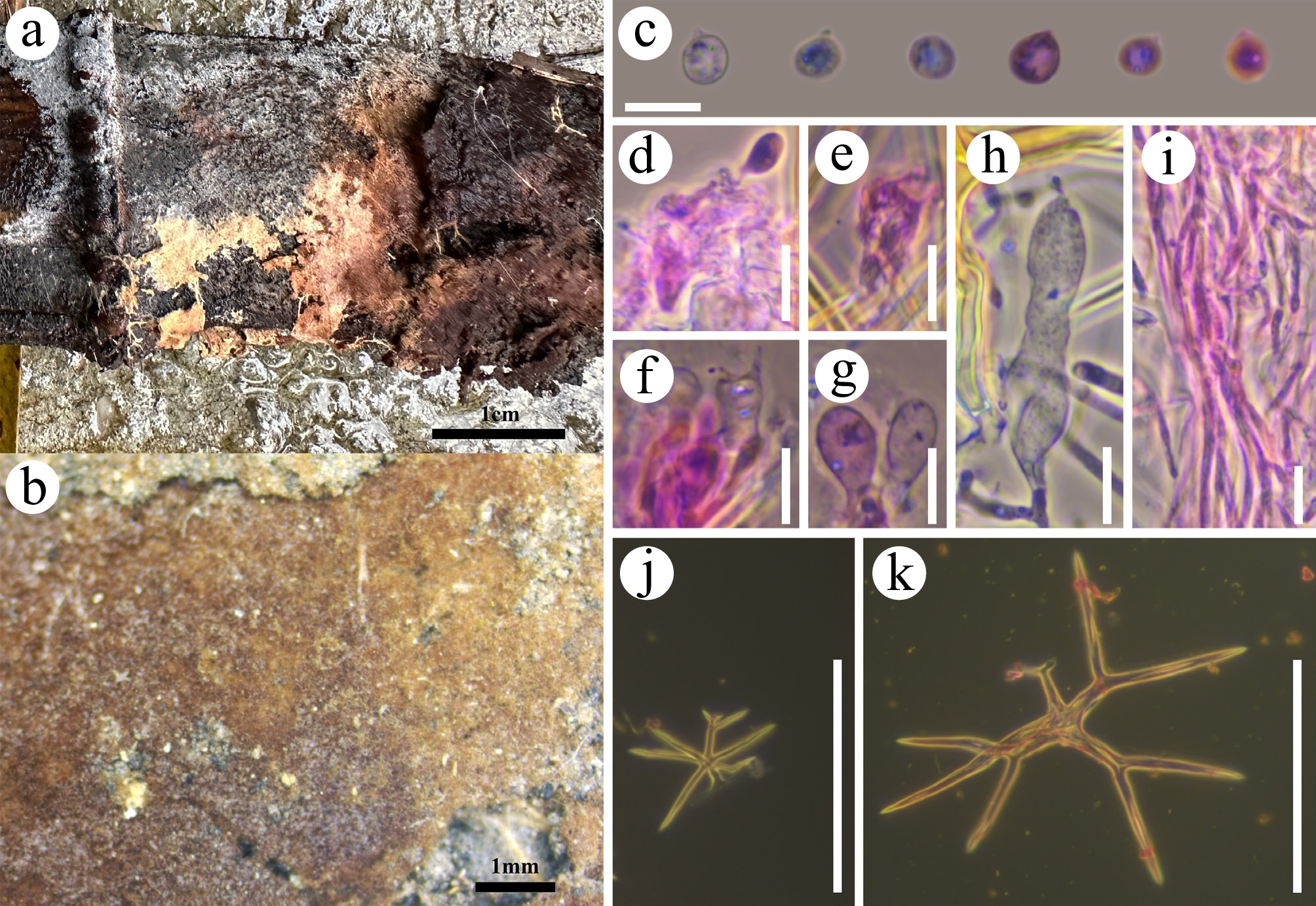
Figure 8.
Asterostroma brevispinum (holotype, Dai 35726). (a), (b) Basidiomata. (c) Basidiospores. (d), (e) Basidia and basidioles. (f) Gloeocystidia and cystidioles. (g) Generative hyphae. (h) Asterosetae and Asterohyphidia. Scale bars: (c)–(g) = 10 µm; (h) = 50 µm.
Index Fungorum number: IF905287.
Etymology – Brevispinum (Lat.): refers to the basidiospores of the species with short spines.
Diagnosis – characterized by fusiform cystidioles, globose, echinulate basidiospores measuring 5.6–6 × 5.5–5.8 µm with short spines (up to 0.5 µm long), and growing on Bambusa in subtropical China.
Type – China, Guizhou Province, Guiyang, Qianling Mountain Park, 26.605301° N, 106.697464° E, elevation 1,116 m, on living culm of Bambusa, leg. Y.C. Dai, 7 July 2025, Dai 35726 (BJFC056987).
Description – basidiomata annual, resupinate, soft, membranous, loosely adnate, up to 7.8 cm long, 4.6 cm wide, 65 µm thick at center. Hymenial surface smooth, uncracked, cottony to hypochnoid, cream (4A3) to buff (4A4), without odor or taste when fresh and dry; margin white (–A1), with distinct hyphal strands.
Hyphal system monomitic; generative hyphae with simple septa, hyaline, thin-walled, frequently branched and septate, IKI–, CB–, 2–4 μm in diam. Asterosetae in subiculum abundant, predominant, dark brown, thick-walled, regularly star-shaped, weakly IKI[+], CB–, 3.2–6.4 µm in diam, rays up to 125 µm long, with acute tips; asterohyphidia in hymenium similar to asterosetae in subiculum, but smaller and less regularly shaped, weakly IKI[+], CB–, 3–5 µm in diam, rays up to 77 µm long, with acute tips. Gloeocystidia occasionally present, subcylindrical, hyaline, slightly thick-walled, with a basal simple septum, 40–60 × 7–10 μm; fusiform cystidioles occasionally present. Basidia clavate with constricted middle, usually with a few guttules, hyaline, thin-walled, with four sterigmata and a basal simple septum, 33–45 × 4.3–6.2 μm; basidioles morphologically resembling basidia, yet slightly smaller in size. Basidiospores globose, occasionally with a big oil drop, hyaline, thin-walled, echinulate, IKI+, CB−, (5.5–)5.6–6(–6.2) × (5.4–)5.5–5.8(–6) µm, L = 5.72 µm, W = 5.54 µm, Q = 1–1.1 (n = 60/2); spines obtuse, up to 0.5 µm long.
Additional specimens examined – China, Guizhou Province, Guiyang, Qianling Mountain Park, 26.605029° N, 106.697994° E, elevation 1,103 m, on sheath of Bambusa, leg. Y.C. Dai, 7 July 2025, Dai 35725 (BJFC056986).
Known distribution – currently known only from subtropical bamboo forests in Southwestern China (Guizhou), found on culms and sheaths of Bambusa.
Notes – phylogenetically, Asterostroma brevispinum forms an independent lineage within the sect. Asterostroma clade (99% ML, 1 BPP; Supplementary Fig. S2), sister to A. arundinicola, A. bicystidiatum, A. fimbriatum, and A. medium. Morphologically, A. arundinicola has cream to flesh-pink hymenial surface, lacks cystidia, and grows on Arundo donax[48]; A. bicystidiatum is easily distinguished from A. brevispinum by having two kinds of gloeocystidia (fusiform or sinuous); A. medium is distinguished from A. brevispinum by its subglobose, tuberculate basidiospores (with sparse tubercles up to 1.5 µm long vs dense spines up to 0.5 µm long) and growing on wood of Quercus and Pinus pinea in Europe[1]; A. fimbriatum differs by its subglobose to globose basidiospores (with conical echinulae vs dense spines up to 0.5 µm long), shorter, subulate to fusiform gloeocystidia (15.6–24.7 × 4.6–8.2 µm vs 40–60 × 7–10 µm)[39]. Additionally, A. fimbriatum was described on dead bamboo in Yunnan, China, while A. brevispinum occurs on living culms and sheaths of Bambusa in Guizhou, China.
Asterostroma papillatum Xin Zhang, Y.C. Dai, M.R. Li & Yuan Yuan, sp. nov. Fig. 9
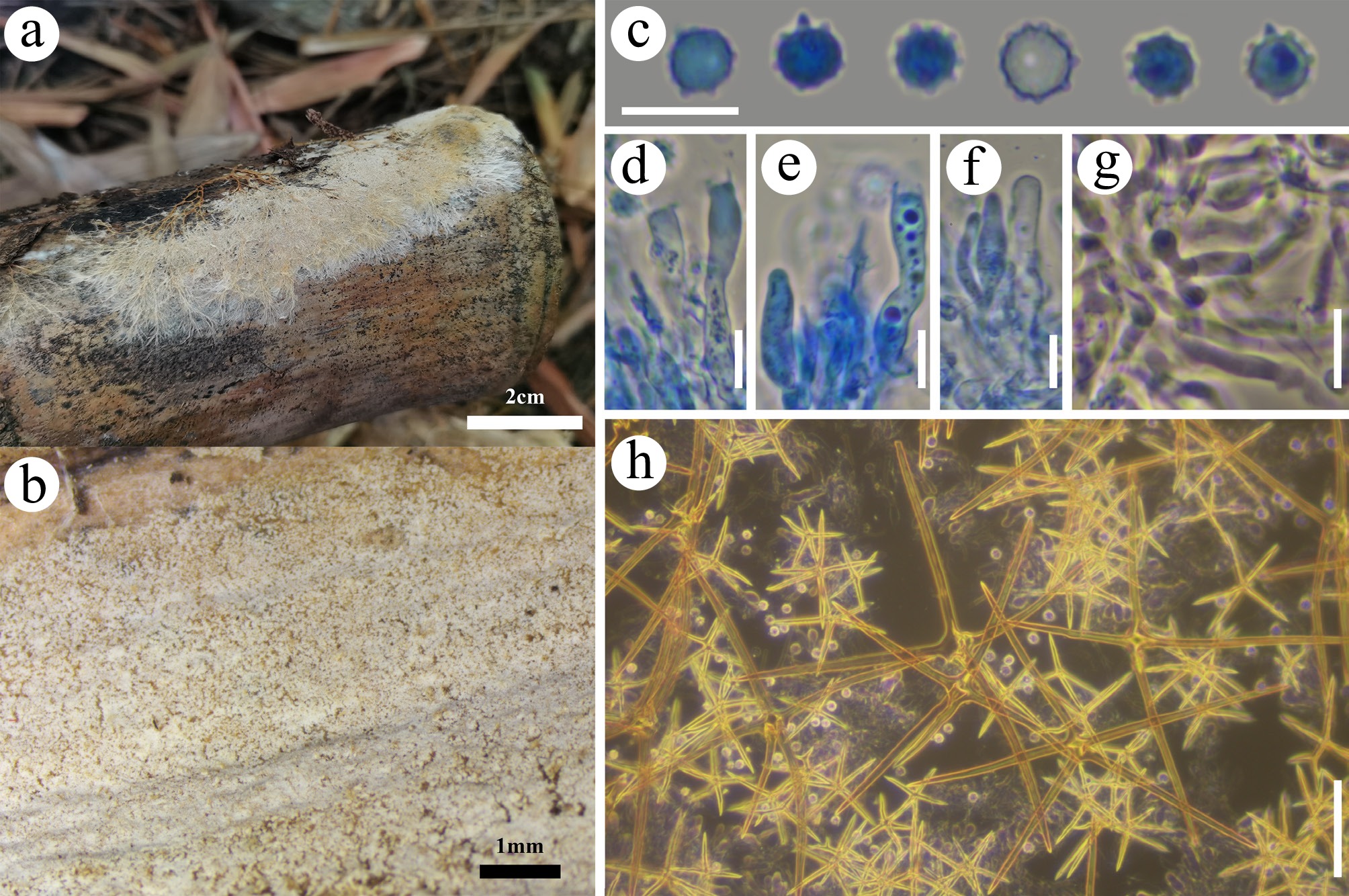
Figure 9.
Asterostroma papillatum (holotype, Dai 38603). (a), (b) Basidiomata. (c) Basidiospores. (d)–(g) Basidia and basidioles. (h) Gloeocystidia. (i) Generative hyphae. (j), (k) Dichohyphae from subiculum. Scale bars: (c)–(i) = 10 µm; (j), (k) = 50 µm.
Index Fungorum number: IF905288.
Etymology – Papillatum (Lat.): refers to the gloeocystidia of the species with a schizopapillate tip.
Diagnosis – characterized by the presence of dichotomously branched asterosetae, clavate gloeocystidia with a distinctly constricted zone in the middle and a schizopapillate tip, subglobose, smooth basidiospores measuring 6.3–6.7 × 5.2–6.2 µm, and growing on bamboo in warm-temperate China.
Type – China, Henan Province, Luoyang, Luanchuan County, Wangfuzhuhai, 33.876185° N, 111.555178° E, elevation 925 m, on rotten bamboo culm, leg. Y.C. Dai, 20 October 2025, Dai 38603 (BJFC059862).
Description – basidiomata annual, resupinate, soft, membranous, adnate, up to 5 cm long, 2 cm wide, 80 µm thick at center. Hymenial surface smooth, uncracked, cottony to hypochnoid, cream (4A3) to salmon (6A4) and without odor or taste when fresh, cinnamon buff (4B4) to reddish brown (9E7) when dry; margin white (–A1), with distinct hyphal strands.
Hyphal system monomitic; generative hyphae with simple septa, hyaline, thin-walled, moderately branched and septate, IKI–, CB–, 2–5.9 μm in diam. Asterosetae in subiculum abundant, predominant, dark brown, thick-walled, dichotomously branched, weakly IKI[+], CB–, 7–9 µm in diam, terminal branches up to 128 μm long, with acute tips; asterohyphidia in hymenium similar to asterosetae in subiculum, but smaller and with shorter branches. Gloeocystidia occasionally present, clavate, with a distinctly constricted zone in the middle and a schizopapillate apex, hyaline, thin-walled, with a basal simple septum, 27–40 × 7–10 μm; cystidioles absent. Basidia subcylindrical to clavate, hyaline, thin-walled, with four sterigmata and a basal simple septum, 11–18.7 × 4–7 μm; basidioles morphologically resembling basidia, yet slightly smaller in size. Basidiospores subglobose, hyaline, thin-walled, smooth, IKI+, CB−, (6.2–)6.3–6.7(–7) × 5.2–6.2(–6.3) µm, L = 6.48 µm, W = 5.76 µm, Q = 1–1.2 (n = 30/1).
Known distribution – currently known only from a warm-temperate mountain forest in Central China (Henan), found on rotten bamboo culm.
Notes – phylogenetically, Asterostroma papillatum was nested within the sect. Laevispora clade, forming an independent lineage, sister to A. andinum, A. vararioides, and A. laxum (Supplementary Fig. S2). Morphologically, A. papillatum resembles A. andinum, A. vararioides, and A. laxum by sharing dichotomously branched asterosetae and smooth, amyloid basidiospores. However, A. andinum differs from A. papillatum by having narrower gloeocystidia (4–5 µm vs 7–9 µm in width) and a wide geographic distribution across North America, the Caribbean, Sri Lanka, and New Zealand[106]; A. vararioides differs from A. papillatum by having longer basidia (30–65 µm vs 11–18.7 µm in length) and growing on angiosperms in tropical Thailand[61]; A. laxum is distinguished from A. papillatum by larger gloeocystidia (40–100 × 6–10 µm vs 27–40 × 7–10 µm), longer basidia (40–80 µm vs 11–18.7 µm in length) and growing on Picea abies in Europe[1,107].
Baltazaria Leal-Dutra, Dentinger & G.W. Griff.
Index Fungorum number: IF825233.
Type species – Baltazaria galactina (Fr.) Leal-Dutra, Dentinger & G.W. Griff.
Notes – Baltazaria was established recently by Leal-Dutra et al. to accommodate several species formerly placed in Scytinostroma Donk and Parapterulicium Corner. The genus is characterized by coriaceous to membranous basidiomata when fresh, becoming hard and whitish when dry, and a dimitic hyphal system dominated by thick-walled, dextrinoid skeletal-binding hyphae. In this study, we broaden the taxonomic and ecological distribution of Baltazaria by describing a new species, B. massonianae, from subtropical China, and proposing a new combination, B. quintasiana comb. nov. from West Africa[108].
This combination is supported by phylogenetic analyses, in which sequences obtained from the paratypes of Corticium quintasianum Bres. & Roum. (CBS 749.86 and CBS 750.86) formed a well-supported sister lineage within the clade (67% ML; Supplementary Fig. S3) containing Baltazaria massonianae and B. galactina. Morphologically, it corresponds to the generic diagnosis by having a dimitic hyphal system with clamped generative hyphae and gloeocystidia[108]. The combination is thus proposed.
Baltazaria massonianae Xin Zhang, Y.C. Dai, M.R. Li & Yuan Yuan, sp. nov. Fig. 10
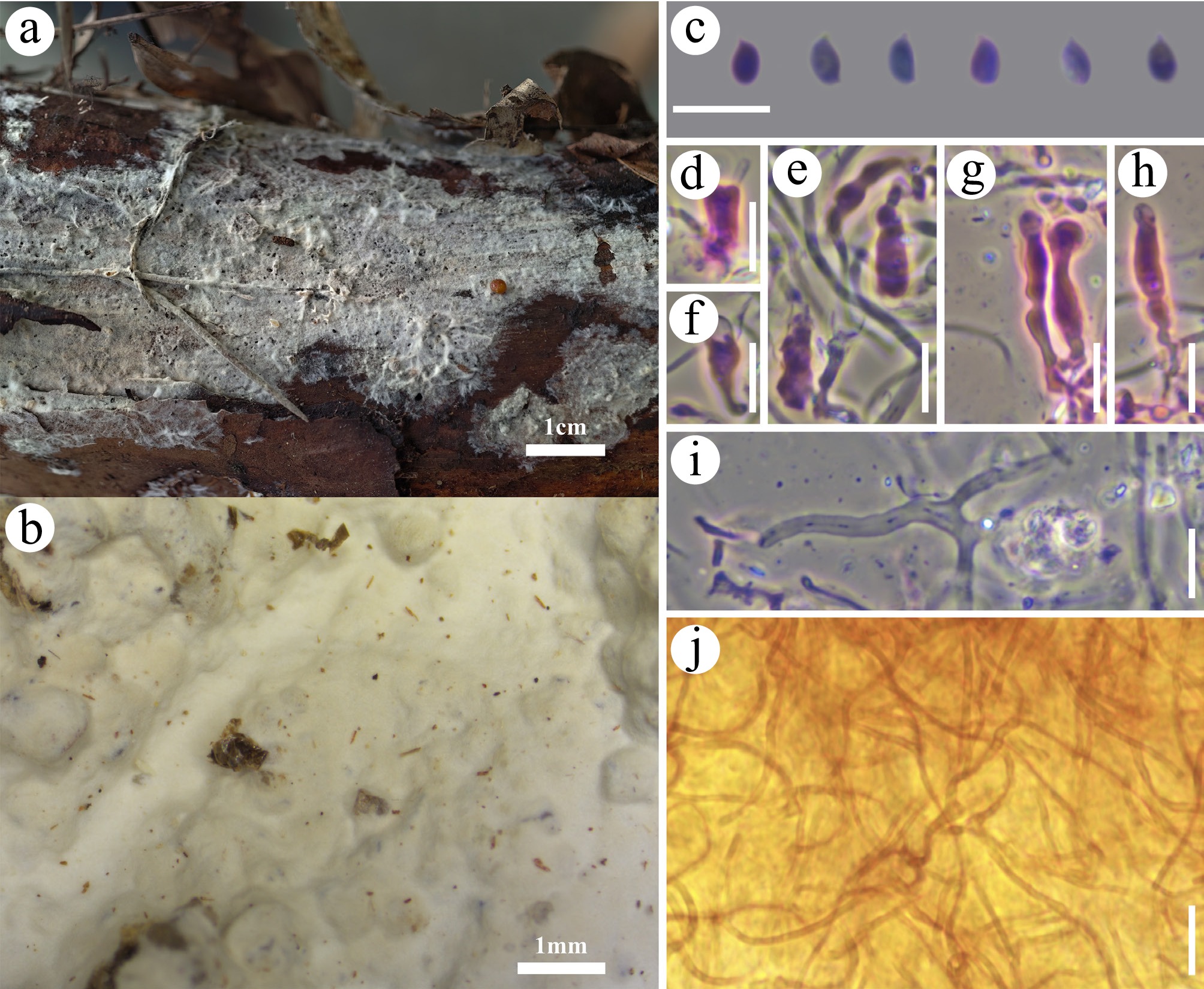
Figure 10.
Baltazaria massonianae (holotype, Yuan 3170). (a), (b) Basidiomata. (c) Basidiospores. (d), (e) Basidia and basidioles. (g), (h) Gloeocystidia. (i) Dichotomously branched hyphae. (j) Hyphal system in Melzer's reagent. Scale bars: (c)–(j) = 10 µm.
Index Fungorum number: IF905289.
Etymology – Massonianae (Lat.): refers to the species growing on Pinus massoniana.
Diagnosis – characterized by uniform basidia, oblong-ellipsoid, inamyloid basidiospores measuring 5–5.3 × 3.1–3.4 µm, and growing on dead Pinus massoniana in subtropical China.
Type – China, Guangdong Province, Zhaoqing, Fengkai County, Heishiding Nature Reserve, 23.433333° N, 111.883333° E, elevation 445 m, on a fallen trunk of Pinus massoniana, leg. Yuan Yuan, 6 July 2025, Yuan 3170 (BJFC062716).
Description – basidiomata annual, resupinate, soft, coriaceous, adnate, up to 14 cm long, 4 cm wide, 120 µm thick at center. Hymenial surface smooth to locally tuberculate, uncracked, white (–A1) and without odor or taste when fresh, cream (4A3) to buff (4A4) when dry; margin white (–A1), with distinct hyphal strands.
Hyphal system dimitic; generative hyphae with clamp connections, hyaline, thin-walled, moderately branched and septate, IKI–, CB–, 2–3.4 μm in diam; skeletal hyphae dominant, frequently dichotomously branched, aseptate, tortuous, interwoven, thick-walled, IKI[+], CB–, 1.8–3 μm in diam. Gloeocystidia occasionally present, capitate, hyaline, thin-walled, 23–30 × 3.6–4.5 µm. Basidia urniform, thin-walled, with four sterigmata and a basal clamp connection, 10–15 × 3–5 µm; basidioles morphologically resembling basidia, yet slightly smaller in size. Basidiospores oblong-ellipsoid, hyaline, thin-walled, smooth, IKI–, CB–, (4.9–)5–5.3(–5.4) × (3–)3.1–3.4(–3.6) µm, L = 5.15 µm, W = 3.31 µm, Q = 1.4–1.6 (n = 60/2).
Additional specimens examined – China, Guangdong Province, Zhaoqing, Dinghu District, Dinghushan National Nature Reserve, 23.159571° N, 112.538344° E, elevation 511 m, on a fallen branch of Pinus massoniana, leg. Yuan Yuan, 7 July 2025, Yuan 3207 (BJFC062753).
Known distribution – currently known from subtropical montane coniferous forests in Southern China (Guangdong), found on dead Pinus massoniana.
Notes – phylogenetically, Baltazaria massonianae formed a well-supported clade (67% ML; Supplementary Fig. S3) with B. galactina and B. quintasiana (≡ Scytinostroma quintasianum). Morphologically, the three species share the generic characteristics, including a dimitic hyphal system with frequently dichotomous skeletal hyphae and subcylindrical, capitate gloeocystidia[26]. However, B. galactina is distinguished from B. massonianae by clavate to subcylindrical and longer basidia (20–40 × 3–4 µm vs 10–15 × 3–5 µm), longer gloeocystidia (40–60 × 2–5 µm vs 23–30 × 3.6–4.5 µm), and growing on various angiosperm and gymnosperm wood throughout North America[1,109]; B. quintasiana differs from B. massonianae by having shorter basidiospores (3.8–4.5 µm vs 5–5.3 µm in width) with a small amyloid apiculus and growing on angiosperm wood from West Africa[110]. In addition, BLAST searches using the ITS sequence of B. massonianae revealed high similarity to two sequences (LC852187: 98.9% identity, AB470241: 98.7% identity). Although these two accessions are labelled as Scytinostroma sp., we consider them to represent the same species, B. massonianae, based on their near-identical sequences and consistent phylogenetic placement (Supplementary Fig. S3).
Baltazaria quintasiana (Bres. & Roum.) Xin Zhang, Y.C. Dai & Yuan Yuan, comb. nov.
Index Fungorum number: IF905290.
Basionym – Corticium quintasianum Bres. & Roum., Rev. Mycol., Toulouse 12(no. 45): 36 (1890)
≡ Scytinostroma quintasianum (Bres. & Roum.) Nakasone, Cryptog. Mycol. 29(3): 239 (2008)
Known distribution – currently known from West Africa, found on dead angiosperm wood in tropical forests.
Gloiothele Bres.
Index Fungorum number: IF17678.
Type species – Gloiothele lamellosa (Henn.) Bres.
Notes – the genus Gloiothele is defined by a monomitic hyphal system with simple septa, the presence of gloeocystidia (often with guttulate contents), and smooth, weakly amyloid basidiospores[1,23]. This study introduces two new species, notably documenting its first occurrence on bamboo and extending its distribution into temperate East Asia. Gloiothele bambusicola is characterized by constricted basidia, subulate gloeocystidia, oblong-ellipsoid basidiospores, and growth on both bamboo and angiosperm trees in subtropical to temperate China. Gloiothele spathulata is characterized by spathulate basidia and globose basidiospores, and grows on Quercus mongolica in temperate China, with evidence of occurrence in mixed forests in South Korea, representing a new temperate East Asian lineage.
Gloiothele bambusicola Xin Zhang, Y.C. Dai, M.R. Li & Yuan Yuan, sp. nov. Fig. 11
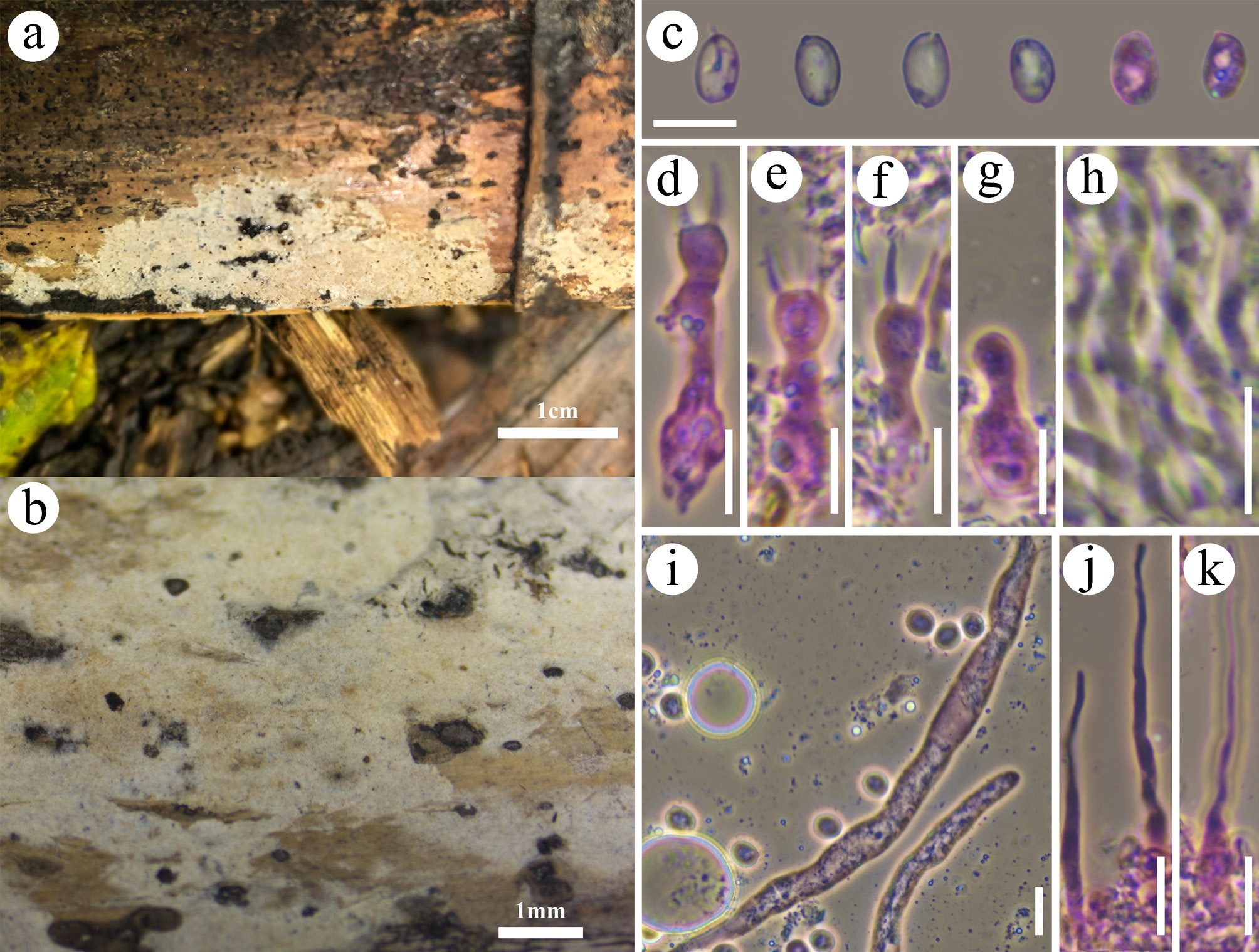
Figure 11.
Gloiothele bambusicola (holotype, Yuan 3356). (a), (b) Basidiomata. (c) Basidiospores. (d)–(g) Basidia and basidioles. (h) Generative hyphae. (i) Gloeocystidia when mature. (j), (k) Gloeocystidia when juvenile. Scale bars: (c)–(k) = 10 µm.
Index Fungorum number: IF905291.
Etymology – Bambusicola (Lat.): refers to the species growing on Bambusa.
Diagnosis – characterized by the presence of a distinct constriction on the basidia, oblong-ellipsoid basidiospores, and growing on both bamboo and angiosperm wood.
Type – China, Sichuan Province, Dujiangyan, Tongmagouzhuhai Park, 31.041175° N, 103.649225° E, elevation 714 m, on dead culm of Bambusa emeiensis, leg. Yuan Yuan, 29 September 2025, Yuan 3356 (BJFC062902).
Description – basidiomata annual, resupinate, ceraceous, adnate, up to 4.3 cm long, 3.6 cm wide, 120 µm thick at center. Hymenial surface smooth, uncracked, cream (4A3) to buff yellow (ca. 4A4) and without odor and taste when fresh, buff yellow (ca. 4A4) to olivaceous buff (4C4) when dry; margin thinning out, indistinct, concolorous with the hymenophore.
Hyphal system monomitic; generative hyphae with simple septa, hyaline, thin-walled, moderately branched and septate, IKI–, CB–, 2–3.2 μm in diam. Gloeocystidia frequent, more or less subulate, flexuous, distinctly and strongly swollen at base and tapering to tip without guttulate content when juvenile, becoming clavate and often curved with guttulate content when mature, hyaline, thin-walled, 55–150 × 7–10 µm. Basidia urniform, with a strong median constriction, thin-walled, with four sterigmata and a basal simple septum, 22–27.6 × 5–7.9 µm; basidioles morphologically resembling basidia, yet slightly smaller in size. Basidiospores oblong-ellipsoid, occasionally with oil drops, hyaline, thick-walled, smooth, weakly IKI+, CB–, (8–)8.2–9(–9.2) × (5.4–)5.5–5.7(–5.9) µm, L = 8.73 µm, W = 5.61 µm, Q = 1.4–1.6 (n = 60/2).
Additional specimens examined – China, Beijing, Xishan Experimental Forest Farm, Heilongtan Sub-farm, on a dead standing angiosperm tree, leg. Yuan Yuan, 23 August 2024, Yuan 2591 (BJFC062137); Dongbeiwang Sub-farm, on angiosperm trunk, leg. Yuan Yuan, 3 September 2024, Yuan 2698 (BJFC062244); Sichuan Province, Dujiangyan, Tongmagouzhuhai Park, 31.041281° N, 103.649118° E, elevation 708 m, on dead culm of Bambusa emeiensis, leg. Yuan Yuan, 29 September 2025, Yuan 3370 (BJFC062916).
Known distribution – currently known only from temperate to subtropical China (Beijing and Sichuan), found on dead culms of Bambusa emeiensis and angiosperm wood.
Notes – phylogenetically, Gloiothele bambusicola formed a strongly supported lineage (94% ML, 1 BPP; Supplementary Fig. S6) sister to G. tuberculata, but G. tuberculata differs by having a tuberculate hymenial surface and broadly ellipsoid to globose basidiospores[39]. Morphologically, G. ventricosa Ghobad-Nejhad resembles G. bambusicola by having constricted basidia, but G. ventricosa differs by its globose to subglobose basidiospores[111]. Gloiothele lactescens (Berk.) Hjortstam also resembles G. bambusicola by having oblong-ellipsoid basidiospores, but G. lactescens differs by having longer basidia (40–55 × 6–7 µm vs 22–28 × 5–8 µm)[1,112]. In addition, Gloiothele bambusicola exhibits a broad substrate range, growing on both bamboo (subtropical China) and angiosperm wood (temperate China), while G. tuberculata grows on fallen angiosperm branches in subtropical China, G. ventricosa grows on angiosperm wood in Réunion Island, and G. lactescens grows on angiosperm wood in temperate and subtropical regions[1,39,111,112].
Gloiothele spathulata Xin Zhang, Y.C. Dai, M.R. Li & Yuan Yuan, sp. nov. Fig. 12
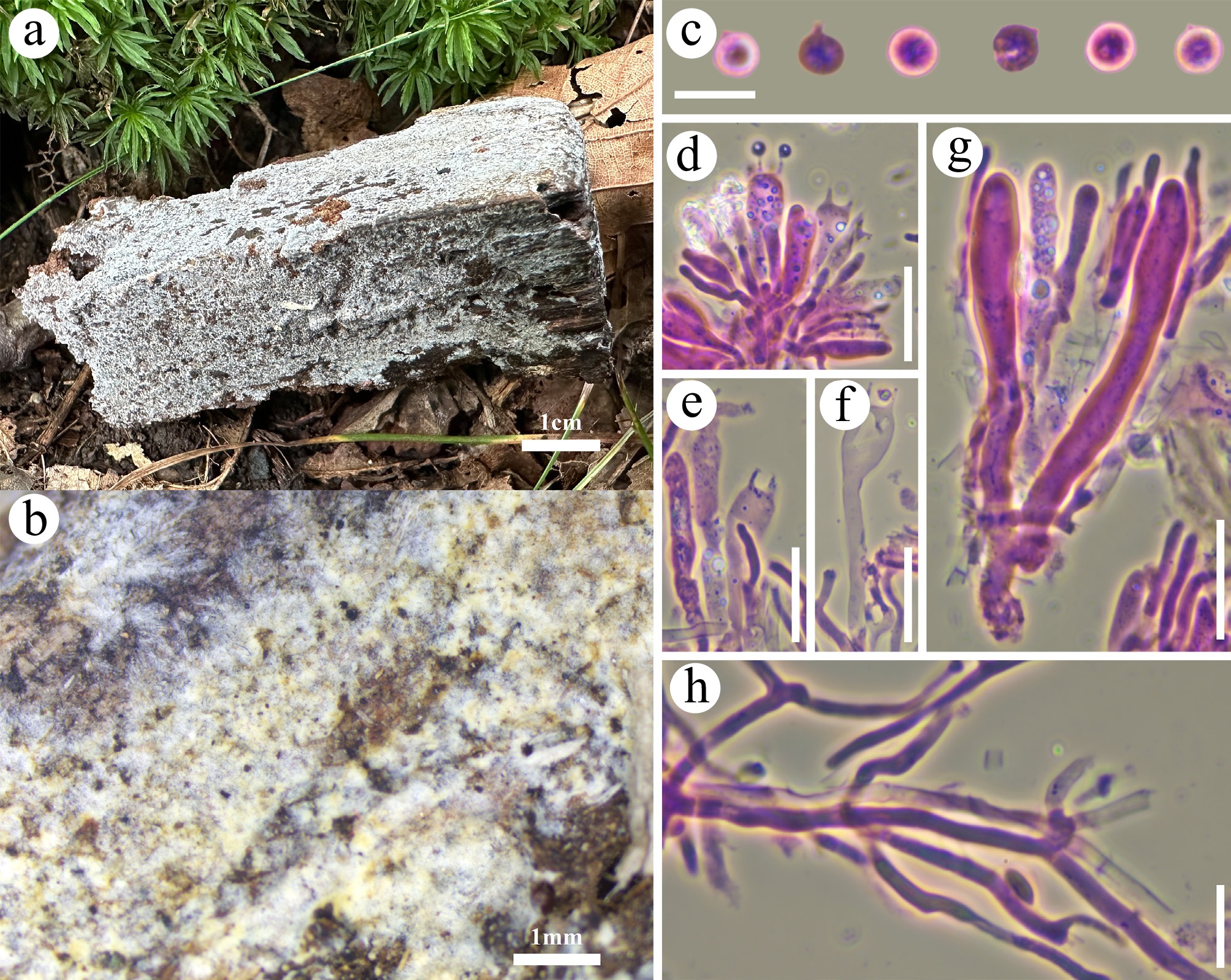
Figure 12.
Gloiothele spathulata (holotype, Dai 37279). (a), (b) Basidiomata. (c) Basidiospores. (d)–(f) Basidia and basidioles. (g) Gloeocystidia. (h) Generative hyphae. Scale bars: (c)–(h) = 10 µm.
Index Fungorum number: IF905292.
Etymology – Spathulata (Lat.): refers to the species having spathulate basidia.
Diagnosis – characterized by the presence of spathulate basidia, globose basidiospores, and growing on Quercus mongolica.
Type – China, Heilongjiang Province, Wuchang, Chenxiangdian Forest Farm, 44.957241° N, 127.727710° E, elevation 212 m, on fallen branch of Quercus mongolica, leg. Y.C. Dai, 30 August 2025, Dai 37279 (BJFC058538).
Description – basidiomata annual, resupinate, ceraceous, adnate, up to 6.5 cm long, 6 cm wide, 63 µm thick at center. Hymenial surface smooth, uncracked, irregularly and indistinctly tuberculate, white (–A1) to cream (4A3) and without odor and taste when fresh, straw yellow (3B3) to cream (4A3) when dry; margin white (–A1), thinning out, fimbriate.
Hyphal system monomitic; generative hyphae with simple septa, hyaline, thin-walled, frequently branched and moderately septate, IKI–, CB–, 2–3.8 μm in diam. Gloeocystidia frequent, tubular to narrowly clavate, some with guttulate content, hyaline, thick-walled, with guttulate content, 55–70 × 5–8.5 µm. Basidia more or less spathulate, thin-walled, with four sterigmata and a basal simple septum, 29–50 × 5–9 µm; basidioles morphologically resembling basidia, yet slightly smaller in size. Basidiospores globose, hyaline, thin-walled, smooth, weakly IK+, CB–, (5.7–)5.9–6.3(–6.4) × (5.4–)5.5–6(–6.2) µm, L = 5.91 µm, W = 5.77 µm, Q = 1–1.1 (n = 30/1).
Known distribution – currently known only from a temperate broadleaved forest in Northeast China (Heilongjiang), found on a fallen branch of Quercus mongolica, and indicated by sequence data from mixed forest in Gangwon, South Korea.
Notes – phylogenetically, Gloiothele spathulata was recovered within a well-supported clade with G. lactescens (69% ML, 1 BPP; Supplementary Fig. S6), but G. lactescens differs from G. spathulata by its longer basidia (45–66 × 6.5–7.5 µm vs 29–50 × 5–9 µm) and longer gloeocystidia (180–270 µm vs 55–70 µm in length)[99]. In addition, G. spathulata is strongly supported and includes an additional sequence (KUC20130718-09, GenBank: KJ668539) from South Korea, which exhibits less than 1.5% ITS sequence dissimilarity. The sample KUC20130718-09 was collected in a mixed coniferous and deciduous forest in Odaesan National Park, South Korea, which has a similar ecology to our collection in Heilongjiang, China[113]. Therefore, we treat KUC20130718-09 as G. spathulata.
Vararia P. Karst.
Index Fungorum number: IF18724.
Type species – Vararia investiens (Schwein.) P. Karst.
Notes – the genus is defined by resupinate basidiomata, a dimitic hyphal system, generative hyphae with or without clamp connections, with more or less dextrinoid dichohyphae, the presence of gloeocystidia, and smooth basidiospores[1]. The genus has long been recognized as polyphyletic[22,24,25,27,29,39,47], and our phylogeny confirms this (Fig. 2). Our study expands the morphological, ecological, and geographical scope of the genus by describing eight new species from China. These species are recovered in different lineages across the tree (Fig. 2), but all conform morphologically to Vararia, which can be grouped into several distinct ecological groups: a subtropical bamboo-associated clade (V. emeiensis and V. subulata), a subtropical grass-associated lineage (V. miscanthi), a tropical bamboo- and grass-associated clade (V. falcata and V. acanthocystidia), a tropical palm/rattan lineage (V. septocystidiata), a high-altitude temperate bamboo- and wood-associated lineage (V. alpina), and a high-altitude temperate wood-associated lineage (V. incarnata). A key to the species of Vararia in China is provided at the end of the manuscript.
Vararia acanthocystidia Xin Zhang, Y.C. Dai, M.R. Li & Yuan Yuan, sp. nov. Fig. 13
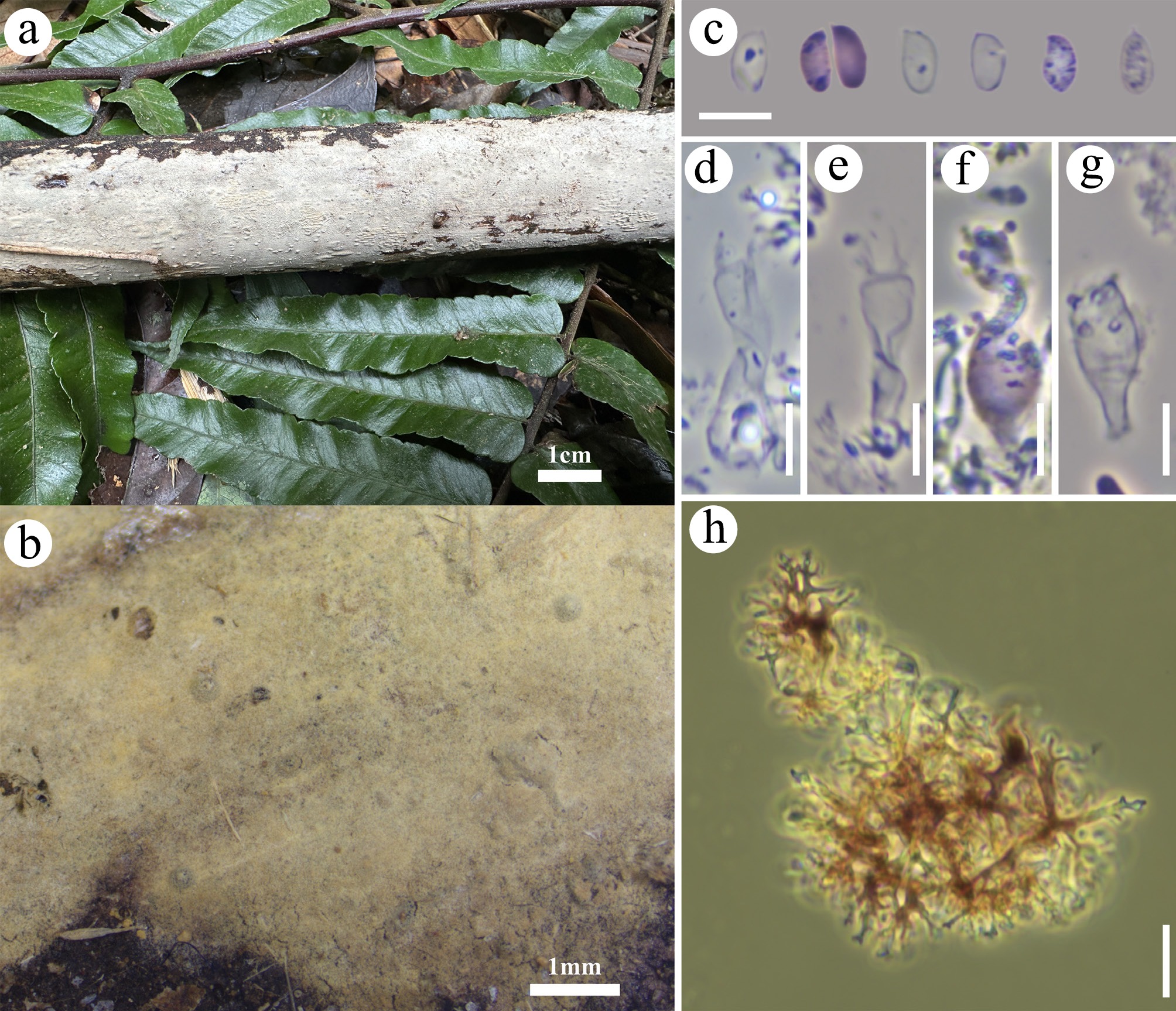
Figure 13.
Vararia acanthocystidia (holotype, Dai 30011). (a), (b) Basidiomata. (c) Basidiospores. (d), (e) Basidia. (f), (g) Acanthocystidia. (h) Dichohyphae in subiculum (Melzer's reagent). Scale bars: (c)–(h) = 10 µm.
Index Fungorum number: IF905293.
Etymology – Acanthocystidia (Lat.): refers to the species having acanthocystidia.
Diagnosis – characterized by the presence of urniform to clavate acanthocystidia densely covered with tuberculate spines, oblong-ellipsoid basidiospores measuring 7.9–9.1 × 4.1–5.2 µm, and growing on rotten bamboo in tropical forests of Hainan, China.
Type – China, Hainan Province, Qiongzhong County, Limushan National Forest Park, 19.176944° N, 109.747526° E, elevation 784 m, on rotten bamboo, leg. Y.C. Dai, 22 September 2024, Dai 30011 (BJFC050270).
Description – basidiomata annual, resupinate, soft, membranous, adnate, up to 13.4 cm long, 2.2 cm wide, 65 µm thick at center. Hymenial surface smooth, uncracked, white (–A1) to cream (4A3) and without odor and taste when fresh, buff (4A4) to olivaceous buff (4C4) when dry; margin thinning out, indistinct, concolorous with the hymenophore.
Hyphal system dimitic; generative hyphae with simple septa, hyaline, thin- to slightly thick-walled, moderately branched and frequently septate, loosely interwoven, IKI–, CB–, 1.5–3 µm in diam. Dichohyphae predominant, bush-like at apex with acute tips, dichotomously to irregularly branched, thick-walled, IKI[+], CB+, stem 1.5–3.5 μm wide, upper branches narrow and thin-walled. Acanthocystidia occasionally present, urniform to clavate, densely covered with short, tuberculate spines over the upper part, hyaline, thin-walled, 15–45 × 6–9 µm. Basidia subcylindrical to urniform, thin-walled, with four sterigmata and a basal simple septum, 15–30 × 4–9 µm; basidioles morphologically resembling basidia, yet slightly smaller in size. Basidiospores oblong-ellipsoid, hyaline, thin-walled, smooth, occasionally with oil drops, IKI–, CB–, (7.8–)7.9–9.1(–9.4) × (4–)4.1–5.2(–5.4) µm, L = 8.87 µm, W = 4.78 µm, Q = 1.7–1.9 (n = 160/4).
Additional specimens examined – China, Hainan Province, Qiongzhong County, Limushan National Forest Park, 19.176944° N, 109.747526° E, elevation 784 m, on rotten bamboo, leg. Y.C. Dai, 22 September 2024, Dai 30009 (BJFC050268); 19.176932° N, 109.747802° E, elevation 793 m, on rotten bamboo, leg. Y.C. Dai, 22 September 2024, Dai 30025 (BJFC050284) and Dai 30033 (BJFC050292).
Known distribution – currently known only from tropical forests in Southern China (Hainan), found on rotten bamboo.
Notes – phylogenetically, Vararia acanthocystidia formed an independent, well-supported lineage within Vararia (100% ML, 1 BPP; Supplementary Fig. S7). Morphologically, V. abortiphysa Boidin & Lanq. resembles V. acanthocystidia in having similar basidia, but V. abortiphysa differs by having fusiform to narrowly ellipsoid basidiospores and lacking acanthocystidia[24]. In addition, Vararia acanthocystidia is currently known only from rotten bamboo in the tropical forests of Hainan, China, while V. abortiphysa is recorded from dead wood in tropical Africa[24].
Vararia alpina Xin Zhang, Y.C. Dai, M.R. Li & Yuan Yuan, sp. nov. Fig. 14
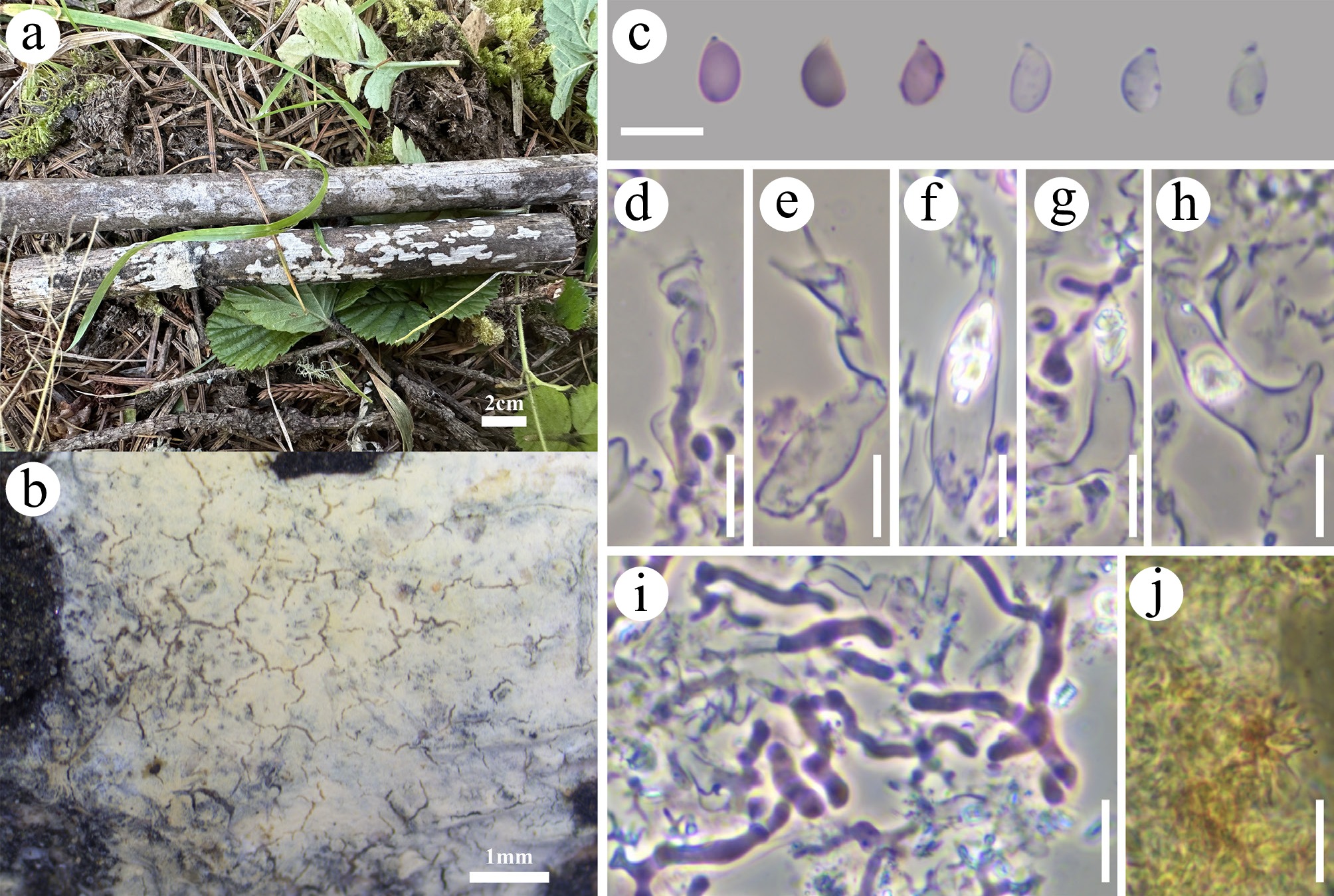
Figure 14.
Vararia alpina (holotype, Dai 31508). (a), (b) Basidiomata. (c) Basidiospores. (d), (e) Basidia. (f)–(h) Gloeocystidia. (i) Generative hyphae. (j) Dichohyphae in subiculum (Melzer's reagent). Scale bars: (c)–(j) = 10 µm.
Index Fungorum number: IF905294.
Etymology – Alpina (Lat.): refers to the species occurring in high mountainous areas.
Diagnosis – characterized by ellipsoid basidiospores measuring 7.5–8.1 × 4.6–5.0 µm and growing on diverse substrates including bamboo, angiosperm and gymnosperm wood at high-elevation temperate forests of Xizang, China.
Type – China, Xizang Autonomous Region, Rikaze, Yadong County, Yadong Customs Site, 27.4247° N, 88.9319° E, elevation 2,875 m, on dead bamboo, leg. Y.C. Dai, 15 October 2024, Dai 31508 (BJFC051767).
Description – basidiomata annual, resupinate, soft, membranous to coriaceous, adnate, up to 12.2 cm long, 3.9 cm wide, 130 µm thick at center. Hymenial surface smooth, cracked, white (–A1) to cream (4A3) and without odor and taste when fresh, buff yellow (ca. 4A4) to buff (4A4) when dry; margin white (–A1), thinning out, fimbriate.
Hyphal system dimitic; generative hyphae with simple septa, hyaline, thin- to slightly thick-walled, frequently branched and septate, interwoven, IKI–, CB–, 2–3.5 µm in diam. Dichohyphae predominant, bush-like at apex with acute tips, dichotomously to irregularly branched, thick-walled, IKI[+], CB+, stem 1.5–2.5 μm wide, upper branches narrow and thin-walled. Gloeocystidia occasionally present, subulate, with a schizopapillate apex, with guttulate content often aggregated in the central or upper part, hyaline, thin-walled, 25–40 × 5–9 µm. Basidia clavate, thin-walled, with four sterigmata and a basal simple septum, 20–45 × 5–9 µm; basidioles morphologically resembling basidia, yet slightly smaller in size. Basidiospores ellipsoid, hyaline, thin-walled, smooth, IKI–, CB–, (7.4–)7.5–8.1(–8.3) × (4.4–)4.6–5(–5.1) µm, L = 7.81 µm, W = 4.85 µm, Q = 1.5–1.7 (n = 180/6).
Additional specimens examined – China, Xizang Autonomous Region, Rikaze, Yadong County, along the road from Lower Yadong to Baxia Waterfall, 27.4121° N, 88.9482° E, elevation 2,838 m, on a fallen angiosperm twig, leg. Y.C. Dai, 14 October 2024, Dai 31274 (BJFC051533); Renqinggang Village, Lower Yadong, 27.4247° N, 88.9319° E, elevation 2,875 m, on a rotten bamboo, leg. Y.C. Dai, 15 October 2024, Dai 31417 (BJFC051676), Dai 31418 (BJFC051677), and Dai 31419 (BJFC051678); Yadong Customs Site, 27.4274° N, 88.9019° E, elevation 3,322 m, on a fallen gymnosperm branch, leg. Y.C. Dai, 15 October 2024, Dai 31507 (BJFC051766), and on a fallen angiosperm branch, leg. Y.C. Dai, 15 October 2024, Dai 31514 (BJFC051773).
Known distribution – currently known only from high-elevation temperate forests in Southwestern China (Xizang), found on various substrates including bamboo and angiosperm and gymnosperm wood.
Notes – phylogenetically, Vararia alpina formed a well-supported clade with V. muscicola (70% ML, 0.98 BPP; Supplementary Fig. S7). However, V. muscicola is distinguished by having two kinds of gloeocystidia (subcylindrical to fusiform, and cylindrical to subclavate), fusiform to subcylindrical, flexuous basidia, and growing only on angiosperm branches in subtropical montane forests of Yunnan, China. (2,600 m)[39].
Vararia emeiensis Xin Zhang, Y.C. Dai, M.R. Li & Yuan Yuan, sp. nov. Fig. 15
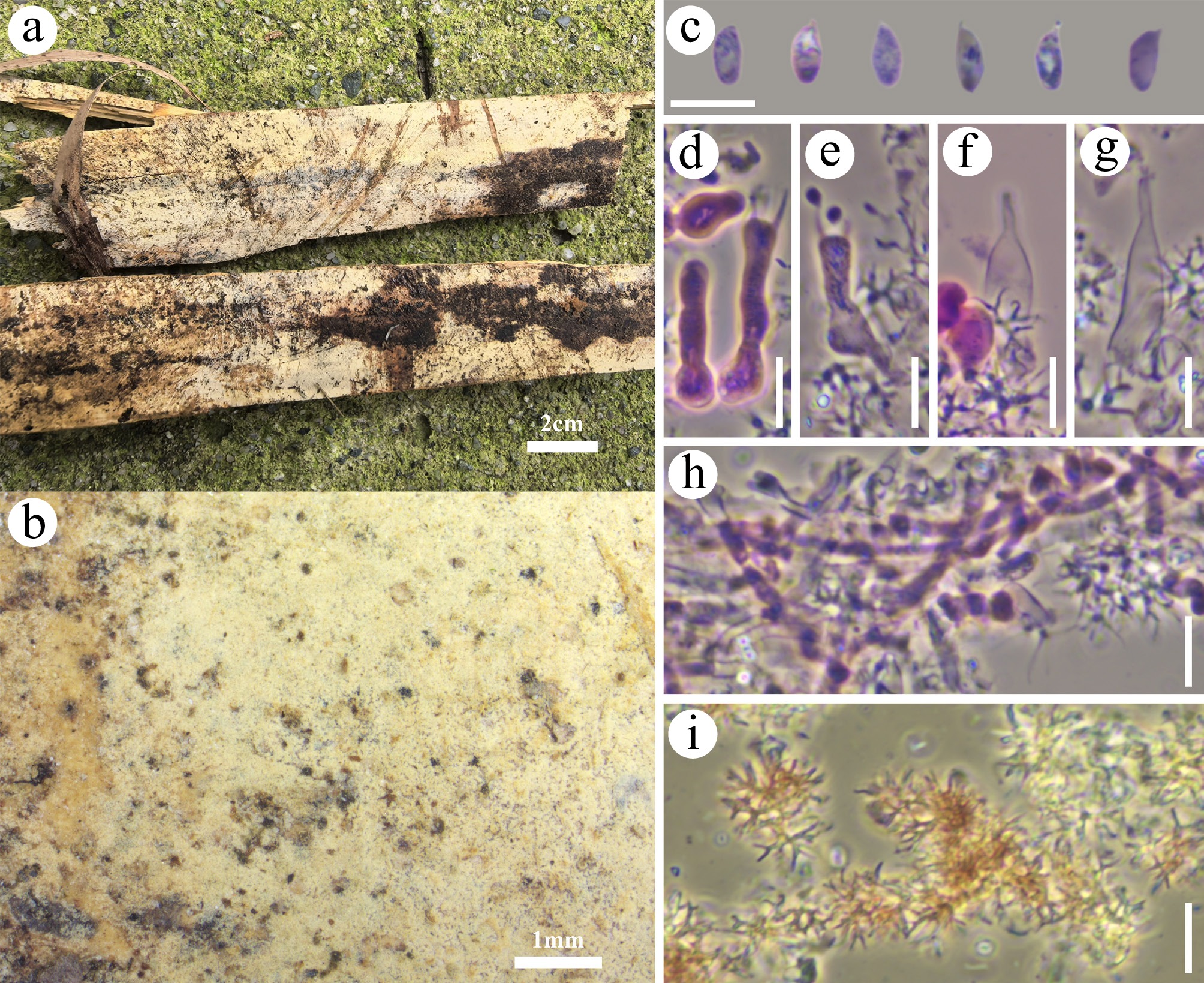
Figure 15.
Vararia emeiensis (holotype, Yuan 3382). (a), (b) Basidiomata. (c) Basidiospores. (d), (e) Basidia and basidioles. (f), (g) Gloeocystidia. (h) Generative hyphae. (i) Dichohyphae in subiculum (Melzer's reagent). Scale bars: (c)–(i)= 10 µm.
Index Fungorum number: IF905295.
Etymology – Emeiensis (Lat.): refers to the species growing on Bambusa emeiensis.
Diagnosis – characterized by oblong-ellipsoid basidiospores measuring 7–7.9 × 3.1–3.6 µm and growing only on Bambusa emeiensis in subtropical Southwestern China.
Type – China, Sichuan Province, Dujiangyan, Tongmagouzhuhai Park, 31.042008° N, 103.647461° E, elevation 724 m, on dead culm of Bambusa emeiensis, leg. Yuan Yuan, 29 September 2025, Yuan 3382 (BJFC062928).
Description – basidiomata annual, resupinate, soft, membranous, adnate, up to 12.2 cm long, 3.9 cm wide, 130 µm thick at center. Hymenial surface smooth, uncracked, cream (4A3) to buff yellow (ca. 4A4) and without odor and taste when fresh, buff yellow (ca. 4A4) to olivaceous buff (4C4) when dry; margin thinning out, indistinct, concolorous with the hymenophore.
Hyphal system dimitic; generative hyphae with simple septa, hyaline, thin-walled, moderately branched and frequently septate, interwoven, IKI–, CB–, 1.5–3.5 µm in diam. Dichohyphae predominant, bush-like at apex with acute tips, dichotomously to irregularly branched, thick-walled, IKI[+], CB+, stem 1.5–3 μm wide, upper branches narrow and thin-walled. Gloeocystidia occasionally present, subulate, with a schizopapillate apex, hyaline, thin-walled, 30–50 × 6–10 µm. Basidia urniform to clavate, thin-walled, with four sterigmata and a basal simple septum, 20–30 × 5.5–7.8 µm; basidioles morphologically resembling basidia, yet slightly smaller in size. Basidiospores oblong-ellipsoid, occasionally with oil drops, hyaline, thin-walled, smooth, IKI–, CB–, 7–7.9(–8.1) × (3–)3.1–3.6(–3.8) µm, L = 7.56 µm, W = 3.46 µm, Q = 2–2.5 (n = 60/3).
Additional specimens examined – China, Sichuan Province, Dujiangyan, Tongmagouzhuhai Park, 31.041971° N, 103.647 550° E, elevation 722 m, on dead culm of Bambusa emeiensis, leg. Yuan Yuan, 29 September 2025, Yuan 3381 (BJFC062927).
Known distribution – currently known only from subtropical montane bamboo forests in Southwestern China (Sichuan, Chongqing), found on dead culms of Bambusa emeiensis.
Notes – phylogenetically, Vararia emeiensis formed a strongly supported clade with V. subulata (100% ML, 1 BPP; Supplementary Fig. S7). Morphologically, it is characterized by oblong-ellipsoid basidiospores, an uncracked hymenophore, and growing only on Bambusa emeiensis in subtropical China. Vararia subulata has similar urniform basidia and an uncracked hymenophore, but differs by having ellipsoid basidiospores (8.1–9.2 × 4–4.9 µm, Q = 1.6–2 vs 7–7.9 × 3.1–3.6 µm, Q = 2–2.5) and the presence of projecting paraphyses. Vararia emeiensis also resembles V. alpina in having subulate gloeocystidia, but V. alpina differs from V. emeiensis by having broader basidiospores (4.6–5.0 µm vs 3.1–3.6 µm in width), a cracked hymenophore, and growth on bamboo, angiosperm, and coniferous wood in Xizang.
Vararia falcata Xin Zhang, Y.C. Dai, M.R. Li & Yuan Yuan, sp. nov. Fig. 16
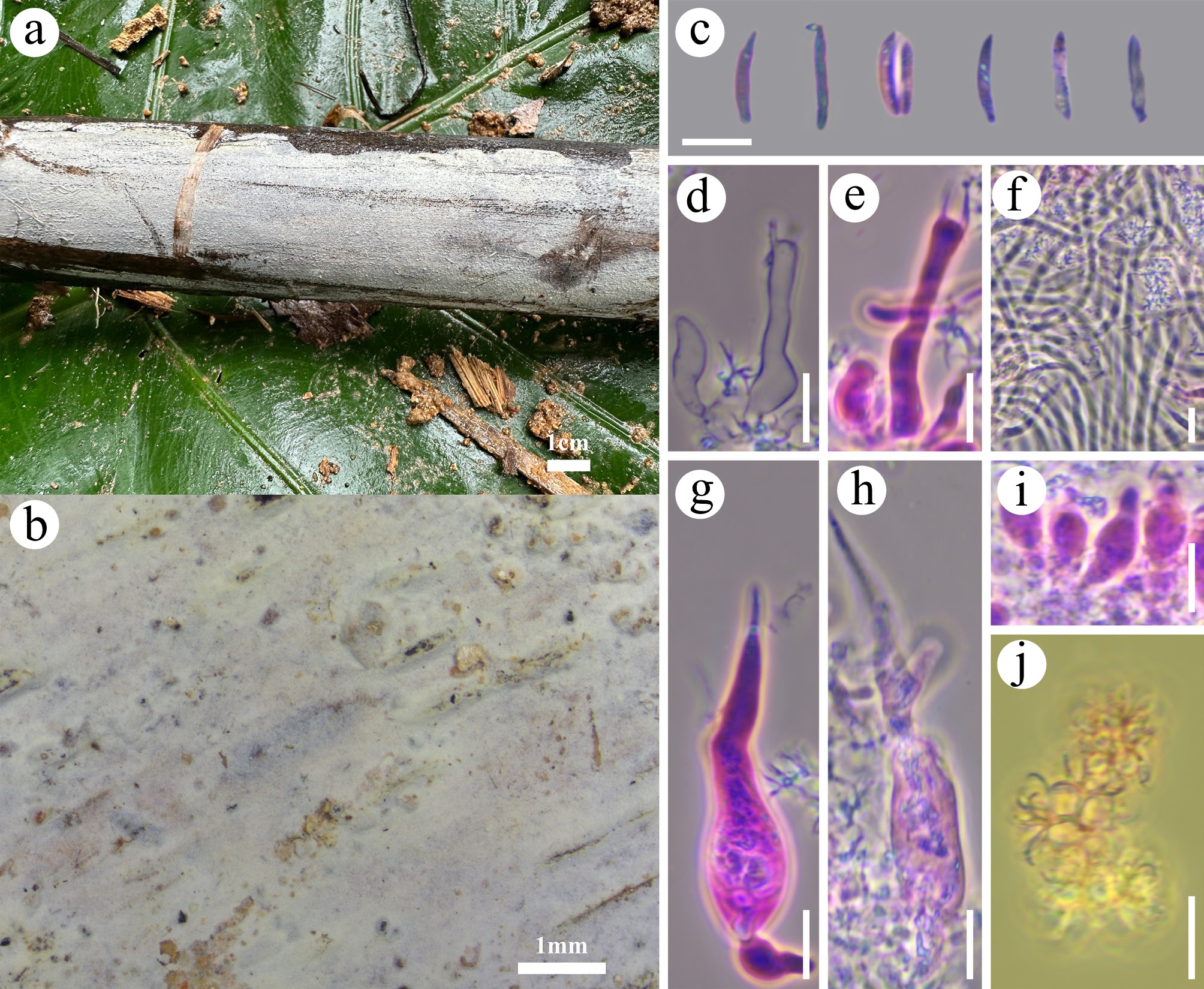
Figure 16.
Vararia falcata (holotype, Dai 30171). (a), (b) Basidiomata. (c) Basidiospores. (d) Basidia and cystidioles. (e) Basidia and basidioles. (f) Generative hyphae. (g), (h) Gloeocystidia. (i) Cystidioles and basidioles. (j) Dichohyphae in subiculum (Melzer's reagent). Scale bars: (c)–(j) = 10 µm.
Index Fungorum number: IF905296.
Etymology – Falcata (Lat.): refers to the species having falcate basidiospores.
Diagnosis – characterized by sickle-shaped basidiospores measuring 11–15.7 × 1.8–2.5 µm, subulate gloeocystidia with a schizopapillate apex, and growing on rotten bamboo and Miscanthus in tropical southern China.
Type – China, Hainan Province, Baisha County, Qingsong, 19.241425° N, 109.393279° E, elevation 369 m, on rotten bamboo, leg. Y.C. Dai, 24 September 2024, Dai 30171 (BJFC050430).
Description – Basidiomata annual, resupinate, soft, coriaceous, adnate, up to 10.6 cm long, 3.7 cm wide, 75 µm thick at center. Hymenial surface smooth, uncracked, white (–A1) to grayish white (1B1) and without odor and taste when fresh, white (–A1) to cream (4A3) when dry; margin thinning out, indistinct, concolorous with the hymenophore.
Hyphal system dimitic; generative hyphae with simple septa, hyaline, thin- to slightly thick-walled, occasionally branched and septate, interwoven, IKI–, CB–, 2–5 µm in diam. Dichohyphae predominant, bush-like at apex with acute tips, dichotomously to irregularly branched, thick-walled, IKI[+], CB+, stem 1.5–3 μm wide, upper branches narrow and thin-walled. Gloeocystidia occasionally present, subulate, with guttulate content and a schizopapillate apex, hyaline, thin-walled, 35–65 × 8–13 µm; fusiform cystidioles occasionally present. Basidia clavate, thin-walled, with four sterigmata and a basal simple septum, 20–35 × 4–7.5 µm; basidioles morphologically resembling basidia, yet slightly smaller in size. Basidiospores sickle-shaped, often aggregated in pairs or quartets, occasionally with oil drops, hyaline, thin-walled, smooth, IKI–, CB–, (10.8–)11–15.7(–16) × (1.7–)1.8–2.5(–2.6) µm, L = 12.99 µm, W = 2.23 µm, Q = 4.5–9 (n = 210/7).
Additional specimens examined – China, Guangxi Autonomous Region, Chongzuo, Longzhou County, Nonggang National Nature Reserve, on rotten bamboo, leg. Y.C. Dai, 29 May 2024, Dai 27813 (BJFC048073); Hainan Province, Baisha County, Qingsong, 19.241425° N, 109.393279° E, elevation 369 m, on rotten bamboo, leg. Y.C. Dai, 24 September 2024, Dai 30169 (BJFC050428); 19.249437° N, 109.389240° E, elevation 456 m, on rotten bamboo, leg. Y.C. Dai, 24 September 2024, Dai 30196 (BJFC050455); and on rotten bamboo leaf, leg. Y.C. Dai, 24 September 2024, Dai 30194 (BJFC050453); Wuzhishan County, Shuiman, 18.813533° N, 109.646510° E, elevation 577 m, on rotten Miscanthus, leg. Y.C. Dai, 23 September 2024, Dai 30092 (BJFC050351), Dai 30093 (BJFC050352), and Dai 30097 (BJFC050356).
Known distribution – currently known only from tropical forests in Southern China (Guangxi, Hainan), found on rotten bamboo and Miscanthus.
Notes – Vararia falcata formed a phylogenetically distinct lineage (100% ML, 1 BPP; Supplementary Fig.S7). The sickle-shaped basidiospores of V. falcata are unique within the genus, contrasting with the fusiform to ellipsoid basidiospores of tropical relatives such as V. aurantiaca Boidin & Lanq. (Central Africa), V. rosulenta Boidin et al. (New Caledonia), V. gomezii Boidin & Lanq., V. intricata Boidin & Lanq., and V. insolita Boidin & Lanq. (tropical Africa and the Americas), all of which grow on angiosperm wood[24,114]. Ecologically, V. falcata is currently known from rotten bamboo and Miscanthus in tropical Southern China (Hainan, Guangxi).
Vararia incarnata Xin Zhang, Y.C. Dai, M.R. Li & Yuan Yuan, sp. nov. Fig. 17
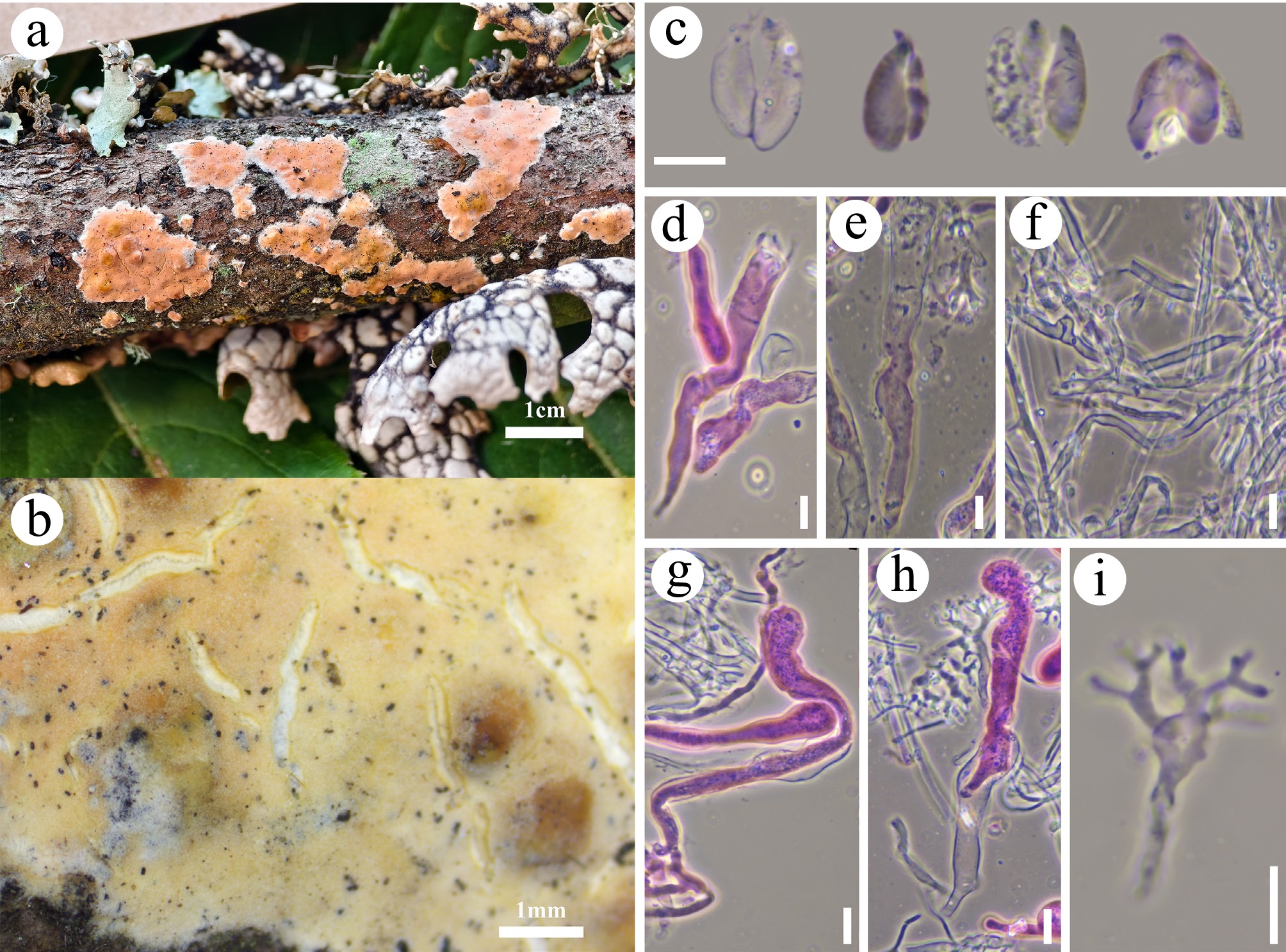
Figure 17.
Vararia incarnata (holotype, Dai 38813). (a), (b) Basidiomata. (c) Basidiospores. (d), (e) Basidia and basidioles. (f) Generative hyphae. (g), (h) Gloeocystidia. (i) Dichohyphidia. Scale bars: (c)–(i) = 10 µm.
Index Fungorum number: IF905297.
Etymology – Incarnata (Lat.): refers to the species having a flesh-pink hymenophore when fresh.
Diagnosis – characterized by the flesh-pink hymenophore when fresh, fusiform basidiospores measuring 15.8–17.5 × 5.9–7.0 μm, the bush-like, blunt-tipped dichohyphidia in the hymenium, and growing on both angiosperm and gymnosperm wood in high-elevation temperate to subalpine forests of Southwestern China.
Type – China, Xizang Autonomous Region, Linzhi, Bayi District, near the 318 National Highway, 29.8150° N, 94.7426° E, elevation 3,130 m, on a fallen angiosperm branch, leg. Y.C. Dai, 7 October 2025, Dai 38813 (BJFC060072).
Description – basidiomata annual, resupinate, soft, membranous, adnate, up to 6 cm long, 1.2 cm wide, 310 µm thick at center. Hymenial surface smooth to locally tuberculate, cracked, flesh pink (9A4) and without odor or taste when fresh, buff (4A4) to reddish brown (9E7) when dry; margin white (–A1), thinning out, fimbriate.
Hyphal system dimitic; generative hyphae with clamp connections, hyaline, thin- to slightly thick-walled, moderately branched and septate, loosely interwoven, IKI–, CB–, 2.5–4.5 µm in diam; skeletal hyphae infrequent, rarely branched, interwoven, hyaline, thick-walled, 2–3 µm in diam, IKI–, CB–. Dichohyphae predominant, bush-like at apex with acute tips, dichotomously to irregularly branched, thick-walled, IKI–, CB+, stem 2–3 μm wide, upper branches narrow and thin-walled; dichohyphidia present, in shape similar to dichohyphae, but with shorter and blunter upper branches. Gloeocystidia occasionally present, mostly capitate, more or less curved at the middle, some with guttulate content, hyaline, slightly thick-walled, 60–120 × 9–15 µm. Basidia clavate and slightly curved, thin-walled, with four sterigmata and a basal clamp connection, 60–85 × 7.5–13 µm; basidioles morphologically resembling basidia, yet slightly smaller in size. Basidiospores fusiform, hyaline, thin-walled, smooth, commonly aggregated in pairs or quartets, IKI–, CB–, (15.5–)15.8–17.5(–17.7) × (5.6–)5.9–7(–7.2) µm, L = 16.9 µm, W = 6.6 µm, Q = 2.4–2.9 (n = 40/2).
Additional specimens examined – China, Yunnan Province, Kunming, Luquan County, Jiaozishan Forest Park, elevation 2,950 m, on a dead standing tree of Abies georgei, leg. Y.C. Dai, 4 November 2018, Dai 19280 (BJFC027748).
Known distribution – currently known only from high-elevation temperate to subalpine forests in Southwestern China (Xizang, Yunnan), found on fallen angiosperm branches and dead Abies trees.
Notes – phylogenetically, Vararia incarnata formed an independent, well-supported lineage (100% ML, 1 BPP; Supplementary Fig. S7) within a larger stable clade comprising V. breviphysa, V. pirispora, V. sinensis, and V. tenuata (78% ML, 1 BPP; Supplementary Fig. S7). Morphologically, V. incarnata and V. sinensis share a cracked hymenial surface when mature and a dimitic hyphal system with clamp connections[28]. However, V. sinensis differs from V. incarnata by its smaller basidiospores (6–11 × 4–6 µm vs 15.8–17.5 × 5.9–7.0 µm)[28]. Vararia tenuata, originally described from Thailand and also recorded here from Hainan, China (Dai 29978), differs by having smaller fusiform basidiospores (13.5–15 × 5–6 µm vs 15.8–17.5 × 5.9–7.0 µm), and smaller gloeocystidia (28–40 × 7–10 µm vs 60–120 × 9–15 µm)[115]. Vararia breviphysa, known from Gabon, is distinguished from V. incarnata by having shorter gloeocystidia (30–70 × 6–12 µm vs 60–120 × 9–15 µm), and narrower basidiospores (4–5.5 µm vs 5.9–7.0 µm in width)[24]. Vararia pirispora, described from Réunion on dead wood, differs by its distinctly piriform basidiospores[114].
Ecologically, V. incarnata grows on both angiosperm and coniferous wood in high-elevation temperate to subalpine forests of Southwestern China (Xizang, Yunnan, 2,950–3,130 m), whereas its relatives occur in lower-elevation forests of Thailand and China (V. tenuata on bamboo)[115], and tropical Africa (V. breviphysa and V. pirispora on wood)[114].
Vararia miscanthi Xin Zhang, Y.C. Dai, M.R. Li & Yuan Yuan, sp. nov. Fig. 18
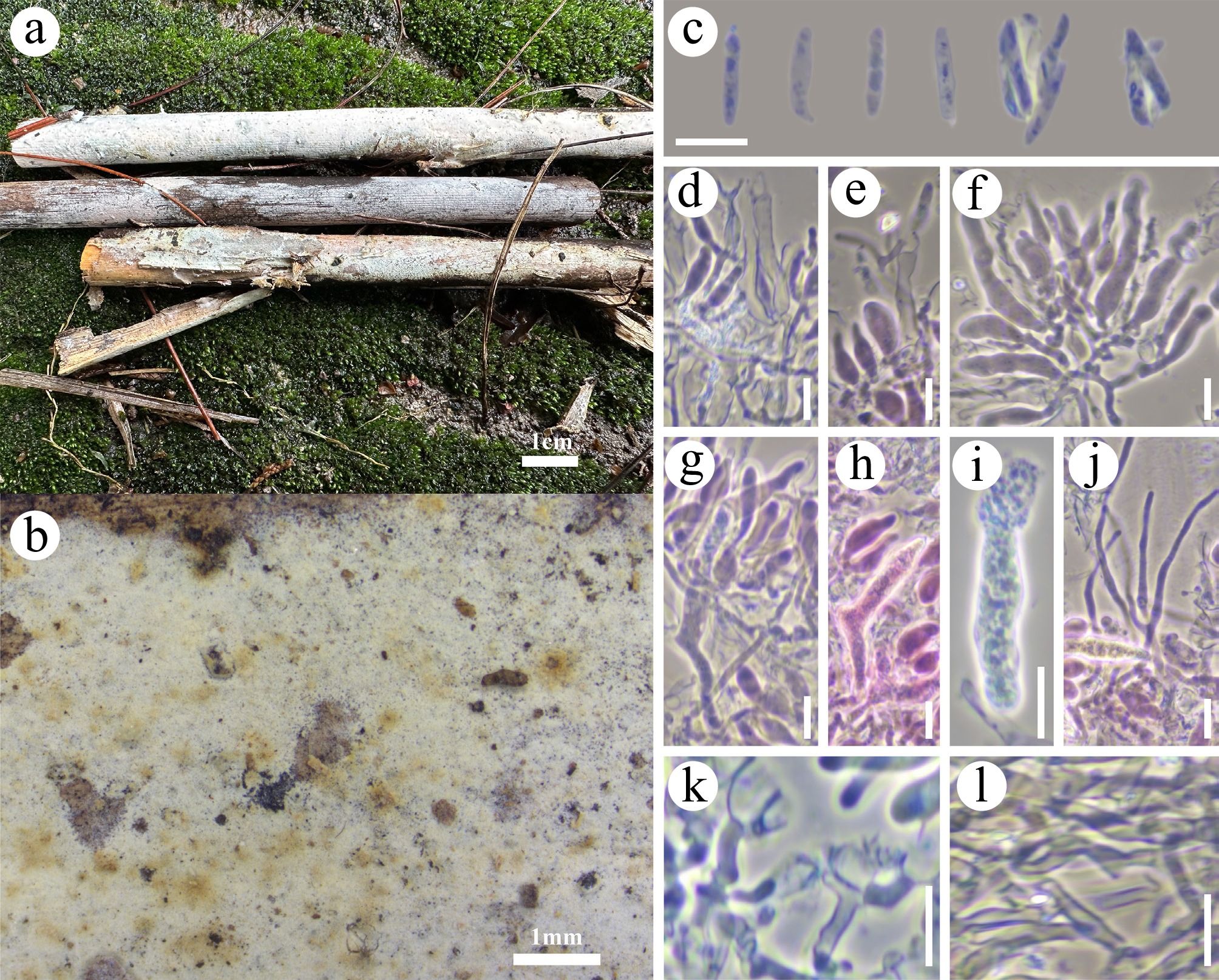
Figure 18.
Vararia miscanthi (holotype, Dai 26333). (a), (b) Basidiomata. (c) Basidiospores. (d), (e) Basidia and basidioles. (f) A section of hymenium. (g)–(i) Gloeocystidia. (j) Paraphyses. (k) Dichohyphae in subiculum. (l) Generative hyphae. Scale bars: (c)–(l) = 10 µm.
Index Fungorum number: IF905298.
Etymology – Miscanthi (Lat.): refers to the species growing on Miscanthus.
Diagnosis – characterized by the presence of cylindrical basidiospores measuring 12.3–15.5 × 2–3 µm and subclavate gloeocystidia densely encrusted with crystals, and growing on dead Miscanthus in Zhejiang, subtropical China.
Type – China, Zhejiang Province, Jinhua, Wuyi County, Yuyuan, Dahuanglingtou Village, 28.753447° N, 119.658151° E, elevation 240 m, on dead Miscanthus, leg. Y.C. Dai, 13 October 2023, Dai 26333 (BJFC043883).
Description – basidiomata annual, resupinate, soft, membranous, adnate, up to 13 cm long, 0.9 cm wide, 65 µm thick at center. Hymenial surface smooth to locally tuberculate, uncracked, white (–A1) to grayish white (1B1) and without odor and taste when fresh, buff (4A4) to olivaceous buff (4C4) when dry; margin thinning out, indistinct, concolorous with the hymenophore.
Hyphal system dimitic; generative hyphae with clamp connections, hyaline, thin- to slightly thick-walled, moderately branched and frequently septate, interwoven, IKI–, CB–, 1.5–3 µm in diam. Dichohyphae rarely present, bush-like at apex with acute tips, dichotomously to irregularly branched, thick-walled, IKI–, CB–, stem 1.5–2.5 μm wide, upper branches narrow and thin-walled. Paraphyses present, cylindrical, slightly projecting, 1.5–2 µm wide. Gloeocystidia occasionally present, more or less subulate, often obtusely bent near the base, hyaline, thin-walled, densely encrusted with crystals, 55–100 × 4–7 µm, IKI+, CB+. Basidia clavate to suburniform, thin-walled, with four sterigmata and a clamp connection, 20–40 × 3.5–8 µm; basidioles morphologically resembling basidia, yet slightly smaller in size. Basidiospores cylindrical, hyaline, thin-walled, smooth, occasionally with oil drops, commonly aggregated in quartets, IKI–, CB–, (12–)12.3–15.5(–15.7) × (1.8–)2–3(–3.2) µm, L = 13.63 µm, W = 2.41 µm, Q = 4.3–7.5 (n = 60/2).
Additional specimens examined – China, Zhejiang Province, Jinhua, Wuyi County, Yuyuan, 28.753425° N, 119.658148° E, elevation 230 m, on dead Miscanthus, leg. Y.C. Dai, 8 October 2024, Dai 30889 (BJFC051148).
Known distribution – currently known only from a subtropical forest in Eastern China (Zhejiang), found on dead Miscanthus.
Notes – phylogenetically, Vararia miscanthi formed a strongly supported clade with V. calami (100% ML, 1 BPP; Supplementary Fig. S7). Morphologically, V. calami resembles V. miscanthi by sharing a dimitic hyphal system with clamp connections on generative hyphae, and a substrate preference for dead monocot stems, but V. calami differs by having thicker basidiospores (3.5–4 µm vs 2–3 µm in width) and lacking crystal-encrusted gloeocystidia[24]. Besides, Vararia miscanthi is known from dead Miscanthus in subtropical China, while V. calami occurs on palms in tropical Africa[24].
Vararia septocystidiata Xin Zhang, Y.C. Dai, M.R. Li & Yuan Yuan, sp. nov. Fig. 19
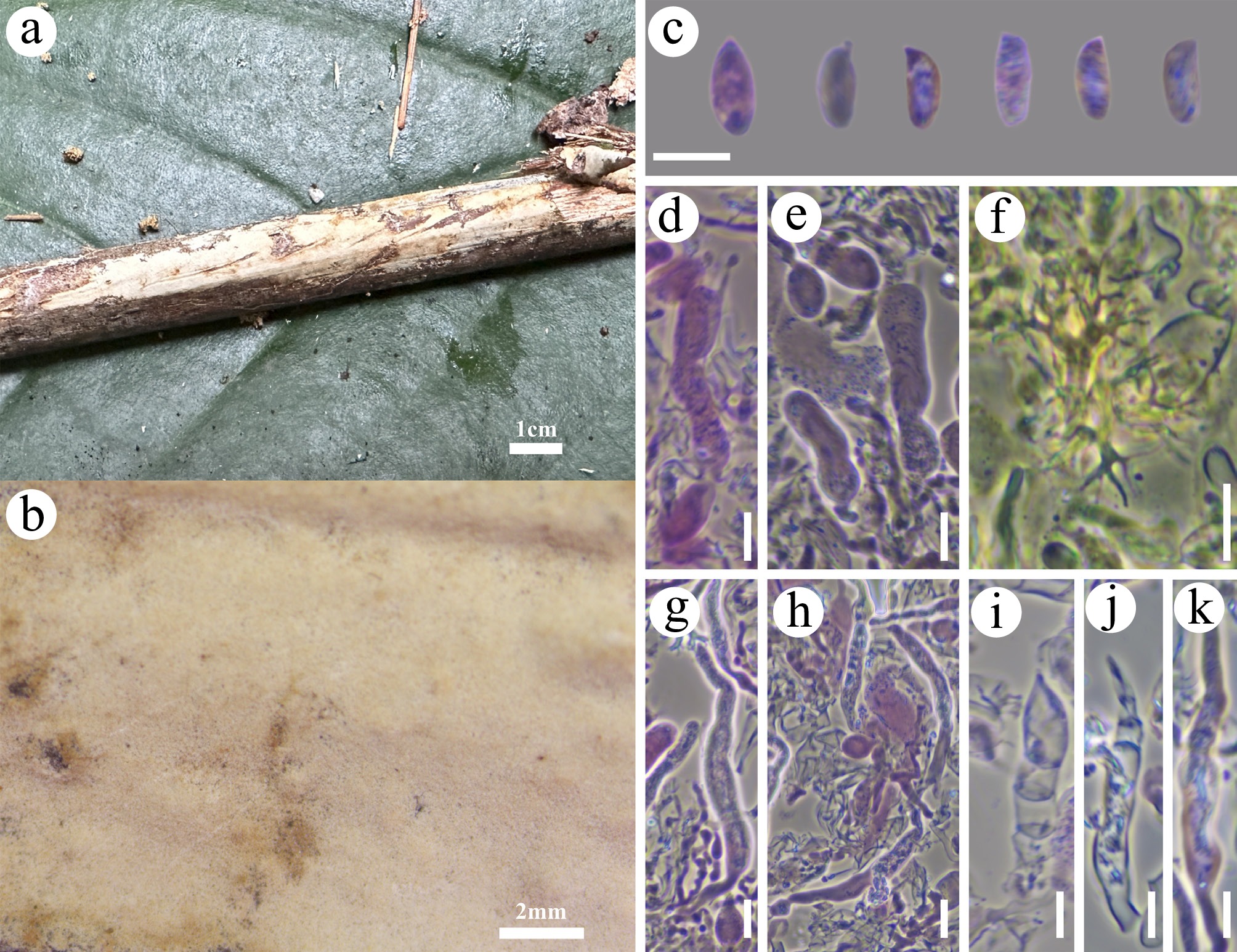
Figure 19.
Vararia septocystidiata (holotype, Dai 30051). (a), (b) Basidiomata. (c) Basidiospores. (d), (e) Basidia and basidioles. (f) Dichohyphae in subiculum (Melzer's reagent). (g), (h) Gloeocystidia. (i)–(k) Septocystidium. Scale bars: (c)–(k) = 10 µm.
Index Fungorum number: IF905299.
Etymology – Septocystidiata (Lat.): refers to the species having septocystidia.
Diagnosis – characterized by two distinct cystidia (tubular gloeocystidia and septocystidia with 3–5 septa), oblong-ellipsoid basidiospores measuring 11–13.1 × 4.7–5.3 µm, and growth on diverse substrates including palm, rattan, angiosperm and gymnosperm wood in tropical to subtropical China.
Type – China, Hainan Province, Qiongzhong County, Limushan National Forest Park, 19.176177° N, 109.744454° E, elevation 651 m, on rotten palm, leg. Y.C. Dai, 22 September 2024, Dai 30051 (BJFC050310).
Description – basidiomata annual, resupinate, soft, membranous, adnate, up to 6.8 cm long, 0.9 cm wide, 60 µm thick at center. Hymenial surface smooth, uncracked, cream (4A3) to buff (4A4), without odor and taste when fresh, buff (4A4) to honey yellow (5B4) when dry; margin thinning out, indistinct, concolorous with the hymenophore.
Hyphal system dimitic; generative hyphae with simple septa, hyaline, thin- to slightly thick-walled, moderately branched and septate, interwoven, IKI–, CB–, 2–4 µm in diam. Dichohyphae predominant, bush-like at apex with acute tips, dichotomously to irregularly branched, thick-walled, IKI[+], CB+, stem 2–4 μm wide, upper branches narrow and thin-walled. Cystidia of two kinds: gloeocystidia abundant, more or less subulate, winding, with guttulate content, hyaline, thin-walled, 70–125 × 5–9 µm; septocystidia occasionally present, subulate, some with guttulate content, hyaline, slightly thick-walled, with 3–5 distinct septa, 60–85 × 5–10 µm. Basidia clavate, thin-walled, with four sterigmata and a basal simple septum, 40–60 × 7–11 µm; basidioles morphologically resembling basidia, yet slightly smaller in size. Basidiospores oblong-ellipsoid, occasionally with oil drops, hyaline, thin-walled, smooth, IKI–, CB–, (10.8–)11–13.1(–13.3) × (4.5–)4.7–5.3(–5.5) µm, L = 11.64 µm, W = 5.11 µm, Q = 2.2–2.5 (n = 120/4).
Additional specimens examined – China, Fujian Province, Zhangzhou, Tianzhushan National Forest Park, 24.599587° N, 117.869454° E, elevation 131 m, on a fallen angiosperm branch, leg. Y.C. Dai, 14 July 2025, Dai 35362 (BJFC056623); Guangdong Province, Zhaoqing, Dinghu District, Dinghushan National Nature Reserve, on a fallen twig of Pinus massoniana, leg. Yuan Yuan, 8 July 2025, Yuan 3219 (BJFC062765); Hainan Province, Qiongzhong County, Limushan National Forest Park, 19.176177° N, 109.744454° E, elevation 651 m, on rotten rattan, leg. Y.C. Dai, 22 September 2024, Dai 30052 (BJFC050311).
Known distribution – currently known only from tropical to subtropical China (Hainan, Guangdong, Fujian), found on various substrates including rotten palm, rattan, and fallen angiosperm and gymnosperm branches.
Notes – phylogenetically, Vararia septocystidiata formed a well-supported clade with V. cinnamomea and V. ferruginosa (88% ML, 1 BPP; Supplementary Fig. S7). Morphologically, all three species share a dimitic hyphal system with simple-septate generative hyphae[25,39]. However, V. cinnamomea differs by having subcylindrical basidia and growing on dead wood in tropical Africa[25]; V. ferruginosa differs by having ellipsoid basidiospores, obclavate gloeocystidia without septa, and growing on angiosperm branches in Yunnan, Southwestern China[39].
Vararia subulata Xin Zhang, Y.C. Dai, M.R. Li & Yuan Yuan, sp. nov. Fig. 20
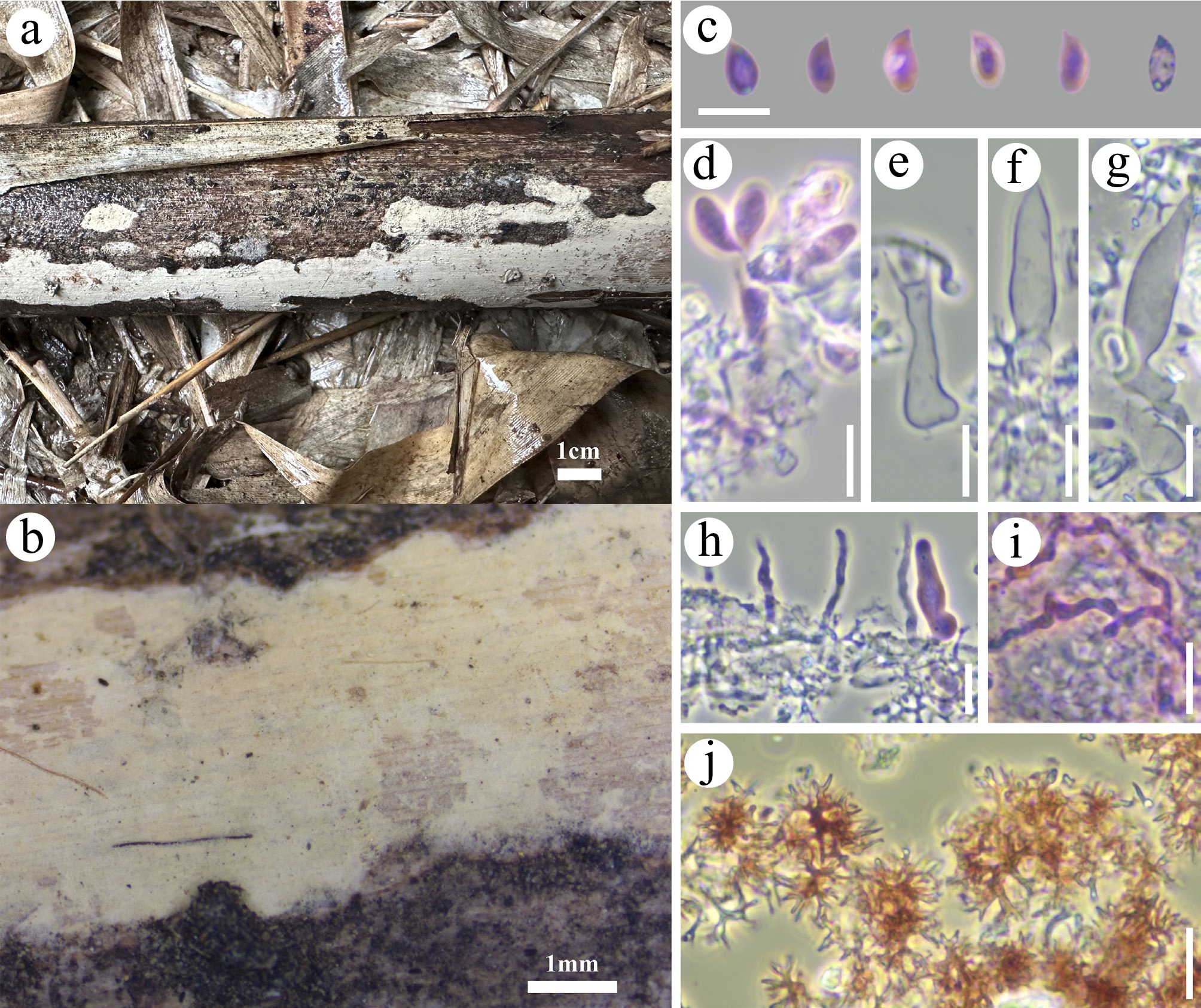
Figure 20.
Vararia subulata (holotype, Dai 36777). (a), (b) Basidiomata. (c) Basidiospores. (d), (e) Basidia. (f), (g) Gloeocystidia. (h) Paraphyses. (i) Generative hyphae. (j) Dichohyphae in subiculum (Melzer's reagent). Scale bars: (c)–(j) = 10 µm.
Index Fungorum number: IF905300.
Etymology – subulata (Lat.): refers to the species having subulate gloeocystidia.
Diagnosis – characterized by the presence of subulate gloeocystidia, projecting paraphyses, and ellipsoid basidiospores with a tapering apiculus.
Type – China, Chongqing Municipality, Yongchuan District, Yinshan Forest Farm, 29.325276° N, 105.698251° E, elevation 373 m, on dead culm of Bambusa emeiensis, leg. Y.C. Dai, 14 November 2025, Dai 36777 (BJFC058036).
Description – basidiomata annual, resupinate, soft, coriaceous, adnate, up to 16 cm long, 4.1 cm wide, 65 µm thick at center. Hymenial surface smooth, uncracked, white (–A1) to pale cream (3A2), without odor and taste when fresh, buff yellow (ca. 4A4) to buff (4A4) when dry; margin white (–A1), thinning out, fimbriate.
Hyphal system dimitic; generative hyphae with simple septa, hyaline, thin-walled, moderately branched and septate, loosely interwoven, IKI–, CB–, 1.7–3.3 µm in diam. Dichohyphae predominant, bush-like at apex with acute tips, dichotomously to irregularly branched, thick-walled, IKI[+], CB+, stem 1.5–2 μm wide, upper branches narrow and thin-walled. Paraphyses present, cylindrical, slightly projecting, 1.5–2 µm wide. Gloeocystidia occasionally present, subulate, with a schizopapillate apex, hyaline, thin-walled, 35–50 × 4–6 µm. Basidia urniform, thin-walled, with four sterigmata and a basal simple septum, 15–25 × 5–9 µm; basidioles morphologically resembling basidia, yet slightly smaller in size. Basidiospores ellipsoid, tapering to an apiculus, hyaline, thin-walled, smooth, occasionally with oil drops, IKI–, CB–, (8–)8.1–9.2(–9.5) × (3.8–)4–4.9(–5) µm, L = 8.61 µm, W = 4.49 µm, Q = 1.6–2 (n = 210/7).
Additional specimens examined – China, Anhui Province, Liuan, Jinzhai County, Tianma Nature Reserve, 31.123471° N, 115.683911° E, elevation 325 m, on a fallen branch of Phyllostachys heterocycla, leg. Y.C. Dai, 18 September 2025, Dai 35840 (BJFC057101); Chongqing, Yongchuan District, Chashanzhuhai National Forest Park, 29.402084° N, 105.917336° E, elevation 737 m, on dead culms of Bambusa emeiensis, leg. Y.C. Dai, 13 November 2025, Dai 36738 (BJFC057997), Dai 36719 (BJFC057978); Guangxi Autonomous Region, Guilin, Ziyuan County, Meixi, Bajiaozhai Scenic Spot, 26.180258° N, 110.671014° E, elevation 429 m, on dead bamboo culm, leg. Y.C. Dai, 11 May 2025, Dai 36455 (BJFC057714); Hunan Province, Changsha, Hunan Botanical Garden, 28.104948° N, 113.024667° E, elevation 89 m, on dead culm of Bambusa textilis, leg. Yuan Yuan, 25 April 2025, Yuan 2223 (BJFC061769).
Known distribution – currently known only from subtropical bamboo forests in subtropical China (Anhui, Guangxi, Hunan, and Chongqing), found on various bamboo species. It is characterized by ellipsoid basidiospores tapering to an apiculus, the presence of projecting paraphyses, and growth on various bamboo species in subtropical China.
Notes – phylogenetically, Vararia subulata formed a strongly supported clade with V. emeiensis (100% ML, 1 BPP; Supplementary Fig. S7). However, V. emeiensis differs by having oblong-ellipsoid basidiospores, lacking paraphyses and growing only on Bambusa emeiensis in Sichuan, whereas V. subulata exhibits a broader host range, occurring on multiple bamboo genera (e.g., Bambusa and Phyllostachys) across subtropical China. Vararia subulata may be confused with V. alpina in basidiospore shape; however, V. alpina differs by having slightly shorter basidiospores, not tapering to an apiculus (7.5–8.1 × 4.6–5.0 µm vs 8.1–9.2 × 4–4.9 µm), a cracked hymenophore, and occurrence on diverse substrates at high elevations.
Family Stereaceae Pilát
Index Fungorum number: IF81424.
Type genus – Stereum Hill ex Pers.
Acanthobasidium Oberw.
Index Fungorum number: IF17002.
Type species – Acanthobasidium delicatum (Wakef.) Oberw. ex Jülich
Notes – the genus Acanthobasidium historically circumscribed within Aleurodiscus s. lat., is defined by resupinate, corticioid basidiomata typically on monocotyledons, a monomitic hyphal system with clamp connections on generative hyphae, the presence of basidia with lateral protuberances (acanthobasidia), acanthophyses, and amyloid basidiospores[31,94,116,117]. Our study expands the morphological and ecological scope of the genus by describing two new species from rotten bamboo in subtropical China (Guangxi): A. encrustans (characterized by crystal-encrusted gloeocystidia) and A. septobasidium (characterized by phragmobasidiate basidia developing 2–4 horizontal septa at maturity).
Acanthobasidium encrustans Xin Zhang, Y.L. Zhao & Yuan Yuan, sp. nov. Fig. 21
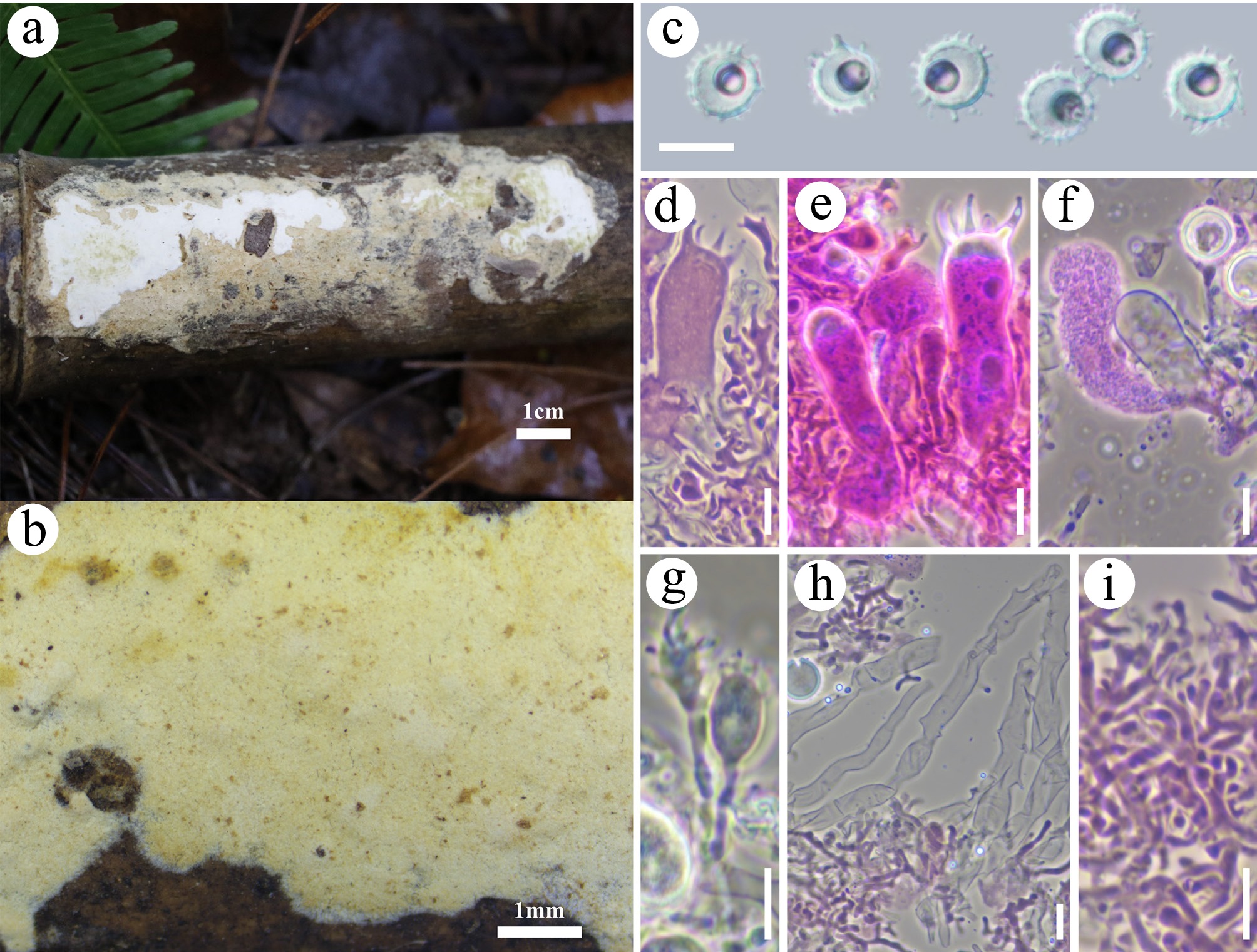
Figure 21.
Acanthobasidium encrustans (holotype, Dai 28852). (a), (b) Basidiomata. (c) Basidiospores. (d), (e) Basidia and basidioles. (f) Gloeocystidia. (g) Acanthophyses. (h) Acanthohyphidia. (i) Dendrohyphidia. Scale bars: (c)–(i) = 10 µm.
Index Fungorum number: IF905301.
Etymology – Encrustans (Lat.): refers to the species having encrusted gloeocystidia.
Diagnosis – characterized by the presence of crystal-encrusted gloeocystidia, variable acanthophyses, dendrohyphidia, globose, thick-walled, echinulate, amyloid basidiospores with a big oil drop measuring 8.5–9.2 × 8–8.7 µm, and growing on rotten bamboo in subtropical China.
Type – China, Guangxi Autonomous Region, Laibin, Jinxiu County, Liugang, Daling Village, 23.940620° N, 110.070302° E, elevation 650 m, on rotten bamboo, leg. Y.C. Dai, 15 July 2024, Dai 28852 (BJFC049111).
Description – basidiomata annual, resupinate, soft, coriaceous, closely adnate, up to 7.5 cm long, 2.5 cm wide, 65 µm thick at center. Hymenial surface smooth, uncracked, snow white (–A1) and without odor and taste when fresh, pale yellow (3A4) to curry yellow (4B8) when dry; margin white (–A1), thinning out as byssoid.
Hyphal system monomitic; generative hyphae with clamp connections, hyaline, thin- to slightly thick-walled, occasionally branched and septate, loosely interwoven, IKI–, CB–, 1.5–4.5 µm in diam. Acanthophyses abundant, variable in shape, mostly clavate with a swollen apex, with several to many blunt and cylindrical spines up to 7 μm long at apex, hyaline, slightly thick-walled, IKI–, CB–, 20–35 × 3–9 μm. Acanthohyphidia numerous, bearing several to many acute protuberances (spines) up to 3 μm long, hyaline, thin-walled, IKI–, 60–130 × 4–9 μm. Dendrohyphidia numerous, frequently branched at apex, hyaline, thin-walled, IKI–, CB–. Gloeocystidia occasionally present, more or less pyriform, slightly thick-walled, densely encrusted with fine crystals, 40–65 × 7–17 μm. Basidia subclavate, with many short and blunt spines at base, slightly thick-walled, with four sterigmata and a basal clamp connection, 35–60 × 11–17 µm; basidioles morphologically resembling basidia, yet slightly smaller in size. Basidiospores globose, hyaline, thick-walled, with numerous blunt cylindrical spines up to 4 μm long, echinulate, with a big oil drop, IKI+, CB+, (8.4–)8.5–9.2 × (7.9–)8–8.7(–8.8) µm, L = 8.77 µm, W = 8.39 µm, Q = 1–1.1 (n = 60/2).
Additional specimens examined – China, Guangxi Autonomous Region, Fangchenggang, Shangsi County, Shiwandashan National Forest Park, 21.89932° N, 107.905843° E, elevation 317 m, on rotten bamboo, leg. Y.C. Dai, 4 September 2024, Dai 32883 (BJFC053142).
Known distribution – currently known only from subtropical forests in Southern China (Guangxi), found on rotten bamboo.
Notes – Acanthobasidium encrustans is phylogenetically sister to the clade containing A. septobasidium and A. bambusicola (Supplementary Fig. S1). Morphologically, A. encrustans shares with A. septobasidium and A. bambusicola the presence of variable acanthophyses and globose, thick-walled, echinulate, amyloid basidiospores, as well as growth on bamboo in Southern China. However, A. septobasidium and A. bambusicola can be distinguished from A. encrustans by non-encrusted gloeocystidia and basidiospores without a big oil drop[32].
Acanthobasidium septobasidium Xin Zhang, Y.C. Dai, Y.L. Zhao & Yuan Yuan, sp. nov. Fig. 22
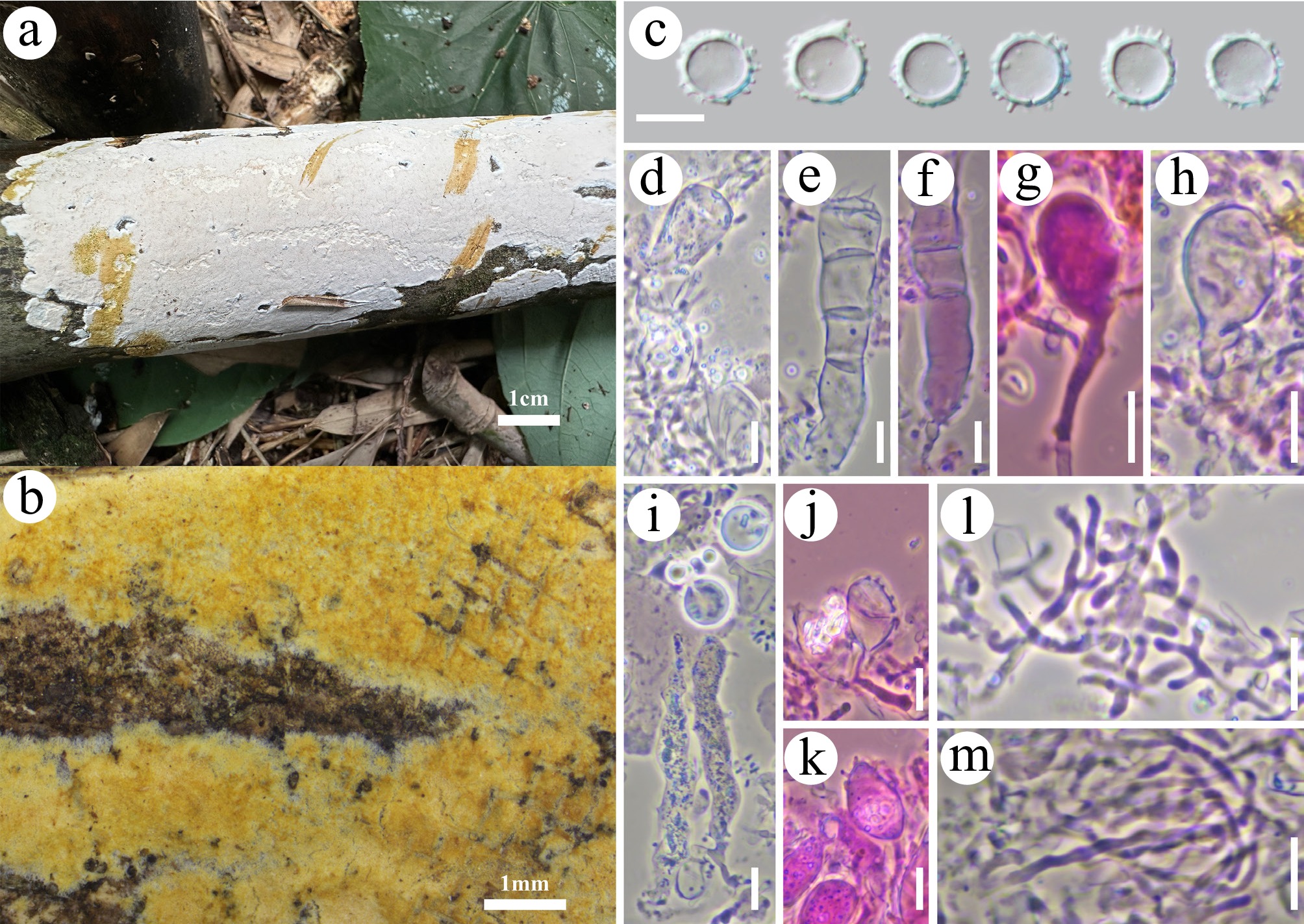
Figure 22.
Acanthobasidium septobasidium (holotype, Dai 36359). (a), (b) Basidiomata. (c) Basidiospores. (d)–(f) Basidia. (g), (h) Gloeocystidia. (i) Acanthohyphidia. (j), (k) Acanthophyses. (l) Dendrohyphidia. (m) Generative hyphae. Scale bars: (c)–(m) = 10 µm.
Index Fungorum number: IF905302.
Etymology – Septobasidium (Lat.): refers to the species having septate basidia.
Diagnosis – characterized by the presence of 2–4 horizontal septa in mature basidia; acanthophyses; gloeocystidia; globose, echinulate, amyloid basidiospores, and growth on dead culms of Indosasa crassiflora in subtropical China.
Type – China, Guangxi Autonomous Region, Guilin, Maoershan National Nature Reserve, 25.885672° N, 110.484717° E, elevation 1,182 m, on dead culm of Indosasa crassiflora, leg. Y.C. Dai, 10 May 2025, Dai 36359 (BJFC057616).
Description – basidiomata annual, resupinate, soft, coriaceous, closely adnate, up to 9 cm long, 3.5 cm wide, 300 µm thick at center. Hymenial surface smooth, slightly cracked, pale grayish white (1A1) and without odor and taste when fresh, becoming curry yellow when bruised, buff (4A4) to cinnamon (6D6) when dry; margin thinning out as byssoid, paler or concolorous with the hymenophore.
Hyphal system monomitic; generative hyphae with clamp connections, hyaline, thin- to slightly thick-walled, occasionally branched and septate, more or less regularly arranged to loosely interwoven, IKI–, CB–, 1.5–4 µm in diam. Acanthophyses abundant, variable in shape, mostly racket-shaped, with several to many blunt and cylindrical spines up to 2 μm long at apex, hyaline, slightly thick-walled, IKI–, CB–, 20–45 × 7–15 μm. Acanthohyphidia numerous, bearing several to many acute protuberances (spines) up to 3.5 μm long, hyaline, some with guttulate content, thin-walled, IKI–, CB–, 45–80 × 4–8 μm. Dendrohyphidia predominant, frequently branched at apex, hyaline, thin-walled, IKI–, CB–. Gloeocystidia occasionally present, spathulate, slightly thick-walled, 25–65 × 10–20 μm. Basidia clavate, with many short and blunt spines at base, slightly thick-walled, initially aseptate, developing 2–4 horizontal septa at maturity, with four sterigmata and a basal clamp connection, 40–75 × 11–17 µm; basidioles morphologically resembling basidia, yet slightly smaller in size. Basidiospores globose, hyaline, thick-walled, with numerous blunt cylindrical spines up to 4 μm long, echinulate, IKI+, CB+, (9.6–)9.7–10.2 × (9.2–)9.3–10(–10.2) µm, L = 10.09 µm, W = 9.72 µm, Q = 1–1.1 (n = 120/4).
Additional specimens examined – China, Guangxi Autonomous Region, Guilin, Maoershan National Nature Reserve, 25.863445° N, 110.493975° E, elevation 886 m, on dead culm of Indosasa crassiflora, leg. Y.C. Dai, 8 May 2025, Dai 36155 (BJFC057414) and Dai 36158 (BJFC057417); 25.885054° N, 110.485055° E, elevation 1,146 m, on dead culm of Indosasa crassiflora, leg. Y.C. Dai, 10 May 2025, Dai 36357 (BJFC057618).
Known distribution – currently known only from a subtropical montane forest in Southern China (Guangxi), found on dead culms of Indosasa crassiflora.
Notes – phylogenetically, Acanthobasidium septobasidium formed a well-supported clade with A. bambusicola (87 ML%, 1 BPP; Supplementary Fig. S1), and together they are sister to A. encrustans. These three species share a monomitic hyphal system with clamp connections, the presence of acanthophyses, gloeocystidia, globose, echinulate, amyloid basidiospores, and all are associated with bamboo in Southern China[32]. Acanthobasidium septobasidium occurs on dead culms of Indosasa crassiflora in Guangxi, distinguished by a unique feature within the genus: its basidia develop 2–4 horizontal septa at maturity; A. encrustans differs by its crystal-encrusted gloeocystidia, while A. bambusicola is characterized by two distinct kinds of gloeocystidia and lacks dendrohyphidia[32].
Aleurodiscus Rabenh. ex J. Schröt.
Index Fungorum number: IF17041.
Type species – Aleurodiscus amorphus (Pers.) J. Schröt.
Notes – the genus Aleurodiscus is morphologically defined by resupinate to discoid basidiomata, various sterile elements (e.g., acanthophyses, dendrohyphidia), gloeocystidia, and amyloid basidiospores[1,31,116,118,119]. Recent phylogenetic studies have revealed that this broad concept comprises several distinct lineages, leading to the restriction of Aleurodiscus to a core clade[34,118]. Notably, Neoaleurodiscus Sheng H. Wu, characterized by thick-walled smooth basidiospores, is also nested within this core clade[34,94]. Thus, Aleurodiscus s. str. remains morphologically heterogeneous, comprising taxa with simple- or nodose-septate hyphae, smooth or ornamented basidiospores, and with or without acanthohyphidia[34]. Our new species, found on Pinus massoniana in subtropical China, is phylogenetically nested within the Aleurodiscus s. str. clade (Fig. 3), and contributes to its documented morphological and ecological diversity.
Aleurodiscus subtropicus Xin Zhang, Y.C. Dai, Y.L. Zhao & Yuan Yuan, sp. nov. Fig. 23
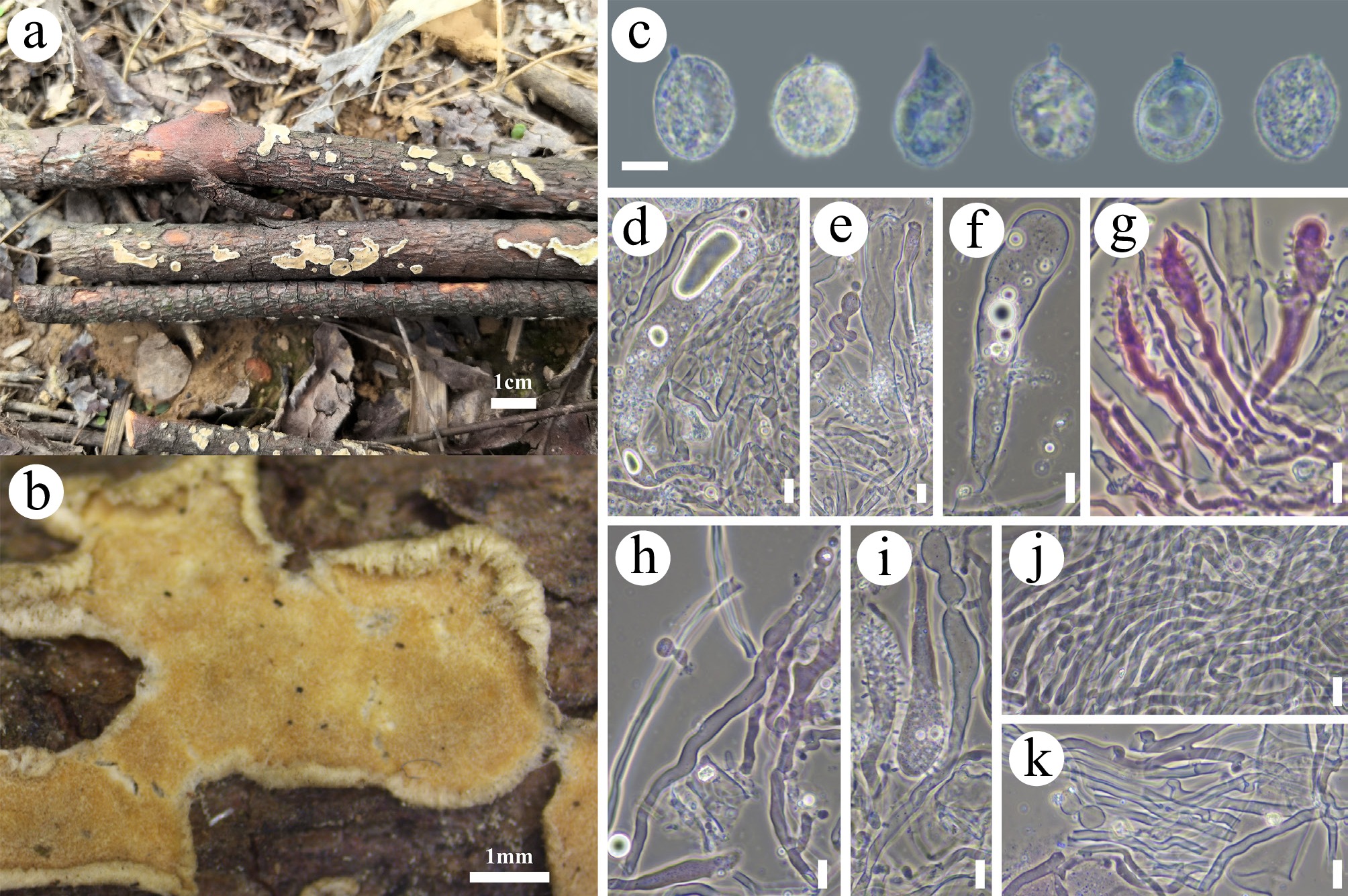
Figure 23.
Aleurodiscus subtropicus (holotype, Yuan 2270). (a), (b) Basidiomata. (c) Basidiospores. (d), (e) Basidia. (f) Basidioles. (g) Acanthophyses. (h), (i) Gloeocystidia. (j), (k) Generative hyphae. Scale bars: (c)–(k) = 10 µm.
Index Fungorum number: IF905303.
Etymology – Subtropicus (Lat.): refers to the species having a distribution in subtropical China.
Diagnosis – characterized by resupinate to effuse-reflexed basidiomata, the presence of clavate acanthophyses with blunt apical spines; moniliform gloeocystidia; ellipsoid, verruculose basidiospores measuring 10–12 × 8.2–9.8 µm, and growth on Pinus massoniana in subtropical China.
Type – China, Jiangxi Province, Nanchang, Shengshuitang National Forest Park, 28.992633° N, 115.535941° E, elevation 258 m, on fallen branches of Pinus massoniana, leg. Yuan Yuan, 26 April 2025, Yuan 2270 (BJFC061816).
Description – basidiomata annual, resupinate to effuse-reflexed, soft, membranous to coriaceous, easily separated from the substrate, up to 1.3 cm long, 0.4 cm wide, 400 µm thick at center. Hymenial surface smooth, pruinose, uncracked, cream (4A3) to buff yellow (ca. 4A4) and without odor and taste when fresh, buff (4A4) to clay buff (6D4) when dry; margin incurved, thinning out, fimbriate, paler with the hymenophore.
Hyphal system monomitic; generative hyphae with clamp connections, hyaline, thin- to slightly thick-walled, moderately branched and septate, more or less regularly arranged to loosely interwoven, IKI–, CB–, 2–6 µm in diam. Acanthophyses abundant, variable in shape, mostly clavate, with several to many blunt and cylindrical spines up to 3.5 μm long at apex, hyaline, slightly thick-walled, IKI–, CB–, 40–65 × 4–9 μm. Hyphidia numerous, hyaline, thin-walled, IKI–, CB–, 45–130 × 3–7 μm. Gloeocystidia occasionally present, moniliform, slightly thick-walled, 75–160 × 5–12 μm. Basidia clavate, with many short and blunt spines in the middle, slightly thick-walled, with four sterigmata and a basal clamp connection, 65–130 × 13–25 µm; basidioles morphologically resembling basidia, yet slightly smaller in size. Basidiospores broadly ellipsoid, hyaline, slightly thick-walled, verruculose, IKI+, CB+, (9.7–)10–12(–12.2) × (8–)8.2–9.8(–10) µm, L = 11.26 µm, W = 9.28 µm, Q = 1.1–1.3 (n = 120/4).
Additional specimens examined – China, Hunan Province, Hengyang, Hengshan Scenic Spot, 27.248327° N, 112.732913° E, elevation 122 m, on fallen branches of Pinus massoniana, leg. Yuan Yuan, 24 April 2025, Yuan 2133 (BJFC061679); on fallen trunk of Pinus massoniana, leg. Yuan Yuan, 24 April 2025, Yuan 2146 (BJFC061692); on fallen twigs of Pinus massoniana, leg. Yuan Yuan, 24 April 2025, Yuan 2158 (BJFC061704) and Yuan 2159 (BJFC061705); Zhejiang Province, Jinhua, Wuyi County, Tongqin, Xiaxie Village, Wuniu Mountain, on a fallen branch of Pinus massoniana, leg. Y.C. Dai, 15 April 2024, Dai 27280 (BJFC047540).
Known distribution – currently known only from subtropical montane coniferous forests in Eastern China (Jiangxi, Hunan, and Zhejiang), found on fallen trunks, branches, and twigs of Pinus massoniana.
Notes – phylogenetically, Aleurodiscus subtropicus occupies an independent position within the core Aleurodiscus s. str. clade, which is sister to A. pinicola (0.98 BPP; Fig. 3). Morphologically, A. pinicola shares the presence of moniliform gloeocystidia, acanthophyses, amyloid basidiospores, and growth on Pinus with A. subtropicus[119]. However, A. pinicola differs from A. subtropicus by its larger basidiospores (23–27 × 19–23 µm vs 10–12 × 8.2–9.8 µm) and its occurrence in high-elevation temperate forests (2,580–3,250 m vs 122–258 m)[119].
Confertotrama Nakasone & S.H. He
Index Fungorum number: IF27592.
Type species – Confertotrama rugulosa (Berk. & M.A. Curtis) Nakasone & S.H. He
Notes – the genus Confertotrama was established to accommodate corticioid fungi characterized by yellowish basidiomata with compact texture, clamped generative hyphae, numerous large gloeocystidia with a positive sulphovanillin reaction, and ellipsoid to cylindrical, smooth or ornamented, amyloid basidiospores[34]. In our phylogenies (Fig. 3), species of Confertotrama are recovered as a well-supported monophyletic clade distinct from Gloeocystidiellum s. str.
In this present study, the new combination is proposed on the basis of phylogenetic analyses (Fig. 3). Gloeocystidiellum lojanense A.C. Jaram. et al. was originally described from Ecuador[104]. In the original phylogeny based on ITS and LSU sequences, G. lojanense formed a strongly supported clade with G. aspellum Hjortstam, G. compactum Sheng H. Wu, G. formosanum Sheng H. Wu, and G. rajchenbergii Gorjón & Hallenb.[104]. These species have subsequently been transferred to Confertotrama[34]. Our phylogenetic analyses confirmed that G. lojanense is nested within Confertotrama, sister to C. aspella and C. rajchenbergii (Fig. 3). Morphologically, G. lojanense shares the diagnostic features of Confertotrama, including yellowish basidiomata, the presence of clamped generative hyphae, gloeocystidia with granular protoplasmic contents, and ellipsoid, verrucose, amyloid basidiospores[104]. The combination is thus proposed.
Confertotrama lojanense (A.C. Jaram., D. Cruz & Decock) Xin Zhang, Y.C. Dai & Yuan Yuan, comb. nov.
Index Fungorum number: IF905304.
Basionym – Gloeocystidiellum lojanense A.C. Jaram., D. Cruz & Decock, in Jaramillo-Riofrío, Decock, Suárez, Benítez, Castillo & Cruz, J. Fungi 9(1, no. 54): 9 (2023).
Known distribution – currently known from the type locality in Ecuador, growing on a fallen, decomposing branch of an unknown tree in tropical montane rainforest.
Gloeomyces Sheng H. Wu
Index Fungorum number: IF27592.
Type species – Gloeomyces graminicola Sheng H. Wu
Notes – the genus Gloeomyces is characterized by resupinate, corticoid basidiomata, a monomitic hyphal system with simple-septate generative hyphae, the presence of distinctive sterile elements such as acanthophyses, and smooth basidiospores[101]. It is phylogenetically and morphologically distinct from Aleurodiscus s. str., which typically has thick-walled, ornamented or smooth basidiospores[34,118]. Our new species, G. tapetiformis, grows on bamboo as well as other woody substrates, further expanding the ecological diversity known within this genus.
Gloeomyces tapetiformis Xin Zhang, Y.C. Dai, Y.L. Zhao & Yuan Yuan, sp. nov. Fig. 24
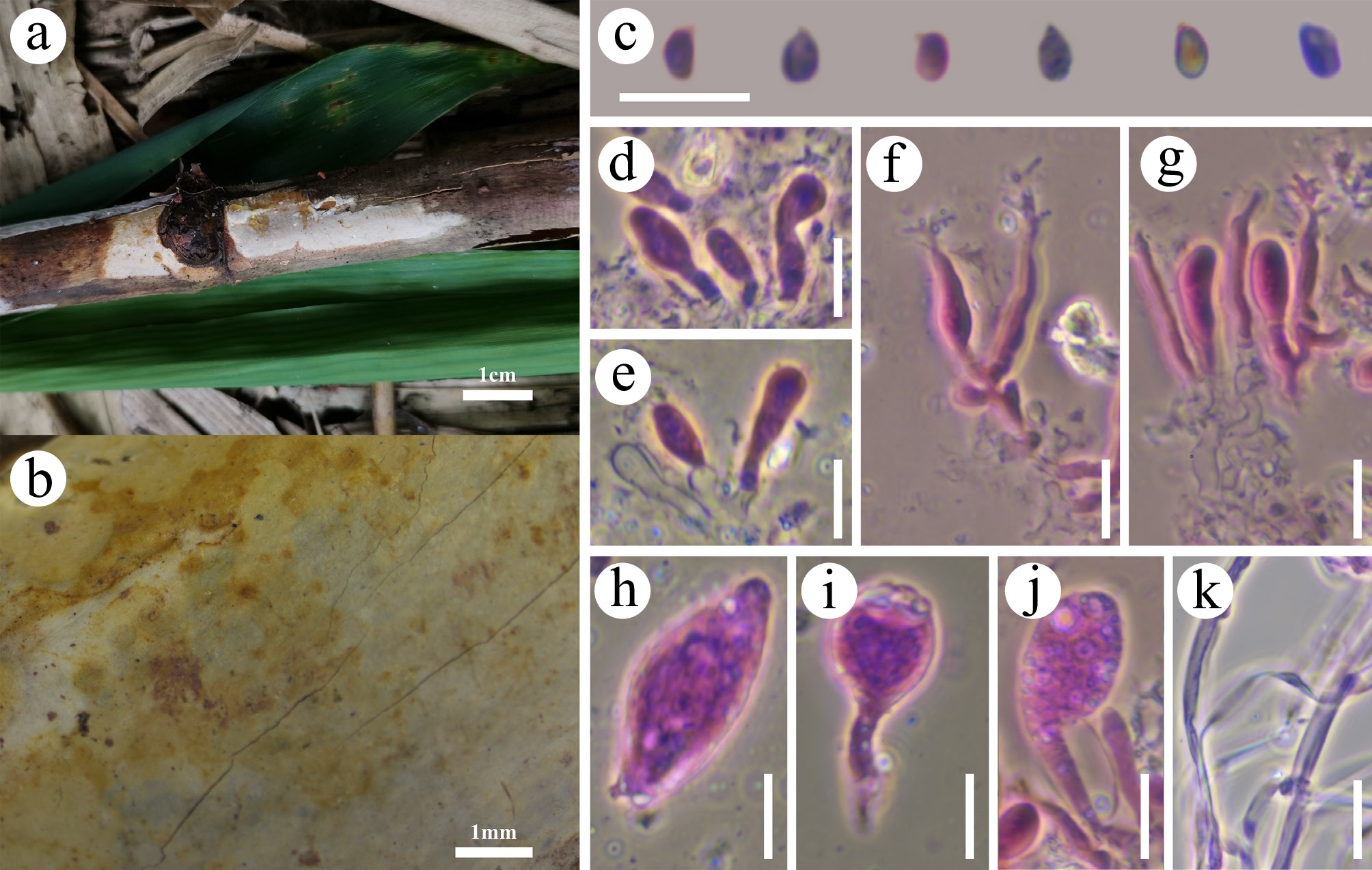
Figure 24.
Gloeomyces tapetiformis (holotype, Dai 35487). (a), (b) Basidiomata. (c) Basidiospores. (d), (e) Basidia and basidioles. (f), (g) Acanthophyses. (h)–(j) Gloeocystidia. (k) Generative hyphae. Scale bars: (c)–(k) = 10 µm.
Index Fungorum number: IF905305.
Etymology – Tapetiformis (Lat.): refers to the species having acanthophyses tapering to the apex.
Diagnosis – characterized by the presence of hyphoid acanthophyses tapering from the base to a frequently branched apex, ellipsoid, amyloid basidiospores measuring 3.8–4.4 × 2.6–2.9 µm, and occurrence on various substrates (bamboo, gymnosperm and angiosperm wood) in temperate to tropical China.
Type – China, Yunnan Province, Xishuangbanna, Jinghong City, along G219 National Highway from Jinghong to Menglun, 22.007047° N, 101.033348° E, elevation 871 m, on fallen branches of Dendrocalamus yunnanicus, leg. Y.C. Dai, 1 July 2025, Dai 35487 (BJFC056748).
Description – basidiomata annual, resupinate, soft, coriaceous, adnate, up to 6 cm long, 1.5 cm wide, 65 µm thick at center. Hymenial surface smooth, uncracked, white (–A1) to cream (4A3) and without odor and taste when fresh, pale yellow (3A4) to buff (4A4) when dry; margin thinning out, indistinct, concolorous with the hymenophore.
Hyphal system monomitic; generative hyphae with simple septa, hyaline, thin- to slightly thick-walled, moderately branched and septate, loosely interwoven, IKI–, CB–, 1.2–2.5 µm in diam. Acanthophyses abundant, variable in shape, mostly hyphoid, tapering to apex, frequently branched at apex, hyaline, slightly thick-walled, IKI–, CB–, 15–25 × 2–5 μm. Hyphidia numerous, unbranched, hyaline, thin-walled, IKI–, CB–, 13–18 × 2–4 μm. Gloeocystidia occasionally present, mostly fusiform, slightly thick-walled, with guttulate content, 18–35 × 7–18 μm. Basidia clavate, thin-walled, with four sterigmata and a basal simple septum, 15–25 × 4–7 µm; basidioles morphologically resembling basidia, yet slightly smaller in size. Basidiospores ellipsoid, tapering to an apiculus, hyaline, thin-walled, smooth, IKI+, CB–, (3.6–)3.8–4.4(–4.6) × (2.3–)2.6–2.9(–3) µm, L = 4.17 µm, W = 2.63 µm, Q = 1.6–1.7 (n = 120/4).
Additional specimens examined – China, Jilin Province, Baishan, Fusong County, Lushuihe, Korean Pine Virgin Forest, 42.482319° N, 127.868987° E, elevation 804 m, on a fallen branch of Pinus koraiensis, leg. Y.C. Dai, 12 September 2025, Dai 37784 (BJFC059043); Yunnan Province, Xishuangbanna, Jinghong, near Daizhai Viewing Platform along G219 National Highway, 21.981136° N, 101.166855° E, elevation 939 m, on dead culm of Dendrocalamus sp., leg. Y.C. Dai, 4 July 2025, Dai 35646 (BJFC056907).
Known distribution – currently known from temperate to tropical forests in Northern to Southwestern China (Jilin and Yunnan), found on various substrates including bamboo and coniferous wood.
Notes – phylogenetically, Gloeomyces tapetiformis is closely related to G. dextrinoideophyses (52% ML; Supplementary Fig. S5). Both species share simple-septate generative hyphae, the presence of acanthophyses, clavate basidia, and smooth, amyloid basidiospores[34,60]. However, G. dextrinoideophyses is distinguished from G. tapetiformis by its dextrinoid acanthophyses, larger basidiospores (5–7 × 3–4 µm vs 3.8–4.4 × 2.6–2.9 µm), and growing in tropical Thailand and only on bamboo[60].
-
The order Russulales encompasses a remarkable diversity of basidiomata forms, with corticioid species mainly in Peniophoraceae and Stereaceae[1,3,21,22,34,36,39,120−122]. Our multi-loci phylogenetic analyses provide a well-resolved framework for reassessing these families and the Gloeocystidiellum complex by establishing a new family. The results also suggest multiple independent transitions to monocotyledonous hosts, particularly bamboo, in China, suggesting that the region could represent a center of ecological specialization.
Phylogenetic complexity, morphological diversity, and substrate associations in the Gloeocystidiellum complex: resolving into Camptocystidiellaceae and Gloeocystidiellaceae
-
Previous placements of species, such as Gloeocystidiellum sinense, G. cremeum, G. fissuratum, and G. yaoshanense, within Stereaceae were based on limited phylogenetic sampling and an incomplete understanding of the polyphyly of the Gloeocystidiellum complex, leading to their misplacement[36−38]. Our multi-gene phylogeny resolves the Gloeocystidiellum complex into two distinct families within Russulales (Fig. 1): Camptocystidiellaceae and Gloeocystidiellaceae, consistent with recent phylogenetic evidence[21,39,96,97].
Camptocystidiellaceae is a phylogenetically distinct and morphologically more diverse group, comprising a single genus, Camptocystidiellum. Within this genus, species exhibit variation in hyphal septation (clamped or simple-septate), gloeocystidial morphology (straight to slightly curved or flexuous), basidiospore ornamentation (verrucose or smooth), substrate preference, and geographic distribution[38,39,96,98,99,101,102]. Unlike Gloeocystidiellaceae, none of the Camptocystidiellaceae species show affinity for monocots; instead, they occur on gymnosperm and angiosperm wood across diverse ecosystems in Africa, Asia, America, and Europe.
Gloeocystidiellaceae contains a single genus, Gloeocystidiellum, characterized by mostly clamped hyphae and straight to slightly curved gloeocystidia[35−37,101,123,124]. Species of this family are distributed across the Northern Hemisphere, with particularly notable diversity in East Asia, particularly in China, where at least six species are now documented. The type species, G. porosum, has a wide distribution in the Northern Hemisphere, recorded from Asia, Europe, and North America, occurring on diverse woody substrates and occasionally on bamboo (Phyllostachys in France)[1,35,96,97,101,104,110]. Beyond the widespread G. porosum and the European species G. permixtum[35], an unexpected richness of Gloeocystidiellum has recently been documented in China, including G. sinense, G. cremeum, G. fissuratum, G. yunnanense from Yunnan[36,37,124], and our new species G. monocotyledonum from Zhejiang. All these Chinese representatives share clamped generative hyphae, with the exception of G. sinense, which has simple-septate generative hyphae[37]. These four species, described from Yunnan, are known only from their type localities at elevations of 900–1,900 m, showing variation in gloeocystidia (straight to slightly curved) and basidiospores (smooth or verrucose), occurring on angiosperm wood, with G. fissuratum also on Picea[36,37,124]. In contrast, G. monocotyledonum grows on palms and Miscanthus in subtropical Eastern China (Zhejiang), representing the first monocot specialist within Gloeocystidiellum. Morphologically, it is characterized by subcylindrical to subclavate, flexuous gloeocystidia, fusiform cystidioles, and broadly ellipsoid to subglobose, verruculose basidiospores (5.6–6.7 × 4.9–5.2 µm), which are notably larger than those of its close relatives.
The recognition of two families within the former Gloeocystidiellum complex resolves its long-standing polyphyly. Moreover, the discovery of Gloeocystidiellum monocotyledonum in Gloeocystidiellaceae suggests a possible specialization on monocots, having larger basidiospores, fusiform cystidioles, and flexuous gloeocystidia, compared to its wood-associated relatives. Whether these morphological differences are linked to host shift remains to be investigated.
Peniophoraceae: morphological diversity and substrate associations of Asterostroma, Baltazaria, Gloiothele, and Vararia
-
Within Peniophoraceae, Vararia, Asterostroma, Gloiothele, and Baltazaria differ in substrate associations and morphological traits. Vararia stands out with the highest diversity on monocotyledonous hosts, with seven of the eight new species showing some degree of monocotyledonous associations. Asterostroma follows a similar trend, with three new species emerging on bamboo across both sections within this genus.
Historically, Vararia species outside Asia are predominantly found on woody plants, with only rare monocotyledonous records such as V. dussii Boidin & Lanq. on Philodendron in the West Indies and V. gallica on Phyllostachys in Europe[24,125]. In striking contrast, the eight new species exhibit remarkable morphological diversity alongside varied substrate associations. Six are strictly monocot-associated: V. emeiensis and V. subulata on bamboo, V. miscanthi on Miscanthus, V. falcata on bamboo, Miscanthus and V. septocystidiata on palms and rattans, and V. acanthocystidia on bamboo. In addition, V. alpina occurs on both bamboo and woody plants, while V. incarnata is restricted to angiosperm and gymnosperm wood in high-elevation forests. These ecological shifts appear to be accompanied by lineage-specific morphological traits: sickle-shaped basidiospores in V. falcata, septocystidia in V. septocystidiata, acanthocystidia in V. acanthocystidia, and crystal-encrusted gloeocystidia in V. miscanthi.
Among the strictly bamboo-associated species, Vararia emeiensis and V. subulata share urniform basidia and subulate gloeocystidia, but differ in more details and host range: V. emeiensis has oblong-ellipsoid basidiospores (7–7.9 × 3.1–3.6 µm) and grows only on Bambusa emeiensis in Sichuan, while V. subulata has ellipsoid basidiospores (8.1–9.2 × 4–4.9 µm) with tapering apiculus and projecting paraphyses, occurring on multiple bamboo genera across subtropical China. Vararia acanthocystidia, also bamboo-associated, is distinguished by unique, urniform to clavate acanthocystidia densely covered with tuberculate spines, and oblong-ellipsoid basidiospores (7.9–9.1 × 4.1–5.2 µm) in tropical Hainan.
Species on other monocots show further morphological divergence. Vararia falcata possesses unique sickle-shaped basidiospores (11–15.7 × 1.8–2.5 µm) and subulate gloeocystidia with a schizopapillate apex, growing on both bamboo and Miscanthus in tropical Hainan and Guangxi. Vararia miscanthi is characterized by cylindrical basidiospores (12.3–15.5 × 2–3 µm) and crystal-encrusted gloeocystidia, and growth only on Miscanthus in Zhejiang. Vararia septocystidiata is distinguished by two cystidia types: subulate gloeocystidia and septocystidia with 3–5 septa—a feature reported here for the first time within Vararia. It has oblong-ellipsoid basidiospores (11–13.1 × 4.7–5.3 µm) and grows on palms, rattans, and woody plants in tropical to subtropical China. Vararia alpina, characterized by ellipsoid basidiospores (7.5–8.1 × 4.6–5.0 µm) and subulate gloeocystidia, occurs on both bamboo and woody plants in high-elevation Xizang, representing a broad ecological tolerance.
Vararia incarnata stands apart from all other new species, found on angiosperm and gymnosperm wood in high-elevation forests of Xizang and Yunnan. It is characterized by fusiform basidiospores (15.8–17.5 × 5.9–7.0 µm), a flesh-pink hymenophore when fresh, and bush-like, blunt-tipped dichohyphidia.
A parallel yet contrasting pattern occurs in Asterostroma. Species worldwide are predominantly wood-associated, with occasional exceptions such as A. cervicolor on sugarcane and A. spinososporum on Agave[35]. The three new species described here are all bamboo-associated and are distributed across both sections of Asterostroma. Unlike Vararia, however, these species retain the diagnostic basidiospore ornamentation of their respective sections, suggesting that transitions to bamboo occurred without altering fundamental basidiospore architecture. Among the bamboo-associated species in sect. Asterostroma, characterized by echinulate basidiospores and regularly star-shaped asterosetae, three species form a well-supported bamboo-associated subclade in Southern China (0.97 BPP; Fig. 2). Asterostroma bicystidiatum, distinguished by two types of gloeocystidia (fusiform and sinuous), is widely distributed across multiple bamboo genera from Sichuan to Guangxi. Asterostroma brevispinum, distinguished by fusiform cystidioles, occurs on Bambusa in Guizhou, and A. fimbriatum was recently described from bamboo in Yunnan[39]. Representing sect. Laevispora, A. papillatum is currently known only from bamboo in warm-temperate Henan, representing the northernmost distribution of bamboo-associated Asterostroma in China.
Turning to the remaining genera within Peniophoraceae, Gloiothele and Baltazaria show different trends. Gloiothele species have previously been recorded on angiosperm wood across Europe, North America, and tropical regions[111,112]. Gloiothele bambusicola represents the first bamboo-associated species in the genus, characterized by distinctly constricted basidia, and occurs on both bamboo and angiosperms in China. A second new species, G. spathulata, possesses spathulate basidia and globose basidiospores, and grows on Quercus mongolica in temperate China and Korea. In contrast, Baltazaria shows no monocotyledonous associations. Species in this genus are predominantly found on gymnosperm and angiosperm wood across the Northern Hemisphere[26,110]. Baltazaria massonianae follows this trend, occurring on Pinus massoniana from subtropical China, and is characterized by urniform basidia and oblong-ellipsoid, inamyloid basidiospores. The new combination B. quintasiana, based on sequences from paratypes of Corticium quintasianum (CBS 749.86, CBS 750.86), extends the genus to West Africa, showing an intriguing disjunct distribution[82,109].
Together, these findings indicate that monocots, particularly bamboo, have been repeatedly colonized by different lineages of corticioid fungi in East Asia: Vararia shows considerable ecological and morphological diversification on monocots, with notable traits including sickle-shaped basidiospores, acanthocystidia, and septocystidia; Asterostroma, in contrast, shows repeated transitions to bamboo across both sections of Asterostroma yet retaining the diagnostic ornamentation basidiospores; Gloiothele gains its first bamboo-associated species in G. bambusicola, while Baltazaria remains strictly wood-associated with a disjunct intercontinental distribution[1,26]. The repeated and independent transitions to bamboo and other monocots across multiple lineages differ from the predominantly wood-associated habits of these genera elsewhere, suggesting that East Asia may be a significant area for ecological specialization within Peniophoraceae.
Stereaceae: morphological diversity and substrate associations of Aleurodiscus s. str., Acanthobasidium, Confertotrama, and Gloeomyces
-
Turning to Stereaceae, a different pattern emerges: bamboo association is less widespread than in Peniophoraceae but morphologically more striking. Within this family, four genera differ markedly in substrate preference and morphological traits.
Acanthobasidium, segregated from Aleurodiscus s. lat. by its distinctive acanthobasidia, has historically been recorded on gymnosperms and angiosperms, with only occasional bamboo records outside Asia, such as A. phragmitis in France[110]. In striking contrast, our study shows that Acanthobasidium hosts the most concentrated bamboo-associated lineage in Stereaceae: A. bambusicola and two new species—A. encrustans and A. septobasidium formed a well-supported clade restricted to Southern China (Hunan and Guangxi), exhibiting remarkable morphological traits. Acanthobasidium encrustans possesses crystal-encrusted gloeocystidia, a feature previously unreported in the genus, while A. septobasidium develops phragmobasidia with 2–4 transverse septa at maturity—a feature previously unknown in Stereaceae[3,34,60,94]. The consistent presence of this trait across multiple collections from its specific host, Indosasa crassiflora, suggests biological significance rather than a developmental anomaly.
Gloeomyces, characterized by simple-septate generative hyphae, acanthophyses, and smooth, amyloid basidiospores, has long been known from diverse substrates including gymnosperms, angiosperms, and monocots across the Northern Hemisphere[23,34,94]. Our new species G. tapetiformis expands this ecological breadth further, occurring on bamboo and conifers across temperate to tropical China. Its relative with the bamboo-restricted G. dextrinoideophyses in Thailand mirrors patterns observed in other genera, suggesting the evolutionary lability of substrate preference[60].
Elsewhere in Stereaceae, bamboo association appears sporadically. Aleurodiscus s. str., historically obscured by a broad polyphyletic circumscription that included species on diverse woody plants and even monocotyledons[31,118], has been restricted by recent phylogenies to a core clade[34,39,94,118]. Within this restricted concept, the genus maintains a conservative morphology on coniferous hosts, with our new species A. subtropicus representing a low-elevation ecological counterpart to the high-elevation A. pinicola, extending the altitudinal range of the genus in China while showing no affinity for monocotyledonous hosts[119].
Meanwhile, Confertotrama, recently established for species formerly in Gloeocystidiellum s. lat. with yellowish basidiomata, clamped generative hyphae, and ornamented amyloid basidiospores, was previously known only from Asia and North America[34]. Our phylogenetic analysis confirms the transfer of Gloeocystidiellum lojanense to Confertotrama, based on its type sequence from Ecuador, adding the first South American record (Ecuador) and extending its distribution across two hemispheres[104].
Thus, within Stereaceae, these contrasting patterns suggest how different lineages may have responded uniquely to ecological opportunities, with Acanthobasidium standing out as the most concentrated bamboo-associated clade, characterized by crystal-encrusted gloeocystidia in A. encrustans and phragmobasidia with transverse septa in A. septobasidium—a feature novel to the family[34,39].
Divergence time estimates and high intrageneric variation in Vararia.
-
Using the same three fossil calibrations (Agaricales, Hymenochaetales, and the Ascomycota–Basidiomycota split), Deng et al.[39] estimated the crown age of Russulales at approximately 222.49 Mya and Camptocystidiellaceae at ca. 109.96 Mya. Our analysis, applying the same calibration points, yields comparable estimates: Russulales at ca. 199.48 Mya (142.29–276.26 Mya, 95% HPD), Camptocystidiellaceae at ca. 99.07 Mya (52.84–153.4 Mya, 95% HPD), Gloeocystidiellaceae at ca. 87.95 Mya (51.94–134.78 Mya, 95% HPD). The relative divergence order of major families remains consistent with previous studies[7,93,95].
A striking observation is the exceptionally high level of sequence variability within Peniophoraceae, and no genus exemplifies this more strikingly than Vararia. Long suspected to be polyphyletic[22,24,25,29,39], Vararia is confirmed as such by our phylogeny (Fig. 2). Our divergence time tree (Fig. 4) also reveals that Vararia has experienced multiple independent divergence events at different evolutionary depths. For example, V. parmastoi Boidin & Lanquetin represents the earliest diverging lineage (ca. 80.39 Ma) among these species, followed by V. abortiphysa Boidin & Lanquetin (ca. 71.42 Ma), V. alpina (ca. 67.19 Ma) and V. miscanthi (ca. 64.84 Ma). These staggered divergence times suggest that the genus may have experienced a series of sequential speciation events rather than a single radiation event. The pattern matches the high level of sequence variability seen in Vararia, which further confirms its long-known polyphyly. The extreme sequence divergence within the genus, particularly in the ITS region, posed serious challenges for Bayesian convergence. However, the eight new species are always clearly defined in single-genus trees (Supplementary Figs S7–S9), and their species definition is strong. A future genus-level revision is needed. For now, we retain them in Vararia because they fit the traditional concept of the genus.
In summary, this study adds substantially to the documented diversity of corticioid fungi in China, contributing one new genus, 20 new species, and nine new combinations across Camptocystidiellaceae, Gloeocystidiellaceae, Peniophoraceae, and Stereaceae. Our multi-gene phylogeny provided a robust framework for understanding evolutionary relationships within these families, with a particular focus on bamboo-associated taxa. Together, these findings suggest that monocots, particularly bamboo, may have served as recurrent arenas for ecological specialization across three distantly related families within Russulales: Gloeocystidiellaceae, Peniophoraceae, and Stereaceae. The repeated, independent transitions to monocots across multiple lineages in East Asia—diverse in Vararia, repeated but conservative in Asterostroma, emergent in Gloiothele, and concentrated in Acanthobasidium—contrast sharply with the predominantly wood-associated habits elsewhere, suggesting the region may be a significant center for diversification. These patterns indicate possible directions for future research on host shifts.
Key to species of Vararia in China (35 species)
1. Basidia with 2 sterigmata 2 1. Basidia with 4 sterigmata 3 2. Gloeocystidia ventricose, thick-walled; basidiospores fusiform to cylindrical, 18–22 × 6–7.2 μm V. bispora 2. Gloeocystidia subclavate to subcylindrical, sinuous, thin-walled; basidiospores ellipsoid to cylindrical, 10–13 × 4.2–5.2 μm V. amphithallica 3. Generative hyphae with clamp connections 4 3. Generative hyphae with simple septa 11 4. Basidiospores falcate, allantoid, or subcylindrical to cylindrical 5 4. Basidiospores fusiform to broadly ellipsoid, or subglobose 7 5. Gloeocystidia densely encrusted with crystals V. miscanthi 5. Gloeocystidia without crystals 6 6. Basidiospores falcate; gloeocystidia subulate 35–65 × 8–13 μm V. falcata 6. Basidiospores allantoid; gloeocystidia subcylindrical, elliptical to ovoid, 9–23 × 7–10.5 μm V. daweishanensis 7. Basidiospores with a suprahilar amyloid appendage V. investiens 7. Basidiospores without amyloid appendage 8 8. Basidiospores > 15 μm long 9 8. Basidiospores ≤ 15 μm long 10 9. Basidiospores fusiform to ellipsoid, 15.8–17.5 × 5.9–7 μm; gloeocystidia capitate, 60–120 × 9–15 μm V. incarnata 9. Basidiospores broadly ellipsoid with a beak-like extension, 18–23 × 9.5–13 μm; Gloeocystidia clavate, 50–100 × 4–9 μm V. montana 10. Basidiospores ellipsoid, 7.5–9.5 × 4–5 μm; hymenial surface deeply cracked; gloeocystidia of two types (ventricose and obclavate) V. fissurata 10. Basidiospores subglobose to spherical, 8–10 × 7.5–8.5 μm; gloeocystidia of one type (subcylindrical to fusiform) V. sphaericospora 11. Basidiospores amyloid 12 11. Basidiospores inamyloid 20 12. Basidiospores > 20 μm long V. bambusicola 12. Basidiospores ≤ 20 μm long 13 13. Rhizomorph present V. yunnanensis 13. Rhizomorph absent 14 14. Basidiospores > 5 μm wide 15 14. Basidiospores ≤ 5 μm wide 19 15. Gloeocystidia thin-walled 16 15. Gloeocystidia thick-walled 17 16. Gloeocystidia urniform and fusiform V. membranacea 16. Gloeocystidia subcylindrical to fusiform, and cylindrical to subclavate V. muscicola 17. Gloeocystidia with 1–2 constrictions V. yingjiangensis 17. Gloeocystidia without constrictions 18 18. Gloeocystidia clavate to cylindrical, with oil drops V. punctata 18. Gloeocystidia subglobose and fusiform, without oil drops V. yaoshanensis 19. Hymenial surface cream to buff, cracked; basidiospores broadly ellipsoid, 6–7.5 × 3.5–5 μm V. lacerata 19. Hymenial surface white to cream, smooth; basidiospores subcylindrical to narrowly ellipsoid, 7.5–9.5 × 4–5 µm V. wumengshanensis 20. Gloeocystidia of two or three types 21 20. Gloeocystidia of one type 23 21. Gloeocystidia of three types, cylindrical, subulate, and cylindrical to bottled shape V. tuberculata 21. Gloeocystidia of two types 22 22. Basidiospores fusiform to ellipsoid, 11.8–16.1 × 5.6–7.7 μm V. bannaensis 22. Basidiospores ellipsoid, 3.5–5.5 × 2.5–3.5 µm V. fragilis 23. Acanthocystidia or septocystidia present 24 23. Acanthocystidia or septocystidia absent 25 24. Septocystidia present (with 3–5 transverse septa) V. septocystidiata 24. Acanthocystidia present (densely covered with tuberculate spines) V. acanthocystidia 25. Paraphyses present V. subulata 25. Paraphyses absent 26 26. Basidiospores with a distinct beak-like extension 27 26. Basidiospores without a beak-like extension 28 27. Basidiospores subfusiform to navicular, 9–13 × 5–8 μm; gloeocystidia spindle to subcylindrical, 38–47 × 8–13 μm V. isabellina 27. Basidiospores broadly ellipsoid, 6–11 × 4–6 μm; Gloeocystidia subulate, 17–35 × 6–7 μm V. sinensis 28. Gloeocystidia subulate 29 28. Gloeocystidia not subulate 31 29. Basidiospores ≤ 7.5 μm long V. ambigua 29. Basidiospores > 7.5 μm long 30 30. Basidiospores 7.5–8.1 × 4.6–5 μm; high altitude (ca. 2,600–2,875 m); on bamboo and wood V. alpina 30. Basidiospores 7–7.9 × 3.1–3.6 μm; low altitude (ca. 700 m); strictly on Bambusa emeiensis V. emeiensis 31. Gloeocystidia ≤ 25 μm long 32 31. Gloeocystidia > 25 μm long V. tenuata 32. Basidia clavate or barrel-shaped 33 32. Basidia fusiform to subcylindrical 34 33. Basidia clavate, gloeocystidia subglobose, clavate to fusiform V. lincangensis 33. Basidia barrel-shaped, gloeocystidia pyramidal V. pingbianensis 34. Gloeocystidia fusiform to subcylindrical, basidiospores broadly ellipsoid, 2.5–4 × 1.5–2.5 μm V. asiana 34. Gloeocystidia obclavate, basidiospores ellipsoid, 5.9–8.8 × 3.1–5.1 μm V. ferruginosa -
The authors confirm contribution to the paper as follows: study conception and design: Yuan Y; data collection: Yuan Y, Dai Y, Zhang X, Li M, Zhao Y, Cui Y, Luo K, Liu S, Zeng G, Wang C, Deng C, Li Z; analysis and interpretation of results: Zhang X, Dai Y, Li M, Zhao Y, Yuan Y; draft manuscript preparation: Zhang X, Dai Y, Yuan Y. All authors reviewed the results and approved the final version of the manuscript.
-
The phylogenetic datasets (including multiple sequence alignments for ITS, nLSU, RPB2, and tef1-α) and the resulting Maximum Likelihood and Bayesian phylogenetic trees generated during the current study are available in the Figshare repository (doi: 10.6084/m9.figshare.31889623)
-
Author Zhenhao Li was employed by the company Zhejiang Shouxiangu Pharmaceutical Co., Ltd. The remaining authors declare that the research was conducted in the absence of any commercial or financial relationships that could be construed as a potential conflict of interest.
-
accompanies this paper online at: https://doi.org/10.48130/mycosphere-0026-0016.
- Supplementary Table S1 Species and sequences used in the phylogenetic analyses.
- Supplementary Fig. S1 The phylogeny of Acanthobasidium was reconstructed using Maximum Likelihood analysis of combined ITS+nLSU sequences.
- Supplementary Fig. S2 The phylogeny of Asterostroma was reconstructed using Maximum Likelihood analysis of combined ITS+nLSU sequences.
- Supplementary Fig. S3 The phylogeny of Baltazaria was reconstructed using Maximum Likelihood analysis of combined ITS+nLSU sequences.
- Supplementary Fig. S4 The phylogeny of Gloeocystidiellum complex (including species from Camptocystidiellaceae fam. nov., Gloeocystidiellaceae, Peniophoraceae, Russulaceae, and Stereaceae) was reconstructed using Maximum Likelihood analysis of combined ITS+nLSU sequences.
- Supplementary Fig. S5 The phylogeny of Gloeomyces was reconstructed using Maximum Likelihood analysis of combined ITS+nLSU sequences. Bayesian analysis ran for 4.5 million generations (ASDSF < 0.01, ESS > 200).
- Supplementary Fig. S6 The phylogeny of Gloiothele was reconstructed using Maximum Likelihood analysis of combined ITS+nLSU sequences.
- Supplementary Fig. S7 The phylogeny of Vararia was reconstructed using Maximum Likelihood analysis of ITS sequences alone.
- Supplementary Fig. S8 The phylogeny of Vararia was reconstructed using Maximum Likelihood analysis of LSU sequences alone (only the ML tree is presented).
- Supplementary Fig. S9 The phylogeny of Vararia was reconstructed using Maximum Likelihood analysis of combined ITS+LSU sequences (only the ML tree is presented).
- Copyright: © 2026 by the author(s). Published by Maximum Academic Press, Fayetteville, GA. This article is an open access article distributed under Creative Commons Attribution License (CC BY 4.0), visit https://creativecommons.org/licenses/by/4.0/.
-
About this article
Cite this article
Zhang X, Dai Y, Li M, Zhao Y, Cui Y, et al. 2026. New corticioid Russulales from China: bamboo-associated diversity and the establishment of Camptocystidiellaceae fam. nov. Mycosphere 17: e015 doi: 10.48130/mycosphere-0026-0016 

New corticioid Russulales from China: bamboo-associated diversity and the establishment of Camptocystidiellaceae fam. nov.
- Received: 09 April 2026
- Revised: 08 July 2026
- Accepted: 10 July 2026
- Published online: 18 August 2026
Abstract: Corticioid fungi in the Russulales are key decomposers in forest ecosystems, yet their diversity on specialized substrates, particularly bamboo, remains poorly understood. Based on extensive field collections across China with an emphasis on species of bamboo, morphological examinations and multi-loci phylogenetic analyses (ITS, nLSU, RPB2, and tef1-α) were employed to assess corticioid fungi in the Peniophoraceae, Stereaceae, and the Gloeocystidiellum complex. The phylogenies confirm the polyphyly of Gloeocystidiellum s. lat., resolving two distinct clades within the Russulales. The core clade, containing the type species G. porosum, is recognized within Gloeocystidiellaceae, while the second clade, distinct from the Gloeocystidiellaceae, is described here as a new family, Camptocystidiellaceae fam. nov., comprising one new genus, Camptocystidiellum gen. nov. Morphological and multi-loci phylogenetic analyses revealed 20 new species within nine genera, viz., Acanthobasidium encrustans, A. septobasidium, Aleurodiscus subtropicus, Asterostroma bicystidiatum, A. brevispinum, A. papillatum, Baltazaria massonianae, Camptocystidiellum flexuosum, Gloeocystidiellum monocotyledonum, Gloeomyces tapetiformis, Gloiothele bambusicola, G. spathulata, Vararia acanthocystidia, V. alpina, V. emeiensis, V. falcata, V. incarnata, V. miscanthi, V. septocystidiata, and V. subulata. In addition, nine new combinations are proposed: Baltazaria quintasiana, Confertotrama lojanense, Camptocystidiellum bisporum, C. kenyense, C. membranaceum, C. parvum, C. porosellum, C. purpureum, and C. yaoshanense. Notably, monocots, particularly bamboos, appear to have served as recurrent arenas for ecological specialization across Gloeocystidiellaceae, Peniophoraceae, and Stereaceae, suggesting repeated independent transitions to these hosts across multiple lineages in East Asia. This pattern indicates that the region could be an important center for diversification on specialized substrates.
-
Key words:
- Bamboo-associated fungi /
- Basidiomycota /
- East Asia /
- Phylogeny /
- Taxonomy