-
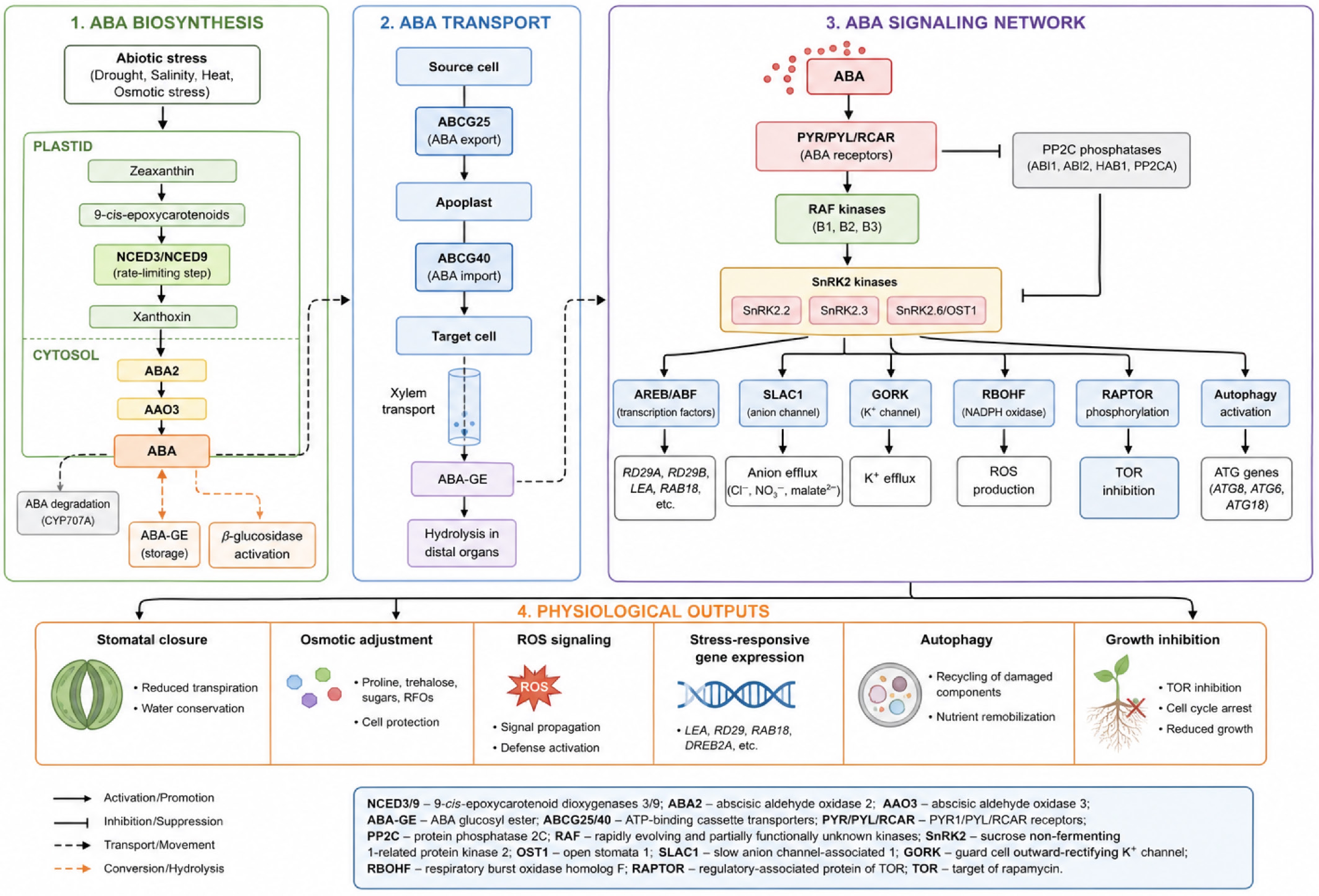
Figure 1.
Integrated network of ABA biosynthesis, transport, signaling, and downstream physiological responses. (1) Abiotic stress perception induces ABA biosynthesis through the plastidial carotenoid pathway involving NCED3/NCED9, ABA2, and AAO3. (2) ABA homeostasis is regulated by CYP707A-mediated catabolism, ABA-GE hydrolysis by β-glucosidases, and ABA transport via ABCG25/ABCG40 transporters. (3) Perception of ABA by PYR/PYL/RCAR receptors inhibits PP2C phosphatases, enabling RAF–SnRK2 kinase activation and downstream phosphorylation events. (4) Activated SnRK2 coordinates physiological adaptation through regulation of AREB/ABF, SLAC1, GORK, RBOHF, and RAPTOR, integrating ABA signaling with stomatal closure, osmotic adjustment, ROS signaling, autophagy activation, and growth inhibition.
-
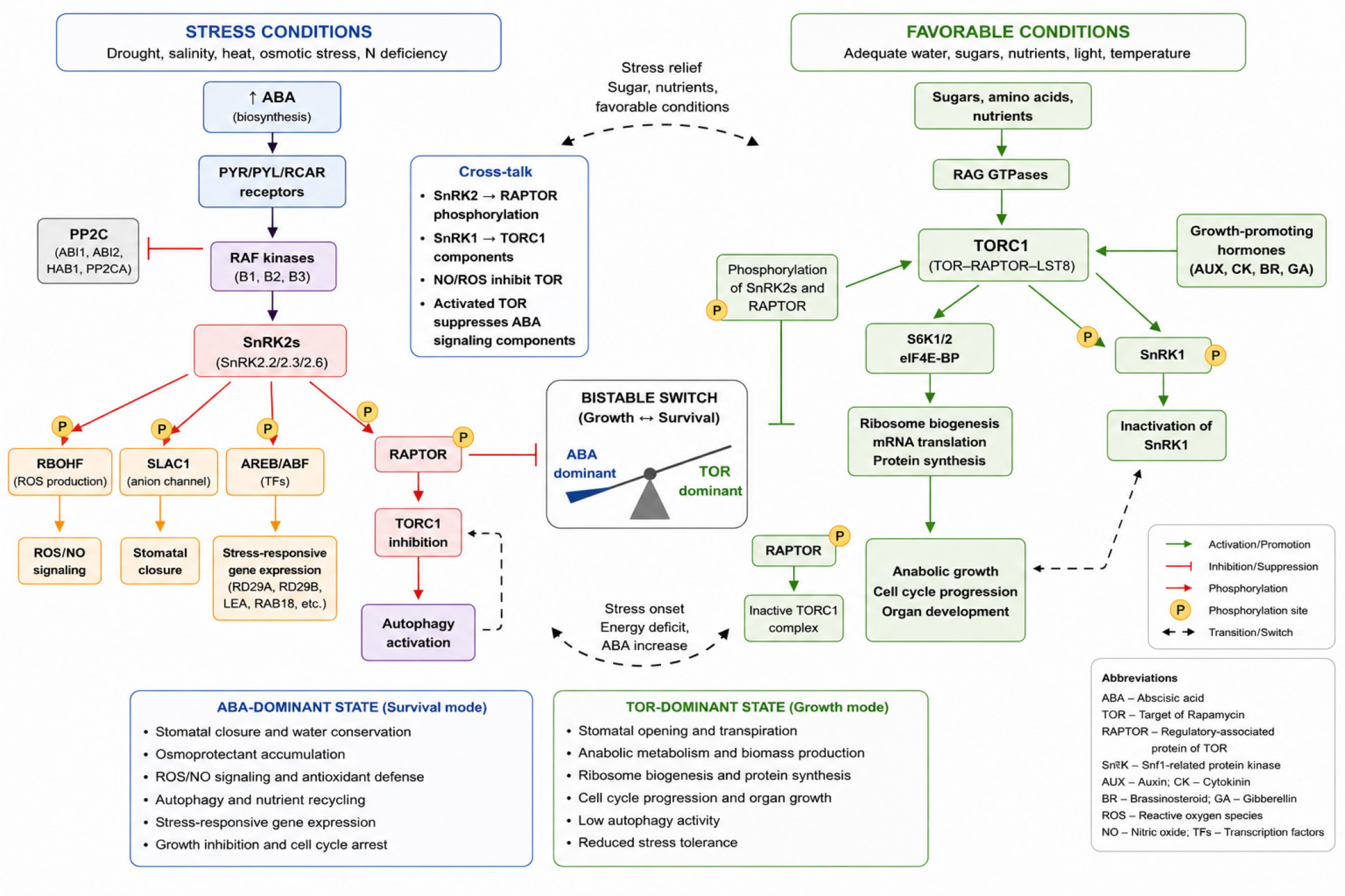
Figure 2.
Proposed ABA–TOR bistable molecular switch controlling the transition between stress survival and growth. Under abiotic stress, ABA signaling activates the PYR/PYL–PP2C–RAF–SnRK2 cascade, resulting in phosphorylation of RAPTOR, suppression of TORC1 activity, activation of autophagy, and induction of stress-adaptive responses. Under favorable conditions, TOR signaling promotes anabolic metabolism, ribosome biogenesis, protein synthesis, cell cycle progression, and organ growth while repressing ABA-mediated stress responses. The reciprocal antagonism between ABA and TOR represents a proposed bistable regulatory switch coordinating plant adaptation to changing environmental conditions.
-
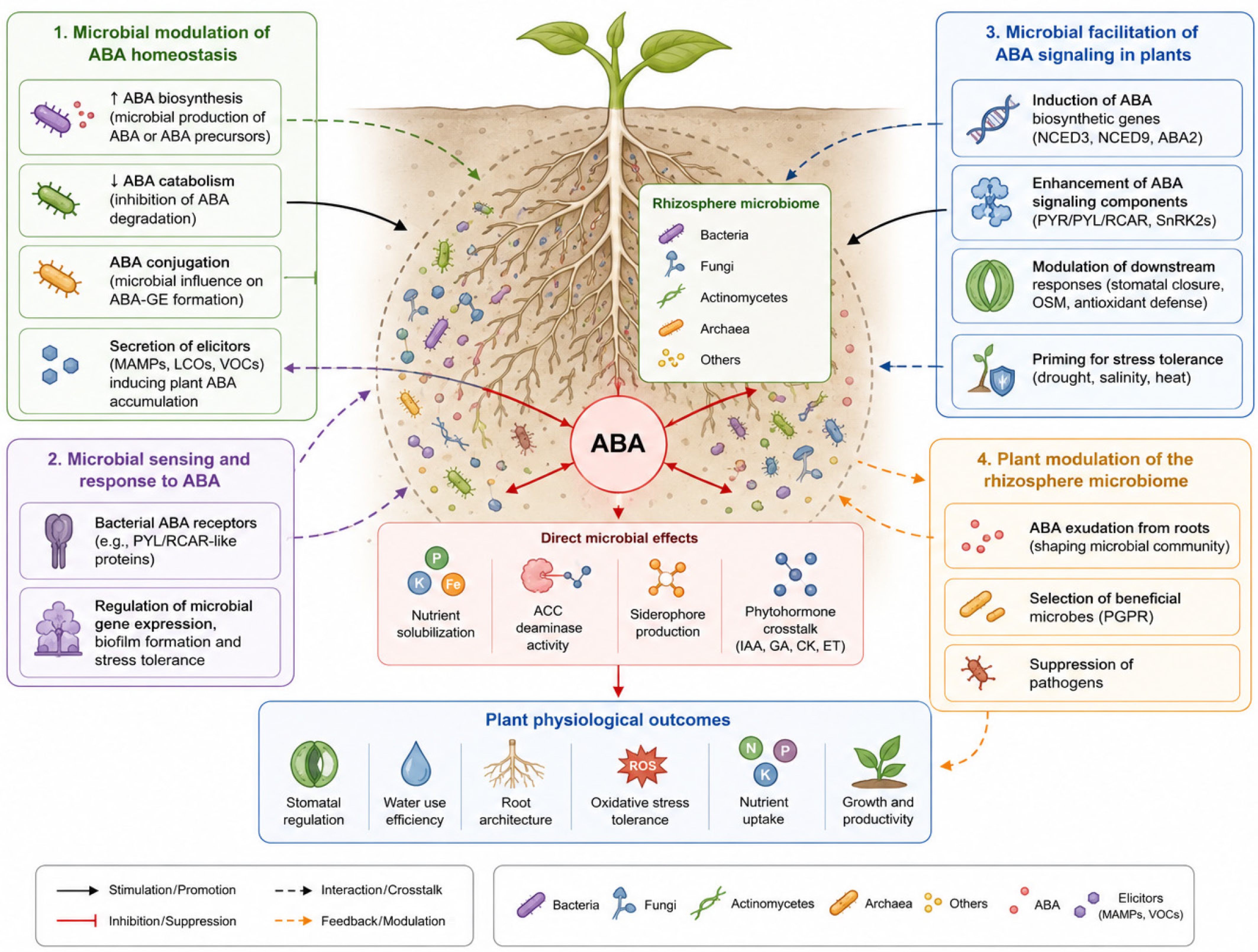
Figure 3.
Integrated microbiome–ABA interaction network in the rhizosphere. The rhizosphere microbiome functions as an integrated regulatory system that modulates the ABA-dominant abiotic stress tolerance state. PGPR, AMF, endophytes, and actinomycetes regulate ABA biosynthesis (NCED3), PYR/PYL–PP2C–RAF–SnRK2 signaling, ROS homeostasis, nutrient acquisition, and phytohormone balance. These complementary microbial activities promote osmoprotection, autophagy, stress-responsive gene expression, and epigenetic stress memory, thereby enhancing plants' adaptation and resilience under abiotic stress.
-
Feature SA-dominant state JA/ET-dominant state ABA-dominant state TOR-dominant (growth) state Major triggers Biotrophic pathogens, PAMPs, effectors Necrotrophic pathogens, herbivory, wounding Drought, salinity, heat, osmotic stress, low water potential Nutrient repletion, high sucrose/glucose, favorable temperature and light Key hormonal signals ↑SA; ↓AUX, GA, CK ↑JA, ↑ET; ↓GA (DELLA stabilised) ↑ABA; ↓CK, AUX, GA; partial suppression of SA ↑AUX, GA, BR, CK; ↓ABA, SA, JA Core signaling components NPR1, ICS1, TGA factors, PR1 COI1, JAZ, MYC2, ERF1, PDF1.2 NCED3, PYR/PYL, PP2C, SnRK2.6/OST1, AREB/ABF, RAF kinases TOR–RAPTOR–LST8 (TORC1), S6K1/2, eIF4E, BZR1, ARF TOR/SnRK1 status ↓TOR; ↑SnRK1 (moderate) Moderate ↓TOR; partial SnRK1 activation ↓TOR (SnRK2-mediated RAPTOR phosphorylation; SnRK1 co-activation); ↑SnRK1; ↑autophagy ↑TOR; ↓SnRK1; ↑T6P; high ATP/AMP; ↓autophagy Physiological outputs PR gene expression, SAR, growth restriction Phytoalexins, protease inhibitors, ISR, moderate growth inhibition Stomatal closure, osmoprotectant accumulation (proline, trehalose, LEA proteins), ROS/NO signaling; autophagic recycling; epigenetic stress memory Ribosome biogenesis, cell cycle progression, anabolic metabolism, organ expansion Representative marker genes NPR1, ICS1, PR1, TGA2 MYC2, ERF1, PDF1.2, COI1 NCED3, RD29A/B, RAB18, SnRK2.6 (OST1), SLAC1 TOR, S6K1/2, CYCD, BZR1, ARF Table 1.
Comparison of the four proposed regulatory attractor states in the SA–JA/ET–ABA–TOR network.
Figures
(3)
Tables
(1)