-
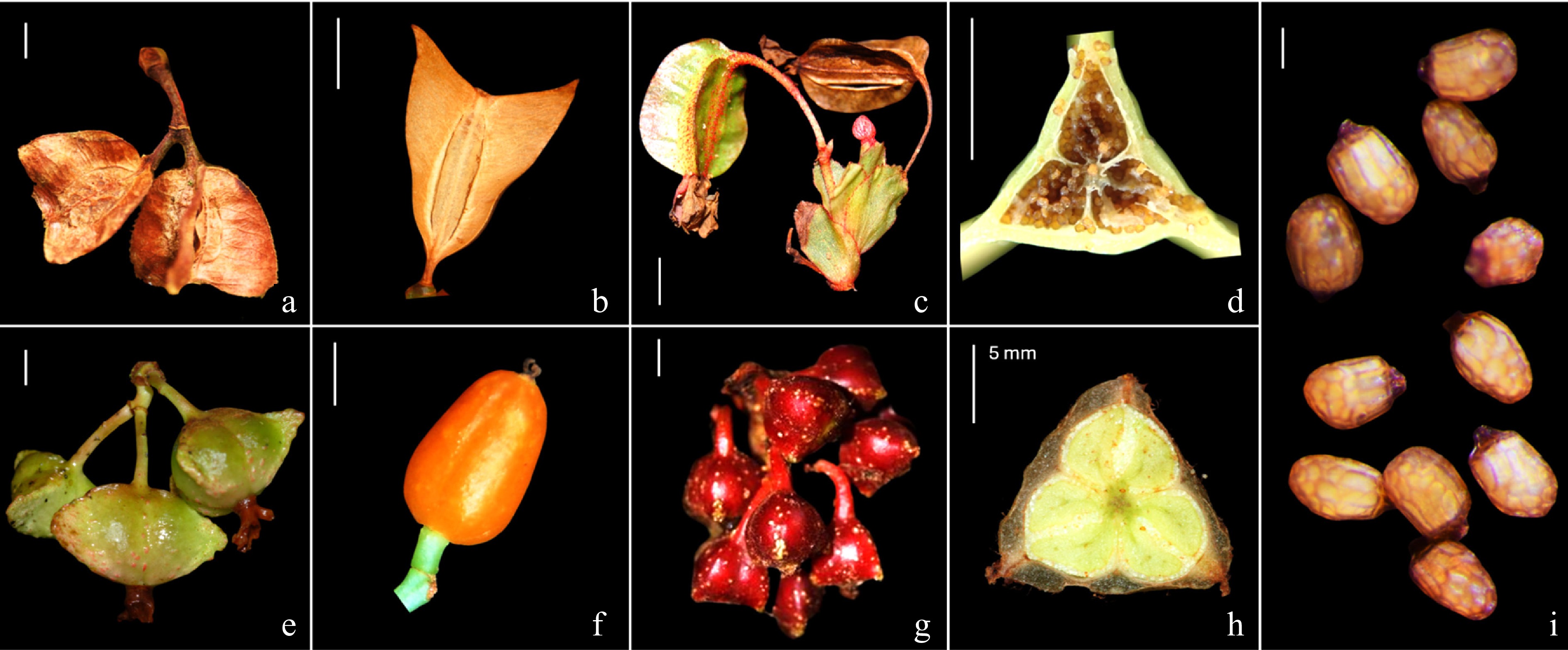
Figure 1.
Representative Begonia fruit diversity. Fruits range from (a)–(d) obliquely three-winged, dry dehiscent capsules adapted for wind dispersal of dust-like seeds to (e)–(h) fleshy, berry-like fruits. (a) B. gambutensis Ardi & D.C. Thomas. (b) B. ozotothrix D.C. Thomas. (c) B. resecta Miq. (d) Cross-section of B. ozotothrix ovary. (e) B. multangula Blume (f) B. salaziensis (Gaudich.) Warb. (g) B. pseudoscottii Girm. (h) Cross-section of B. multangula fruit. (i) Begonia seeds. Scale bars (a)–(h): 5 mm; (i): 0.1 mm. (Photo credit: Wisnu Ardi).
-
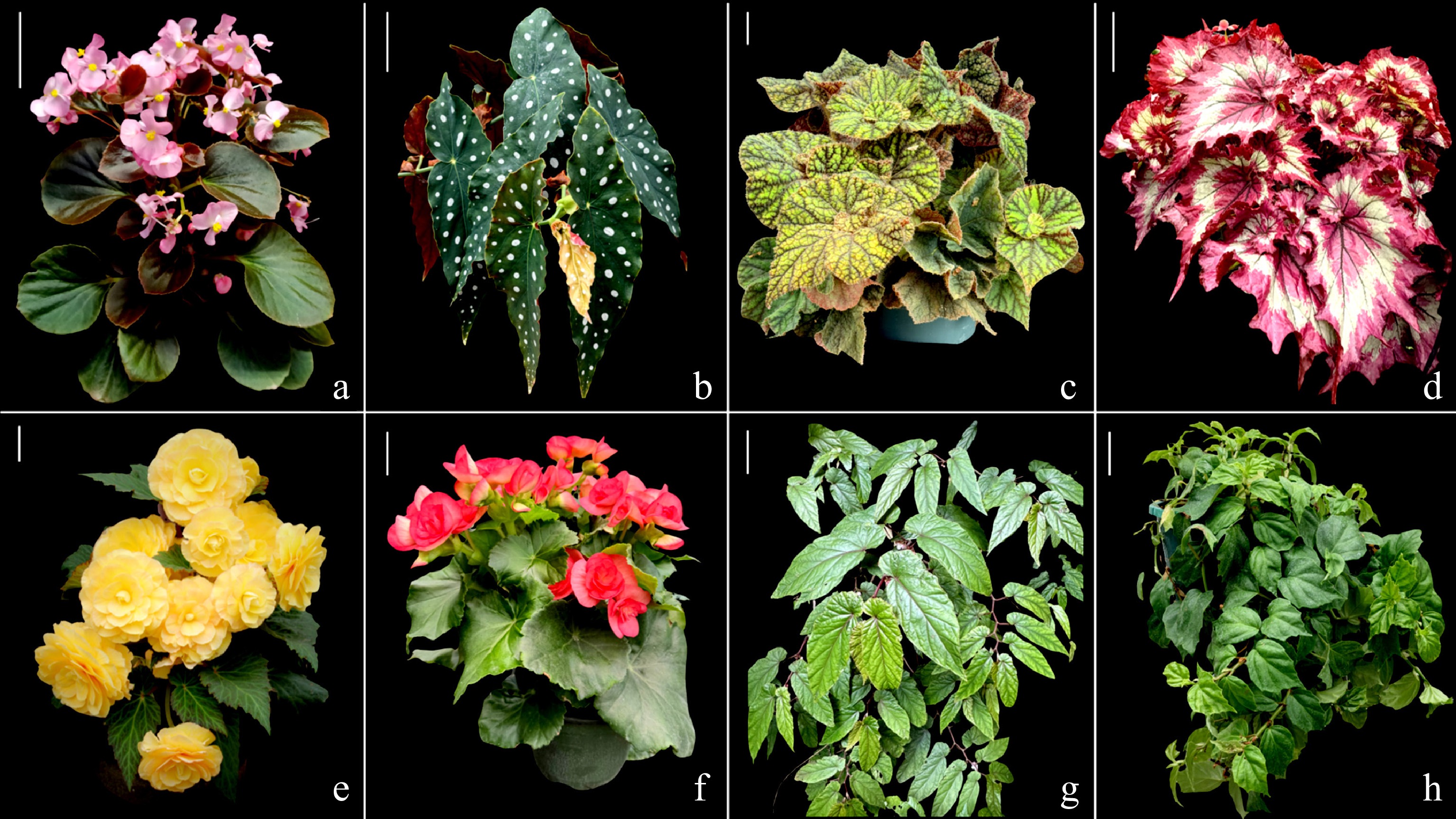
Figure 2.
Major horticultural groups of Begonia, illustrating diversity in growth habit, foliage, and flowering type: (a) semperflorens begonia, represented by Begonia × semperflorens-cultorum 'Cocktail Gin', (b) cane-like begonia, B. maculata Raddi var. wightii hort. ex Fotsch, (c) rhizomatous begonia, represented by Begonia 'Cowardly Lion', (d) Rex Cultorum begonia, (e) tuberous begonia, B. × tuberhybrida, (f) Rieger begonia, B. × hiemalis, represented by B. 'Berseba Pink', (g) shrub-like begonia, B. longifolia Blume, and (h) trailing or scandent begonia, B. glabra Aubl. Scale bars (a)–(h) represent 5 cm. Photo credit: (a)–(d), (h): Wisnu Ardi; (e): Gary Hunt; (f): Lovita Siregar; (g): D. Hämmerli.
-
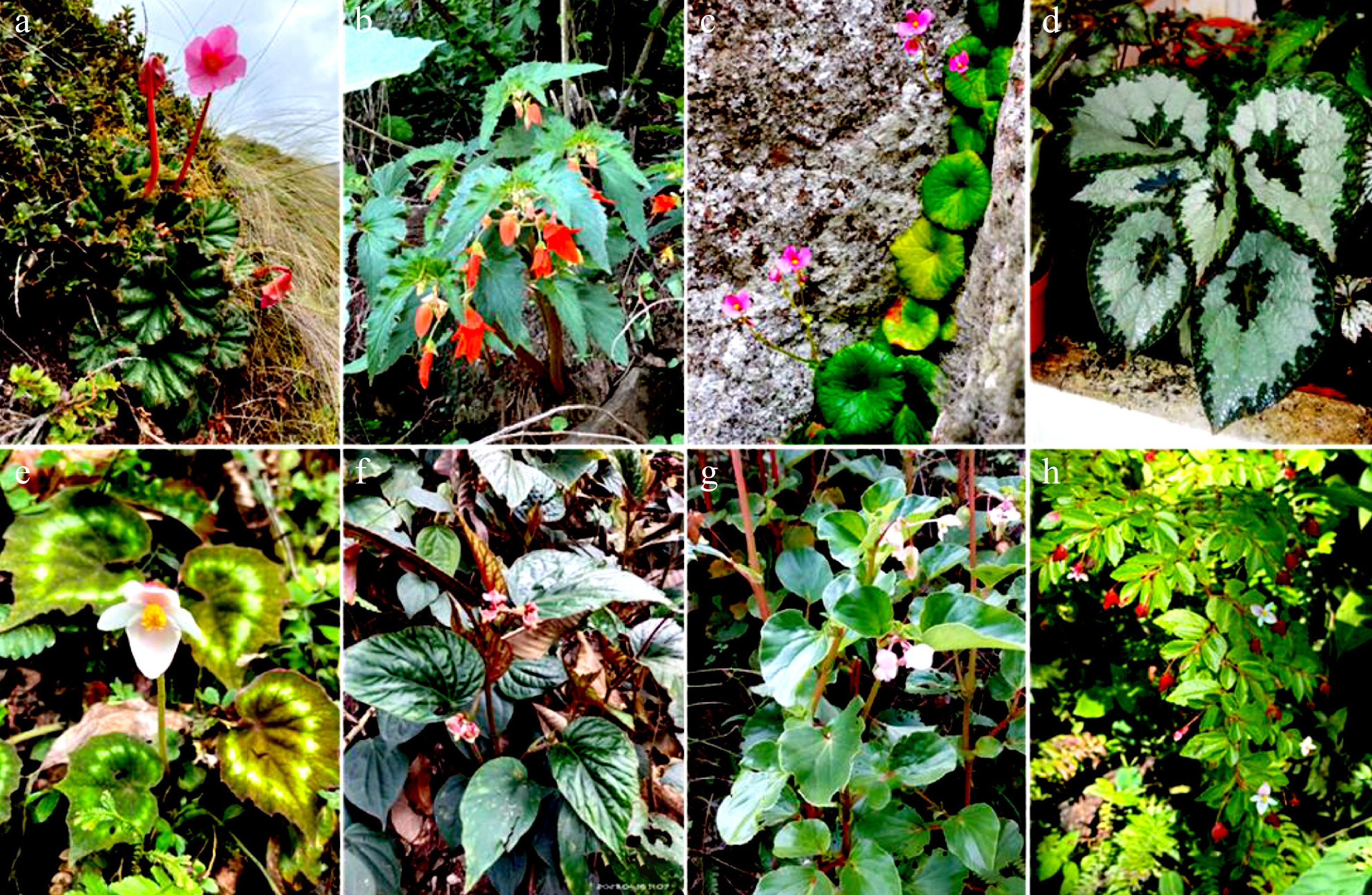
Figure 3.
Representative wild Begonia species used as parents or as valuable resources for improving ornamental traits. (a) B. veitchii. (b) B. boliviensis. (c) B. socotrana. (d) B. rex. (e) B. annulata K.Koch. (f) B. hatacoa Buch.-Ham. ex D. Don. (g) B. pearcei. (h) B. foliosa. Photo credit: (a) Challen Willemsen; (b) Rosario Douglas; (c) Nick Helme; (d) Wisnu Ardi; (e) Craig Robinson; (f) Rinzin Dorji; (g) Fabio Carvalho; and (h) Michael G.
-
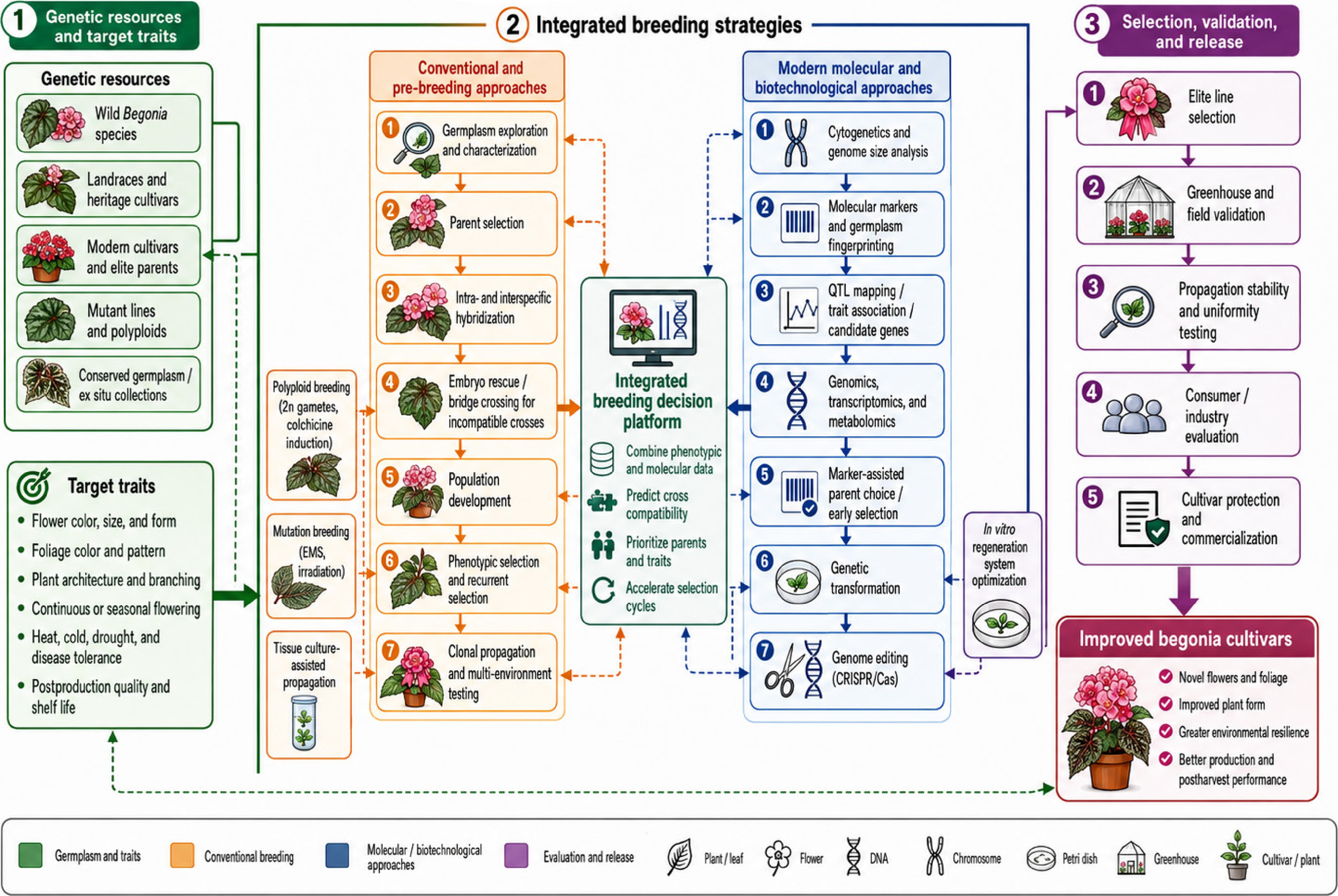
Figure 4.
Integrated breeding framework for Begonia improvement. The framework comprises three interconnected modules, each with defined activities and outputs. Module 1 assembles genetic resources, including wild Begonia species, landraces and heritage cultivars, modern cultivars and elite parents, mutant lines and polyploids, and germplasm maintained in ex situ collections, and evaluates them for priority breeding traits. Target traits include floral and foliar characteristics, plant architecture and branching, flowering habits, tolerance or resistance to biotic and abiotic stresses, and production and post-production performance. The principal outputs of this module are a characterized germplasm pool and a prioritized set of breeding objectives. Module 2 integrates conventional and pre-breeding approaches, including germplasm characterization, parental selection, intra- and interspecific hybridization, embryo rescue or bridge crossing, population development, phenotypic and recurrent selection, and clonal propagation and testing, with modern molecular and biotechnological tools. These tools include cytogenetic and genome-size analyses, molecular markers and germplasm fingerprinting, QTL mapping and association analysis, genomics and other omics approaches, marker-assisted selection, genetic transformation, and genome editing. Polyploid and mutation breeding provide additional sources of variation, whereas tissue culture propagation and optimization of in vitro regeneration facilitate the recovery and multiplication of selected genotypes. A central decision platform integrates phenotypic, cytogenetic, molecular, and propagation data to predict cross-compatibility, prioritize parents and target traits, and accelerate selection cycles. Module 2 outputs genetically improved candidate lines and prioritized elite parents. Module 3 advances candidate lines through elite-line selection, greenhouse and field validation, testing for propagation stability and uniformity, consumer and industry evaluation, and cultivar protection and commercialization. Feedback among the three modules allows validation results to inform subsequent germplasm evaluation, parental selection, and breeding decisions. The ultimate output is improved Begonia cultivars combining novel floral and foliar characteristics with desirable plant form, greater environmental resilience, and enhanced production and post-production performance.
-
Group Representative species/hybrids Growth habit Key ornamental traits Breeding focus Semperflorens B. × semperflorens-cultorum Compact with fibrous roots Continuous flowering, bedding-plant uniformity Compact form, color range, climatic adaptability Cane-like B. maculata Bamboo-like, segmented stems Patterned/spotted leaves, pendant flowers Variegation, compact habit, branching Rhizomatous Begonia 'Cowardly Lion' Rhizomes, foliage primary Textured, spiraled, metallic-variegated leaves Foliage diversity for indoor culture Rex Cultorum B. rex Putzeys derivatives Rhizomatous Vivid leaf colors and patterns Leaf color, pattern, and humidity tolerance Tuberous B. × tuberhybrida Underground tubers Large showy single/double/frilled flowers Flower size, form, and color spectrum Rieger/Elatior B. × hiemalis (B. socotrana Hook. f. Parent) Variable, often tuberous Profuse winter flowering (short-day) Photoperiod response, double flowers Shrub-like B. longifolia Persistent woody/semi-woody stems Year-round flowering in warm climates Compact growth, floriferousness Trailing/scandent B. convolvulacea (Klotzsch) A.DC. Pendant or climbing Continuous lateral flowers, cascading display Flower size, branching, light tolerance Grouping and trait descriptions are summarized primarily from Tebbitt[4], Ginori et al.[8], Hvoslef-Eide & Münster[9], Thompson & Thompson[11], and Haegeman[17]. Table 1.
Major horticultural groups of Begonia in cultivation, with representative taxa, growth habit, key ornamental traits, and primary breeding objectives.
-
Complex First commercial release Parental species Key contributed traits Ref. B. × semperflorens-cultorum (wax begonias) 1879 (Germany) B. cucullata, B. schmidtiana, B. bracteosa, B. foliosa, B. gracilis Compact form, continuous flowering, and climatic adaptability [4,9] B. × tuberhybrida (tuberous begonias) 1870s (Veitch & Sons) B. boliviensis, B. pearcei, B. veitchii, and ≥ 4 other Andean species Large flowers, broad color range, yellow pigmentation [4,11,17,21] Lorraine group 1891 B. socotrana × B. × tuberhybrida Winter flowering (short-day response) [4] Elatior (B. × hiemalis) Mid-1900s (Denmark) B. socotrana × tuberhybrid complex Continuous controlled-environment flowering, expanded color range [9,17,25] Dragon Wings Late 1990s (Ball FloraPlant) Proprietary interspecific F1 hybrid background Sterility, heat tolerance, arching habit, continuous bloom [37,38] BIG (B. × benariensis) 2010s (Benary) B. × benariensis and related interspecific lineages Large flowers, full sun/heat performance, weather resilience [39,40] Table 2.
Major Begonia horticultural complexes, approximate dates of their first commercial releases, principal parental species, key breeding-relevant traits, and supporting references.
-
Species/ cultivars Explants Transformation methods Ref. B. rex and Saintpaulia spp. Leaf discs,
(pre-cultured 15–21 d on NAA + BAP)Agrobacterium tumefaciens (binary vector pIG121HM) [65] B. × hiemalis Fotsch (Elatior begonia) Leaves A. tumefaciens strains AGL0 and LBA4404 (binary vector pIG121Hm) [58] B. × tuberhybrida cv. Perfecta Leaf and petiole disks A. tumefaciens LBA4404 (binary vector pBI121E15) [59] B. × tuberhybrida Leaves A. tumefaciens EHA105 (binary vector pCAMBIA13011-OsmiR393a) [66] B. maculata Leaves A. tumefaciens GV3101 (binary vector pPCV702) [67] B. × semperflorens-cultorum Leaves A. tumefaciens strain EHA101 binary vector pIG121-Hm [68] B. wallichiana Leaf discs A. tumefaciens strain EHA101 harboring the binary vector pIG121-Hm [69] B. × semperflorens Leaves A. tumefaciens strain GV3101, binary vector PCanG-EGFP [70] B. × semperflorens Leaves A. tumefaciens EHA105 carrying pIG-BvDODA1-BvCYP76AD1 [71] B. × tuberhybrida 'Urban Bicolor Pink' Leaves CRISPR/Cas9 + A. tumefaciens [60] Table 3.
Reported genetic transformation studies and gene-editing attempts in Begonia.
-
Species/cultivars Transgene Promoter Transformation results Ref. B. rex and Saintpaulia
spp.gusA (intron-containing GUS reporter); hpt (selection) CaMV 35S (gusA); 35S (hpt) Preliminary report; optimum hygromycin B =
20 µg·mL−1 (Begonia) and 30 µg·mL−1 (Saintpaulia)[65] B. × hiemalis Fotsch (Elatior begonia) gusA (intron-containing GUS); nptII + hpt (selection) CaMV 35S (gusA, hpt); NOS (nptII) Stable transformants obtained; foundational protocol for Elatior transformation [58] B. × tuberhybrida cv. Perfecta rolA, rolB, rolC (4.3 kb fragment from agropine-type Ri plasmid pRiA4b); nptII; gusA CaMV 35S (gusA); NOS (nptII); native rol promoters Ri-type phenotype: dwarfism, delayed flowering, wrinkled leaves & petals [59] B. × tuberhybrida OsmiR393a (rice microRNA), nptII; hpt CaMV35S (OsmiR393a); pnos (nptII); 35S (hpt) Improved drought tolerance; increased flower longevity + 8 d; reduced transpiration; increased proline and chlorophyll [66] B. maculata PttKN1 (class I KNOX gene from hybrid aspen Populus tremula × P. tremuloides); nptII CaMV35S Altered plant architecture [67] B. × semperflorens-cultorum nptII, gusA CaMV35S Regeneration and transformation pipeline established [68] B. wallichiana S eGFP (reporter); hpt (selection) selection/reporter markers CaMV35S Optimized protocol; rapid PCR-based screening [69] B. × semperflorens TaCBF2 (wheat transcription factor) CaMV35S Enhanced cold tolerance at 4 °C; up-regulation of downstream BsCOR cold-responsive genes [70] B. × semperflorens RUBY (BvDODA1 + BvCYP76AD1) CaMV35S (DODA1- CYP76AD1), NOS (nptII) CaMV35S (hpt) Increased betalain biosynthesis; induced pale-pink petals and brownish-olive leaves; validated RUBY as a non-destructive reporter [71] B. × tuberhybrida
'Urban Bicolor Pink'F3'H gRNA + Cas9 CaMV35S (Cas9), U6 (gRNA) Construct verified in Arabidopsis; no edited B. × tuberhybrida plants regenerated [60] Table 4.
Functions and phenotypic effects of transgenes and gene-editing targets reported in Begonia.
-
Resource type Species/scope Key features Genome size Accession Ref. Chromosome-scale genome B. loranthoides First Begonia chromosome-scale series 716.44 Mb (assembly);
~724 Mb (k-mer estimate)CNA0013974 (CNGB); PRJNA791490 (NCBI); CNP0001056 (CNSA) [29] Chromosome-scale genome B. masoniana ~800 Mb (largest in initial series) 799.40 Mb (assembly);
~806 Mb (k-mer estimate)CNA0013975 (CNGB); PRJNA791490 (NCBI); CNP0001056 (CNSA) [29] Chromosome-scale genome B. darthvaderiana Phylogenomically diagnostic taxon 771.67 Mb (assembly);
~797 Mb (k-mer estimate)CNA0013973 (CNGB); PRJNA791490 (NCBI); CNP0001056 (CNSA) [30] Chromosome-scale genome B. peltatifolia ~332 Mb (smallest in initial series) 334.09 Mb (assembly);
~349 Mb (k-mer estimate)CNA0013976 (CNGB); PRJNA791490 (NCBI); CNP0001056 (CNSA) [30] Chromosome-scale genome B. fimbristipula ONT + Illumina + Hi-C assembly, 11 pseudochromosomes, 25,563 genes 462.11 Mb (assembly); ~439.94 Mb
(k-mer estimate)CRA019543/PRJCA031018 (NGDC/CNCB); JBIQHB000000000/PRJNA1173897 (NCBI) [72] Draft genome B. manicata Anthocyanin-pathway gene identification 602 Mb (assembly) PRJEB86434 (ENA) [73] Genus-wide genome-size dataset 400 species C-value variation across the genus C-values from 245 Mb
(B. ulmifolia) to 2,497 Mb
(B. formosana)Ph.D. thesis dataset (University of Edinburgh/RBG Edinburgh, Kew) [24] Transcriptome (highlight) B. semperflorens Anthocyanin metabolism under high light Not available SRS1429521 (NCBI SRA) [75] Transcriptome (low-T/high-light) B. semperflorens Anthocyanin biosynthesis: structural and regulatory genes Not available SRP126322 & SRP130727 (NCBI SRA); GSE107805 (NCBI GEO) [74] Multi-tissue RNA-seq B. conchifolia,
B. plebejaChalcone synthase gene-family expansion Not available PRJEB26711 (ENA) [76] Comparative transcriptome B. conchifolia,
B. plebejaLight-regulated, ethylene, jasmonate pathway divergence Not available PRJEB26711 (ENA; re-analysis of Emelianova et al.) [77] Metabolomics + transcriptome B. × hybrida
'Dragon Wing'Cyanidin as the principal pigment for leaf-color divergence Not available figshare, DOI: 10.6084/m9.figshare.31321228 (processed data); raw RNA-seq from the authors' previously published dataset[78] Functional-genomic analysis B. semperflorens 'Super Olympia' PEBP gene family (Ten BsPEBP genes; flowering control) Not available Data within manuscript & supplementary materials (additional data on request) [81] Table 5.
Genomic and transcriptomic resources available for Begonia, including resource type, target species or taxonomic scope, key features, and corresponding references.
Figures
(4)
Tables
(5)