-
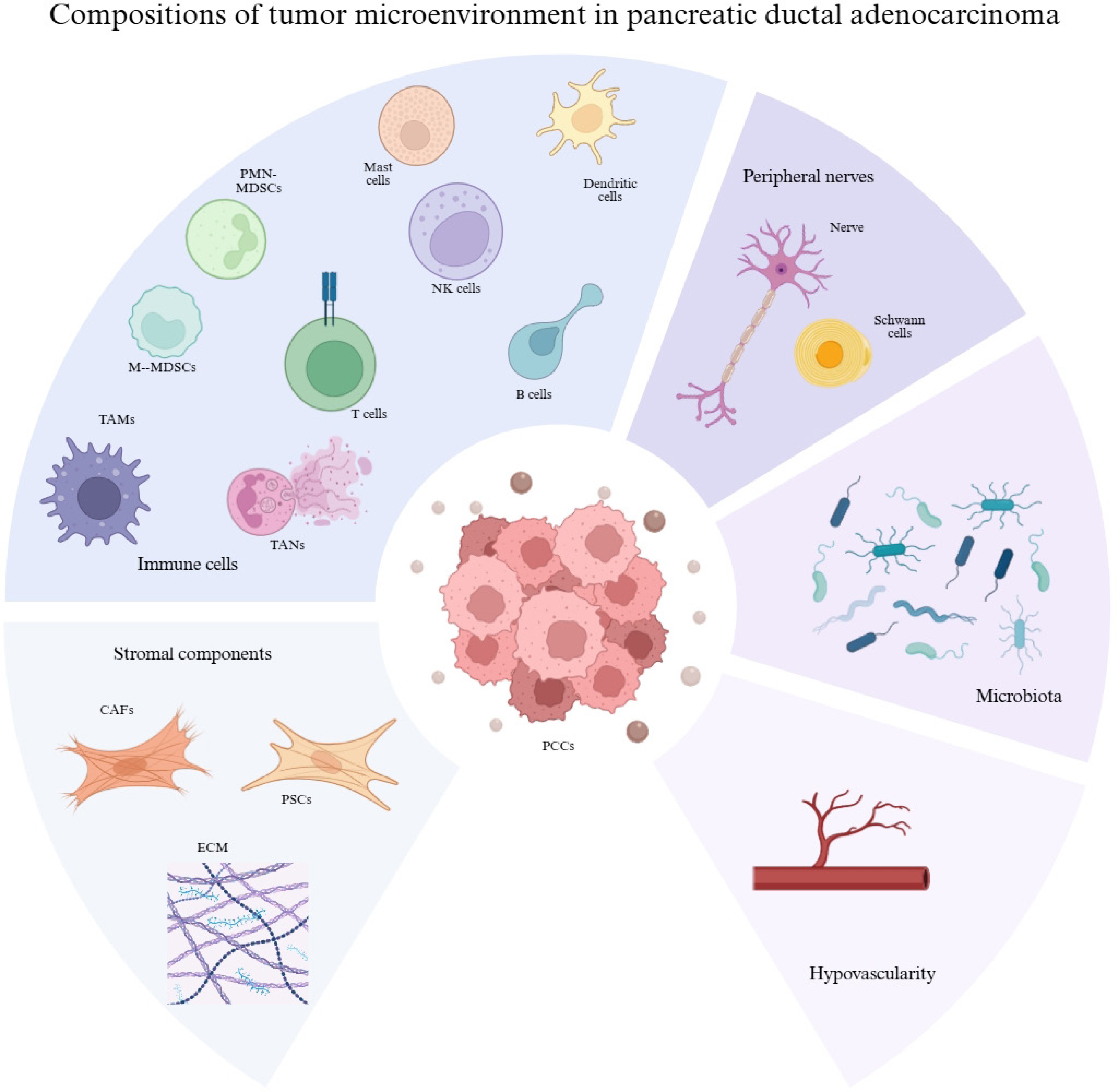
Figure 1.
Components of the TME in PDAC. Heterogenous CAFs and PSCs produce materials for ECM formation and contribute to desmoplasia. The immune cells infiltrated into tumors include TAMs, TANs, MDSCs, Treg cells, cytotoxic T cells, B cells, NK cells, and so on, creating an immunosuppressive environment. Microbiota, neurons, and vasculature also serve as important constituents of the TME in PDAC.
-
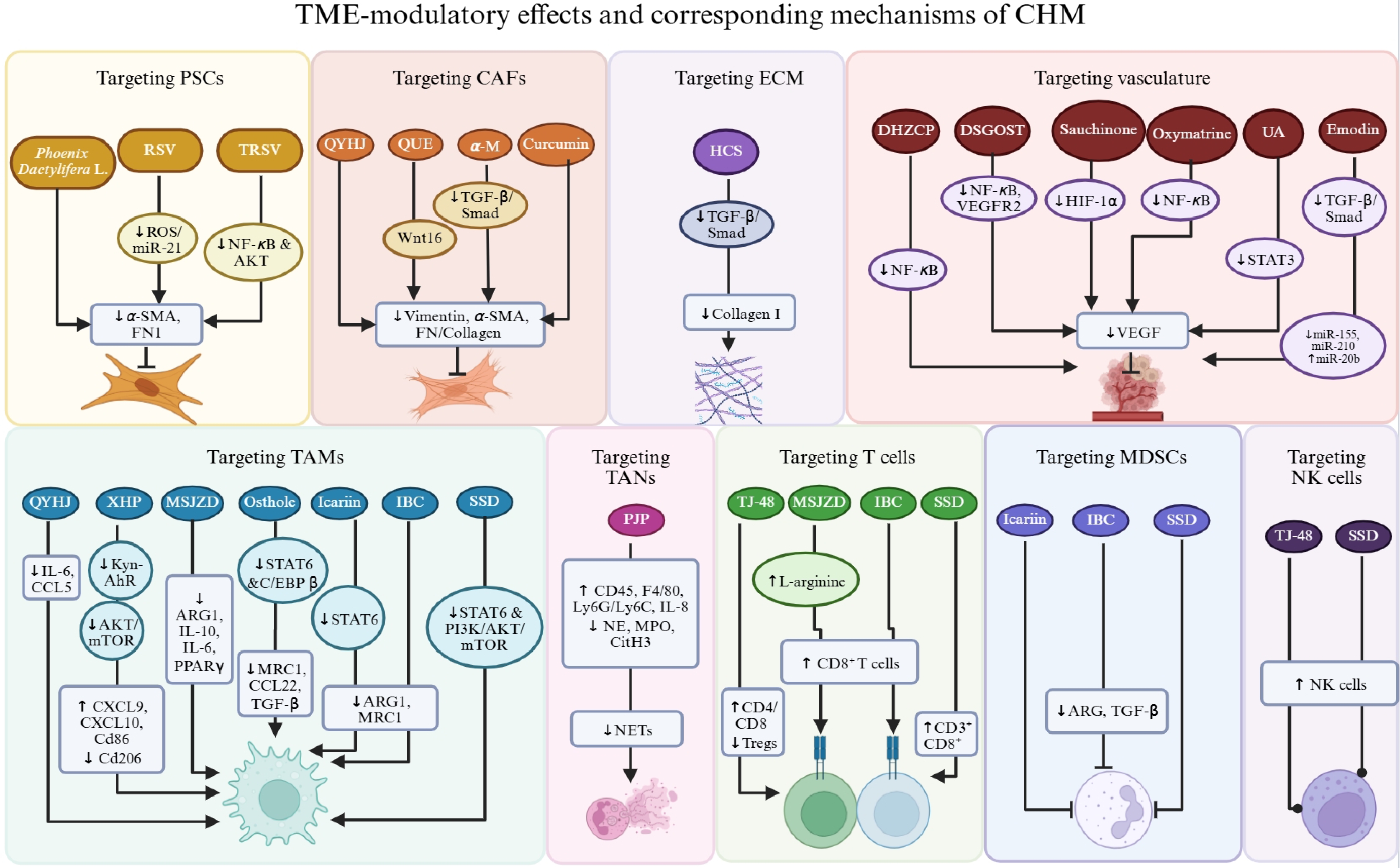
Figure 2.
Effects and mechanisms of CHM in targeting TME components. CHM inhibits the proliferation and activity of PSCs and CAFs, as well as remodeling of the ECM, via suppression of a variety of fibrotic mediators, miRNAs, and pathways such as TGF-β/Smad. Vasculature in the TME can be regulated by CHM mainly through inhibition of NF-κB-mediated VEGF, VEGF binding to VEGFR2, pathways including STAT3 and TGF-β/Smad, and modulation of miRNAs. Multiple tumor-infiltrating immune cells have been revealed as targets of CHM, including targeting the polarization of M1/M2 macrophages, inhibition of TAMs, MDSCs, TANs, and Treg infiltration, as well as increasing cytotoxic T cell and NK cell responses, involving cytokines and chemokines such as IL-6, ARG1, MRC1, TGF-β, and signaling pathways including STAT6 and PI3K/AKT/mTOR.
-
Target CHM formula/extract/compound Constituents/solvent/origins Model Effect TME-modulatory mechanisms Ref. PSCs Phoenix Dactylifera L. Water, EtOH, acetone, EtOAc extracts PSCs ↓ PSCs’ fibrotic phenotype ↓ FN1, α-SMA
↑ antioxidant capacity[76] Resveratrol Multiple PSCs
PANC-1 cells↓ PSCs activation, migration, invasion
↓ ROS-induced glycolysis in PSCs↓ α-SMA
↓ ROS/miR-21
↑ PTEN[78] PSCs
PANC-1, Mia Paca-2 cells
KPC mice↓ PSCs activation ↓ HIF-1α, α-SMA, SDF-1, IL-6 [77] Trans-resveratol Multiple LTC-14 cells ↓ PSCs
↓ Fibrotic mediators↓ α-SMA, FN1
↓ Acta2, Fn1, Col2-α1
↓ p-AKT
↓ NF-κB and AKT signaling[79] CAFs Qing-Yi-Hua-Ji formula Scutellariae Barbatae Herba, Hedyoti Diffusae Herba, Amorphopallus Ribieri Rhizoma, Coicis Semen, Gynostemmatis Pentaphylli Herba, Ganoderma, Amomi Rotundus Fructus Panc02 cells
C57 mice↓ CAFs proliferative activity ↓ SDF-1, α-SMA, vimentin [80] α-Mangostin Mangosteen NIH3T3
PANC-1, PANC-1-Luc2 cells
BALB/c nude mice↓ CAFs
↑ Vascular normalization↓ α-SMA, FAP-α, FN
↓ TGF-β, p-Smad2, p-Smad3
↓ TGF-β/Smad signaling[91] Curcumin Curcumae Longae Rhizoma CAFs
Capan-1, PANC-1 cells,
BALB/c nude mice↓ CAFs
↓ Mesenchymal characteristic↓ Vimentin, α-SMA [82] Quercetin Multiple NIH3T3 cells
Panc02, Panc02-luc cells
C57BL/6 mice↓ CAFs
↑ Blood perfusion↓ α-SMA, Wnt 16
↓ HIF-1α, FN, collagen[83] ECM Huachansu Bufonis Venenum PSCs
SW1990 cells
BALB/c-nu mice↓ ECM ↓ collagen-1
↑ Smad4
↓ Smad2/3, p-Smad2/3
↓ TGF-β/Smad2/3 pathway[84] Vasculature Dahuang Zhechong pill Rhei Radix et Rhizoma, Eupolyphaga seu Steleophaga, Armeniacae Amarum Semen, Persicae Semen, Scutellariae Radix, Rehmanniae Radix, Paeoniae Alba Radix, Glycyrrhizae Radix, Tabanus, Hirudo, Holotrichia Sauteri Moser, Toxicodendri Resina CFPAC-1 cells
Nude mice↓ Angiogenesis ↓ VEGF, NF-κB [85] Danggui-Sayuk-Ga-Osuyu-Saenggang-Tang Radix Angelicae Sinensis, Cinnamomi Cortex, Paeoniae Alba Radix, Clematidis Armandii Caulis, Asari Radix et Rhizoma, Glycyrrhizae Radix, Jujubae Fructus, Evodiae Fructus, Zingiberis Rhizoma Recens HUVECs
Panc-28-luc cells
BALB/c nude mice↓ HUVECs/HDMECs migration, invasion, and tube formation
↓ Vascular leakage↓ Phosphorylation of VEGFR2, FAK, SRC, AKT, IKKα/β, IκBα, NF-κB
↓ MMP-9
↓ VEGF binding to VEGFR2[86] Sauchinone Saururi Herba PANC-1, BxPC-3 cells ↓ Tumor blood flow ↓ VEGF, HIF-1α [87] Oxymatrine Sophorae Flavescentis Radix PANC-1 cells
BALB/C (nu/nu) mice↓ Angiogenesis ↓ NF-κB-mediated VEGF [88] Ursolic acid Multiple AsPC-1, MIA PaCa-2, Panc-28 cells
Athymic nu/nu mice↓ Angiogenesis ↓ VEGF, VEGFR2, CD31
↓ p-STAT3
↓ STAT3 signaling[89] Emodin Multiple SW1990 cells
BALB/c nu/nu mice↓ Angiogenesis ↑ TβRI, TβRII, Smad4
↓ TGF-βI, Angptl4
↑ miR-20b
↓ miR-155 and miR-210[90] TAMs Qingyihuaji formula Scutellariae Barbatae Herba, Hedyoti Diffusae Herba, Amorphopallus Ribieri Rhizoma, Coicis Semen, Gynostemmatis Pentaphylli Herba, Ganoderma, Amomi Rotundus Fructus BxPC, SW1990 cells
BALB/c-nu/nu nude mice↓ TAMs ↓ IL-6 [91] Panc02 cells
C57 mice↓ TAMs ↓ CCL5 [80] Xihuang pill Bovis Calculus, Moschus, Olibanum, Myrrha RAW 264.7 cells Panc02, Panc02-luc cells
C57BL/6J mice↑ M1-TAMs
↓ M2-TAMs↑ CXCL9, CXCL10, Cd86
↓ Cd206
↓ Kyn-AhR axis
↓ AKT/mTOR pathway[92] Modified Sijunzi decoction Poria, Codonopsis Radix, Rhodiolae Crenulatae Radix et Rhizoma Atractylodis, Atractylodis Macrocephalae Rhizoma, Glycyrrhizae Radix et Rhizoma, Dioscoreae Rhizoma Panc02 cells
C57BL/6 mice↑ M1-TAMs
↓ M2-TAMs↓ ARG1, IL-10, IL-6, PPARγ [93] Osthole Cnidii Fructus RAW 264.7
Panc02 cells
C57BL/6 mice↓ M2-TAMs infiltration ↓M2 polarization ↓ MRC1, CCL22, TGF-β
↓ p-ERK1/2, p-STAT6
↓ STAT6 and C/EBP β signaling:[94] Icarrin Epimedii Herba RAW 264.7
Panc02 cells
C57BL/6 mice↓ M2-TAMs infiltration
↓ M2 polarization↓ ARG1, MRC1
↓ p-STAT6
↓ STAT6 signaling[95] Isobavachalcone Fructus Psoraleae RAW 264.7
Panc02 cells
C57BL/6 mice↓ M2-TAMs infiltration
↓ M2 polarization↓ ARG1, MRC1 [96] Saikosaponin D Bupleuri Radix RAW 264.7, H7, BMDM
Panc02 cells
C57BL/6 mice↑ M1-TAMs
↓ M2-TAMs↓ STAT6 and PI3K/AKT/mTOR in RAW264.7 cells [97] TANs Piji pills Curcuma Rhizoma, Sparganii Rhizoma, Alpiniae Officinarum Rhizoma, Pericarpium Citri Reticulatae Viride, Aucklandiae Radix, Gleditsiae Abnormalis Fructus, Pulvis Fumi Carbonisatus HL-60 cells
SW1990
BALB/c nude mice↓ NETs ↑ CD45, F4/80, Ly6G/Ly6C, IL-8
↓ NE, MPO, CitH3[98] MDSCs Icarrin Epimedii Herba RAW 264.7 cells
Panc02 cells
C57BL/6 mice↓ PMN-MDSCs [95] Isobavachalcone Fructus Psoraleae RAW 264.7 cells
Panc02 cells
C57BL/6 mice↓ MDSCs ↓ ARG, TGFβ [96] Saikosaponin D Bupleuri Radix H7, RAW 264.7, BMDM cells
Panc02 cells
C57BL/6 mice↓ PMN-MDSCs [97] T cells Juzen-Taiboto Codonopsis Radix, Atractylodis Rhizoma Alba, Rhizoma Poria, Glycyrrhizae Radix et Rhizoma, Rehmanniae Radix Preparata, Paeoniae Radix Alba, Chuanxiong Rhizoma, Angelicae Sinensis Radix, Astragali Radix, and Cinnamomi Cortex Clinical trial ↑ CD4/CD8 cells
↓ Treg cells[99] Modified Sijunzi decoction Poria, Codonopsis Radix, Rhodiolae Crenulatae Radix et Rhizoma Atractylodis, Atractylodis Macrocephalae Rhizoma, Glycyrrhizae Radix et Rhizoma, Dioscoreae Rhizoma Panc02 cells
C57BL/6 mice↑ CD8+ T cells ↑ L-arginine [93] Isobavachalcone Fructus Psoraleae RAW 264.7 cells
Panc02 cells
C57BL/6 mice↑ CD8+T cells [96] Saikosaponin D Bupleuri Radix H7, RAW 264.7, BMDM cells
Panc02 cells
C57BL/6 mice↑ CD3+CD8+ cells [97] NK cells Juzen-Taiboto Codonopsis Radix, Atractylodis Rhizoma Alba, Rhizoma Poria, Glycyrrhizae Radix et Rhizoma, Rehmanniae Radix Preparata, Paeoniae Radix Alba, Chuanxiong Rhizoma, Angelicae Sinensis Radix, Astragali Radix, and Cinnamomi Cortex Clinical trial ↑ NK cells [99] Saikosaponin D Bupleuri Radix H7, RAW 264.7, BMDM cells
Panc02 cells
C57BL/6 mice↑ NK cells [97] ARG1: Arginase-1; BMDM: Bone marrow mononuclear cells; CAFs: Cancer-associated fibroblasts; ECM: Extracellular matrix; FN: Fibronectin; Glut1: Glucose transporter 1; HDMECs: Human dermal microvascular endothelial cells; HIF: Hypoxia-Inducible Factors; HUVECs: Human umbilical vein endothelial cells; IL: Interleukin; MDSCs: Myeloid-derived suppressor cells; NETs: Neutrophil extracellular traps; NK: Natural killer; PMN-MDSCs: Polymorphonuclear myeloid-derived suppressor cells; PSCs: Pancreatic stellate cells; ROS: Reactive oxygen species; TAMs: Tumor-associated macrophages; TANs:Tumor-associated neutrophils; TGF-β: Transforming growth factor-β; Treg: Regulatory T. α-SMA: Alpha-smooth muscle actin; ↓: Decreased level; ↑: Elevated level. Table 1.
TME-modulatory effects and corresponding mechanisms of CHM formulae, herbs and active compounds.
-
CHM formulae/extract/
compoundsTarget Constituents/solvent/
originsToxicity Qingyihuaji formula CAFs, TAMs, vasculature Amorphopallus Ribieri Rhizoma Toxic Dahuang Zhechong pill Vasculature Toxicodendri Resina Slight Armeniacae Amarum Semen Toxic Holotrichia Sauteri Moser Extreme Hirudo Slight Persicae Semen Slight Danggui-Sayuk-Ga-Osuyu-Saenggang-Tang Vasculature Evodiae Fructus Slight Extreme: Causing severe adverse response at low dosage. Toxic: Therapeutic dose being close to toxic dose. Slight: Toxic when used in excess. Table 2.
Toxicity of selected CHM.
Figures
(2)
Tables
(2)