-
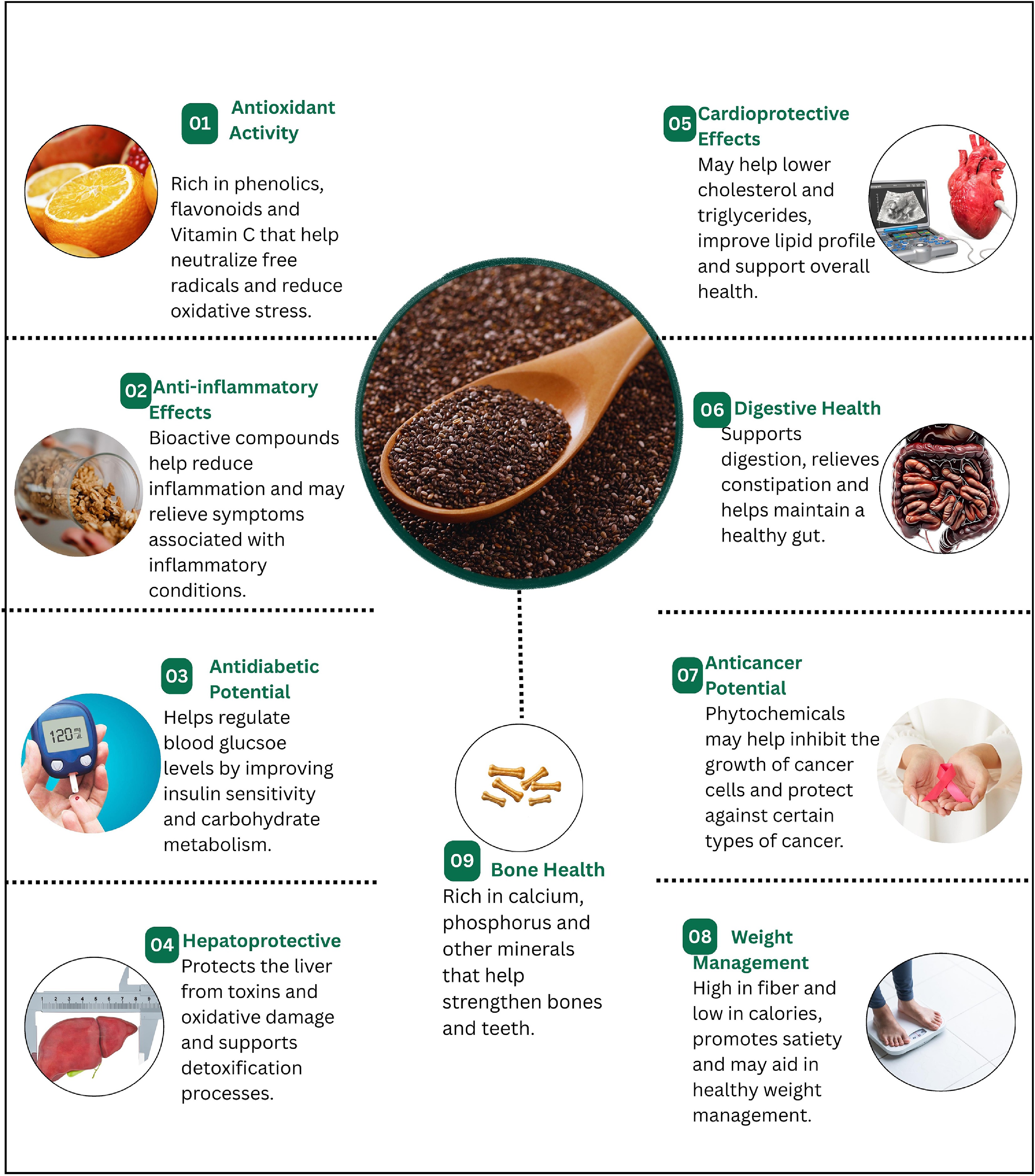
Figure 1.
Overview of the major health-promoting properties of garden cress (Image is prepared through Canva:
https://canva.link/ser2zdsr0bno2vy ). -
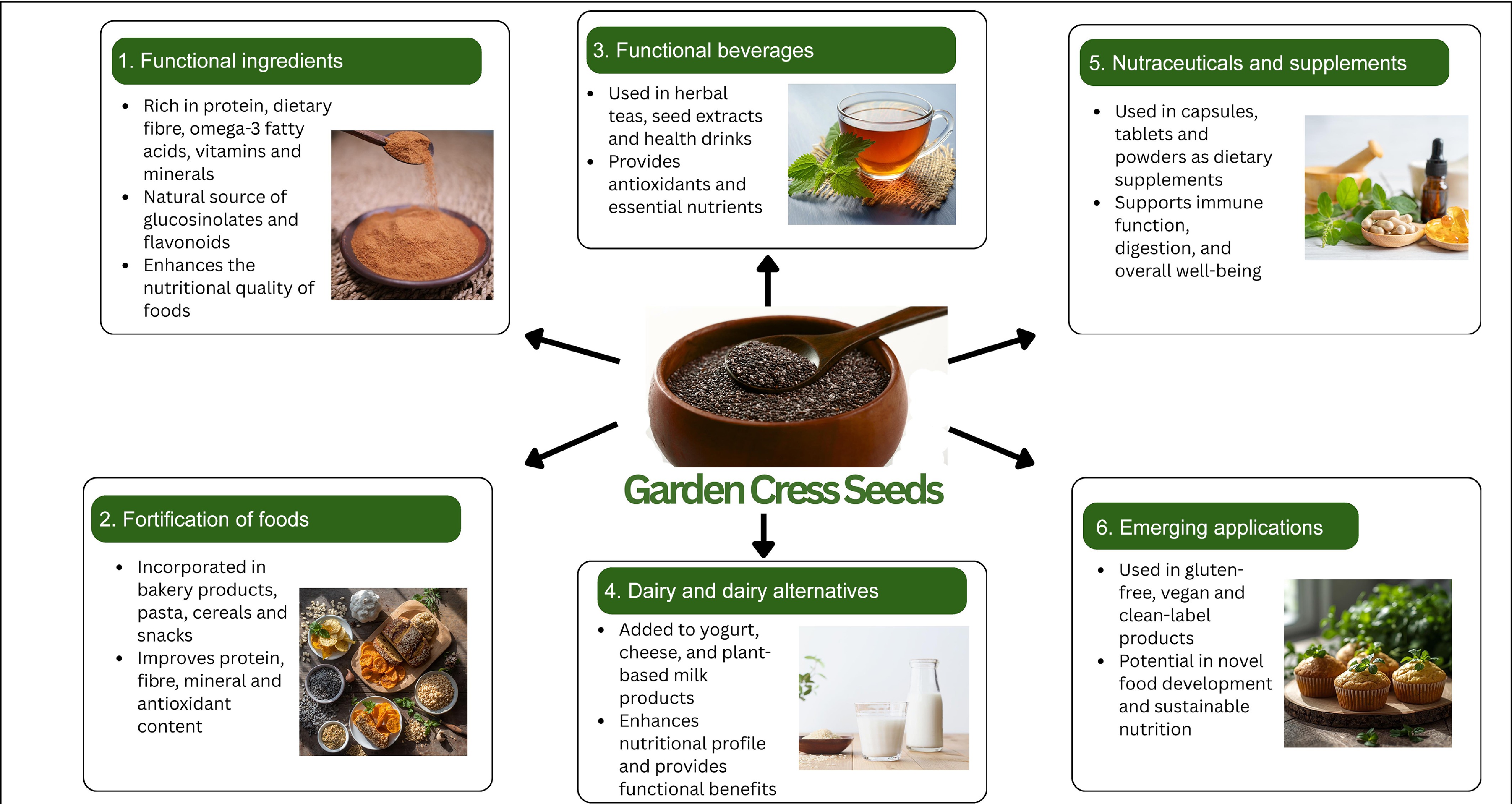
Figure 2.
Functional food applications of garden cress seeds (Lepidium sativum L.) (Image is prepared through Canva:
https://canva.link/cjtavquooie6ke7 ). -
Nutrient (per 100 g) Garden cress Wheat Maize Sorghum Tef (white) Crude protein (g) 21.0–25.0 11.7 8.0–11.0 8.3 11.0 Crude fat (g) 23.0–28.0 1.9 4.0–4.6 3.0 2.4 Carbohydrate (g) 30.0–34.0 73.0 73.0 75.0 73.0 Crude fibre (g) 7.0–11.9 1.6 2.7 6.5 3.0 Iron (mg) 8.3–100.0 3.7 3.6–4.8 3.5–4.1 9.5–37.7 Calcium (mg) 266.4–377.0 15.2–39.5 16.0 5.0–5.8 17.0–124.0 Potassium (mg) 1,236.5 117.3 54.8 — 128.9 Phosphorus (mg) 608.6–723.0 233.0 15.8 — 99.2 Magnesium (mg) 339.2–430.0 78.7 36.1 — 54.3 Zinc (mg) 7.0 1.7 2.6–4.6 1.4–1.7 2.4–6.8 Note: ranges integrate values reported by refs [2,6,14−16]. Table 1.
Proximate and mineral composition of garden cress seeds compared with major cereal staples (per 100 g).
-
Compound class Representative compounds Documented bioactivities Phenolic acids Gallic acid; protocatechuic acid; ellagic acid; sinapic acid; sinapin; caffeic acid; coumaric acid Free-radical scavenging, anti-inflammatory, antihypertensive, hypolipidaemic, and antimicrobial activity Flavonoids Kaempferol and its glycosides; quercetin; quercitrin; naringin; hesperidin; rosmarinic acid Antioxidant, anticancer (apoptosis induction), hepatoprotective, antidiabetic, and anti-inflammatory effects Imidazole alkaloids Lepidine B-F; semilepidinosides A and B Hypoglycaemic activity in alloxan-induced diabetic rats; modulation of antioxidant enzymes Glucosinolates/isothiocyanates Glucotropaeolin (benzyl glucosinolate); benzyl isothiocyanate; 2-phenylethyl glucosinolate Chemopreventive, cytotoxic against breast cancer cells, and insecticidal against Bemisia tabaci Tocopherols and phytosterols γ-Tocopherol; δ-tocopherol; β-sitosterol; α-tocopherol Antioxidant, anti-inflammatory, cardioprotective, antiatherogenic activity Other constituents Tannins, saponins, anthraquinones, anthocyanidins, xanthones, coumarins, triterpenes, polyterpenes Astringent, antimicrobial, antiulcer, and broad antioxidant effects Note: Compiled from refs [2,6]. Table 2.
Major bioactive compound classes in garden cress seeds and their health benefits.
-
Study design Extraction method Dose and duration Model/subjects Key findings Proposed mechanism Ref. In vivo, experimental
(Animal study;
two groups, n = 6/group)Ethanolic extract
(Soxhlet; ethyl alcohol solvent); dried in a rotary evaporator under reduced pressure; soxhlet of trampled seeds400 mg/kg p.o. (1/5th NOAEL; OECD-420 acute toxicity: no mortality at 2,000 mg/kg) Duration: 8 wk Adult male Wistar rats (150–200 g); right femoral osteotomy + K-wire intramedullary fixation;
Groups: Control (saline) vs. Test (extract)Week 4: Test group showed significantly larger callus formation and greater osseous material deposition vs. control (CM: p < 0.001; LL and LM: NS).
Week 8: Complete bone union in all test group animals; incomplete healing in control (LM: p < 0.045; CM: p < 0.005; LL: NS throughout).
Phytochemical screening (ethanolic extract): Cardiac glycosides (+), anthraquinone glycosides (+), flavonoids (+), alkaloids (+ve by Dragendraff, Wagner, Hager, Mayer tests), tannins/phenolics (+), amino acids glycine (+), cysteine (+), glutamine (+), steroids (+), reducing glycosides (+). Coumarin glycoside (–), saponins (–), tyrosine (–), and tryptophan (–).Anti-inflammatory activity reduces periosteal response; glycine, cysteine, and glutamine residues promote collagen I synthesis via Gly-X-Y triple-helix structure; osteoblast →
Osteocyte differentiation facilitated by
collagen matrix[22] In vivo, experimental
(animal study;
six groups, n = 6/group) +
GC–MS phytochemical
analysis (FAME)Ethanolic extract
(Soxhlet; 60 g
seeds + 600 mL
ethanol, 6–8 h);
rotary evaporation
(Buchi; 60 °C,
175 mbar);
semi-solid mass;
stored at 4 °CLSS:
100 mg/kg p.o.
200 mg/kg p.o.
400 mg/kg p.o.
Silymarin:
100 mg/kg p.o.
(reference)
All once daily
× 7 d pre
treatment; sacrifice
24 h post-CCl4Male Wistar rats
(190–200 g);
CCl4-induced acute
hepato-toxicity
(1 mL/kg, 50%
in olive oil, i.p.)
six groups:
control (olive
oil); toxic (CCl4);
low, medium,
high-dose LSS
+ CCl4;
Silymarin + CCl4Liver enzymes (ALT, AST, ALP, and bilirubin): significantly elevated by CCl4 vs. control (p ≤ 0.05); significantly reduced by all three LSS doses and silymarin vs. toxic group (p ≤ 0.05) in a dose-dependent manner.
MPO: significantly decreased in all LSS-pretreated groups vs. the CCl4-only group (p ≤ 0.05).
SOD: significantly maintained in LSS + silymarin-treated groups (p ≤ 0.05).
Histopathology: 100 mg/kg LSS less nuclear degeneration, focal necrosis, lymphocyte infiltration vs. toxic; 200 mg/kg moderate nuclear degeneration, mild leucocyte infiltration; 400 mg/kg minimum fatty changes, mild nuclear degeneration, slight necrosis; general hepatocyte architecture retained. Silymarin group: normal cellular architecture preserved.
GC-MS (12 fatty acids identified):
• Alpha-linolenic acid (C18:3): 55.47%—major constituent
• Cis-13-eicosenoic/Paullinic acid (C20:1): 14.21%
• Palmitic acid (C16:0): 8.54%
• Erucic acid (C22:1): 5.65%
• Stearic acid (C18:0): 3.29%; others: myristic, palmitoleic, behenic, nervonic, lignoceric acidsAntioxidant activity mediated by phenolic compounds in extract; alpha-
linolenic acid downregulates proinflammatory cytokines IL-6, IL-1β, and TNF-α; prevents CCl4-induced free-
radical (CCl3) formation which disrupts Ca2+ homeostasis and causes necrotic cell death[23] In vivo, experimental
(animal study;
comparative design:
LS vs. Irbesartan);
three groups per
cohort, n = 5/groupAqueous extract
(decoction: 1 g
dried powdered seeds + 100 mL distilled water, boiled 10 min, infused 15 min; cooled and filtered); filtrate lyophilized; reconstituted in 10 mL/kg H2O just before useLS: 20 mg/kg
p.o. once daily
× 3 wk
(traditional
Moroccan dose)
Irbesartan:
20 mg/kg p.o.
(AT-II antagonist;
reference drug)
Measurements:
D0, D7, D14, and D21Male WKY
(normotensive)
and SHR (sponta-
neously hyper-
tensive) rats
(210–260 g);
housed in metabolic
cages; three groups:
Control (H2O),
LS, Irbesartan;
Coll. from retro-
orbital sinus
under ether
anaesthesiaSHR-blood pressure: significant reduction in SBP from Day 7 (p < 0.05) through Day 14 and Day 21 (p < 0.01); effect comparable in magnitude to Irbesartan (p < 0.01 at Day 21).
WKY-blood pressure: no significant SBP change with LS throughout treatment (Irbesartan caused reversible SBP reduction: p < 0.05).
Heart rate: no significant change in WKY or SHR after LS treatment (data not shown).
WKY-diuresis: significant increase in urine output from Day 7 (p < 0.05), more potent from Day 14 onward (p < 0.001). Increased urinary Na+ (p < 0.05), K+ (p < 0.01), and Cl– (p < 0.01) after 3 wk. GFR significantly increased (p < 0.001).
SHR diuresis/electrolytes: no significant change in urine volume despite SBP reduction. Significant increases in urinary Na+ (p < 0.01, weeks 2–3), K+ (p < 0.05 at Day 14; p < 0.001 at Day 21), Cl– (p < 0.001).
Plasma electrolytes: no significant change in plasma Na+ or Cl–; plasma K+ significantly decreased in all SHR groups. WKY plasma values unchanged.
Conclusion: LS selectively lowers blood pressure in hypertensive rats only; antihypertensive activity appears independent of diuretic mechanism in SHR.Antihypertensive in SHR appears independent of diuretic/natriuretic activity; possible direct vasodilatory or ATII receptor-like antagonism
similar to Irbesartan; In WKY: GFR
increase suggests afferent renal arteriole dilation → increased filtered Na+ load → natriuresis and diuresis; tubular reabsorption reduction via reduced anion cotransport; active constituent(s) and precise mechanism remain to be determined[24] In vivo, experimental
(animal study;
acute single-dose
+ chronic 15-d
design);
comparative:
LS vs. sodium-
vanadate;
four groups per
cohort, n =
5/groupAqueous extract (traditional Moroccan decoction: 1 g
powdered seeds +
100 mL H2O;
boiled 10 min,
cooled 15 min); Millipore-filtered
(0.2 mm); filtrate
freeze-dried; reconstituted
daily in 1.5 mL H2O
just before administrationLS: 20 mg/kg p.o.
(traditional
phytotherapy dose;
prescribed in
Tafilalet region,
Morocco)
Sodium-vanadate:
0.8 mg/kg p.o.
(insulin-mimetic
reference drug)
Acute: single
dose; measured
at 1, 2, 4, 6 h
Chronic: daily
× 15 d;
measured at
2, 4, 7, 15 dAdult male Wistar
rats (200–250 g);
Normal rats and
STZ-induced
diabetic rats:
STZ 65 mg/kg i.v.
(tail vein; dissolved
in 0.1 M sodium
citrate buffer
pH 4.5);
Diabetic criterion:
fasting blood
glucose > 16.5
mmol/L after 18 h;
All experiments
in overnight-
fasted ratsACUTE (Single dose, LS 20 mg/kg):
Normal rats: Significant blood glucose reduction from 1 h (p < 0.05); more pronounced reduction at 6 h (p < 0.01).
STZ diabetic rats: Significant reduction from 2 h post-administration (p < 0.05); maintained at 4 h and 6 h (p < 0.001).
CHRONIC (15 d daily, LS 20 mg/kg):
Normal rats: Significant reduction after 4 d (p < 0.05), 7 d (p < 0.01), 15 d (p < 0.001); progressive cumulative effect noted.
STZ diabetic rats: Significant blood glucose reduction from Day 2 (p < 0.01); marked normalization of glycaemia achieved at 2 wk (p < 0.001), sustained to Day 15.
Plasma Insulin: No significant change in LS-treated groups in either normal or STZ diabetic rats on Day 0 vs. Day 15, confirming insulin-independent mechanism.
Body weight: significant reduction in LS-treated normal rats (p < 0.05) and STZ rats (p < 0.01) after 15 d; attributed to reduction in food intake. Vanadate-treated groups also showed marked body weight reduction (p < 0.001).
Vanadate reference: Significant blood glucose reduction from Day 2 in STZ rats (p < 0.001), maintained to Day 15; similar trend in normal rats at higher time-points.Extra-pancreatic (insulin-independent) mechanism confirmed by unchanged
plasma insulin; Possible sites:
(1) Liver—inhibition of endogenous glucose production
(2) Kidney—inhibition of renal glucose reabsorption via altered SGLT1 expression
(3) Muscle/adipose enhanced glucose
uptake and intracellular metabolism
(4) Intestine—inhibition of glucose absorption; Imidazole alkaloids (lepidine, semilepidine) likely active constituents; precise mechanism and active constituent(s) still to be confirmed[25] In vivo, experimental
(animal study;
six groups, n = 6/group);
LD50 determination
in female albino
mice (OECD No.
420 and 425)Lepidium sativum:
Total Alkaloid (LSTA): seeds (1.5 kg) defatted with n-hexane (Soxhlet, 16 h); re-extracted with MeOH (8 h); evaporated; resus-pended in H2O; acidified with conc. HCl; extracted 3 × with ethyl acetate; aqueous layer basified with conc. NH3; re-extracted 3 × ethyl acetate; combined EtOAc layers concentrated and dried; Yield: 0.29% w/w; Dragendorff test +ve; Major components: lepidine and semilepidine (imidazole alkaloids)LSTA:
50 mg/kg i.p.
150 mg/kg i.p.
250 mg/kg i.p.
Metformin:
20 mg/kg p.o.
(reference)
All × 21 d
continuous
LD50+ (i.p.) =
2,204.95 mg/kg
(GHS Class 4:
300 < LD50+ < 2,000 mg/kg)
Dose range
selected based
on LD50+ resultFemale albino mice
(20–25 g) for
acute toxicity;
Wistar albino rats
(120–150 g) either
sex for antidiabetic;
Alloxan mono-
hydrate 150 mg/kg
i.p. in normal saline;
Diabetic criterion:
fasting BG >150
mg/dL confirmed
after 72 h;
IAEC approval:
IAEC/RCP/2008/05
six groups (n = 6):
Vehicle control;
Diabetic control;
Metformin 20;
LSTA 50, 150,
250 mg/kgAcute toxicity: LD50 = 2,204.95 mg/kg i.p. (GHS Class 4; relatively low toxicity). Alkaloid yield: 0.29% w/w from seeds.
Body weight: LSTA 250 mg/kg showed +1.94% gain on Day 21 vs. +6.14% (vehicle control) and –8.94% (diabetic control); metformin +(−2.41%).
Blood glucose (mg/dL): LSTA 150 mg/kg: Day 7: 205.37 ± 12.33 (p < 0.01), Day 14: 175.76 ± 16.37 (p < 0.001), Day 21: 126.46 ± 11.42 (p < 0.001). LSTA 250 mg/kg: Day 7: 196.30 ± 13.42 (p < 0.01), Day 14: 142.22 ± 14.68 (p < 0.001), Day 21: 124.40 ± 12.23 (p < 0.001). Diabetic control: 277–284 mg/dL throughout. LSTA 50 mg/kg showed a nonsignificant reduction.
Lipid profile: LSTA 150 and 250 mg/kg significantly reduced TC, TG, and LDL (p < 0.001) in diabetic rats; all three doses of LSTA prominently increased HDL (p < 0.001). No significant change in creatinine across all doses.
Organ weights: All LSTA doses significantly (p < 0.001) reduced elevated liver weight in diabetic animals. LSTA 50 and 150 mg/kg significantly suppressed elevated pancreas weight (p < 0.001). Kidney weight highest in vehicle control, lowest in diabetic control; LSTA 250 mg/kg restored kidney weight (0.759 ± 0.028 g/100g vs. metformin 0.768 ± 0.042).Reducing oxidative damage via modulation of antioxidant enzymes (SOD, glutathione); protection of β-pancreatic cells from alloxan-generated free radicals; potentiation of pancreatic insulin secretion from remaining islet β-cells; restoration of delayed insulin response and slow carbohydrate absorption; Possible AMPK-dependent pathway → GLUT4 upregulation → insulin-independent glucose transport; Increased glycogenesis; inhibition of gluconeogenesis; inhibition of intestinal glucose absorption; exact mechanism and active constituent(s) to be elucidated [20] In vivo, experimental
(animal study;
three-group design:
control, low dose,
high dose);
two independent
inflammation modelsCrude seed powder (Chandrashura) suspended in distilled water (sufficient quantity to dissolve the required dose); no solvent extraction performed; crude suspension used as test drug; administered via oral route with gastric catheter Low dose A: 500 mg/kg p.o.
(therapeutic dose) High dose B: 1,100 mg/kg p.o. (2 × therapeutic dose)
Control: distilled water (same volume) All administered 1 h before edema induction; IAEC approval: IAEC 04-05/01/ PhD.03Charles Foster
albino rats
(150–240 g)
of either sex;
three groups;
Model 1:
Carrageenan-
induced paw
edema:
0.1 mL 1%
carrageenan i.pl.
sub-plantar
aponeurosis
(left hind limb)
Model 2:
Formaldehyde-
induced paw
edema: 0.05 mL
formalin s.c.
left hind pawCarrageenan model (acute inflammatory phase):
Low dose (500 mg/kg): 15.04% reduction at 1 h; 28.50% at 2 h; 4.60% at 3 h vs. control; statistically nonsignificant (NS) throughout.
High dose (1,100 mg/kg): 13.65% reduction at 1 h; 34.50% at 2 h; 31.40% at 3 h vs. control; NS throughout.
Control group showed high variability (40.41% ± 13.03% at 1 h; 75.03% ± 28.75% at 2 h); the effect was not dose-dependent.
ANOVA: F = 2.79, p < 0.10 (df 2,15); no statistically significant activity reached.
Formaldehyde model (chronic proliferative phase):
Low dose (500 mg/kg): 34.29% reduction at 24 h (significant by ANOVA, p < 0.05); 29.37% at 48 h.
High dose (1,100 mg/kg): 51.60% reduction at 24 h (p < 0.05); 48.56% at 48 h.
Overall conclusion: Moderate anti-inflammatory activity in carrageenan (acute) model (NS due to control variability); moderate to significant suppression in formaldehyde (chronic) model. Drug effective in both acute and chronic inflammatory models at lower dose level.Carrageenan model represents phase 1 (acute exudative) inflammation; Mediated by histamine, serotonin, bradykinin, prostaglandins; possible inhibition of these phlogistic mediators or modulation of their receptors; dose-independent response suggests multicomponent nature: higher doses may contain opposing active principles; formaldehyde model represents phase 3 (chronic proliferative) inflammation via fibroblast proliferation; test drug shows strong inhibitory effect on fibroblast proliferation and connective tissue modulation; specific active constituent(s) responsible for anti-inflammatory effect remain to be identified [26] Open-label,
noncomparative
clinical study
(single-arm,
before-after design)Finely powdered
dried seeds
(commercial
supplier;
authenticated by
Dr. Daniel, Dept.
of Botany,
M.S. University,
Vadodara, Gujarat;
voucher deposited
in 'BARO' herbarium,
MS University;
no solvent
extraction;
crude seed
powder administered
orally with water)1 g t.i.d.
(3 g/d) orally
with water
× 4 wk
Weekly medication
supply; patients
reviewed weekly;
no concurrent
asthma medication
allowed;
baseline PFTs
and symptom
scores recorded
before treatmentn = 30 patients
(enrolled 34;
four discontinued;
30 completed);
Either sex;
Age: 15–80 y
(mean 50.83 ± 3.32);
Male: Female = 17:13;
Weight: 48.26 ± 1.63 kg;
Disease duration:
3.82 ± 0.91 y; Mild to moderate bronchial asthma (25 intrinsic, five extrinsic); Outpatient Dept., Govt. Ayurvedic Hospital, Vadodara; Exclusions: Cardiovascular disease; severe asthma (PEFR < 20%, FEV1 < 20% predicted); age < 15 y; pregnancy; TBPulmonary function tests (spirometry):
FVC: highly significant increase p < 0.001; 1.60 → 1.98 L; mean% increase 32.92% ± 10.07%.
FEV1: Significant p < 0.01; 1.28 → 1.68 L; mean% increase 35.81% ± 8.32%.
FEV1/FVC%: NS (81.76% → 85.50%); both volumes increased proportionally.
PEFR: p < 0.01; 2.58 → 3.31 L/s; mean% increase 43.58% ± 13.56%.
FEF25−75%: p < 0.05; mean% increase 42.00% ± 13.48%.
FEF25%: p < 0.01; mean% increase 43.87% ± 13.37%.
FEF50+%: p < 0.05; mean% increase 43.21% ± 13.28%.
FEF75%: NS; mean% increase 38.49% ± 14.80%.
MVV: p < 0.01; 50.29 → 57.02 L/min; mean% increase 18.23% ± 6.59%.
Clinical symptoms: significant reduction in symptom scores for dyspnoea, wheezing, cough, and chest tightness (all p < 0.05 Student's paired t test).
Haematological: ESR significantly reduced 26.74 → 17.04 mm/h (p < 0.05); eosinophil count trend towards reduction (NS overall; normalization observed in patients with elevated baseline counts); Hb, TC, differential count, BP, heart rate, respiratory rate: all NS.
Safety: No adverse effects observed in any of the 30 patients throughout the 4-wk treatment period.Not fully elucidated; Probable action through adrenergic mechanisms; seeds contain cardioactive substance with Adreno mimetic properties); anti-inflammatory effect evidenced by reduction in ESR; possible inhibition of airway inflammatory mediators (histamine, bradykinin, prostaglandins); flavonoids and phenolics in seeds may modulate bronchial smooth muscle tone; Detailed mechanistic studies and RCTs required to confirm efficacy and elucidate precise pathways [27] Abbreviations: ALT, alanine transaminase; AST, aspartate transaminase; ALP, alkaline phosphatase; BIL, bilirubin; CCl4, carbon tetrachloride; CM, circumferential callus; d, days; FAME, fatty acid methyl ester; FEV1, forced expiratory volume in 1 s; FVC, forced vital capacity; GFR, glomerular filtration rate; GC–MS, gas chromatography–mass spectrometry; GSH, reduced glutathione; H2O, water; Hb, haemoglobin; HDL, high-density lipoprotein; i.p., intraperitoneal; i.v., intravenous; IL, interleukin; LDL, low-density lipoprotein; LL, longitudinal lateral callus; LM, longitudinal medial callus; LSS, Lepidium sativum seed(s); MDA, malondialdehyde; MPO, myeloperoxidase; NIST, National Institute of Standards and Technology; NOAEL, no-observed-adverse-effect level; NS, not significant; OECD, Organisation for Economic Co-operation and Development; PEFR, peak expiratory flow rate; p.o., per os (oral); PGE2, prostaglandin E2; RIA, radioimmunoassay; SBP, systolic blood pressure; SHR, spontaneously hypertensive rats; SGLT1, sodium-glucose cotransporter 1; SOD, superoxide dismutase; STZ, streptozotocin; t.i.d., three times daily; TC, total cholesterol; TG, triglycerides; TNF-α, tumour necrosis factor alpha; WKY, Wistar-Kyoto (normotensive) rats; wk, weeks; °C, degrees Celsius; AMPK, AMP-activated protein kinase; AOAC, Association of Official Analytical Chemists; AAS, Atomic Absorption Spectrophotometer; DBP, diastolic blood pressure; Eos, eosinophils; ESR, erythrocyte sedimentation rate; FEF, forced expiratory flow; GHS, Globally Harmonized System; GLUT4, glucose transporter type 4; Hb, haemoglobin; HPLC, high-performance liquid chromatography; LSTA, L. sativum total alkaloid; MDL, method detection limit; MVV, maximum voluntary ventilation; NIST, National Institute of Standards and Technology; PE, petroleum ether; PEFR, peak expiratory flow rate; ROS, reactive oxygen species; SEM, standard error of mean; s.c., subcutaneous; CPCSEA, Committee for the Purpose of Control and Supervision of Experiments on Animals; IAEC, Institutional Animal Ethics Committee. Table 3.
Pharmacological studies on Lepidium sativum (garden cress) seeds.
Figures
(2)
Tables
(3)