-
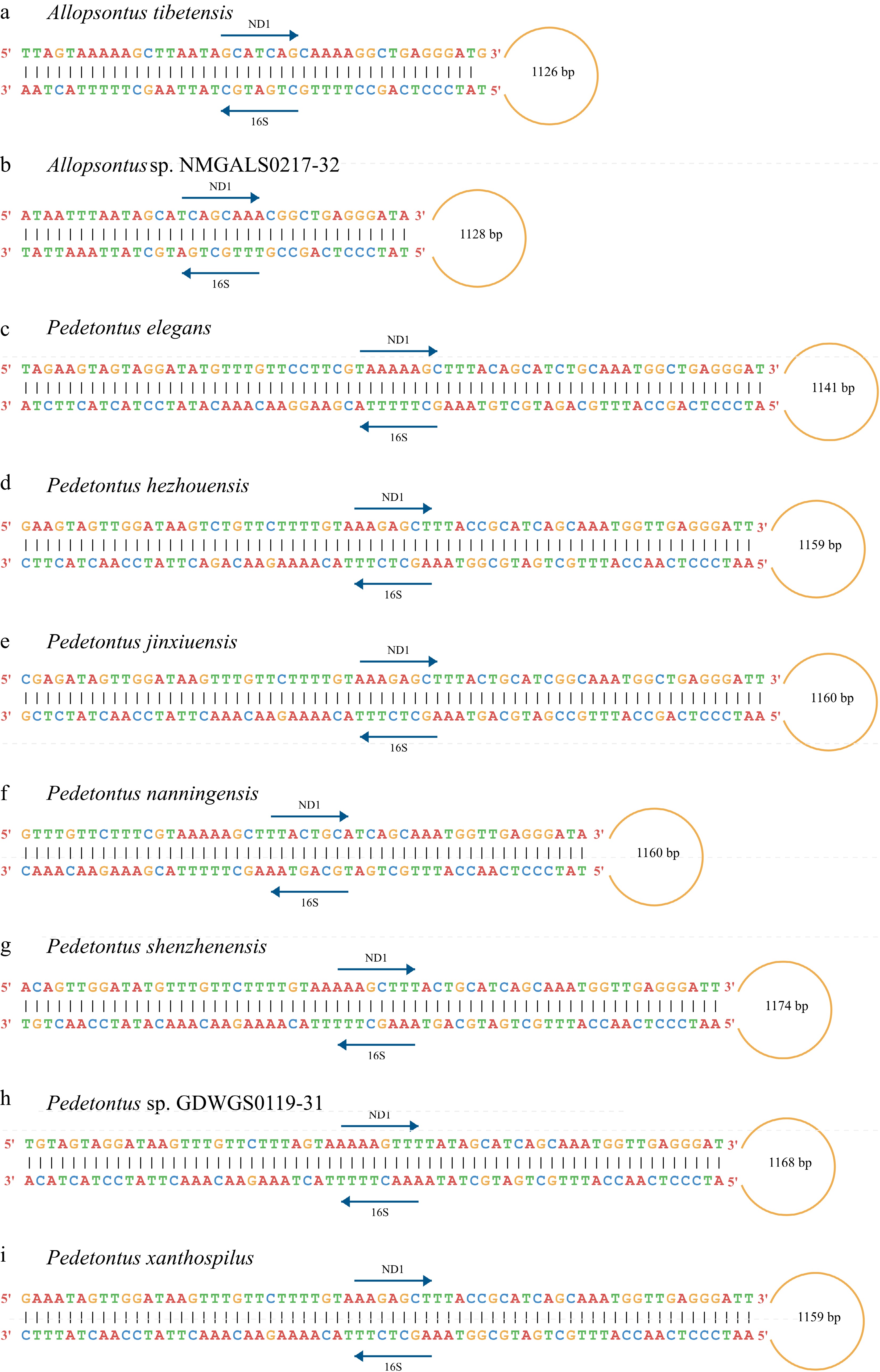
Figure 1.
Inferred hairpin structures of nine mitogenomes. The circle means the length between the ND1 gene and 16S rRNA gene. (a) Allopsontus tibetensis. (b) Allopsontus sp. NMGALS0217-32. (c) Pedetontus elegans. (d) Pedetontus hezhouensis. (e) Pedetontus jinxiuensis. (f) Pedetontus nanningensis. (g) Pedetontus shenzhenensis. (h) Pedetontus sp. GDWGS0119-31. (i) Pedetontus xanthospilus.
-
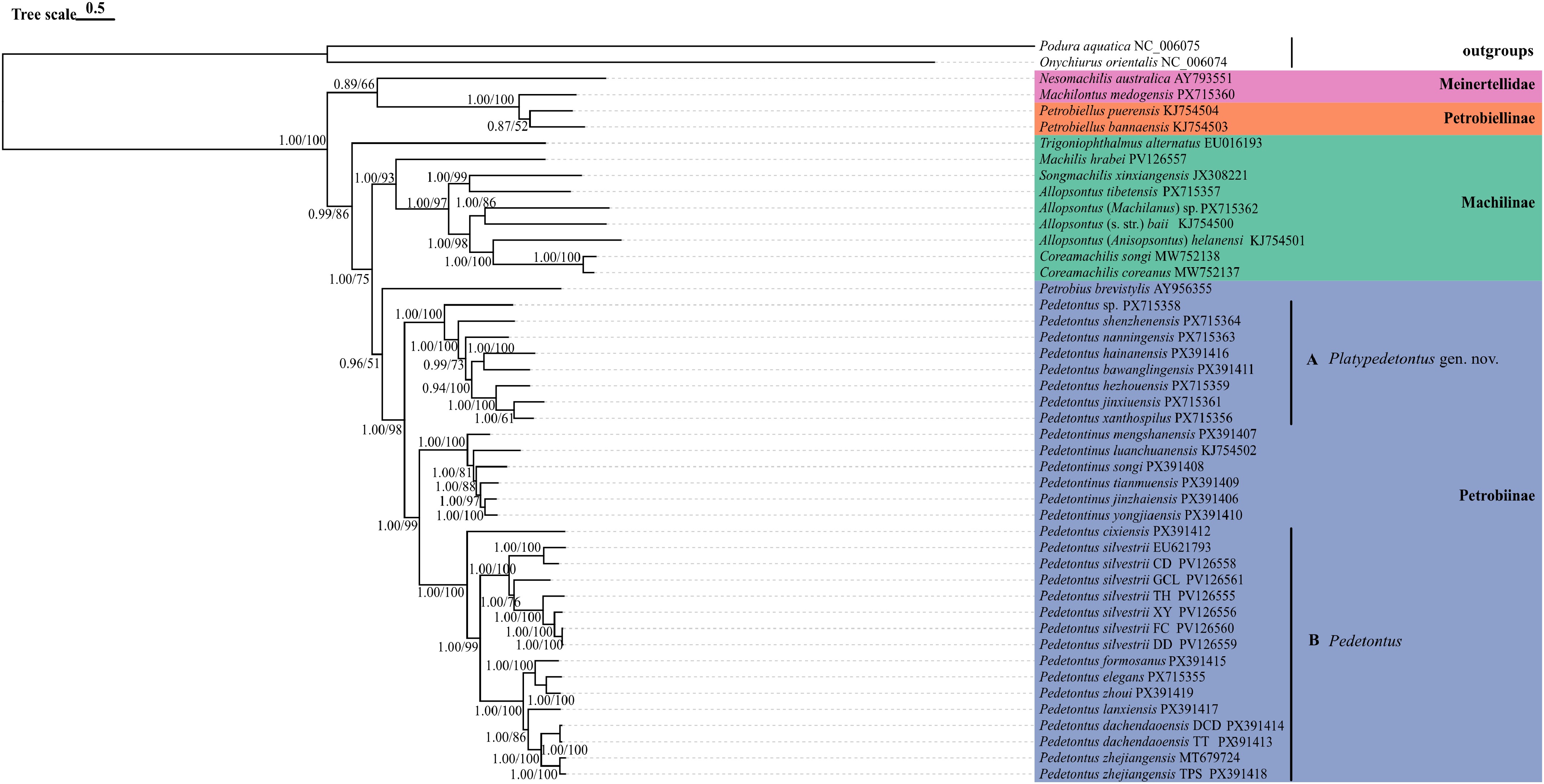
Figure 2.
Phylogenetic relationships within Archaeognatha inferred from the analysis of 13 mitochondrial PCGs using ML and BI methods. The numbers on the right side of each branch represent bootstrap values, while those on the left side represent posterior probabilities.
-
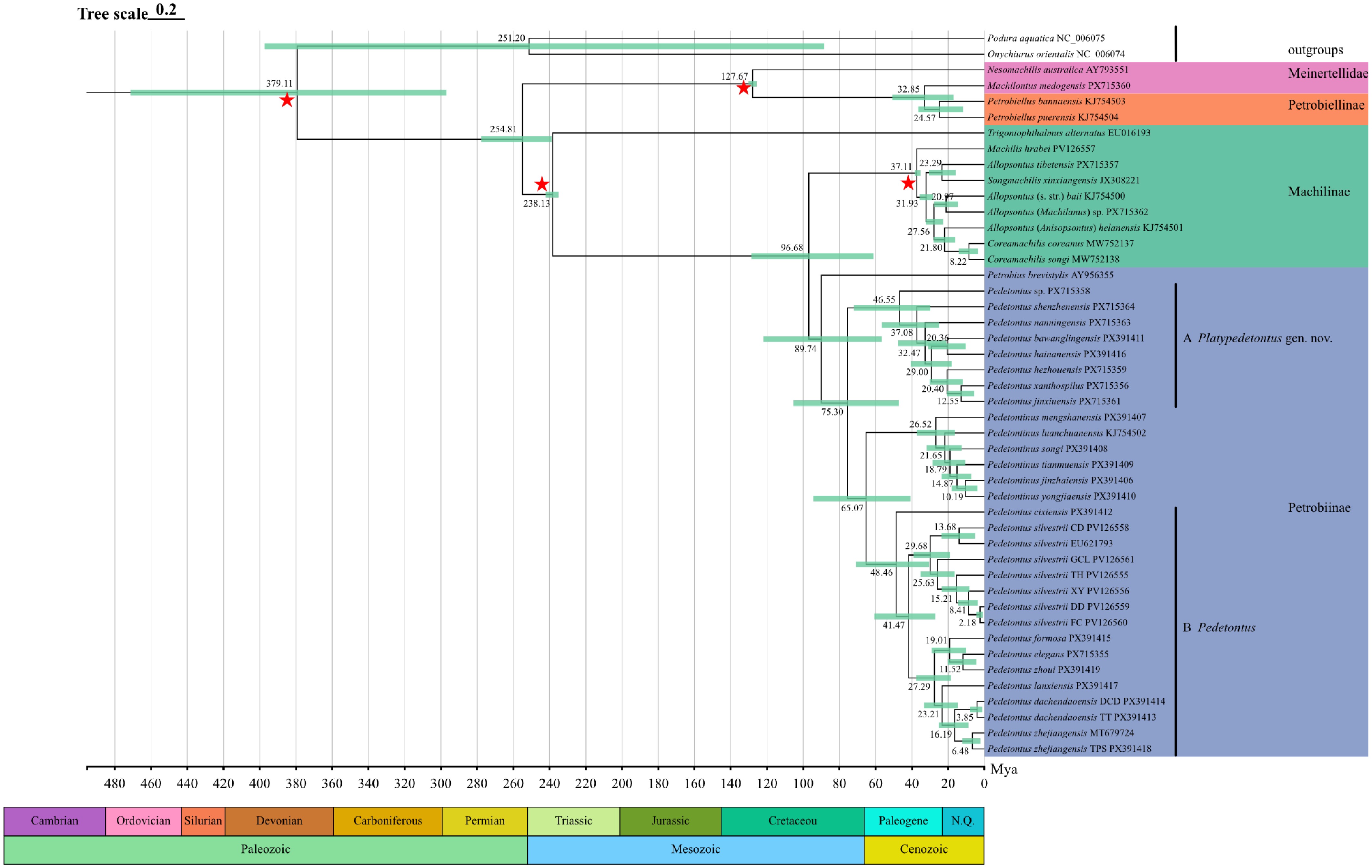
Figure 3.
The chronogram of Archaeognatha was inferred using MCMCTree, with the 95% highest posterior density (HPD) intervals indicated by bars at the nodes. Stars denote the placement of fossil calibration points. Median ages are provided below each node.
-
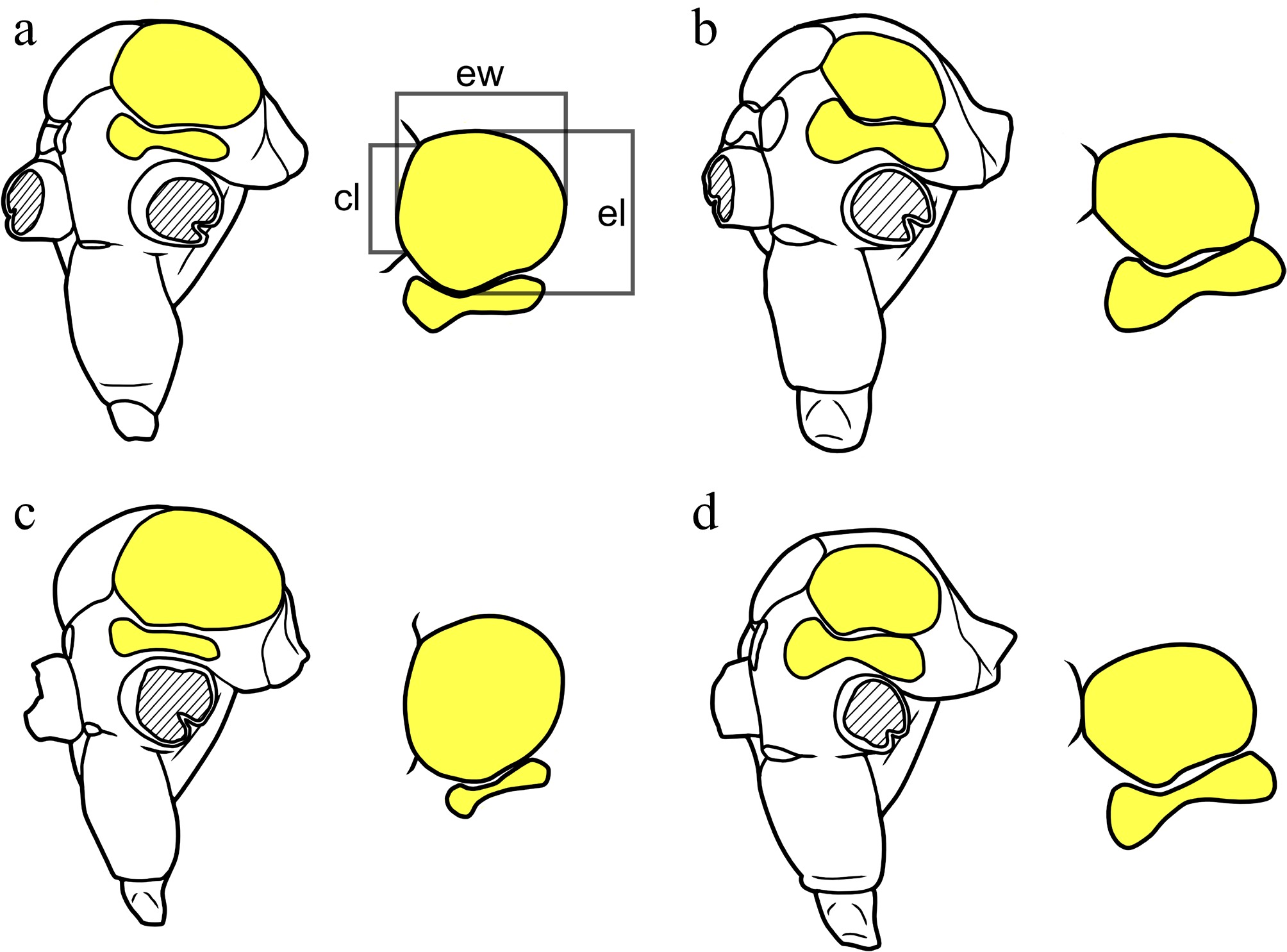
Figure 4.
Head, eyes and ocelli of Archaeognatha. Yellow indicates the visual organs (compound eyes and lateral ocelli). (a) Pedetontus (Verhoeffilis) unimaculatus Machida, 1980, after Machida 1980. (b) Platypedetontus nanningensis (Shen, Yang, Ji & Zhang, 2025) Yang & Zhang comb. nov., original; (c) Pedetontus (Verhoeffilis) elegans Shen, Yang, Ji & Zhang, 2025, original. (d) Platypedetontus xanthospilus (Shen, Yang, Ji & Zhang, 2025) Yang & Zhang, comb. nov., original. Abbreviation: cl: length of contact line; el: eye length; ew: eye width.
-
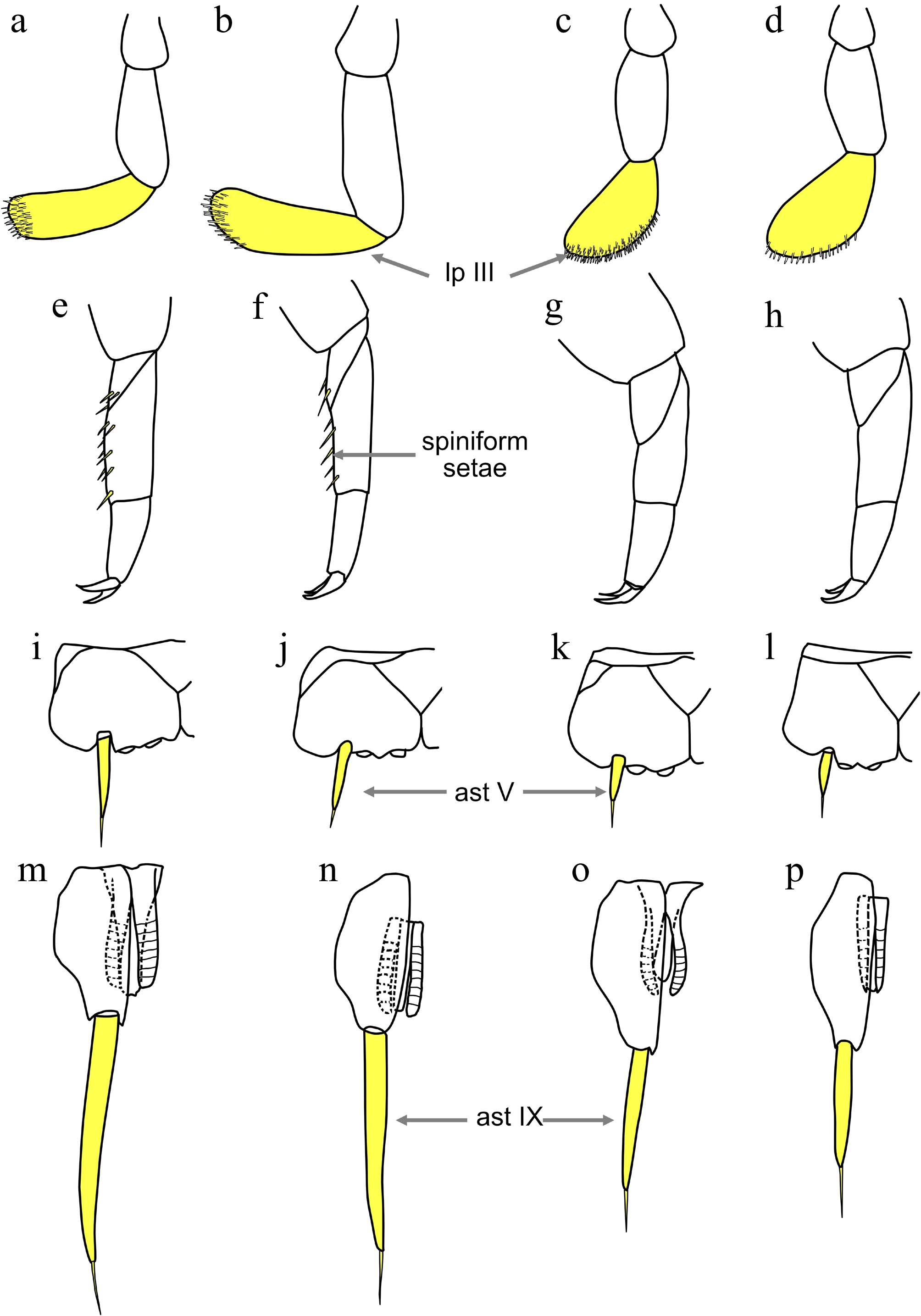
Figure 5.
Labial palps. (a) Pedetontus (Verhoeffilis) nigrus Kaplin, 2025, after Kaplin 2025. (b) Pedetontus (Verhoeffilis) elegans Shen, Yang, Ji & Zhang, 2025, original. (c) Platypedetontus xanthospilus (Shen, Yang, Ji & Zhang, 2025) Yang & Zhang, comb. nov., original. (d) Platypedetontus fukiensis (Silvestri, 1936) comb. nov., after Silvestri 1936. Forelegs. (e) Pedetontus (Verhoeffilis) silvestrii Mendes, 1991, after Mendes 1991. (f) Pedetontus (Verhoeffilis) elegans Shen, Yang, Ji & Zhang, 2025, original. (g) Platypedetontus phuketi (Kaplin, 2013) comb. nov., after Kaplin 2013. (h) Platypedetontus meridionalis (Mendes, 1981) comb. nov., after Mendes 1981. Coxites V. (i) Pedetontus (Verhoeffilis) longus Lee & Choe, 1992, after Lee 1992. (j) Pedetontus (Verhoeffilis) zhejiangensis Xue & Yin, 1991, after Xue 1991. (k) Platypedetontus xanthospilus (Shen, Yang, Ji & Zhang, 2025) Yang & Zhang, comb. nov., original; l: Platypedetontus bianchii (Silvestri, 1936) comb. nov., after Silvestri 1936. Coxites IX. (m) Pedetontus (Verhoeffilis) elegans Shen, Yang, Ji & Zhang, 2025, original; (n) Pedetontus (Verhoeffilis) zhoui Yu, Zhang & Zhang, 2010, after Yu 2010. (o) Platypedetontus xanthospilus (Shen, Yang, Ji & Zhang, 2025) Yang & Zhang, comb. nov., original; (p) Platypedetontus hainanensis (Yu, Zhang & Zhang, 2010) Yang & Zhang, comb. nov. Yellow indicates distinguishing characters. Abbreviation: ast: abdominal stylus; lp: labial palp.
-
Specimen No. Species Sampling localities Accession No. XZYB Allopsontus tibetensis Nyingchi, Xizang, China PX715357 NMGALS0217-32 Allopsontus sp. Alxa, Inner Mongolia, China PX715362 GDWGS0119-31 Pedetontus sp. Zhongshan, Guangdong, China PX715358 GDZQ0118-28 Pedetontus xanthospilus Zhaoqing, Guangdong, China PX715356 GXHZ1222-27 Pedetontus hezhouensis Hezhou, Guangxi, China PX715359 GXJX0703-1 Pedetontus jinxiuensis Laibin, Guangxi, China PX715361 GXNN0218-33 Pedetontus nanningensis Nanning, Guangxi, China PX715363 JHPA1114-18 Pedetontus elegans Jinhua, Zhejiang, China PX715355 SZYTS1126-23 Pedetontus shenzhenensis Shenzhen, Guangdong, China PX715364 18XZMT Machilontus medogensis Nyingchi, Xizang, China PX715360 Table 1.
The detail information of the 10 species used in this study.
-
1 Abdominal coxite II–V with 1 + 1 eversible vesicles Pedetontinus Silvestri, 1943 − Abdominal coxite II–V with 2 + 2 eversible vesicles 2 2 Compound eyes suboval, wider than long (L/W < 0.95), with a short contact line (CL/L < 0.6), thin and hyaline spiniform setae on ventral side of tarsus absent Platypedetontus Yang & Zhang, gen. nov. − Compound eyes longer than wide or length and width subequal (L/W ≥ 0.95), with a short contact line (CL/L ≥ 0.6), thin and hyaline spiniform setae on ventral side of tarsus present Pedetontus (V.) Paclt, 1972 -
1 Compound eyes length to width ratio ≥ 9/10 2 − Compound eyes length to width ratio < 9/10 5 2 Paired ocelli width to length ratio > 3 Platypedetontus issikii (Silvestri, 1943) Yang & Zhang, comb. nov. − Paired ocelli width to length ratio ≤ 3 3 3 Ovipositor exceeding stylus IX (including supporting spines) Platypedetontus coreanus (Silvestri, 1943) Yang & Zhang, comb. nov. − Ovipositor not exceeding stylus IX (including supporting spines) 4 4 Suberect brush-like setae on articles of maxillary palpus of male present; paramere with 1 + 7 divisions Platypedetontus bianchii (Silvestri, 1936) Yang & Zhang, comb. nov. − Suberect brush-like setae on articles of maxillary palpus of male absent; paramere with 1 + 8 divisions Platypedetontus phuketi (Kaplin, 2013) Yang & Zhang, comb. nov. 5 Ovipositor not exceeding stylus IX (including supporting spines) 6 − Ovipositor exceeding stylus IX (including supporting spines) 8 6 Compound eyes yellowish-green; article III of female labial palpus clavate Platypedetontus shenzhenensis (Shen, Yang, Ji & Zhang, 2025) Yang & Zhang, comb. nov. − Compound eyes brownish-yellow; article III of female labial palpus distinctly modified 7 7 Article III of labial palpus strongly modified, apex of female labial palpus without sensory cones Platypedetontus jinxiuensis (Shen, Yang, Ji & Zhang, 2025) Yang & Zhang, comb. nov. − Article III of labial palpus less modified, apex of female labial palpus with numerous sensory cones Platypedetontus xanthospilus (Shen, Yang, Ji & Zhang, 2025) Yang & Zhang, comb. nov. 8 Paired ocelli width to length ratio > 3 9 − Paired ocelli width to length ratio ≤ 3 10 9 Article VII of maxillary palpus distinctly longer than half the length of article VI; ratio of length of eye contact line to eye length ≥ 0.5 Platypedetontus fukiensis (Silvestri, 1936) Yang & Zhang, comb. nov. − Article VII of maxillary palpus distinctly shorter than half the length of article VI; ratio of length of eye contact line to eye length < 0.5 Platypedetontus bouvieri (Silvestri, 1906) Yang & Zhang, comb. nov. 10 Paired ocelli close to each other (ratio of distance between inner margins of paired ocelli to combined width of eyes < 0.1) Platypedetontus uraiensis (Uchida, 1965) Yang & Zhang, comb. nov. − Ratio of distance between inner margins of paired ocelli to combined width of eyes ≥ 0.1 11 11 Paired ocelli widely separated (ratio of distance between inner margins of paired ocelli to combined width of eyes ≥ 0.3) Platypedetontus meridionalis (Mendes, 1981) Yang & Zhang, comb. nov. − Ratio of distance between inner margins of paired ocelli to combined width of eyes < 0.3 12 12 Ratio of length of eye contact line to eye length ≤ 0.4 13 − Ratio of length of eye contact line to eye length > 0.4 14 13 Suberect brush-like setae on articles of maxillary palpus of male absent; paramere with 1 + 7 divisions Platypedetontus nanningensis (Shen, Yang, Ji & Zhang, 2025) Yang & Zhang, comb. nov. − Suberect brush-like setae on articles of maxillary palpus of male present; paramere with 1 + 8 divisions Platypedetontus hezhouensis (Shen, Yang, Ji & Zhang, 2025) Yang & Zhang, comb. nov. 14 Ratio of distance between inner margins of paired ocelli to combined width of eyes < 0.15 Platypedetontus sauterii (Silvestri, 1943) Yang & Zhang, comb. nov. − Ratio of distance between inner margins of paired ocelli to combined width of eyes ≥ 0.15 15 15 Paired ocelli width to length ratio > 2.5; paramere with 1 + 7 divisions Platypedetontus okajimae (Silvestri, 1943) Yang & Zhang, comb. nov. − Paired ocelli width to length ratio ≤ 2.5; paramere with 1 + 6 divisions Platypedetontus hainanensis (Yu, Zhang & Zhang, 2010) Yang & Zhang, comb. nov. -
1 Ventral apex of male maxillary palpus article V with a dense tuft of stout setae Pedetontus (V.) silvestrii Mendes, 1991 − Ventral apex of male maxillary palpus article V without dense tuft of stout setae 2 2 Article III of labial palpus distinctly modified, nearly subconical Pedetontus (V.) gershneri Allen, 1995 − Article III of labial palpus not modified, clavate 3 3 Compound eyes length to width ratio ≥ 1 4 − Compound eyes length to width ratio < 1 15 4 Ratio of length of eye contact line to eye length ≥ 0.7 5 − Ratio of length of eye contact line to eye length < 0.7 9 5 Paired ocelli width to length ratio ≥ 4 6 − Paired ocelli width to length ratio < 4 8 6 Paramere with 1 + 8 divisions Pedetontus (V.) zhoui Yu, Zhang & Zhang, 2010 − Paramere with 1 + 7 divisions 7 7 Ratio of distance between inner margins of paired ocelli to combined width of eyes > 0.2 Pedetontus (V.) formosanus Silvestri, 1943 − Ratio of distance between inner margins of paired ocelli to combined width of eyes ≤ 0.2 Pedetontus (V.) diversicornis Silvestri, 1943 8 Ovipositor of secondary type Pedetontus (V.) calcaratus (Silvestri, 1911) − Ovipositor of primary type Pedetontus (V.) savioi Silvestri, 1936 9 Paired ocelli width to length ratio > 3 10 − Paired ocelli width to length ratio ≤ 3 11 10 Article VII of maxillary palpus as long as article VI Pedetontus (V.) elegans Shen, Yang, Ji & Zhang, 2025 − Article VII of maxillary palpus shorter than article VI Pedetontus (V.) takahashi Silvestri, 1943 11 Female stylus IX distinctly shorter than length of coxite IX Pedetontus (V.) furuhjelmi Kaplin, 2025 − Female stylus IX not shorter than length of coxite IX 12 12 Paired ocelli width to length ratio > 2.8 Pedetontus (V.) amamiensis Uchida, 1960 − Paired ocelli width to length ratio ≤ 2.8 13 13 Paired ocelli width to length ratio < 2.4; article VII of maxillary palpus almost as long as article VI Pedetontus (V.) ussuriensis Kaplin, 1980 − Paired ocelli width to length ratio ≥ 2.4; article VII of maxillary palpus shorter than article VI 14 14 Paramere with 1 + 7 divisions Pedetontus (V.) nigrus Kaplin, 2025 − Paramere with 1 + 8 divisions Pedetontus (V.) zhejiangensis Xue & Yin, 1991 15 Paired ocelli width to length ratio > 4 Pedetontus (V.) persquamosus (Silvestri, 1911) − Paired ocelli width to length ratio ≤ 4 16 16 Suberect brush-like setae on articles of maxillary palpus of male absent Pedetontus (V.) submutans (Silvestri, 1911) − Suberect brush-like setae on articles of maxillary palpus of male present 17 17 Suberect brush-like setae on article I of maxillary palpus of male present; ovipositor not exceeding stylus IX (including supporting spines) Pedetontus (V.) unimaculatus Machida, 1980 − Suberect brush-like setae on article I of maxillary palpus of male absent; ovipositor exceeding stylus IX (including supporting spines) 18 18 Paired ocelli close to each other (ratio of distance between inner margins of paired ocelli to combined width of eyes ≤ 0.1) Pedetontus (V.) longus Lee & Choe, 1992 − Paired ocelli not close to each other (ratio of distance between inner margins of paired ocelli to combined width of eyes > 0.1) Pedetontus (V.) nipponicus (Silvestri, 1907)
Figures
(5)
Tables
(4)