













-
Bristletails (Insecta: Archaeognatha) are apterous, dorsally iridescent insects that predominantly occupy cryptic, mesic microhabitats including rock fissures, talus slopes, and decaying leaf litter, and feed on algae, lichens, and detritus[1,2]. As the phylogenetically most basal extant lineage of Insecta, Archaeognatha diverged prior to the origin of all other insect orders and currently comprises two extant families: Machilidae and Meinertellidae[3−7]. Within the Machilidae, four subfamilies are formally recognized: Machilinae, Petrobiinae, Petrobiellinae, and Ditrigoniophthalminae[8,9].
Archaeognatha is widely accepted as the sister clade to all other extant insects, with its monophyly extensively supported by both morphological and molecular evidence[4−6,10−12]. Nevertheless, higher-level relationships within Archaeognatha particularly concerning familial and subfamilial boundaries remain unresolved. Recent integrative analyses combining morphological and molecular datasets have challenged the monophyly of Machilidae, prompting proposals for taxonomic revision[11,13−16]. At the subfamily level, morphological studies have recovered a topology of ([Petrobiellinae + Petrobiinae] + Machilinae), but the monophyly of Machilinae itself remains equivocal[1,17]. In contrast, molecular phylogenies frequently fail to recover Machilinae or Petrobiinae as monophyletic; instead, Petrobiellinae is often resolved as sister to Meinertellidae, raising questions about its current classification within Machilidae and suggesting that its systematic placement requires critical reassessment[11,13,15,18,19]. Notably, longstanding taxonomic inconsistencies especially in species delimitation and character homology assessments within Petrobiellinae have been repeatedly emphasized, underscoring the need for caution when interpreting its phylogenetic position[20−22]. Within Machilinae, Coreamachilis is consistently recovered as a well-supported monophyletic clade, whereas the monophyly of Allopsontus has been questioned[15]. In Petrobiinae, the generic status of Pedetontus is still debated. Some molecular studies support it as sister clade to Pedetontinus[11,13,18], while others advocate splitting its constituent species into two distinct clades with Pedetontinus cluster into Pedetontus[20].
Although the fossil record of Archaeognatha extends from the Late Devonian to the Miocene, most specimens are fragmentary and exhibit poor morphological preservation[23,24]. Fossils from the Devonian and the Paleozoic–Mesozoic transition are primarily assigned to the extinct order Monura (such as Dasyleptus), whereas Cenozoic species are largely attributable to the genus Machilis within the family Machilidae[25−28]. Insect origins date to the Early Ordovician with emergence of ectognathous lineages by the Early Silurian, while evidence from Burmese amber indicates that Machilidae and Meinertellidae had already diverged prior to the Cretaceous, implying a Gondwanan origin for Meinertellidae[4,14,16]. Subsequently, through the study of two key Triassic fossil species, a Machilidae key fossil (Gigamachilis triassicus) from the Middle Triassic Lagerstätte of Monte San Giorgio and a representative of †Monura (Dasyleptus triassicus) from the same fossiliferous site, it was found that G. triassicus belongs to Machilidae, and this indicates that members of the extant Machilidae were already present in the Middle Triassic, which is at least ~100 Mya earlier than previously estimated[29]. Consistent with fossil evidence, Cen et al. demonstrated that Archaeognatha originated in the Late Carboniferous, with subsequent crown-clade diversification of Machilidae occurring during the Middle Triassic[13,20].
The insect mitochondrial genome (mitogenome) is a maternally inherited, semi-autonomous, circular DNA molecule of approximately 14–20 kb in size. It typically encodes 13 protein-coding genes (PCGs), 22 transfer RNA (tRNA) genes, two ribosomal RNA (rRNA) genes, and a non-coding control region (CR)[11,30]. Owing to its relatively small size, gene-dense architecture, and broadly conserved evolutionary rate across insect lineages, the mitogenome has become a cornerstone molecular marker for phylogenetic inference, population genetic analysis, and studies of molecular evolution[11,31]. Moreover, patterns of sequence variation including site-specific substitutions, indels, and codon usage bias can provide insights into the action of natural selection, particularly environment-associated selective pressures. This functional sensitivity markedly enhances the utility of mitochondrial genomic data in evolutionary and ecological research[32−34].
Adaptive evolution is a fundamental evolutionary process whereby species accumulate beneficial genetic variants through positive selection, thereby maintaining adaptive genotypes within populations[35]. Recent empirical studies have demonstrated that mitochondrial protein-coding genes (PCGs) frequently bear statistically robust signatures of positive selection during adaptation to extreme environmental conditions, underscoring the functional significance of the mitogenome in adaptive evolution. For example, the selection of mitochondrial genes helps locusts on the Tibetan Plateau meet the high metabolic demands of high-altitude flight[36], while the positive selection of ND4 and ATP6 genes in Tetranychus species may be related to adaptation to cold climates[37]. Furthermore, mitochondrial PCGs in Pedetontus species exhibit statistically significant signatures of positive selection in both cold and tropical habitats[20]. Collectively, these findings underscore the central role of the mitogenome in mediating adaptive evolution across diverse environmental regimes.
As of 15 December 2025, the NCBI GenBank database (
www.ncbi.nlm.nih.gov , accessed on 15 December 2025) contains 34 complete or near-complete mitogenomes from Archaeognatha, representing two families: Meinertellidae (one species) and Machilidae (33 sequences spanning nine genera across three subfamilies)[11,13,15,18,20,38−41]. In this study, we sequenced ten new mitogenomes, including two Allopsontus species from Inner Mongolia and Xizang, China, one Machilontus species from Xizang, China, and seven Pedetontus species from Guangdong, Guangxi, and Zhejiang provinces, China. Integrating newly generated and publicly available mitogenomic data from NCBI, this study comprehensively characterizes mitogenome architecture in Archaeognatha, reconstructs a time-calibrated phylogeny to assess the monophyly of key taxonomic lineages including Pedetontus, and identifies lineage-specific signatures of positive selection in Allopsontus and Machilontus species inhabiting arid and cold environments. -
Ten specimens were collected from geographically distinct localities across five provinces in China and preserved in 100% ethanol at −20 °C in the Zhang Laboratory, College of Life Sciences, Zhejiang Normal University. Detailed collection information is provided in Table 1. Species identification was conducted by comparative morphological characteristics using an Olympus SZX16 stereomicroscope (Olympus Corporation, Tokyo, Japan)[1,42−48]. Following morphological examination, total genomic DNA was extracted using the Ezup Column Animal Genomic DNA Purification Kit (Sangon Biotech Co., Ltd, Shanghai, China) following the manufacturer’s standard protocols.
Table 1. The detail information of the 10 species used in this study.
Specimen No. Species Sampling localities Accession No. XZYB Allopsontus tibetensis Nyingchi, Xizang, China PX715357 NMGALS0217-32 Allopsontus sp. Alxa, Inner Mongolia, China PX715362 GDWGS0119-31 Pedetontus sp. Zhongshan, Guangdong, China PX715358 GDZQ0118-28 Pedetontus xanthospilus Zhaoqing, Guangdong, China PX715356 GXHZ1222-27 Pedetontus hezhouensis Hezhou, Guangxi, China PX715359 GXJX0703-1 Pedetontus jinxiuensis Laibin, Guangxi, China PX715361 GXNN0218-33 Pedetontus nanningensis Nanning, Guangxi, China PX715363 JHPA1114-18 Pedetontus elegans Jinhua, Zhejiang, China PX715355 SZYTS1126-23 Pedetontus shenzhenensis Shenzhen, Guangdong, China PX715364 18XZMT Machilontus medogensis Nyingchi, Xizang, China PX715360 Sequencing and mitogenome assembly
-
Following genomic DNA extraction, a COX1 fragment was amplified using universal primers LCO1490 (5′-GGTCAACAAATCATAAAGATATTGG-3′) and HCO2198 (5′-TAAACTTCAGGGTGACCAAAAAATCA-3′)[49]. Amplification products were verified by agarose gel electrophoresis, and bidirectional Sanger sequencing was performed by Zhejiang Youkang Biotechnology Co., Ltd (Hangzhou, China). Sequence identities were confirmed via nucleotide BLAST against the NCBI GenBank database (
https://blast.ncbi.nlm.nih.gov/Blast.cgi , accessed on 1 March 2025). Genomic DNA samples with concentrations ≥ 500 ng/μL were submitted to BerryGenomics (Beijing, China) for next-generation sequencing (NGS). Raw paired-end reads (HiSeq 2000 platform) underwent quality control using fastp 1.0.1[50] and were independently assembled via NOVOPlasty v.4.2[51], GetOrganelle v.1.7.1[52], and MitoZ v.2.4[53]. Final consensus mitogenomes were accepted only when identical circularized assemblies were recovered across at least two pipelines.Annotation and structural analysis
-
tRNA genes were identified using an integrative approach combining MITOS2[54] (
https://usegalaxy.org/ , accessed on 6 April 2025) and tRNAscan-SE 2.0[55] (https://lowelab.ucsc.edu/tRNAscan-SE , accessed on 10 April 2025). The 13 PCGs and two rRNAs were annotated via homology alignment in MEGA v.11[56] against NCBI references, then visualized using Proksee[57] (https://proksee.ca , accessed on 15 April 2025) and refined with Affinity Designer v.2.6.0 (available from:https://affinity.serif.com/ , accessed on 15 April 2025)[58]. The secondary structures of tRNAs were predicted using Forna (http://rna.tbi.univie.ac.at/forna/ , accessed on 15 April 2025)[59]. Relative synonymous codon usage (RSCU), AT content, AT-skew, and GC-skew were calculated using PhyloSuite v.1.2.3[60]. The nucleotide skews were determined using the following formulas: AT-skew = (A – T) / (A + T); GC-skew = (G – C) / (G + C)[61].Phylogenetic analyses
-
A total of 46 mitogenomes, including ten newly generated and 36 publicly available sequences retrieved from NCBI GenBank, were included in phylogenetic analyses, with Onychiurus orientalis and Podura aquatica designated as outgroups (Supplementary Table S1)[11,13,15,18,20,38−41,62,63]. The 13 PCGs were extracted using PhyloSuite v.1.2.3[60], aligned with MAFFT v.7.475[64], and trimmed using Gblocks v.0.91b[65]. Concatenated nucleotide alignments were partitioned by gene and codon position, and PartitionFinder v.2.1.1[66] identified an optimal partitioning scheme consisting of seven subsets with distinct substitution models, as detailed in Supplementary Table S2. Phylogenetic trees were reconstructed via Maximum Likelihood (ML) in RAxML v.8.2.0[67] with 1,000 bootstrap replicates, and via Bayesian Inference (BI) in MrBayes v.3.2.7[68] using 10 million generations with a 25% burn-in. The resulting phylogenetic trees were visualized and refined using FigTree v.1.4.4[69] and Affinity Designer v.2.6.0 (available from:
https://affinity.serif.com/ , accessed on 25 April 2025)[58].Divergence time analysis
-
Divergence times within Archaeognatha were estimated using MCMCTree in PAML v.4.10.7[70] based on the obtained phylogenetic topology. Four fossil calibration points were utilized: (1) Dasyleptus lucasi (298.9–303.7 Mya) for the Archaeognatha[71]; (2) Gigamachilis triassicus (235–242 Mya) for Machilidae[29]; (3) Cretaceomachilis libanensis (125.45–130.00 Mya) for Meinertellidae[72]; and (4) Machilis acuminata (33.9–38.0 Mya) for the genus Machilis[73]. The maximum root age was set to 479 Mya, reflecting current consensus on the Cambrian–Ordovician boundary and early hexapod divergence[4]. Prior to further analyses, we conducted a heterogeneity test on the concatenated dataset comprising the first, second, and third codon positions (PCG123) of mitochondrial PCGs. Substitution rates and branch lengths were first estimated via Baseml v.4.8[70]. Subsequently, parameters in MCMCTree were set as: usedata = 3, RootAge = < 4.79, burn-in = 2,000,000; sample frequency = 100; number of samples = 100,000. Convergence and adequate sampling were rigorously assessed using Tracer v1.7.1, ensuring all Effective Sample Sizes (ESS) exceeded 200[74]. The time-calibrated tree was visualized in FigTree v1.4.4[69] and annotated with 95% highest posterior density (HPD) intervals.
Positive selection analyses
-
To investigate molecular signatures of adaptive evolution in response to contrasting environmental stressors, this study focused on Allopsontus and Machilontus species from extreme environments: the cold-adapted A. tibetensis from the Xizang (annual average temperature 8.2 °C and average altitude of 3,700 m,
www.weather.com.cn/ , accessed on 15 December 2025) and M. medogensis from the Xizang (annual average temperature 14 °C and average altitude of 1,200 m,www.tianqi24.com/motuo/history.html/ , accessed on 15 December 2025), and an arid-dwelling Allopsontus sp. from Inner Mongolia (annual average temperature 6.6 °C and regional average annual precipitation 324 mm,www.nmg.gov.cn/ , accessed on 15 December 2025).Selection pressure analyses were performed using EasyCodeML v1.41[75]. Specifically, this study designated A. tibetensis and M. medogensis as the foreground branches for adaptation to high-altitude and low-temperature environments. Conversely, Allopsontus sp. was designated as the foreground branch for adaptation to arid and low-temperature environments. To detect positive selection, four models were implemented: the branch model to test for evolutionary rate differences[76]; the branch-site model to identify specific codons under selection on foreground branches[77]; the clade model to assess selective constraints across specific clades[78]; and the site model to examine homogeneous pressures across all branches[79]. Model significance was evaluated using Likelihood Ratio Tests (LRTs), while the Bayes Empirical Bayes (BEB) method estimated posterior probabilities for sites[80,81]. Functional annotation of candidate genes was retrieved from UniProt release 2026_01 (
www.uniprot.org/ , accessed on 11 January 2026)[82], and homology-modeled 3D structures of proteins harboring positively selected residues were generated using AlphaFold 3 via the ColabFold pipeline (https://alphafoldserver.com/ , accessed on 11 January 2026)[83]. -
All ten newly sequenced archaeognathan mitogenomes comprise double-stranded, circular molecules ranging in length from 15,437 bp (Allopsontus tibetensis) to 15,827 bp (Pedetontus sp.). Size variation was primarily driven by differences in the CR length, which spanned 597 bp (A. tibetensis) to 876 bp (P. nanningensis). All genomes contained the standard 37 genes (13 PCGs, 2 rRNAs, and 22 tRNAs) and exhibited identical gene order across all species (Supplementary Fig. S1). Specifically, 23 genes were located on the majority strand (J-strand), while the remaining 14 were encoded on the minority strand (N-strand). Gene overlaps ranged from five to ten per genome and were largely conserved, primarily involving tRNAs and the ATP8–ATP6–COX3 junctions (1–7 bp). For instance, M. medogensis lacked the gene overlaps between COX1 and trnL, as well as between trnS2 and ND1. Additionally, 13 to 20 intergenic spacers (1–34 bp) were identified. Notable unique spacers included ND2–trnW in Allopsontus sp., trnL2–COX2 and trnK–trnD in M. medogensis, and ATP8–ATP6 in P. nanningensis.
All mitogenomes exhibited pronounced AT bias, with overall nucleotide composition ranging from 67.0% to 74.9% AT. This bias was markedly elevated within the control region (CR) and at third codon positions across all PCGs. All genomes exhibited a positive AT-skew (0.031 to 0.09) and a consistently negative GC-skew (−0.179 to −0.245; Supplementary Table S3). Across all species, the 13 PCGs (11,169–11,235 bp total) displayed negative AT-skew on both strands, while GC-skew was negative on the majority strand and positive on the minority strand. The 22 tRNA genes (1,475–1,539 bp total) mostly folded into typical cloverleaf structures, however, trnS1 lacked the dihydrouridine (DHU) arm across all species (Supplementary Fig. S2). The 16S rRNA (1,301–1,396 bp) and 12S rRNA (737–898 bp) genes were also AT-rich (69.4%–76.6%). The CR (597–876 bp) was located between trnI and 12S rRNA. PCG start codons were predominantly ATN (ATA/ATG/ATC/ATT), with ND2, ND4 (GTG), and ND1 (TTG) using alternative starts in some species (Supplementary Table S4). Most PCGs used TAA or TAG stop codons, though COX1, COX2, and ND5 terminated with incomplete T or TA. Codon usage was dominated by UUA (Leu), AUU (Ile), UUU (Phe), and AUA (Met) (Supplementary Fig. S3). Notably, a highly conserved long hairpin structure (35–67 bp) was identified between ND1 and 16S rRNA in nine species, this motif was absent in M. medogensis (Fig. 1).
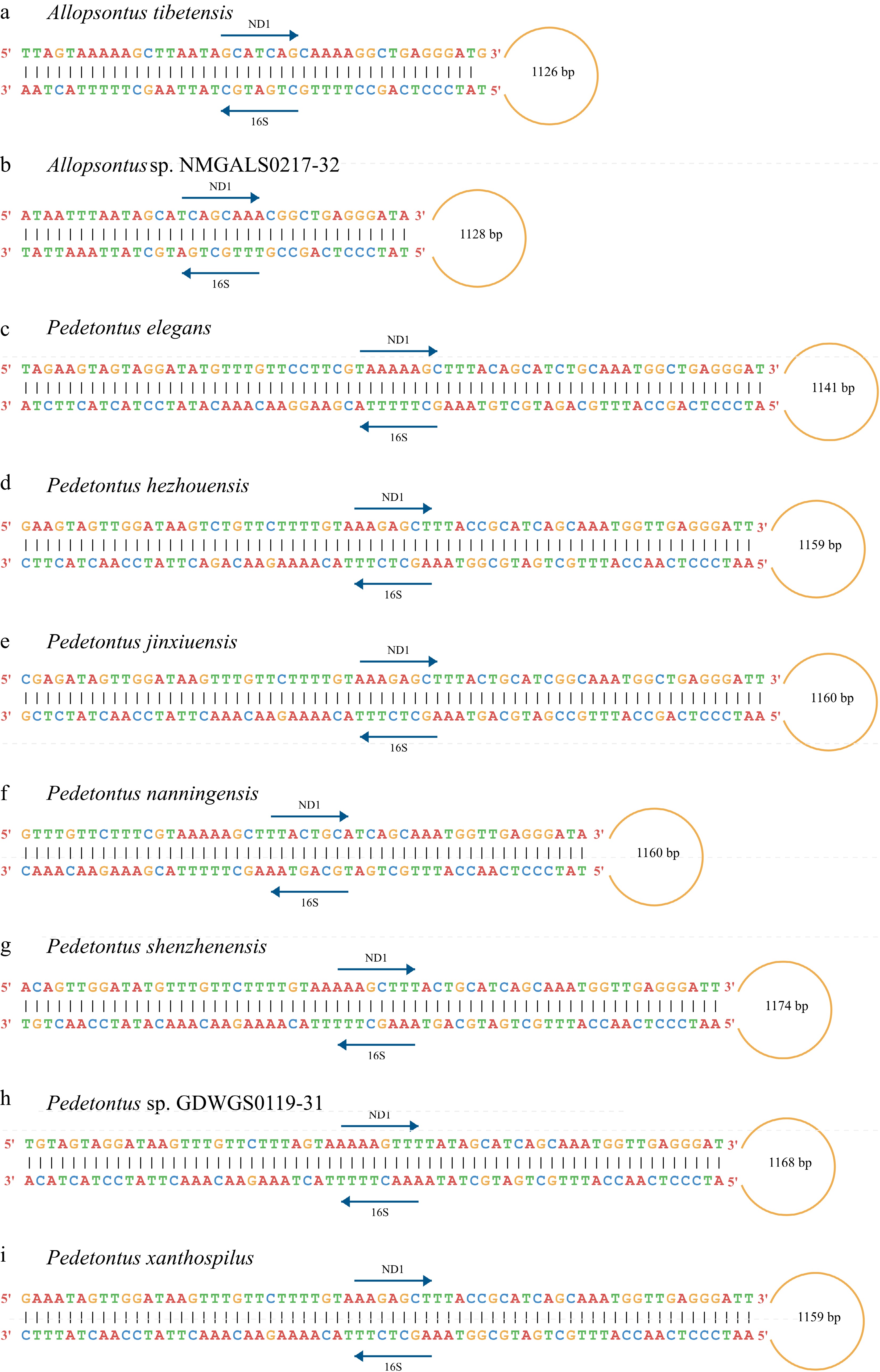
Figure 1.
Inferred hairpin structures of nine mitogenomes. The circle means the length between the ND1 gene and 16S rRNA gene. (a) Allopsontus tibetensis. (b) Allopsontus sp. NMGALS0217-32. (c) Pedetontus elegans. (d) Pedetontus hezhouensis. (e) Pedetontus jinxiuensis. (f) Pedetontus nanningensis. (g) Pedetontus shenzhenensis. (h) Pedetontus sp. GDWGS0119-31. (i) Pedetontus xanthospilus.
Phylogeny analyses
-
Based on 13 PCGs, phylogenetic trees were constructed using BI and ML. Topologies recovered by both methods were highly congruent (Fig. 2), with all major clades receiving strong statistical support (Bayesian posterior probabilities ≥ 0.95; ML bootstrap values ≥ 90%). These analyses robustly corroborate the monophyly of Archaeognatha. At the family level, Meinertellidae was recovered as paraphyletic: Machilontus medogensis was consistently placed as sister to Petrobiellinae, forming a clade (((Petrobiellus puerensis + P. bannaensis) + M. medogensis) + Nesomachilis australica). Likewise, Machilidae was paraphyletic, with Petrobiellinae embedded within a broader lineage that includes Meinertellidae. Petrobiinae was confirmed as monophyletic, whereas Machilinae was not, as Trigoniophthalmus alternatus was recovered core Machilinae clade, rendering the subfamily paraphyletic. At the genus level, Pedetontinus and Coreamachilis were recovered as monophyletic lineages. In contrast, Allopsontus was recovered as polyphyletic, with its species nesting among Coreamachilis and Songmachilis in the topology ((((C. coreanus + C. songi) + A. helanensis) + (A. baii + Allopsontus sp.)) + (A. tibetensis + S. xinxiangensis)).
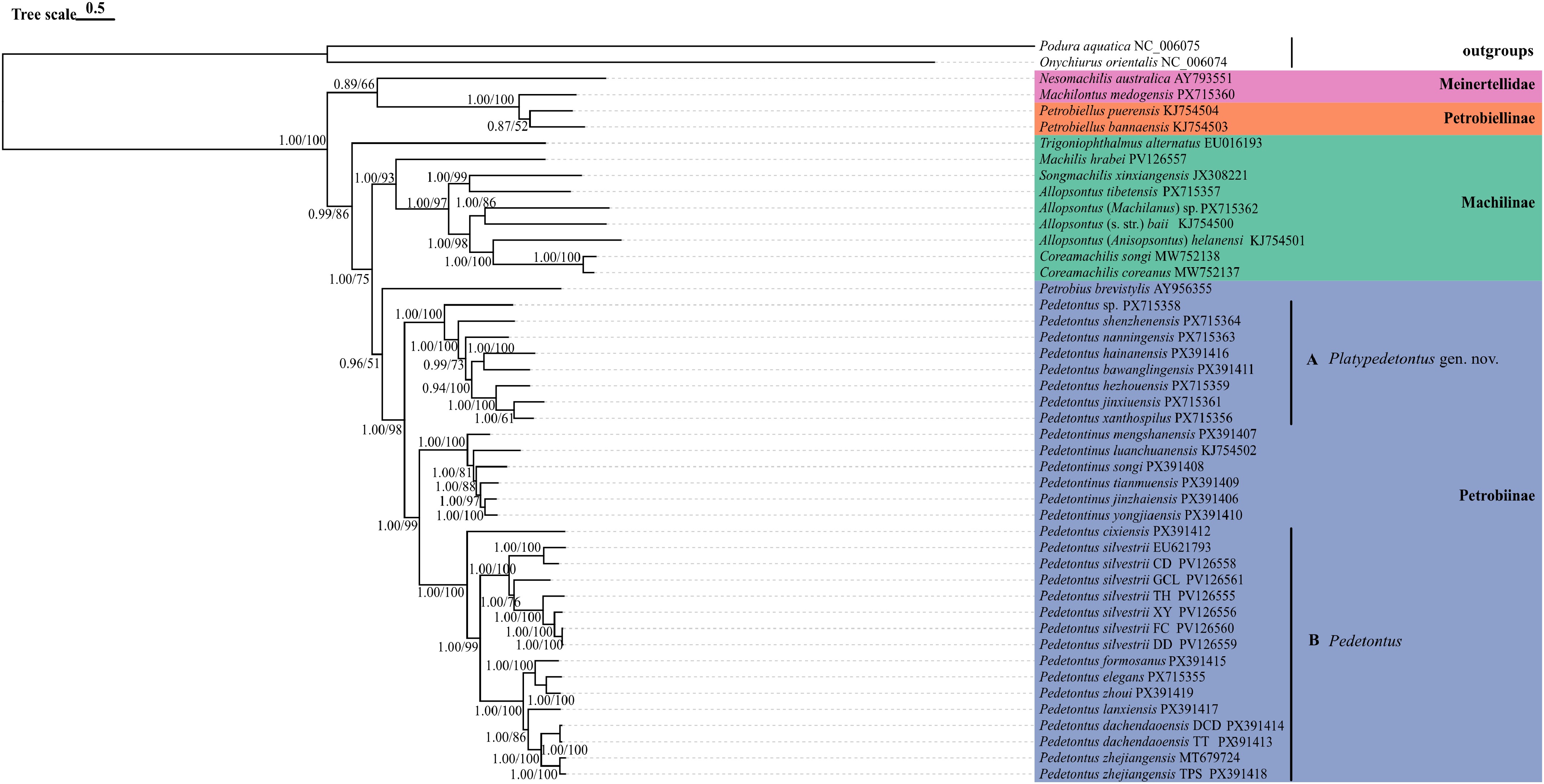
Figure 2.
Phylogenetic relationships within Archaeognatha inferred from the analysis of 13 mitochondrial PCGs using ML and BI methods. The numbers on the right side of each branch represent bootstrap values, while those on the left side represent posterior probabilities.
In contrast, Pedetontus was paraphyletic (Fig. 2), splitting into two distinct clades: (Pedetontus clade A + [Pedetontinus + Pedetontus clade B]). Pedetontus clade A showed the following phylogenetic relationship: ((((((P. jinxiuensis + P. xanthospilus) + P. hezhouensis) + (P. hainanensis + P. bawanglingensis)) + P. nanningensis) + P. shenzhenensis) + Pedetontus sp.), and Pedetontus clade B including 17 mitogenomes of seven species, which formed a sister clade to Pedetontinus.
Estimation of divergence time
-
Divergence time estimation (Fig. 3) indicates that Archaeognatha originated in the Late Devonian (approximately 379.11 Mya). The family Machilidae diverged during the Middle Triassic (approximately 238.13 Mya), whereas the most recent common ancestor (MRCA) of Meinertellidae and the subfamily Petrobiellinae dates to the Early Cretaceous (approximately 127.67 Mya). The MRCA of Machilinae and Petrobiinae also arose in the Late Cretaceous (approximately 96.68 Mya), by the diversification of Petrobiinae in the early Late Cretaceous (approximately 89.74 Mya). At the genus level, within the Pedetontus, clade A originated in the Late Cretaceous (approximately 75.30 Mya), with its internal radiation occurring in the Paleogene (approximately 46.55 Mya). Pedetontinus diverged during the Paleocene Epoch (approximately 65.07 Mya), whereas Pedetontus clade B diverged during the Eocene Epoch (approximately 48.46 Mya). Machilis originated in the Eocene (approximately 37.11 Mya). Subsequent Miocene diversification gave rise to Allopsontus (approximately 31.93 Mya), Coreamachilis (approximately 21.80 Mya), and Songmachilis (approximately 23.29 Mya). Within Meinertellidae, Machilontus medogensis diverged in the Eocene (approximately 32.85 Mya), and A. tibetensis subsequently diverged during the Miocene (approximately 23.29 Mya).
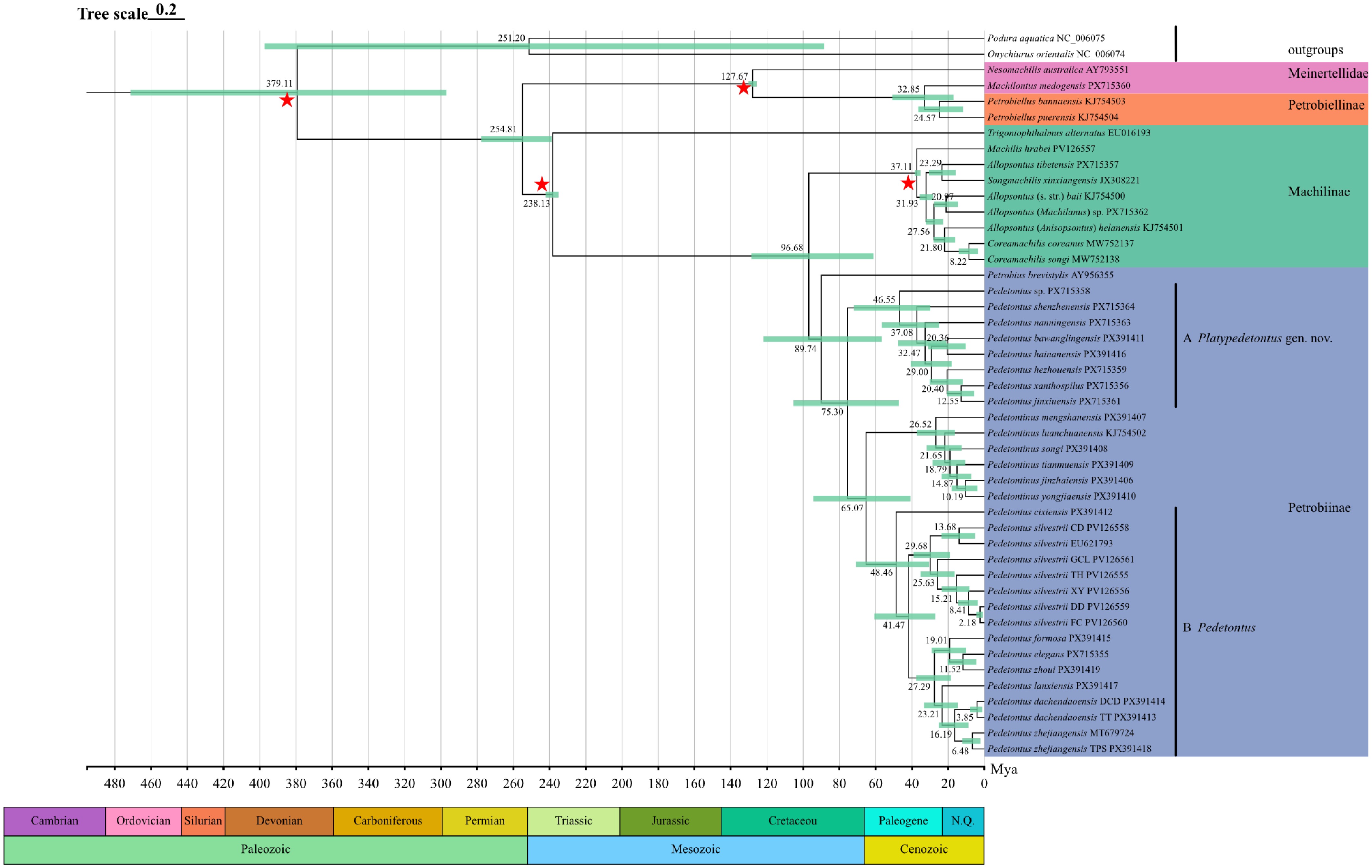
Figure 3.
The chronogram of Archaeognatha was inferred using MCMCTree, with the 95% highest posterior density (HPD) intervals indicated by bars at the nodes. Stars denote the placement of fossil calibration points. Median ages are provided below each node.
Analysis of positive selection
-
Using a concatenated dataset of 13 PCGs from 44 Archaeognatha species, we employed the branch-site model to detect positive selection at specific amino acid sites. With Allopsontus sp. as the foreground branch, five positively selected sites were identified as potentially under significant positive selection (p < 0.001, BEB ≥ 0.95): ND2 (site 181), ND4 (site 82), ND5 (sites 330 and 402), and ND6 (site 122). Notably, site 181 of ND2 was localized within a predicted transmembrane domain (Supplementary Table S5, Supplementary Fig. S4). With A. tibetensis as the foreground branch, six positively selected sites were identified: COX2 (site 155), CYTB (site 106), ND1 (site 245), ND4 (site 179), and ND5 (sites 376 and 498) (Supplementary Tables S5 and S6). In contrast, analysis with M. medogensis as the foreground branch revealed three positively selected sites: COX1 (site 484), ND2 (site 227), and ND5 (site 495) (Supplementary Tables S5 and S6). In contrast, no significant signals were detected using the branch, site, or clade models, suggesting that selection pressures are restricted to specific codons rather than entire genes or clades.
-
The ten newly sequenced Archaeognatha mitogenomes are circular, double-stranded DNA molecules containing the standard 37 genes; their arrangement follows the ancestral Drosophila yakuba pattern, supporting extensive genomic stability across the order[11,84]. Codon usage was dominated by UUA (L), AUU (I), UUU (F), and AUA (M), with a strong preference for A/U at the third position, a feature shared with Hymenoptera and Ephemeroptera but distinct from Diptera[32,85−87]. Most PCGs terminate with complete stop codons (TAA or TAG); however, COX1, COX2, and ND5 terminate with an incomplete T, a feature widely documented in Archaeognatha and presumed to be completed post-transcriptionally via post-transcriptional polyadenylation[13,15,20,88].
All tRNA genes mostly exhibited typical cloverleaf structures, except for trnS1, which lacked the DHU arm, consistent with broader metazoan trends[30]. The tRNA cluster located between ND3 and ND5 exhibits the highly conserved tRNAAla-tRNAArg-tRNAAsn-tRNASer1-tRNAGlu-tRNAPhe cluster, with no gene rearrangements detected unlike those reported in Trigoniophthalmus alternatus or Petrobius brevistyli[11,40]. Notably, a conserved long hairpin structure is present in the intergenic region between ND1 and 16S rRNA in all examined Petrobiinae and Machilinae species but is absent in M. medogensis (Meinertellidae) as well as in Petrobiellus puerensis and Petrobiellus bannaensis (Petrobiellinae). This structural feature thus represents a robust molecular synapomorphy uniting Petrobiinae and Machilinae[15,20].
Phylogeny analyses
-
Our concatenated molecular phylogeny robustly supports the monophyly of the order Archaeognatha. However, both Machilidae and Meinertellidae are recovered as non-monophyletic. Specifically, Meinertellidae is recovered as non-monophyletic. This topological placement contradicts well-supported prior molecular phylogenies[14,29] and undermines classical morphological synapomorphies supporting meinertellid monophyly[16,89]. Future studies should substantially increase taxon sampling within Meinertellidae and integrate genome-scale molecular data with morphological re-evaluation. Moreover, previous studies have suggested that some specimens attributed to Petrobiellinae may have been misidentified and do not represent true Petrobiellus species, potentially introducing systematic error into previous analyses[20−22]. Given the close phylogenetic relationship between Petrobiellinae and Meinertellidae, Machilidae is rendered paraphyletic, a result congruent with multiple previous studies[11,13−15,20,89]. Collectively, these results highlight that the current delimitation of Meinertellidae remains unstable, and the phylogenetic position of Petrobiellinae requires rigorous reassessment using denser taxon sampling, genome-scale molecular data, and integrated morphological re-evaluation[20].
The monophyly of Machilinae is not recovered in our analyses, as Trigoniophthalmus alternatus is consistently recovered as the sister clade to all other Machilinae species. This finding aligns with previous morphological and molecular evidence[1,11,15,20]. Similarly, Allopsontus is resolved as polyphyletic, a pattern consistent with earlier molecular studies[15,19]. This polyphyletic pattern may be attributed to its seven currently recognized subgenera, which exhibit broad and disjunct distributions across Central Asia, Northwest China, and the southern foothills of the Himalayas[19,90]. Consequently, a systematic re-evaluation of these subgenera integrating both molecular and morphological data is warranted. In contrast, Petrobiinae is robustly supported as monophyletic, supporting previous conclusions on both molecular and morphological datasets[15,18,20]. Within this subfamily, Petrobius brevistylis occupies a well-supported basal position. Morphologically, it is distinguished by undivided claspers and an aedeagus significantly longer than gonocoxite IX, contrasting sharply with the segmented claspers and shorter aedeagus typical of most Petrobiinae species[19,91].
All Pedetontus species included in this study were historically assigned to the subgenus Verhoeffilis. Phylogeographic reconstructions indicate that Verhoeffilis originated in the East Asian Palaearctic, from which ancestral lineages dispersed into North America and subsequently underwent vicariance in the Nearctic region, giving rise to the nominate subgenus Pedetontus s. str.[92]. Later, certain Nearctic-derived lineages recolonized the Palaearctic, forming the extant Palaearctic Pedetontus species. Concurrently, Verhoeffilis expanded southward into the Indomalayan region[92]. Our concatenated molecular phylogeny robustly recovers Pedetontus as non-monophyletic, comprising two deeply divergent, reciprocally monophyletic clades (clade A and clade B), with clade B forming a well-supported sister-clade relationship to Pedetontinus. This topological relationship is independently corroborated by maximum-parsimony analysis of a discrete morphological character matrix (Supplementary Fig. S5, Supplementary Tables S7 and S8). Collectively, these findings reveal a profound incongruence between the current Linnaean classification of Archaeognatha and its empirically inferred evolutionary history.
Analysis of divergence time
-
Divergence time estimates indicate that Archaeognatha originated in the Late Devonian, which differs from previous studies[13]. This origin predates a documented macroevolutionary peak in mitochondrial nucleotide substitution rates spanning the Carboniferous–Permian boundary[7]. These lush ground-level plant communities likely provided the essential resource foundation for the radiative evolution of this ancient order. We estimate the crown-group origin of Machilidae to the Middle Triassic, corroborating previous molecular and paleontological inferences[13,20,29]. The most recent common ancestor (MRCA) of Machilidae and Meinertellidae is dated to the Early Cretaceous (~127 Mya), a timeframe strongly supported by the exquisitely preserved Early Cretaceous fossil Cretaceomachilis libanensis[72] and congruent with comparative morphological studies of the ovipositor and phallus[14]. Our analysis further resolves the divergence between Machilinae and Petrobiinae to the Late Cretaceous, which is a notably younger estimate than the Late Jurassic (~155 Mya) proposed in earlier studies[13,20]. Critically, these major lineage-splitting events coincide temporally with the angiosperm radiation and the intensification of insect–plant coevolutionary interactions during the Cretaceous Terrestrial Revolution[93,94]. Under the prevailing greenhouse climate and elevated atmospheric CO2 concentrations[95], epiphytic bryophyte and early angiosperm understory communities underwent rapid diversification[96]. The expansion of these plant communities likely provided the ecological niches requisite for driving the Cretaceous diversification of Archaeognatha.
At the genus level, the origin of Machilis is estimated to be the Eocene, consistent with the well-constrained fossil-calibrated divergence window of 32.5–56.5 Mya[13,14,20]. Diversification of Allopsontus, Coreamachilis, and Songmachilis occurred during the Miocene, a period characterized intense global tectonism including the rapid uplift of the Himalayas, Alps, and Andes, which reconfigured continental-scale topography, established modern mountain–basin systems, and generated extensive new ecological gradients[97,98]. Pedetontus clade A originated during the Late Cretaceous, whereas its subsequent lineage diversification, as well as the divergence of Pedetontus, both took place during the Paleogene. During the peak of the Late Cretaceous 'Super-Greenhouse' effect, the poles were ice-free and covered by dense forest corridors[99,100]; this likely provided an ideal opportunity for flightless Archaeognathans to engage in transcontinental dispersal via the Bering Land Bridge[101]. As the Paleogene progressed, particularly during the Early Eocene Climatic Optimum (EECO), sustained global warmth significantly accelerated physiological metabolism and molecular evolutionary rates across ectothermic lineages[102−104]. This thermal regime drove widespread range contractions and habitat fragmentation across East Asia and North America, promoting the emergence of spatially isolated 'refugial microhabitats' embedded within dense vegetation matrices[105]. Within these fragmented landscapes, microenvironmental heterogeneity including localized humidity gradients, substrate composition, and canopy density, likely intensified genetic drift and promoted adaptive divergence, thereby catalyzing elevated intra-lineage speciation rates[92,105−107].
The divergence of M. medogensis (approximately 32.85 Mya) coincided with the systemic regional uplift of the Qinghai-Tibetan Plateau (QTP)[108−110]. While the plateau featured a fragmented 'central canyon' topography rather than a uniform mass, the low-elevation, humid Medog region served as a stable tropical/subtropical refugium[111−114]. This orogeny-driven tectonic vicariance severed gene flow between populations, thereby inducing genetic fragmentation and independent evolution. Later, the divergence of A. tibetensis (approximately 23.29 Mya) was anchored at the nexus of rapid QTP uplift and the onset of the East Asian Monsoon (EAM)[110,115−117]. This spatio-temporal coupling driven by Himalayan orogeny–induced vegetation turnover in Nyingchi and monsoon-modulated precipitation redistribution has intensified habitat fragmentation[114,118,119]. The synergy between stepwise uplift and geoclimatic transitions not only shaped the genus’s complex Eurasian distribution but also facilitated morphological specialization within these extreme environments[110].
In summary, from the Late Devonian to the Neogene, the evolutionary trajectory of Archaeognatha has been fundamentally shaped by episodic tectonic reorganization, climatic regime shifts, and associated transformations of terrestrial vegetation structure and biogeographic connectivity. Our findings demonstrate that the macroevolutionary history of this ancient hexapod lineage is tightly coupled with the spatiotemporally structured transformation of Earth’s terrestrial ecosystems, particularly the assembly of complex ground-layer flora, the rise of angiosperm-dominated forests, and the orogenically driven fragmentation and reconfiguration of habitable landscape.
Positive selection analysis
-
Branch-site model analysis of the drought-adapted Allopsontus sp. revealed significant signatures of positive selection in several Complex I subunits (ND2, ND4, ND5, and ND6). Notably, positively selected site at position 181 of ND2 resides within a conserved transmembrane domain. These adaptive substitutions are spatially concentrated in respiratory chain Complex I, the primary entry point of the mitochondrial electron transport chain (ETC), which drives proton translocation across the inner membrane to establish the electrochemical gradient essential for oxidative phosphorylation[120−124]. As seven of its 45 subunits are mtDNA-encoded, Complex I is particularly susceptible to oxidative damage induced by reactive oxygen species (ROS) generated during electron leakage[124]. ND2 serves as a core structural scaffold and directly contributes to proton-pumping function through conformational coupling with the membrane[125,126]. The recurrent positive selection observed across these ND subunits implies that amino acid replacements may fine-tune proton translocation efficiency, thereby optimizing ATP synthesis under water-limited conditions, a plausible molecular adaptation to sustain cellular energy homeostasis during drought stress.
Low temperatures reduce biochemical reaction rates, impair energy metabolism efficiency, and induce oxidative stress[127]. Using high-altitude and cold-adapted A. tibetensis as the foreground branch, branch-site model analysis identified six statistically significant positively selected sites across COX2, CYTB, ND1, ND4, and ND5 genes. In contrast, when Machilontus medogensis was designated as the foreground lineage, positive selection was detected at only three sites in COX1, ND2, and ND5. These genes encode evolutionarily conserved core subunits of mitochondrial respiratory chain Complexes I, III, and IV. Specifically, ND subunits constitute the membrane-embedded core of Complex I, ND2 functions as a central structural scaffold essential for complex assembly and stability; ND4 and ND5 form critical components of the proton-pumping machine, directly participating in conformational coupling that drives proton translocation[123,126,128,129]. CYTB is the primary transmembrane subunit of Complex III, coupling redox reactions with proton transport[130]. Within Complex IV, COX1 serves as the catalytic core for oxygen reduction and proton pumping, while COX2 acts as an environment-sensitive subunit facilitating electron transfer and potentially regulating ATP synthesis[131−134]. The recurrent positive selection observed at these sites likely represents molecular imprints enabling A. tibetensis and M. medogensis to maintain efficient energy production and proton gradient establishment under thermal stress. Extensive research confirms that mitochondrial genes undergo adaptive evolution under low-temperature stress. This inference aligns with extensive evidence of mitochondrial adaptive evolution in cold-adapted ectotherms: positive selection has been documented in CYTB and COX1 of alpine heptageniid mayflies[135], ND4 of cold-tolerant Tetranychus species[37], and ATP8 and ND2 of potamanthid mayflies inhabiting glacial streams[32]. Similarly, cold climates have driven positive selection in the metabolic genes of Hyla and Rana frogs[136]. Collectively, the identification of six positively selected sites in the A. tibetensis mitogenome reinforces the well-established principle that mitochondrial respiratory genes are primary targets for natural selection in low-temperature environments.
In summary, Archaeognatha exhibits convergent molecular evolution across lineages adapted to distinct environmental stressors, eg. drought, cold, and high-altitude hypoxia. Although the specific positively selected amino acid substitutions are environment-specific, the underlying genetic targets, predominantly ND subunits of mitochondrial Complex I, are consistently implicated. This recurrent targeting of core respiratory machinery indicates that fine-tuning electron transport chain efficiency represents a fundamental adaptive strategy for maintaining cellular energy homeostasis under diverse environmental constraints. Future functional studies will be essential to elucidate the biochemical and biophysical consequences of these candidate substitutions.
-
Platypedetontus Yang & Zhang, gen. nov.
The genus Pedetontus is resolved as non-monophyletic, comprising two deeply divergent, reciprocally monophyletic clades, here designated clade A and clade B, with the topology (Pedetontus clade A + (Pedetontinus + Pedetontus clade B)) recovered in both molecular and morphological phylogenies (Supplementary Fig. S5). Divergence time estimation indicates that Pedetontus clade A originated in the Late Cretaceous (~75.30 Mya), whereas Pedetontus clade B diverged during the early Eocene (~48.46 Mya), reflecting independent evolutionary trajectories spanning distinct geological epochs. This deep temporal separation is corroborated by a suite of consistent, non-homoplastic morphological synapomorphies: clade A exhibits the following features: Compound eyes suboval, distinctly wider than long, with a short contact line (Fig. 4). Labial palp III with distinctly modified shape (dilated laterally), even more specialized in male. Thin and hyaline spiniform setae on ventral side of tarsus absent. Abdominal stylets relatively short, with well-developed apical spines. Abdominal stylet IX (excluding apical spine) shorter than coxite IX (Fig. 5). In contrast, clade B is distinctly different from clade A. Compound eyes rounded, longer than wide or length and width subequal, with a long contact line (Fig. 4). Labial palp III clavate, with a lesser degree of lateral dilation. Thin and hyaline spiniform setae on ventral side of tarsus present. Abdominal stylets relatively long, with well-developed apical spines. Abdominal stylet IX (excluding apical spine) longer than coxite IX (Fig. 5). Given the strong concordance between molecular phylogeny, divergence timing, and discrete morphological apomorphies, we conclude that Pedetontus clade A represents an independent evolutionary lineage warranting generic recognition. Accordingly, we erect the new genus Platypedetontus Yang & Zhang, gen. nov. to accommodate Pedetontus clade A and its closest relatives.
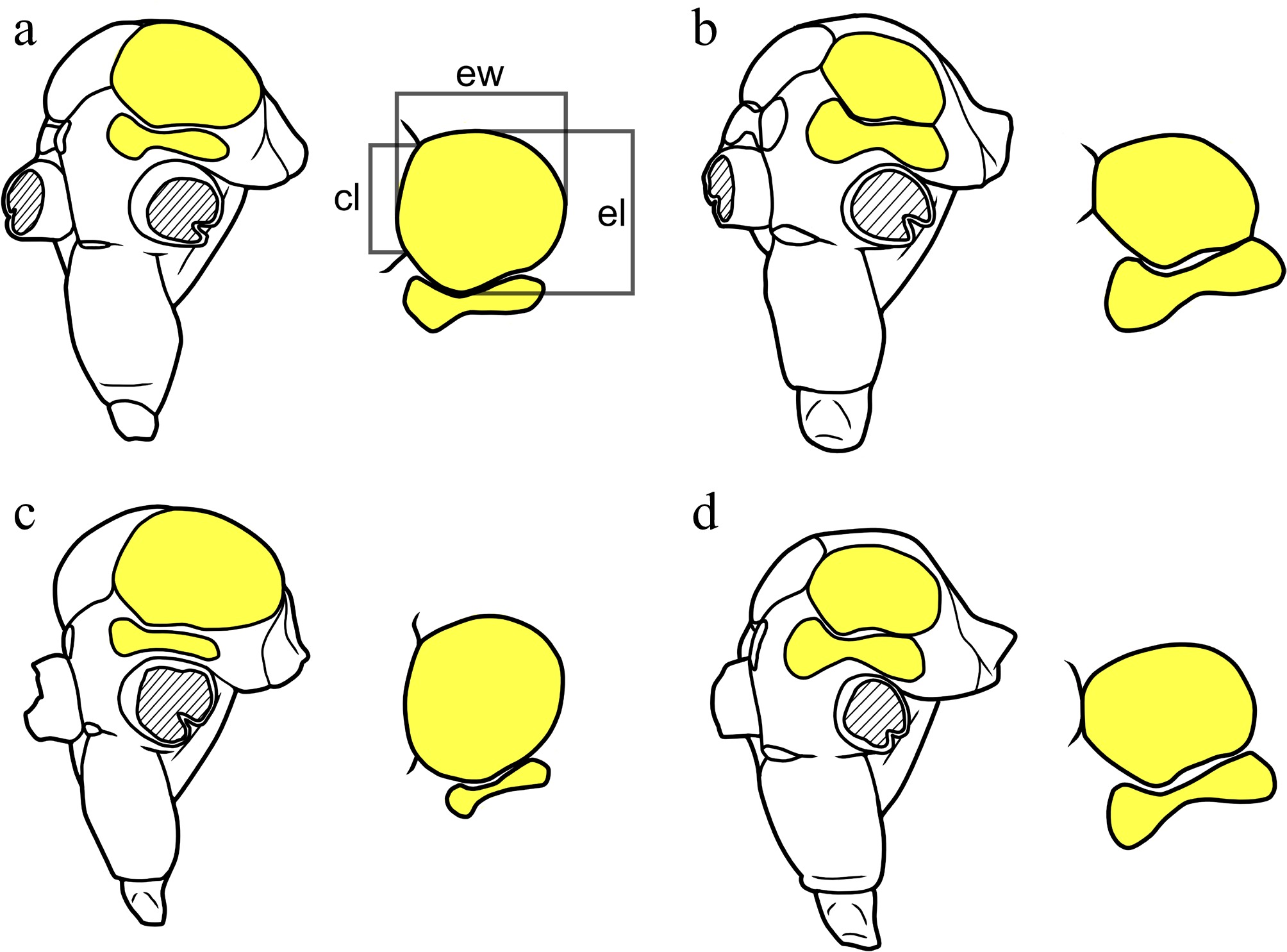
Figure 4.
Head, eyes and ocelli of Archaeognatha. Yellow indicates the visual organs (compound eyes and lateral ocelli). (a) Pedetontus (Verhoeffilis) unimaculatus Machida, 1980, after Machida 1980. (b) Platypedetontus nanningensis (Shen, Yang, Ji & Zhang, 2025) Yang & Zhang comb. nov., original; (c) Pedetontus (Verhoeffilis) elegans Shen, Yang, Ji & Zhang, 2025, original. (d) Platypedetontus xanthospilus (Shen, Yang, Ji & Zhang, 2025) Yang & Zhang, comb. nov., original. Abbreviation: cl: length of contact line; el: eye length; ew: eye width.
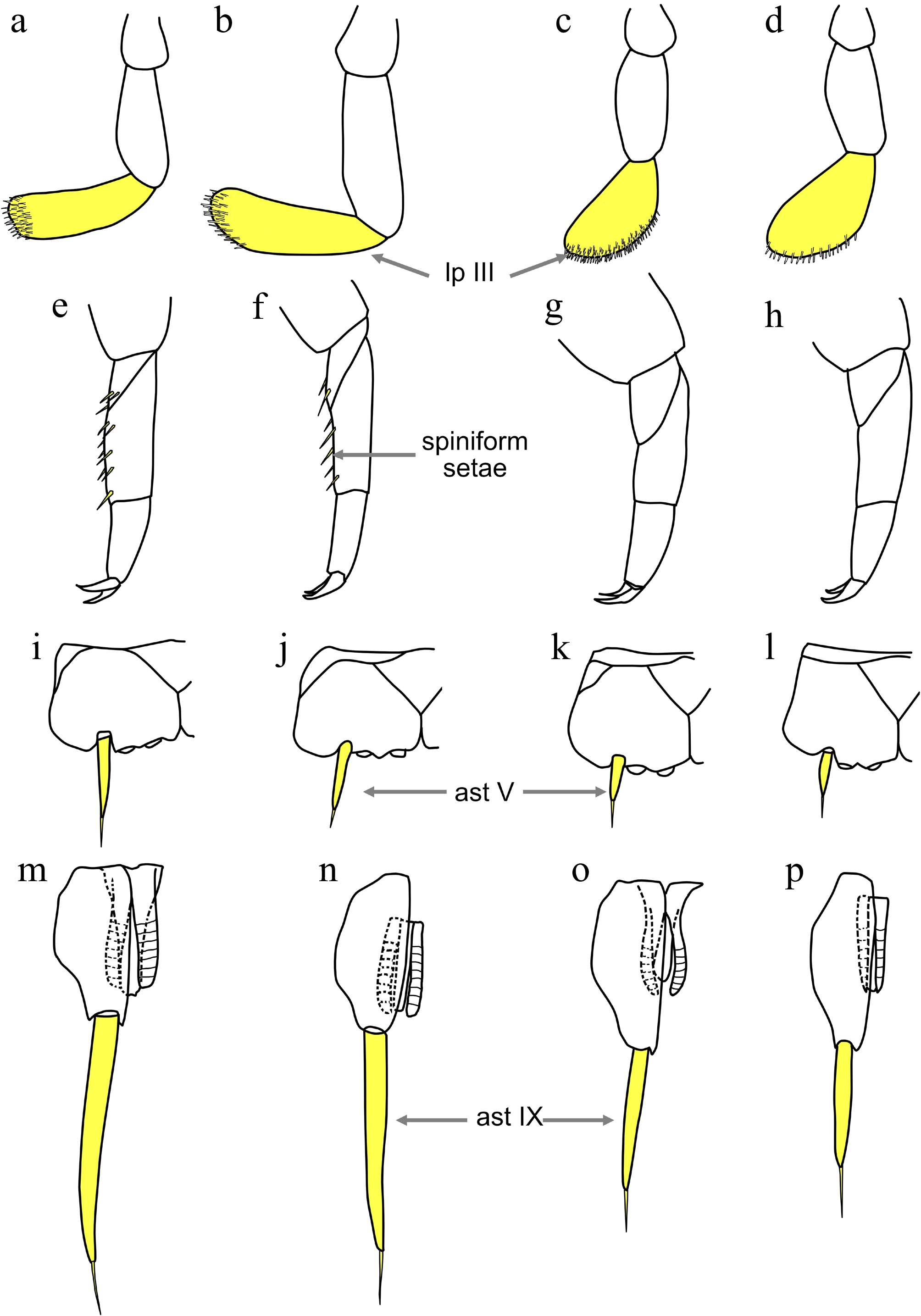
Figure 5.
Labial palps. (a) Pedetontus (Verhoeffilis) nigrus Kaplin, 2025, after Kaplin 2025. (b) Pedetontus (Verhoeffilis) elegans Shen, Yang, Ji & Zhang, 2025, original. (c) Platypedetontus xanthospilus (Shen, Yang, Ji & Zhang, 2025) Yang & Zhang, comb. nov., original. (d) Platypedetontus fukiensis (Silvestri, 1936) comb. nov., after Silvestri 1936. Forelegs. (e) Pedetontus (Verhoeffilis) silvestrii Mendes, 1991, after Mendes 1991. (f) Pedetontus (Verhoeffilis) elegans Shen, Yang, Ji & Zhang, 2025, original. (g) Platypedetontus phuketi (Kaplin, 2013) comb. nov., after Kaplin 2013. (h) Platypedetontus meridionalis (Mendes, 1981) comb. nov., after Mendes 1981. Coxites V. (i) Pedetontus (Verhoeffilis) longus Lee & Choe, 1992, after Lee 1992. (j) Pedetontus (Verhoeffilis) zhejiangensis Xue & Yin, 1991, after Xue 1991. (k) Platypedetontus xanthospilus (Shen, Yang, Ji & Zhang, 2025) Yang & Zhang, comb. nov., original; l: Platypedetontus bianchii (Silvestri, 1936) comb. nov., after Silvestri 1936. Coxites IX. (m) Pedetontus (Verhoeffilis) elegans Shen, Yang, Ji & Zhang, 2025, original; (n) Pedetontus (Verhoeffilis) zhoui Yu, Zhang & Zhang, 2010, after Yu 2010. (o) Platypedetontus xanthospilus (Shen, Yang, Ji & Zhang, 2025) Yang & Zhang, comb. nov., original; (p) Platypedetontus hainanensis (Yu, Zhang & Zhang, 2010) Yang & Zhang, comb. nov. Yellow indicates distinguishing characters. Abbreviation: ast: abdominal stylus; lp: labial palp.
ZooBank registration urn: lsid: zoobank.org:pub:85B04CC6-95E6-49E6-A7C7-410C89EB9345
Type species: Platypedetontus xanthospilus (Shen, Yang, Ji & Zhang, 2025) Yang & Zhang, comb. nov., original combination: Pedetontus xanthospilus Shen, Yang, Ji & Zhang, 2025. Holotype: ♂ (GDZQ0118-28), well-preserved; labeled: 'Beiling Mountain Forest Park, Duanzhou District, Zhaoqing City, Guangdong Province, China, 23.1500° N, 112.5000° E, 50–150 m, 20.11.2024–3.1.2025'. The holotype is deposited in the Animal Museum of Zhejiang Normal University, Jinhua, China. Dissected body parts of the holotype are individually stored in 200 μL PCR tubes containing 80% ethanol and preserved at −20 °C in the dark (with 80% ethanol regularly replenished).
Generic description: Flagellum of antenna devoid of scales. Compound eyes suboval, distinctly wider than long, with a short contact line. Paired ocelli shoe-shaped (dumbbell-shaped), subinferior to the compound eyes, relatively close to each other. Frons moderately convex between the paired ocelli. Mandibles with four typical apical teeth; labial palp III with distinctly modified shape (dilated laterally), even more specialized in male. Thorax normal, the nota with the usual development. Coxal stylets on P II and P III only. Thin and hyaline spiniform setae on ventral side of tarsus absent. P I of male not swollen. Tarsal scopula absent. 2 + 2 eversible vesicles on the abdominal segments II–V. Urosternites acutangle to rectangle. Abdominal stylets relatively short, with well-developed apical spines. Abdominal stylet IX (excluding apical spine) shorter than coxite IX. Paramera restricted to segment IX, clearly articulated. Penis opening little, apical. Male genitalia completely covered by coxites IX. Ovipositor of the primary type. Terminal filaments with piliform setae.
Etymology: The generic name Platypedetontus is derived from the Greek prefix 'platy-' (meaning broad or flat) and the established genus Pedetontus. It refers to the fact that the new genus is established for a clade of species previously assigned to Pedetontus, characterized by compound eyes that are distinctly wider than long. The Chinese name for Platypedetontus gen. nov. is 宽跳蛃属.
Key to the genera Pedetontus (V.), Pedetontinus, and Platypedetontus gen. nov.
1 Abdominal coxite II–V with 1 + 1 eversible vesicles Pedetontinus Silvestri, 1943 − Abdominal coxite II–V with 2 + 2 eversible vesicles 2 2 Compound eyes suboval, wider than long (L/W < 0.95), with a short contact line (CL/L < 0.6), thin and hyaline spiniform setae on ventral side of tarsus absent Platypedetontus Yang & Zhang, gen. nov. − Compound eyes longer than wide or length and width subequal (L/W ≥ 0.95), with a short contact line (CL/L ≥ 0.6), thin and hyaline spiniform setae on ventral side of tarsus present Pedetontus (V.) Paclt, 1972 Checklist of species of Platypedetontus Yang & Zhang, gen. nov.
Platypedetontus bouvieri (Silvestri, 1906) Yang & Zhang, comb. nov.
Platypedetontus bianchii (Silvestri, 1936) Yang & Zhang, comb. nov.
Platypedetontus fukiensis (Silvestri, 1936) Yang & Zhang, comb. nov.
Platypedetontus issikii (Silvestri, 1943) Yang & Zhang, comb. nov.
Platypedetontus coreanus (Silvestri, 1943) Yang & Zhang, comb. nov.
Platypedetontus sauterii (Silvestri, 1943) Yang & Zhang, comb. nov.
Platypedetontus okajimae (Silvestri, 1943) Yang & Zhang, comb. nov.
Platypedetontus uraiensis (Uchida, 1965) Yang & Zhang, comb. nov.
Platypedetontus meridionalis (Mendes, 1981) Yang & Zhang, comb. nov.
Platypedetontus hainanensis (Yu, Zhang & Zhang, 2010) Yang & Zhang, comb. nov.
Platypedetontus phuketi (Kaplin, 2013) Yang & Zhang, comb. nov.
Platypedetontus shenzhenensis (Shen, Yang, Ji & Zhang, 2025) Yang & Zhang, comb. nov.
Platypedetontus jinxiuensis (Shen, Yang, Ji & Zhang, 2025) Yang & Zhang, comb. nov.
Platypedetontus nanningensis (Shen, Yang, Ji & Zhang, 2025) Yang & Zhang, comb. nov.
Platypedetontus xanthospilus (Shen, Yang, Ji & Zhang, 2025) Yang & Zhang, comb. nov.
Platypedetontus hezhouensis (Shen, Yang, Ji & Zhang, 2025) Yang & Zhang, comb. nov.
Key to the species of Platypedetontus gen. nov.
1 Compound eyes length to width ratio ≥ 9/10 2 − Compound eyes length to width ratio < 9/10 5 2 Paired ocelli width to length ratio > 3 Platypedetontus issikii (Silvestri, 1943) Yang & Zhang, comb. nov. − Paired ocelli width to length ratio ≤ 3 3 3 Ovipositor exceeding stylus IX (including supporting spines) Platypedetontus coreanus (Silvestri, 1943) Yang & Zhang, comb. nov. − Ovipositor not exceeding stylus IX (including supporting spines) 4 4 Suberect brush-like setae on articles of maxillary palpus of male present; paramere with 1 + 7 divisions Platypedetontus bianchii (Silvestri, 1936) Yang & Zhang, comb. nov. − Suberect brush-like setae on articles of maxillary palpus of male absent; paramere with 1 + 8 divisions Platypedetontus phuketi (Kaplin, 2013) Yang & Zhang, comb. nov. 5 Ovipositor not exceeding stylus IX (including supporting spines) 6 − Ovipositor exceeding stylus IX (including supporting spines) 8 6 Compound eyes yellowish-green; article III of female labial palpus clavate Platypedetontus shenzhenensis (Shen, Yang, Ji & Zhang, 2025) Yang & Zhang, comb. nov. − Compound eyes brownish-yellow; article III of female labial palpus distinctly modified 7 7 Article III of labial palpus strongly modified, apex of female labial palpus without sensory cones Platypedetontus jinxiuensis (Shen, Yang, Ji & Zhang, 2025) Yang & Zhang, comb. nov. − Article III of labial palpus less modified, apex of female labial palpus with numerous sensory cones Platypedetontus xanthospilus (Shen, Yang, Ji & Zhang, 2025) Yang & Zhang, comb. nov. 8 Paired ocelli width to length ratio > 3 9 − Paired ocelli width to length ratio ≤ 3 10 9 Article VII of maxillary palpus distinctly longer than half the length of article VI; ratio of length of eye contact line to eye length ≥ 0.5 Platypedetontus fukiensis (Silvestri, 1936) Yang & Zhang, comb. nov. − Article VII of maxillary palpus distinctly shorter than half the length of article VI; ratio of length of eye contact line to eye length < 0.5 Platypedetontus bouvieri (Silvestri, 1906) Yang & Zhang, comb. nov. 10 Paired ocelli close to each other (ratio of distance between inner margins of paired ocelli to combined width of eyes < 0.1) Platypedetontus uraiensis (Uchida, 1965) Yang & Zhang, comb. nov. − Ratio of distance between inner margins of paired ocelli to combined width of eyes ≥ 0.1 11 11 Paired ocelli widely separated (ratio of distance between inner margins of paired ocelli to combined width of eyes ≥ 0.3) Platypedetontus meridionalis (Mendes, 1981) Yang & Zhang, comb. nov. − Ratio of distance between inner margins of paired ocelli to combined width of eyes < 0.3 12 12 Ratio of length of eye contact line to eye length ≤ 0.4 13 − Ratio of length of eye contact line to eye length > 0.4 14 13 Suberect brush-like setae on articles of maxillary palpus of male absent; paramere with 1 + 7 divisions Platypedetontus nanningensis (Shen, Yang, Ji & Zhang, 2025) Yang & Zhang, comb. nov. − Suberect brush-like setae on articles of maxillary palpus of male present; paramere with 1 + 8 divisions Platypedetontus hezhouensis (Shen, Yang, Ji & Zhang, 2025) Yang & Zhang, comb. nov. 14 Ratio of distance between inner margins of paired ocelli to combined width of eyes < 0.15 Platypedetontus sauterii (Silvestri, 1943) Yang & Zhang, comb. nov. − Ratio of distance between inner margins of paired ocelli to combined width of eyes ≥ 0.15 15 15 Paired ocelli width to length ratio > 2.5; paramere with 1 + 7 divisions Platypedetontus okajimae (Silvestri, 1943) Yang & Zhang, comb. nov. − Paired ocelli width to length ratio ≤ 2.5; paramere with 1 + 6 divisions Platypedetontus hainanensis (Yu, Zhang & Zhang, 2010) Yang & Zhang, comb. nov. Pedetontus (Verhoeffilis) Paclt, 1972
Type species: Petrobius (Pedetontus) calcaratus (Silvestri, 1911)
Subgeneric description: Flagellum of antenna devoid of scales. Compound eyes rounded, longer than wide or length and subequal width, with a long contact line. Paired ocelli shoe-shaped (dumbbell-shaped), subinferior to the compound eyes, relatively close to each other. Frons moderately convex between the paired ocelli. Mandibles with four typical apical teeth; labial palp III clavate, with a lesser degree of lateral dilation. Thorax normal, the nota with the usual development. Coxal stylets on P II and P III only. Thin and hyaline spiniform setae on ventral side of tarsus present. P I of male not swollen. Tarsal scopula absent. 2 + 2 eversible vesicles on the abdominal segments II–V. Urosternites acutangle to rectangle. Abdominal stylets relatively long, with well-developed apical spines. Abdominal stylet IX (excluding apical spine) longer than coxite IX. Paramera restricted to segment IX, clearly articulated. Penis opening little, apical. Male genitalia completely covered by coxites IX. Ovipositor of the primary type. Terminal filaments with piliform setae.
Revised checklist of species of Pedetontus (V.) Paclt, 1972
Pedetontus (V.) nipponicus (Silvestri, 1907)
Pedetontus (V.) persquamosus (Silvestri, 1911)
Pedetontus (V.) submutans (Silvestri, 1911)
Pedetontus (V.) calcaratus (Silvestri, 1911)
Pedetontus (V.) savioi Silvestri, 1936
Pedetontus (V.) diversicornis Silvestri, 1943
Pedetontus (V.) formosanus Silvestri, 1943
Pedetontus (V.) takahashi Silvestri, 1943
Pedetontus (V.) amamiensis Uchida, 1960
Pedetontus (V.) ussuriensis Kaplin, 1980
Pedetontus (V.) unimaculatus Machida, 1980
Pedetontus (V.) zhejiangensis Xue & Yin, 1991
Pedetontus (V.) silvestrii Mendes, 1991
Pedetontus (V.) longus Lee & Choe, 1992
Pedetontus (V.) gershneri Allen, 1995
Pedetontus (V.) zhoui Yu, Zhang & Zhang, 2010
Pedetontus (V.) furuhjelmi Kaplin, 2025
Pedetontus (V.) nigrus Kaplin, 2025
Pedetontus (V.) elegans Shen, Yang, Ji & Zhang, 2025
Revised key to the species of Pedetontus (V.)
1 Ventral apex of male maxillary palpus article V with a dense tuft of stout setae Pedetontus (V.) silvestrii Mendes, 1991 − Ventral apex of male maxillary palpus article V without dense tuft of stout setae 2 2 Article III of labial palpus distinctly modified, nearly subconical Pedetontus (V.) gershneri Allen, 1995 − Article III of labial palpus not modified, clavate 3 3 Compound eyes length to width ratio ≥ 1 4 − Compound eyes length to width ratio < 1 15 4 Ratio of length of eye contact line to eye length ≥ 0.7 5 − Ratio of length of eye contact line to eye length < 0.7 9 5 Paired ocelli width to length ratio ≥ 4 6 − Paired ocelli width to length ratio < 4 8 6 Paramere with 1 + 8 divisions Pedetontus (V.) zhoui Yu, Zhang & Zhang, 2010 − Paramere with 1 + 7 divisions 7 7 Ratio of distance between inner margins of paired ocelli to combined width of eyes > 0.2 Pedetontus (V.) formosanus Silvestri, 1943 − Ratio of distance between inner margins of paired ocelli to combined width of eyes ≤ 0.2 Pedetontus (V.) diversicornis Silvestri, 1943 8 Ovipositor of secondary type Pedetontus (V.) calcaratus (Silvestri, 1911) − Ovipositor of primary type Pedetontus (V.) savioi Silvestri, 1936 9 Paired ocelli width to length ratio > 3 10 − Paired ocelli width to length ratio ≤ 3 11 10 Article VII of maxillary palpus as long as article VI Pedetontus (V.) elegans Shen, Yang, Ji & Zhang, 2025 − Article VII of maxillary palpus shorter than article VI Pedetontus (V.) takahashi Silvestri, 1943 11 Female stylus IX distinctly shorter than length of coxite IX Pedetontus (V.) furuhjelmi Kaplin, 2025 − Female stylus IX not shorter than length of coxite IX 12 12 Paired ocelli width to length ratio > 2.8 Pedetontus (V.) amamiensis Uchida, 1960 − Paired ocelli width to length ratio ≤ 2.8 13 13 Paired ocelli width to length ratio < 2.4; article VII of maxillary palpus almost as long as article VI Pedetontus (V.) ussuriensis Kaplin, 1980 − Paired ocelli width to length ratio ≥ 2.4; article VII of maxillary palpus shorter than article VI 14 14 Paramere with 1 + 7 divisions Pedetontus (V.) nigrus Kaplin, 2025 − Paramere with 1 + 8 divisions Pedetontus (V.) zhejiangensis Xue & Yin, 1991 15 Paired ocelli width to length ratio > 4 Pedetontus (V.) persquamosus (Silvestri, 1911) − Paired ocelli width to length ratio ≤ 4 16 16 Suberect brush-like setae on articles of maxillary palpus of male absent Pedetontus (V.) submutans (Silvestri, 1911) − Suberect brush-like setae on articles of maxillary palpus of male present 17 17 Suberect brush-like setae on article I of maxillary palpus of male present; ovipositor not exceeding stylus IX (including supporting spines) Pedetontus (V.) unimaculatus Machida, 1980 − Suberect brush-like setae on article I of maxillary palpus of male absent; ovipositor exceeding stylus IX (including supporting spines) 18 18 Paired ocelli close to each other (ratio of distance between inner margins of paired ocelli to combined width of eyes ≤ 0.1) Pedetontus (V.) longus Lee & Choe, 1992 − Paired ocelli not close to each other (ratio of distance between inner margins of paired ocelli to combined width of eyes > 0.1) Pedetontus (V.) nipponicus (Silvestri, 1907) -
We report ten newly sequenced complete mitogenomes from Archaeognatha, all conforming to the canonical structural organization characteristic of insect mitogenomes. A highly conserved intergenic stem-loop structure (35–67 bp) was identified in the spacer region between ND1 and 16S rRNA across nine of the ten species; its consistent absence in Machilontus medogensis constitutes a molecular synapomorphy supporting its phylogenetic distinctness. Divergence time estimation suggests an Archaeognatha origin in the Late Devonian, with crown-clade Machilidae undergoing initial diversification during the Middle Triassic. The Allopsontus lineage diverged in the Miocene, whereas Pedetontus clade A = Platypedetontus gen. nov. originated in the Late Cretaceous, while subsequent lineage diversification within Platypedetontus and the radiation of Pedetontus (V.) both occurred during the Paleogene. Branch-site model analysis detected statistically significant signatures of positive selection in multiple mitochondrial respiratory genes including ND2, ND4, ND5, COX1, COX2, and CYTB, indicating adaptive fine-tuning of oxidative phosphorylation efficiency under arid and low-temperature environments. Integrating robust phylogenomic inference, divergence time estimation, and discrete morphological synapomorphies, we formally establish Platypedetontus gen. nov. This taxonomic revision resolves the non-monophyly of Pedetontus and establishes the well-supported topology (Platypedetontus gen. nov. + (Pedetontinus + Pedetontus (V.))).
We gratefully acknowledge Chen-Yang Shen, the Institute of Zoology of the Guangdong Academy of Sciences, Han-Sheng Ou, Ji-Liang Liu (Northwest Institute of Eco-Environment and Resources, Chinese Academy of Sciences) and Zhi-Qiang Guo for their assistance in sample collection during this study. Additionally, the authors thank Chen-Yang Shen for assistance in specimen dissection, species identification and during the establishment of the new genus.
-
This study was conducted using field-collected insect specimens and did not involve experiments on live vertebrates. According to relevant regulations, IACUC ethical approval was not required.
-
The authors confirm contribution to the paper as follows: study conception and design: Yang T, Zhang J; data collection: Yang T, Hu C, Cen W; analysis and interpretation of results: Yang T, Hu C, Ji J, Yu D; draft manuscript preparation: Yang T; Revision of manuscript: Yang T, Hu C, Cen W, Ji J, Yu D, Zhang J. All authors reviewed the results and approved the final version of the manuscript.
-
Supporting data for this study are available from the National Center for Biotechnology Information (www.ncbi.nlm.nih.gov) (accessed on 15 December 2025). GenBank numbers are PX715355–PX715364, see Table 1.
-
The authors declare that they have no conflict of interest.
-
accompanies this paper online at: https://doi.org/10.48130/jzser-0026-0018.
- Supplementary Table S1 Species used to construct the phylogenetic relationships along with GenBank accession numbers.
- Supplementary Table S2 Partition schemes and best evolutionary models obtained from PartitionFinder 2.1.1.
- Supplementary Table S3 The base composition of 13 PCGs in ten mitogenomes.
- Supplementary Table S4 The location of features of ten mitogenomes.
- Supplementary Table S5 Description of positively selected sites in mitochondrial PCGs.
- Supplementary Table S6 The results of the branch-site model when using three different foreground branches.
- Supplementary Table S7 Plesiomorphic and apomorphic states of the main morphological characters of Pedetontus (Verhoeffilis), Platypedetontus, Pedetontinus, and Silvestrichilis.
- Supplementary Table S8 Plesiomorphic and apomorphic states of the morphological characters of Pedetontus (Verhoeffilis), Platypedetontus, Pedetontinus, and Silvestrichilis.
- Supplementary Fig. S1 Circular maps of mitochondrial genes from ten species.
- Supplementary Fig. S2 Predicted secondary structures of mitochondrial tRNAs in Archaeognatha.
- Supplementary Fig. S3 Histograms of the relative synonymous codon usage (RSCU) for the ten mitogenomes.
- Supplementary Fig. S4 Positively selected sites in mitochondrial genes of Archaeognatha identified by the branch-site model.
- Supplementary Fig. S5 Phylogenetic relationships of Pedetontus (Verhoeffilis), Platypedetontus, Pedetontinus, and Silvestrichilis.
- This is an open access article under the terms of the Creative Commons Attribution License, which permits use, distribution and reproduction in any medium, provided the original work is properly cited.
-
About this article
Cite this article
Yang T, Hu C, Cen W, Ji J, Yu D, et al. 2026. Mitogenomics reveals the phylogeny and mitochondrial adaptation to environmental stress of Archaeognatha, with the description of a new genus. Journal of Zoological Systematics and Evolutionary Research 2026: e018 doi: 10.48130/jzser-0026-0018 

Mitogenomics reveals the phylogeny and mitochondrial adaptation to environmental stress of Archaeognatha, with the description of a new genus
- Received: 18 May 2026
- Revised: 07 August 2026
- Accepted: 11 September 2026
- Published online: 09 October 2026
Journal of Zoological Systematics and Evolutionary Research
2026,
Article number: e018 (2026)
|
Cite this article
Abstract: Archaeognatha is the most basal extant lineage of Insecta; however, its internal phylogeny and evolutionary history remain poorly resolved. In this study, we integrated ten newly sequenced Archaeognatha mitochondrial genomes with publicly available mitogenomic data retrieved from NCBI to investigate genomic architecture and evolutionary patterns. A notable long hairpin structure was identified between ND1 and 16S rRNA in nine species, excluding Machilontus medogensis. Phylogenomic inference robustly supported the topology (Pedetontus clade A + [Pedetontinus + Pedetontus clade B]). Divergence time estimation suggests an Archaeognatha origin in the Late Devonian, with subsequent diversification of Machilidae occurring during the Middle Triassic. Integrating congruent molecular phylogenetic signals with diagnostic morphological characteristics, including distinctive compound eyes, labial palps, and abdominal stylet proportions, we propose the new genus Platypedetontus gen. nov. to accommodate the monophyletic clade corresponding to Pedetontus clade A. Divergence time estimation indicates that Platypedetontus gen. nov. originated in the Late Cretaceous, while both its subsequent lineage diversification and the origin of the genus Pedetontus occurred during the Paleogene. Furthermore, branch-site model analysis detected positive selection signals in mitochondrial genes, suggesting adaptive molecular evolution potentially linked to physiological adaptations to arid and low-temperature environments.
