-
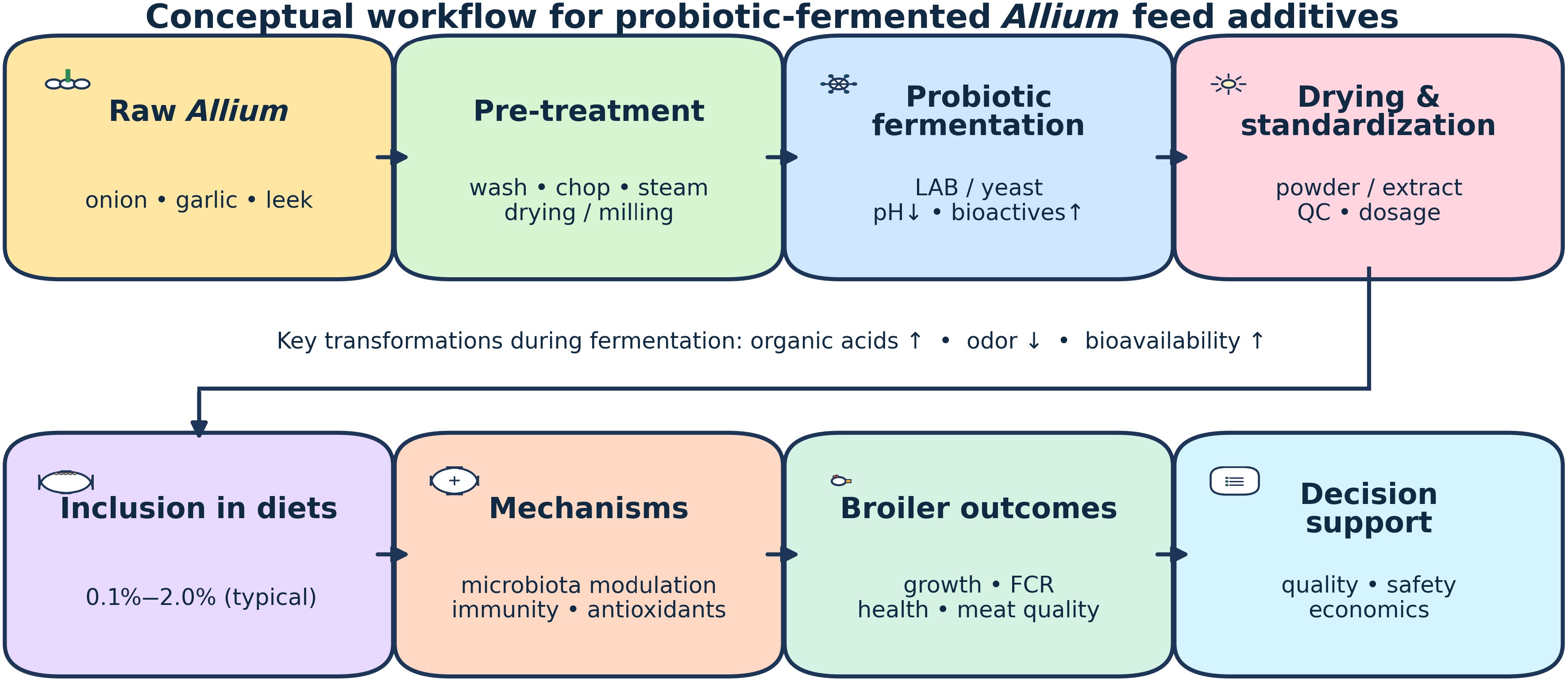
Figure 1.
Conceptual workflow for producing probiotic-fermented Allium feed additives. The diagram summarizes typical processing steps and key biochemical transformations reported for probiotic fermentation of Allium matrices.
-
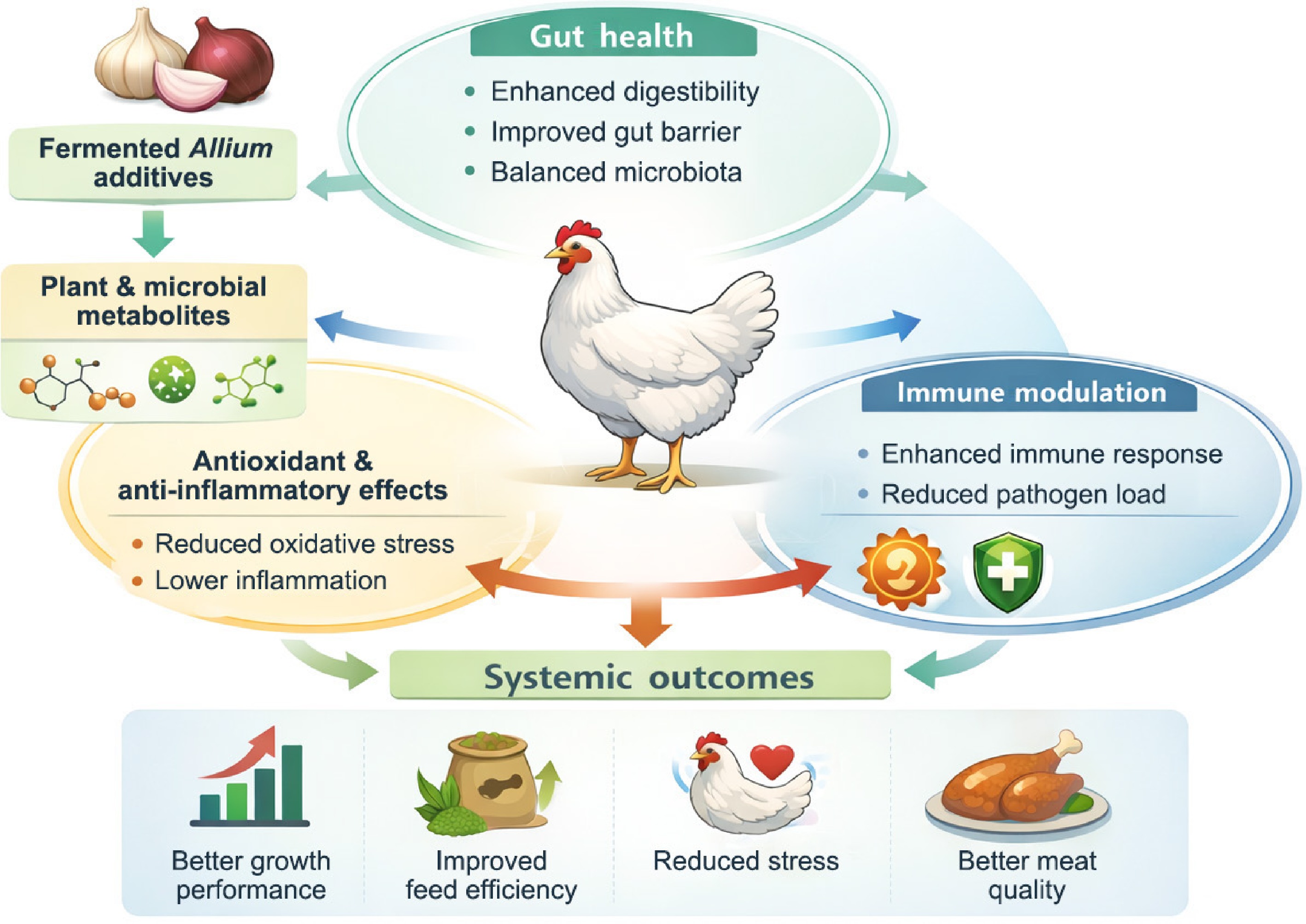
Figure 2.
Integrated mode of action model for fermented Allium additives in broilers. Multiple interacting pathways link plant and microbial metabolites to gut function and systemic outcomes.
-
Animal/model Allium source and form Dominant bioactive Main reported effects Ref. Broiler Garlic powder/extract OSCs; phenolics ↓ Enteric pathogens; ↑ antioxidant enzymes; variable BW/FCR [1−4,7,23−26] Broiler Onion/shallot powder Quercetin; fructans ↑ Microbiota diversity; potential ↓ serum lipids; modest performance gains [1,35−42] Broiler Allium hookeri root OSCs; saponins ↑ Tight junction markers; ↓ inflammatory response under LPS/NE models [27−29,43−45] Layers/quail Allium mixtures Mixed Improved egg quality; antioxidative status; microbial modulation [1,5,46] Challenge models Encapsulated PTSO/PTSO2 Thiosulfonates Reduced lesions and pathogen load; improved gut integrity [30−32] Table 1.
Summary of the reported effects of Allium-based additives in poultry and their associated bioactive classes.
-
Allium substrate Starter culture Format Indicative conditions Reported compositional shifts Functional implication Garlic/black garlic LAB and/or yeast SSF/SMF 24–72 h; pH ↓ ↑ Water-soluble sulfur metabolites;
↑ antioxidant capacityImproved stability and redox effects Onion/shallot Lactiplantibacillus spp. SMF 30–37 °C; 24–48 h ↑ Free phenolics (deglycosylation);
↓ pungencyHigher bio-accessibility; better palatability Allium hookeri root LAB or Bacillus SSF Moist substrate; 2–5 d Altered OSC/saponin profile;
↑ organic acidsBarrier protection under challenge Mixed herbs including Allium Bacillus + LAB SSF 1–3 d; aeration ↓ Antinutritional factors;
↑ enzyme activitiesPotential synergy with digestibility Table 2.
Typical effects of probiotic fermentation on Allium matrices.
-
Study / independence Design / context Product / dose Study-level result Interpretation Hai et al.[4] /
Author-group evidencen = 250 male J-Dabaco broilers; E. coli challenge on day 8; 35 d L. plantarum-fermented chive; 1% or 3% diet FC3: full-period BWG 739.5 vs 659.4 g/bird in challenged control; PEI 83.91 vs 57.37; FCR 2.32 vs 2.30 Clear challenge-model benefit for BWG/PEI; FCR not superior to challenged control Malematja et al.[22] / Independent n = 200 Ross 308; 42 d; no pathogen challenge Onion extract 0, 5, 10, 15, or 25 g/kg diet Growth performance and meat sensory outcomes were not significantly affected
(p > 0.05)Neutral performance result; demonstrates context/product heterogeneity Elbaz et al.[27] / Independent n = 480 Ross 308; 35 d; environmental heat stress Garlic essential oil 200 mg/kg; lemon EO 200 mg/kg; or mixture EO treatments improved body
weight/FCR and reduced mortality; SOD/GPx increased and MDA decreased
(p < 0.05)Supports stress-context benefit; not a fermented product, so used as related Allium evidence Fathi & Rezaee [31] / Independent n = 500 Ross 308 males; heat stress; 42 d Black garlic powder 10, 20,
or 30 g/kg in heat-stressed groupsSupplementation improved growth performance and reduced mortality; antioxidant defense increased (GPx) and
MDA decreasedSupports processed/fermented-garlic benefit under heat stress; dose- and context-specific Note: This is a structured narrative review; no pooled effect size or confidence interval is presented because products, challenge models, doses, and endpoints are heterogeneous. The table therefore reports study-level sample size, exposure, and quantitative/clearly significant outcomes where available. Table 3.
Representative evidence in broilers for fermented Allium-based products and related formulations (selected examples; qualitative synthesis).
-
Design element Recommendation Rationale Notes Raw material Specify species, plant part, cultivar/region, and processing history The chemical profile varies widely across sources Include marker analytics where feasible Fermentation Report starter strain(s), inoculum, time, temperature, moisture, and pH trajectory Biotransformation depends on the processing variables Differentiate SSF vs SMF Dose and duration Use dose-finding pilots; consider starter vs finisher phases Responses can be nonlinear; palatability matters Report feed intake/refusals Outcomes Measure performance plus gut/immune/redox biomarkers Mechanistic endpoints explain heterogeneity Include lesion scoring under challenge Economics Report cost per ton of feed and return on investment under farm conditions Adoption depends on net benefit Consider local ingredient costs Safety Monitor organoleptic effects and potential interactions High OSC loads may affect flavor or physiology Check compatibility with vaccines/coccidiostats Table 4.
Practical considerations for designing and evaluating fermented Allium interventions in broilers.
Figures
(2)
Tables
(4)