-
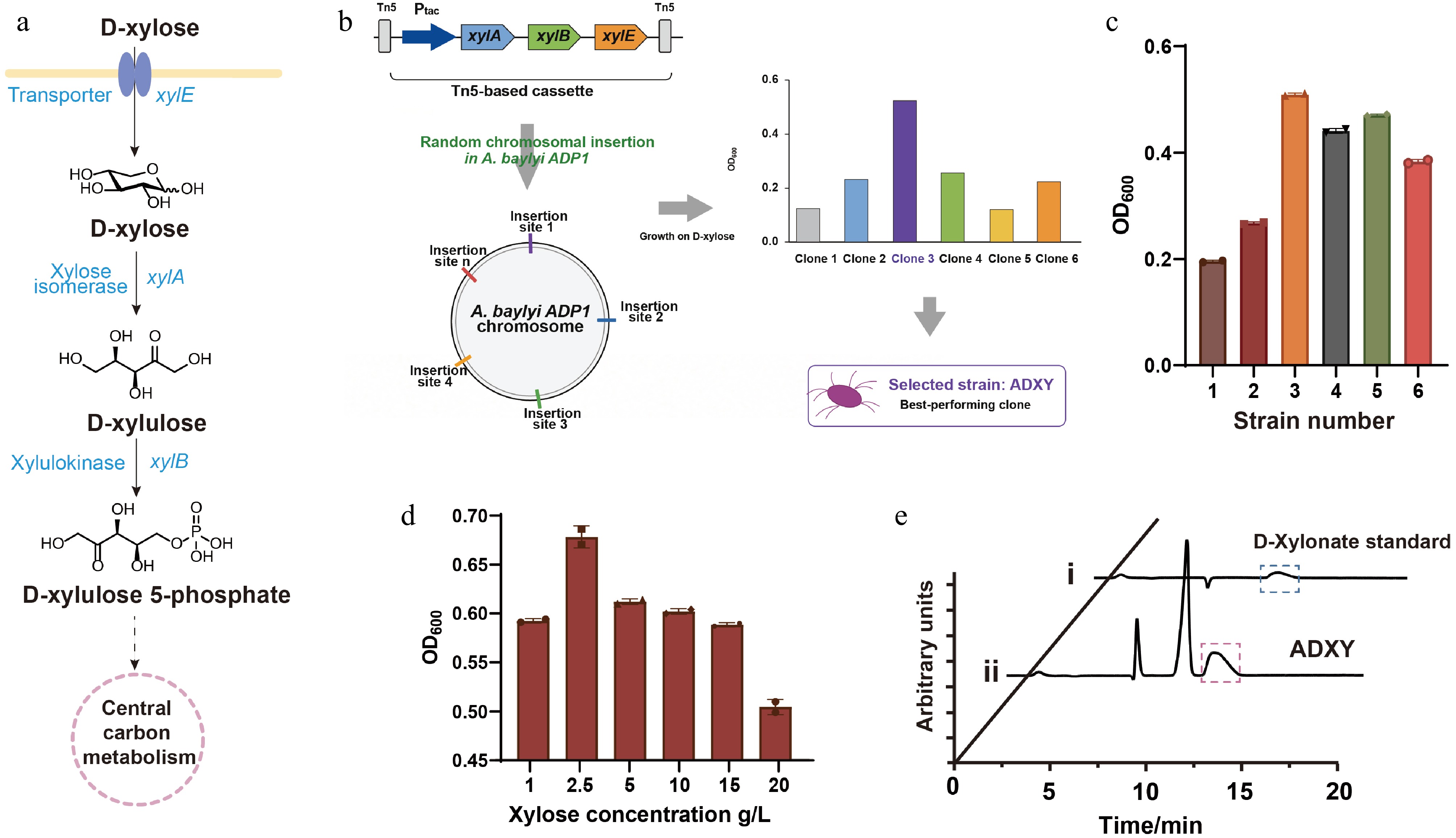
Figure 1.
Establishment of a xylose-assimilating A. baylyi strain. (a) Schematic representation of the xylose isomerization pathway. (b) Scheme of random insertion of xylABE through transposon-mediated method. (c) Screening of transposon-engineered A. baylyi ADP1 mutant strains in M9 medium containing 2 g/L D-xylose after 24 h of cultivation. (d) Growth performance of the selected strain ADXY in M9 medium supplemented with 1−20 g/L D-xylose after 24 h of cultivation. (e) HPLC profiles showing D-xylose consumption and the emergence of a peak consistent with D-xylonate accumulation. i, authentic D-xylonate standard; ii, sample from the fermentation broth. HPLC chromatograms were baseline-corrected and independently normalized to their respective maximum detector responses. The normalized profiles are shown for a comparison of the retention times and peak identities rather than a quantitative comparison of peak intensities. Experiments were carried out in triplicate, and data are presented as mean values with standard deviations.
-
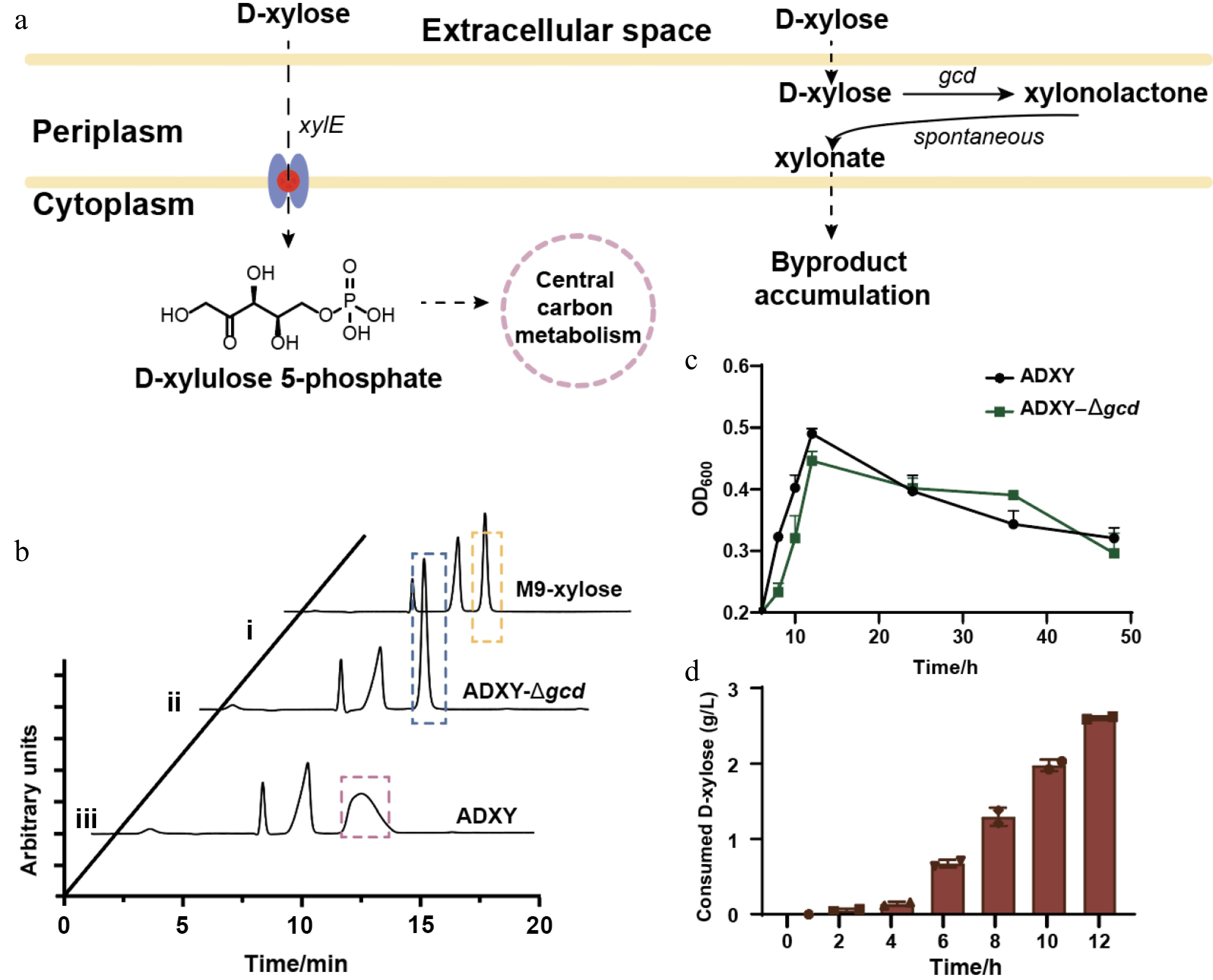
Figure 2.
Effects of deleting gcd on D-xylonate accumulation and growth on D-xylose. (a) Scheme of periplasmic oxidation branch converting D-xylose to D-xylonate. (b) HPLC profiles of (i) the fresh medium, (ii) ADXY-∆gcd, (iii) and ADXY. Experiments were carried out in triplicate and representative HPLC chromatograms are presented. Samples were obtained after 12 h cultivation. HPLC chromatograms were baseline-corrected and independently normalized to their respective maximum detector responses. The normalized profiles are shown for a comparison of the retention times and peak identities rather than a quantitative comparison of the peak intensities. (c) Growth curves of strain ADXY and ADXY-∆gcd in M9 medium supplemented with 5 g/L xylose. (d) Cumulative xylose consumption of strain ADXY-∆gcd over 12 h in M9 medium supplemented with 5 g/L xylose. Experiments were carried out in triplicate, and data are presented as mean values with standard deviations.
-
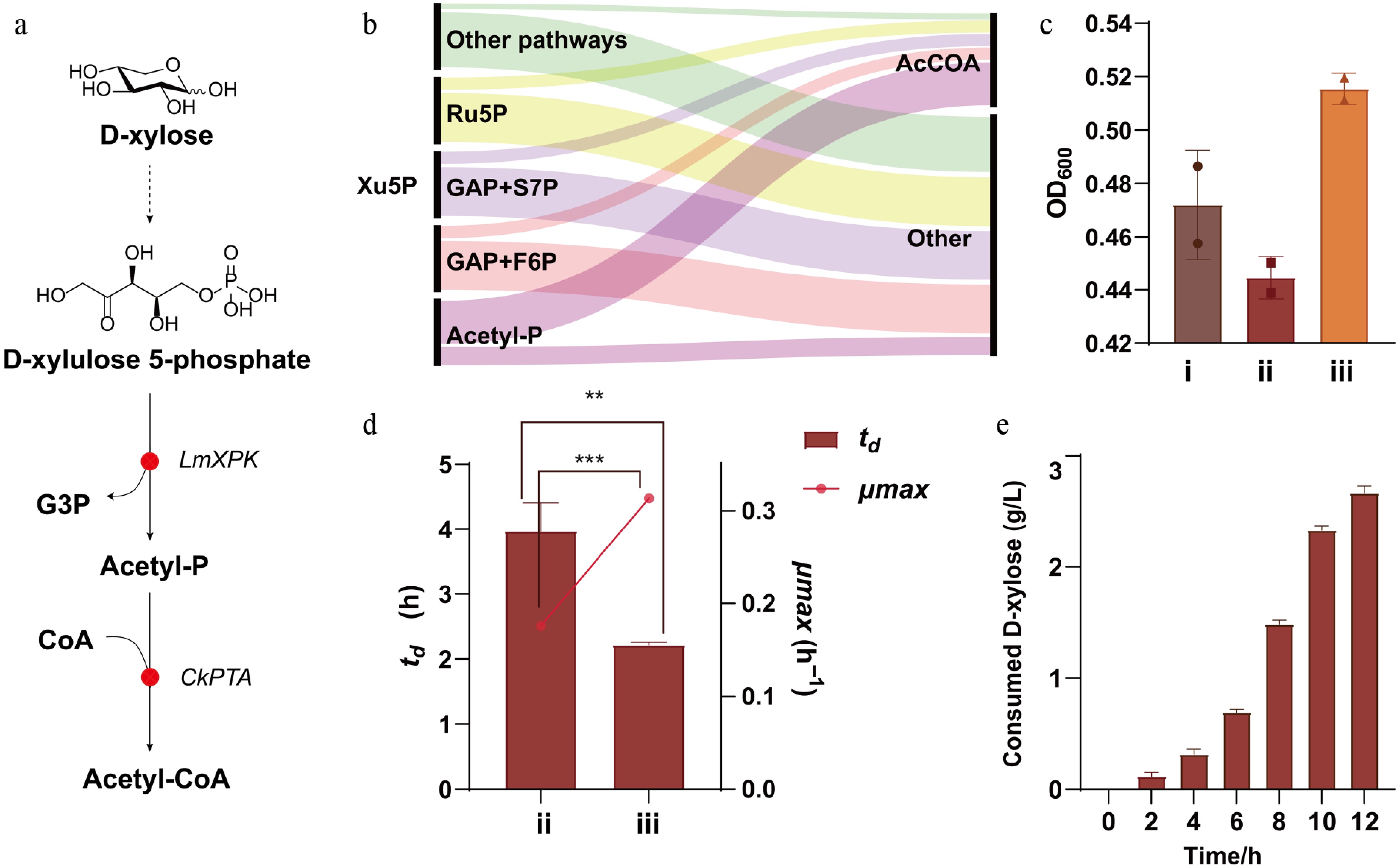
Figure 3.
Introduction of an acetyl-CoA shortcut to improve the growth of ADXY-∆gcd strain. (a) The metabolic pathway of the engineered strain from D-xylose to lipids. (b) Schematic representation of potential carbon-routing pathways downstream of D-xylulose 5-phosphate. Line widths are schematic and do not represent experimentally quantified metabolic fluxes. Acetyl-P, acetyl-phosphate; F6P, fructose-6-phosphate; GAP, glyceraldehyde-3-phosphate; Ru5P, ribulose-5-phosphate; S7P, sedoheptulose-7-phosphate; Xu5P, xylulose-5-phosphate. (c) Growth of (i) ADXY, (ii) ADXY-∆gcd, and (iii) ADXY-∆gcd::LmXPK-CkPTA in M9 medium containing 5 g/L D-xylose after 24 h. (d) The maximum specific growth rate (μmax) and doubling time of Strain ADXY-∆gcd::LmXPK-CkPTA (marked as iii) and Strain ADXY-∆gcd (marked as ii) (*** p < 0.001; ** p < 0.01). (e) The cumulative xylose consumption of ADXY-∆gcd::LmXPK-CkPTA at 12 h. Experiments were carried out in triplicate, and data are presented as mean values with standard deviations.
-
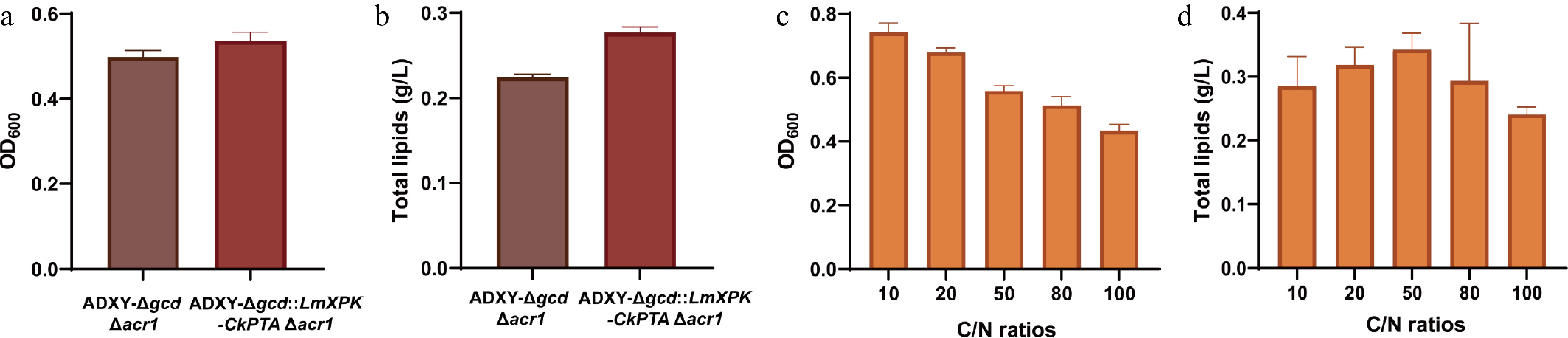
Figure 4.
Nitrogen-limited lipid accumulation and strain comparison. (a) Biomass (OD600) of ADXY-∆gcd::LmXPK-CkPTA ∆acr1 and ADXY-∆gcd ∆acr1 after 72 h of cultivation at a C/N ratio of 50. (b) The amount of lipid accumulated by the engineered strains ADXY-∆gcd ∆acr1 and ADXY-∆gcd::LmXPK-CkPTA ∆acr1 after being cultivated for 72 h at a C/N ratio of 50. (c) Biomass (OD600) of ADXY-∆gcd::LmXPK-CkPTA ∆acr1 after 96 h across carbon-to-nitrogen ratios. (d) The accumulation amount of lipid in ADXY-∆gcd::LmXPK-CkPTA ∆acr1 under different C/N ratios. Experiments were carried out in triplicate, and data are presented as mean values with standard deviations.
Figures
(4)
Tables
(0)