








Search
2021 Volume 8
Article Contents
RESEARCH ARTICLE   Open Access    

The Effect of Laparoscopic Technique on the Surgical Outcome of Colorectal Cancer in a Small-Volume Rural Finnish Lapland Central Hospital

More Information
  • Corresponding author: Heikki I. Huhta Oulu University Hospital PO Box PL 10 FI–90029 OYS Oulu (Finland) heikki.huhta@oulu.fi
  • Introduction: Laparoscopic colorectal surgery has become widely used in treating colorectal cancer. Multicenter studies have shown that laparoscopy decreases postoperative complications and provides equivalent long-term oncological results compared to open surgery. Previous studies were conducted in high-volume institutions, with selected patients, which may influence the reported outcome of laparoscopy.
    Methods: All patients with colorectal cancer that underwent surgery for a primary tumor between 2005 and 2015 in the Lapland Central Hospital were retrospectively collected. We retrieved data on the primary surgical outcome and complications within the first 30 days after surgery from patient records. We surveyed the national patient registry to determine long-term oncological results and patient survival.
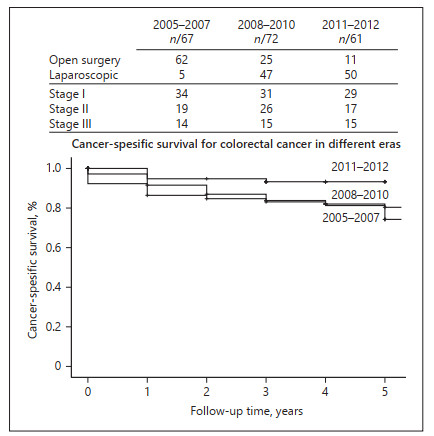
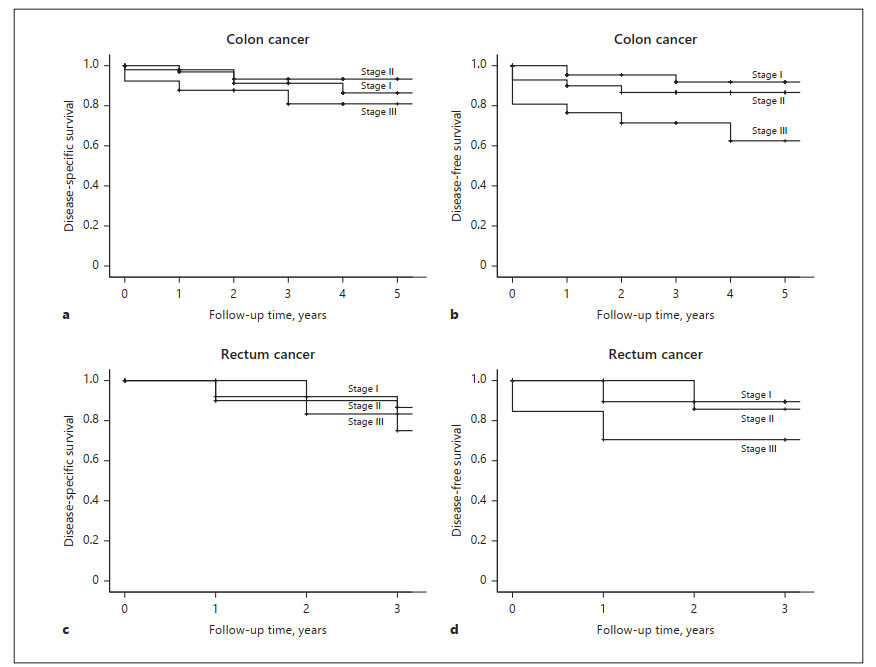
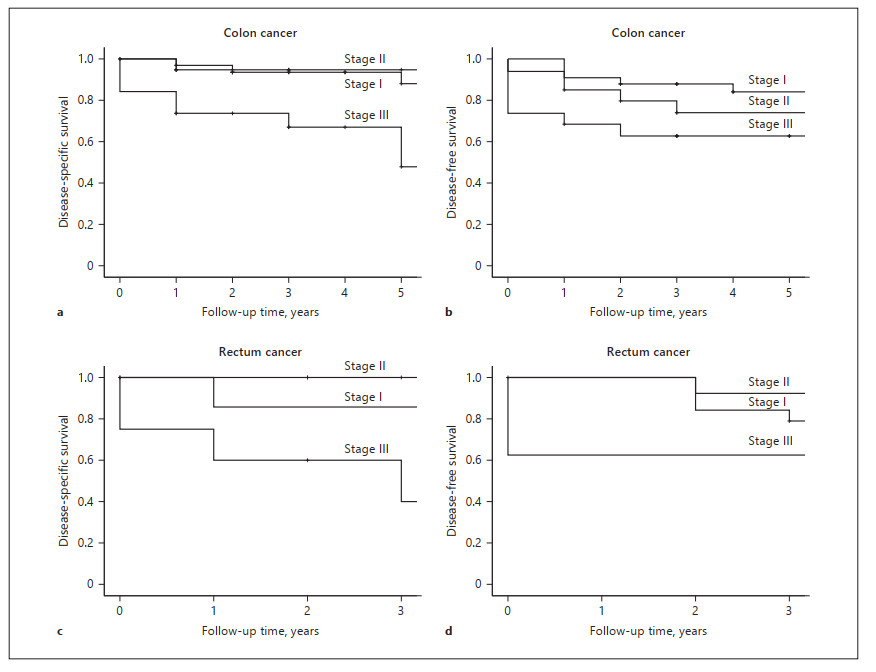
    Results: We identified 349 patients treated for colorectal cancer during 2005–2015. Of these, 219 patients (median age 71 years) underwent laparoscopy and 130 (median age 72 years) underwent open surgery. The 5-year disease-specific survival rates for stages Ⅰ–Ⅲ colon cancer were 83.3 and 87.7%, respectively. The 3-year disease-specific survival rates for stages Ⅰ–Ⅲ rectal cancer were 86.1 and 65.0%, respectively.
    Conclusion: Our results showed that the introduction of laparoscopic colorectal surgery for treating cancer in a rural, small-volume hospital provided short- and long-term results comparable to findings from previous studies conducted in high-volume centers. Therefore, laparoscopy should be considered the treatment of choice for colorectal cancer in small, rural clinics.
  • Cite this article

    Jukka M. Rintala, Pirita R. Tahvonen, Saija T. Vuolio, Ilpo T. Typpö, Kai A. Suokanerva, Heikki I. Huhta. 2021. The Effect of Laparoscopic Technique on the Surgical Outcome of Colorectal Cancer in a Small-Volume Rural Finnish Lapland Central Hospital. Gastrointestinal Tumors. 8:4 doi: 10.1159/000511104
    Jukka M. Rintala, Pirita R. Tahvonen, Saija T. Vuolio, Ilpo T. Typpö, Kai A. Suokanerva, Heikki I. Huhta. 2021. The Effect of Laparoscopic Technique on the Surgical Outcome of Colorectal Cancer in a Small-Volume Rural Finnish Lapland Central Hospital. Gastrointestinal Tumors. 8:4 doi: 10.1159/000511104

Figures(3)  /  Tables(4)

Article Metrics

Article views(702) PDF downloads(497)

Research Article   Open Access    

The Effect of Laparoscopic Technique on the Surgical Outcome of Colorectal Cancer in a Small-Volume Rural Finnish Lapland Central Hospital

  • Corresponding author: Heikki I. Huhta Oulu University Hospital PO Box PL 10 FI–90029 OYS Oulu (Finland) heikki.huhta@oulu.fi
Gastrointestinal Tumors  8 Article number: 10.1159/000511104  (2021)  |  Cite this article

Abstract: 

Introduction: Laparoscopic colorectal surgery has become widely used in treating colorectal cancer. Multicenter studies have shown that laparoscopy decreases postoperative complications and provides equivalent long-term oncological results compared to open surgery. Previous studies were conducted in high-volume institutions, with selected patients, which may influence the reported outcome of laparoscopy.
Methods: All patients with colorectal cancer that underwent surgery for a primary tumor between 2005 and 2015 in the Lapland Central Hospital were retrospectively collected. We retrieved data on the primary surgical outcome and complications within the first 30 days after surgery from patient records. We surveyed the national patient registry to determine long-term oncological results and patient survival.
Results: We identified 349 patients treated for colorectal cancer during 2005–2015. Of these, 219 patients (median age 71 years) underwent laparoscopy and 130 (median age 72 years) underwent open surgery. The 5-year disease-specific survival rates for stages Ⅰ–Ⅲ colon cancer were 83.3 and 87.7%, respectively. The 3-year disease-specific survival rates for stages Ⅰ–Ⅲ rectal cancer were 86.1 and 65.0%, respectively.
Conclusion: Our results showed that the introduction of laparoscopic colorectal surgery for treating cancer in a rural, small-volume hospital provided short- and long-term results comparable to findings from previous studies conducted in high-volume centers. Therefore, laparoscopy should be considered the treatment of choice for colorectal cancer in small, rural clinics.
  • About this article
    Cite this article
    Jukka M. Rintala, Pirita R. Tahvonen, Saija T. Vuolio, Ilpo T. Typpö, Kai A. Suokanerva, Heikki I. Huhta. 2021. The Effect of Laparoscopic Technique on the Surgical Outcome of Colorectal Cancer in a Small-Volume Rural Finnish Lapland Central Hospital. Gastrointestinal Tumors. 8:4 doi: 10.1159/000511104
    Jukka M. Rintala, Pirita R. Tahvonen, Saija T. Vuolio, Ilpo T. Typpö, Kai A. Suokanerva, Heikki I. Huhta. 2021. The Effect of Laparoscopic Technique on the Surgical Outcome of Colorectal Cancer in a Small-Volume Rural Finnish Lapland Central Hospital. Gastrointestinal Tumors. 8:4 doi: 10.1159/000511104

Catalog

    /

    DownLoad:  Full-Size Img  PowerPoint
    Return
    Return