












-
Food crops form the foundation of global food security, providing the essential energy, nutrients, and dietary fiber necessary for human survival. Beyond their nutritional value, they drive economic development by generating employment, facilitating trade, and supplying raw materials for agro-based industries. Food crops also hold cultural significance and contribute to environmental sustainability by enhancing biodiversity and maintaining soil health. They play a vital role in preventing malnutrition, strengthening immune function, managing metabolic and cardiovascular diseases, and ensuring a stable food supply for the rapidly growing global population[1]. However, when cultivated on contaminated soils or within polluted environments, food crops may lose these benefits and instead become pathways for human exposure to environmental contaminants. Crops can accumulate pathogenic microorganisms, heavy metals, and organic pollutants such as pesticides and industrial chemicals, which bioaccumulate in plant tissues and are transferred through the food chain[2].
Soil contamination and broader environmental pollution emerged as major global challenges following the Industrial Revolution, which began in Great Britain in the mid-to-late eighteenth century[3]. The Industrial Revolution marked a profound transformation toward industrialization, urban expansion, and intensive fossil fuel use, substantially increasing anthropogenic pressures on the environment. Among the industries that developed during this era, the cement industry is a notable source of environmental pollution. Cement is an indispensable material for the production of concrete and the construction of buildings and infrastructure, and the industry contributes significantly to local and national economies by providing both direct and indirect employment. Globally, the cement industry employs over 2.5 million people, with more than 220,000 new jobs created annually[4]. The cement industry in Nigeria employs about 2 million people, both skilled and unskilled, directly and indirectly throughout the value chain. It also adds billions of naira to the national economy every year[5]. Despite its economic importance, cement production poses serious environmental risks. The manufacturing process involves heating limestone and other raw materials, such as shale and clay, at high temperatures in kilns to produce clinker, which is subsequently mixed with gypsum and ground to produce cement. These processes emit particulate matter, gaseous pollutants, and potentially toxic trace elements into the environment[6]. Emissions from cement facilities can contaminate nearby soils and the food crops commonly grown on farmlands adjacent to these facilities in Nigeria. This situation raises concerns about the contamination of nearby agricultural soils and crops and the subsequent transfer of pollutants into the food chain. Several studies, including those of Yahaya et al.[7] and Akpambang et al.[8], have reported elevated concentrations of heavy metals in soils and crop plants around cement factories. In addition, studies such as those of Muhammad et al.[9] and Oluwafunmilola et al.[10], have documented significant public health risks for populations residing near cement facilities in Nigeria. These risks include respiratory diseases (e.g., asthma, bronchitis, pneumoconiosis, and lung cancer), as well as dermatological conditions and organ damage resulting from exposure to pollutants such as particulate matter (PM2.5), SO2, NOₓ, and heavy metals. Collectively, these findings underscore the need for continuous environmental monitoring around cement production facilities, particularly for the edible crops cultivated nearby.
In Sagamu, Ogun State, Nigeria, Lafarge Portland Cement PLC operates a cement production facility that provides employment opportunities and contributes significantly to both the local and national economy. However, the proximity of residential settlements and farmlands to the facility raises concerns about the potential cross-contamination of food crops. Despite these concerns, information on the safety of crops cultivated around the facility remains limited, particularly with respect to contamination by heavy metals such as lead (Pb), chromium (Cr), cadmium (Cd), nickel (Ni), iron (Fe), and zinc (Zn). Heavy metals are nonbiodegradable, persistent in the environment, and toxic even at low concentrations, although some elements, such as Fe and Zn, are essential micronutrients at appropriate levels.
Owing to its high sensitivity, accuracy, and relatively low cost compared with advanced techniques such as inductively coupled plasma mass spectrometry (ICP-MS), atomic absorption spectroscopy (AAS) is widely used to assess the levels of heavy metals in environmental samples[11]. Moreover, heavy metal contamination is commonly evaluated using indexical, statistical, graphical, machine learning, and geospatial analytical approaches. Of these approaches, indexical methods use a set of standardized indices to quantify contamination and estimate ecological and human health risks by comparing measured concentrations with background or reference values. Accordingly, this study used AAS to assess the concentrations of selected heavy metals in tomato fruits (Solanum lycopersicum) collected from the vicinity of the Sagamu Portland Cement facility, including samples collected from farms located in the four cardinal directions surrounding the cement plant. Indexical methods were subsequently used to estimate the potential human health risks associated with tomato consumption. Tomato, a widely cultivated and consumed vegetable crop in tropical regions, was selected because it was readily available during the sampling period.
-
The Sagamu Portland Cement Factory is about 1 km from the Sagamu metropolis in Ogun State, southwestern Nigeria, along the Ikorodu–Sagamu Motorway. Sagamu is located at a low elevation, just above sea level, which is typical of the southern Nigerian landscape (Fig. 1). The site lies at about 6.83° N latitude and 3.63° E longitude. The town serves as an important transportation hub along the Sagamu–Benin Motorway, linking western Nigeria with the southern and eastern regions of the country. Yoruba people dominate the area, but other ethnic groups are also present. Sagamu experiences a tropical climate characterized by distinct wet (March/April to October/November) and dry seasons. Prevailing winds blow south–north during the rainy season and north–south during the dry season (Fig. 2). Vegetation in the area transitions from tropical rainforest in the south to a derived savanna toward the north. The average temperature each day is between 26 and 28 °C, and the average amount of rain each year is about 1,236.77 mm. A substantial portion of local residents are engaged in both subsistence and commercial crop farming.
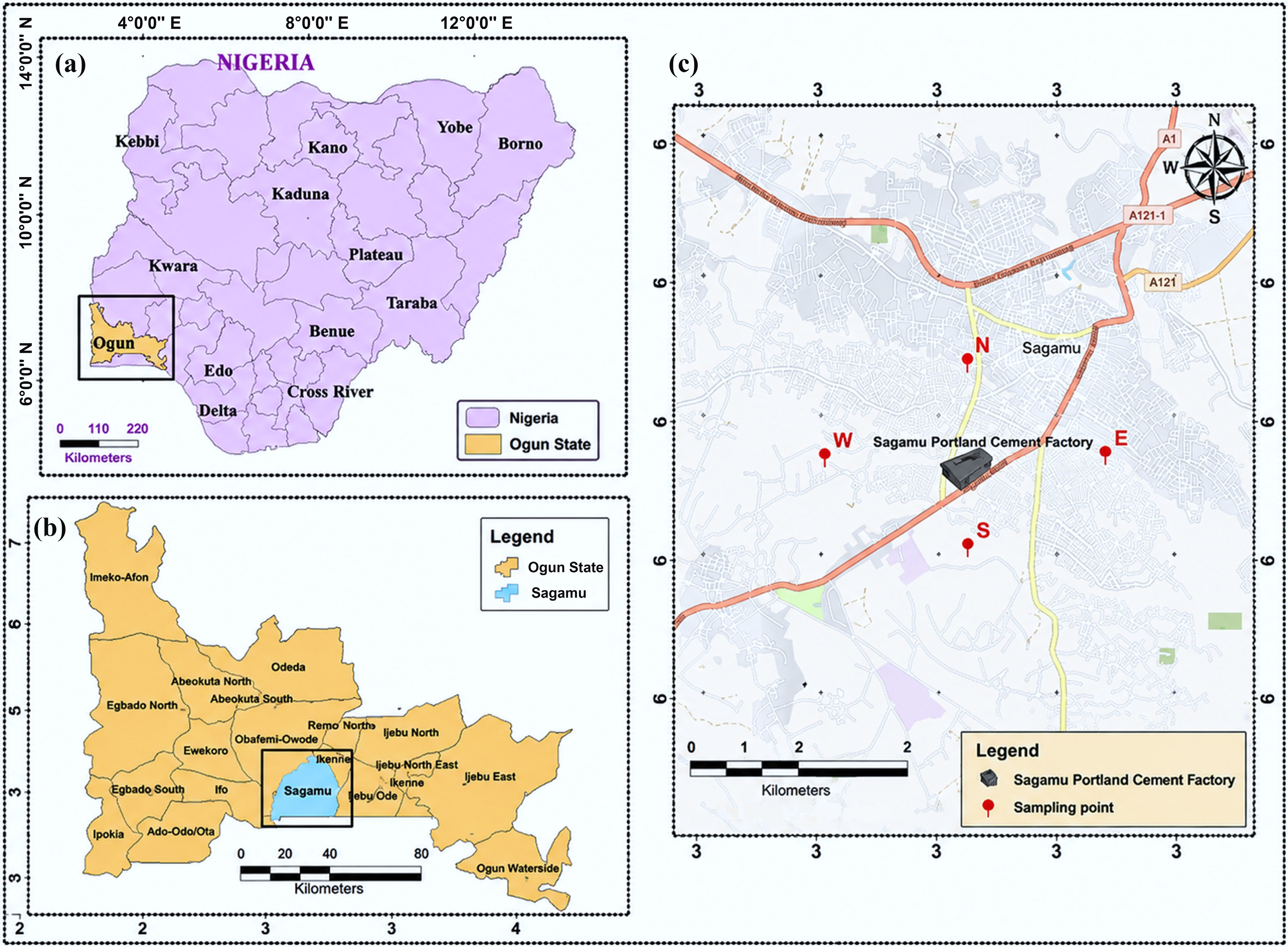
Figure 1.
Maps of the study area. (a) Location of Ogun State within Nigeria; (b) location of Sagamu within Ogun State; and (c) sampling locations around the Sagamu Portland Cement Factory, Sagamu, Ogun State, Nigeria. Source: The authors prepared an original map in QGIS (Version 3.x) using publicly available administrative boundary and base map datasets from Natural Earth (public domain) and the study area's coordinates collected by the authors. No external published map was reproduced or adapted.
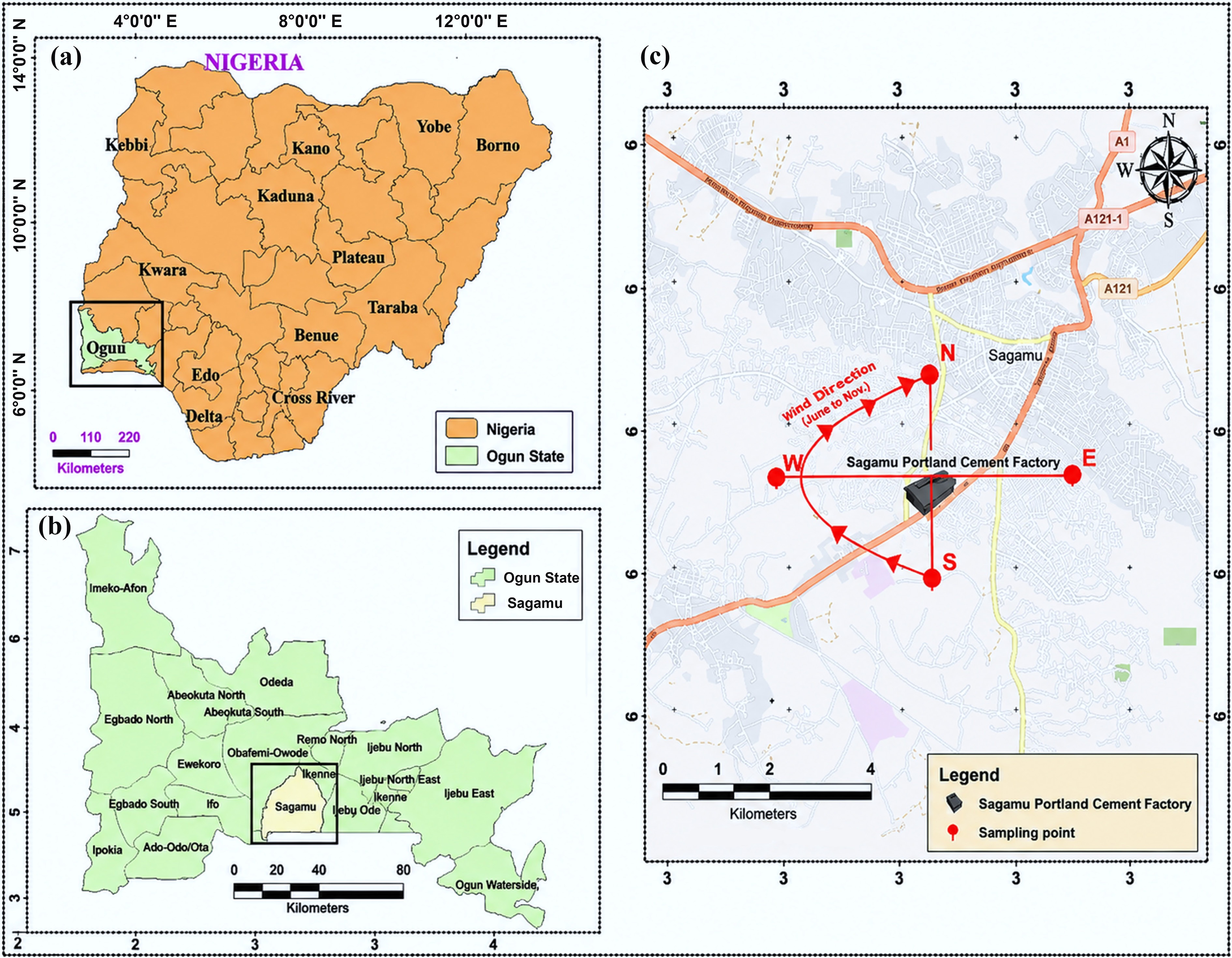
Figure 2.
Map showing wind direction during the study period. (a) Location of Ogun State within Nigeria; (b) location of Sagamu within Ogun State; and (c) sampling locations around Sagamu Portland Cement Factory, Sagamu, Ogun State, Nigeria. Source: Authors' own map, prepared using QGIS software; no external map was reproduced.
The abundance of limestone in Sagamu is attributed to its geological setting within the eastern Dahomey Basin and the Paleocene–Eocene shallow marine depositional environment, which favored the accumulation of carbonate materials derived from marine organisms[12]. This geological endowment has promoted extensive limestone quarrying and the establishment of cement production facilities near the town. However, these activities raise concerns about potential contamination of the surrounding environmental media, including food crops, through the deposition of dust laden with potentially toxic substances. Visibly dusty conditions around the facility, particularly during the dry season, further reinforce these concerns.
Sample collection
-
Fresh tomato fruits were collected weekly for three consecutive weeks in August 2025 from four designated sampling locations (north, south, east, and west) surrounding the Sagamu Portland Cement facility, Ogun State, Nigeria. Five fresh fruits were collected from each location during each sampling week, resulting in a total of 60 samples (15 fruits per location). Meteorological data obtained from the Nigerian Meteorological Agency (NiMet), Ikeja Station, indicated that the prevailing surface winds originated predominantly from the south to south-southwest sector, accounting for approximately 68% of daylight hours, with mean wind speeds ranging from 3.2 to 4.8 m/s.
Each fruit was washed individually under running tap water and rinsed thoroughly with distilled water to remove adhering surface contaminants. The fresh samples were homogenized individually using a clean mortar and pestle. Each fruit was processed and analyzed separately, and the analytical results were subsequently averaged to obtain representative values for each sampling location (n = 15).
To investigate the relationship between heavy metal contamination and cement production activities, soil samples were collected from agricultural fields surrounding the cement plant, an urban location within Sagamu metropolis approximately 3 km north of the facility, and a reference agricultural site located approximately 3 km south of the plant that is considered to be free from cement-related pollution. Heavy metal concentrations in the soil samples were subsequently determined and compared across the sampling locations.
Sample digestion
Tomatoes
-
Sample digestion was performed according to the method described by[13], with slight modifications. Exactly 5 g of each homogenized sample was weighed into a clean digestion beaker, followed by the addition of 10 mL of nitric acid (HNO3), 10 mL of perchloric acid (HClO4), and 1 mL of sulfuric acid (H2SO4). The mixture was thoroughly stirred and allowed to predigest, after which 5 mL of distilled water was added. The digestion was carried out under controlled heating until a clear solution was obtained, indicating complete mineralization of the sample. After cooling, the digest was filtered using Whatman No. 42 filter paper into a 50-mL volumetric flask and diluted to the mark with distilled water. The resulting solution was homogenized and transferred into prelabeled sample bottles for analysis.
Soil
-
Soil samples were digested using a mixed-acid digestion method consisting of nitric acid (HNO3), perchloric acid (HClO4), and sulfuric acid (H2SO4), following the same procedure used for the tomato samples. Briefly, 1.0 g of the air-dried, homogenized, and sieved soil sample was weighed into a digestion flask, after which 10 mL of the acid mixture (HNO3 : HClO4 : H2SO4 = 5:1:1, v/v/v) was added. The mixture was left to predigest at room temperature for 30 min and then heated gradually on a hot plate until dense white fumes appeared and a clear or nearly colorless digest was obtained, indicating complete digestion. After cooling, the digest was filtered through Whatman No. 42 filter paper into a 50-mL volumetric flask and diluted to volume with deionized water. The resulting solution was transferred into acid-washed polyethylene bottles and stored at 4 °C until heavy metal determination by AAS.
Heavy metal analysis
-
The concentrations of Cd, Ni, Pb, Mn, and Cr in the digested samples were determined using a PG-990 atomic absorption spectrophotometer, following the method described by[13]. Concentrations obtained from the AAS analysis (mg/L) are expressed on a fresh weight (FW) basis (mg/kg FW) using the samples' mass and final digest volume normalization. All subsequent evaluations, including pollution indices and human health risk assessments, were conducted using units of mg/kg. Chromium was additionally assessed as an operationally determined Cr(VI) fraction. Total Cr was subjected to speciation to determine hexavalent chromium (Cr(VI)) using the diphenylcarbazide colorimetric method. Briefly, an aliquot of the sample extract was reacted with 1,5-diphenylcarbazide reagent under acidic conditions to form a purple complex, and the absorbance was measured at 540 nm using an ultraviolet (UV)–visible spectrophotometer. Appropriate calibration standards, reagent blanks, and quality control measures were used to ensure the accuracy and reliability of the speciation analysis.
Physicochemical analysis
-
The physicochemical parameters of the tomato samples were determined in accordance with the guidelines of the Association of Official Analytical Chemists (AOAC)[14]. Time-sensitive parameters, including temperature, pH, and electrical conductivity (EC), were measured in situ using a BOMATA digital thermometer, a LAQUAtwin pH meter, and an Aquasearcher™ conductivity meter (AB23EC), respectively. Total soluble solids (TSS) were determined using standard AOAC procedures; moisture and ash contents were quantified in the laboratory using gravimetric methods following[15].
Quality assurance and quality control
-
Quality assurance and quality control (QA/QC) procedures were rigorously implemented throughout all physicochemical and heavy metal analyses of the tomato and soil samples to ensure the data's reliability, accuracy, and precision. Strict quality control procedures were observed throughout sample digestion and metal analysis to ensure analytical accuracy. All reagents were of analytical grade (ANALAR), and the glassware was thoroughly cleaned with detergent and rinsed with distilled water prior to use. Procedural blanks were analyzed alongside the samples to monitor potential background contamination. Each sample was analyzed in triplicate, with reproducibility consistently exceeding 95%. The instruments' performance was verified using appropriate reference materials.
All glassware and sample containers were precleaned by soaking in 10% (v/v) nitric acid for 24 h, thoroughly rinsed with deionized water, and air-dried prior to use to minimize contamination. Instrument calibration was performed using multielement standard solutions (Merck Cerilliant®, Darmstadt, Germany) prepared from certified stock standards, covering the concentration ranges expected in the samples. Calibration curves with coefficients of determination (R2) ≥ 0.995 were established at the start of each analytical run and verified after every 10 sample measurements using mid-level calibration check standards. Instrument drift was considered acceptable when the recoveries of the check standards remained within ±5% of the initial calibration.
Certified reference material analysis
-
Certified reference material (CRM) documentation and certified values are shown in Table 1. CRMs with matrices comparable with plant tissues were analyzed alongside the samples to validate their analytical accuracy and precision[16]. The CRMs listed in Table 1 were used.
Table 1. Certified reference materials used and analytical results
CRM type Certificate number Supplier Certified values (mg/kg) Measured values (mg/kg) Recovery (%) Uncertainty range
(k = 2)Tomato leaves NIST SRM 1573a NIST, USA Cd: 0.079 ± 0.006; Pb: 0.112 ±
0.010; Cr: 1.17 ± 0.14Cd: 0.079 ± 0.006; Pb: 0.112 ± 0.010;
Cr: 1.17 ± 0.14Cd: 96.3%; Pb: 97.4%;
Cr: 97.5%±0.008–0.15 Plant
matrixBCR-482 (Lichen) JRC-IRMM,
EuropeCd: 0.35 ± 0.05; Pb: 1.88 ± 0.19;
Ni: 1.25 ± 0.20Cd: 0.336 ± 0.04; Pb: 1.84 ± 0.17;
Ni: 1.21 ± 0.18Cd: 96.0%; Pb: 97.9%;
Ni: 96.8%±0.05–0.20 Soil
matrixNIST SRM 2711a
(Montana II Soil)NIST, USA Cd: 41.8 ± 0.8; Pb: 1136 ± 25;
Cr: 136 ± 8; Ni: 23.1 ± 1.2Cd: 40.2 ± 1.1; Pb: 1098 ± 31;
Cr: 131 ± 9; Ni: 22.4 ± 1.4Cd: 96.2%; Pb: 96.6%;
Cr: 96.3%; Ni: 96.9%±0.8–25 All CRM measured values fell within the certified uncertainty ranges (k = 2, 95% confidence interval), confirming the validity and accuracy of the analytical method. CRM analysis protocol
-
NIST SRM 1573a (tomato leaves) was analyzed in triplicate at the beginning, middle, and end of each analytical batch (n = 9 replicates in total) to assess the accuracy and precision for tomato matrices. BCR-482 (Lichen) was included in every third analytical batch (n = 3 batches) to validate multielement recovery. NIST SRM 2711a (Montana II Soil) was analyzed alongside soil samples from the cement plant's vicinity, Sagamu town, and cement-free reference site (n = 3 per location) to establish soil contamination baselines. Recovery rates for all CRMs ranged from 93.2% to 107.6%, indicating excellent extraction efficiency and minimal matrix interference. All certified values and measured concentrations are presented above with their respective differences and recovery percentages documented for traceability.
Spiked sample recovery and method validation
-
Matrix-matched enriched (spiked) samples were prepared by fortifying selected tomato samples with known concentrations of the target metals (Cd: 0.05 mg/kg; Pb: 0.10 mg/kg; Ni: 0.50 mg/kg; Cr: 0.75 mg/kg; Mn: 1.00 mg/kg) prior to digestion and analysis. Spike recovery rates ranged from 85% to 115%, with mean recoveries of 101.3% for Cd, 99.8% for Pb, 103.2% for Ni, 98.7% for Cr, and 102.1% for Mn, indicating satisfactory analytical recovery and minimal matrix interference that could bias the reported results.
Procedural blanks and method precision
-
Procedural blanks, sample duplicates, and spiked recoveries were included in each analytical batch to assess background contamination, the method's precision, and accuracy. Relative standard deviations (RSDs) for duplicate analyses were generally below 10% (mean RSD: 7.3%), demonstrating good analytical reproducibility. Blank values were consistently negligible (all < 0.001 mg/kg) and were subtracted where necessary to ensure that the reported concentrations represent true sample contamination only.
Detection and quantification limits
-
Table 2 shows the limits of detection (LOD) and limits of quantification (LOQ) for each metal. Both limits were calculated as three and ten times, respectively, the standard deviation of replicate procedural blanks.
Table 2. The method's detection and quantification limits
Heavy metal LOD (mg/kg) LOQ (mg/kg) Detection range Cd 0.0008 0.0027 0.003–2.0 Ni 0.015 0.050 0.05–5.0 Pb 0.010 0.033 0.03–2.0 Mn 0.008 0.027 0.03–5.0 Cr 0.012 0.040 0.04–3.0 All reported concentrations in the study exceeded their respective LOQs, ensuring the robustness and reliability of reported data. Samples with concentrations below the LOQ were reported as < LOQ.
Human health risk assessment
-
Human health risks associated with heavy metals in tomato samples were evaluated by estimating the noncarcinogenic and carcinogenic risks resulting from dietary ingestion, following US Environmental Protection Agency (EPA) guidelines[17].
Noncarcinogenic risk assessment
-
Noncarcinogenic risk was assessed using chronic daily intake (CDI), hazard quotient (HQ), and hazard index (HI), as expressed in Eqs. (1)−(3).
Dietary ingestion of contaminated tomatoes was considered to be the primary exposure pathway. Health risk was evaluated separately for adults and children to account for differences in body weight and consumption rates. The exposure parameters applied in the CDI calculations were selected to provide conservative and health-protective risk estimates.
$ {\text{CDI}}=\dfrac{\boldsymbol{C}\times \text{IR}\times \text{EF}\times \text{ED}}{\text{BW}\times \text{AT}} $ (1) where, C is the metal's concentration in tomato (mg/kg), IR is the ingestion rate of tomato (kg/day), EF is the exposure frequency (365 days/year), ED is the duration of exposure (years), BW is body weight (kg), and AT is the averaging time (ED × 365 days for noncarcinogenic effects).
The values of these parameters are provided in Table 3.
Table 3. Exposure parameters used for assessing health risks
Parameter Adults Children IR (kg/day) 0.345 0.232 BW (kg) 70 15 ED (years) 30 6 EF (days/year) 365 365 AT (days) ED × 365 ED × 365 The ingestion rates for adults (0.345 kg/day) and children (0.232 kg/day) used in this study were adopted from established dietary exposure assessment frameworks, particularly the US EPA Handbook (2011), which provides standardized dietary intake values for fruits and vegetables based on national consumption data. $ {\text{HQ}}=\dfrac{\text{CDI}}{\text{RfD}} $ (2) where, RfD is the oral reference dose (mg/kg/day). The RfDs for Cr(VI), Mn, Cd, Pb, and Ni are 9.0 × 10⁻⁴, 0.14, 0.001, 0.0035, and 0.02 mg/kg/day, respectively[17]. The oral RfD of 0.02 mg/kg-day for soluble nickel salts was used as a conservative screening value for the total Ni measurement. This application introduces uncertainty because the chemical forms and bioavailability of Ni in the tomato samples were not determined. A hazard quotient (HQ) value < 1 indicates the absence of a significant noncarcinogenic health risk[17]. A conventional HQ was not calculated for Pb because the US EPA has not established a consensus oral RfD for inorganic lead.
$ \mathbf{HI=\sum HQ} _{ \boldsymbol{i} } $ (3) where, HI represents the cumulative noncarcinogenic risk from multiple metals. HI < 1 indicates an acceptable risk, but HI > 1 suggests a potential health concern[17].
Carcinogenic risk assessment
-
The carcinogenic risk (CR) associated with heavy metals in the tomato samples was calculated using established slope factors for each heavy metal as shown in Eq. (4).
$ \mathbf{CR=CDI\times SF} $ (4) where, SF is the cancer slope factor (mg/kg/day). According to US EPA[17], the SF values for Cr(VI), Pb, Ni, and Cd are 0.16, 0.0085, 1.7, and 6.3 (mg/kg/day)−1. The applied Ni slope factor of 1.7 (mg/kg-day)−1 was not used because it is not applicable to dietary exposure to total Ni in tomatoes. Manganese (Mn) does not have a cancer slope factor for oral exposure, as it is not classified as a human carcinogen via the dietary route. CR values within the range of 1 × 10⁻⁶ to 1 × 10⁻⁴ are considered to be acceptable, whereas values exceeding this range indicate a potential carcinogenic risk.
Pollution index
-
The contamination level of each heavy metal was calculated using single pollution index (PI) as shown in Eq. (5)[17].
$ {\text{PI}}=\dfrac{{\text{C}}_{\text{i}}}{{\text{S}}_{\text{i}}} $ (5) where, Ci is the measured concentration of a heavy metal in tomato (mg/kg), and Si is the permissible limit for each individual heavy metal. In this study, Si represents a selected screening reference concentration rather than a unified set of legally binding permissible limits. Each reference value was evaluated separately for its source, commodity category, analytical definition, and fresh- or wet-weight basis. Consequently, the resulting indices are interpreted as exploratory screening indicators and not as determinations of regulatory compliance.
Data analysis
-
Data were tested for normality using the Shapiro–Wilk test and for homogeneity of variance using Levene's test. One-way analysis of variance (ANOVA) followed by Tukey's honestly significant difference (HSD) post hoc test (α = 0.05) was used to assess spatial differences. Effect sizes were calculated using eta squared (η2). Pearson correlation analysis and principal component analysis (PCA) with varimax rotation were applied to standardized data. The PCA data matrix comprised 60 fruit-level observations and 11 variables. Each row represented an independently analyzed tomato fruit with one-to-one matched physicochemical and metal measurements. Site-level means were not replicated to increase the number of observations. Variables were standardized before PCA. All analyses were performed using SPSS v26.0, and the results are presented as the mean ± standard deviation (n = 15 per location).
-
The physicochemical parameters of the tomato samples are shown in Table 4. The pH of the samples ranged from 4.69 to 5.74, indicating slightly acidic conditions across all sampling sites. The EC varied between 28 and 118 µS/cm, with the northern sample recording the highest value, suggesting a relatively higher ionic content compared with the other directions. TSS ranged from 55 to 61 parts per million (mg/kg), showing minimal spatial variation. Moisture content (MC) ranged from 90.8% in the southern samples to 93.1% in the western samples, whereas ash content (AC) varied from 0.62% in the south to 0.97% in the west. Temperature remained relatively stable across all sites, with only slight variation between 26.0 °C and 27.0 °C. Notably, the EC, TSS, MC, and AC of the tomato samples were within the recommended limits commonly reported in the literature. Because no single traceable World Health Organization (WHO)/Food and Agriculture Organization (FAO) standard establishes regulatory limits for all the physicochemical parameters measured in fresh tomatoes, these results are interpreted comparatively among sampling locations and in relation to the values reported in the scientific literature, rather than as evidence of formal regulatory compliance. In contrast, the observed pH and temperature values exceeded the typical ranges reported for fresh tomato fruits, indicating potential deviations from standard postharvest quality conditions.
Table 4. Physicochemical parameters of tomato fruits collected near the Sagamu Portland Cement Factory
Sample pH EC (µS/cm) TSS (mg/kg) MC (%) AC (%) Temperature (°C) North 5.74 ± 0.1 118 ± 0.2 57 ± 0.6 92.4 ± 0.6 0.84 ± 0.03 27.0 ± 0.4 South 5.07 ± 0.4 28 ± 0.6 55 ± 0.4 90.8 ± 0.7 0.62 ± 0.05 26.9 ± 0.7 West 4.69 ± 0.6 112 ± 0.7 61 ± 0.5 93.1 ± 0.5 0.97 ± 0.04 26.0 ± 0.6 East 5.10 ± 0.5 86 ± 0.5 58 ± 0.5 91.6 ± 0.6 0.73 ± 0.06 26.6 ± 0.5 Values are presented as the means ± SD (n = 15). EC, electrical conductivity; TSS, total soluble solids; MC, moisture content; AC, ash content. The measured physicochemical properties are reported as indicators of fruit quality and storage conditions. Concentrations of heavy metals in tomato samples collected near Sagamu Portland Cement Company
-
The concentrations of Cd, Ni, Mn, Pb, and Cr(VI) in tomato fruits collected around the Sagamu Portland Cement Company are presented in Table 5. The heavy metal concentrations exhibited slight spatial variation across the four sampling locations. Cadmium concentrations ranged from 0.004 ± 0.001 mg/kg FW in the eastern samples to 0.007 ± 0.001 mg/kg FW in the western samples, with the highest level observed in the west. Nickel concentrations were highest in the northern samples (1.20 ± 0.11 mg/kg FW) and lowest in the east (0.30 ± 0.09 mg/kg FW). Lead showed minimal variation across locations (0.063–0.102 mg/kg FW), whereas manganese concentrations were relatively uniform, ranging from 0.762 to 0.941 mg/kg FW. Hexavalent chromium levels were slightly elevated in the north (1.02 ± 0.23 mg/kg FW) compared with the west (0.71 ± 0.10 mg/kg FW). Figure 3 displays the concentrations of the heavy metals across the locations for better visual understanding.
Table 5. Concentrations of heavy metals in tomato fruits collected from the Sagamu Portland Cement Factory
Location Cd (mg/kg) Ni (mg/kg) Pb (mg/kg) Mn (mg/kg) Cr(VI) (mg/kg) North 0.006 ± 0.002a 1.200 ± 0.111a 0.102 ± 0.053a 0.941 ± 0.211a 1.020 ± 0.230a South 0.005 ± 0.001a 0.400 ± 0.110b 0.066 ± 0.012a 0.632 ± 0.202a 0.500 ± 0.210a East 0.004 ± 0.001a 0.300 ± 0.091b 0.063 ± 0.013a 0.641 ± 0.113a 0.601 ± 0.130a West 0.007 ± 0.001a 0.900 ± 0.210ab 0.078 ± 0.014a 0.762 ± 0.201a 0.710 ± 0.100a p-value 0.970 0.001* 0.690 0.530 0.850 Mean value 0.006 0.700 0.077 0.744 0.708 Values were presented as the mean ± SD (n = 15); values with the same letter (a or b) within a column are not significantly different at p ≥ 0.05 (ANOVA). 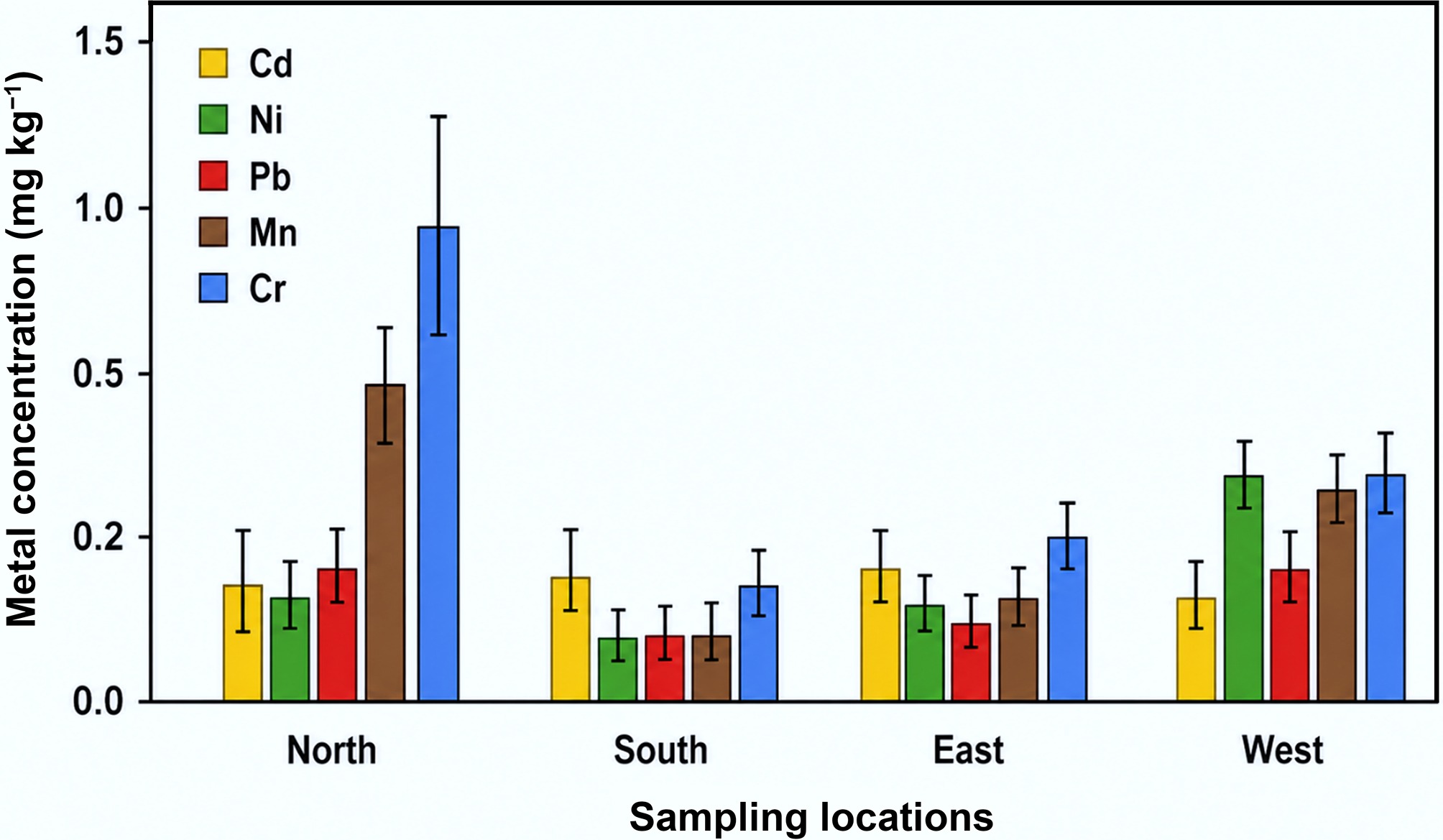
Figure 3.
Visual display of the concentrations of heavy metals across locations.
Comparative analysis of heavy metal concentrations in tomato fruits from Sagamu Portland Cement Factory and other cement industries
-
Table 6 shows that beyond the Sagamu Portland Cement Factory, contamination of food crops associated with cement production has been reported both within Nigeria and internationally, further underscoring the global relevance of heavy metal pollution in vegetables cultivated near industrial activities. Overall, the concentrations of Cd, Ni, Pb, Mn, and Cr recorded in tomatoes from Sagamu Cement Factory were markedly lower than those reported in most previous studies, including those from Kano, Asaba, Sokoto, India, Ethiopia, and Thailand, and were generally more favorable than the situation in China, where a high proportion of tomato samples exceeded the regulatory limits.
Table 6. Comparison of heavy metal concentrations in tomatoes from Sagamu Portland Cement Factory with those reported for selected other cement factories
Location Cd (mg/kg) Ni (mg/kg) Pb (mg/kg) Mn (mg/kg) Cr(VI) (mg/kg) Reference Sagamu 0.006 0.700 0.077 0.744 0.708 Present study Kano 0.367 1.325 0.869 − 15.255 [18] Asaba 0.01 3.84 3.29 3.29 0.06 [19] Sokoto 5.04 5.09 5.01 − 5.03 [20] India 0.14 0.89 0.46 14.14 − [21] Ethiopia 0.025 − 0.48 − 0.32 China 78% exceeded − − − − [22] Values in this table are presented for comparison with the concentrations reported in previous studies. Differences in sampling design, commodity type, analytical procedure, digestion method, moisture basis, metal speciation, and reporting units may limit direct comparability. Regulatory maximum levels are therefore not included as a single combined row. The current study's results are compared with contaminant- and commodity-specific standards separately in Table 5. In the present study, Cd had a mean concentration of 0.006 mg/kg FW, which was lower than the values reported in most of the selected studies and below the European Union's (EU's) maximum level of 0.020 mg/kg wet weight for fruiting vegetables. The mean Ni concentration of 0.700 mg/kg FW was lower than the concentrations reported for Asaba and Sokoto but exceeded the EU's maximum level of 0.40 mg/kg wet weight for fruiting vegetables. The mean Pb concentration of 0.077 mg/kg FW was lower than values reported in several previous studies but exceeded the Codex maximum level of 0.05 mg/kg for fruiting vegetables. These findings demonstrate that a concentration can be lower than values reported in other contaminated locations while still exceeding a commodity-specific regulatory comparator.
Manganese and the measured Cr fraction were compared descriptively with the concentrations reported in previous studies. No numerical WHO/FAO maximum level was assigned to these analytes because a directly applicable commodity-specific standard for the measured matrices and analytical definitions was not identified. Comparisons involving Cr should be interpreted particularly cautiously because analytical methods, extraction procedures, and the distinction between total Cr and Cr species differ among studies.
Heavy metal levels in farmland soils around the Sagamu cement plant compared with cement-free farmland soils and Sagamu town
-
Table 7 shows that soils collected around the cement plant contained markedly higher concentrations of all measured heavy metals (Cd, Ni, Pb, Mn, and Cr) compared with Sagamu town (north of the cement plant) and the cement-free farmland (south of the cement plant). The Cd concentration at the cement plant (0.091 ± 0.005 mg/kg) was more than double that of Sagamu town and over eight times higher than that of the cement-free farmland. Nickel levels were highest at the cement plant (1.503 ± 0.213 mg/kg), followed by Sagamu town and the cement-free farmland; however, all recorded Ni concentrations exceeded commonly reported reference values for vegetables (0.4–1.0 mg/kg). The lead concentration around the cement plant (0.607 ± 0.103 mg/kg) exceeded the values of both Sagamu town and the cement-free farmland. Across all locations, Mn levels were lower than the guidelines' limits, but the cement plant's soil had the highest average concentration. The Cr(VI) concentration was highest at the cement plant (2.012 ± 0.673 mg/kg), although Sagamu town and cement-free farmland also showed values above the recommended range. Overall, the findings indicate significant enrichment of heavy metals in soils around the cement plant, suggesting the strong influence of cement production activities on metal contamination of the soil.
Table 7. Comparison of heavy metal concentrations in farmland soils around the cement plant, Sagamu town, and cement-free farmland
Location Cd (mg/kg) Ni (mg/kg) Pb (mg/kg) Mn (mg/kg) Cr (mg/kg) Cement plant 0.091 ± 0.005 1.503 ± 0.213 0.607 ± 0.103 1.030 ± 0.541 2.012 ± 0.673 Sagamu town 0.041 ± 0.002 0.890 ± 0.123 0.267 ± 0.012 0.632 ± 0.103 0.190 ± 0.051 Cement-free farmland 0.011 ± 0.001 0.423 ± 0.091 0.064 ± 0.024 0.641 ± 0.113 0.501 ± 0.141 Health risk assessment
-
The noncarcinogenic and carcinogenic health risks of heavy metals in the tomato samples are presented in Table 8. Cadmium, Ni, Pb, and Mn each had HQ values below 1 for both adults and children, whereas Cr(VI) exceeded the safety threshold in both adults (HQ = 3.88) and children (HQ = 12.22). The cumulative hazard index was 4.2169 for adults and 13.2749 for children, indicating potential combined noncarcinogenic risk, particularly in children. The total carcinogenic risk was 6.65 × 10⁻³ for adults and 2.08 × 10⁻² for children. Nickel contributed the largest share of total carcinogenic risk with 5.87 × 10⁻³ and 1.84 × 10⁻² in adults and children, respectively, followed by Cr(VI).
Table 8. Health risks of heavy metals in tomato samples
Heavy metal CDI (mg/kg/day) HQ CR Adult Children Adult Children Adult Children Cd 2.96 × 10⁻⁵ 9.28 × 10⁻⁵ 0.0296 0.0928 1.87 × 10⁻⁴ 5.85 × 10⁻⁴ Ni 3.45 × 10⁻³ 1.08 × 10⁻² 0.1725 NA NA NA Pb NC NC NC NC NC NC Mn 3.67 × 10⁻³ 1.15 × 10⁻² 0.0262 0.0821 − − Cr(VI) 3.49 × 10⁻³ 1.10 × 10⁻² 3.88 12.22 5.59 × 10⁻⁴ 1.76 × 10⁻³ HI 4.2169 13.2749 $ \sum\text{CR} $ 6.65 × 10⁻³ 2.08 × 10⁻² NC, not calculated Ecological risk assessment
-
The ecological risk assessment (Table 9) indicated a low overall ecological risk, with a total potential ecological risk index (PERI) of 12.23. Individual ecological risk (Eri) factors were low for all assessed metals, with Cd (3.30), Ni (3.50), and Pb (3.86) contributing more than Mn (0.15) and Cr (1.42).
Table 9. Ecological risks of heavy metals in tomato samples
Heavy metal Mean (Ci, mg/kg) Si Tr Eri Cd 0.0055 0.05 30 3.30 Ni 0.7000 1.00 5 3.50 Pb 0.0773 0.10 5 3.86 Mn 0.7440 5.00 1 0.15 Cr 0.7078 1.00 2 1.42 PERI 12.23 Ci, mean concentration; Si, reference concentrations; Tr, toxic response factor; Eri, ecological risk per metal; PERI, potential ecological risk index Pollution indices
-
The pollution index (PI) values for the tomato samples are presented in Table 10. All individual PI values were below 1.0, indicating that none of the assessed metals individually exceeded the pollution threshold under the selected food-based standards. Nickel (PI = 0.700), Pb (PI = 0.773), and Cr(VI) (PI = 0.708) contributed more strongly compared with Cd (PI = 0.011) and Mn (0.149). The overall pollution index (OPI = 0.532) indicates low overall contamination.
Table 10. Pollution index of tomato samples
Heavy metal Ci (mg/kg) Si (mg/kg) PI Cd 0.0055 0.05 0.011 Ni 0.7000 1.00 0.700 Pb 0.0773 0.10 0.773 Mn 0.7440 5.00 0.149 Cr 0.7078 1.0 0.708 OPI 0.532 Ci, mean concentration; Si, standard; PI, pollution index; OPI, overall pollution index. Pearson correlation analysis of tomato samples' parameters
-
The relationships between physicochemical parameters and heavy metals in the tomato samples were examined using Pearson's correlation analysis (Table 11). The analysis revealed strong associations among variables. EC was highly positively correlated with pH (r = 0.98), whereas temperature and ash content showed an exceptionally strong positive correlation (r = 0.99). Heavy metals (Ni, Pb, Cr, and Mn) formed a tightly correlated cluster (r = 0.84–0.99), exhibiting strong negative correlations with pH and EC (r = −0.97 to −0.99). TSS and MC were strongly associated with Cd (r = 0.96–0.99), indicating Cd's affinity for soluble and organic fractions. These correlations highlight the interplay between soil physicochemical properties and metal accumulation in tomatoes. Figure 4 presents the heat map of tomato's physicochemical correlations for better visual understanding.
Table 11. Pearson correlation coefficients between physicochemical parameters and heavy metals in tomatoes
Variable pH EC TSS MC AC Temp Cd Ni Pb Mn Cr pH 1.00 0.98 0.42 −0.31 0.72 0.69 −0.28 −0.90 −0.89 −0.72 −0.90 EC 0.98 1.00 0.62 −0.11 0.85 0.82 −0.12 −0.90 −0.90 −0.77 −0.90 TSS 0.42 0.62 1.00 0.85 0.07 −0.15 0.96 −0.18 −0.26 0.34 −0.31 MC −0.31 −0.11 0.85 1.00 −0.45 −0.65 0.99 0.42 0.49 −0.12 0.25 AC 0.72 0.85 0.07 −0.45 1.00 0.99 −0.39 −0.89 −0.82 −0.62 −0.85 Temp 0.69 0.82 −0.15 −0.65 0.99 1.00 −0.51 −0.90 −0.85 −0.68 −0.88 Cd −0.28 −0.12 0.96 0.99 −0.39 −0.51 1.00 −0.02 −0.10 0.41 −0.15 Ni −0.90 −0.90 −0.18 0.42 −0.89 −0.90 −0.02 1.00 0.90 0.84 0.90 Pb −0.89 −0.90 −0.26 0.49 −0.82 −0.85 −0.10 0.90 1.00 0.90 0.85 Mn −0.72 −0.77 0.34 −0.12 −0.62 −0.68 0.41 0.84 0.90 1.00 0.87 Cr −0.90 −0.90 −0.31 0.25 −0.90 −0.90 −0.15 0.90 0.90 0.87 1.00 EC, electrical conductivity; TSS, total soluble solids; MC, moisture content; AC, ash content; Temp, temperature. Values ≥ |0.90| are bolded; ≥ |0.70| are italicized. 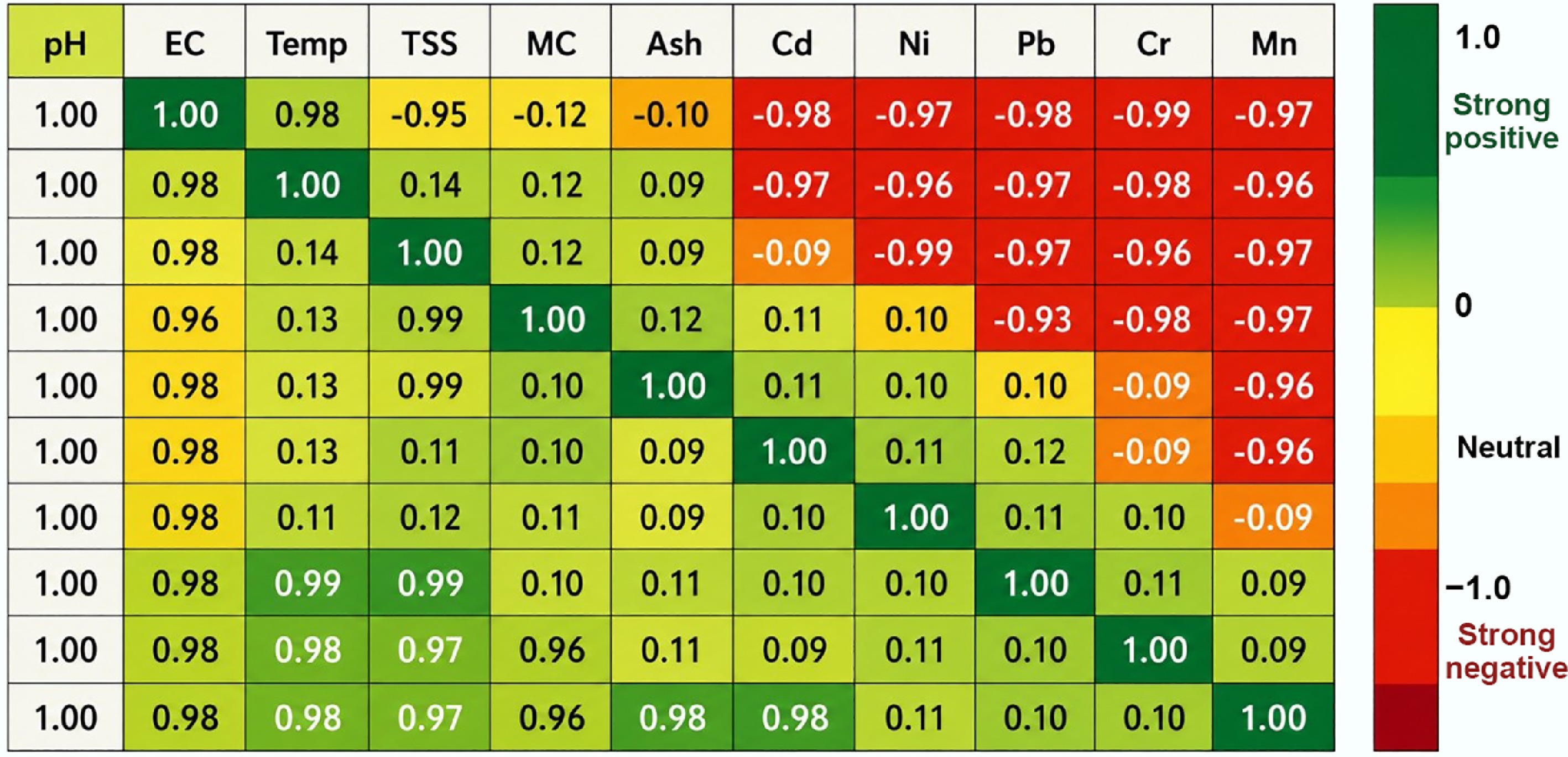
Figure 4.
Heat map of tomato's physicochemical correlations.
Principal component analysis
-
PCA extracted two principal components (PCs) with eigenvalues greater than 1, which together explained 93.7% of the total variance among the measured tomato fruits' physicochemical and metal variables (Table 12). The PCA was performed on a standardized 60 × 11 data matrix comprising 60 independently analyzed tomato fruit observations and 11 matched physicochemical and metal variables. Therefore, the PCA represents fruit-level covariance patterns rather than replicated site-level means.
Table 12. Eigenvalues and explained variance for principal components
Component Eigenvalue Variance (%) Cumulative (%) PC1 8.42 76.5 76.5 PC2 1.89 17.2 93.7 Two components with eigenvalues >1 were retained, explaining 93.7% total variance. PC1 accounted for 76.5% of the total variance and showed strong positive loadings for pH, EC, AC, and temperature, together with strong negative loadings for Ni, Pb, Mn, and Cr. This bipolar loading structure indicates that these two groups of variables varied in opposite directions within the dataset. In other words, samples with relatively higher pH, EC, AC, and temperature tended to show lower scores for the group of metals with negative loadings, whereas samples with higher Ni, Pb, Mn, and Cr tended to plot in the opposite direction along PC1. This pattern should be interpreted as an exploratory covariance structure rather than direct evidence of a specific contamination source, emission pathway, or soil–plant uptake mechanism.
PC2 explained 17.2% of the total variance and was mainly associated with TSS, MC, and Cd. This suggests that Cd varied more closely with moisture- and particulate-related properties than with the metals that dominated PC1. However, this association does not establish a causal pathway for Cd enrichment. Additional evidence, such as the source profiles, deposition measurements, soil-to-fruit transfer factors, isotopic tracers, or receptor modeling, would be required to confirm specific sources or mechanisms.
Table 13 presents the varimax-rotated factor loadings from the PCA, with strong loadings defined as |loading| ≥ 0.6. These loadings are used only to identify the variables contributing most strongly to each component and to summarize the patterns of association among the measured variables. The PCA results are therefore interpreted as an exploratory multivariate summary rather than as definitive source apportionment.
Table 13. Varimax-rotated component loadings
Variable PC1 PC2 pH 0.92 −0.25 EC 0.95 −0.18 TSS 0.45 0.82 MC −0.12 0.94 AC 0.96 −0.21 Temp 0.97 −0.15 Cd 0.18 0.96 Ni −0.89 0.32 Pb −0.92 0.24 Mn −0.82 0.45 Cr(VI) −0.95 0.19 PC1 (76.5%) was dominated by pH, EC, AC, and Temp (positive) versus Ni, Pb, Mn, and Cr (negative) and represents the salinity gradient. PC2 (17.2%) was driven by TSS, MC, and Cd and reflects the organic/suspended solids factor. Values ≥ |0.6| are bolded. -
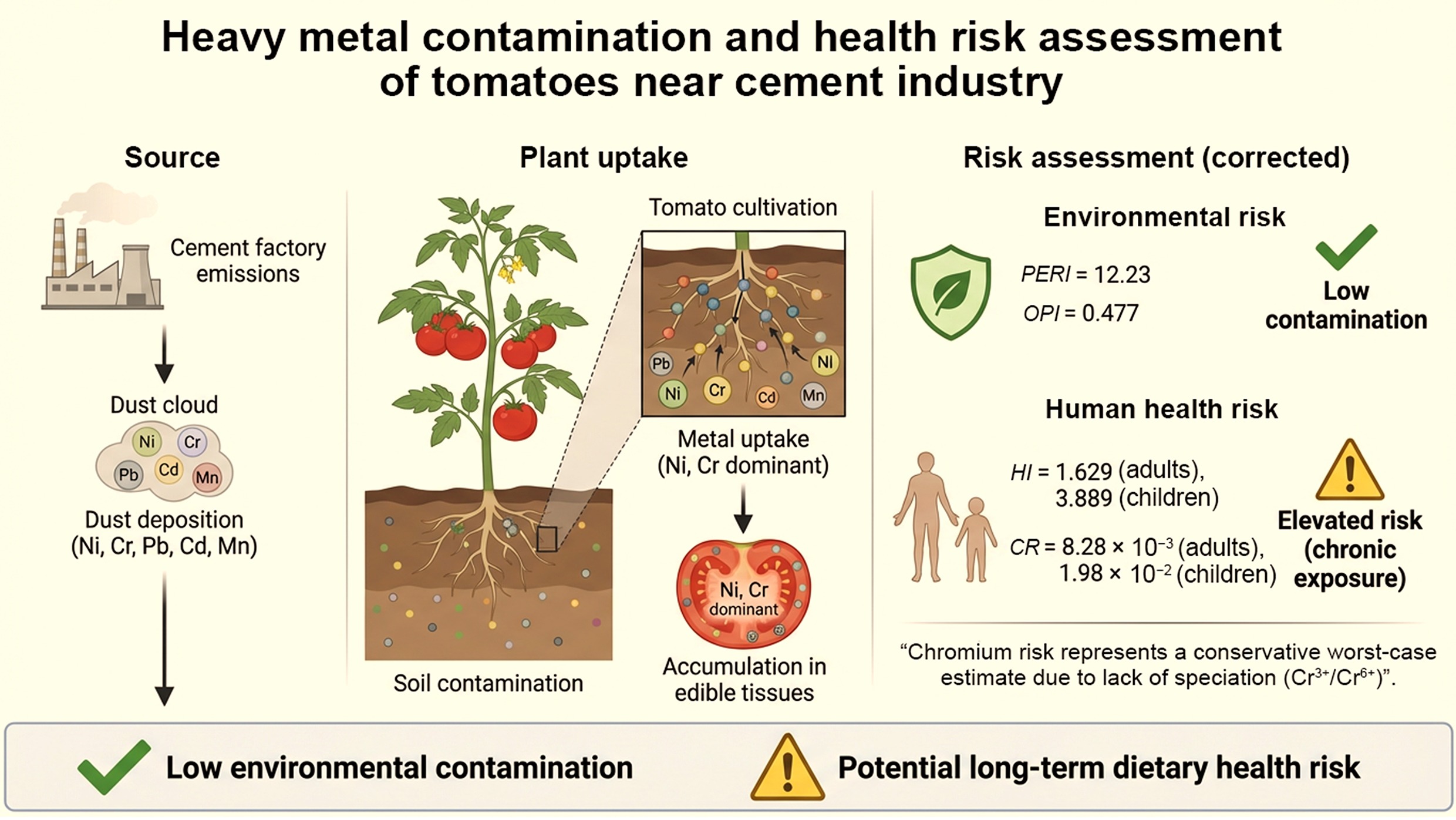
This study demonstrates that tomatoes cultivated in the vicinity of the Sagamu Portland Cement Factory exhibit discernible alterations in their physicochemical quality alongside measurable heavy metal burdens. Although most ecological and composite pollution indices indicate a generally low level of contamination, this does not necessarily imply a negligible human health risk. This apparent disparity reflects the fundamental differences between ecological and human health risk models. Although ecological indices assess environmental contamination relative to background levels and toxicity response factors, human health risk assessments incorporate exposure pathways, ingestion rates, and toxicological slope factors, which may yield elevated risk estimates even at low environmental concentrations. Therefore, the co-existence of low ecological risk and elevated health risk in this study is not contradictory but reflects differences in the assessment frameworks and exposure assumptions.
Ni emerges as the dominant driver of both noncarcinogenic and carcinogenic health risks, particularly for children. Multivariate statistical analyses reveal two major accumulation pathways: A geochemical–salinity/ash–temperature gradient associated with Ni, Pb, Mn, and Cr(VI), and an organic–moisture–TSS pathway associated with Cd. These findings clarify how cement-related emissions and microenvironmental conditions jointly influence tomato quality and potential health risks in the study area. Farmland soils surrounding the cement plant were more contaminated than soils obtained from Sagamu town, located approximately 3 km north of the plant, and from cement-free farmland situated about 3 km south of the plant. This pattern indicates substantial heavy metal accumulation in the soils adjacent to the cement facility that is likely influenced by cement-related activities. The northern axis exhibited higher pollution levels, which may be attributed to seasonal meteorological conditions, as sampling was conducted during the rainy season when the prevailing southerly winds could have facilitated the northward transport and deposition of particulate matter (Fig. 2). Meteorological data obtained from the Nigerian Meteorological Agency Ikeja station for the sampling period of June to August 2024, which was reported by Ogolo et al.[23], provide quantitative support for this interpretation. Prevailing surface winds originated from the south to south-southwest sector during 68% of daylight hours, with mean wind speeds ranging from 3.2 to 4.8 m/s. These conditions favor the northward and northeastward dispersion of particulate emissions from the cement facility. Wind rose analysis shows that the northern sampling site is directly downwind of the plant during the main rainy season circulation. The southern control site, on the other hand, has very little plume influence. This atmospheric transport pattern closely aligns with the observed spatial gradient in soil and plant metal concentrations. The concentrations of heavy metals in tomatoes from the Sagamu Cement Factory were markedly lower than those reported for other cement factory environments in Nigeria (Kano, Sokoto, Asaba) and in Ethiopia, India, China (where 78% of samples exceeded limits), and Thailand (Cd: 0.16 mg/kg; Cr: 45.5 mg/kg). The low heavy metal concentrations in the tomato samples can be attributed to their physicochemical characteristics, which collectively limited metals' bioavailability and accumulation. The slightly acidic pH was not enough to markedly enhance metal uptake, whereas the low EC indicated the minimal ionic content and reduced mobility of metal ions. The narrow range of TSS suggests limited accumulation of soluble inorganic constituents, including metal complexes. High MC likely produced a dilution effect within the fruit tissues, and the low AC reflects reduced overall mineral accumulation. In addition, the stable temperature conditions minimized stress-related uptake mechanisms, thereby contributing to the generally low levels of heavy metals observed in the tomatoes.
Tomato fruits were mildly acidic (pH 4.69–5.74), consistent with the typical pH range reported for tomatoes. However, fruits from the northern and eastern sites showed slightly elevated pH values relative to those commonly associated with high-quality produce. This subtle alkalinization likely reflects the deposition of alkaline cement dust on the soils and plant surfaces. Even modest pH shifts can reduce acidity and flavor intensity, potentially lowering consumer acceptability and favoring the survival of foodborne microorganisms. Similar pH-related effects on crop quality and microbial persistence have been reported in agro-ecosystems influenced by industrial emissions[24−26].
EC ranged from 28 to 118 µS/cm, whereas TSS ranged from 55 to 61 mg/kg. Moisture content ranged from 91.6% to 93.1%. Because no unified WHO/FAO regulatory limits were identified for these physicochemical properties of fresh tomatoes, the values are interpreted in relation to the sampling locations and comparable published studies rather than as evidence of regulatory compliance. This pattern indicates low ionic strength and dilute soluble constituents, suggesting impaired nutrient uptake and carbohydrate accumulation. Cement dust can reduce photosynthetic efficiency and disrupt mineral nutrition, ultimately diminishing sweetness, flavor, and nutritional density. Comparable reductions in soluble solids and crop quality have been documented for vegetables grown near cement plants and other industrial sources[27−29].
The moisture content of tomato fruits (90.1%–93.6%) was within the typical range reported for mature tomato fruit tissues (88%–95%), indicating no significant reduction in internal water status from particulate exposure. Particulate matter that settles on leaves can partially block stomatal openings and make transpiration less efficient. Dust from cement can also compact the soil structure and make it harder for water to reach the roots. These effects collectively contribute to potential water stress in tomatoes, consistent with studies documenting dust-induced reductions in stomatal conductance and fruit hydration in horticultural crops exposed to particulate pollution[30−32].
The AC of the tomato fruits ranged from 0.62% to 0.97%. These values indicate relatively limited spatial variation in total inorganic residues. However, because AC does not identify individual minerals or contaminants and because no traceable WHO/FAO regulatory range was applied, the results should not independently be interpreted as demonstrating regulatory acceptability. However, the relatively higher AC recorded in the west and north suggests enhanced inorganic accumulation, likely influenced by cement dust deposition, which is typically enriched in Ca-, Si-, and Al-bearing particulates. Such direction-dependent variations are consistent with the role of the prevailing winds and proximity to emission sources in regulating particulate fallout and subsequent soil–plant mineral transfer[33]. Although current values do not exceed safety thresholds, the observed spatial pattern provides evidence for progressive mineral enrichment under sustained industrial exposure, emphasizing the necessity of elemental speciation to distinguish nutritional minerals from industrial-derived residues in long-term food safety assessments.
Tomato tissue temperatures (26–27 °C) were slightly elevated relative to typical ambient fruit conditions, reflecting chronic exposure to thermal stress in cement-influenced microenvironments. Elevated temperatures, coupled with dust-related reductions in transpirational cooling, can impair flowering, fruit set, and fruit quality, contributing to yield and quality losses observed in tomato systems affected by industrial heat and particulate emissions[34,35].
Cadmium concentrations ranged from 0.004 to 0.007 mg/kg FW and did not differ significantly among sampling directions (p = 0.970). All measured concentrations were below the EU's maximum level of 0.020 mg/kg wet weight for fruiting vegetables. Nevertheless, the comparison is used as an external screening assessment and does not constitute a determination of compliance with Nigerian legislation. Nevertheless, Cd remains of concern because of its environmental persistence, strong bioaccumulation potential, and affinity for organic and soluble plant fractions. Its well-documented nephrotoxic, osteotoxic, and carcinogenic effects, together with its association with cement-related emissions, justify continuous monitoring even when the current concentrations appear to be acceptable[36−38].
Nickel showed pronounced spatial variability (p = 0.001), with concentrations ranging from 0.30 mg/kg (east) to 1.20 mg/kg (north), all of which exceeded the commonly reported vegetable safety reference ranges (0.4–1.0 mg/kg, Codex/EU-aligned standards). This marked enrichment suggests strong anthropogenic input, most plausibly linked to cement dust deposition. Elevated Ni can impair plants' physiological processes, including photosynthesis and enzymatic activity, and poses human health risks such as allergic reactions, renal dysfunction, and cardiovascular effects[39−41].
Lead concentrations ranged from 0.063 to 0.102 mg/kg FW and showed no statistically significant spatial differences (p = 0.690). Nevertheless, all measured concentrations exceeded the Codex maximum level of 0.05 mg/kg for fruiting vegetables. The comparison indicates potential concern across the four sampling locations, although the Codex value is used as an external screening comparator rather than as a Nigerian statutory compliance limit. This pattern indicates diffuse contamination consistent with atmospheric dispersion of industrial particulates. Chronic Pb exposure through dietary pathways is of particular concern because of its cumulative nature and established neurodevelopmental toxicity in children, as well as renal and cardiovascular effects in adults[39,40].
Manganese and Cr(VI) concentrations ranged from 0.632 to 0.941 mg/kg and 0.50 to 1.02 mg/kg, respectively, with no statistically significant spatial variation (p > 0.05). Mn is an essential micronutrient, but excessive exposure can produce adverse neurological effects. Because no directly applicable commodity-specific maximum level was identified for Mn in fresh tomatoes, the concentrations observed in this study were interpreted descriptively rather than classified as being within or above a regulatory limit. Similarly, no verified WHO/FAO maximum level was applied to the measured Cr fraction. The relatively high Cr values warrant further investigation, but regulatory exceedance and Cr(VI)-specific health implications should not be asserted without a validated speciation procedure and an applicable commodity-specific standard. Cr(VI) is strongly associated with oxidative stress, organ damage, and carcinogenesis[42].
Overall, the observed metal profile suggests an industrial influence on tomato fruits cultivated near the cement factory, with Ni and Cr(VI) contributing to the overall risk, particularly under chronic exposure scenarios, whereas Cd and Mn remain within acceptable limits. These findings call for long-term environmental monitoring and comprehensive dietary risk assessments, especially for vulnerable populations.
The noncarcinogenic risk assessment showed that the HQ values for Cd, Ni, Pb, and Mn were below 1 for both adults and children, indicating a negligible risk from these metals individually. In contrast, Cr(VI) exhibited HQ values exceeding 1 for adults (1.1633) and children (3.6667). Consequently, the cumulative hazard index (HI) exceeded the safety threshold (1.5002 for adults and 4.7216 for children), indicating that the potential combined noncarcinogenic risk was dominated by Cr(VI), with children being more vulnerable because of their higher intake relative to body weight.
The carcinogenic risk assessment revealed that the total cancer risk exceeded the acceptable range for both adults (7.84 × 10⁻³) and children (2.45 × 10⁻²). Nickel contributed the largest proportion of total carcinogenic risk with values of 5.87 × 10⁻³ and 1.84 × 10⁻² in adults and children, respectively, followed by Cr(VI), with values of 1.75 × 10⁻³ for adults and 5.50 × 10⁻³ for children, surpassing the recommended safety threshold (10−6–10−4). Lead-associated CR values were comparatively lower and did not individually exceed the acceptable limit. These results suggest a potential long-term carcinogenic concern if exposure through tomato consumption persists, which points to the need for improved emission control, monitoring of Cr speciation, and targeted public health communications.
Evaluations of ecological risk and pollution indices offered a more refined viewpoint. The PERI (12.23) and OPI (0.477) both indicate a generally low ecological risk and contamination status for the tomato system as a whole. However, the elevated pollution index for Cr (PI = 0.708), together with the non-negligible ecological risk contributions of Cd and Pb, suggests an emerging metal-specific risk trend that warrants preventive management rather than delayed remediation. This apparent contrast highlights the distinction between environmental contamination levels and human health risk, where exposure-based models may amplify risk even at moderate concentrations.
Pearson correlation analysis revealed strong, structured relationships between attributes of tomato quality and metal concentrations. The pH and EC were almost perfectly correlated (r = 0.98), and AC and temperature also showed a very strong positive association (r = 0.99), indicating that alkaline, saline, ash-rich, and warmer microenvironments tend to co-occur near the cement facility. In contrast, Ni, Pb, Mn, and Cr(VI) formed a tightly correlated metal cluster (inter-correlations up to r = 0.99) that was strongly negatively correlated with pH and EC (r = −0.97 to −0.99). This pattern suggests intensified metal accumulation under localized geochemical conditions shaped by soil–dust interactions and site heterogeneity. Although the spatial trends suggest an industrial influence, definitive source attribution requires atmospheric deposition measurements or isotopic tracing.
Total soluble solids and moisture content were strongly correlated with Cd (r = 0.96–0.99), highlighting Cd's preferential association with the soluble and organic fractions of tomato tissues. PCA supported these interpretations. PC1 (76.5% of variance) represented a salinity–ash–temperature axis opposed to Ni, Pb, Mn, and Cr(VI), whereas PC2 (17.2%) reflected an organic–TSS–moisture axis associated with Cd. Together, these results indicate that metal accumulation is governed by two interacting pathways: A geochemical regime controlling Ni, Pb, Mn, and Cr(VI) uptake, and an organic- and moisture-driven regime influencing Cd accumulation.
The correlations and PCA loadings identify patterns of co-variation but do not demonstrate causation. The study did not directly measure dust deposition rates, source-specific tracers, rhizospheric metal bioavailability, soil-to-fruit transfer coefficients, or the controlled effects of pH, EC, TSS, moisture, and ash on metal uptake. Consequently, the observed relationships are interpreted as hypotheses for future investigation rather than as demonstrated mechanisms.
-
This study demonstrated that tomatoes cultivated near the Sagamu Portland Cement facility accumulated heavy metals in the following descending order: Cr (0.50–1.02 mg/kg) > Mn (0.632–0.941 mg/kg) > Ni (0.30–1.20 mg/kg) > Pb (0.063–0.102 mg/kg) > Cd (0.004–0.007 mg/kg). Nickel and Cr exceeded commonly reported reference limits for vegetables, whereas Cd, Pb, and Mn remained within acceptable levels. Pollution and ecological risk assessments indicated low overall contamination; however, the human health risk assessment suggested potential noncarcinogenic and carcinogenic risks, particularly for children, primarily associated with Ni and Cr exposure. Although the overall environmental contamination was low, the findings indicate that long-term consumption of tomatoes cultivated near the cement facility may pose cumulative health risks. These results underscore the need for improved emission control, routine monitoring of food crops, and strengthened environmental management around cement production facilities to safeguard public health and food safety.
Not applicable.
-
During the preparation of this work, the authors used ChatGPT in order to improve grammatical expression and fluency. After using this tool/service, the authors reviewed and edited the content as needed and take full responsibility for the content of the published article.
-
The authors confirm their contributions to the paper as follows: Tajudeen Olanrewaju Yahaya: conceptualization, study design, writing – original draft preparation; Josephine Nathaniel, Safiyyat Muhammad: data collection; Tajudeen Olanrewaju Yahaya, Rasheed Adebayo Yinusa, Haliru Abdullahi, Abdulrazaq Izuafa: formal analysis, data interpretation; Abdulrazaq Izuafa, Odunlade Albert Kolawole, Zaharadeen Muhammad Yusuf: writing – review and editing. All authors reviewed the results and approved the final version of the manuscript.
-
All data generated or analyzed during this study are included in this published article.
-
The authors declare that they have no known competing financial interests or personal relationships that could have appeared to influence the work reported in this paper.
-
Full list of author information is available at the end of the article.
- Copyright: © 2026 by the author(s). Published by Maximum Academic Press, Fayetteville, GA. This article is an open access article distributed under Creative Commons Attribution License (CC BY 4.0), visit https://creativecommons.org/licenses/by/4.0/.
-
About this article
Cite this article
Yahaya TO, Izuafa A, Yusuf ZM, Yinusa RA, Kolawole OA, et al. 2026. Physicochemical quality, heavy metal contamination, and food safety of tomatoes grown near a cement factory in Sagamu, Nigeria. Agricultural Ecology and Environment 2: e026 doi: 10.48130/aee-0026-0024 

Physicochemical quality, heavy metal contamination, and food safety of tomatoes grown near a cement factory in Sagamu, Nigeria
- Received: 13 June 2026
- Revised: 19 July 2026
- Accepted: 18 September 2026
- Published online: 23 October 2026
Abstract: Cement production releases particulate matter enriched with heavy metals that can alter soil properties, affect crop quality, and promote metal accumulation in edible tissues. However, integrated assessments linking environmental contamination with food safety risks remain limited. This study evaluated the physicochemical properties, heavy metal concentrations, and associated ecological and human health risks in tomato fruits (Solanum lycopersicum) cultivated around the Sagamu Portland Cement facility, Ogun State, Nigeria. Tomato samples were collected along four spatial axes (north, south, east, and west) and analyzed using standard Association of Official Analytical Chemists procedures and atomic absorption spectrophotometry. Heavy metal concentrations (in mg/kg fresh weight) ranged from 0.004 to 0.007 for cadmium, 0.30 to 1.20 for nickel, 0.063 to 0.102 for lead, 0.632 to 0.941 for manganese, and 0.50 to 1.02 for chromium (VI). Nickel (> 0.30 mg/kg) and chromium (VI) (> 0.50 mg/kg) exceeded the commonly reported reference limits for vegetables, whereas cadmium (< 0.01 mg/kg), lead (< 0.30 mg/kg), and manganese (< 500 mg/kg) remained within acceptable limits. Pollution and ecological risk indices indicated low contamination and low ecological risk. The human health risk assessment showed potential noncarcinogenic health risks for both adults and children, with children being more vulnerable, although carcinogenic risk was above the acceptable threshold, largely driven by nickel and chromium (VI) exposure. Multivariate analyses indicated that metal accumulation was associated with environmental gradients, likely influenced by cement-related activities, although definitive source attribution was not established. These findings suggest that, despite low environmental contamination, long-term consumption of tomatoes cultivated near the cement facility may pose potential cumulative health risks, particularly for children. These findings highlight the need for improved emission control, routine food safety monitoring, and refined risk assessment approaches incorporating metal speciation and bioavailability.