











-
Fluorine (F) is prevalent in the Earth's crust, which may lead to a natural accumulation of fluoride ions (F−) in freshwater[1]. Additionally, as one of the most electronegative and highly reactive halogens, F is widely utilized in agricultural and industrial fields, including the manufacture of semiconductors, glass, pesticides, electroplating, photovoltaics, lithium refining, and pharmaceutical production, leading to the production of a quantity of F−-containing wastewater with a concentration range from 50 to 10,000 mg/L in the most extreme conditions[2−8]. Currently, the accumulation of F− in aquatic systems has become a universal health concern, potentially threatening hundreds of millions of people throughout the globe, in particular in the Global South[9,10]. The excessive intake of F− may cause a variety of health issues, including dental and skeletal fluorosis, Alzheimer syndrome, reduced intelligence in children, and impaired thyroid function[10−12]. Given these, the World Health Organization (WHO) recommended an optimal F− threshold in drinking water of ≤ 1.5 mg/L, while according to the drinking water hygiene standard (GB5749-2022) in China, the threshold was ≤ 1.0 mg/L.
Recently, a variety of defluorination treatment technologies have been developed, including electrocoagulation, electrodialysis, ion exchange, membrane separation, biotechnology, and adsorption[13−16], among which adsorption is an attractive method with great practical application potential due to its effectiveness, simple operation, flexibility, cost-effectiveness, and environmentally friendly nature[17−19]. The adsorption performance towards F− is commonly governed by the properties of adsorbent materials as well as the environmental factors, such as solution pH, ionic strength, and coexisting ions[20,21].
Due to their unique interfacial properties, including high specific surface area, abundant surface functional groups, surface charge properties, and environmental sustainability, nanomaterials, in particular metal oxide nanoparticles, provide a significant candidate as an adsorbent for F−[22−24]. Among different nanomaterials, nano-magnesium oxide (nMgO) is a promising defluorination adsorbent owing to its unique lattice arrangement and crystal structure, large surface area, nontoxicity, biocompatibility, competitive cost, and significant abundance in the Earth's crust (~ 2.5%)[25,26]. Additionally, nMgO can strongly electrostatically attract F− within a wide pH range due to its high zero-point charge (pHpzc > 12). Although a variety of MgO materials with different particle sizes and porous structures have been fabricated, their adsorption capacities towards F− are generally lower than 100 mg/g[27]. Furthermore, nMgO also exhibits the common drawbacks of nanomaterials, such as agglomeration and difficulty in separation and recovery.
Recently, using biochar as a carbonaceous matrix, a biochar-supported strategy has been developed to further enhance the performance and facilitate the dispersion of nMgO and its separation from aqueous solution, due to the porous structure and surface oxygen-containing functional groups[28−31]. Biochar can generally be categorized into hydrochar and pyrochar; the hydrochar is characterized by abundant oxygen-containing functional groups and mild preparation conditions, while the pyrochar commonly possesses a large specific surface area[32−35]. Thus, pyro-hydrochar (Py-HyC) prepared via pyrolysis of the hydrochar may combine their advantages to achieve superior physicochemical properties and promote performance[36,37]. Moreover, porous nMgO can be synthesized by thermal calcination at 500−800 °C during the pyrolysis process for preparing Py-HyC; consequently, nMgO-modified pyro-hydrochar (nMgO/Py-HyC) composite material can be fabricated via one-step synthesis[38]. Moreover, owing to its highly environmentally resistant property, Py-HyC can function as a carbon-negative material and contribute to carbon sequestration at the global scale[39−41]. Furthermore, Py-HyC has comparably limited environmental impacts in comparison with hydrochar and pyrochar[36,37].
The widespread distribution of invasive plants has become a global issue, exerting adverse effects on ecosystem integrity and public health; however, their residues can act as an excellent biomass feedstock due to their shared features, including massive biomass reserves, widespread accessibility, fast growth rate, high yield, suitable lignocellulosic composition, and low cost. Thus, invasive plant residues may act as excellent feedstocks for fabricating high-grade Py-HyC, and nMgO modification may further enhance the performance in F− removal from aqueous solution, thereby also providing a low-carbon strategy to achieve a win-win situation of spread control and resource utilization of invasive plants[30,42]. Therefore, as an invasive plant in China, Rhus typhina was utilized to fabricate nMgO/Py-HyC with the aim of: (i) developing a promising carbonaceous adsorbent for the removal of F− from aqueous solution; (ii) investigating the influences of environmental factors (pH, coexisting anions) on the adsorption performance; and (iii) revealing the adsorption mechanisms.
-
The details on the fabrication processes of nMgO/Py-HyC are provided in Supplementary Text S1.
Characterization
-
nMgO/Py-HyC was characterized before and after adsorption experiments, and the details are provided in Supplementary Text S2.
Batch adsorption experiments
-
Batch adsorption experiments were conducted to investigate the adsorption thermodynamics and kinetics, as well as the factors influencing F− adsorption onto nMgO/Py-HyC; the details are provided in Supplementary Text S3; Supplementary Tables S1, S2. The data analysis is given in Supplementary Text S4.
-
SEM (Fig. 1a) exhibited that the morphology of nMgO/Py-HyC possessed certain large pore channels, and the skeleton was covered by numerous stacked nanoscale lamellae forming coral-reef-like folds, which may have a large specific surface area and provide abundant adsorption sites. According to EDS spectra, nMgO/Py-HyC (Fig. 1b) consisted of C (42.0 wt%), O (34.9 wt%), and Mg (23.0 wt%), indicating that MgO may have been loaded onto the surface of Py-HyC. XRD (Fig. 1c) showed that a wide diffraction peak was observed at 22.3°, assigned to the (002) plane of amorphous carbon. The diffraction peaks emerged at 36.7°, 42.7°, 62.1°, 74.4°, and 78.4° in nMgO/Py-HyC, corresponding to the (111), (200), (220), (311), and (222) planes of MgO, respectively[26,43]. These results confirmed that nMgO was successfully loaded onto Py-HyC and that the nMgO crystal structure was well-preserved in nMgO/Py-HyC.
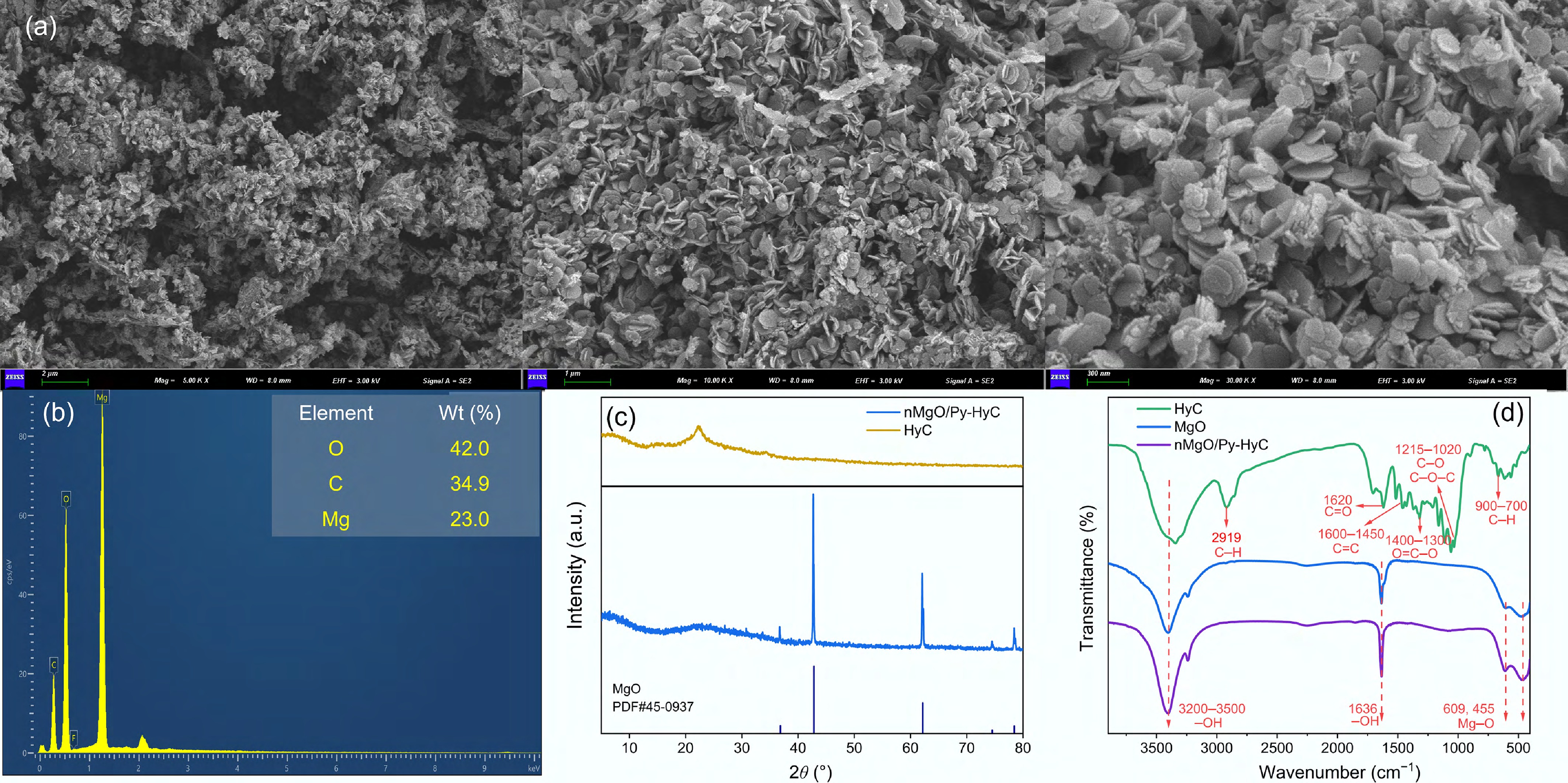
Figure 1.
(a) SEM image, (b) EDS spectrum, (c) XRD pattern, and (d) FTIR spectrum of nMgO/Py-HyC.
FTIR (Fig. 1d) exhibited that the stretching vibrations of C–H in methyl and methylene (2,919 cm−1), C=C stretching vibrations (1,600–1,450 cm−1), and C–H bending vibrations in the aromatic structure (900–700 cm−1) related to the carbon skeleton of HyC were obtained[44,45]. A variety of oxygen-containing functional groups were also observed, including the stretching vibration of O–H (3,500–3,200 cm−1), the vibration of aliphatic C=O (1,620 cm−1), the stretching vibration of O=C–O in the carboxyl group (1,400–1,300 cm−1), and the stretching vibration of aromatic C–O (1,215 cm−1) and aliphatic C–O–C (1,020 cm−1)[27]. After modification, nMgO/Py-HyC shared a similar pattern with MgO; the peaks at 3,450 and 1,636 cm−1 were associated with the stretching vibration of –OH and the bending vibration of –OH of adsorbed H2O, while the ones at 609 and 455 cm−1 were assigned to the Mg–O stretching vibration[46,47], which were consistent with the results of XRD.
Adsorption thermodynamics
-
The isotherm experiment data on the adsorption of F− onto nMgO/Py-HyC at different temperatures were fitted by both the Langmuir and Freundlich isotherm models (Fig. 2a; Supplementary Table S3, R2 > 0.90, p < 0.01). The maximum adsorption capacity (Qmax) of F− reached 469.64 mg/g at 298 K according to the Langmuir isotherm, which surpassed the performance of previously reported materials (Table 1). Furthermore, based on the van't Hoff plots (Fig. 2b), the thermodynamic parameters were calculated (Supplementary Table S4). The values of ΔG0 were negative at all tested temperatures, indicating that the adsorption was spontaneous; ΔH0 reached 64.68 kJ/mol, suggesting that the adsorption was dominated by chemisorption.
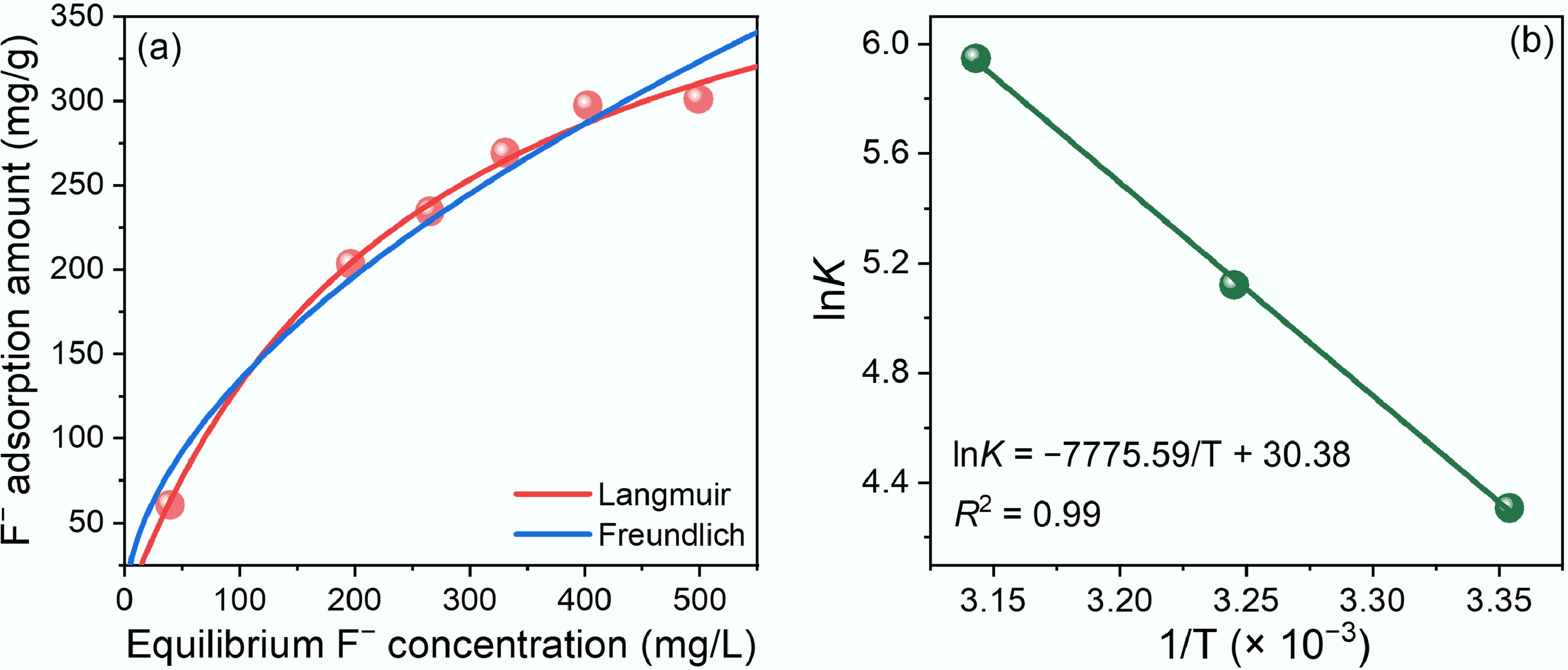
Figure 2.
(a) Adsorption isotherms and (b) thermodynamic plot of fluoride ions on nMgO/Py-HyC.
Table 1. The performance and mechanisms of F− removal by different materials
Adsorbent material Adsorption
capacity (mg/g)Dosage
(mg/L)pH Mechanisms Ref. Mn-modified natural bentonite 2.64 40 6.2 Electrostatic interaction; ion exchange; surface complexation [48] Natural clay adsorbent 16.05 20 6 ± 0.5 Ion exchange; electrostatic interaction; surface adsorption [49] MnO2/graphene oxide composite 2.52 0.5–2.0 7.0 ± 0.5 Electrostatic interaction; surface complexation [50] Zr-based MOFs 40.26 4 5.0 Ligand exchange; electrostatic interaction;
metal–fluoride complexation[51] UiO-66/CF composite 295.00 200 7.0 ± 0.5 Anion exchange; Zr–F complexation; electrostatic attraction [52] Corn stalk biochar 75.20 1,000 7.0 AlCl3 modification increases aluminum active sites [53] Fe3O4/mSiO2/mLDH 28.52 1,000 6.0 Anion exchange; electrostatic interaction; surface complexation [54] Co/Mg/Al-LDH 38.01 500 5.0 Anion exchange; surface complexation [55] Mg/Al/La-LDHs 62.33 1,000 6.0 Anion exchange; ligand exchange; electrostatic attraction [56] MgO-modified biochar 83.05 1,000 8.0 ± 0.2 Mg–F complexation; precipitation; electrostatic attraction [46] MgO/RH 63.47 1.0 7.0 Biochar preparation followed by MgO loading and calcination [57] MgO/SCG 141.98 1.0 7.0 Biochar preparation followed by MgO loading and calcination [57] nMgO/Py-HyC 469.64 1.0 7.0 ± 0.1 Hydrothermal pre-carbonization followed by one-step
MgCl2-assisted pyrolytic modificationThis study Adsorption kinetics
-
Initially, F− adsorption amount increased sharply within 24 h, and thereafter approached equilibrium at 48 h. The experimental data were well fitted by the pseudo-first-order model (R2 = 0.99, Supplementary Fig. S1a; Supplementary Table S5), pseudo-second-order model (R2 = 0.99, Supplementary Fig. S1b), and Elovich model (R2 = 0.96, Supplementary Fig. S1c), suggesting that both the physical and chemical adsorption processes may contribute to the adsorption. The intraparticle diffusion plots (Supplementary Fig. S1d) can be divided into two distinct linear segments without passing through the origin, demonstrating a considerable contribution of boundary-layer film resistance. The Boyd plots were linearly fitted (R2 = 0.98, Supplementary Fig. S1e) without passing through the origin, indicating that the adsorption was governed by film diffusion.
Influencing factors
Effects of pH
-
pH commonly plays a primary role in influencing adsorption, which can simultaneously alter the surface charge property and the ionic fraction. The adsorption of F− by nMgO/Py-HyC remained stable within a wide range of pH = 5.0–11.0 (p > 0.05) but dropped significantly at pH = 3.0 and 13.0 (p < 0.001) (Fig. 3a). The surface of nMgO was positively charged when pH < 12.0 due to its pHpzc of 12.0, which facilitated the electrostatic attraction or electric dipole action towards F−, whereas in strongly alkaline conditions (pH > 12.0), the electrostatic repulsion occurred between F− and nMgO; additionally, excessive OH− also inhibited the adsorption due to competitive effects[47,58]. For the chemical fraction distribution of F− when pH < pKa of HF (pKa = 3.18), the electrostatic interaction cannot contribute to the adsorption since the molecular form HF became dominant (Fig. 3b)[59,60].
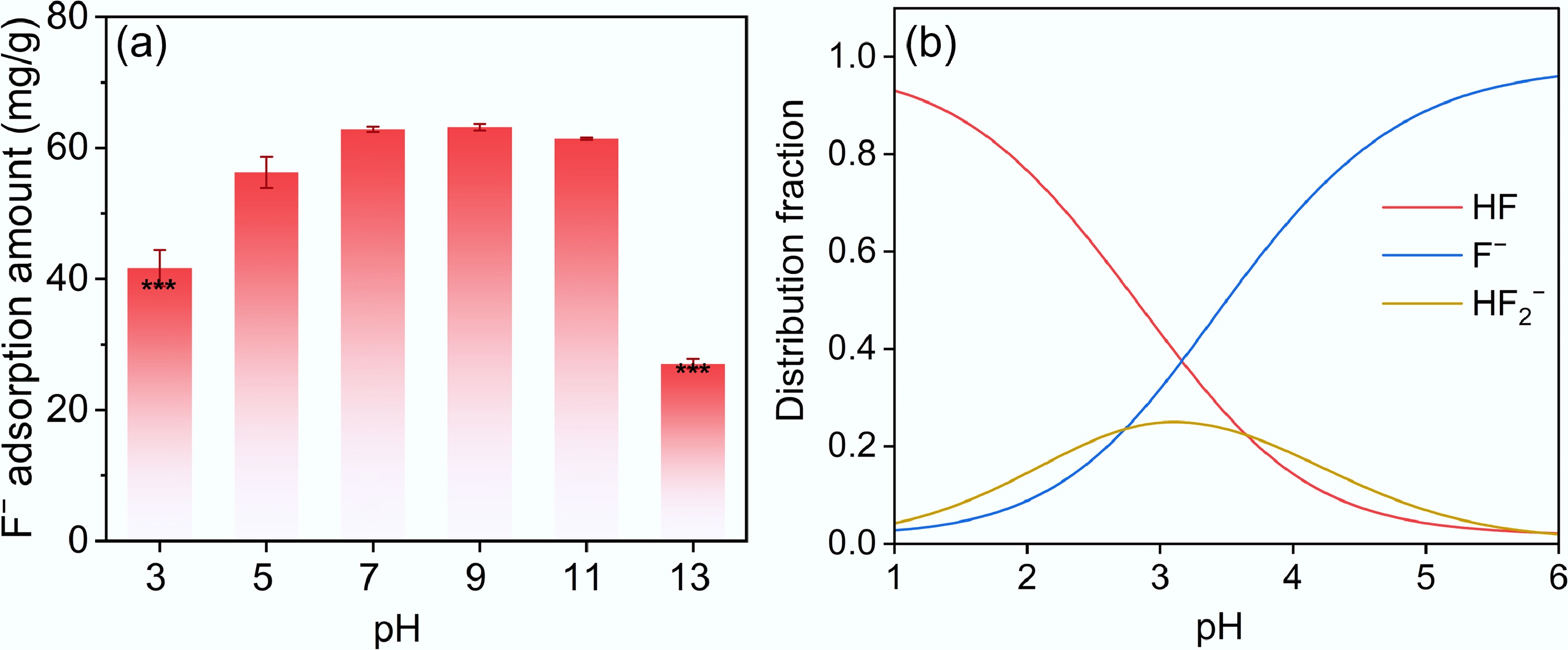
Figure 3.
Effects of pH on F− adsorption by nMgO/Py-HyC.
Effects of coexisting anions
-
The anions coexisting with F− in aquatic environments, such as NO3−, SO42−, and HCO3−, also have a significant influence on the adsorption. As shown in Fig. 4, the concentrations of NO3− and SO42− within a range of 0–10 mmol/L did not exert a significant influence on the adsorption of F− onto nMgO/Py-HyC (p > 0.05). The increase in the ion concentration inhibited the electrostatic adsorption by reducing the thickness of the electrical double layer; thus, the negligible effects of NO3− and SO42− further confirmed that the adsorption of F− by nMgO/Py-HyC was governed by chemisorption with high selectivity. In contrast, the presence of HCO3− significantly hindered the adsorption when the concentration exceeded 1 mmol/L (p < 0.01), since intense competitive adsorption occurred between HCO3− and F−, as they shared comparable hydrated ionic radii (0.352 nm for F− and 0.364 nm for HCO3−)[61]. Furthermore, hydrolysis of HCO3− increased pH, which further impeded F− adsorption by modulating the surface electrochemical properties, as discussed previously.
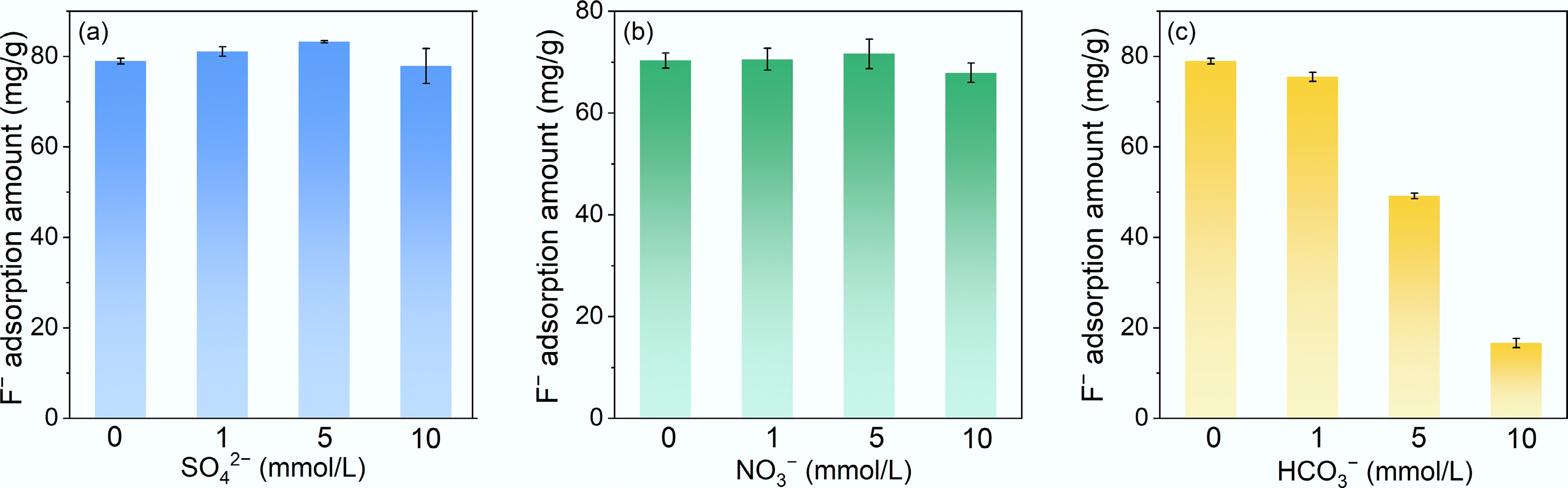
Figure 4.
Effect of coexisting (a) SO42−, (b) NO3−, and (c) HCO3− on F− adsorption by nMgO/Py-HyC.
Effect of ionic strength
-
The effect of ionic strength on F− adsorption by nMgO/Py-HyC was investigated (Supplementary Fig. S2). When the ionic strength increased from 0 to 0.2, the adsorption decreased by approximately 42% and remained stable when it further increased to 0.3. The ionic strength can be used to distinguish physisorption from chemisorption via compression of the electrical double layer; accordingly, F− adsorption onto nMgO/Py-HyC was dominated by chemisorption with a contribution of approximately 58%, which agrees well with the results of adsorption thermodynamics.
Adsorption mechanisms
-
SEM of nMgO/Py-HyC (Fig. 5a) demonstrated that after adsorption, the porous structures collapsed, together with a decrease in the amount of nano-scale flaky aggregates. EDS (Fig. 5b) revealed that the element F was detected after adsorption with a proportion of 22.4 wt% due to the uptake of F− by nMgO/Py-HyC. N2 adsorption-desorption isotherms (Supplementary Fig. S3a) remained type IV after adsorption with an alteration of hysteresis loop transforming from H4-type to H3-type; the specific surface area, total pore volume, and average pore diameter increased from 63.55 to 120.4 m2/g, 0.25 to 0.62 cm3/g, and 15.96 to 20.74 nm, respectively, accompanied by a decrease in the relative proportion of microporous and mesoporous structures (Supplementary Fig. S3b). F− chemically etched the nMgO crystallites and disintegrated the aggregates, which may increase the specific surface area, accompanied by the collapse of certain original intracrystalline pores and the formation of numerous porous structures by topological reconstruction, broadening of slit-shaped mesopores, and disordering of particle stacking, which may lower the intraparticle diffusion resistance and promote F− uptake[62,63].
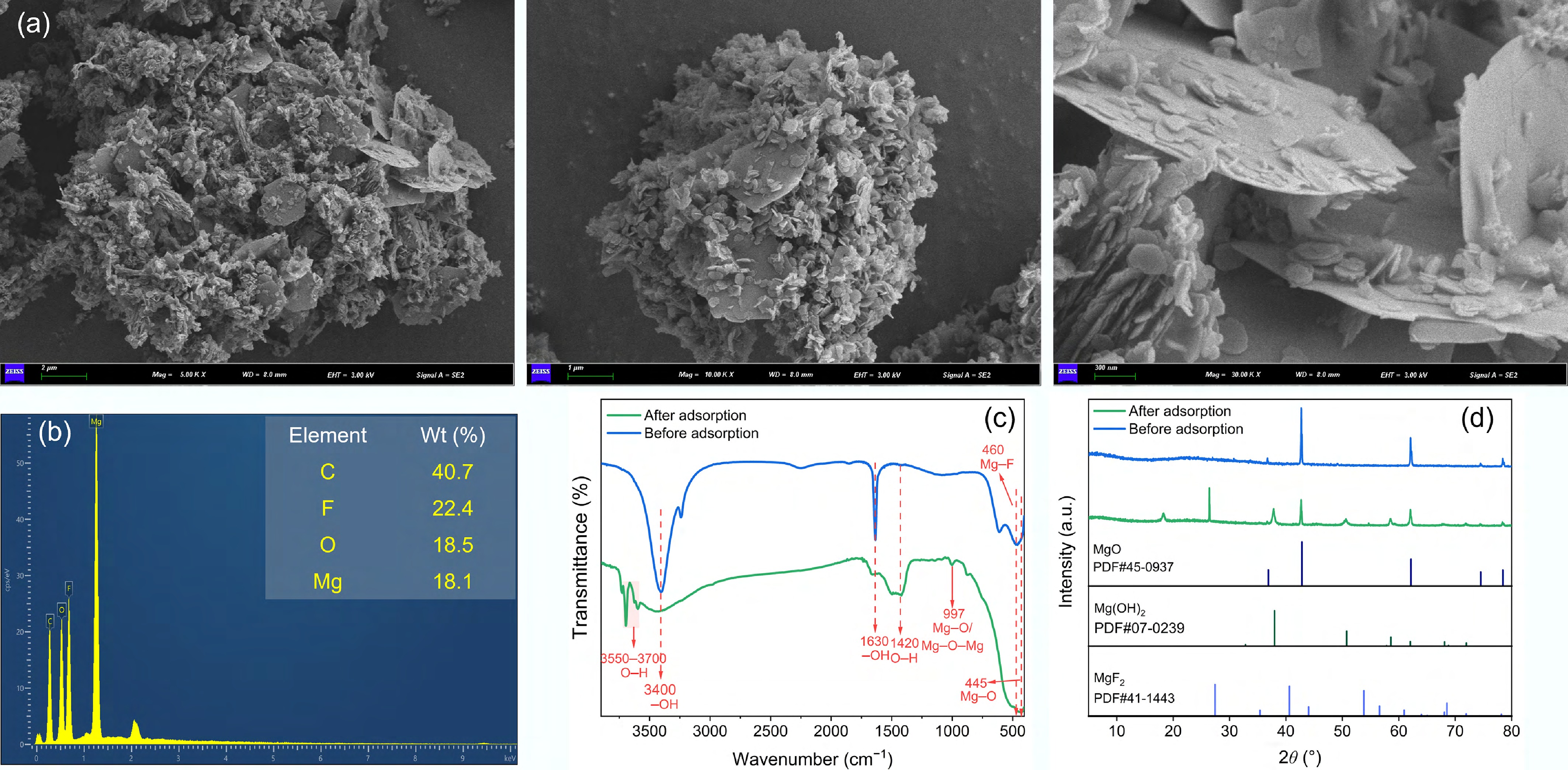
Figure 5.
(a), (b) SEM images and EDS spectra of nMgO/Py-HyC after fluoride adsorption; (c) FTIR spectra, and (d) XRD patterns before and after fluoride adsorption.
According to XRD (Fig. 5d), the diffraction peaks at 2θ = 36.7° (111), 42.7° (200), 62.1° (220), 74.4° (311), and 78.4° (222) assigned to MgO weakened after adsorption[64], accompanied by the emergence of peaks corresponding to the crystal plane diffractions of Mg(OH)2 at 2θ =18.3° (001), 37.8° (101), 50.6° (102), and 58.5° (110), and MgF2 at 2θ = 27.4° (110). Mg(OH)2 was produced due to the hydrolysis of nMgO; although the solubility product constant of Mg(OH)2 was low (ksp = 5.61 × 10⁻¹² at 25 °C), it tended to dissolve when pH < 10. Thus, within a pH range of 4–10, F− can precipitate with released Mg2+ to form MgF2 (ksp = 5.16 × 10⁻¹¹ at 25 °C), while when pH > 10, Mg(OH)2(s) may complex with F− via ligand exchange[65−67]. FTIR (Fig. 5c) showed that a series of peaks emerged, in which the ones located between 3,550 and 3,700 cm−1 corresponded to the stretching vibration of O–H in Mg(OH)2 and Mg(OH)2−xFx, while the wide peaks at around 1,420 cm−1 were ascribed to the bending vibration of O–H in Mg(OH)2 and Mg(OH)2−xFx[68−70]. The peak at 997 cm−1 was related to the stretching vibration of Mg–O or Mg–O–Mg[71,72]. Those at 445 and 460 cm−1 were assigned to the stretching vibration of Mg–O and Mg–F, respectively[73−75]. Furthermore, after adsorption, the stretching vibration of –OH at 3,400 cm−1 and the bending vibration of –OH at 1,630 cm−1 shifted, weakened, and/or broadened, indicating the occurrence of intermolecular hydrogen bonds between ≡Mg–OH and F−.
XPS spectra (Fig. 6) showed that for O 1s, the signal was deconvoluted into Mg–O (at 530.98 eV, 23.54%) and Ar–OH (at 532.89 eV, 40.23%) in nMgO/Py-HyC. A shift of Mg–O from 530.98 to 532.17 eV was observed after adsorption, indicating an alteration in the coordination environment of Mg. Furthermore, the binding energy of Ar–OH increased to 533.51 eV, which was attributed to the hydrogen bond between Ar–OH on Py-HyC and F−, with an electron transfer from O towards F[76]. For F 1s, no signal was observed before adsorption, whereas two peaks assigned to Mg–F at 686.06 eV (39.26%) and Mg–OH–F at 687.26 eV (60.74%) were obtained, suggesting that F− was complexed with Mg and that the hydrogen bond as Mg–OH…F also contributed to the adsorption of F−[77−79]. According to Mg 1s, this further confirmed that, in addition to Mg–O (1,304.02 eV), Mg–OH (1,305.29 eV) and Mg–F (1,306.53 eV) were also observed due to the hydrolysis of nMgO and the formation of chemical bonds between Mg2+ and F−[80,81].
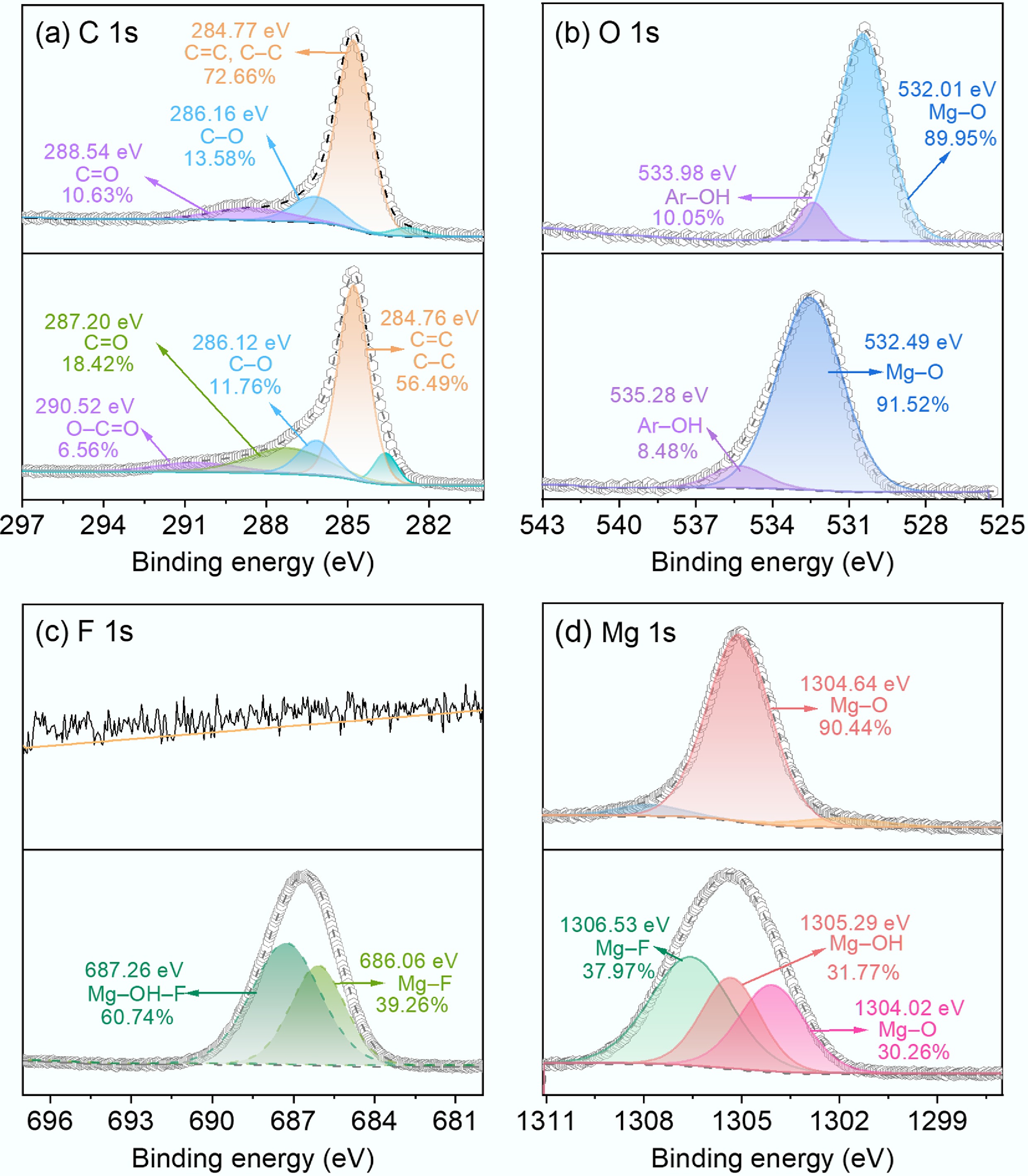
Figure 6.
XPS spectra of nMgO/Py-HyC before and after the adsorption of fluoride ion.
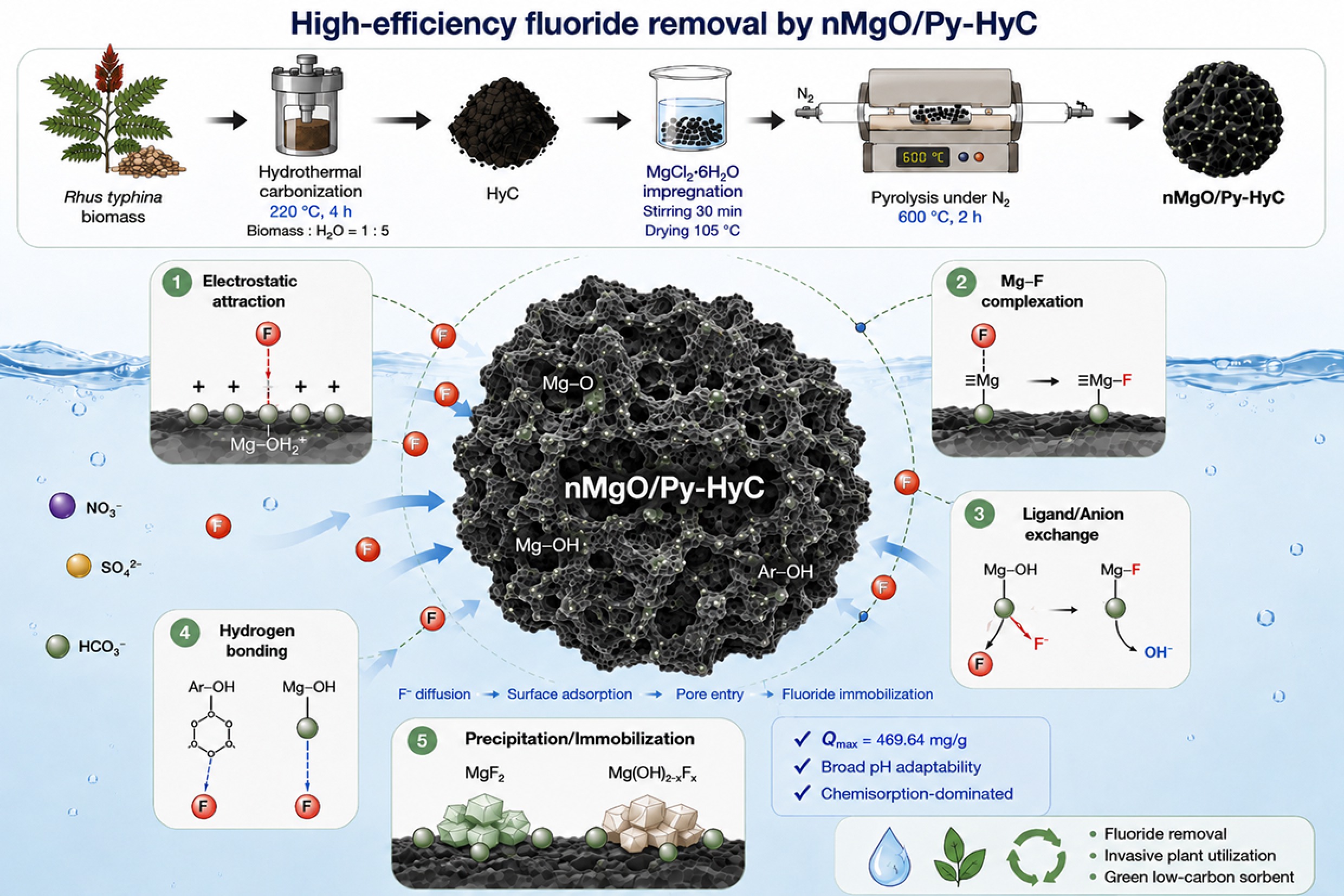
Thus, during the adsorption process, F− initially diffused to the surface of nMgO/Py-HyC and entered the mesopores and micropores, where it was adsorbed via electrostatic attraction within a wide pH range and/or directly complexed with Mg2+. Furthermore, nMgO could be hydrolyzed into Mg(OH)2 with abundant OH−, which further fixed F− by anion/ligand exchange to form insoluble MgF2 or Mg(OH)2−xFx, inducing intensive lattice distortion and structural defects. Additionally, F− was further adsorbed via hydrogen bonds formed between F− and Mg(OH)2, Mg(OH)2−xFx, as well as Ar–OH on Py-HyC. Furthermore, the fabrication and adsorption experiments for Py-HyC and nMgO were conducted under the same conditions as those for nMgO/Py-HyC, with the nMgO-to-Py-HyC ratio of 1:1 (consistent with that in nMgO/Py-HyC), and an initial F− concentration of 100 mg/L. The results showed that the sum of the adsorption capacities of Py-HyC (4.31 ± 0.182 mg/g) and nMgO (43.54 ± 0.174 mg/g) was significantly lower than that of nMgO/Py-HyC (86.44 ± 0.013 mg/g), indicating a prominent synergistic effect between Py-HyC and anchored nMgO. The porous hierarchical framework of Py-HyC acted as an ideal supporting carbonaceous matrix, which effectively restrained the aggregation of Py-HyC, greatly boosted the exposure of active adsorption sites for F− immobilization, and facilitated the transformation of nMgO into Mg(OH)2−xFx and MgF2 via ligand exchange, while the interconnected porous network may reduce intraparticle diffusion resistance and facilitate the contact between F− and the active sites of nMgO/Py-HyC. In addition, the acidic oxygen-containing groups on the Py-HyC surface also exhibited favorable pH buffering performance, which can neutralize the excess OH− generated and eliminate the inhibitory effects of high alkalinity on F− adsorption. Moreover, under actual wastewater conditions, nMgO/Py-HyC also showed efficient performance towards F− removal (Supplementary Text S5; Supplementary Table S6), and the environmental impacts of nMgO/Py-HyC were further evaluated via life cycle assessment (Supplementary Text S6; Supplementary Fig. S4).
-
In this study, a high-performance nMgO/Py-HyC composite material was successfully synthesized via a facile one-step pyrolysis process using invasive plant residues of Rhus typhina as the biomass feedstock. The results of batch adsorption experiments showed that an excellent adsorption performance towards F− was achieved for nMgO/Py-HyC with a maximum capacity of 469.64 mg/g at 298 K. Thermodynamic parameters revealed that F− adsorption was a spontaneous chemisorption process. The composite material also displayed outstanding environmental adaptability, with defluoridation efficiency being retained steadily within a wide pH range of 5.0–11.0, and the coexisting anions, such as NO3−and SO42−, did not interfere with the adsorption of F−, suggesting a significant practical potential for F− removal from aqueous solution. The proposed fluoride-removal mechanisms included electrostatic interaction, anion/ligand exchange, surface complexation, precipitation, and hydrogen bonding based on comprehensive characterizations. This research provides a high-efficiency, low-carbon, and green material for F− removal and a viable economic pathway for the utilization of invasive plant biomass. Future research may focus on the practical engineering evaluation and application of nMgO/Py-HyC in different actual F− wastewater treatment conditions.
Not applicable.
-
It accompanies this paper at: https://doi.org/10.48130/bchax-0026-0021.
-
This study did not involve human participants, human-derived materials or data, animals, clinical trials, or identifiable personal information; therefore, ethical approval and informed consent were not required. During the preparation of this work, the authors used Gemini on 15 June 2026 to generate an initial conceptual graphical abstract illustrating the preparation of nMgO/Py-HyC and the proposed fluoride adsorption mechanisms. This use falls under Category B: Generative Creation of Illustrative Figures. The prompt provided was: "electrostatic attraction, Mg-F complexation, ligand/anion exchange, hydrogen bonding, and precipitation/immobilization." The authors manually reviewed and edited the generated illustration, checking and correcting scientific labels, material names, reaction steps, adsorption mechanisms, and layout to ensure consistency with the experimental design and interpretations presented in the manuscript. The final graphical abstract is solely conceptual and illustrative; it does not contain, replace, modify, or misrepresent experimental data, spectra, microscopy images, or quantitative measurements. No AI-generated content was used to alter or enhance experimental figures or data. The authors verified the scientific accuracy of the final content and take full responsibility for the integrity and originality of the manuscript. This work represents the authors' own intellectual contribution, and no AI tool is credited as an author.
-
The authors confirm their contributions to the paper as follows: Yao Tong: investigation, formal analysis, writing—original draft; Donglin Wang: methodology, formal analysis; Lingqing Gu: investigation; Yujie Tai: investigation; Xianjie Tang: formal analysis; Xi Zhang: data curation; Rongdi An: data curation; Til Feike: writing—review and editing; Jiunian Guan: conceptualization, methodology, funding acquisition, supervision, writing—review and editing. All authors reviewed the results and approved the final version of the manuscript.
-
The datasets generated during and/or analyzed in the current study are available from the corresponding author upon reasonable request.
-
The authors declare that they have no known competing financial interests or personal relationships that could have appeared to influence the work reported in this paper.
-
Full list of author information is available at the end of the article.
- The supplementary files can be downloaded from here.
- Copyright: © 2026 by the author(s). Published by Maximum Academic Press, Fayetteville, GA. This article is an open access article distributed under Creative Commons Attribution License (CC BY 4.0), visit https://creativecommons.org/licenses/by/4.0/.
-
About this article
Cite this article
Tong Y, Wang D, Gu L, Tai Y, Tang X, et al. 2026. Nano-MgO/pyro-hydrochar for enhancing adsorption of fluoride ion from aqueous solution: performance, influencing factors, and mechanisms. Biochar X 2: e023 doi: 10.48130/bchax-0026-0021 

Nano-MgO/pyro-hydrochar for enhancing adsorption of fluoride ion from aqueous solution: performance, influencing factors, and mechanisms
- Received: 06 July 2026
- Revised: 06 September 2026
- Accepted: 17 September 2026
- Published online: 30 September 2026
Abstract: Currently, the accumulation of fluoride ions (F−) in aquatic systems has become a universal concern threatening public health globally. In this study, an nMgO-modified pyro-hydrochar (nMgO/Py-HyC) composite was fabricated via a facile one-step pyrolysis process to provide an efficient, green, and low-carbon adsorbent for F− removal from aquatic environments. Batch adsorption experiments demonstrated that the adsorption isotherm data were well fitted by the Langmuir and Freundlich models, and the adsorption capacity achieved 469.64 mg/g, which was superior to previously reported materials. Thermodynamic parameters suggested that F− adsorption was spontaneous and governed by chemisorption. The adsorption efficiency of nMgO/Py-HyC remained stable over a broad pH range of 5.0−11.0, while the coexisting anions (i.e., NO3−, SO42−) did not significantly interfere with the adsorption of F−; only high-concentration HCO3− (> 1 mmol/L) hindered the adsorption, suggesting a practical potential of nMgO/Py-HyC for F− removal. Based on comprehensive characterization, F− was first diffused to the surface of nMgO/Py-HyC, where it was fixed via electrostatic attraction, hydrogen bonding, direct complexation with Mg2+, and anion/ligand exchange with the generation of insoluble MgF2 or Mg(OH)2−xFx. Therefore, as a high-efficiency and sustainable material, nMgO/Py-HyC may offer a practical approach not only for F− removal but also for the integrated management and valorization of invasive plants.
-
Key words:
- Nano-MgO /
- Pyro-hydrochar /
- Defluoridation /
- Fluoride ion adsorption /
- Adsorption mechanisms /
- Invasive plant biomass