












-
Soil chemical constraints can strongly influence forest plantation establishment, particularly in acidic, nutrient-poor soils where low nutrient availability and limited buffering capacity restrict early tree development[1−3]. This is especially relevant in Mediterranean Eucalyptus globulus plantation systems, where seasonal water limitation and low soil fertility can constrain early stand development[4]. In Portugal, Eucalyptus globulus is widely cultivated for fiber production, and early plantation performance depends strongly on adequate nutrient supply and suitable rooting conditions[2,5]. At the study site, these constraints were expressed as strongly acidic soil, low available P, low exchangeable Ca, and low effective CEC, creating a practical need to improve nutrient availability and soil chemical buffering during plantation establishment.
Biochar has been proposed as a soil amendment capable of improving acidic and degraded soils while simultaneously valorizing residual biomass and retaining carbon in relatively stable forms[6−8]. Its effects are commonly associated with increased soil pH, nutrient retention, cation exchange processes, and changes in organic carbon status, although the magnitude and persistence of these responses depend strongly on feedstock, pyrolysis conditions, soil properties, and application context[9−12]. Importantly, biochar should not be regarded as a uniform material. Differences in carbon content, ash composition, alkalinity, and nutrient enrichment can substantially alter its functional behavior in soil[8,13−15]. High-carbon woody biochars may primarily act as soil conditioners, whereas nutrient-enriched formulations may additionally supply or retain plant-available nutrients. This distinction becomes particularly relevant when biochar is combined with conventional fertilization, because positive plant responses may result from complementary effects between nutrient supply and improved soil chemical conditions rather than from biochar acting as a direct fertilizer substitute[16−19].
Meta-analytical evidence indicates that biochar effects on plant productivity are highly context-dependent and tend to be stronger in acidic or degraded soils and when biochar is used together with fertilization[11,19−21]. However, most of this evidence derives from agricultural systems. Field studies in forest plantations remain comparatively limited, even though forest systems differ from annual cropping systems in rooting depth, nutrient cycling, management duration, and biomass-return pathways[22−26]. This gap is especially relevant for Eucalyptus plantations, where forest residues can potentially be converted into biochar and returned to plantation soils, creating a circular pathway between biomass management, soil improvement, and stand establishment[27−31]. Although contrasting biochar formulations have been compared in controlled pot and greenhouse experiments, field comparisons under plantation conditions remain uncommon, particularly where formulations derived from the same general biomass resource are evaluated with and without conventional mineral fertilization.
The present study therefore evaluated two Eucalyptus-derived biochar formulations during the first 12 months of Eucalyptus globulus plantation establishment on acidic soil in central Portugal. A high-carbon Biochar Pure and a mineral-enriched Biochar Plus were applied locally within planting holes, with and without mineral fertilization, in flat and terraced areas. The study assessed treatment effects on soil chemical properties and early tree growth under operational field conditions. We tested three main expectations: (i) biochar would improve soil chemical conditions, particularly soil pH, organic carbon, and exchangeable nutrient status; (ii) plant growth responses would be greater when biochar was combined with mineral fertilization than when high-carbon biochar was applied alone; and (iii) in the flat area, where both formulations were represented, mineral-enriched Biochar Plus would produce a stronger standalone growth response than Biochar Pure because of its greater nutrient content. Responses in the flat and terraced areas were analyzed separately because the two areas differed in baseline soil properties and treatment structure; consequently, direct comparison between Biochar Pure and Biochar Plus was restricted to the flat area. By linking biochar formulation, soil chemical response, and early plantation performance, this study evaluates how product composition influences the functional role of biochar in circular forest-management systems.
-
The field trial was established in Vale Domingos in Águeda, central Portugal (40°35'03.54" N 8°25'20.02" W) in June 2016. The site has an Atlantic–Mediterranean transitional climate, characterized by mild, wet winters and comparatively dry summers. Mean annual precipitation in the region is approximately 1,200–1,400 mm, with marked seasonal variability. The flat and terraced trial areas were located within the same Vale Domingos experimental site, allowing comparison under the same local climatic setting but contrasting micro-topographic and baseline soil conditions. The study site, experimental layout, and installation process are shown in Fig. 1.
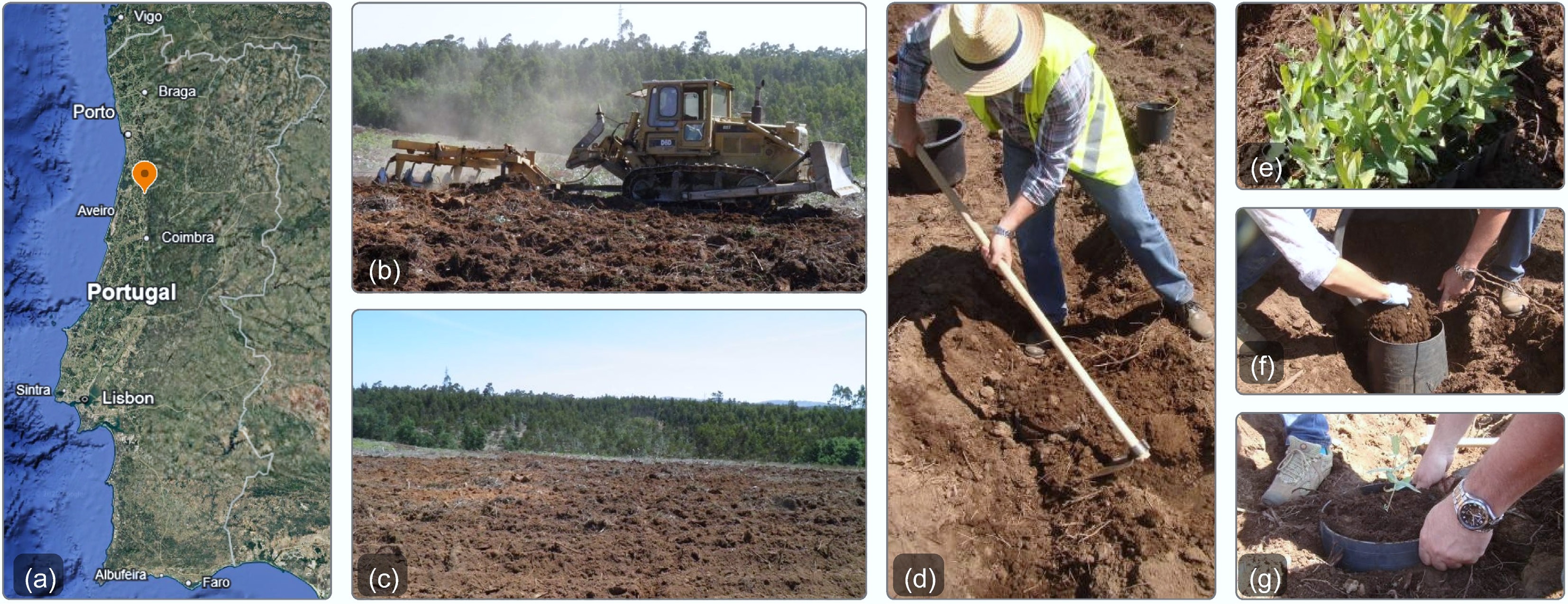
Figure 1.
(a) Geographic location of the trial at Vale Domingos (source: Google Earth Engine), including (i) flat area and (ii) terrace area. (b)–(d) Soil tillage before planting and local soil preparation. (e) The Eucalyptus globulus plants before planting. (f), (g) Installation stages of the trial.
Soil and biochar characteristics
-
The soil at the site is generally acidic, with low cation exchange capacity (CEC) and base saturation, reflecting common conditions in managed Eucalyptus globulus plantations in Portugal[1,2]. Compared with the flat area, the terraced area had substantially higher topsoil organic matter content (1.58-fold), clay content (1.60-fold), CEC (1.65-fold), and base saturation (1.36-fold). The flat-area topsoil was sandy loam, whereas the terraced topsoil had a finer texture with substantially greater silt and clay contents. The physical and chemical characteristics of the soil are presented in Table 1.
Table 1. General physical and chemical characteristics of the soils in the trial areas
Parameter Unit Flat area Terrace area 0–20 cm 20–40 cm 0–20 cm 20–40 cm Coarse sand % 38.9 36.5 20.1 21.1 Fine sand % 30.9 29.5 17.9 16.7 Silt % 13.0 17.0 34.4 35.9 Clay % 17.2 17.0 27.6 26.3 pH (H2O) – 5.2 5.1 4.9 5.0 Organic matter % 6.5 6.3 10.3 14.2 Total N % 0.2 0.2 0.5 0.5 P mg kg−1 6.6 5.7 7.9 7.9 Exchangeable Ca cmolc kg−1 0.1 0.1 0.2 0.3 Exchangeable Mg cmolc kg−1 0.2 0.1 0.5 0.7 Exchangeable K cmolc kg−1 0.1 0.1 0.2 0.2 Exchangeable Na cmolc kg−1 0.1 0.1 0.1 0.1 Effective CEC cmolc kg−1 3.1 2.5 5.1 5.7 Effective base
saturation% 13.7 14.5 18.6 24.2 Zn mg kg−1 1.3 1.1 2.8 3.4 Cu mg kg−1 0.5 0.6 1.5 1.8 Mn mg kg−1 1.3 0.8 5.4 6.4 Fe mg kg−1 139.2 130.7 170.6 154.2 B mg kg−1 0.7 0.8 1.1 0.9 Two commercial Eucalyptus-derived biochar formulations were evaluated: a high-carbon product (Biochar Pure) and a mineral-enriched formulation (Biochar Plus). Both products were supplied by a commercial biochar producer in Portugal (Ibero Massa Florestal S.A.) and were produced by slow pyrolysis of Eucalyptus biomass residues at a nominal pyrolysis temperature of approximately 600 °C. Biochar Pure had a pH (H2O) of 9.7 and total carbon content of 78.0%, whereas Biochar Plus had a pH of 10.0 and total carbon content of 61.1%. Biochar Plus contained substantially higher total concentrations of K, Mg, Na, Ca, Zn and Cu, together with higher exchangeable Mg, K and Na, and therefore represented a mineral-enriched formulation rather than simply a second woody biochar. The supplier provided technical sheets and analysis certificates for both products. The values reported in Table 2 were compiled from the archived product documentation and trial characterization records. Biochar pH was determined according to ISO 10390. Exchangeable Ca, Mg, K, and Na were extracted with 1 M ammonium acetate at pH 7 using a 1:10 (m/v) solid-to-solution ratio and quantified by ICP-OES. Water-extractable elements were determined using a procedure adapted from ISO/TS 21268-2:2007 at a liquid-to-solid ratio of 10 L kg−1 dry matter, followed by filtration and ICP-OES quantification. Total elemental concentrations were determined after aqua regia digestion by ICP-OES. Detailed information on other production parameters, including residence time, and the specific ICP-OES manufacturer and model used in these analyses were not retained in the archived records.
Table 2. Physical and chemical characteristics of the two biochar products based on archived product documentation and trial characterization records
Parameter Unit Biochar Pure Biochar Plus pH (H2O) − 9.7 10 Carbon % 78.04 61.12 Exchangeable Ca cmolc kg−1 5.5 5.12 Exchangeable Mg cmolc kg−1 1.79 3.54 Exchangeable K cmolc kg−1 1.11 8.26 Exchangeable Na cmolc kg−1 0.48 3.22 Water-extractable Zn mg kg−1 <0.25 5.42 Water-extractable Cu mg kg−1 <0.25 3.49 Water-extractable Mn mg kg−1 <0.2 4.65 Water-extractable Fe mg kg−1 <0.2 32.3 Water-extractable Mg mg kg−1 191 132.6 Water-extractable K mg kg−1 632.2 4,823.0 Water-extractable Na mg kg−1 120.4 1,417 Total Zn mg kg−1 12.1 187.6 Total Cu mg kg−1 3.2 46.3 Total Mn mg kg−1 463.8 431.3 Total Fe mg kg−1 4,028 4,883 Total Ca mg kg−1 6,834 20,986 Total Mg mg kg−1 840 3,551 Total K mg kg−1 2,878 23,975 Total Na mg kg−1 349 2,510 Experimental design and treatments
-
The experiment comprised two adjacent plantation areas: (i) a flat area; and (ii) a terraced area created on sloping terrain through soil preparation (Fig. 2). Each area contained three replicated blocks. In the flat area, six treatments were established, with five plants per treatment in each block (15 plants per treatment in total). In the terraced area, three treatments were established, with four plants per treatment in each block (12 plants per treatment in total). The treatments were defined as follows: (i) T0: control without NPK (fertilizer); (ii) T0A: control with NPK; (iii) T1: Biochar Pure without NPK, (iv) T2: Biochar Pure with NPK; (v) T3: Biochar Plus without NPK; and (vi) T4: Biochar Plus with NPK. Because the available terraced planting area and associated field logistics limited the experiment to three treatment groups, the conventional fertilized treatment (T0A) was retained as the operational reference, together with Biochar Plus without NPK (T3) and Biochar Plus with NPK (T4). This reduced design enabled evaluation of the mineral-enriched formulation with and without conventional fertilization but did not include Biochar Pure.
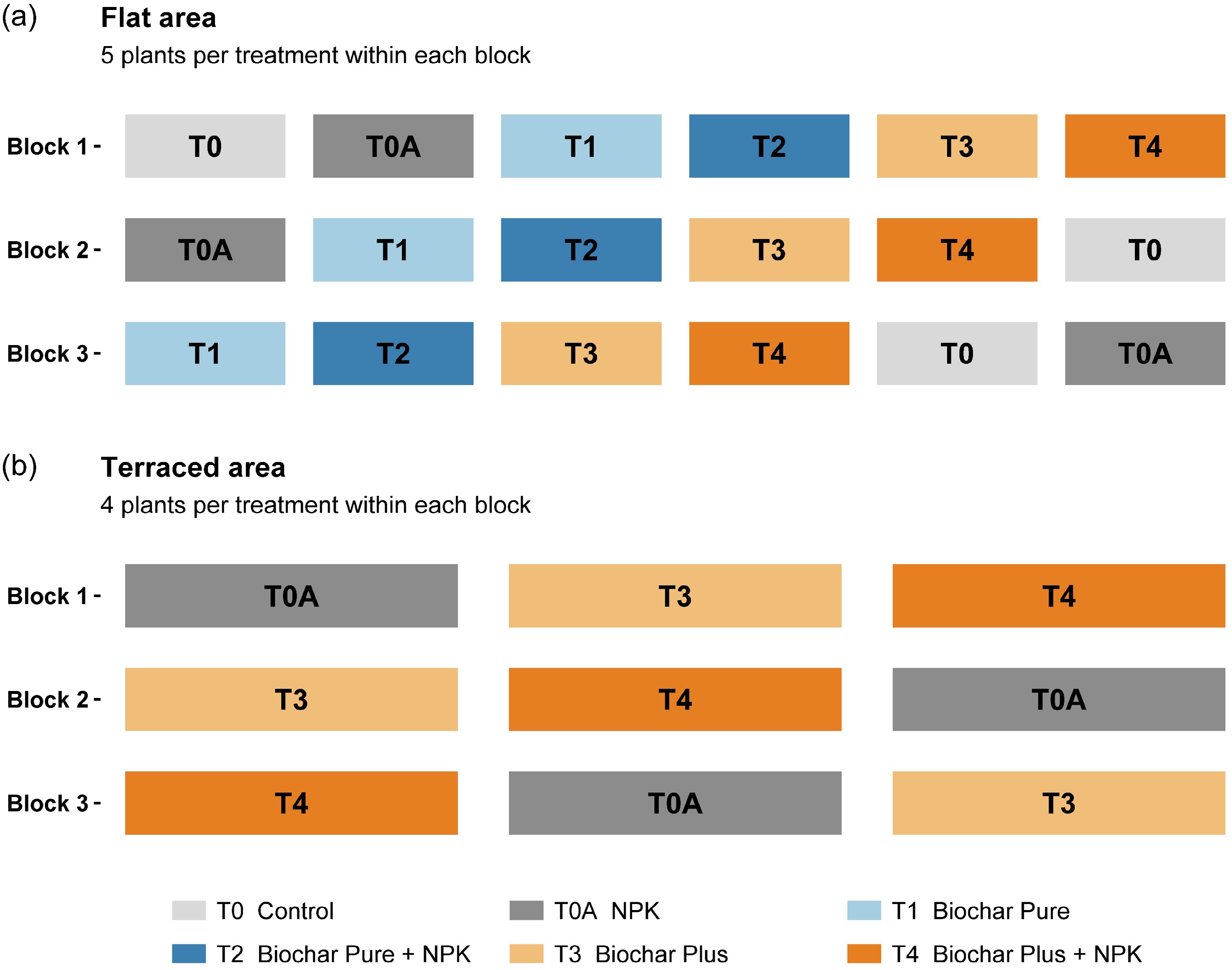
Figure 2.
Experimental treatment structure in the flat and terraced plantation areas. The flat area comprised three replicated blocks, with six treatments and five plants per treatment within each block (15 plants per treatment in total). The terraced area comprised three replicated blocks, with the fertilized control (T0A), Biochar Plus without NPK (T3), and Biochar Plus + NPK (T4), with four plants per treatment within each block (12 plants per treatment in total). Biochar was applied locally at 1.2 L plant−1 (approximately 8.5% v/v of the nominal planting-hole mixture). Treatment order within blocks is shown schematically; the figure is intended to communicate the experimental structure rather than geographic scale.
Consequently, direct statistical comparisons between the flat and terraced areas were not conducted. Biochar was applied locally within each planting hole at 1.2 L per plant, corresponding to approximately 8.5% v/v of the nominal 14.1-L soil–biochar planting-hole mixture. The application rate was selected based on preliminary incubation trials targeting a soil pH range suitable for E. globulus establishment (approximately 6.0–6.5). Mineral fertilization consisted of 30 g Agroblen (11–22–9 + 6% MgO; eight-to-nine-month controlled-release fertilizer, ICL Speciality Fertilizers) and 60 g of triple calcium superphosphate (42% P2O5; ADP Fertilizantes) per plant, reflecting standard plantation practice. Reliable formulation-specific bulk-density values for the products used in the 2016 trial were not retained in the archived trial documentation. Therefore, mass-based application rates cannot be reconstructed retrospectively from the recorded volumetric dose without introducing unsupported assumptions. Planting was carried out on June 20, 2016 using Eucalyptus globulus seedlings. Soil tillage included light harrowing and ripping before planting. At approximately 1,250 plants ha−1, this local application corresponds to a nominal planting-density equivalent of 1.5 m3 ha−1; because biochar was confined to individual planting holes, this value does not represent a whole-field incorporation rate. Detailed treatment descriptions, application rates, and plant numbers are provided in Supplementary Table S1.
Soil sampling and analytical methods
-
Before treatment application, baseline soil characterisation was based on area-level composite samples formed from 15 subsamples collected separately from the 0–20 and 20–40 cm layers in the flat and terraced areas. Post-planting monitoring samples were collected from 0–20 cm at approximately 5 and 12 months after planting. For each treatment within each block, a composite sample was prepared from at least ten subsamples collected within the treated planting zone. The three block-level composite samples represented the experimental replicates for soil analyses. Measured properties included soil pH (H2O), organic matter (OM), organic carbon (OC), available P, total N, exchangeable Ca, Mg, K, and Na, cation exchange capacity (CEC), and extractable Zn, Cu, Mn, Fe, and B. Soil pH was determined in aqueous soil suspension using a calibrated glass-electrode pH meter (Hanna Instruments HI-2002-02), following standard laboratory procedures for soil pH measurement[32]. Available P was determined using the Egner–Riehm extraction method. Organic carbon was calculated from organic matter using OC (%) = OM (%) × 0.58. Elemental concentrations were quantified by inductively coupled plasma–optical emission spectrometry (ICP-OES) following the laboratory extraction procedures used for the original soil analyses. The specific ICP-OES manufacturer and model were not retained in the archived analytical records available for this trial.
Plant measurements
-
Plant survival was assessed 1 month after planting, and dead individuals were replaced to ensure uniform stand conditions. Tree height was measured for all available trees at 5 and 12 months after trial implementation. For statistical analysis, measurements were averaged within each treatment-by-block combination, and the three block-level means were treated as the experimental replicates (n = 3 per treatment). Mean tree height was used as the primary plant-growth response variable. Plant survival and relative changes in mean height are summarized in Table 3, while treatment mean heights and Tukey groupings are shown in Fig. 3. The detailed monitoring schedule is provided in Supplementary Table S2.
Table 3. Initial survival at 1 month and relative change in mean plant height at 5 and 12 months after planting
Area Treatment Survival at
1 month (%)Relative height change at 5 months (%) 12 months (%) Flat T0 – Control
without NPK87 – – Flat T0A – Control
with NPK93 57.1 116.7 Flat T1 – Biochar Pure
without NPK93 0 0 Flat T2 – Biochar Pure
with NPK100 85.7 175 Flat T3 – Biochar Plus
without NPK100 28.6 75 Flat T4 – Biochar Plus
with NPK100 85.7 158.3 Terrace T0A – Control
with NPK100 – – Terrace T3 – Biochar Plus
without NPK92 −3.7 −15.5 Terrace T4 – Biochar Plus
with NPK100 8.3 17.7 Relative changes were calculated against T0 in the flat area and against T0A in the terraced area, where no unfertilized control was established. 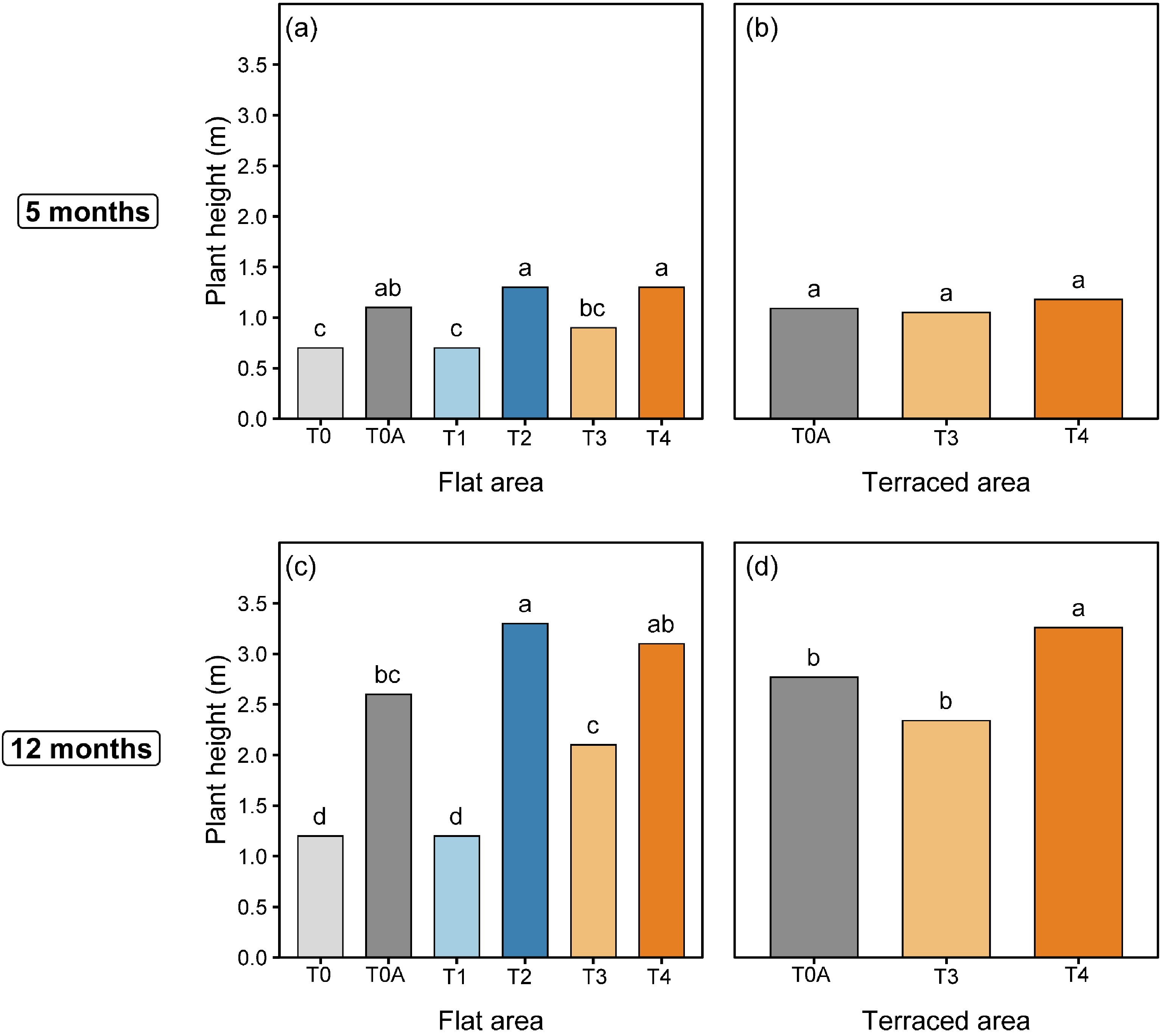
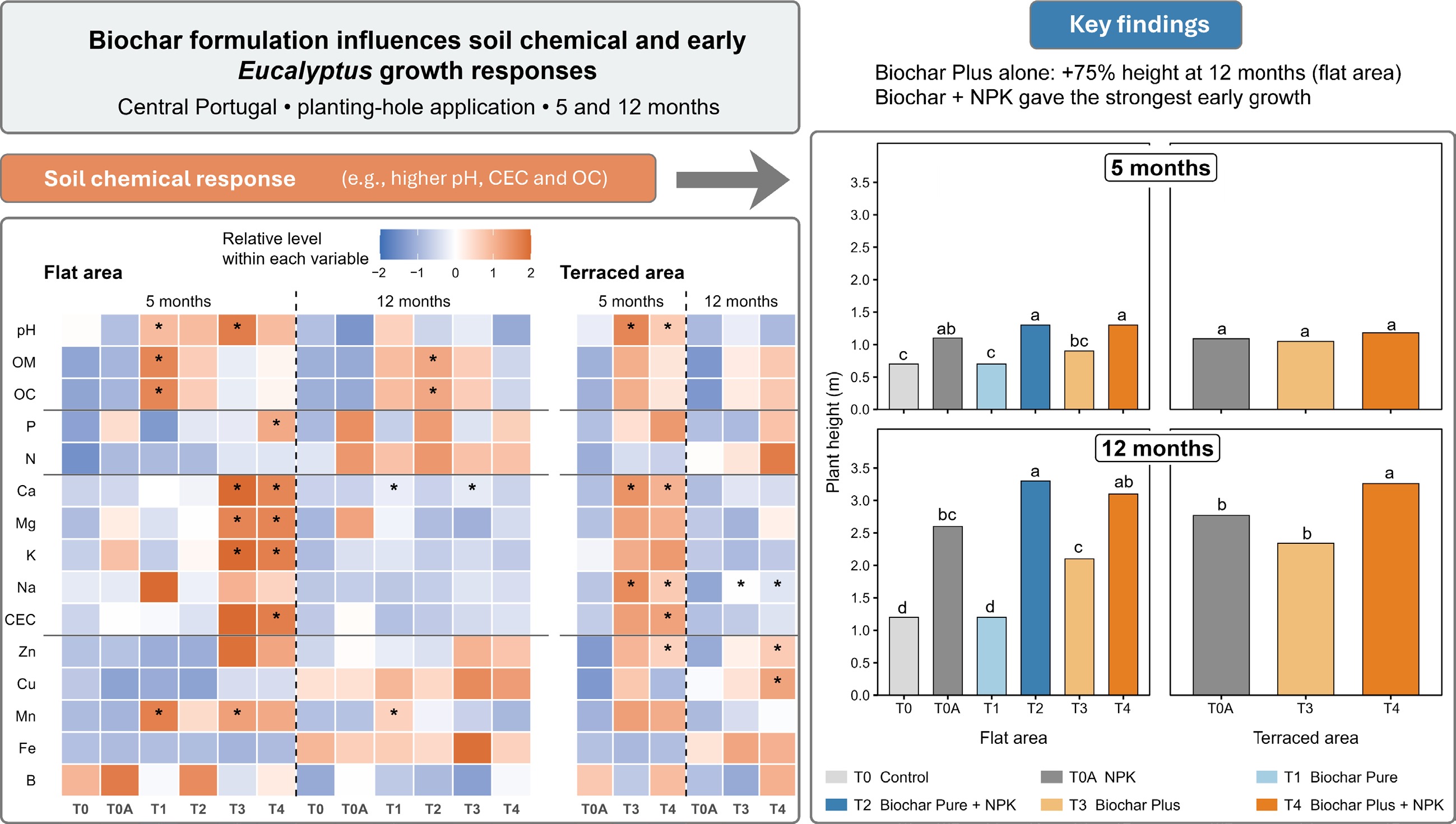
Figure 3.
Mean height of Eucalyptus globulus at (a), (b) 5 months and (c), (d) 12 months after planting in (a), (c) the flat and (b), (d) terraced areas. Bars represent treatment means based on three block-level replicates (n = 3). Different lowercase letters within the same area and sampling time indicate significant differences among treatments according to Tukey's HSD test (p < 0.05). Error bars are not shown because the archived block-level observations required to reconstruct SD or SE are no longer available.
Statistical analysis
-
Statistical analyses were performed separately for the flat and terraced areas because the two areas differed in treatment structure and baseline soil conditions. For plant height and soil chemical variables, treatment differences within each area and sampling time were evaluated using one-way analysis of variance (ANOVA), followed by Tukey's honestly significant difference (HSD) test at p < 0.05. The three block-level means were treated as the experimental replicates (n = 3 per treatment); individual trees or soil subsamples were not treated as independent replicates. Relative treatment responses were calculated as:
$ {\text{Relative change}}\;({\text{%}})=\dfrac{{X}_{\text{treatment}}-{X}_{\text{control}}}{{X}_{\text{control}}}\times 100 $ For the flat area, T0 was used as the reference control. For the terraced area, where an unfertilized control was not established, T0A was used as the area-specific reference. SPSS (v26) was used for statistical analyses and R (v4.6.1) for visualization. Initial soil values were used as area-level contextual baselines and were not included in the treatment ANOVA; therefore, changes relative to the initial values are interpreted descriptively. The archived dataset for this trial retains treatment means and the original Tukey HSD significance groupings, but the underlying block-level observations and dispersion statistics are no longer available. Consequently, SD/SE values and the original Tukey HSD critical differences could not be reconstructed retrospectively.
-
Initial survival 1 month after planting was high across treatments. In the flat area, survival ranged from 87% in T0 to 100% in T2, T3, and T4, while in the terraced area it ranged from 92% in T3 to 100% in T0A and T4. Dead seedlings were subsequently replaced; therefore, these survival values are reported descriptively and were not analyzed as a later treatment response. Plant height differed among treatments in the flat area at both sampling times (Fig. 3).
T0 and Biochar Pure alone (T1) remained the shortest treatments, whereas the greatest mean heights generally occurred when biochar was combined with mineral fertilization. At 5 months, T2 and T4 were significantly taller than T0 and T1. By 12 months, T2 reached 3.30 m, and T4 reached 3.10 m; T2 was significantly taller than T0A and T3, whereas T4 did not differ significantly from T0A or T2. Biochar Plus alone (T3) reached 2.10 m and was significantly taller than T0 and T1. Relative to T0, the 12-month mean height responses were +117% for T0A, +175% for T2, +75% for T3, and +158% for T4 (Table 3).
In the terraced area, plant height did not differ significantly among T0A, T3, and T4 at 5 months (Fig. 3). At 12 months, T4 reached 3.26 m and was significantly taller than both T0A (2.77 m) and T3 (2.34 m), whereas T0A and T3 did not differ significantly. Relative to T0A, the corresponding 12-month differences were −15.5% for T3 and +17.7% for T4 (Table 3). Because the flat and terraced areas had different treatment structures, treatment responses were not statistically compared between areas.
Soil chemical responses
-
Treatment effects on soil chemistry were most apparent at the first post-planting sampling, although their magnitude and statistical significance differed among variables (Fig. 4; Supplementary Table S3).
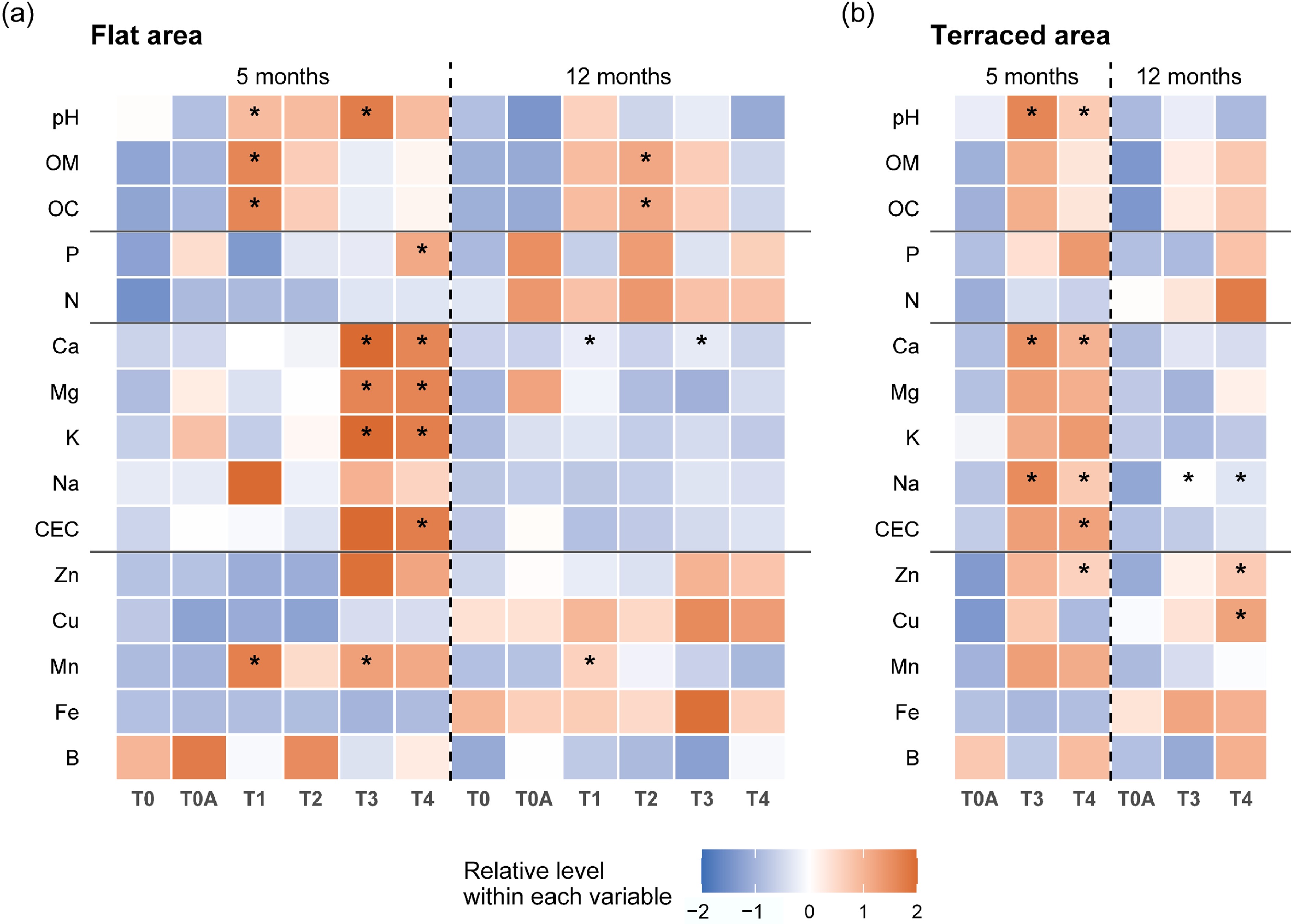
Figure 4.
Standardized soil-chemical response matrix at approximately 5 and 12 months after planting in the flat and terraced areas. Cell color represents the standardized relative level (z-score) of each treatment mean within the corresponding soil variable and area, allowing variables with different units to be compared on a common scale. Asterisks indicate treatment means that did not share a Tukey letter with the area-specific reference treatment at the same sampling time (T0 in the flat area; T0A in the terraced area; p < 0.05). Standardization was used for visualization only; original treatment means and Tukey groupings are reported in Supplementary Table S3.
Initial soil values are presented as contextual baselines; statistical comparisons refer only to treatments within each area and sampling time. Figure 5 summarizes the corresponding 12-month relative changes, with the underlying values reported in Supplementary Table S4.
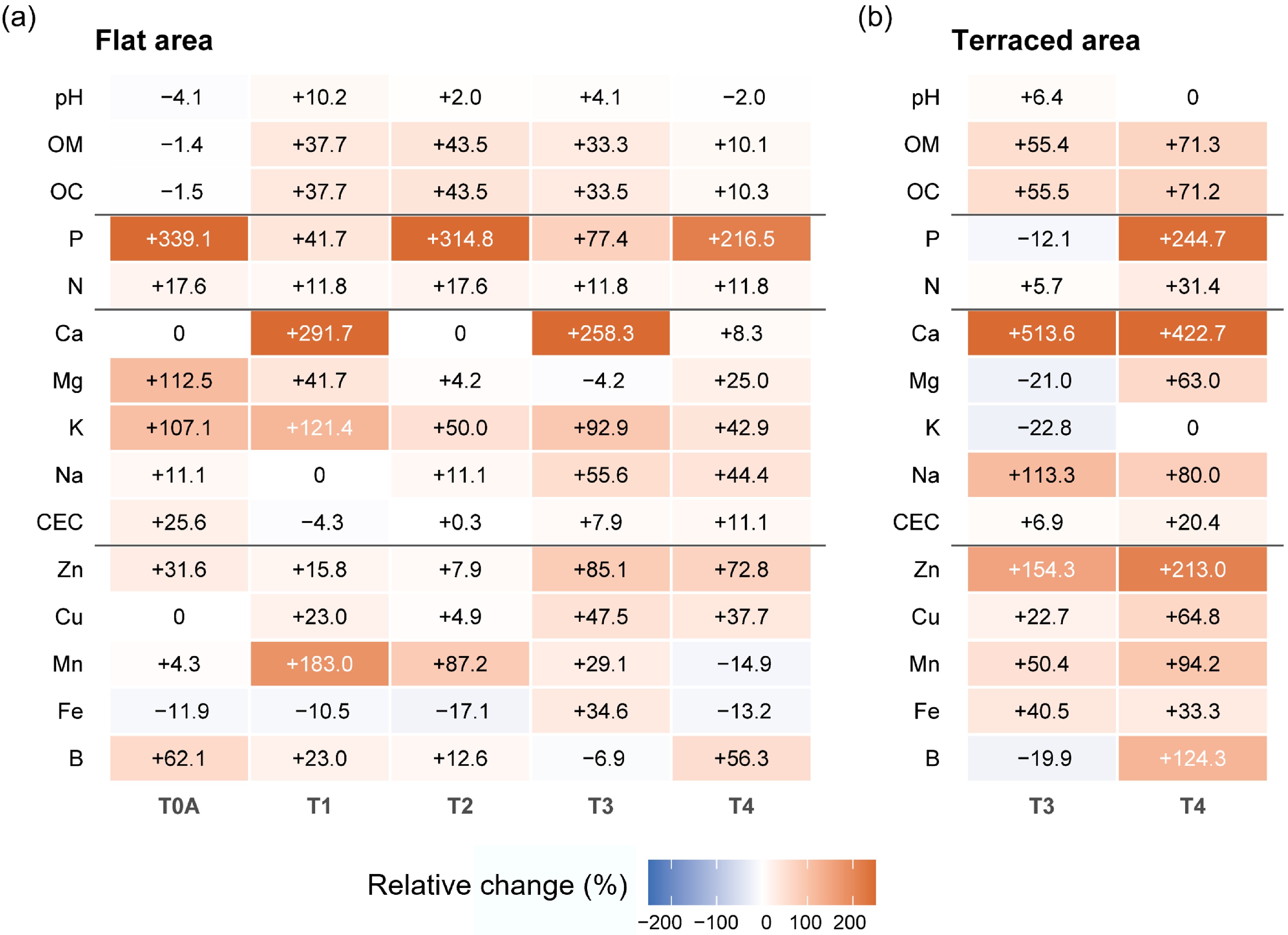
Figure 5.
Relative changes in soil chemical properties at 12 months relative to the area-specific reference treatment. T0 was used as the reference in the flat area and T0A in the terraced area. Cell labels show relative change (%), while color intensity indicates the direction and magnitude of the response. The color scale is visually capped at ± 250% to prevent very large responses from obscuring smaller contrasts; printed cell values retain the original percentages. These relative changes are descriptive; statistical treatment comparisons are reported separately in Supplementary Table S4.
In the flat area, the clearest early responses involved soil pH, organic carbon, and exchangeable bases. At approximately 5 months, Biochar Pure alone (T1) and Biochar Plus alone (T3) had significantly higher soil pH than the unfertilized control (T0), while biochar-amended treatment means were 0.3–0.6 pH units above the initial flat-area value. Organic carbon also increased under biochar, with T1 showing the highest 5-month concentration and T2 remaining significantly higher than T0 and T0A at 12 months. Biochar Plus produced the strongest early response in exchangeable base cations. CEC reached 6.2 cmolc kg−1 in T3 and 5.6 cmolc kg−1 in T4 compared with 3.2 cmolc kg−1 in T0; T3 did not differ significantly from T0, whereas T4 had significantly greater CEC than T0. By 12 months, these CEC differences were no longer significant. Available P showed large numerical responses to fertilization and Biochar Plus, but treatment separation was less consistent and no significant differences were detected at 12 months.
In the terraced area, treatment separation was also strongest at approximately 5 months. Soil pH was significantly higher under both Biochar Plus treatments than under T0A, and exchangeable Ca and CEC showed pronounced numerical increases. CEC reached 10.6 cmolc kg−1 in T3 and 10.5 cmolc kg−1 in T4 compared with 5.9 cmolc kg−1 in T0A, although only T4 was significantly different from T0A. Available P also increased strongly numerically, but these differences were not significant. By 12 months, treatment separation had generally weakened, with no significant differences in OC or CEC among the three terraced treatments.
-
The two biochar formulations produced distinct short-term soil chemical responses, supporting the view that biochar performance depends strongly on product composition rather than on biochar application per se. Both formulations initially increased soil pH relative to the acidic baseline, consistent with the liming potential of alkaline woody biochars[8,9,11,33]. However, treatment separation weakened by 12 months. This attenuation may reflect redistribution, plant uptake, or loss of soluble alkaline constituents, although these processes were not measured and therefore remain speculative.
Biochar Pure produced the clearest persistent response in organic carbon, consistent with direct incorporation of a carbon-rich material into the sampled planting zone. These concentration increases should not, however, be interpreted as evidence of stand-scale carbon sequestration because soil bulk density, treatment-scale carbon stocks, and complete carbon inputs and losses were not quantified[34]. In contrast, Biochar Plus produced the strongest early response in exchangeable base cations and CEC, which is consistent with its greater mineral content. The weakening of these differences by 12 months suggests that the initial nutrient-enrichment effect was transient or redistributed within the soil–plant system.
Available P showed comparatively large but statistically inconsistent responses, particularly where mineral fertilization or Biochar Plus was applied. The present data therefore do not support attributing higher P concentrations specifically to enhanced P retention by biochar. More broadly, the contrasting responses of Biochar Pure and Biochar Plus demonstrate that biochar formulation can shift the dominant soil function from carbon addition and chemical conditioning toward additional nutrient contribution. This distinction is important when selecting biochar products for operational plantation management[8,13−15].
Biochar formulation and nutrient context determine early tree response
-
The growth responses reinforced the functional distinction between the two biochar formulations. Biochar Pure alone did not increase plant height despite improving several soil chemical properties, indicating that soil conditioning alone was insufficient to overcome the principal constraint to early growth. In contrast, mineral fertilization increased 12-month height by 117%, consistent with substantial nutrient limitation at the site. When Biochar Pure was combined with NPK, growth exceeded that under mineral fertilization alone, suggesting complementarity between the amendment and external nutrient supply. This pattern is consistent with evidence that woody biochar can function more effectively as a soil conditioner accompanying fertilization than as a direct fertilizer replacement[16−19].
The mechanisms underlying this apparent complementarity were not directly tested and therefore remain speculative. Plausible explanations include pH-mediated changes in nutrient availability, greater retention of fertilizer-derived nutrients within the amended rooting zone, and changes in rhizosphere processes that enhance nutrient acquisition. Distinguishing among these mechanisms will require field measurements of nutrient fluxes, plant nutrient uptake, root development, and rhizosphere microbial activity.
Biochar Plus showed a different response. Without NPK, it increased 12-month plant height by 75% relative to the unfertilized control in the flat area, consistent with its mineral-enriched composition and supporting a combined role in soil conditioning and nutrient contribution. Nevertheless, Biochar Plus did not fully substitute for conventional fertilization. In the flat area, neither Biochar Plus alone nor Biochar Plus + NPK significantly exceeded the fertilized control, whereas in the terraced area Biochar Plus + NPK significantly exceeded both the fertilized control and Biochar Plus alone. Because the terraced area lacked an unfertilized control and Biochar Pure treatment, and differed in baseline soil properties, this contrast cannot be interpreted as a formal site × treatment interaction. It nevertheless indicates that the importance of formulation and nutrient context was evident under both site conditions.
These findings are consistent with the broader evidence that plant responses to biochar are context-dependent and frequently greater in nutrient-limited soils or when biochar is combined with fertilization[11,19−21,35]. The present field trial adds a formulation-specific perspective: biochars derived from the same general biomass resource can differ substantially in their growth response depending on their chemical composition and nutrient enrichment.
Implications for circular forest bioresource use
-
Converting Eucalyptus biomass residues into biochar and returning the material to plantation soils provides a direct circular pathway for forest residues. The contrasting responses of Biochar Pure and Biochar Plus further show that product selection should be linked to the intended function and site constraint: a high-carbon formulation may primarily serve soil conditioning and carbon addition, whereas a mineral-enriched formulation can additionally contribute to nutrient supply and early plant growth[27,28,30,31]. Localized planting-hole application may improve the operational feasibility of this approach by concentrating biochar within the early rooting zone and reducing the amount of material required relative to whole-field incorporation. Its economic value will nevertheless depend on whether biochar production, transport, and application costs are offset by improved establishment performance or reduced fertilizer requirements. The present experiment did not test reduced fertilizer rates, so potential fertilizer savings cannot be quantified from these data.
From an environmental perspective, localized application may reduce material and transport requirements per treated hectare, while recycling forest residues into a longer-lived soil amendment. The standalone growth response to Biochar Plus indicates some potential for reducing dependence on conventional fertilization under suitable conditions, but the largest growth responses generally occurred when biochar and mineral fertilization were combined. Complete fertilizer substitution is therefore not supported by the present dataset. Evaluation of commercial deployment will require integrated life-cycle and cost assessment covering biochar production, transport, field application, fertilizer inputs, plantation productivity, and longer-term carbon outcomes.
Limitations and outlook
-
The study was restricted to the first 12 months of plantation establishment and used three replicated blocks per treatment. The terraced area also had an incomplete treatment structure, preventing formal comparison of treatment responses between site conditions. In addition, biochar was applied locally within planting holes, so the measured soil responses represent treated rooting zones rather than whole-stand soil conditions[36]. The archived dataset retains treatment means and Tukey HSD groupings but not the original block-level observations, which prevents retrospective calculation of SD/SE values or Tukey critical differences.
The experiment focused on soil chemistry and early tree growth. Soil water dynamics, rooting characteristics, plant nutrient uptake, and biological processes were not measured, although these mechanisms may contribute to biochar responses under Mediterranean conditions[37]. Future field trials should integrate these measurements with longer-term tree growth, nutrient dynamics, and carbon stocks to determine whether the formulation-specific responses observed during establishment persist through later stand development[38,39].
-
Treatment responses differed substantially between the two biochar formulations during early Eucalyptus globulus plantation establishment. Biochar Pure improved several soil chemical properties but did not increase tree height when applied alone, whereas mineral-enriched Biochar Plus produced both soil chemical responses and a significant standalone growth response in the flat area. The greatest early growth generally occurred when biochar was combined with mineral fertilization, indicating that biochar function depended on both product composition and nutrient context. These findings show that biochar should not be treated as a functionally uniform soil amendment. The conclusions are restricted to the first 12 months of establishment and do not demonstrate rotation-scale effects on stand productivity or soil carbon storage. Longer-term field evaluation is required to determine whether the observed formulation-specific responses persist through later stand development.
The authors thank the field and laboratory teams of Associação Florestal do Baixo Vouga, RAIZ, and Universidade de Aveiro for their contributions to trial installation, monitoring, and analysis.
-
It accompanies this paper at: https://doi.org/10.48130/bchax-0026-0022.
-
During the preparation of this manuscript, the authors utilized AI-assisted tools, including ChatGPT (OpenAI), to improve readability, language editing, and reference formatting. After using these tools, the authors conducted a thorough review and editing of the manuscript.
-
The authors confirm their contributions to the paper as follows: Behrouz Gholamahmadi: investigation, formal analysis, validation, visualization, draft manuscript preparation, review and editing; Frank Verheijen: conceptualization, investigation, methodology, formal analysis, review and editing; Sérgio Fabres: conceptualization, methodology, investigation, resources, review and editing; Ana Quintela: conceptualization, investigation, methodology, data curation, formal analysis, supervision, review and editing. All authors reviewed and approved the final version of the manuscript.
-
All data generated or analyzed during this study are included in this published article and its supplementary information files.
-
Behrouz Gholamahmadi is employed by Ibero Massa Florestal S.A., a company active in biochar R&D and production. The other authors declare that there are no known competing financial interests or personal relationships that could have appeared to influence this article.
-
Full list of author information is available at the end of the article.
- The supplementary files can be downloaded from here.
- Copyright: © 2026 by the author(s). Published by Maximum Academic Press, Fayetteville, GA. This article is an open access article distributed under Creative Commons Attribution License (CC BY 4.0), visit https://creativecommons.org/licenses/by/4.0/.
-
About this article
Cite this article
Gholamahmadi B, Verheijen F, Fabres S, Quintela A. 2026. Biochar formulation influences soil chemical properties and early growth response of Eucalyptus globulus to fertilization. Biochar X 2: e025 doi: 10.48130/bchax-0026-0022 

Biochar formulation influences soil chemical properties and early growth response of Eucalyptus globulus to fertilization
- Received: 21 September 2026
- Revised: 10 October 2026
- Accepted: 13 October 2026
- Published online: 02 November 2026
Abstract: Biochar produced from forest biomass residues can couple residue valorization with soil improvement in planted forests, but its effectiveness may depend on product formulation and nutrient supply. This study evaluated a high-carbon Biochar Pure and a mineral-enriched Biochar Plus, applied with and without mineral fertilization, during the early establishment of Eucalyptus globulus on acidic forest soil in central Portugal. Six treatments were assessed in the flat area and three in the terraced area, each with three replicated blocks. At 12 months in the flat area, mineral fertilization alone increased plant height by 117% relative to the unfertilized control. Biochar Pure alone produced no growth response, whereas Biochar Plus alone increased height by 75%. Biochar Pure + NPK and Biochar Plus + NPK increased height by 175% and 158%, respectively. At the first post-planting sampling, biochar-amended treatments showed soil pH values 0.3–0.6 units above the initial flat-area value. In the terraced area, CEC reached 10.6 cmolc kg−1 under Biochar Plus without NPK, approximately 108% above the initial area-level value of 5.10 cmolc kg−1. Biochar Plus also produced the strongest numerical short-term enrichment of several exchangeable bases. In the terraced area at 12 months, Biochar Plus + NPK reached 3.26 m and was significantly taller than both mineral fertilization alone (2.77 m) and Biochar Plus alone (2.34 m). Overall, biochar formulation differentially affected soil chemical conditions and early tree growth, with the largest growth responses generally occurring when biochar was combined with mineral fertilization.