













-
In addition to providing humans with essential nutrients, functional foods also bring many biologically active ingredients to humans. These ingredients will exert a wide range of biological activities including anti-oxidation, hypoglycemic, neuroprotection, and lipid-lowering[1]. It has always been a hot and difficult area in food chemistry research to quickly find these potential functional ingredients from the complex extracts of food. Generally, research on functional ingredients in food mostly use phytochemical research procedures, including extraction, separation, structure analysis, and activity evaluation[2]. However, this traditional research method is usually blind, will bring a lot of extra work, and ultimately may not be able to determine active ingredients. In recent years, to improve the research efficiency, state-of-the-art instruments like NMR[3,4], HPLC-SPE-NMR[5], and HPLC-MSn[6−13] have been used alone or combined with activity detection or metabolomics analysis to quickly carry out dereplication.
Since the method by which the target bioactive metabolites can be quickly obtained at a low cost, activity tracking is an important concept in the dereplication of metabolites. In activity-oriented research, NMR, and LC-MSn are still the two most frequently adopted detection methods[14]. In NMR detection, through simple sample pretreatment, the comprehensive information of the protons and/or carbons of the mixture can be quickly captured in a non-destructive manner without chromatographic separation. Then, by comparing with the NMR database, part of known compounds can be dereplicated[3,4]. Compared with NMR, the sensitivity advantage of LC-MSn allows it to realize the detection of trace compounds present in crude mixture. It is worth mentioning that, in recent years, LC-MS/MS-based molecular networking has been widely used in the tracking of active compounds[12,15]. Although several cases have shown that LC-MSn can perform well in the mining of active compounds, but the complexity of fragment interpretation limits it as an independent detection method for structural identification[14]. Therefore, the identification scheme of active compounds by integrating NMR and LC-MS/MS is worth exploring.
Coffee, as the most popular beverage in the world, is grown in over 70 countries and regions, intimately connected to the lives of billions of people worldwide, and stands as one of the most economically valuable plants. Currently, the globally cultivated coffee consists primarily of two species: Arabica (Coffea arabica) and Robusta (Coffea canephora). Arabica coffee excels in taste and aroma compared to Robusta coffee, making it the most widely planted, produced, and traded coffee globally. Coffee diterpenoids are a class of key characteristic components found in coffee, with the majority (about 99.6%) existing in the form of diterpene esters in coffee oil[15]. Approximately 24 fatty acids participate in the formation of these esters, with palmitic acid and linoleic acid diterpene esters being the most abundant. The content of coffee diterpenoids varies significantly among different coffee species, with Arabica coffee generally containing higher levels of coffee alcohols compared to Robusta coffee[15]. Reports on the structure of coffee diterpenoids can be traced back to the 1930s. In 1932, Bengis & Anderson and others first detected Kahweol in coffee beans[16]. So far, over 70 types of coffee diterpenes, including multiple sub-types, have been reported[1]. Research has shown that C&K can exhibit anti-cancer effects through various pathways[17]. Additionally, C&K may potentially lower blood sugar levels by stimulating insulin secretion and increasing glucose uptake[18,19]. Because coffee roasted beans are a very complex mixture system, whether there are other novel active coffee diterpenes in it is a question worth exploring in depth.
In the current research, an activity-oriented scheme combining NMR and LC-MS/MS technology are proposed. Basing on the strategy, three new coffee diterpene esters exhibiting moderate α-glucosidase inhibitory activity were isolated from roasted Arabica coffee beans. The structures of these novel compounds were elucidated through thorough spectral analysis. To investigate similar trace active diterpenoids in coffee, a molecular network was established using LC-MS/MS, leading to the identification of three additional novel coffee diterpene esters.
-
The 1H NMR, 13C NMR, DEPT, and 2D NMR data were collected using Bruker DRX-600 instruments (Bruker, Zurich, Switzerland). The deuterated chloroform for NMR experiments was purchased from Beijing Yinuokai Technology Co., Ltd (Beijing, China). The purification of the compounds was performed on an Agilent HP1100 series instrument equipped with a UV L-2400 detector. The acetonitrile (99.9%) for semi-preparation was produced by Oceanpak Alexative Chemical, Ltd (Sweden). The optical rotation and UV spectra were obtained with a Jasco P-1020 polarimeter (Jasco, Japan) and a UV-2401 PC spectrophotometer (Shimadzu, Japan), respectively. The LC-MS/MS and HRESIMS experiments were performed on a UPLC system (1260, Agilent) coupled to a quadrupole time-of-flight mass spectrometer (Agilent 6540 Q-TOF, Agilent Technologies).
Acarbose and p-nitrophenyl-α-D-glucopyranoside were obtained from Aladdin Co., Ltd. (Shanghai, China). The α-glucosidase was purchased from Sigma-Aldrich Trading Co., Ltd (Lot # 089M4087V) (Shanghai, China). The green coffee beans of Coffea arabica were purchased in Yunnan province, China. Green coffee beans were roasted to a moderate degree according to the color value by a professional barista[20]. The diterpene ester extract (80.7 g) used as demonstration example in the current study was from the PE/EtOAc = 8:1 fraction of the petroleum ether extraction.
D NMR detection and α-glucosidase activity screening
-
Silica gel column chromatography was applied to separate the diterpene extract into Fr.1−Fr.19 (Fr.1, 1.7 g; Fr.2, 2.2 g; Fr.3, 4.7 g; Fr.4, 3.8 g; Fr.5, 5.4 g; Fr.6 3.9 g; Fr.7, 2.4 g; Fr.8, 0.9 g; Fr.9, 1.6 g; Fr.10, 2.4 g; Fr.11, 1.2 g; Fr.12, 3.0 g; Fr.13, 1.9 g; Fr.14, 3.4 g; Fr.15, 4.6 g; Fr.16, 4.9 g; Fr.17, 3.4 g; Fr.18, 0.7 g; Fr.19, 2.6 g) with PE/EA (5:2−1:1) system. The right amount of extract from each fraction were transferred into a 1.5 mL EP tube. A 25 mg/mL solution was prepared with deuterated chloroform, and 600 μL was pipetted into a nuclear magnetic tube, and 1H NMR data collected on a 600 MHz nuclear magnetic resonance instrument. Refer to previous literature for 1H NMR acquisition parameters[21]. The method described in a previous article was adopted to detect α-glucosidase (50 μg/mL) inhibitory activity for Fr.1−Fr.19[20].
MestReNova (version: 6.1.0−6224) was adopted to align and standardize the1H NMR data of Fr.1−Fr.19, solvent peaks (7.250−7.280 ppm) and areas without characteristic signals (8.396−9.000 ppm) were removed. The standardization parameter was set as 100, the integration interval was 5.0−11.0 ppm. The interval was 0.004 ppm, and the integrated data was stored as a file with the suffix '.csv' to obtain an integrated area matrix of 1,167 × 19. Further, a clustering heat map containing the 1H NMR data matrix and α-glucosidase inhibitory activity data was plotted by using the R program package 'pheatmap' in RStudio (version: 1.3.1056). Representative samples Fr.9 were selected from the groups showing α-glucosidase inhibitory activity for 13C DEPT NMR detection.
Purification, identification, and activity verification of target compounds
-
The representative Fr.9 was further purified by semi-preparative HPLC (ZORBAX, RX-C8, 5 μm, 9.4 mm × 250 mm, CNCH3 : H2O = 95:5) to obtain compounds 1 (tR = 16 min, 8.6 mg), 2 (tR = 24 min, 3.4 mg) and 3 (tR = 31 min, 3.1 mg). Then, 1H NMR and 13C NMR were performed for the establishment of exact structures of compounds 1−3. To further confirm the structures of compounds 1−3, 2 was selected for 2D NMR (HSQC, 1H-1H COSY, HMBC and ROESY) detection. The α-glucosidase inhibitory activities of 1−3 were screened according to the methodology reported in a previous study[22].
Caffaldehyde A (1) colorless oily liquid, [α]20D −82.19 (c = 0.05, MeOH), UV (MeOH) λmax (log ε) 218.5 (3.74), 263.5 (3.50). m/z 591.4022 [M+Na]+ (calcd for C36H56O5Na+, 591.4020. 1H and 13C NMR spectral data are shown in Supplemental Table S1, Supplemental Figs S3 & S4.
Caffaldehyde B (2) colorless oily liquid, [α]21D −65.16 (c=0.05, MeOH), UV (MeOH) λmax (log ε) 218.5 (3.66), 268.0 (3.45). HRESIMS m/z 597.4517 [M+H]+ (calcd for C38H61O5+, 597.4514). 1H and 13C NMR spectral data are shown in Supplemental Table S1 and Supplemental Figs S5 & S6. 2D NMR spectra are shown in Supplemental Figs S7−S10.
Caffaldehyde C (3) colorless oily liquid, [α]21D −60.67 (c = 0.05, MeOH), UV (MeOH) λmax (log ε) 221 (3.75), 267.5 (3.59). HRESIMS m/z 625.4831 [M+H]+ (calcd for C40H65O5+, 625.4827). 1H and 13C NMR spectral data are shown in Supplemental Table S1, Supplemental Figs S11 & S12
LC-MS/MS analysis and molecular network construction
-
UPLC-MS/MS analysis was performed using an UPLC system (1260, Agilent) coupled to a quadrupole time-of-flight mass spectrometer (Agilent 6540 Q-TOF, Agilent Technologies) equipped with an ESI source operating with a positive polarity. An RX-C8 column (150 mm × 4.6 mm × 5 μm) was used for separation. Water (A) and acetonitrile (B) were selected as eluents, and the optimal condition was set as: acetonitrile from 70% to 100% for 30 min, then eluting with 100% acetonitrile for 30 min. The flow rate was 0.5 mL/min. The detection wavelengths of the DAD detector were 210, 254, 270, and 330 nm. The MS acquisition conditions and the construction method of the molecular network were the same as previous reports[22].
-
In the experimental design of this study, it is hoped that the scheme will take into account several aspects: (1) Assist in the discovery and separation of active compounds; (2) Direct identification of trace novel compounds without chromatographic purification; (3) Avoid chromatographic separation as much as possible to reduce the use of solvents and consumables; (4) Reduce the difficulty of spectrum analysis and shorten the research time.
After weighing the pros and cons of various dereplication methods, a three-step scheme, as shown in Fig. 1, was proposed. Firstly, the sub-fraction samples are subjected to 1H-NMR and activity detection. The 1H NMR and activity data obtained are analyzed by cluster-heatmap to group and screen out the active groups. Secondly, fractions of interest were screened out for 13C-DEPT NMR detection. Fractions likely to contain active novel compounds are purified by semi-preparative HPLC. The isolated novel compounds were confirmed by 2D NMR and HRESIMS and verified for activity. Finally, LC-MS/MS based molecular network is adopted to explore potential trace novel active compounds.
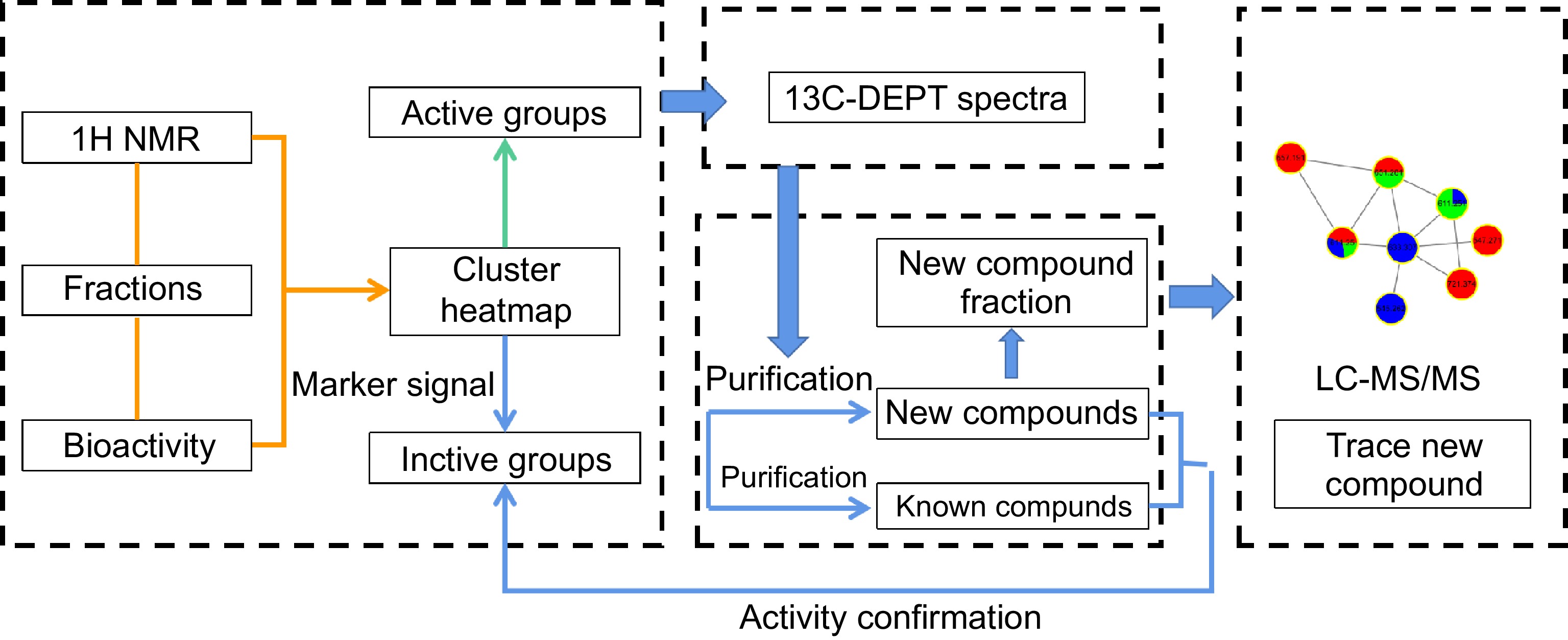
Figure 1.
General strategy for discovery of bioactive ingredients in roasted coffee.
Bioactive compounds from Coffea arabica
-
In natural product research, valuable compounds account for only a small portion, most of the extracts are worthless. Therefore, the earlier to locate the valuable part of the extract, the less the workload will be. In the current study, the crude diterpene extract of roasted coffea Arabica was chosen to to discover active novel compounds in natural products.
1H NMR integrates several advantages such as high sensitivity, fast detection, good repeatability, and non-destructive testing, making it a very convenient qualitative method to carry out rapid testing on a large number of samples to obtain high-quality spectra. In previous studies, several teams achieved rapid identification of the main components in coffee D2O extracts by 1H NMR, indicating the possibility of identifying compounds in the mixture[23,24]. In the current study, the diterpene extract of roasted coffee was divided into 19 fractions using silica gel column chromatography. To achieve the purpose of shortening the research time and reducing the use of solvents, 1H-NMR combining activity detection was selected as the first step of repetition for the 19 fractions to make an early stop-or-go decision (Supplementary Fig. S1). The 1H NMR spectra of the fractions were processed with MestReNova to obtain the integral value of the characteristic region (5.0−11.0 ppm). At the same time, solvent peak areas and the areas without characteristic signals were manually deleted. Therefore, a matrix with 19 rows, 1,167 columns was generated for the construction of cluster heatmap (Fig. 2). Meanwhile, the α-glucosidase inhibitory activity of the fractions at 50 μg/mL were marked at the top of the heatmap according to the shade of the color.
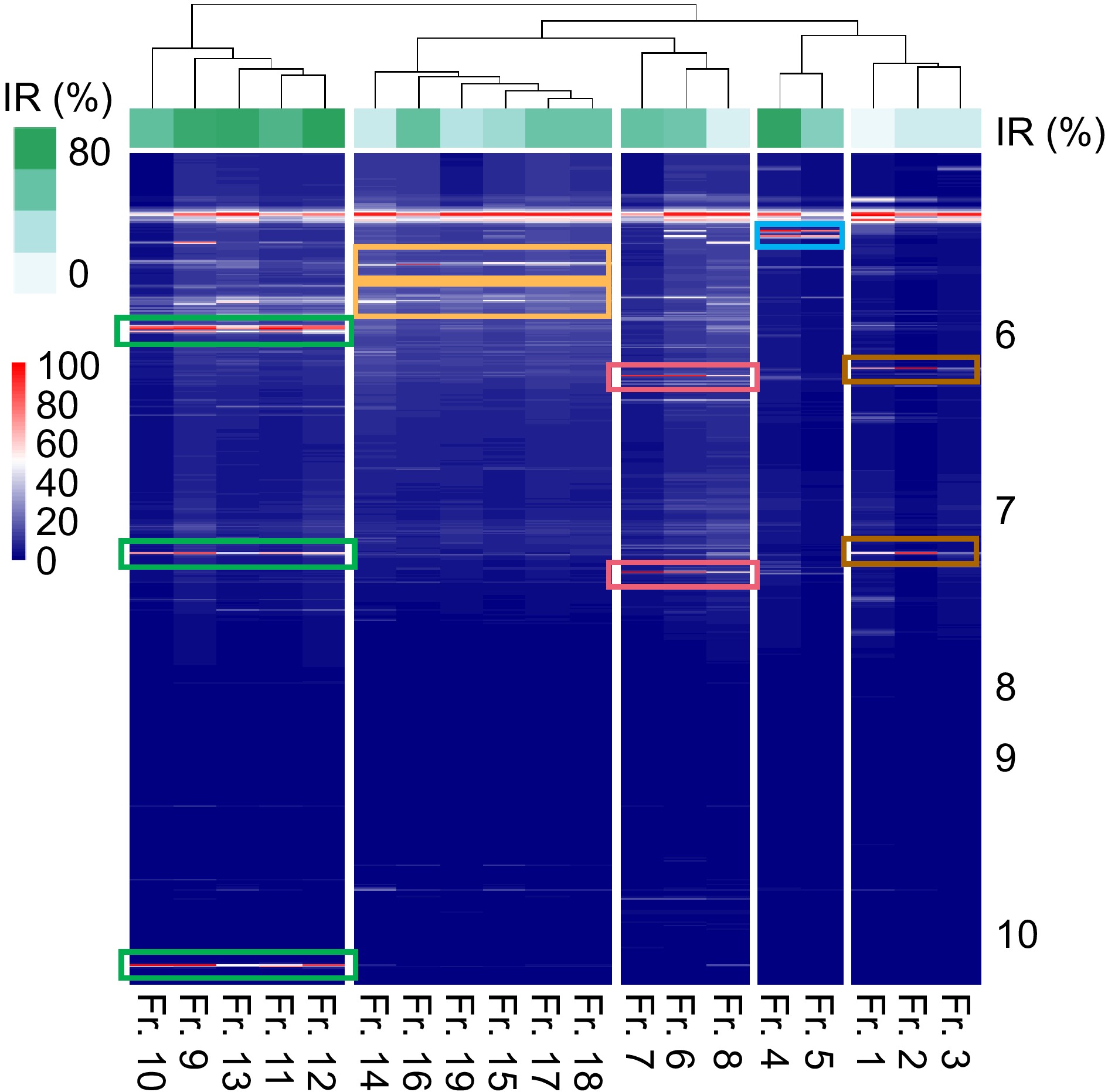
Figure 2.
Cluster heatmap of coffee diterpene fractions basing on 1H NMR data. The α-glucosidase inhibitory rate (IR, 50 μg/mL, n = 3) of each fraction are marked on the top. The darker the color indicates the stronger the activity.
As shown in Fig. 2, according to the cluster result basing on 1H NMR data, fractions were divided into five groups (Fr.1−Fr.3, Fr.4−Fr.5, Fr.6−Fr.8, Fr.9−Fr.13, and Fr.14−Fr.19). The Fr.1−Fr.3 group did not show any α-glucosidase inhibitory activity, therefore, no follow-up analysis was performed on this group. The fractions from the remaining four groups exhibited varying degrees of inhibitory activity. Interestingly, the fractions with significant activity were mainly concentrated in Fr.9−Fr.13. Combining clustering heatmap and 1H NMR spectra found that Fr.9−Fr.13 possessed common characteristic signals at δH 10.19 (d, 7.2 Hz), δH 7.25 (d, 10.01 Hz), δH 6.00 (d, 10.01 Hz), and δH 5.97 (d, 7.2 Hz), indicating that the compounds with these characteristic signals may play a key role in Fr.9−Fr.13 exerting α-glucosidase inhibitory activity (Fig. 2). Since fractions within group have high 1H NMR similarity, it is only necessary to randomly select a representative fraction in each group of interest for subsequent analysis, which can effectively reduce the workload.
After the first step, the location and characteristic signal of the bio-active compounds have been found. However, it was hard to infer more information based on the limited 1H NMR signals. Therefore, in the second step of dereplication, the representative sample Fr.9 from the active group (Fr.9−Fr.13) was tested for 13C DEPT NMR data (Supplementary Fig. S2). The results indicate that there is a characteristic carbon signal of aldehyde groups (δC 192.9) in the mixture, which is consistent with its characteristic proton signal (δH 10.19 d, 7.2 Hz). Furthermore, the representative sample Fr.9 was separated by HPLC (Fig. 3). The three main chromatographic peaks (tR = 16 min, tR = 24 min, tR = 31 min) with UVmax at 218 ± 5 and 265 ± 5 nm were purified by semi-preparative HPLC to obtain compounds 1−3 (Figs 3, 4).
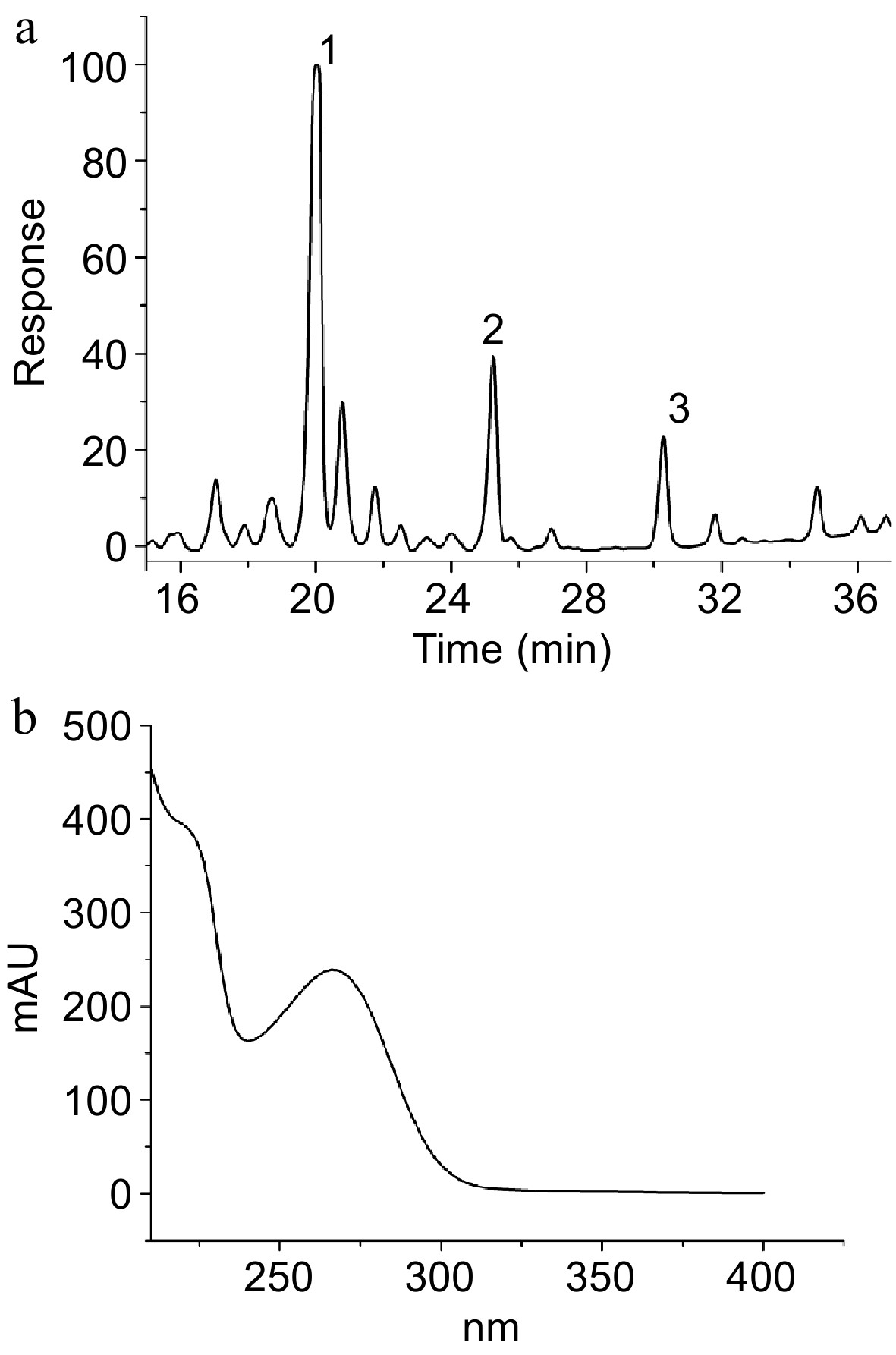
Figure 3.
(a) HPLC chromatogram of Fr.9. (b) UV spectrum of 1 (UVmax = 218 ± 5 nm, 265 ± 5 nm).
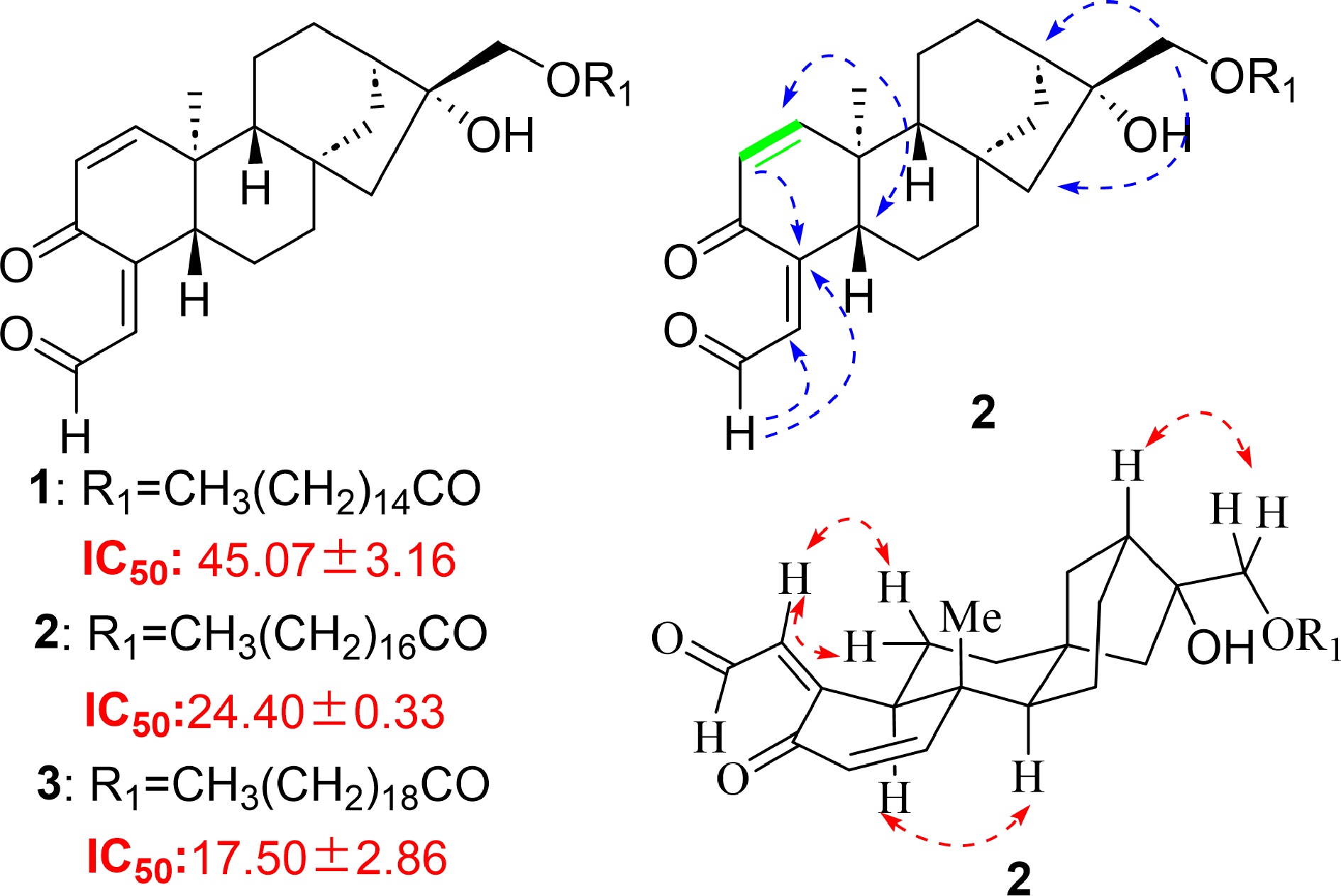
Figure 4.
Structures of compounds 1−3 and their IC50 to α-glucosidase (μM, data expressed as means ± SD, n = 3); Key 2D NMR correlations of compound 2.
Compound 1 was obtained as colorless oily liquid. 1H NMR spectrum showed two methyl at δH 1.17 (3H, s) and δH 0.88 (3H, t, 7.0 Hz), one oxidation methylene signal at δH 4.26 (2H, s), three olefinic protons δH 7.25 (1H, d, 10.1 Hz), δH 5.97 (1H, dd, 7.2 Hz, 1,8 Hz), and δH 6.00 (1H, d, 10.1 Hz), one aldehyde proton signal δH 10.18 (1H, d, 7.2 Hz). The 13C-DEPT NMR spectrum showed that 1 possessed a total of 36 carbon atoms, which were two methyl groups, 21 methylene groups (including one oxymethylene group), and seven methine groups (including three olefinic carbons, one aldehyde carbon), six quaternary carbons (including one oxygenated tertiary carbon, one alkene carbon, one ketone carbonyl, one ester carbonyl). Through literature comparison, it was found that 1 contained exactly the same diterpene skeleton reported by De Lucia et al. in 2009[25]. In addition, a palmitic acid signal appeared in 13C NMR, indicating that 1 is a diterpene ester with sixteen carbon saturated fatty acids. The 1H NMR and 13C NMR data of compounds 2 and 3 are exactly similar to those of 1, except the 13C NMR and HRESIMS indicated that 2 has two more methylenes and 3 has four more methylenes in the long chain of fatty acids compared to 1. Therefore, the fatty acid moieties of compounds 2 and 3 were determined to be stearic acid (18:0) and arachidic acid (20:0), respectively. To further confirm the structures of these three compounds, 2 was selected for 2D NMR detection The esterification location was proved to be at C-17 based on the HMBC correlation from δH 4.26 (H-17) to δC 174.0 (C-1') (Fig. 4). The above inference was consistent with all 2D NMR correlations and HRESIMS data. The ROESY correlations of H-13/H-17 assigned OH-16 as α-orientation. Consequently, the structures of 1−3 were determined as shown and named as caffaldehydes A-C, respectively.
Furthermore, the α-glucosidase inhibitory activities of compounds 1−3 were verified, and their IC50 values were calculated as 45.07 ± 3.16, 24.40 ± 0.33, and 17.50 ± 2.86 μM respectively (Fig. 4), compared to the positive control (acarbose, IC50: 60.71 ± 16.45 μM). This proves that 1−3 are the components of Fr.9 that exert α-glucosidase inhibitory activity.
In the previous two steps, some known compounds have been identified without chromatographic separation and the active compounds with a high content (1−3) have been identified and separated. However, due to the sensitivity limitation of NMR or HPLC, it is hard to identify and separate compounds with lower content. To achieve this purpose, Fr.1−Fr.19 were combined to form 4 groups (G1: Fr.1−Fr.5; G2: Fr.6−Fr.8; G3: Fr.9−Fr.13; G4: Fr.14−Fr.19) and LC-HRMS/MS was performed. Based on the MS/MS data from G1−G4, a molecular network was constructed using GNPS (
http://gnps.ucsd.edu ) and visualized with cytoscape 3.8.0 (Fig. 5a, Supplementary Fig. S13). The specific parameters and results of the molecular network can be accessed through the linkhttps://gnps.ucsd.edu/ProteoSAFe/status.jsp?task=e5f985a8148c4ee58fa5c8e4f90ed50c . In the molecular network, a node represents the quasi-molecular ion peak of a compound, and the color represents the group in which the compound exists.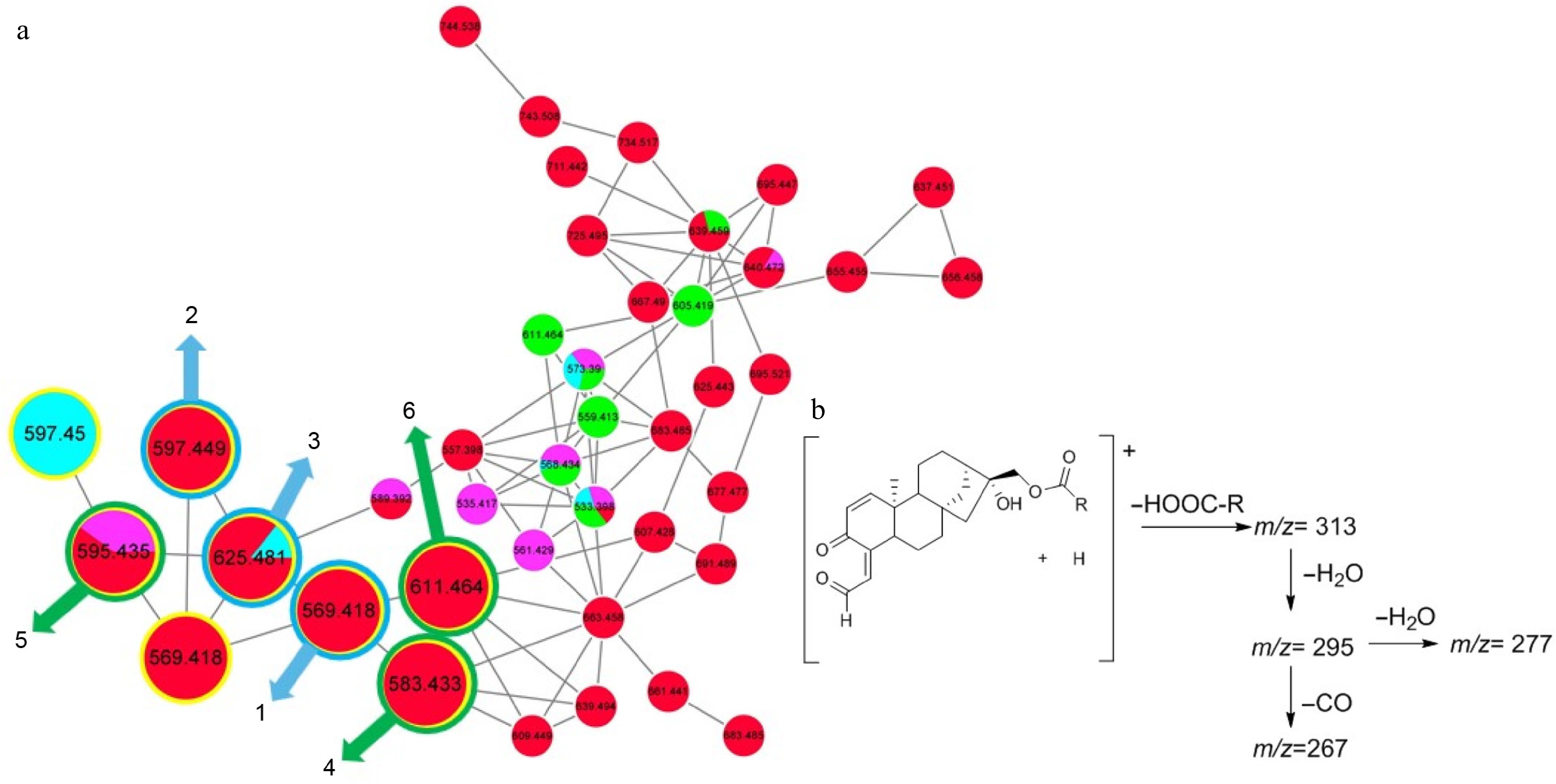
Figure 5.
(a) MN1 containing diterpenes (G1: Fr.1−Fr.5, green; G2: Fr.6-−Fr.8, blue; G3: Fr.9−Fr.13, red; G4: Fr.14−Fr.19, purple). (b) Possible formation pathways of characteristic fragments of compounds 1−6.
Compounds 1−3 were identified in the MN-1 based on the HRESIMS data of their [M+H]+ peak and characteristic fragment ion peak comparison. As shown in Fig. 5a, the three nodes representing 1−3 were in adjacent positions in MN1. MS/MS analysis found that 1−3 have common fragment ion peaks m/z 313, 295, 277, and 267, which were calculated as C20H25O3+ (313.1813, −4.64 ppm), C20H23O2+ (295.1682, 3.41 ppm), C20H21O+ (277.1577, 2.94 ppm) and C19H23O+ (267.1737, 5.92 ppm), respectively. Interestingly, near the nodes of 1−3, there were three nodes 583.433 (4, 583.4329, C37H59O5+, 4.52 ppm), 595.435 (5, 595.4339, C38H59O5+, 3.22 ppm) and 611.464 (6, 611.4650, C39H63O5+, 3.71 ppm) with the same characteristic fragments (Table 1), indicating 4−6 were also diterpene esters whose diterpene moieties were the same as 1−3. Through the molecular weight search of DATAanalyte, it was found that 4−6 did not exist in the database, indicating that they were also novel coffee diterpene esters. Combined with the molecular formula from the HRESIMS, it could be inferred that the fatty acids esterified with 4−6 were magaric acid (17:0), octadecene acid (18:1), and nonadecanoic acid (19:0), respectively. The possible formation pathways of the characteristic fragments of 1−6 were deduced in Fig. 5b and Supplementary Fig. S14−S19.
Table 1. The HRESIMS data of compounds 1−6.
No. HRMS Formula Category Δ ppm 1 569.4178 C36H56O5 (M+H)+ 4.13 2 597.4492 C38H60O5 (M+H)+ 3.89 3 625.4799 C40H64O5 (M+H)+ 4.04 4 583.4329 C37H58O5 (M+H)+ 4.52 5 595.4339 C38H58O5 (M+H)+ 3.22 6 611.4650 C39H62O5 (M+H)+ 3.71 -
An active compound-oriented separation strategy was proposed. The proof-of-principle of the strategy was successfully achieved in the diterpene extract of Coffea arabica. Three novel diterpene ester compounds (1−3) with significant α-glucosidase inhibitory activity were rapidly achieved targeted separation with very small amounts of organic solvent. Three other trace coffee diterpene esters (4−6) with potential α-glucosidase inhibitory activity were directly identified without enrichment with the aid of an LC-MS/MS-based molecular network. The results indicated that the multi-spectral technology dereplication strategy proposed in the current research can greatly improve the research efficiency of novel active compounds. In the future, this method is worthy of being applied to the targeted separation of active metabolites of other food.
This study was supported financially by the National Natural Science Foundation of China, China (U1902206) , Key Research and Development Project of Yunnan Province (202003AD15 0006), China Postdoctoral Science Foundation (2023M743591), Postdoctoral Fellowship Program of CPSF (GZC20232766), Special Research Assistant of Chinese Academy of Sciences, Yunnan Caiyun Postdoctoral Program, Coffee Industry Science and Technology Mission in Zhenkang County, Yunnan (202204BI090009), Project of Yunnan International Joint Innovation platform (202203AP140106), Project of Expert workstation of Yunnan Science and Technology Association (2024).
-
The authors confirm contribution to the paper as follows: methodology, validation, formal analysis: Hu G, Quan C, Al-Romaima A, Dai H; funding aquisition: Hu G, Qiu M; data curation, visualization, writing - original draft, review & editing: Hu G; supervision, project administration: Qiu M. All authors reviewed the results and approved the final version of the manuscript.
-
The datasets generated during and/or analyzed during the current study are available from the corresponding author on reasonable request.
-
The authors declare that they have no conflict of interest.
- Supplementary Table S1 1H NMR, 13C NMR and DEPT data of compounds 1−3a.
- Supplementary Fig. S1 1H NMR spectra of Fr.1-19.
- Supplementary Fig. S2 The mixed DEPT and 13C NMR spectra of Fr.9.
- Supplementary Fig. S3 1H NMR spectra of 1.
- Supplementary Fig. S4 13C NMR spectra of 1.
- Supplementary Fig. S5 1H NMR spectra of 2.
- Supplementary Fig. S6 13C NMR spectra of 2.
- Supplementary Fig. S7 HSQC spectra of 2.
- Supplementary Fig. S8 1H 1H COSY spectra of 2.
- Supplementary Fig. S9 HMBC spectra of 2.
- Supplementary Fig. S10 ROESY spectra of 2.
- Supplementary Fig. S11 1H NMR spectra of 3.
- Supplementary Fig. S12 13C NMR spectra of 3.
- Supplementary Fig. S13 LC-MS/MS based molecular network of coffee diterpene extracts. (G1: green; G2: blue, G3: red, G4: purple).
- Supplementary Fig. S14 The MS spectra for 1.
- Supplementary Fig. S15 The MS spectra for 2.
- Supplementary Fig. S16 The MS spectra for 3.
- Supplementary Fig. S17 The MS spectra for 4.
- Supplementary Fig. S18 The MS spectra for 5.
- Supplementary Fig. S19 The MS spectra for 6.
- Copyright: © 2025 by the author(s). Published by Maximum Academic Press, Fayetteville, GA. This article is an open access article distributed under Creative Commons Attribution License (CC BY 4.0), visit https://creativecommons.org/licenses/by/4.0/.
-
About this article
Cite this article
Hu G, Quan C, Al-Romaima A, Dai H, Qiu M. 2025. Bioactive oriented discovery of diterpenoids in Coffea arabica basing on 1D NMR and LC-MS/MS molecular network. Beverage Plant Research 5: e004 doi: 10.48130/bpr-0024-0035 

Bioactive oriented discovery of diterpenoids in Coffea arabica basing on 1D NMR and LC-MS/MS molecular network
- Received: 08 June 2024
- Revised: 20 August 2024
- Accepted: 23 September 2024
- Published online: 18 February 2025
Abstract: Coffee diterpenes are a class of characteristic components in coffee, which have potential biological activities including the prevention of cancer, obesity, diabetes, and other diseases. Due to the complex chemical composition of roasted coffee beans, analyzing the composition and potential activity of coffee diterpenes has always been a challenge. In the current research, based on activity-oriented research strategies, three novel coffee diterpene esters (1−3) with moderate α-glucosidase inhibitory activity were separated from roasted Arabica coffee beans. The structures of the three new compounds were determined through comprehensive spectral analysis. To explore trace active diterpene esters of the same type in coffee, a molecular network based on LC-MS/MS was constructed, and three novel coffee diterpene esters (4−6) were identified.
-
Key words:
- Coffee /
- Diterpene /
- Molecular network /
- α-glucosidase