











-
With the aggravation of traffic congestion, energy crisis, environmental pollution, and other problems, the strategy of prioritizing public transportation has been the consensus of many transportation practitioners. Bus systems are favored by governments and operators for its efficient, green, and cost-saving advantages, to reduce traffic congestion and emissions through the promotion of bus travel[1]. In addition, in terms of equity, buses provide a vital service to those who do not have access to a vehicle or cannot drive, such as the elderly, the young, and the economically disadvantaged. Therefore, the development bus systems is an important direction to promote sustainable urban development.
However, the development of bus systems also faces challenges. Due to financial pressures and competition from other modes of transport, the development of bus systems has been severely tested. According to information from the Ministry of Transport of China, bus system ridership in China has shown a declining trend over the past decade[2], as illustrated in Fig. 1. The ridership in 2023 was 38.050 billion passengers, a decrease of 49% compared to 74.535 billion passengers in 2014. The problem of decreasing passenger flow is also happening in the USA, Japan, the UK, and other countries. To improve competitiveness, it is crucial to optimize bus systems.
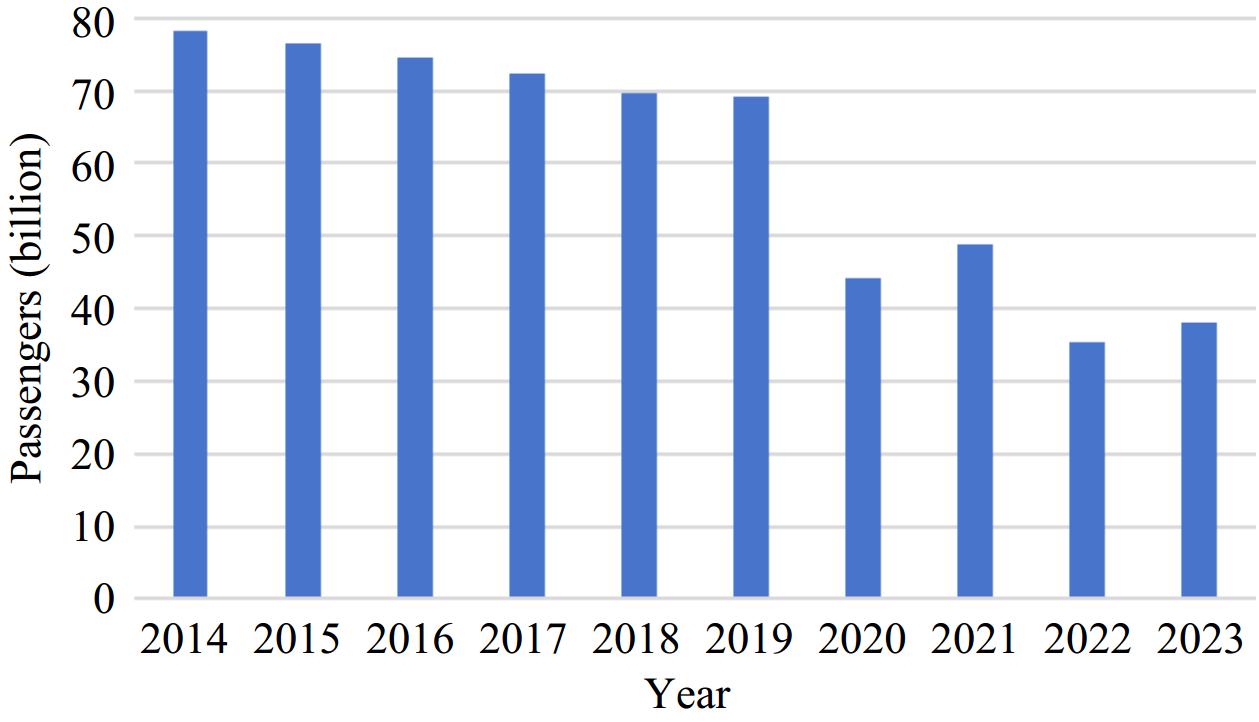
Figure 1.
Bus system ridership in China from 2014 to 2023.
Although the trend in passenger numbers is declining, bus systems remain essential. By the end of 2023, China's bus ownership reached 682,500, with 554,400 of these being new energy buses, accounting for 81.2%. The number of operating routes reached 79,800, and dedicated bus lanes exceeded 20,000 km. Meanwhile, passenger demands are also shifting. Alongside efficiency and affordability, digitalization and customization have become new areas of focus.
The optimization of bus systems holds importance in advancing urban infrastructure and enhancing the quality of life in cities. Optimizing bus timetables, rationalizing bus routes, improving bus charging, and modifying bus facilities can significantly enhance the service capacity of the bus system and reduce wait time and travel duration, making public transportation a more attractive option over private vehicles. Moreover, it can lead to a substantial decrease in traffic congestion. Integrating advanced theories and technologies into the bus system not only improves operational efficiency but also fosters public trust and reliance on public transport by providing accurate arrival times and service updates. This integration enhances the user experience and boosts the effectiveness of the public transportation system. An efficient bus system is crucial for reducing urban congestion. Furthermore, optimizing bus systems is essential for environmental sustainability. It contributes to a reduction in carbon emissions, aligning with global efforts towards sustainable living. As urban populations grow, the role of efficient, reliable, and eco-friendly public transportation systems becomes increasingly crucial. Continuous investment in and attention to the optimization of bus systems are recognized as a cornerstone for building smarter, more livable urban environments. Last but not least, optimizing bus systems helps reduce costs, which is crucial for increasing transit companies’ profitability and easing government financial pressures. Lower costs ensure the sustainable development of bus systems, thereby enhancing its efficiency and service quality.
This paper conducts a literature review on the topic of bus system optimization to obtain a comprehensive understanding of the research carried out on bus systems in the areas of bus timetable optimization, bus route optimization, bus charging optimization, and bus facility optimization, as well as the future direction of development, to provide theoretical support for a more efficient and high-quality operation of bus systems. The reason for this classification is that these four key aspects are independent yet interrelated. The significance lies in the ability to encompass the most important issues in bus system optimization and to provide scholars with concrete references.
-
The Web of Science database was searched for research related to bus system optimization published in 2020 and beyond. After screening based on the title and abstract, the literature selected in this paper was analyzed using CiteSpace software. The distribution of countries contributing to this research is shown in Fig. 2. Many countries are engaged in research on bus system optimization, with significant contributions from China, the USA, Singapore, the Netherlands, Sweden, India, Australia, and Canada. This is because these countries have well-developed bus systems and/or high population density, creating an urgent need for bus system optimization.

Figure 2.
Countries contributing to research on bus system optimization.
To achieve a comprehensive understanding of the research on bus system optimization, the literature was summarized according to the strategy outlined in Fig. 3. For bus timetable optimization, bus route optimization, and bus charging optimization, they were summarized and analyzed from three levels: scenarios, objectives, and optimization methodologies. For bus facilities optimization, the analysis was divided into the aspects of bus stations and bus lines.
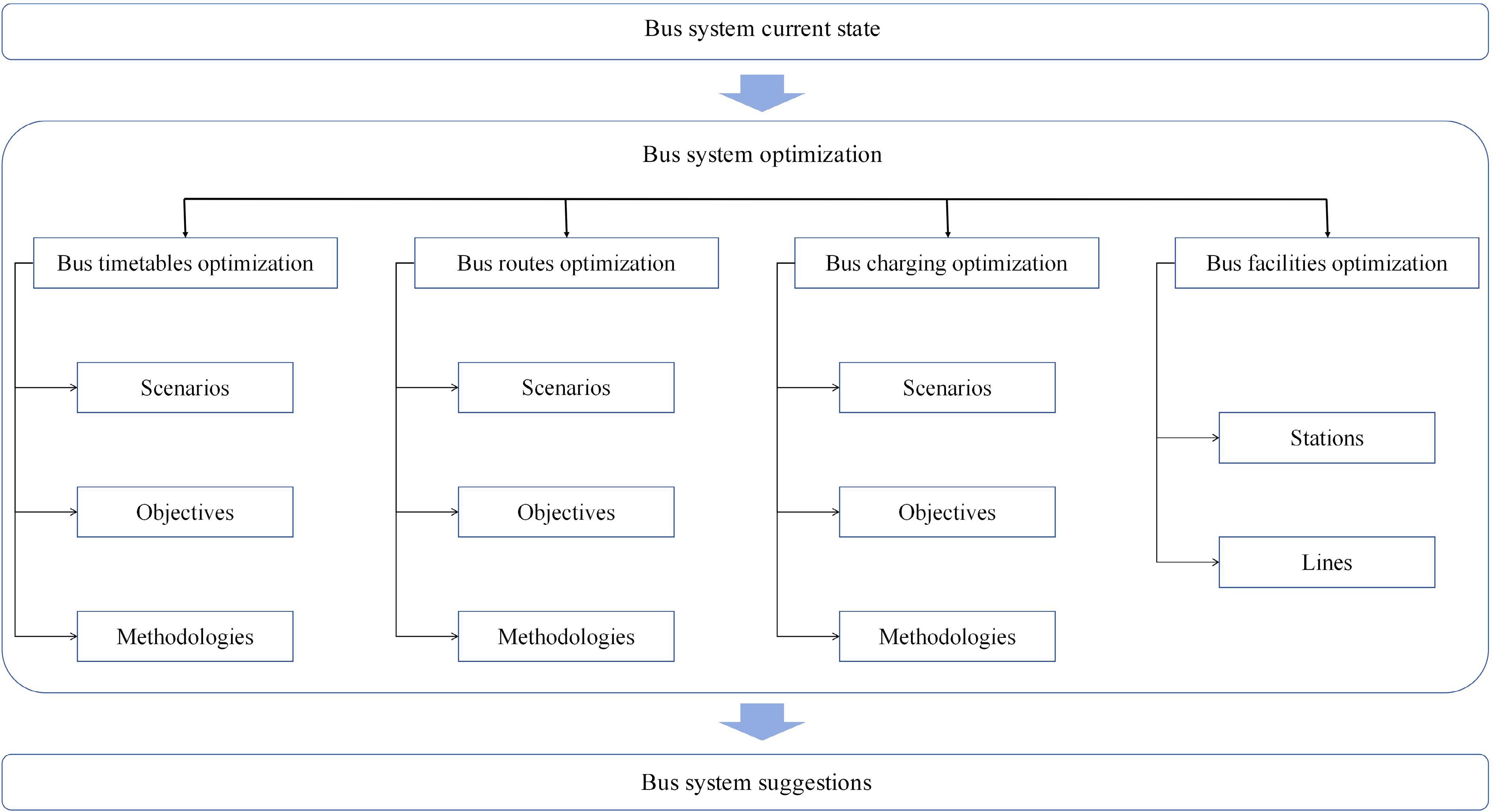
Figure 3.
The framework of bus system optimization.
This paper provides a review of bus system optimization from these four closely interrelated perspectives. Bus timetable optimization and route optimization work synergistically and should be considered together as objectives in bus system optimization. Bus charging optimization focuses specifically on electric buses, ensuring sustainable battery levels based on timetable and route optimization. Bus facility optimization enhances the efficiency and service level of the bus system on a physical basis and supports bus charging optimization.
-
Bus timetable optimization refers to the analytical process of designing bus timetables that maximize operational efficiency and passenger satisfaction while minimizing costs and resource utilization. This process involves determining the most effective arrival and departure times for buses at various stops along a route, considering passenger demand patterns, traffic conditions, and operational constraints of the transit system. Bus timetable optimization typically employs many mathematical and computational models, including linear programming, machine learning models, and simulation techniques. The main goal is to find an optimal balance among competing objectives, such as reducing passenger wait times, minimizing bus overcrowding, ensuring timely connections with other modes of transport, and optimizing the utilization of buses and human resources. Furthermore, bus timetable optimization often requires a dynamic approach, adapting to changing traffic conditions, varying passenger demand throughout the day, and unforeseen disruptions. Advanced models might incorporate real-time data, deep learning algorithms, or predictive analytics to adjust timetables dynamically and maintain service reliability. The ultimate goal of bus timetable optimization is to provide a public bus service that is efficient, cost-effective, and responsive to the needs of passengers, thus contributing to a more sustainable and accessible urban transportation system.
The present paper provides an overview of relevant research on bus timetable optimization from three perspectives: scenarios, objectives, and methodologies. In the scenarios of optimizing bus timetables, the application of synchronization in bus transfer networks, multi-modal transportation networks, and the integration of transportation with social activities is discussed. The objectives of bus timetable optimization include minimizing costs, minimizing the number of vehicles, maximizing passenger capacity, etc. Methods for bus timetable optimization include classical methods and deep learning methods.
Bus timetable optimization scenarios
-
Synchronization is one of the most important issues in optimizing bus timetables, which directly affects the practicability and attractiveness of the system. Bus synchronization includes alignment with other buses, other modes of transportation, and social activities.
In transfer-based transportation networks, synchronizing the timetable of crossing routes is the key to reducing passenger transfer time. To this end, Ansarilari et al.[3] compared different transmission time optimization methods and investigated their solutions individually at the network level and at each transmission node. Ataeian et al.[4] proposed a model to set bus network timetables with maximum synchronization and minimum fleet size as objectives. The model was suitable for both small and large transportation networks and was used to develop timetables on two samples of different sizes.
Synchronizing bus timetables based on train timetables can provide convenience for passengers. Song & Shao[5] proposed a mathematical model to optimize the timetables of bridging buses, specifically during rail transit adjustments. This model sought to minimize passenger waiting time, reduce the number of lost passengers, and limit the use of bridging buses, ensuring flexible operation across different routes while considering bus capacity and availability. Takamatsu & Taguchi[6] explored the issue of timetable design in areas served by low-frequency public transportation to ensure smooth changeover between buses and trains, using existing bus routes and train timetables as much as possible, and proposed a mathematical optimization model to generate a revised bus timetable that reduces transfer waiting times.
Synchronizing bus times with social activities can enhance passenger satisfaction. Wang & Haghani[7] tackled the integrated problem of school bell timing and bus scheduling with stochastic travel times. Their models aimed to minimize both the total number of buses and the overall vehicle time while accounting for the uncertainties present in real-world situations.
Bus timetable optimization objectives
-
The objectives of optimizing bus timetables include minimizing costs, minimizing the number of vehicles, maximizing passenger capacity, and achieving a balance among various interdependent factors.
Minimizing costs is the primary objective of bus timetables optimization. Sung et al.[8] proposed a simulation model and heuristic algorithm for complex electric bus scheduling problem. A model was proposed aiming to minimize total costs, including those for buses, chargers, and electricity, and output requirements for bus and charger types, as well as dispatching and recharging timetables. Risso et al.[9] tackled the intricate issues related to bus scheduling, specifically aiming to enhance multi-leg trips and transfers. They proposed a novel model that reduces costs and meets essential quality-of-service standards for regular travel. To achieve this, they employed an exact analytic method based on the epsilon constraint approach, enabling the derivation of efficient solutions.
Minimizing the number of vehicles is also an important goal alongside cost reduction. Fan et al.[10] examined the timetabling and scheduling of various electric bus lines, taking into account the nonlinear energy consumption linked to dynamic bus loads. Their objective was to minimize the number of vehicles and the overall operational costs while addressing constraints such as operational range and battery capacity at charging stations. Teng et al.[11] created a multi-objective optimization model for scheduling electric buses, concentrating on a single bus line. Their goals included optimizing vehicle departure intervals, reducing the number of vehicles, and minimizing total charging costs, all while accounting for departure interval ranges, operational mileage, and charging conditions.
Maximizing passenger capacity can enhance the service capability of the bus system. Ma et al.[12] proposed replacing the traditional experience-based bus timetables with a data-driven model, leveraging the bus Global Positioning System (GPS) and Integrated Circuit (IC) card data. Their model focused on optimizing time-dependent passenger demand and travel times to maximize passenger volume, incorporating a preference-based passenger selection model. It also considered constraints such as working hours, headway, and departure times.
Additionally, optimizing bus timetables must consider a balance of multiple factors. Lin et al.[13] developed an optimization model for bus timetables that caters to varying passenger demands and vehicle types, offering two service levels. The model balanced passenger satisfaction, bus company income, and government subsidies. Wu et al.[14] presented a model that combines ride-matching with shuttle bus dispatching. This framework optimized various aspects of bus trip timetables, including the number and types of trips, departure times, stopping times, and travel speeds, along with passenger-to-vehicle matching schemes.
Bus timetable optimization methodologies
-
Many methods are applied to solve the bus timetable optimization problem. Classical methods include linear programming, nonlinear programming, iterative algorithms, genetic algorithms, etc. With the development of artificial intelligence, deep reinforcement learning methods are also widely used.
Classical methods have extensive applications in bus timetable optimization. Dou et al.[15] introduced a mixed integer linear programming (MILP) model for a customized bus service, accounting for travel demand uncertainty. This model facilitated complex decision-making on routing, timetabling, and bus deployment, aiming to generate profitable bus services for diverse commuting requests using a fleet of heterogeneous vehicles. Zhang et al.[16] addressed the challenge of optimally adjusting single-line bus timetables while accounting for time-dependent travel times. They formulated this problem as a nonlinear programming model and employed a derivative-free constrained compass search algorithm specifically designed to suit the model’s distinct structure. Gkiotsalitis[17] introduced a rolling horizon dispatch time control model that adapts to fluctuations in travel times and passenger demand. This approach, supported by an iterative algorithm using gradient approximations, allows for flexible timetable adjustments and is computationally efficient. Tang et al.[18] created a bi-objective optimization model aimed at minimizing total passenger waiting time while optimizing departure times for the bus company. By leveraging GPS trajectories and smart card data, the model computed essential parameters such as travel time, bus dwell time, and passenger volume. An improved Non-dominated Sorting Genetic Algorithm-II (NSGA-II) was applied to efficiently search Pareto optimal solutions.
In recent years, deep reinforcement learning has shown advantages in bus timetables optimization problems. Yan et al.[19] approached the multi-line dynamic bus timetables optimization as a Markov decision process, utilizing a multi-agent deep reinforcement learning framework to manage the uncertainties in passenger demand and traffic conditions. Ai et al.[20] introduced a method for dynamic bus timetables optimization that leverages deep reinforcement learning. Utilizing a deep Q-network, this method adjusted departure intervals in real-time based on passenger demand, incorporating state features like load factor and waiting times.
-
Bus route optimization refers to the systematic process of designing and adjusting the layout and interconnections of bus routes within a transit system to maximize efficiency, coverage, and accessibility. This involves a comprehensive analysis of various factors such as urban geography, passenger demand patterns, existing transportation infrastructure, and socio-economic variables. The primary aim is to create a network that effectively serves the diverse mobility needs of the urban population while balancing operational costs and resource constraints. Theoretically, bus route optimization often employs complex mathematical models and algorithms, including network design algorithms, graph theory, and optimization techniques like linear programming and heuristic methods. These models seek to address key challenges such as determining the optimal number of routes, their paths, the frequency of service, and the integration with other modes of transportation. The optimization process aims to minimize travel times, reduce transfers, enhance connectivity between key urban areas, and improve overall service reliability and efficiency. Moreover, bus route optimization requires a dynamic approach due to the constantly evolving urban landscapes and changing passenger demands. Advanced models may incorporate real-time data analytic, simulation techniques, and machine learning algorithms to predict changes in demand and adjust the network accordingly. The ultimate objective of bus route optimization is to develop a public transportation system that is efficient in terms of cost and operations while equitable and accessible, thereby promoting sustainable urban mobility and enhancing the quality of life in cities.
In this paper, an analysis of bus route optimization is conducted across three dimensions: scenarios, objectives, and methodologies. Concerning the scenarios of bus route optimization, customized buses, autonomous buses, and enhancing the service capacity of the bus system are introduced. The objectives of bus routes optimization include minimizing costs, travel time, and carbon emissions, as well as providing the most satisfactory service for passengers. Methodologies for optimizing bus routes include heuristic algorithms, exact algorithms, and the analytic hierarchy process, among others.
Bus route optimization scenarios
-
Bus route optimization is applied in various scenarios, including customized buses and autonomous buses. Additionally, bus route optimization is used to enhance the service capacity of the transportation system.
Optimizing routes for customized buses is crucial. Wang et al.[21] focused on real-time customized bus routes optimization in the context of uncertain user demand. They constructed a multi-objective optimization model that describes the complete operation process of customized buses mathematically. This method initially handled static bus travel requests for preliminary routes optimization and subsequently updated the routes in real time for dynamic requests. Gong et al.[22] suggested designing a transfer-based customized bus network with a modular fleet, optimizing passenger-route assignments.
The integration of autonomous vehicles into bus routes optimization plays a crucial role in enhancing public transportation. Hatzenbühler et al.[23] investigated this integration by developing a multi-objective optimization and multi-agent simulation framework. Their approach examined network design and frequency adjustments when deploying autonomous vehicles, comparing the outcomes with traditional public transport systems. Similarly, Tian et al.[24] focused on incorporating autonomous vehicles into bus networks, considering uncertain demand across multiple routes to determine the optimal bus fleet size and allocation.
Bus route optimization helps enhance the service capacity of urban transportation systems. Lee et al.[25] investigated a flexible bus service offering door-to-door transport, reducing urban congestion. This service, focusing on shared rides, assigned buses to zonal routes based on historical demand, before the actual demand materializes. Chen et al.[26] proposed an optimization approach for redesigning bus routes to improve transit services for seniors. They developed a decision support model in which transit agencies act as lower-level decision-makers, optimizing bus stop locations and routes to minimize travel distances. At the upper level, the model sought to maximize accessibility for seniors, ensuring that the redesigned routes better meet their needs.
Bus route optimization objectives
-
Bus route optimization has many objectives that need to be addressed. With the development of low-carbon concepts, reducing carbon emissions has become an important issue in bus route optimization. Minimizing costs and travel time are also key concerns. Furthermore, bus route optimization aims to provide the most satisfactory service for passengers.
Low carbon emissions are a direction for bus route optimization. Ma et al.[27] proposed a three-stage hybrid coding approach to optimize customized bus routes in the face of uncertainty. They developed a robust optimization model to minimize passenger travel time and bus carbon emissions. Zhang et al.[28] presented a two-phase approach for on-demand electric bus system, aiming to reduce carbon footprints and enhance service. The first stage utilized a label-setting dynamic programming algorithm to efficiently generate bus trips based on passenger requests. The second stage applied a time-space network optimization model to enable integrated planning across various bus routes and charging stations.
Minimizing travel time and costs are critical issues in bus route optimization. Sun et al.[29] presented a flexible bus route optimization model that addresses multi-target stations while considering vehicle capacity, passenger demand, and the transportation network. The model’s objective was to reduce both vehicle operating time and passenger travel time. Addressing the need for efficient customized bus route planning, Wang & Ma[30] proposed a method. Their multi-objective optimization model considered the entire operation process of customized buses and aimed to minimize total passenger travel time and operating costs, accommodating multiple parking lots, vehicles, and boarding points. Mishra et al.[31] proposed a method specifically designed for optimizing low-demand bus routes, focusing on adjusting service headway and stop spacing to minimize costs for operators and passengers. Their approach used analytical cost models based on a negative binomial distribution of passenger demand, accounting for both random and scheduled arrivals. Wu et al.[32] explored a bi-objective problem for bus line planning and lane reservation, formulating a bi-objective integer linear programming model that sought to minimize passenger travel time and mitigate the adverse effects of lane reservation.
Providing services that satisfy passengers is a focus of bus route optimization. Ning et al.[33] developed an integrated framework for bus scheduling and route planning, aiming to maximize passenger numbers, reduce the total route length and the number of buses needed, and ensure a positive user experience. Huang et al.[34] investigated the real-time optimization of customized bus routes, focusing on maximizing both customer service rates and operator profits. Their approach involved collecting data on existing routes, schedules, pick-up and drop-off locations, and time windows, and optimizing the bus routes through the construction of three nonlinear programming models.
Bus route optimization methodologies
-
Many methods are used to solve bus route optimization problems. Among them, heuristic algorithms, such as the ant colony algorithm and genetic algorithm, are the most commonly applied techniques for bus route optimization. In addition, exact algorithms are also utilized to optimize bus routes. The analytic hierarchy process is further employed to assess the effectiveness of the optimization strategies.
Heuristic algorithms are widely used in bus route optimization. Wei et al.[35] introduced a method for optimizing public transportation networks using an ant colony optimization algorithm. Their approach integrated existing routes by representing the actual road network and bus routes with a graphical data structure and incorporating passenger flow data. The ant colony algorithm, combined with line structure constraints and ant migration rules for adjacent nodes, enabled the planning of new bus routes. Zhang et al.[36] applied uncertainty theory to optimize customized bus routes, formulating a two-level planning model aimed at maximizing bus company revenue and minimizing passenger travel costs. A genetic algorithm was used to solve the model considering uncertain factors. Sang et al.[37] also employed uncertainty theory for optimizing customized bus routes, with a focus on minimizing the total vehicle operation mileage. An improved genetic algorithm was utilized, and its effectiveness was validated through a case study. Guo et al.[38] addressed the customized bus routing problem, developing a multi-commodity network flow model to minimize passengers’ service access costs and bus route costs. This model, which allows for split and mixed loads, was solved using a dualized approach and a Lagrangian-based heuristic algorithm.
Exact algorithms are also used to solve bus route optimization problems. He et al.[39] proposed a mixed-integer programming model to optimize customized bus services, focusing on stop assignments and route scheduling while considering constraints on walking distance and travel time. To address the problem’s complexity, they developed an exact solution approach using a branch-and-price algorithm.
The analytic hierarchy process is used to evaluate the effectiveness of bus routes optimization. Shi et al.[40] systematically analyzed the different tiers of bus optimization schemes, encompassing bus routes, stations, and scheduling levels. They developed an evaluation model that covered both the optimization of individual bus routes and the optimization of multiple route combinations. The analytic hierarchy process was utilized to create a comprehensive evaluation framework for bus route optimization.
-
Bus charging optimization is a systematic approach to planning and managing electric buses within a public transportation network. This process involves strategically placing charging stations, scheduling charging sessions, and efficiently allocating resources to ensure the smooth operation of electric buses while minimizing costs and environmental impact. The key objectives of bus charging optimization include minimizing operational expenses by optimizing charging timing to take advantage of off-peak electricity rates, maximizing the utilization of electric buses during peak demand, reducing environmental impact by aligning charging with cleaner energy sources, strategically placing charging infrastructure along bus routes to minimize detours, and ensure reliability through redundancy planning. Additionally, due to the common issue of limited range with electric vehicles, optimizing electric bus fleets by adding fuel-powered or hydrogen-powered buses to ensure stable operation of the public transportation system is a topic of interest.
To achieve these goals, mathematical modeling, optimization algorithms, and advanced data analytics are employed, enabling transit agencies to make informed decisions that result in more sustainable and cost-effective public transportation systems.
This paper discusses three aspects of bus charging optimization: scenarios, objectives, and methodologies. The scenarios for optimizing bus charging include charging station optimization, charging scheduling optimization, and charging optimization under the influence of market factors. The objectives of bus charging optimization are to minimize charging costs and charging time. Methodologies used to address bus charging optimization include integer programming models, heuristic algorithms, and deep learning models.
Bus charging optimization scenarios
-
Bus charging optimization involves many aspects, including charging station optimization, charging scheduling optimization, and optimization considering market factors. All of these factors have a great influence on the electric bus system.
The optimization of bus charging stations is crucial for the electric bus system. Ferro et al.[41] tackled the optimization problem of planning service stations for recharging electric bus fleets used in public transportation. This problem encompassed selecting station sites, determining their size in terms of maximum output power, and assigning bus lines to activated stations while also considering fleet sizing. Liu et al.[42] proposed an optimization model for the placement of electric bus charging stations, the configuration of chargers, scheduling of charging times, and vehicle flow management, taking into account power matching and seasonal variations. Seasonal effects related to air temperature on battery performance were incorporated into the model. Zhou et al.[43] sought to establish an integrated plan for electric bus systems by minimizing total costs through the simultaneous optimization of en-route charger deployment, charging schedules, and battery configurations for electric buses. Hu et al.[44] explored the deployment of fast chargers at bus stops to facilitate en-route opportunity charging, optimizing the placement of chargers at selected stops and developing corresponding charging schedules.
Charging scheduling optimization determines the transportation capacity of the electric bus system. Gkiotsalitis[45] enhanced traditional bus-holding models to account for electric buses’ planned arrival times at charging stations. Their approach incorporated the electric bus holding problem while integrating scheduled charging times into the objective function. He et al.[46] developed an energy consumption model for battery electric buses (BEB) based on characteristic data and proposed a method to extract this data from unstructured sources. Additionally, they introduced a practical optimization model for scheduling BEB charging plans, taking into consideration the departure timetables and estimated energy consumption for trips across the BEB fleet. Zeng et al.[47] introduced a novel bus replacement strategy during the electric bus operation, allowing buses with low battery levels to be driven to a charging station and swapped with fully charged standby buses. To address the specific characteristics of electric buses, such as mileage limitations and various charging options, Xie et al.[48] presented a collaborative optimization model that integrates vehicle scheduling, charging plans, and driver timetables, accommodating fast charging, slow charging, and battery swapping modes. Recognizing the interconnection between system design and operational strategies, He et al.[49] introduced a two-phase optimization framework for planning and scheduling charging infrastructure in BEB systems. The first phase involved an integrated optimization model for charger placement, onboard battery capacity, and charging schedules, while the second phase employed a rolling horizon approach for optimizing real-time charging schedules.
Optimizing bus charging while considering market factors can improve the economic efficiency of electric buses. Yang et al.[50] proposed an optimization model for BEB to participate in carbon trading and peak-shaving auxiliary service markets, aiming to minimize daily energy costs for bus operators while accounting for grid load variations. Duan et al.[51] focused on bidding decisions in energy and reserve markets for urban electric bus operators who managed multiple stations with energy storage systems, as well as the charging schedules for all-electric buses. They introduced a trip-chain-based electric vehicle boundary model to represent the flexibility range for buses with multiple sequential trips, making it suitable for large-scale problems. Dirks et al.[52] presented an integrated modeling approach to address these challenges, aiming to develop a cost-effective, long-term, multi-period transformation plan for incorporating BEB into bus networks.
Bus charging optimization objectives
-
The main goal of bus charging optimization is to reduce costs. At the same time, minimizing charging time is also an important consideration.
Minimizing charging costs is crucial for the bus system. Wang et al.[53] proposed an integrated optimization model that covered charger deployment, bus fleet scheduling, and opportunity charging, intending to minimize total costs. The model optimized battery capacity, fleet size, and the placement of chargers at bus stops and terminals, taking into account realistic factors such as fluctuating ridership, dwell times, and travel times. Csonka[54] created a mathematical model to assist in the deployment of charging infrastructure for urban bus networks. Notably, their model incorporated elements for both static and dynamic charging technologies, without requiring route or schedule adjustments. It optimized charging unit locations to minimize costs, treating charged energy volume as a variable in the objective function. Gairola & Nezamuddin[55] introduced a deterministic optimization framework aimed at assisting BEB operators in making optimal decisions regarding charging station configurations. Their approach minimized both capital and operational costs. It included the creation of BEB recharge schedules designed to minimize electricity costs, accounting for time-of-use energy pricing and demand charges.
Reducing charging time helps improve the efficiency of the bus system. Huang et al.[56] introduced an innovative optimization approach for scheduling electric bus charging. To handle the nonlinear relationship between energy and charging time, the study discretized decision variables into time intervals and formulated a linear integer program. The goal was to reduce the total charging time.
Bus charging optimization methodologies
-
To address the problem of bus charging optimization, many methods have been proposed, among which integer programming models, heuristic algorithms, and deep learning models are widely used.
Integer programming models are common methods for modeling bus charging optimization. Bai et al.[57] explored the use of wireless power transfer (WPT) in multi-line transit systems, where each bus line had a designated number of trips. They introduced a novel WPT location problem that integrates operational details and constraints, formulating it as a mixed-integer programming model. The goal was to determine optimal bus stops for WPT installation while minimizing disruptions to regular traffic. McCabe & Ban[58] proposed a model for the optimal placement of chargers for BEB, using mixed-integer linear programming. This model balanced the initial costs of charging infrastructure with operational efficiency, considering factors such as charger locations, the number of chargers at each site, and the timing and sequence of charger visits for each bus.
Heuristic algorithms are widely applied to solve bus charging optimization problems. Wang et al.[59] proposed a collaborative optimization model to minimize the lifecycle costs of BEB systems, accounting for overnight and opportunity charging strategies. The model aimed to optimize both initial capital expenses and operational costs during the use phase by coordinating infrastructure investment and fleet scheduling simultaneously. To effectively solve the resulting bi-level optimization problem, a hybrid heuristic approach combining tabu search and an immune genetic algorithm was employed. Li et al.[60] addressed the high energy cost associated with fast charging due to electricity rate fluctuations. They introduced a charging optimization model for BEB networks, which jointly optimizes bus service and charging schedules to reduce charging expenses. To enhance efficiency for large-scale networks, they developed a heuristic algorithm named adaptive large neighborhood searching and branch and bound. Verbrugge et al.[61] proposed a real-time scheduling and optimization algorithm for the depot charging of multiple BEB. This algorithm dynamically assigned different charging currents to time slots during the charging process, aiming to minimize costs while respecting power grid constraints and operational schedules. A genetic algorithm was employed to solve the associated cost function in real time.
Deep learning plays an important role in solving the problem of bus charging optimization. Bi et al.[62] proposed a deep reinforcement learning method for the real-time scheduling of electric bus flash charging, optimizing the location, timing, and duration of charging. To minimize operating costs at battery swapping stations, Gao et al.[63] applied deep reinforcement learning to determine the optimal real-time charge/discharge power levels for charging piles. Fathollahi et al.[64] designed a multi-route planning model for wireless charging electric transit buses, focusing on the placement of power transmitters and battery capacity sizing, using a deep deterministic policy gradient approach. An appropriate reward function was defined to address the multi-route problem, and deep neural networks were used to solve for the optimal solution.
-
Bus facility optimization encompasses the systematic and strategic improvement of physical infrastructures and resources integral to the functioning of a public bus system. This includes the optimization of dedicated bus lanes and bus stations or terminals. The primary objective is to enhance the efficiency, reliability, and overall performance of bus services while ensuring sustainable urban mobility. Optimization of dedicated bus lanes involves designing and implementing lanes that are reserved exclusively for buses, to reduce travel times and improve the reliability of bus services. This can involve analyzing traffic patterns, assessing road space allocation, and employing traffic engineering principles to minimize interference from other vehicles. Regarding bus stations and terminals, optimization focuses on improving the layout, capacity, and facilities of these spaces to enhance passenger experience and operational efficiency. This encompasses aspects such as the design of platforms, passenger shelters, information displays, ticketing systems, and accessibility features. Efficient design and management of these facilities are crucial for minimizing dwell times, facilitating easy boarding and alighting, and ensuring smooth passenger flow. Furthermore, integrating these facilities with other transportation modes is crucial for developing a seamless and interconnected public transportation system. In summary, bus facility optimization is a multifaceted approach that aims to improve the physical infrastructure of bus system, thereby enhancing service quality, passenger satisfaction, and environmental sustainability in urban public transportation.
The present paper introduces bus facility optimization from two perspectives: station optimization and lane optimization. In terms of bus station optimization, discussions revolve around station location, spacing, and energy systems. Concerning bus lane optimization, meticulous analysis is conducted on lane planning and allocation.
Bus facility optimization of stations
-
Many studies have been advanced concerning the optimization of bus stations. Jin et al.[65] optimized bus stop locations and designs within a corridor using a two-lane-based model. Their approach considered factors like bus dwell time, demand, and their impact on total travel time. The nonlinear model was converted into MILP for efficient optimization. Wang et al.[66] applied the concept of Voronoi diagrams to partition bus stop service areas, using the average walking time for passengers in each region as a key metric to evaluate service convenience. This approach helped identify a set of candidate bus stops. Zhang et al.[67] developed an optimization model for determining bus stop spacing in on-demand public bus (ODPB) services, aiming to minimize total passenger travel time while accounting for specific ODPB constraints, such as segment length and vehicle capacity. Factors such as passenger density and travel time perception significantly influenced ODPB stop spacing. Hsu et al.[68] addressed the challenge of locating bus depots, charging, and maintenance stations during the transition from diesel to electric buses. They developed an optimization model and a heuristic algorithm to determine optimal facility placement and fleet allocation, considering factors like land acquisition and deadhead mileage. Rafique et al.[69] proposed a stochastic optimization-based energy management system for bus depots. This system enabled energy trading in both day-ahead and real-time energy markets while minimizing electricity costs and battery capacity degradation penalties.
Bus facility optimization of lanes
-
There is a series of research dedicated to the optimization of bus lanes. Sun et al.[70] presented a trajectory-based bus lane planning method that formulated the problem as a multi-objective optimization task. It considered road conditions, traffic flow, bus lane connectivity, construction cost, road utilization, and bus punctuality as constraints and objectives. They proposed an evolutionary algorithm-based solution to optimize bus lane planning in urban networks. Tsitsokas et al.[71] addressed the allocation of dedicated bus lanes in urban networks to enhance bus reliability and alleviate traffic congestion. They proposed a modeling framework that uses dynamic traffic modeling to account for the effects of congestion propagation linked to the location of dedicated bus lanes. The problem was framed as a nonlinear combinatorial optimization task with binary variables. Li et al.[72] also studied the allocation of dedicated bus lanes in urban settings, employing Simulation-Based Optimization (SBO) techniques. To tackle the complexity of high-dimensional and costly problems, they integrated machine learning-based surrogate models into the SBO framework, enhancing the efficiency of dedicated bus lane allocation in practical scenarios.
These studies contribute to improving bus facilities and enhancing the efficiency and service level of bus operations, augmenting the advantages of buses in urban transportation, and thereby fostering improved public bus system sustainability.
-
Bus systems play a crucial role in urban mobility and city development, serving as an indispensable component of residents’ daily lives. To better cater to the transportation needs of residents, continuous optimization of the bus system is essential. Key areas of optimization include timetable optimization, route optimization, charging optimization, and facility optimization.
Regarding bus timetable optimization, existing research focuses on bus transfer networks and multi-modal transportation networks, aiming to achieve objectives such as minimum cost, and vehicle number and maximum passenger capacity. Methods employed include classical methods and deep learning methods. Future research could explore differences in timetable optimization across different routes and the influence of social activities on timetable optimization.
In terms of bus route optimization, current studies concentrate on customized buses and autonomous buses, aiming to reduce costs, travel time, and carbon emissions. Optimization techniques such as heuristic algorithms and exact algorithms are utilized. Future research could investigate the relationship between bus route optimization and urban land use and population dynamics, as well as the resilience of bus route optimization under stochastic factors.
For bus charging optimization, existing research focuses on optimizing charging stations and charging schedules to minimize charging costs and charging time. Optimization is achieved through integer programming models, heuristic algorithms, and deep learning models. Future research could explore the integration of public bus charging with private vehicle charging.
Regarding facility optimization, current research focuses on optimizing bus stations and dedicated lanes, analyzing the location and energy systems of bus stations, as well as the planning and configuration of dedicated bus lanes. Future research could integrate economic theories into the optimization of bus facilities.
This review provides an overview of research on the optimization of bus systems in terms of timetables, routes, charging, and facilities, and proposes suggestions for future research directions. This review also emphasizes the practical significance of bus system optimization for real-world engineering applications. By improving timetables, routing, charging, and facilities, the findings support transit authorities and urban planners in designing efficient and reliable bus networks. Meanwhile, the review highlights methods that reduce operational costs, increase passenger capacity, and optimize resource allocation, which can directly enhance service quality and passenger satisfaction. These insights provide actionable guidance for practitioners in implementing data-driven, sustainable solutions that address current challenges in urban transportation, ultimately promoting a more efficient, environmentally-friendly public transportation system.
This work was supported by the National Key Research and Development Project of China (2022YFE0102700).
-
The authors confirm contribution to the paper as follows: study conception and design: Sui X, Yan H; analysis and interpretation of results: Pan S, Li X, Gu X; draft manuscript preparation: Sui X, Yan H, Pan S. All authors reviewed the results and approved the final version of the manuscript.
-
Data sharing not applicable to this article as no datasets were generated or analyzed during the current study.
-
The authors declare that they have no conflict of interest. Hai Yan is the Editorial Board member of Digital Transportation and Safety who was blinded from reviewing or making decisions on the manuscript. The article was subject to the journal's standard procedures, with peer-review handled independently of this Editorial Board member and the research groups.
- Copyright: © 2025 by the author(s). Published by Maximum Academic Press, Fayetteville, GA. This article is an open access article distributed under Creative Commons Attribution License (CC BY 4.0), visit https://creativecommons.org/licenses/by/4.0/.
-
About this article
Cite this article
Sui X, Yan H, Pan S, Li X, Gu X. 2025. Bus system optimization for timetables, routes, charging, and facilities: a summary. Digital Transportation and Safety 4(1): 1−9 doi: 10.48130/dts-0024-0024 

Bus system optimization for timetables, routes, charging, and facilities: a summary
- Received: 23 October 2024
- Revised: 12 November 2024
- Accepted: 18 November 2024
- Published online: 31 March 2025
Abstract: Bus systems plays an important role in reducing urban traffic congestion, developing green transportation, and providing more equitable transportation services. However, the rising demand for service quality from passengers and the large number of new energy buses have posed new challenges to the operation of bus systems. Integrating resources and optimizing bus systems is a challenge that requires collaboration between the government and bus operators to find effective solutions. This paper reviews the research related to bus system optimization from four aspects: bus timetable optimization, bus route optimization, bus charging optimization, and bus facility optimization. For bus timetable optimization, most of the existing research takes the minimum cost, the number of vehicles, and the maximum passenger capacity as the optimization objectives, which are solved by classical statistical methods and deep learning methods. For bus route optimization, existing research mostly focuses on different scenarios such as customized buses and autonomous buses, and uses heuristic algorithms and exact algorithms to analyze them with the objectives of cost, travel time, and carbon emission minimization. For bus charging optimization, integer programming models and heuristic algorithms are typically applied to address the optimization problems of charging stations and charging schedules, with minimum charging cost and charging time as the optimization objectives. For bus facility optimization, the research is mostly carried out from the optimization of bus stops and bus lanes. This paper can provide suggestions for the optimization and development of bus systems.
-
Key words:
- Transportation system /
- Electric bus /
- Multi-objective optimization /
- Deep learning