












-
This paper examines emergency management as an academic field, discipline, or science. Key questions addressed include: Is emergency management a distinct field/discipline/science? If so, what is its primary object of study, and what constitutes its core knowledge base—including foundational concepts and principles? These issues have been explored in a recent paper by Wu[1] and discussed by several earlier authors. The present paper contributes to this ongoing discussion by offering new insights, drawing on two perspectives not previously applied to emergency management: (1) philosophy of science, particularly Hansson[2], which clarifies fundamental concepts on scientific disciplines; and (2) contemporary risk science, which provides foundational concepts and principles for understanding, assessing, communicating, and managing risk. Contemporary risk science is understood here in accordance with the guidance provided by the Society for Risk Analysis[3−5] and related research; see, for example, Aven[6]. The SRA documents were developed by senior risk researchers with extensive expertise across the full spectrum of risk analysis and risk science, as defined by the SRA. This includes risk fundamentals, assessment, characterisation, perception, communication, management, and governance. The documents also incorporated input from the wider SRA membership.
The present work draws on a wide range of scholarly contributions to emergency management, including the long-standing tradition of research and practice in the Norwegian offshore sector, which has produced extensive foundational work on the relationship between risk and emergency management[7−9].
A review of the literature reveals a wide variety of definitions of emergency management. The following simple view is considered useful as a start: emergency management can be understood as the management of emergencies. An emergency refers to the occurrence—or potential occurrence—of an event or situation that is judged as dangerous and requires immediate action. Management, in this context, encompasses all organized activities aimed at preventing, mitigating, preparing for, responding to, and recovering from such emergencies.
The paper examines the extent to which emergency management constitutes a unique field, discipline, or science, particularly in comparison to closely related areas, in particular risk science. The analysis is primarily theoretical. While there exists a well-established professional practice of emergency management—often organized through governmental agencies and international bodies such as the United Nations—these practices vary in their definitions and implementation approaches. The present paper focuses on the scholarly perspective (the field/discipline/science of emergency management) rather than on professional practice.
An integrated risk – emergency framework is presented in this paper. This framework clarifies the scope and purpose of the emergency management field, its link to risk, and identifies core principles that should guide emergency management. Then various aspects of the framework are discussed, and some conclusions are provided. First, the review of the emergency management field is presented. Consistent with standard practice for conceptual papers, the review is narrative rather than systematic, highlighting issues of importance for the purpose of the paper, drawing on key definitional and foundational contributions identified through targeted database searches and citation tracking from central references, complementing the systematic bibliometric review by Wu[1] and Oh & Lee[10].
-
Emergency management has a long history, as documented by Haddow et al.[11], Urby & McEntire[12], and Van Bavel et al.[13]. The present paper focuses on developments in recent decades, particularly the emergence of emergency management as a distinct field, discipline, and science. Oh & Lee[10] conducted a systematic bibliographic review of publications over the past four decades, highlighting the wide range of topics addressed within the field.
Historically, emergency management has centered on contingency planning, preparedness, response, and recovery operations, with a predominantly reactive focus on managing hazardous events and other potential serious incidents. Alexander[14,15] defines an emergency as an exceptional event that exceeds the capacity of normal resources and organization to cope with it. Over time, this historical perspective has broadened significantly. Today, emergency management also commonly emphasizes risk—anticipating future disasters and implementing preventive measures. As in Herstein et al.[16] emergency management is about mitigation, preparing for, responding to, and recovering. This shift aligns with the eight principles of emergency management developed by Blanchard et al.[17], one of which states that emergency management should be risk-driven. That is, it should apply sound risk management principles and methods when assigning priorities and resources. These principles also stress the reduction of vulnerability, the strengthening of resilience, and the importance of professionalism: 'emergency managers value a science and knowledge-based approach based on education, training, experience, ethical practice, public stewardship and continuous improvement'[17]. The central role of risk is further illustrated by the definition offered by Haddow et al.[11], which describes emergency management as a discipline that deals with risk and risk avoidance.
With this expanded perspective, emergency management overlaps considerably with related fields such as disaster management, homeland security, and societal safety and security.
Disaster management (including disaster risk reduction) shares substantial common ground with emergency management. Whereas emergencies typically encompass a broad spectrum of events that require immediate action, ranging from relatively small, localised incidents (e.g., a man-overboard situation or a workplace accident) to more serious occurrences, disasters, by contrast, are generally reserved for large-scale events whose consequences are widespread and that overwhelm local resources and organizational capacities. Disaster management gained prominence through United Nations initiatives starting in the late 1980s, notably with the proclamation of the International Decade for Natural Disaster Reduction (IDNDR, 1990–1999). This built upon earlier efforts in emergency response and civil protection and evolved through major international frameworks, including the Yokohama Strategy (1994), the Hyogo Framework for Action (2005–2015), and the Sendai Framework for Disaster Risk Reduction (2015–2030)[18,19]. Disaster management involves the systematic study and application of knowledge to understand disaster risks, reduce vulnerabilities, and enhance resilience. It employs integrated measures to prevent new risks, mitigate existing ones, and strengthen preparedness, response, and recovery activities. Its overarching goal, as stated in the Sendai Framework, is the substantial reduction of disaster risk and losses in lives, livelihoods, health, and economic, physical, social, cultural, and environmental assets, while supporting sustainable socioeconomic development.
The concept of homeland security in the United States evolved from Cold War-era civil defense programs to the post-9/11 establishment of the Department of Homeland Security (DHS). Initially focused primarily on terrorism, it has since developed into a comprehensive all-hazards approach encompassing terrorism, natural disasters, cyber threats, pandemics, and other risks[20−23]. Homeland security involves the necessary and feasible preparations to reduce national risks, including preventing terrorist attacks, protecting against adverse incidents, and mitigating, responding to, and recovering from events—including major natural disasters and accidents that threaten national security[21]. The field emphasizes resilience, risk management, and intelligence-led operations, functioning as an operational component of broader national security. It has also emerged as an academic discipline taught at numerous universities, although the concepts and topics covered vary considerably across programs[21], reflecting the broad and multifaceted nature of the field.
Homeland security is frequently intertwined with emergency management[21]. A common agency definition describes emergency management as efforts to support citizens and first responders in building, sustaining, and improving national capabilities to prepare for, protect against, respond to, recover from, and mitigate all hazards[21]. According to Kahan[21], homeland security represents a broader, more securitized national framework, while emergency management is a practical, all-phases discipline focused on effective disaster handling and community protection. The two fields complement each other, with emergency management often integrated into homeland security initiatives. However, professionals note important cultural and operational distinctions: homeland security tends to be more strategic and federally oriented, whereas emergency management is generally more tactical and locally focused[21]. Importantly, not all emergency management activities are directly linked to homeland security. For example, several specialized journals address emergency management independently, covering topics such as emergency planning and response, disaster recovery, business continuity planning, severe weather, floods, hurricanes, and emergency communications.
The concept of societal safety and security (in Norwegian: samfunnssikkerhet) emerged in the 1990s in response to extreme events—initially major weather incidents and later several terrorist attacks[24−26]. It emphasizes the protection of critical infrastructure and societal functions, the integration of emergency preparedness into societal planning, resilience, and coordination across governance levels[26]. As a public policy concept, samfunnssikkerhet is also closely linked to the total defence perspective, in which military and civilian resources collaborate to prevent and manage crises, armed conflicts, and war[26].
While emergency management is most commonly discussed in a societal and governmental context, the concept is also applied in industry and business[9,27,28]. In the Norwegian petroleum industry, for instance, emergency management (preparedness) forms an integrated part of safety regulations and management systems for handling hazardous situations[9,29]. Much of its foundational development occurred in the early 1990s[7]. Key challenges included the selection of scenarios for preparedness planning, the use of risk assessments in such planning, and the establishment of appropriate performance requirements for preparedness measures. In recent years, attention has shifted toward broader barrier management[8] and a strong emphasis on resilience and robustness[8,30].
Considerable work has been undertaken to establish principles and methods for assessing the quality and performance of emergency preparedness arrangements and measures[7,8,31,32]. Performance is typically expressed across multiple dimensions, such as capacity, response time, and availability/reliability. Examples include an availability requirement for a safety system in a process plant or a required time until first aid or stabilizing treatment can begin. A comprehensive formulation that covers all three dimensions is: 'A first-aid group of minimum p persons shall meet at the place of the accident within q minutes, with a reliability (probability) of minimum r'[7]. Methods are developed on how to determine the appropriate level of these performance requirements, for example, what values of p, q, and r should be chosen; see Avena & Pitblado[7]. Performance is also commonly described in terms of functionality, integrity, and robustness[8]. Functionality refers to the effect that the barrier (or preparedness system) has on the sequence of events. Integrity concerns the ability of the system to be in place and intact at all times. Robustness addresses its capacity to withstand deviations from intended conditions and to 'survive' failures, hazards, or accident situations. For organisational and operational measures, examples include:
Functionality: specific competences and participation in training and drills;
Integrity: availability and mobilisation time;
Robustness: capacity and redundancy (e.g., deputies in key roles with the required competence and capability).
In the private sector, Business Continuity Management (BCM) has gained considerable popularity in recent years[33,34]. BCM focuses on mapping, managing, and mitigating risk events and their impacts on the organization[35].
Crisis management and emergency management are closely related, though authors differ on the distinction. Some, such as Waugh[36] view the difference primarily as one of regional tradition: 'emergency management' is the common term in the United States, Australia, Canada, and other English-speaking countries, while 'crisis management' is used in Europe and 'disaster management' in India and within the United Nations and other international organizations. Other authors highlight conceptual and operational differences. Emergency management typically focuses on specific events (natural disasters, accidents, public health incidents, etc.) and follows structured phases—mitigation/prevention, preparedness, response, and recovery—with the goal of restoring normal operations as quickly and efficiently as possible. In contrast, crisis management is often seen as a broader umbrella term. It encompasses strategic leadership, decision-making under high uncertainty, reputational and stakeholder communication, and sometimes transformative responses. Crises may involve not only sudden events but also prolonged instability or political, social, and economic threats, where the previous 'normal' is no longer viable. The aim is often to navigate uncertainty and establish a new, more stable normal[37,38].
Urby & McEntire[12] examined whether emergency management constitutes a field, discipline, or profession. They conclude that it can be viewed as a field and is developing as an academic discipline (evidenced by growing numbers of study programs, degrees, and scholarship), but has not yet reached full maturity as a stand-alone discipline. They define emergency management as 'the study of how humans and their institutions interact and cope with hazards, vulnerabilities, and resulting events, particularly through activities related to preparedness, response, recovery, and mitigation'. The area possesses a vast and rich body of knowledge but remains inherently interdisciplinary, drawing from fields such as geography, sociology, and political science.
In contrast, Wu[1] regards emergency management as both a sufficiently mature discipline and a distinct science, while arguing that it still requires deeper theoretical consolidation to achieve full maturity. Adopting a disciplinary perspective, Wu seeks to strengthen the theoretical foundation of emergency management science. The author classifies it as an applied discipline belonging to both safety and security management and public management. Wu proposes a detailed classification of sub-disciplines using a 'nine-grid model' (theory/technology/equipment × disciplinary/professional/relative science), along with time-based branches (preparedness, response, recovery, systems science) and element-based branches (basic theory, technology, industry, resources, policies, psychology, informatics, etc.). Wu[1] defines emergency management science as 'a science that studies the scientific laws and their applications in emergency management.' It combines management methods with engineering and technology to examine planning, organization, decision-making, and response; reveals mechanisms of disaster incubation, occurrence, and evolution; assesses risks; develops plans; coordinates resources; guides public behavior; and establishes legal systems, among other functions. The scope of research includes basic theories, risk assessment, response technology, resource optimization, psychology, and more. The paper discusses various research methods (e.g., observation, experiment, simulation, case study, system analysis, risk assessment, and interdisciplinary approaches) and presents a structural model illustrating how the science integrates disciplinary branches, research methods, rules, and principles (see the appendix for an overview).
-
This section presents the proposed framework for emergency management. First, a background on key issues relevant to the development of the framework is provided, with particular focus on the conceptualisation and description of risk and the SRA foundation. Then a conceptual basis of the framework is described. Building on this basis, emergency management as a discipline and field of science is discussed. Finally, some core principles for emergency management are presented.
Basic ideas to form the framework
-
The review in the previous section shows that emergency management is predominantly viewed as a field concerned with handling risk events after they have occurred. The central issue is how to deal with incidents such as fires or earthquakes in order to limit or reduce their consequences. Under this interpretation, there is considerable overlap with the concept of vulnerability management as used in contemporary risk science frameworks. Vulnerability, in this context, refers to the consequences and associated uncertainties given that a risk event has occurred. It is essentially risk conditional on the occurrence of the risk events[3,6].
The review also reveals perspectives that explicitly link emergency management to risk and risk management. Several authors argue that emergency management should be risk-driven[17] and should address both risk and risk avoidance[11]. This raises a critical question: Should emergency management be regarded as a field focused primarily on what happens after risk events occur, or does it substantially overlap with risk management in general?
If the former view is adopted, it becomes necessary to clarify how these risk events should be specified, and what distinguishes emergency management from closely related fields such as vulnerability management.
To illustrate the discussion, consider the following example from a process plant. Gas leaks may occur, potentially leading to fires and explosions, with resulting loss of life, environmental damage, and economic losses. In this case, the risk event can be defined as the gas leakage itself, or the subsequent fire or explosion. Emergency management then focuses on preparing for, protecting against, responding to, and recovering from such events.
However, are not all these measures and activities fundamentally about managing risk? In its broadest sense, risk encompasses risk events, their consequences, and the associated uncertainties[3,6]. This perspective is clearly illustrated by the classical bow-tie model used in risk science, which places the risk event in the centre, with causes to the left and consequences to the right. A key part of risk management is precisely the handling of consequences—the very focus of emergency management and vulnerability management.
While not all current risk assessment and management schemes fully address all aspects of consequences (for example, recovery), this is largely a matter of tradition rather than a fundamental limitation of the risk concept itself.
If we examine current risk management schemes, for example as described by Hansson & Aven[39], it can be argued that the risk management process ends when decision makers reach a decision based on risk assessment and management review: The acute phase of the risk-event development (i.e., when the emergency is actually taking place) is not included in the risk management process; hence the process is proactive rather than encompassing the reactive elements of the acute phase of emergency management. To respond to this argument, let us return to the process-plant example above and assume that the focus of the risk assessment and management process is the number of fatalities resulting from gas leakages. It is then clear that the risk assessment and management process also includes the reactive and acute phases of emergency management, up to the point at which the number of fatalities has been specified. Beyond that point, recovery phases are not included. The model presented by Hansson & Aven[39] does not specifically address the actual assessment and management process; instead, it focuses on how science and values influence the decision-making. The risk management and governance frameworks in use today cover the reactive and acute phases of emergency management, but they typically do not encompass all aspects of recovery as noted above.
This means that there is a difference in practice between vulnerability management and emergency management. This difference also stems from the typical focus of vulnerability management, which emphasizes the proactive phase of implementing measures before an event occurs in order to keep consequences small, rather than the acute/reactive phase of dealing with the event itself to limit consequences. The acute/reactive phase is the primary focus of emergency management. From a theoretical point of view, however, vulnerability management as defined in this paper also encompasses the acute/reactive phase, so that the two concepts essentially overlap. We will return to this discussion in the section 'Emergency management as a discipline and science'.
The risk field and discipline cover understanding, assessment, characterization, communication, management and governance of risk. Risk science is defined as[39,40]: the practice that provides us with the most justified knowledge that can be made, at the time being, on subject matters covered by the risk field.
This knowledge takes the form of concepts, principles, theories, models, approaches and methods (in the following just referred to as concepts etc.) for the purpose of understanding, assessing, characterizing, communicating, managing and governing risk.
Risk science as a concept needs to be seen in relation to the term 'risk analysis', as defined by the Society for Risk Analysis (SRA) in 1980[41]. 'Risk analysis' was introduced as an umbrella term to capture all risk-related topics, including risk assessment, risk characterization, risk communication, risk management, and policy relating to risk. In recent years, reference to a distinct risk science has been common in SRA contexts based on guidance work developed[3−5], with supporting scientific publications[2,39,40]. A distinction is made between generic (fundamental) risk science and applied risk science.
Does it make sense to view emergencies as a special category of risk events—namely, situations that are considered dangerous and require immediate action? Yes, but dealing with 'dangerous' situations is also a core concern of risk management, where 'dangerous' essentially means that the risk is judged to be high. Alternatively, the distinction may lie in whether the events exceed routine management capacities and therefore require the involvement of the emergency organization. In this interpretation, emergency management can be understood as the management of serious risk events that activate the emergency organization. This would mean focusing not on any minor gas leakage in a process plant, but on large-scale leakages and situations involving major fires and explosions.
The framework
-
This section proposes a theoretical framework for delineating the field of emergency management, including its scope, boundaries, and relationships to related disciplines. The framework is based on a structure in which emergency management is positioned as having a considerable overlap with risk science. This positioning is motivated by the following foundational concepts:
Risk: That something undesirable or unexpected may occur[3,6].
Emergency: The occurrence of an event or situation that may have serious undesirable consequences and requires immediate action.
Consider an activity (for example, the operation of a process plant or life in a country). Let C denote the future consequences of this activity over a specific period of time. At present, C is unknown and uncertain, which we express by the symbol U. The risk associated with the activity can then be described in its most general form by the pair (C,U). While the focus is typically on undesirable consequences, the risk concept also encompasses desirable outcomes—particularly in business contexts, where the emphasis is on deviations from expected values, whether positive or negative. In the context of emergency management, however, the primary interest lies in risks involving undesirable consequences. The consequences – in both risk science and emergency management – relate to 'things humans value', for example, life, health, societal functions, environmental assets, and economic assets.
The (C,U) conceptualization of risk is commonly expressed in the adjusted form (A,C,U), where A represents an event (or set of events) that may lead to the consequences C (Fig. 1). Examples of A include gas leaks, fires, extreme weather events, earthquakes, and terrorist attacks. In this notation, C is understood to be conditionally dependent on A, although the simplified form C is retained for notational convenience. The uncertainty U relates to both the occurrence of A and the resulting consequences C, particularly regarding whether and when A will occur, and what type of events may materialize.
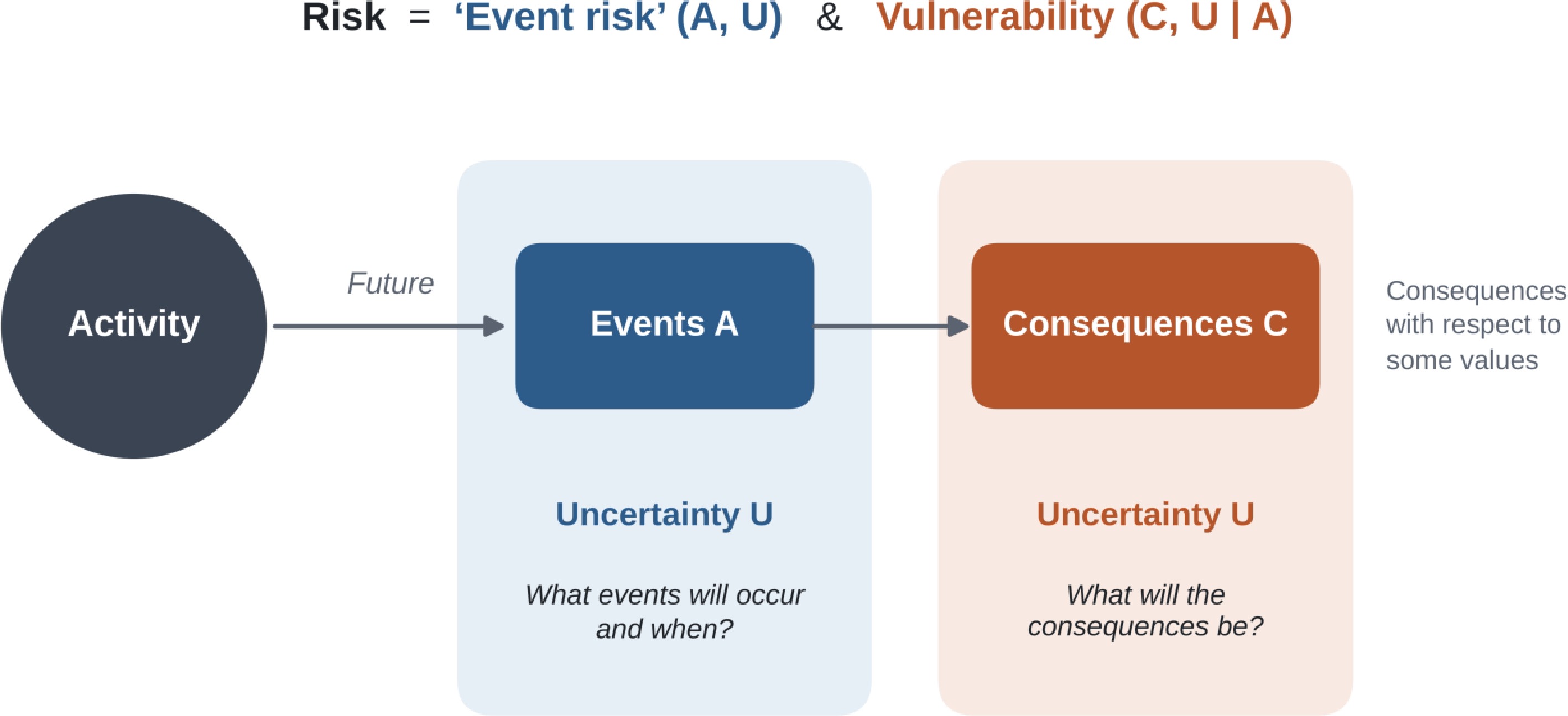
Figure 1.
Illustration of the risk concept with event contribution and vulnerability.
Risk can be conceptually divided into two main components:
The event component (A,U)—concerning which events occur and when they occur.
The vulnerability component (C,U|A)—expressing the risk conditional on the occurrence of a specific event A (for example, a fire).
Symbolically, this can be written as:
Risk = (A,U) & (C,U| A)
(i.e., event contribution to risk & vulnerability contribution to risk).
Risk management involves managing these two core components of risk, where risk assessment is a core type of activity. The risk assessment characterizes the risk, identifying/specifying events (A') and consequences (C'), and use probability to measure or describe the uncertainties.
Note the distinction between (A,C) and (A',C'). The former refers to the actual events and consequences associated with the activity, whereas the latter represents the events and consequences as specified in the risk assessment. A surprising event A may not be covered by the events A' included in the assessment. In addition, the knowledge supporting these judgments needs to be highlighted, and in particular the strength of this knowledge.
Building on this foundation, we define emergency and emergency management as follows: An emergency is understood here as the event A. Emergency management refers to the management of A and its potential consequences C, including the associated uncertainties U. Not all events A qualify as emergencies. Only those judged to be sufficiently serious to warrant immediate action and the involvement of emergency organizations are classified as such. The threshold for 'sufficiently serious' can be predefined using explicit criteria (e.g., the magnitude of a gas leak or the intensity of an earthquake). These criteria are typically established based on experience from past events and prior risk and vulnerability assessments. When a novel or unexpected situation arises, a rapid assessment of its seriousness must be conducted. To enable timely decision-making under time pressure, clear procedures should be in place for performing such assessments.
In addition to the criterion of seriousness, one might suggest requiring that the consequences be capable of being influenced through organized response efforts. There is a certain logic to this, but it is not adopted here as a formal requirement, so as not to exclude events from consideration simply because of the current state of organizational arrangements.
The following criteria can be used to guide decisions on whether to initiate a response to a potential emergency:
(a) Is there a non-negligible probability that the event will lead to very large negative consequences? → Take action.
(b) Is it likely that the event will lead to considerable negative consequences? → Take action.
(c) Is it unlikely that the event will lead to considerable negative consequences, but the uncertainties are substantial? → Take action.
(d) Does the event challenge safety or acceptable risk? → Take action.
These criteria illustrate situations in which emergency management attention or action is warranted. Criteria (a)–(c) are primarily associated with high vulnerability, whereas criterion (d) reflects broader risk and safety concerns. The questions in (a)–(d) should be asked for different levels of preparedness measures implemented. In the planning phase, the key criterion is (d), whereas in the operational post-event phase, the key question is whether the event challenges acceptable vulnerability. As an illustrative example, consider a 'man-overboard' event on an offshore installation. The probability of the event occurring may be low, yet the potential consequences are severe if adequate emergency preparedness systems are not in place. In this case, criterion b applies, as does criterion d: without an effective system for handling man-overboard situations, the overall risk would be deemed unacceptable, and the workplace would not be considered safe. Many similar event types exist where safety can only be ensured through the presence of a dedicated emergency preparedness system. Examples include workplace accidents, oil spills, and 'hot work' operations.
Emergency management as a discipline and science
-
In this context, the term 'field' is interpreted broadly as any area of study. A field qualifies as a distinct discipline when it meets certain criteria[42,43], with the two most fundamental being: (1) a clearly defined research object; and (2) a specialized body of accumulated knowledge—including concepts, theories, and terminology—that is distinctive to the field and not widely shared with others. A discipline encompasses associated educational programs, journals, publications, researchers, research groups, and professional societies.
For emergency management, the primary research object (1) is emergencies examined within a risk context. Identifying a unique body of specialist knowledge (2) is more challenging, however, due to substantial overlap with other fields—particularly risk management and risk science. A review of the emergency management literature indicates that the field's core knowledge and practice traditionally address four phases: mitigation, preparedness, response, and recovery. The status of the mitigation phase is particularly debated. Some interpretations treat mitigation as encompassing all forms of risk reduction, while others limit it to reducing vulnerability conditional on a risk event occurring. The present framework adopts the latter perspective: mitigation in the context of emergency management concerns the reduction of risk given the occurrence of a risk event (i.e., reducing vulnerabilities, denoted as (C,U|A)). If mitigation here would cover unconditional risk reduction, emergency management would overlap entirely with risk management when adopting the conceptual perspective presented in the previous section, 'The framework'. While disaster management often adopts this broader view, its scope extends to overall risk rather than emergencies alone.
The current framework focuses emergency management on three main phases, combining mitigation and preparedness into a single pre-event phase:
Mitigation and preparedness (pre-event phase): Actions taken to reduce the risk given the risk events, i.e., the vulnerabilities (C,U|A). Examples:
Structural measures (engineering and design-focused), such as earthquake-resistant construction, flood levees, elevated buildings, and retrofitting of critical infrastructure.
Non-structural high-level measures (policy, planning, and awareness), such as zoning laws, building codes, land-use planning, and insurance incentives.
Measures to build operational capacity, procedures, and readiness, including training, drills, resource allocation, barrier specification, and performance requirements.
Response: Immediate actions during or immediately after an event to save lives, protect property and the environment, and stabilize the situation. Examples include incident management systems, resource mobilization and logistics, situational awareness and assessments, search-and-rescue operations, on-scene security and law enforcement, public health and medical services, and inter-agency/unified command coordination.
Recovery: Short- and long-term efforts to restore and improve affected systems, infrastructure, and communities. Key activities include damage assessment, debris management, housing and economic recovery, psychosocial and mental health support, infrastructure restoration, after-action reviews (lessons learned), and 'building back better' to integrate resilience enhancements.
All three phases fall under the broader umbrella of risk management, as mitigation and preparedness explicitly address vulnerability—an integral component of risk.
Common practice distinguishes mitigation (risk reduction via assessments) from preparedness, where preparedness typically emphasizes operational, functional, and procedural aspects—planning, training, resource-building, and the definition of barriers with performance standards (e.g., evacuation times or blast-wall resistance to overpressure). The present paper deliberately avoids this separation for conceptual and practical reasons, as illustrated by the following example of gas leakages in a process plant. Here, the leakage of a certain size constitutes the risk event A. Measures to manage the associated vulnerabilities (C,U|A) include:
(i) Active safety barriers (e.g., emergency shutdown systems and gas detection/alarm systems);
(ii) Passive safety barriers (e.g., blast/fire walls);
(iii) Procedural and organizational barriers (e.g., evacuation procedures and maintenance/inspection plans for critical equipment).
Performance requirements can (and should) be specified for all these barriers.
A narrow view of preparedness would restrict it to operational/organizational measures (iii only), labeling (i) and (ii) as mitigation. However, all three types of barriers are implemented to reduce risk given the event and thus serve the same underlying purpose. Moreover, any measure aimed at reducing vulnerability could reasonably be described as enhancing preparedness. In this conditional sense (given A), mitigation and preparedness largely overlap. While this usage is not standard in the literature, similar integrated approaches exist[8]. A key motivation for combining the terms here is to promote integrated thinking across technical, organizational, and operational measures, encouraging the use of risk assessment as a tool for all barrier types rather than limiting it to technical solutions.
The mitigation and preparedness phase also encompasses planning for effective response and recovery. Pre-event arrangements are made to manage a leakage (should it occur) and to restore operations afterward. Thus, mitigation/preparedness is pre-event, while response and recovery are post-event. Emergency management as a field encompasses both empirical knowledge (how the phases function in practice) and normative knowledge (how they should best be planned and executed). Empirical insights from events and exercises continuously inform and refine the normative guidance used in mitigation and preparedness planning.
Uncertainty plays a central role in emergency management, not only prior to events during risk assessment and preparedness planning, but also throughout ongoing emergencies and crises. Emergency response and recovery activities are typically characterised by incomplete information, rapidly changing conditions, conflicting signals, and substantial uncertainty regarding both the current situation and the potential effects of different response options. Traditional risk assessment and management, which rely primarily on historical data and probabilities, often struggle to address such dynamic and evolving uncertainties. By contrast, the contemporary risk science framework adopted in this paper is well suited to accommodate these types of uncertainty, since uncertainty is a core component of the risk concept itself. This focus on uncertainty helps strengthen the connection between emergency management and risk science. Perspectives from contemporary risk science on uncertainty, strength of knowledge, surprise, resilience, and adaptive decision-making are relevant not only for preparedness and prevention, but also during active response and recovery operations.
Given this conceptual analysis, it is evident that there is substantial overlap between emergency management and contemporary risk science/analysis (understood in the broad SRA sense). Some risk scholars may even view emergency management as a subdomain of risk science/analysis. However, as Staupe-Delgado et al.[44] note from a sociological perspective, disciplines are often defined more by identity, in-group belonging, and external recognition than by strict objective boundaries[45]. It is noted that the field of emergency management addresses several topics that have received only limited attention in risk science and risk analysis, such as crisis leadership, improvisation, institutional complexity, and decision-making under time pressure. Research in emergency management can offer valuable insights to risk science and risk analysis on these topics.
A discipline gains status as a 'reference discipline' when it provides theoretical and methodological foundations for other fields and is actively cited by them[46,47]. According to this criterion, it can be argued that emergency management functions mainly as a receiving discipline, drawing heavily from risk science, rather than as a reference discipline itself. While it contributes valuable theory and methodology, it is fair to say that it has not achieved the level of external recognition and paradigm consensus characteristic of 'normal science' in the Kuhnian sense[48].
Emergency management principles
-
This section outlines fundamental principles for emergency management, building on the concepts developed in the preceding sections. It begins with a high-level ideal goal in the form of a vision statement.
Overall goal for emergency management (Vision Statement):
Emergency management is an integrated activity within risk management and risk science that systematically reduces vulnerabilities and limits consequences in the face of adverse events, with the aim of protecting people, the environment, societal functions, assets, and systems.
As vulnerability is defined in this paper, strengthening resilience is viewed as one important means of reducing vulnerabilities (C,U|A).
Generic risk-science related principles
-
The principles presented below are intended to support and operationalize this vision. Since emergency management overlaps considerably with risk management, many general risk management principles apply directly. Comprehensive discussions of risk management principles can be found in SRA[5] and Aven et al.[49]. Several of these are particularly relevant to emergency management and are highlighted here.
P1: Emergency management builds on risk management and risk science knowledge.
This principle emphasizes that emergency management should draw upon the best available scientific knowledge—including concepts, principles, models, and methods—rather than relying solely on standards that may lack a strong scientific foundation. The notion of 'best available knowledge' should here be interpreted broadly to encompass operational, institutional, and experiential forms of knowledge that may not always be fully captured within formal, theory-based frameworks. As in any scientific field, what constitutes 'best knowledge' or state-of-the-art is subject to continuous discussion and refinement. Key sources include the Society for Risk Analysis (SRA) core principles document[5] and related scholarly work. While scientific knowledge is given priority, this ideal must be balanced against considerations of simplicity and operational practicality. Standards offer important advantages, such as shared terminology and consistency across organizations and borders. However, significant gaps can exist between current standards and contemporary scientific understanding. Standards should therefore be used critically and only when they align with the best available science.
To structure the body of relevant knowledge, a distinction is made between two categories:
(a) Generic management knowledge—principles rooted in general management theory and practice (e.g., continuous improvement, process orientation, systems thinking, effectiveness and efficiency, knowledge management, and ethical conduct). Many of these are reflected in standards such as ISO 31000[50].
(b) Specific risk management and risk science knowledge—principles that are distinctive to the risk field.
For category (a), readers are referred to Aven et al.[49]. For category (b), key references include SRA[5] and Aven et al.[49]. Three illustrative examples from category (b) are provided below.
P2: The proper risk level is the result of a value- and evidence/knowledge-informed process that balances different concerns.
The appropriate ('right') level of risk is not fixed or absolute but is determined through a deliberate process that integrates the best available evidence and knowledge with the values and priorities of the decision-makers. This involves balancing safety, economic, social, ethical, and environmental concerns. Risk-related decision-making is not only about minimizing or avoiding risk; it also includes value creation and the conscious acceptance of risk when potential benefits are sufficiently large. Effective risk management therefore requires striking an appropriate balance between risk avoidance, risk reduction, risk acceptance, and risk transfer. While the primary focus is on undesirable events, sound decision-making must consider the full spectrum of outcomes—both positive and negative.
P3: Risk is considered acceptable or tolerable if the probability of undesirable events or consequences is sufficiently low and the supporting knowledge is sufficiently strong.
Determining what is 'sufficiently low' or 'sufficiently strong' involves value judgments that cannot be made by analysts or scientists alone. Standards, regulatory guidance, and established practices can serve as useful references, but societal values, costs, and risk perception may also influence these judgments.
P4: Management review and judgment are essential for appropriate risk management decisions.
This principle highlights the importance of management review and judgment (MRJ) in risk management. There is an inherent leap from the results of formal analyses (risk assessments, cost-benefit analyses, etc.) to actual decisions. Assessments inform decisions but do not dictate them, as they have inherent limitations and cannot capture all relevant concerns[51].
Principles P1–P4 apply to both the proactive and reactive phases of emergency management. The reactive phase is commonly characterized by decision-making under time pressure, which can strongly influence the management review and judgment process—including judgments about risk acceptability (tolerability) and the balance of different concerns. Adaptations to the specific situation are required, but the principles remain valid.
Specific principles for emergency management
-
PE1: Emergency management must be risk-informed to identify the risk events it should address.
Emergency management should focus on all risk events for which the risk is assessed as non-negligible. Risk is considered negligible when both the probability of the event is judged to be negligible, and the supporting knowledge is strong (i.e., the event is considered implausible). For example, while a process plant gas leak has non-negligible probability and severe potential consequences, a meteorite strike would typically be excluded as its risk is judged negligible.
PE2: Emergency management should also include events based on broader considerations beyond professional risk judgments, taking into account ethical concerns, cautionary/precautionary principles, established standards, risk perception, and public concerns.
Some events may warrant inclusion even if formal risk assessments deem them minor. The 'man-overboard' scenario, for instance, can be justified both on risk grounds and on strong ethical considerations.
PE3: A balance is needed between measures that reduce the event component (A,U) and measures that reduce vulnerability (C,U|A).
While likelihood-reducing measures (prevention and inherent safety) are often prioritized, the best results are typically achieved by combining both event-reducing and consequence-reducing measures. Consequence-reducing measures (e.g., design and technical barriers) are often less dependent on human performance and can provide robust protection.
PE4: Significant weight should be given to signal and warning systems, as well as to the development of knowledge that enables adequate interpretation of precursors.
Major accidents and disasters are frequently preceded by signals or warnings[52]. High Reliability Organizations (HRO) research emphasizes key principles such as preoccupation with failure, reluctance to simplify, and sensitivity to operations[53]. Organizations that cultivate these traits, together with commitment to resilience and deference to expertise, are better equipped to detect, interpret, and respond to early warnings.
PE5: Weight should be given to arrangements and measures that enhance system resilience.
Resilience—the ability of a system to sustain or rapidly restore its basic functionality following a disturbance—is a critical component of vulnerability reduction. While traditional emergency management has focused primarily on well-known risk events, resilience is particularly important for dealing with unforeseen or surprising events.
PE6: Clear performance requirements must be defined for emergency systems and barriers.
Performance requirements should start with high-level functional statements (e.g., 'prevent leaks' or 'ensure safe evacuation') and then be developed into more specific requirements for the overall system and its individual elements. Regular performance assessments are necessary to verify that these requirements are being met. See the review section for some examples of such requirements and methods for determining them.
-
It is commonly argued that probability-reducing measures should be given priority over consequence-reducing measures[1,8]. This view is often summarized as the principle that prevention should be prioritized over reaction. The underlying logic is well-established: prevention is almost always cheaper, more effective, less harmful, and more efficient than dealing with consequences after an undesirable event has occurred. This idea is captured in the classic saying 'an ounce of prevention is worth a pound of cure' and traces back to Hippocrates[54].
Although this rationale is compelling—clearly, preventing leaks, fires, or explosions in a process plant is preferable to managing their consequences—the present paper does not formulate it as a standalone principle. Even the best preventive efforts cannot guarantee that undesirable events will never occur. Risk assessments may indicate low or negligible probabilities, but low-probability events do happen from time to time. As surprises and unforeseen events do occur, resilience and reactive (consequence-reducing) measures remain essential components of sound emergency management. Effective risk management therefore requires a balanced combination of preventive and reactive arrangements.
Some guidance exists on the relative weighting of reactive measures. For example, PSAN[8] (p. 13) states that automatically activated technical barriers are generally preferable to those requiring human intervention. While such recommendations have merit, this paper takes a more cautious approach. All types of barriers and emergency measures have inherent strengths and weaknesses that must be evaluated in context, considering multiple concerns. In particular, maintaining diversity in defenses is often crucial for achieving overall system resilience.
The principles presented in this paper are intentionally generic and applicable across domains. When compared with the principles proposed by Blanchard et al.[17] and Wu[1], there is limited overlap. A key reason is that the latter largely address generic management knowledge, whereas the present work focuses primarily on specific risk management and risk science knowledge.
-
The aim of this paper has been to strengthen the conceptual foundation of emergency management by clarifying its boundaries and its close relationship to related fields, particularly risk science and risk management. A central contribution is the development of an integrated risk–emergency management framework. The framework clarifies the scope and purpose of emergency management, its relationship to risk, and identifies core principles to guide the field.
The overall goal (vision statement) for emergency management is formulated as follows:
Emergency management is an integrated activity within risk management and risk science that systematically reduces vulnerabilities and limits the consequences in the face of adverse events, with the aim of protecting people, the environment, societal functions, assets, and systems.
This vision is operationalized through a set of principles that highlight specific areas of importance for emergency management. They are generic in nature and applicable across a wide range of contexts and industries.
To the author's knowledge, no comparable set of principles for emergency management has previously been developed explicitly on the foundation of risk science. Nevertheless, the principles presented here build on established work in risk and emergency management, and all topics they address are well documented in the existing literature.
Although emergency management can be regarded as falling within the broader domain of contemporary risk science and risk management, disciplinary boundaries are often shaped more by identity and recognition than by strict conceptual distinctions. For this reason, the paper has avoided positioning emergency management as a subfield of risk science. Instead, it has shown that the relationship between the two fields is reciprocal: while risk science can support emergency management on many topics, research in emergency management can also offer valuable insights to risk science, particularly on themes such as crisis leadership, improvisation, and decision-making under time pressure.
Future research should apply and test the integrated risk-emergency framework in real-world settings. Collaborative studies involving researchers from both risk science and emergency management would be particularly valuable, as they could provide feedback on both the theoretical robustness and practical applicability of the framework. In addition, there is a need to develop practical guidance and operational tools for emergency management based on the framework and principles proposed in this paper.
During the preparation of this manuscript, the author used Grok to enhance language, readability, and clarity, and to refine phrasing in selected paragraphs and sentences. After employing this tool, the author carefully reviewed and edited the content as necessary and assumes full responsibility for the final text and its publication. The author is grateful to the reviewers for many useful comments and suggestions to earlier versions of the paper.
-
The author confirms sole responsibility for the following: study conception and design, data collection, analysis and interpretation of results, and manuscript preparation.
-
No data beyond scientific and professional publications referred to in the reference list.
-
The author declares that there is no conflict of interest.
- Copyright: © 2026 by the author(s). Published by Maximum Academic Press on behalf of Nanjing Tech University. This article is an open access article distributed under Creative Commons Attribution License (CC BY 4.0), visit https://creativecommons.org/licenses/by/4.0/.
-
About this article
Cite this article
Aven T. 2026. Building a stronger foundation for emergency management: a risk science perspective on core concepts and principles. Emergency Management Science and Technology 6: e012 doi: 10.48130/emst-0026-0012 

Building a stronger foundation for emergency management: a risk science perspective on core concepts and principles
- Received: 28 April 2026
- Revised: 19 August 2026
- Accepted: 19 October 2026
- Published online: 20 November 2026
Abstract: Although emergency management has a long history, it has only recently emerged as a distinct academic discipline. Its foundational boundaries and relationships to related fields, particularly risk science, remain subjects of ongoing debate. This paper aims to strengthen the foundations of emergency management by clarifying its core knowledge base, including fundamental concepts and principles, and by examining its connections to key ideas in risk science. The paper argues that emergency management can be substantially strengthened through deeper integration with insights from this science on risk fundamentals, risk assessment, risk perception and communication, risk management and governance, and associated real-world cases.
-
Key words:
- Emergency management;
- Risk science;
- Uncertainties;
- Vulnerabilities
