











-
Carbon materials have contributed significantly to human civilizations. In primitive society, people picked leaves to cover and warm their bodies, used sticks to hunt and fish, and set fires to make nutritious and tasty food to promote their mental development and initiate the earliest stages of civilization. During the subsequent agricultural era, people cut trees to construct wooden houses and furniture, which improved living conditions. They also produced wooden tools to grow various grains and fruits, promoting physical health. Additionally, they set fires to manufacture ceramics, enhancing the quality of life, and significantly advanced agricultural civilizations. In the industrial era, carbon materials continued to drive human progress. People converted coal to drive steam engines and textile machines, effectively starting the first Industrial Revolution. They used oil to drive engines, automobiles, and airplanes, and produced electricity to run telephones and telecommunications, efficiently propelling the second Industrial Revolution. Most recently, advanced carbon materials such as those used in computers, circuits, and optical fibers have accelerated the third Industrial Revolution.
The wave of industrialization significantly improved lives and propelled the advancement of human civilization. However, alongside the benefits of modern development, humanity has faced a growing number of challenges, including global warming, ozone depletion, water pollution, soil deterioration, ecosystem degradation, spread of disease, biodiversity loss, energy depletion, etc. In response to these crises, concerted global efforts have been made to steer deteriorating human civilizations toward a more sustainable and resilient future. These efforts have been embodied in a series of international strategies and agreements, such as the Declaration of the United Nations Conference on the Human Environment in 1972, Our Common Future in 1987, the Rio Declaration on Environment and Development in 1992, the Kyoto Protocol in 1997, the Paris Agreement in 2015, the 2030 Agenda for Sustainable Development in 2015, etc.
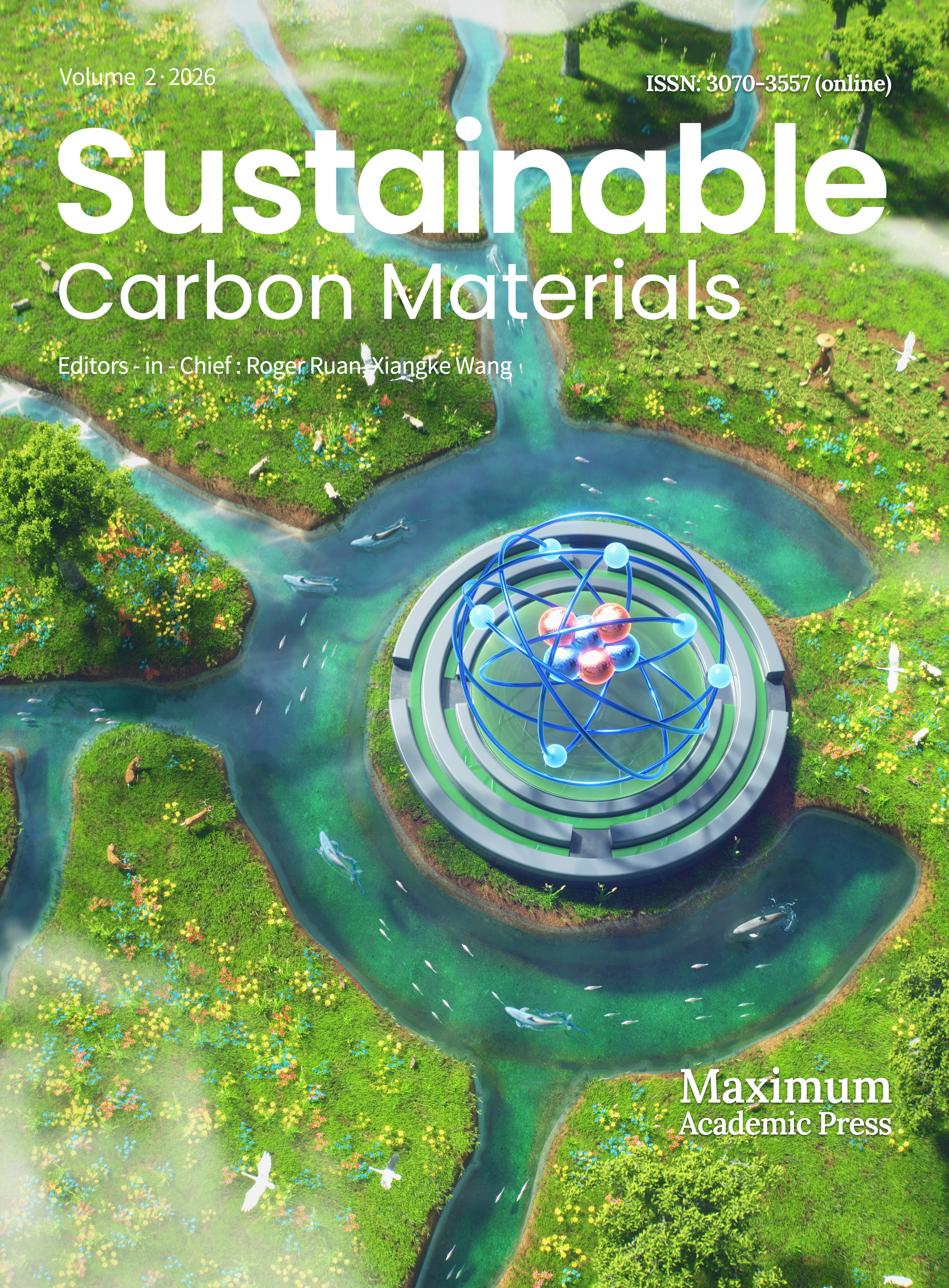
Sustainable Carbon Materials is an international multidisciplinary journal dedicated to the dissemination of recent advances in carbon materials, with a primary focus on their production, characterization, conversion, and application. The journal highlights not only novel technologies for the effective and efficient development and application of carbon materials but also advanced theories that address critical challenges related to energy, environment, ecology, economy, society, and sustainability.
We hope to foster collaborations in developing novel technologies and theoretical frameworks that advance the field of carbon materials, ultimately supporting the progress of human civilization.
HTML
-
The authors declare that they have no conflict of interest.
-
Full list of author information is available at the end of the article.
- Copyright: © 2025 by the author(s). Published by Maximum Academic Press, Fayetteville, GA. This article is an open access article distributed under Creative Commons Attribution License (CC BY 4.0), visit https://creativecommons.org/licenses/by/4.0/.
Ruan R, Wang X, Zhang Y. 2025. Empowering human progress through sustainable carbon materials. Sustainable Carbon Materials 1: e001 doi: 10.48130/scm-0025-0001


|