












-
A central goal of plant developmental biology is to understand how a single zygote gives rise to a complete organism through spatially and temporally coordinated gene expression. Despite decades of effort, several fundamental questions remain unresolved. For example, how are tissue patterning and spatial asymmetry established and maintained? How do different tissues within an organ coordinate their development through intercellular signaling? How do conserved master regulators achieve context-specific functions without causing pleiotropic defects? These questions are particularly acute in seed biology, where precise coordination among the embryo, endosperm, and maternal seed coat determines seed size, nutrient storage, and grain yield and quality[1−3]. Although single-cell and spatial transcriptomics have begun to address these questions[3−8], comprehensive atlases that span the full developmental continuum and couple spatial context with functional validation remain limited.
Jing et al. now provide a major advance through a spatiotemporal transcriptomic atlas of rice covering the entire seed-to-seed lifecycle[9] (Fig. 1). By integrating high-resolution Stereo-seq, single-nucleus RNA sequencing, and a gap-free ZH11 reference genome, they profile 851,725 nuclei and 347,640 spatial bins across 10 organs and 61 developmental stages, annotating 119 cell types and 133 subtypes. The atlas substantially expands the known cellular diversity of rice and provides a framework for investigating how spatial and transcriptional information jointly contribute to rice development. Its major conceptual advance is therefore not simply the scale of the atlas, but the ability to connect cell identity, spatial position, developmental time, and function within a single framework. While the study addresses broad questions in rice biology, its contributions to seed biology are particularly significant and warrant emphasis.
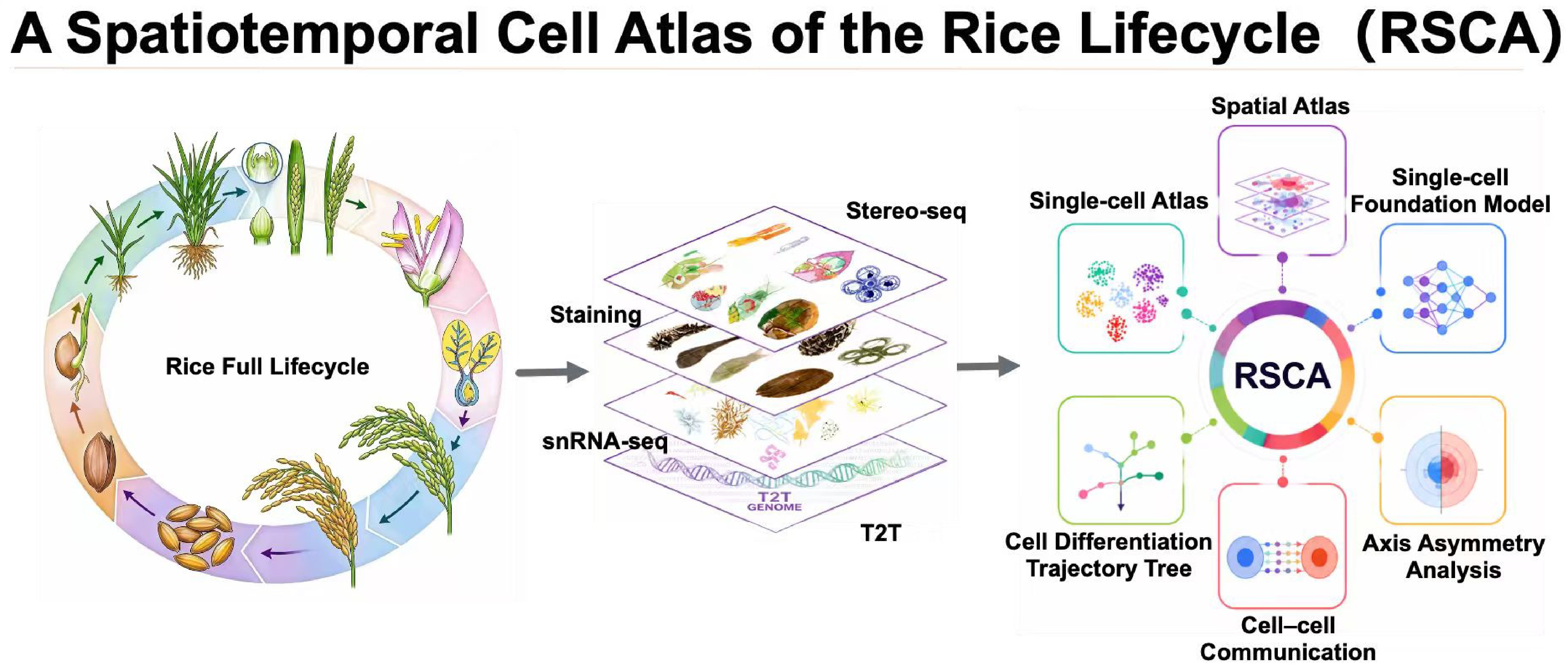
Figure 1.
Mapping a rice journey in space and time. Source: Jing et al.[9].
A key unresolved question in seed biology concerns how the endosperm, traditionally viewed as a homogeneous storage tissue, is spatially organized. Jing et al.[9] provide compelling evidence for previously unrecognized spatial complexity in seeds. Using high-resolution Stereo-seq, they identify a transient cell population termed endosperm adjacent to scutellum (EAS), which appears during 5–15 days after pollination (DAP) and disappears by 18–21 DAP. EAS is transcriptionally distinct from starchy endosperm, aleurone, and peripheral endosperm, and is enriched for sucrose metabolism and synthase activity. Genes involved in sucrose synthesis and transport, such as OsSUS4, OsGS1;2, OsSWEET14, and OsSWEET15, are highly expressed at the EAS-embryo interface, suggesting a role in nutrient supply to the developing embryo. EAS also expresses nitrogen assimilation genes, including OsGS1;2 and OsGS1;3, and the amino acid transporter OsAAP4. Mutants of OsGS1;3 and OsAAP4 show reduced grain weight, lower embryo nitrogen content, or impaired embryo development, supporting a functional role in nutrient allocation. Trajectory inference predicts that EAS converts into starchy endosperm after fulfilling its regulatory role, highlighting developmental plasticity. This discovery reframes the endosperm as a spatially heterogeneous tissue and identifies a specific microenvironment for embryo-endosperm communication.
Spatial screening reveals that axis-associated spatially asymmetric gene expression is common across rice organs, aligned with their respective developmental axes. The discovery of dorsoventral transcriptional asymmetry in the developing endosperm is very interesting. At 5–8 DAP, the peripheral endosperm subdivides into dorsal peripheral endosperm (DPE) and ventral peripheral endosperm (VPE). The authors identify 72 dorsally biased and 206 ventrally biased spatial region-specific genes. DPE is enriched for carbohydrate metabolism and glycolysis, whereas VPE is enriched for nutrient reservoir activity and protein metabolism. Functional gene sets show starch-related genes in DPE and protein storage genes in VPE, suggesting dorsoventral carbon-nitrogen partitioning. Co-expression network analysis reveals that genes involved in auxin biosynthesis, transport, and response are co-expressed with starch biosynthesis genes in the DPE. OsYUC9 and OsYUC11 are specifically expressed in DPE, whereas glutelin and prolamin genes are predominantly expressed in VPE. The osyuc11 seeds exhibit a floury endosperm with altered amyloplast morphology, and osglub6 seeds show denser starch architecture. In wild-type ZH11, starch granules are larger in DPE than VPE, and glutelin levels are higher in VPE than DPE. These differences are not statistically detected or even reversed in osyuc11 or osglub6 mutants. These findings establish that transcriptional asymmetry translates into storage reserve partitioning, with direct implications for grain quality and yield.
The study dissects the context-dependent function of OsARF1, particularly in seed nutrient allocation. OsARF1 is a pleiotropic regulator associated with six developmental sub-trajectories. Screening spatially co-expressed gene modules for ARF-binding motifs (AuxREs) identified context-specific OsARF1 candidate target modules. In the seed module, it is linked to endosperm nutrient allocation and source–sink communication. The authors show that OsARF1 directly binds to and activates the promoters of OsSWEET14 and OsGS1;2, two genes expressed in EAS. In osarf1 seeds, both genes are downregulated in EAS, and mature embryos and endosperms show altered sucrose concentrations. The osarf1 seeds have altered size, weight, and embryo development, consistent with impaired nutrient translocation across the endosperm-embryo boundary. In the root module, the Casparian strip integrity factor OsCIF2, a predicted target predominantly co-expressed with OsARF1 in inner root tissues, exhibits a marked spatial reduction in osarf1 roots. OsARF1 binds the promoter region of OsCIF2 and regulates its expression in roots. The osarf1 mutants show the reduced root length during early development. The localized reduction of OsCIF2 expression suggests that OsARF1 perturbation is associated with an inner root-associated transcriptional program involved in root growth. These findings provide a mechanistic example of how a broadly expressed auxin response factor OsARF1 can achieve seed-specific and root-specific functions through context-dependent target modules.
Another significant contribution is the mapping of embryo-endosperm-seed coat signaling. Seed development depends on coordinated signaling among the embryo, endosperm, and maternal seed coat[1]. The authors curated 97 small signaling peptides and 678 receptors, modeled binary complexes with AlphaFold3, and retained 4,922 high-confidence interactions. The analysis reveals a signaling peak at 5–15 DAP, coinciding with rapid embryo and endosperm growth and differentiation. Seed coat-endosperm communication is high during 1–3 DAP but declines sharply after 5 DAP, consistent with the seed coat being largely established early. In contrast, the embryo maintains robust signaling with surrounding tissues until 15 DAP, with the highest density of predicted ligand−receptor pairs involving subaleurone and EAS cells. They validate a DVL-family peptide and its receptor OsER2 by pull-down and split-luciferase assays, and mutants show reduced grain weight and size. This signaling map is a major resource for seed biology, providing candidate peptide-receptor pairs that may coordinate embryo-endosperm dialogue, nutrient transfer, and seed set.
In conclusion, this paper makes landmark contributions to rice biology, particularly in the field of seed biology. The authors construct a high-resolution 3D spatiotemporal cell atlas covering the complete seed-to-seed life cycle of rice, identify the transient endosperm adjacent to scutellum (EAS) domain, reveal dorsoventral endosperm asymmetry that underlies starch and protein partitioning, dissect the context-dependent function of OsARF1 in nutrient allocation, and map embryo-endosperm-seed coat signaling. These findings advance our fundamental understanding of seed development and provide a rich resource for crop improvement. Although many predictions require experimental validation, the study sets a new standard for integrating spatial transcriptomics with functional genetics and will inspire follow-up studies on seed biology, grain quality, and precision breeding.
HTML
-
The authors confirm their contributions to this study as follows: Li Y and Qian Q wrote the manuscript. Both authors reviewed the results and approved the final version of the manuscript.
-
Data sharing is not applicable to this paper as no datasets were generated or analyzed during the current study.
-
The authors declare that they have no conflict of interest.
- Copyright: © 2026 by the author(s). Published by Maximum Academic Press on behalf of Hainan Yazhou Bay Seed Laboratory. This article is an open access article distributed under Creative Commons Attribution License (CC BY 4.0), visit https://creativecommons.org/licenses/by/4.0/.
Li Y, Qian Q. 2026. From seed to seed: mapping a rice journey in space and time. Seed Biology 5: e025 doi: 10.48130/seedbio-0026-0025


|