












-
Dear Editor,
Glycyrrhiza uralensis Fisch., an economically and medicinally valuable endemic herb native to China, synthesizes abundant bioactive compounds, including glycyrrhizic acid, within its roots and rhizomes, which possess broad promising application prospects[1]. Wild populations of G. uralensis have suffered severe population shrinkage as a result of overexploitation, compounded by the species' inherent slow growth traits. Such predicaments necessitate biotechnological strategies to conserve wild germplasm and sustainable utilization[2]. Current studies mainly focus on deciphering the molecular adaptive mechanisms underlying its drought and salt tolerance, deep-rooted characteristics, and stress-induced biosynthesis of flavonoids and triterpenoids[3,4].
Agrobacterium rhizogenes-mediated hairy root transformation is a key tool for gene functional characterization and genetic improvement in G. uralensis[5]. Yet most available protocols rely on complex in vitro axenic tissue culture, which is laborious, contamination-prone, and low in transformation efficiency, lacking rapid visual validation of transformation[6]. Meanwhile, conventional vegetative propagation of G. uralensis via soil cuttings exhibits slow rooting and unstable survival rates, limiting efficient genetic transformation[7]. Compared with the reported transformation systems of other medicinal leguminous plants, the existing hairy root transformation protocols for G. uralensis generally suffer from several limitations: strict reliance on aseptic manipulation, lack of visual screening markers, and incompatibility with gene-editing tools.
To overcome these bottlenecks, this study first established a semi-wet cutting propagation system for G. uralensis. Distinct from traditional propagation and hairy root transformation strategies, the present system eliminates the rigid requirement for axenic culture. This protocol eliminates soil substrates and rigorous sterile manipulations, featuring simple manipulation and rapid rooting. This experiment was set up with three biological replicates consisting of 105 G. uralensis stem cuttings in total. Following a 15-d culture period using the semi-wet cutting method developed herein, adventitious roots were induced in 84 cuttings, yielding a rooting rate of 80% (Fig. 1b). On this basis, stem cuttings were further adopted as explants.
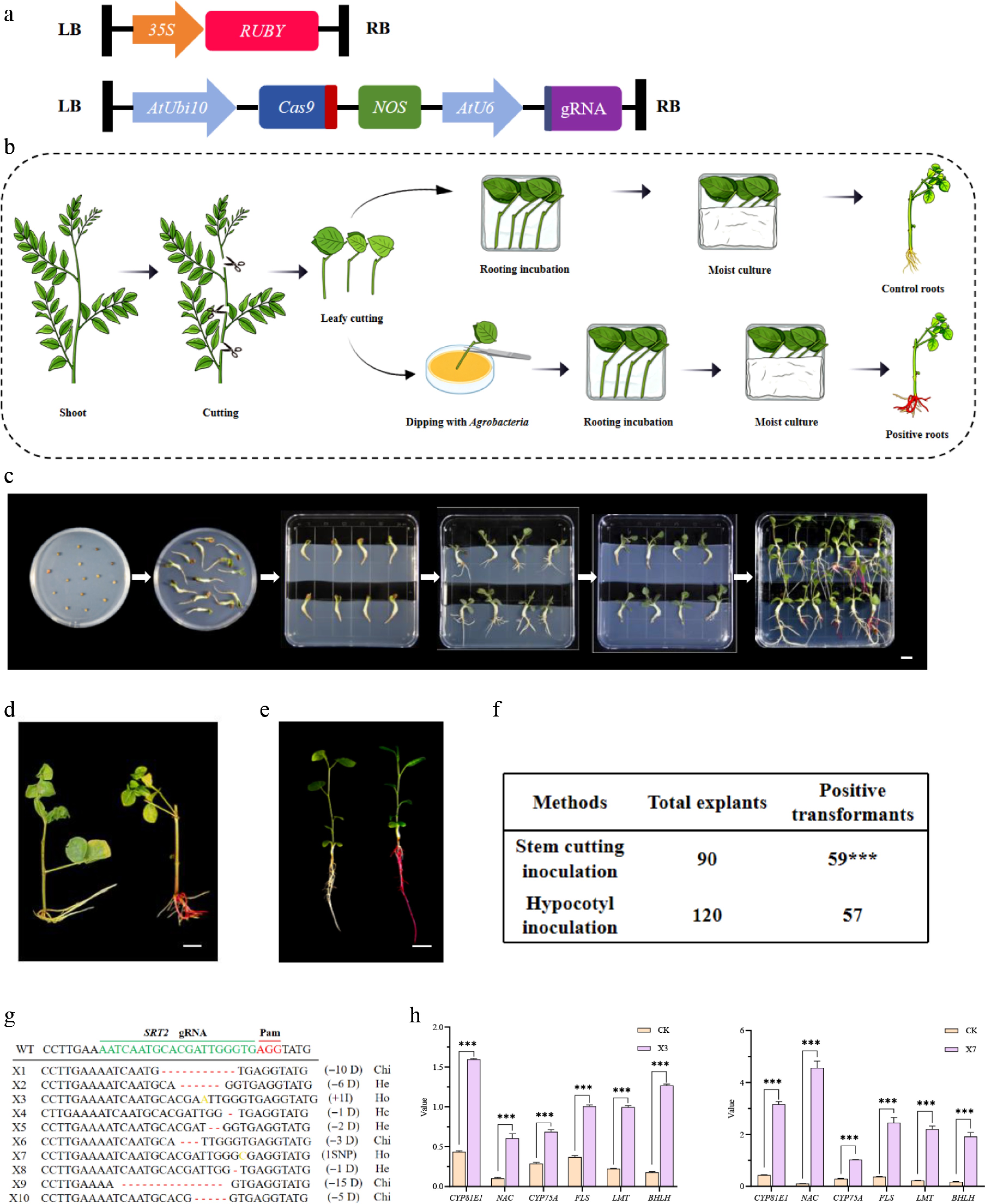
Figure 1.
Transformation and gene editing of G. uralensis mediated by A. rhizogenes. (a) Schematic of T-DNA regions for RUBY (top) and CRISPR/Cas9 (bottom) editing vectors. RUBY expression was driven by the Cauliflower mosaic virus (CaMV) 35S promoter. LB, left border; RB, right border; AtUbi10, Arabidopsis thaliana Ubiquitin 10 promoter; NOS, nopaline synthase terminator; AtU6, A. thaliana U6 spliceosomal RNA promoter. (b) Schematic of parallel cutting regeneration (upper branch) and transformation (lower branch). Leafy cuttings (5–8 cm long, 2–2.5 mm diameter) were harvested from the first to the third internodes with one to two leaves or buds retained. Control explants underwent rooting incubation and moist culture to produce control roots. For transformed cuttings, basal ends were inoculated with A. rhizogenes before identical culture procedures. RUBY-positive hairy roots with red fluorescence were visible at 14 d post-culture. (c) Hairy root transformation workflow of hypocotyls mediated by A. rhizogenes. (d) Comparison of untransformed and transgenic hairy roots in stem cuttings. Left: non-inoculated control with normal white roots; Right: stem cutting inoculated with A. rhizogenes, producing RUBY-positive red hairy roots. Scale bar = 1 cm. (e) Comparison of root phenotypes in hypocotyls. Left: non-inoculated control with normal white roots; Right: hypocotyl infected with A. rhizogenes produces RUBY-positive red hairy roots. Scale bar = 1 cm. (f) Transformation efficiency comparison of stem cutting and hypocotyl dip inoculation. *** Denotes significant difference at p < 0.001. (g) DNA sequencing results of a representative SRT2 gene editing in roots by CRISPR/Cas9. The sgRNA-target sequence is shown in green, the protospacer-adjacent motif is shown in red, and the mutations are shown as dashes (deletion) or orange letters (transition). 1–10: independent transgenic hairy roots with SRT2 gene editing. Ho: homozygous mutation; He: heterozygous mutation; Chi: weak chimerism. (h) qRT-PCR analysis of flavonoid biosynthesis-related gene expression in homozygous SRT2-edited hairy roots (lines X3 and X7). CK: non-edited wild-type hairy roots. Data are shown as mean ± SD. *** p < 0.001.
A. rhizogenes was used to infect wound surfaces under non-aseptic conditions to induce hairy roots expressing the RUBY reporter gene. Accordingly, a simple and efficient hairy root transformation system for G. uralensis was established to achieve direct genetic transformation (Fig. 1b), facilitating future biotechnological research on this medicinal species.
This study used an expression vector carrying the 35S:RUBY visual reporter gene (Fig. 1a). A. rhizogenes strain Ar.1193, which has been validated for genetic transformation in multiple plant species, was used for infection. Stem cuttings (5–8 cm in length) were excised from the first to the third internodes (2–2.5 mm in diameter), retaining one to two leaves and axillary buds. The apical end was cut horizontally, whereas a 45° oblique cut was made at the basal wound surface. Inoculation was performed via wound-dipping. Post-inoculation cuttings were placed in Petri dishes lined with moist filter paper, with their basal ends covered to maintain humidity. The cuttings were cultured at 26 °C under a 16-h light/8-h dark photoperiod (Fig. 1b). Red putative transgenic hairy roots emerged at 14 d post-culture and grew vigorously by 20 d, which were morphologically distinct from the white adventitious roots produced in uninoculated control groups. Normally growing red roots were regarded as putative transgenic hairy roots (Fig. 1d).
A total of 90 G. uralensis stem cuttings were subjected to wound-dip inoculation with A. rhizogenes. After cultivation, red transgenic hairy roots successfully differentiated at the basal ends of 59 cuttings (Fig. 1f). Thirty independent red hairy root lines were randomly selected for PCR detection. The rolB gene fragment was amplified in all tested samples, confirming successful co-transformation with the 35S:RUBY construct. Meanwhile, no virG amplicons were detected in any root sample, ruling out residual A. rhizogenes contamination.
This result verified that A. rhizogenes can effectively induce hairy roots from stem cuttings of G. uralensis, with an overall transformation efficiency of 65%. Rooted cuttings were acclimatized in a nutrient solution for 1 week prior to transplanting into pots for subsequent functional trials.
Meanwhile, this study integrated the A. rhizogenes-mediated hairy root transformation system of Medicago sativa[8] with the 35S:RUBY vector. Hypocotyls of G. uralensis served as explants for transformation following alfalfa infection procedures (Fig. 1c). Meanwhile, to evaluate the transformation efficiency of hypocotyl dip inoculation, we quantified the number of explants producing red transgenic hairy roots. Among the 120 hypocotyl explants subjected to agrobacterial dip inoculation, red hairy roots successfully emerged at the basal region of 57 explants. These results demonstrate that this system can stably induce hairy root formation in G. uralensis and is applicable to genetic transformation studies of G. uralensis. (Fig. 1f). To further validate the capacity of this system for targeted genome editing, we deployed CRISPR/Cas9 to disrupt the SRT2 gene (Fig. 1a). This gene encodes a histone deacetylase (HDAC), which negatively regulates licochalcone A and total flavonoid accumulation, and represses flavonoid biosynthesis by inhibiting downstream structural gene expression[9]. High-throughput sequencing of individual transgenic hairy roots revealed 1–15 bp indel mutations at the SRT2 target site, along with single-base insertions and single-nucleotide polymorphism (SNP) variants. Mutations were precisely localized to the gRNA-targeted sequence and adjacent PAM (Protospacer Adjacent Motif) region (Fig. 1g). A total of 10 independent transgenic hairy root lines were sequenced in this study. Among them, two lines harbored homozygous mutations at the SRT2 target site, while the remaining eight lines exhibited chimeric mutations. The chimeric lines were further divided into two subgroups: four lines possessed high editing efficiencies ranging from 48.47% to 52.54%, and the other four lines showed weak chimerism with relatively low editing efficiencies of 15.92%–33.11%. Such outcomes validate the robust and specific targeted editing activity achievable via this platform. To evaluate the editing specificity of this CRISPR/Cas9 tool, we further predicted the potential off-target sites across the G. uralensis genome based on sequence homology. Sanger sequencing of high-risk off-target loci revealed no mismatched mutations in all tested hairy root lines, confirming the high targeting fidelity of the editing system. Collectively, our CRISPR/Cas9 system achieves robust genome editing in G. uralensis.
Subsequently, qRT-PCR was performed to quantify transcript abundances of six core SRT2-regulated downstream genes (CYP8, NAC, CYP7, FLS, LMT, bHLH), following standardized protocols reported in prior literature. Compared with wild-type hairy roots, homozygous SRT2-edited positive hairy roots exhibited significant upregulation of these downstream genes, consistent with the negative regulatory role of SRT2 (Fig. 1h). These findings confirm that A. rhizogenes-mediated SRT2 editing effectively relieves transcriptional repression of downstream flavonoid biosynthetic pathways. The biological effects of gene editing were validated at the transcriptional level, providing a robust tool for gene functional dissection and metabolic regulation research in G. uralensis.
In summary, this study established a simple and efficient semi-wet cutting technique for G. uralensis, based on which a non-sterile, high-efficiency hairy root transformation system was developed. Moreover, the hairy root transformation system of M. sativa was adapted for G. uralensis, enabling efficient CRISPR/Cas9-mediated gene editing. Target-site mutation detection and qRT-PCR validation of six key downstream genes of SRT2 confirmed editing efficacy at molecular and transcriptional levels, highlighting the great application potential of this system in G. uralensis research. Although the heritable stability of transgenes in progeny plants remains to be characterized, this technique supports functional genomic studies in G. uralensis. It suits pathway dissection, regulatory exploration, and quality improvement of bioactive compounds (glycyrrhizic acid, flavonoids).
HTML
-
The authors confirm their contributions to the paper as follows: performed the experiments and drafted the manuscript: Li X, Sun Y; analyzed the data: Zhao W, Liu S; provided resources and revised the manuscript: Li Y; designed the study, supervised the research, and finalized the manuscript: Chai M. All authors reviewed the results and approved the final version of the manuscript.
-
The methods that support the findings of this study are available in the Supplementary data of this article.
-
This work was supported by the Key Research and Development Program of Inner Mongolia Autonomous Region (2023YFHH0037), entitled 'Mechanism analysis of hard-seededness and germplasm innovation of Astragalus mongholicus and G. uralensis'. The RUBY vector used in this study was kindly provided by the research group of Professor Fu C, Qingdao Institute of Bioenergy and Bioprocess Technology, Chinese Academy of Sciences. We express our sincere gratitude for their generous gift.
-
The authors declare that there is no conflict of interest regarding the publication of this paper. Wei Zhao and Siyang Liu are affiliated with the M·Grass Ecological Environment (Group) Co., Ltd., and Inner Mongolia M·Grass Industry Technology Co., Ltd., Hohhot. The company provided experimental materials/facilities/data collection. All authors declare that the research was conducted in the absence of any commercial or financial relationships that could be construed as a potential conflict of interest.
-
accompanies this paper online at: https://doi.org/10.48130/tihort-0026-0010.
- Supplementary data Experimental methods and gene sequence information of Glycyrrhiza uralensis.
- Supplementary data
- Copyright: © 2026 by the author(s). Published by Maximum Academic Press, Fayetteville, GA. This article is an open access article distributed under Creative Commons Attribution License (CC BY 4.0), visit https://creativecommons.org/licenses/by/4.0/.
Li X, Sun Y, Zhao W, Liu S, Li Y, et al. 2026. A simplified and efficient protocol for hairy root transformation of Glycyrrhiza uralensis. Technology in Horticulture 6: e017 doi: 10.48130/tihort-0026-0010


|