











-
Strawberry (Fragaria × ananassa Duch.) is a very widely cultivated and economically important horticultural crops[1], belonging to the family Rosaceae[2]. The demand for high-quality strawberries continues to rise[3] because of increasing consumer demand[4] and their high nutritional value and functional attributes[5]. Traditionally, strawberry transplants are propagated through runners; however, this approach is labor-intensive, time-consuming and susceptible to the spread of pathogens[6].
Recently, seed-propagated F1 hybrid cultivars have been proposed as an alternative to conventional propagation methods[6,7]. Seed propagation offers several advantages, including large-scale production, flexibility in planting schedules, and reduced production costs[8]. Despite these benefits, practical challenges remain, particularly in seed production, germination, and seedling establishment[9]. A major constraint is the low and inconsistent germination rate of strawberry seeds[7,10], partly due to their hard and impermeable endocarp[7,11]. The emergence of seedlings within the same batch may vary widely, from 90 to 140 days[12]. Delayed and non-uniform germination represents a significant challenge in strawberries, where uniform seedling growth is essential, and low germination rates further limit improvement through hybridization[12,13].
The germination process is typically divided into three phases: Phase I involves rapid water imbibition, Phase II involves the reactivation of metabolic activities, and Phase III is marked by the emergence of the radicle[14,15]. Improving the uniformity and rate of strawberry seed germination is therefore essential for efficient seedling production, especially in controlled cultivation systems[16]. Various treatments, such as cold stratification, light exposure, scarification, acid treatment, and presoaking, have been used to enhance germination[16,17].
However, most involve labor-intensive or chemically harsh methods that may not be feasible or environmentally sustainable under commercial conditions. Hence, there is a need for more biologically based and eco-friendly solutions. In recent years, biostimulants have been reported to improve seed germination, promote early seedling growth, enhance plants' physiological performance and ensure uniform seedling development[18]. A plant biostimulant is any substance or microorganism in a form which is supplied to the user and applied to plants, seeds, or the root environment with the intention to stimulate the natural processes of plants, thus benefiting nutrient use efficiency (NUE) and/or tolerance to abiotic stress, regardless of its nutrient content, or any combination of such substances and/or microorganisms intended for this use[19,20].
The application of plant biostimulants into seeds can improve germination and seedling growth[21,22]. Kelpak® is a commercially available seaweed-based biostimulant derived from Ecklonia maxima and it has been reported to enhance seed germination and early seedling growth in okra (Abelmoschus esculentus)[23]. Furthermore, microalgal extracts derived from Acutodesmus dimorphus have been reported to enhance the germination rate and promote early seedling growth in tomato (Solanum lycopersicum)[24]. In addition, fermented brown alfalfa (Medicago sativa) juice has been reported to enhance seed germination and seedling growth in French marigold (Tagetes patula)[25].
Among various types of plant biostimulants, fatty acid-based biostimulants remain largely underexplored. Fatty acids can penetrate the phospholipid bilayer, altering its fluidity and permeability, leading to beneficial structural and functional changes[26]. In addition, they can undergo oxidation and serve as precursors for phytohormones such as jasmonic acid, which plays an important role in plants' defense mechanisms[27]. Given these functions, fatty acid-based biostimulants may enhance the germination of strawberry seeds and early seedling vigor by promoting metabolic activation and maintaining membrane integrity. However, their effects on strawberry seeds and seedlings have not yet been investigated. Therefore, this study aims to evaluate the influence of a fatty acid-based biostimulant on seed germination and seedling quality in strawberry in a plant factory with artificial lighting (PFAL) conditions, and to determine the optimal presoaking concentration. The findings provide new insights into the potential use of fatty acid-based biostimulants as an environmentally sustainable strategy to improve seed-propagated strawberry production in controlled environment-based agriculture.
-
A fatty acid-based biostimulant (LEAFENERGY®) was obtained from Ibiden Co.LTD., Japan. This is a commercial product made from a rare fatty acid [13-oxo-9(Z),11(E)-octadecadienoic acid; 13-oxo-ODA] derived from vegetable oil[28,29]. LEAFENERGY® contains 13-oxo-ODA at the concentration of 7 μL L–1 of the product as the active substance[29]. Preliminary trials were conducted using four concentrations of the biostimulant for presoaking the seeds: 0%, 0.5%, 1%, and 2% (v/v). The results indicated improved performance at 0.5% and 1%, while 2% showed reduced effectiveness, suggesting a potential inhibitory effect at higher concentrations.
On the basis of these findings, intermediate concentrations of 0.25% and 0.75% were included in the main experiment to refine the optimal range. Concentrations between 1% and 2% were excluded because they had limited potential, and 2% was retained as a high-dose reference. The main experiment focused on refining the most effective range by including six concentrations (0%, 0.25%, 0.5%, 0.75%, 1%, and 2%) by diluting the biostimulant in distilled water and used for soaking the seeds. Seeds were soaked in different concentrations of the biostimulant for 24 h.
Seed germination test
-
Strawberry (Fragaria × ananassa Duch. cv. '162') seeds were used in this study for the seed germination test. This cultivar is a seed-propagated F1 strawberry developed at the Institute for Horticultural Plant Breeding, obtained from multiple cross combinations using the Japanese cultivars 'Yayoihime' and 'Kaorino', together with several self-progeny lines as the maternal and paternal parents. It represents one of the selected F1 hybrids from these combinations and is characterized using a male-sterile maternal line, which enables efficient seed production through insect-mediated pollination (e.g., honeybees). The initial germination percentage prior to treatment was approximately 80%. The seeds were surface-sterilized using a sodium hypochlorite solution and subsequently rinsed thoroughly with sterile distilled water prior to the germination tests. Seed germination tests were conducted after presoaking with the different concentrations of the biostimulant. In each treatment, 150 seeds were soaked in 30 mL of the respective biostimulant solution. The experiment was conducted using a completely randomized design (CRD) with six treatments with three replicates per treatment. Each replicate consisted of a petri dish containing 50 strawberry seeds placed on top of the two layers of filter papers (No. 2; Advantec Toyo, Ltd., Tokyo, Japan). Next, 5 mL of distilled water was added to each petri dish to maintain moisture. The petri dishes were then sealed with a layer of parafilm® (Bemis Company, Inc., Neenah, WI, USA) to prevent moisture loss and to maintain a higher humidity level inside the petri dishes. Under these sealed conditions, a near-saturated humidity (~100%) was maintained inside the petri dishes. Strawberry seeds are commonly germinated under controlled environmental conditions, including regulated humidity, temperature, and growing media, and artificial lighting has recently been used to improve seedling quality[30]. The current seed germination test was conducted in an environmentally controlled room within a PFAL system. Continuous illumination was provided at an average photon flux density (PPFD) of approximately 60 µmol·m−2·s−1 using white light-emitting diode (LED) lights (Philips GreenPower LED), and the temperature was maintained at 25 ± 1 °C throughout the experiment. Distilled water was sprayed on the petri dishes without allowing them to dry. Seed germination was monitored and recorded daily for 21 days. Seeds with a radicle protruding over 1 mm in length were considered to have germinated[6].
Seed germination parameters
-
Six germination parameters were assessed, including the final germination percentage (FGP), mean germination time (MGT), germination index (GI), the coefficient of velocity of germination (CVG), germination rate index (GRI), and the time spread of germination (TSG). These parameters were calculated according to the method outlined by Kader[31].
$ \mathrm{FGP\;=\;Final\;number\;of\;seeds\;germinated\;in\;a\;seed\;lot}\;\times 100; $ $ \mathrm{MGT}=\Sigma _{ {f.x} } {/\Sigma }_{ {f} } $ $ \mathrm{CVG}= {N} _{ \mathrm{1}} + {N} _{ {2}} +\cdots+ {N} _{ {x} } /100\times {N} _{ {1}} {T} _{ {1}} +\cdots+ {N} _{ {x} } {T} _{ {x} } $ $ \mathrm{GRI}= {G} 1/1+ {G} 2/2+\cdots+ {G} _{ {x/x} } $ $ \mathrm{GI}=(10\times {n} 1)+(9\times {n} 2)+\cdots+(1\times {n} {10)} $ $ \begin{split}{\mathrm{TSG}}={\mathrm{The\;time\;in\;days\;between\;the\;first\;and\;last\;germination\;events\;}}\\ {\mathrm{occurring\;in\;a\;seed\;lot}}.\end{split} $ In these equations, f represents seeds germinated on Day x; N is the number of seeds germinated each day; T is the number of days from seeding corresponding to N; G1 is the germination percentage on the first day after sowing; G2 is the germination percentage on the second day after sowing; n1, n2 ··· n10 represent the number of germinated seeds on the first, second and subsequent days until the 10th day; and 10, 9 ··· and 1 are the weights given to the number of germinated seeds on the first, second, and subsequent days, respectively.
Early seedling growth
-
Germinated seedlings were transplanted into 72-cell polyethylene trays containing a commercial seedling substrate immediately upon germination and subsequently used for assessments of seedling growth. The seedlings were grown under PFAL conditions, and it was equipped with white LED lights (Philips research module) providing a PPFD of 250 µmol m−2 s−1 with a 12-h photoperiod per day. The air temperature, relative humidity, and CO2 concentration were set to 25 ± 1 °C (light/dark periods), 50%–60%, and 800 μmol·mol–1, respectively. The seedlings were irrigated using a sprayer until their true leaves emerged. Later, they were irrigated hydroponically twice a day for 15 min each with a nutrient solution (Otsuka hydroponic composition, Otsuka Chemical Co. Ltd., Osaka, Japan), the nutrient contents of which were N, 21%; P2O5, 8%; K2O, 27%; MgO, 4%; CaO, 23%; Fe, 0.18%; Cu, 0.002%; Zn, 0.006%; Mo, 0.002%; MnO, 0.1%; and B2O3, 0.1%[32], with an electrical conductivity (EC) of 0.7 dS m–2. The nutrient solution was changed weekly. Seedlings were grown for around 40 days after seed sowing.
Seedling measurements
-
After 40 days, seedling height, collar diameter and root length were measured using a ruler and digital caliper. Shoot fresh weight and root fresh weight were determined. Shoots and roots were then oven-dried for 72 h at 80 °C, and the dry weight was determined. Seedlings were carefully removed from the trays, and the roots were gently washed with water to remove any adhering substrate. The cleaned roots were then blotted dry with paper towels and used for the measurement of root parameters. Soil–Plant Analysis Development (SPAD) values were measured on the three largest fully expanded leaves per seedling using a chlorophyll meter (SPAD-502plus, Konica Minolta, Tokyo, Japan). For each treatment, six seedlings per replicate were evaluated, with three replicates, resulting in a total of eighteen seedlings per treatment.
Statistical analysis
-
Statistical analyses were performed using SPSS statistical software (IBM SPSS Statistics, Version 23.0). The data were subjected to one-way analysis of variance (ANOVA), and differences among means were evaluated using Duncan's multiple range test (DMRT) at a significance level of p < 0.05.
-
The FGP of strawberry seeds was significantly influenced by the concentration of fatty acid-based biostimulant (Fig. 1). The untreated control showed a FGP of approximately 80%, whereas seeds treated with low to moderate concentrations (0.25%–1%) of the biostimulant exhibited a marked improvement, with FGP exceeding 90%. The highest concentration tested (2%) did not significantly differ from the control (0%) in terms of germination; however, it resulted in lower germination compared with the lower biostimulant concentrations. These results indicate that low to moderate concentrations enhanced seed germination, whereas increasing the concentration to 2% did not provide additional benefits.
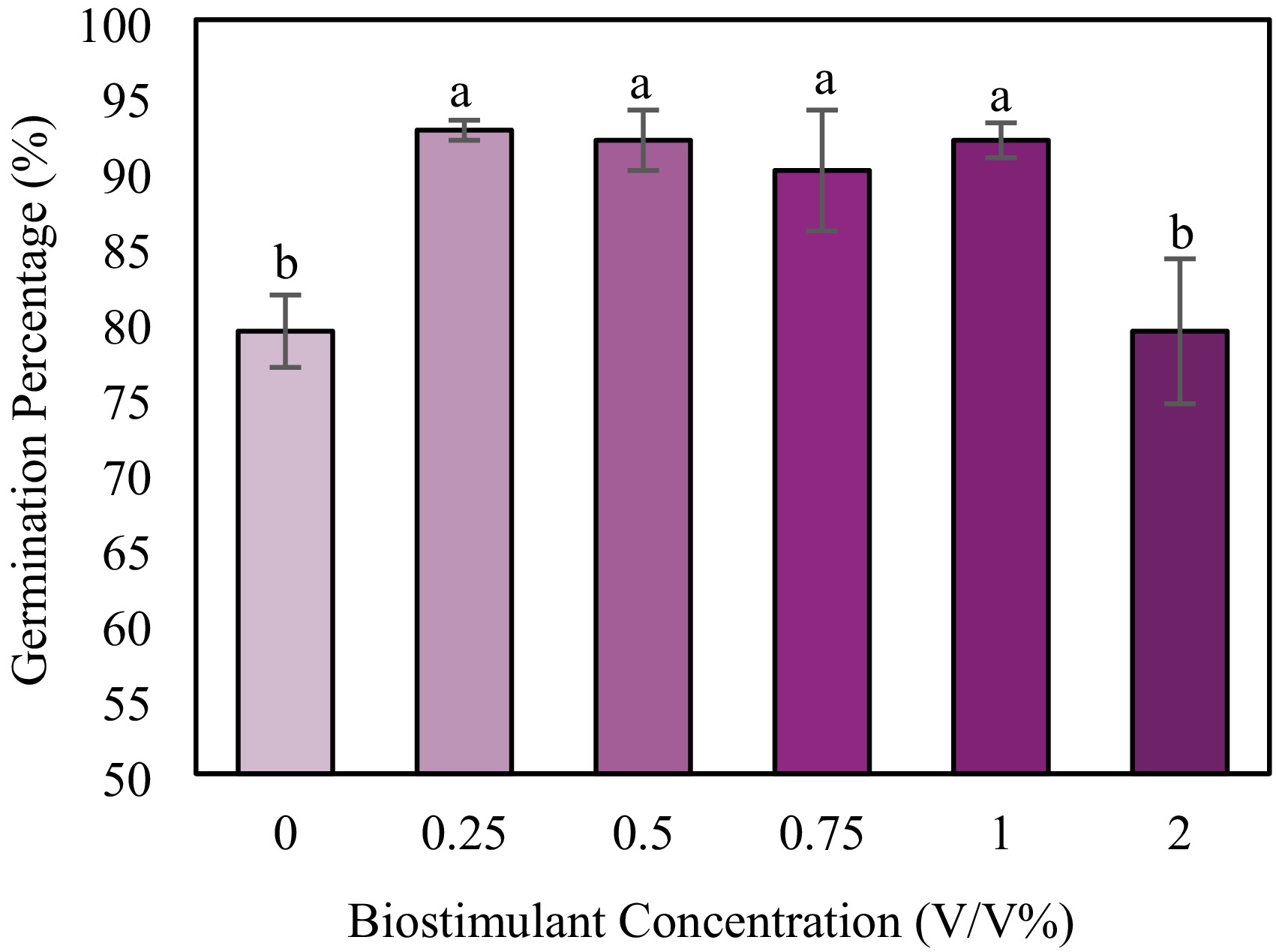
Figure 1.
Final germination percentage (%) of strawberry seeds presoaked with different biostimulant concentrations after 21 days. Data are shown as the means ± standard error (SE) (n = 3). Different letters show significant differences among treatments based on DMRT (p < 0.05).
Other germination parameters
-
Key germination parameters, including GI, GRI, MGT, CVG, and TSG, were calculated. GI showed a significant difference among treatments. Seeds soaked with a 1% (v/v) concentration of the biostimulant exhibited the highest GI (629.00 ± 23.64), whereas the lowest GI (510.67 ± 67.58) was observed in seeds treated with the 2% concentration (Fig. 2a). The GRI also showed a significant difference among treatments, following a similar trend to the GI (Fig. 2b). The highest GRI was observed in seeds soaked with 1% (v/v) biostimulant, indicating more rapid germination, whereas the lowest GRI was recorded at the 2% concentration.
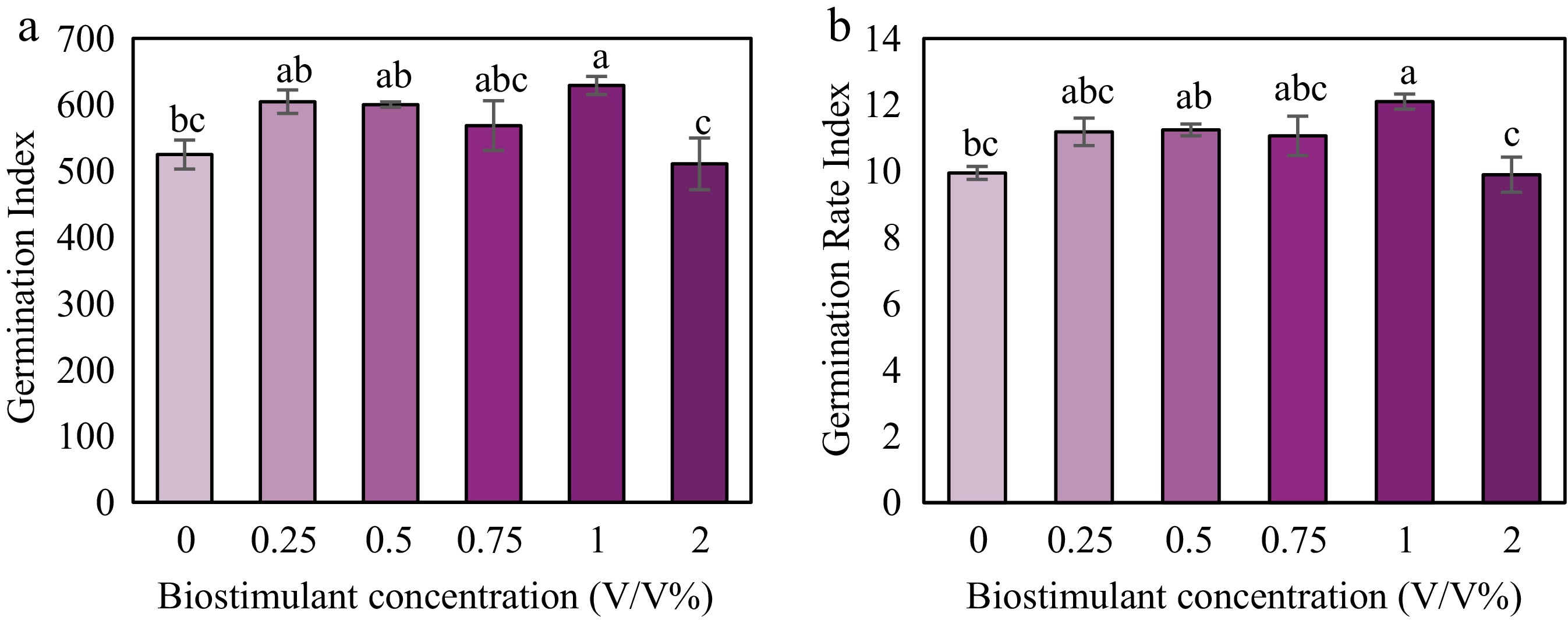
Figure 2.
Germination index (a) and germination rate index (b) of strawberry seeds presoaked with different biostimulant concentrations after 21 days. Data are shown as the means ± SE (n = 3). Different letters show significant difference among treatments based on DMRT (p < 0.05).
The CVG was expressed as a percentage (0%–100%) by multiplying the original values by 100. However, the CVG values did not show any significant differences among seeds treated with different concentrations of biostimulants and the control group. Similarly, MGT and TSG did not differ significantly among treatments (Table 1).
Table 1. MGT, CVG and TSG of germination of strawberry seeds soaked with different concentrations of biostimulant under controlled conditions.
Treatment MGT (days) CVG TSG (days) 0% 9.08 ± 0.32a 11.04 ± 0.41a 11.00 ± 1.53a 0.25% 9.35 ± 0.33a 10.72 ± 0.37a 11.33 ± 0.67a 0.5% 9.34 ± 0.23a 10.72 ± 0.26a 12.00 ± 0.57a 0.75% 9.4 ± 0.30a 10.66 ± 0.33a 12.67 ± 0.88a 1% 8.59 ± 0.2a 11.66 ± 0.35a 11.67 ± 1.33a 2% 9.14 ± 0.29a 10.96 ± 0.34a 12.33 ± 1.67a p-value 0.098 0.098 0.384 Note: Mean germination time (MGT); coefficient of velocity of germination (CVG); time spread of germination (TSG). Data are shown as the means ± SE (n = 3). Different letters in the same column indicate significant differences based on DMRT (p < 0.05). Seedling growth
-
Seedling growth was evaluated in seedlings derived from seeds presoaked with different concentrations of a fatty acid-based biostimulant. Presoaking seeds with the biostimulant significantly enhanced shoot growth compared with the control. However, the highest concentration (2%) of the biostimulant used for presoaking resulted in reduced seedling height (Fig. 3). The collar diameter and leaf area of the seedlings exhibited a similar pattern, showing significant variation among the different treatments. A significant collar diameter was exhibited in the seedlings from the seeds soaked with 1% of biostimulant compared with other treatments. Root length, leaf area, and SPAD chlorophyll contents did not exhibit significant differences among the treatments (Fig. 4).
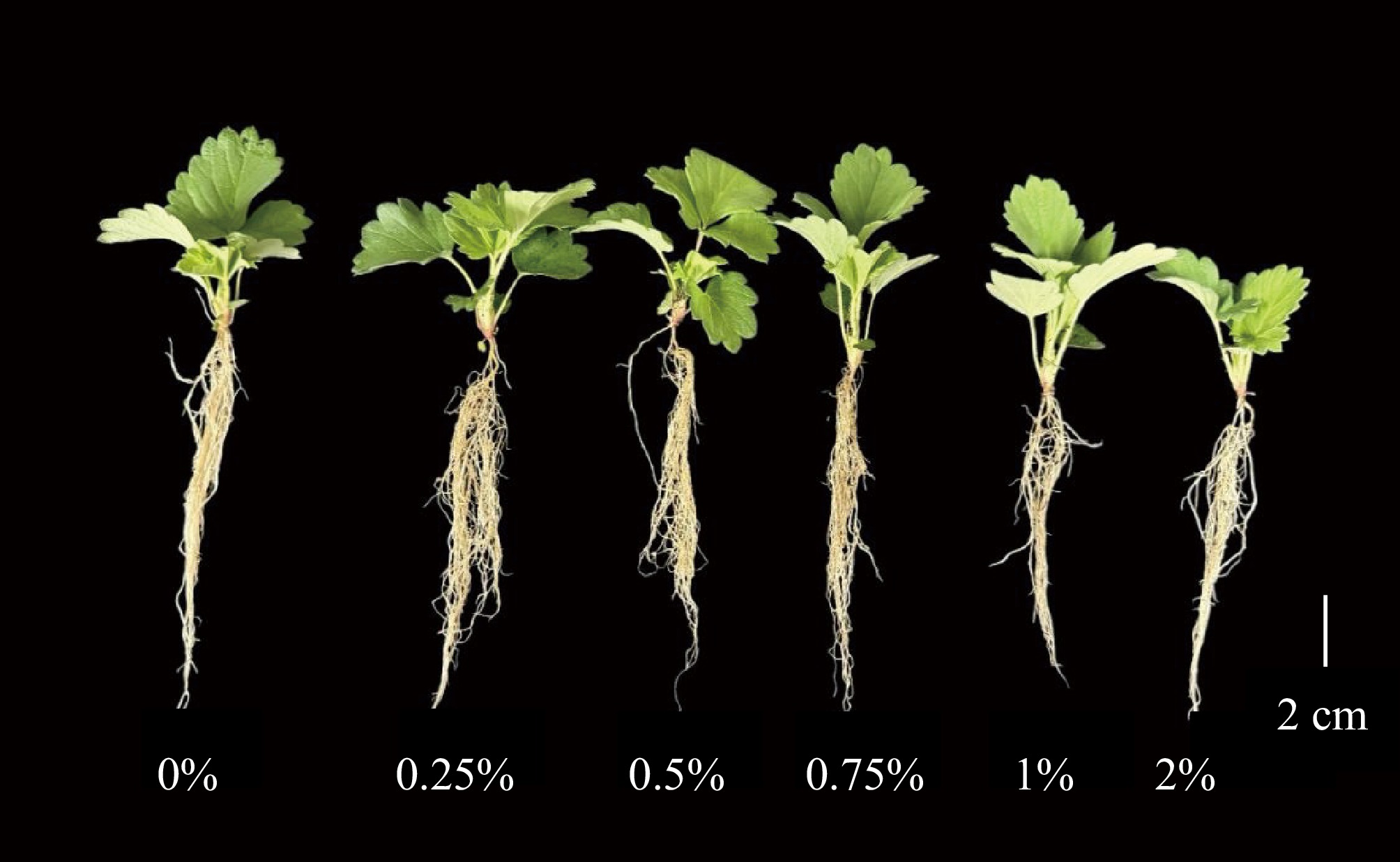
Figure 3.
Early seedling growth of the seeds presoaked with different concentrations of a fatty acid-based biostimulant 40 days after sowing.
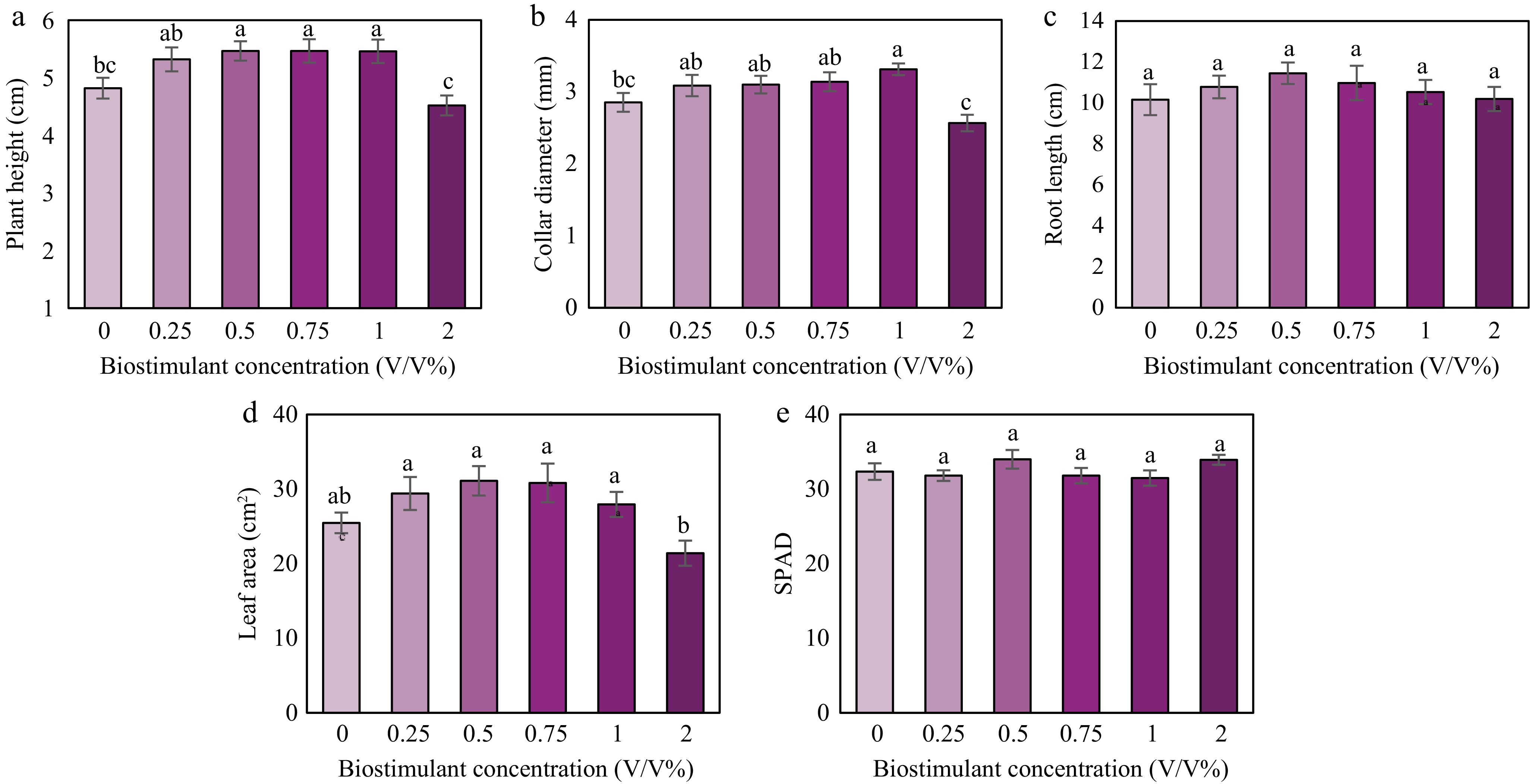
Figure 4.
(a) Seedling height, (b) collar diameter, (c) root length, (d) leaf area, and (e) SPAD at 40 days after sowing. Data are shown as the mean ± SE; n = 18. Different letters show significant differences among treatments based on DMRT (p < 0.05).
Biomass parameters
-
Biostimulant priming significantly improved the fresh and dry weight of shoots, except for the 0% and 2% biostimulant concentration, which showed lower shoot fresh and dry weight compared with the other treatments. However, no significant differences were observed in the root fresh weight and dry weight across all treatments. Despite the varying concentrations of the biostimulant, root growth parameters remained consistent with the control treatment (Fig. 5).
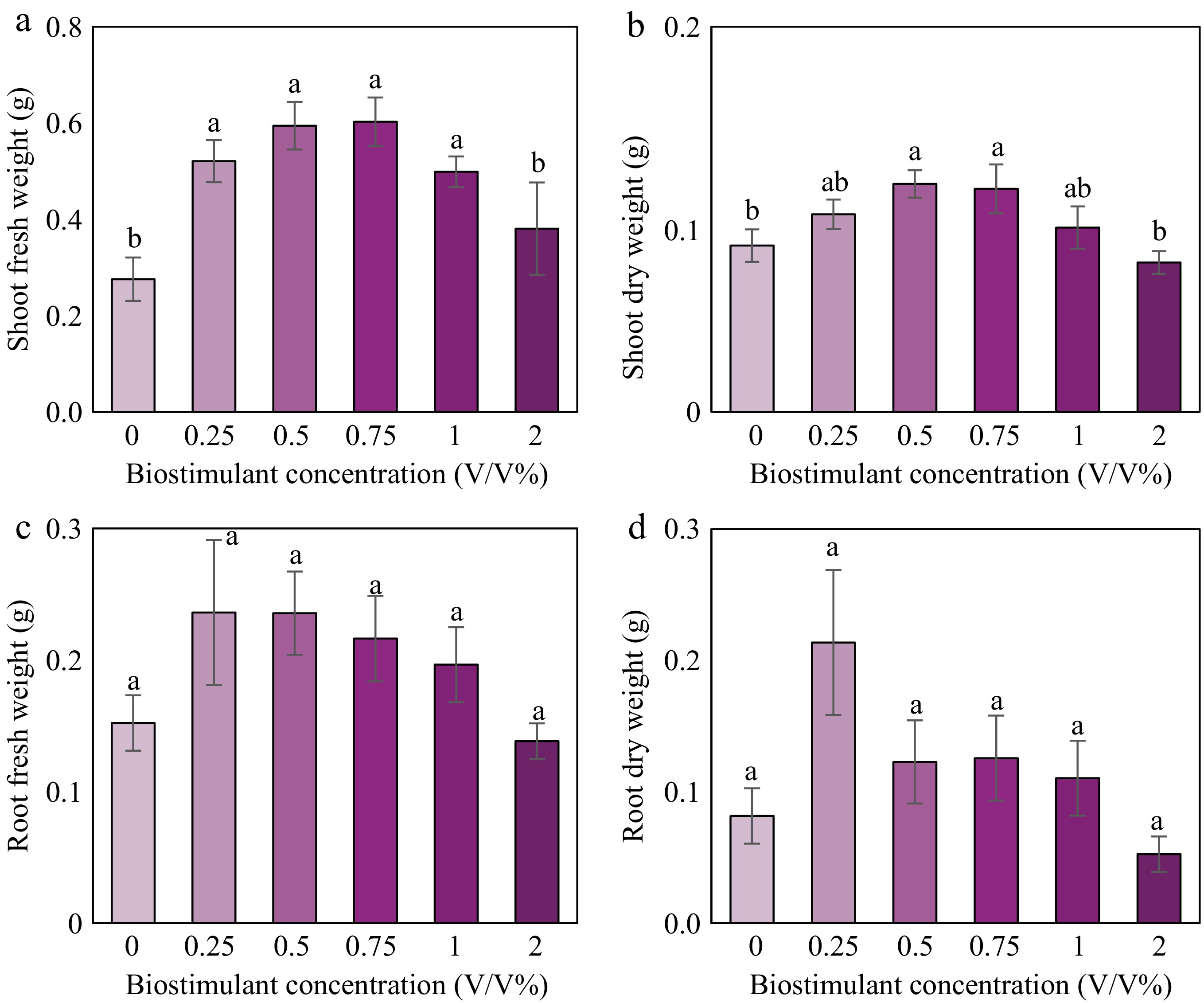
Figure 5.
(a) Shoot fresh weight, (b) shoot dry weight, (c) root fresh weight, and (d) and root dry weight of the seedlings at 40 days after sowing. Data are shown as the mean ± SE; n = 18. Different letters show significant differences among treatments based on DMRT (p < 0.05).
-
This study was conducted to evaluate the impact of fatty acid-based biostimulant presoaking on the germination of strawberry seed and early seedling development under controlled conditions. According to the results, presoaking seeds with a fatty acid-based biostimulant had a positive effect on the seed germination rate, GI, and GRI at low to moderate concentrations, although excessive levels may have inhibitory effects. Presoaking seeds has been shown to enhance the germination rate, improve the uniformity of germination, and increase the overall germination percentage[17]. Presoaking can greatly enhance nutrient uptake and rapidly trigger pregerminative metabolism. This early activation stimulates key metabolic pathways, including cellular respiration, antioxidant defense systems, and DNA repair mechanisms[21]. In this study, presoaking with distilled water was used as the control treatment and it indicated that the improvements in seed germination and seedling vigor under biostimulant treatments represent an additional effect beyond the baseline physiological activation induced by soaking in water.
However, pretreated seeds did not show significant differences in MGT, CVG, and TSG among treatments. These results indicate that even though the presoaking with biostimulant accelerated germination performance and vigor, it did not substantially alter the overall timing of germination under the experimental conditions. This observation may be caused by the involvement of fatty acids in regulating membrane stabilization, lipid remodeling, oxidative signaling, and early seedling growth, which are more closely linked to seedling establishment than to the direct control of radicle emergence[33].
Additionally, presoaking seeds with moderate concentrations of the biostimulant significantly increased plant height, collar diameter and leaf area, whereas higher concentrations showed inhibitory effects. However, seedling biomass accumulation was not significantly affected by the treatments. These results indicate that application of the biostimulant enhanced shoot morphological traits by stimulating shoot elongation and leaf expansion without significantly affecting overall biomass accumulation. This may be induced by the bioactive compounds contained in the biostimulant. Biostimulants can influence plants' hormonal activity, promoting cell division and cell expansion, thereby supporting more efficient and coordinated plant growth[34]. Furthermore, these seed treatments did not show significant differences in root parameters. This might be caused by multiple other factors that contribute to variations in root morphology under biostimulant treatments[35].
This study showed a dose-dependent response to the biostimulant, where beneficial effects at optimal levels shift to inhibitory effects at higher concentrations, leading to suppressed early seedling growth[36]. Similarly, the application of humic acid at moderate concentrations as a biostimulant significantly improved seed germination and seedling growth in several summer vegetable crops; however, excessive application rates delayed germination, inhibited seedling growth, and, in sensitive species, caused seedling mortality[37]. Another study was conducted to evaluate the effect of a fatty acid mixture (FAm), a biostimulant composed of a defined range of unsaturated carboxylic acids (C14–C20), on seed germination and early seedling growth in tomato[26]. The results showed that treating seeds with 0.3% FAm significantly enhanced the germination percentage and promoted earlier germination, whereas application of undiluted FAm completely inhibited germination[26].
The active ingredient of the biostimulant used in the present study is an oxo fatty acid which is a rare fatty acid produced as an intermediate during the metabolism of unsaturated fatty acids[26]. The specific compound used in this study is 13-oxo-ODA, which is a metabolic product formed through the oxidative breakdown of linoleic acid[26]. Polyunsaturated fatty acids (PUFAs) are vital not only as key structural elements of cells but also because of their roles in promoting seed germination, supporting physiological functions, and enhancing resilience[38]. Lipids play vital roles in germinating seeds by supplying energy, supporting membrane biosynthesis, and participating in signal transduction mechanisms[39].
Oxidized derivatives of fatty acids, commonly known as oxylipins[40], act as key signaling molecules in plants[41]. These compounds are produced through the lipoxygenase pathway[42] and play important roles in regulating seed germination, plant defense mechanisms, and early developmental processes[43]. During seed germination, stored seed lipids are metabolized through enzymatic oxidation and β-oxidation pathways, providing the energy and metabolic compounds required for seedling establishment[44,45]. Therefore, exogenous application of oxo-fatty acids may promote seed germination and subsequent seedling development by enhancing metabolic processes, improving membrane fluidity, activating signaling pathways, and supporting energy metabolism in germinating seeds.
Similarly, a study investigated the effects of applying exogenous free fatty acid on the percentage of germination and radicle length in two cottonseed (Gossypium barbadense L.) varieties, 'Pima S-4' and 'Pima S-5', under chilling (14 °C) temperatures. In contrast, the radicle length of fatty acid-treated Pima S-4 significantly increased, particularly with the oleate and linoleate treatments[46]. According to Bartkowski et al.[46] the effectiveness of fatty acid supplementation may be connected to cottonseed's ability to use both external and internal fatty acid sources concurrently during germination and the subsequent radicle elongation. Furthermore, application of mixture of palmitic and oleic acids increased the root dry weight of cucumber (Cucumis sativus) and tomato plants[47]. Moreover, several studies have reported that different fatty acids positively influence plants' growth and vigor[26,48]. Summarizing, we can claim that the rare fatty acids in the present biostimulant have a potent ability to enhance germination and initial shoot growth in strawberry.
-
In conclusion, the present study demonstrated improved seed germination and early seedling growth of strawberry. Using a moderate concentration (0.25%–1%) of a fatty acid-based biostimulant significantly enhanced germination percentage and seedling vigor. These results suggest that fatty acids may influence seed germination and early development of plants through physiological and metabolic adjustments. However, further studies are necessary to prove the mechanism involved. Although this study focused primarily on morphological and growth responses, comprehensive molecular and biochemical analyses are needed to elucidate the underlying mechanisms of action of fatty acid-based biostimulants. In addition, the study was conducted using a single strawberry cultivar, which limits the generalizability of the findings across different genotypes. Future studies should address these limitations to advance the scientific understanding of fatty acid-based biostimulants and facilitate their practical application for high-quality strawberry seedling production in agriculture within controlled environments.
This research did not receive any specific grant from funding agencies in the public, commercial, or not-for-profit sectors.
-
During the preparation of this work, the authors used ChatGPT 5.5 for language refinement. The authors reviewed and edited all content produced with the assistance of this tool, verified its accuracy, and take full responsibility for the integrity and originality of the final manuscript. This work represents the authors' own intellectual contribution, and no AI tool is credited as an author.
-
The authors confirm their contributions to this study as follows: conceptualization, methodology, validation: Thamarsha AKANWMRK, Lu N; writing – review and editing: Lu N, Nakagawa T, Nguyen DTP, Takagaki M; supervision, funding acquisition: Lu N, Takagaki M; formal analysis, investigation: Thamarsha AKANWMRK, Sripawatakul A; resources: Lu N, Nakagawa T; data curation: Thamarsha AKANWMRK, Nguyen DTP; software, writing – original draft preparation, visualization: Thamarsha AKANWMRK. All authors reviewed the results and approved the final version of the manuscript.
-
The original contributions presented in this study are included in the article. Further inquiries can be directed to the corresponding author.
-
The authors declare that they have no conflict of interest.
- Copyright: © 2026 by the author(s). Published by Maximum Academic Press, Fayetteville, GA. This article is an open access article distributed under Creative Commons Attribution License (CC BY 4.0), visit https://creativecommons.org/licenses/by/4.0/.
-
About this article
Cite this article
Thamarsha AKANWMRK, Nguyen DTP, Lu N, Sripawatakul A, Nakagawa T, et al. 2026. Improving seed germination and early seedling growth of strawberry (Fragaria × ananassa Duch.) by using a fatty acid-based biostimulant. Technology in Horticulture 6: e020 doi: 10.48130/tihort-0026-0014 

Improving seed germination and early seedling growth of strawberry (Fragaria × ananassa Duch.) by using a fatty acid-based biostimulant
- Received: 27 May 2026
- Revised: 28 July 2026
- Accepted: 04 August 2026
- Published online: 10 September 2026
Abstract: The seed germination rate in strawberry (Fragaria × ananassa Duch.) is low and non-uniform. In addition to poor seed germination, seedling emergence is typically delayed, posing challenges for propagation and breeding. This study aimed to evaluate the effect of a fatty acid-based biostimulant, applied via presoaking seeds at six concentrations (0%, 0.25%, 0.5%, 0.75%, 1.0%, and 2.0%), on seed germination and subsequent seedling growth. Results revealed that application of the biostimulant significantly enhanced seed germination, with moderate concentrations (0.25%–1.0%) increasing the final germination percentage (FGP) by 13.4%–16.8% relative to the control. In addition, presoaking seeds with moderate biostimulant concentrations enhanced germination vigor, as evidenced by the increased germination index (GI) and germination rate index (GRI). The greatest improvements were recorded at 1.0% biostimulant, with GI and GRI increasing by 19.9% and 21.6%, respectively, compared with other treatments. However, the highest concentration (2%) caused a notable reduction in germination. Moreover, presoaking seeds enhanced the subsequent seedling development at moderate concentrations (0.25%–1%) of the biostimulant. Significant improvements were observed in seedling height, collar diameter, leaf area, and both shoot fresh and dry weights compared with the control. However, the highest concentration (2%) resulted in reduced seedling growth, indicating potential phytotoxic or osmotic stress effects at elevated doses. The fatty acids present in the biostimulant appear to function as effective bioactive compounds, promoting improved seed germination and early shoot development in strawberry.
-
Key words:
- Fatty acid /
- Plant factory /
- Seed germination /
- Seed propagation /
- Strawberry