












-
Visual perception is a complex neural process that involves interactions between the eyes, optic nerves, and the visual cortex of the brain. As such, visual neuroscience is crucial for understanding the neural mechanisms underlying vision and how the brain processes visual information. This field of study not only has significant implications for diagnosing and treating visual disorders, but also holds promise for developing innovative therapies aimed at restoring or enhancing vision[1,2]. Therefore, advancements in visual neuroscience will further deepen our understanding of the complex collaborative mechanisms between the brain and eyes, ultimately paving the way for earlier diagnosis and more effective treatment of visual diseases.
The current research in visual neuroscience covers a wide range of experimental and clinical studies focused on the biological mechanisms and disease processes affecting vision. Recent advancements have provided deeper insights into the molecular, cellular, and system-level processes underlying both normal and pathological visual function, with a particular emphasis on retinal degeneration, optic neuropathies, and neurodegenerative diseases that affect the visual system[3−6]. Novel strategies for restoring vision, including gene therapy, retinal implants, and neuroprotective treatments, are being explored to address a wide range of visual disorders[7]. Furthermore, the integration of advanced imaging techniques, computational models, and psychophysics has significantly enhanced our understanding of visual perception and cognition[8−10]. Last but not least, clinical studies continue to shed light on manifestations of visual neural damage, while simultaneously advancing treatments for visual dysfunction, offering hope for better therapeutic interventions and technologies.
Despite huge advances in visual neuroscience, there's still much to explore. Due to the need for transformation between basic theoretical research and clinical application, many potential therapeutic approaches have not been applied to clinical practice in a timely manner. In addition, current imaging technologies such as optical coherence tomography angiography and electrophysiology, often fail to capture the complexities of visual processing and disease progression fully[11,12]. Future research should focus on developing more cost-effective technologies combining advances in artificial intelligence (AI), gene therapy, and multi-omics research to create personalized, multi-modal treatment strategies[13,14]. In particular, the intersection of computational neuroscience and machine learning can further promote the development of AI-based assistive technologies for visual impairments (Fig. 1).
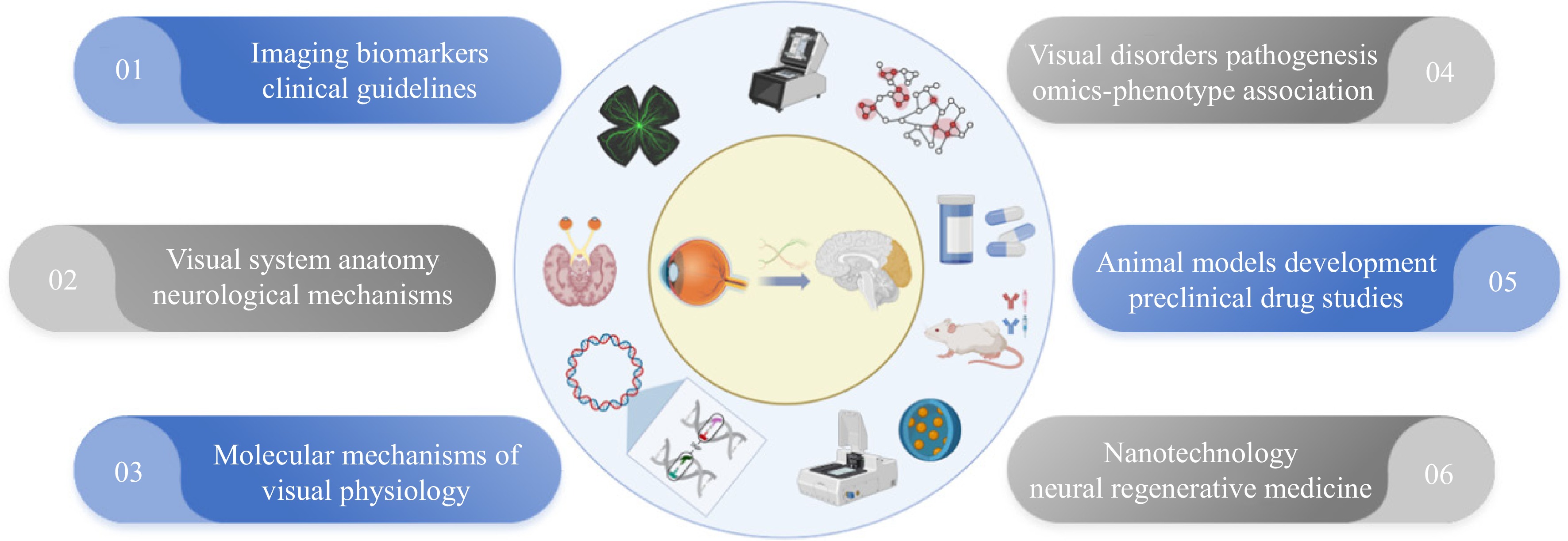
Figure 1.
Research areas in Visual Neuroscience.
To embrace the promise of this fast-growing research discipline, we are excited to relaunch Visual Neuroscience (VNS), a gold open-access international journal devoted to publishing experimental and clinical research on the biology and disease mechanisms of visual neuroscience (
www.maxapress.com/vns ). A major goal of this journal is to bring together a broad range of studies that showcase the originality and breadth of neuroscience research related to the visual system. VNS mainly publishes research papers, review articles, comments, prospects, and editorials, including but not limited to: (1) Development and validation of imaging biomarkers and clinical guidelines pertinent to the detection, diagnosis, and management of visual diseases and their associated neurological alterations; (2) Advanced investigations into the anatomy of the visual system, visual perception, and related neurological mechanisms, aiming to deepen understanding of visual neuroscience; (3) Exploration and elucidation of molecular, cellular or systems-level processes in normal visual physiology, disease pathogenesis, and omics-phenotype relationships; (4) Development and validation of animal models, preclinical drug studies, and innovations in nanotechnology and regenerative medicine, and other clinically relevant translational research in visual neuroscience. As an open-access, rigorously peer-reviewed journal, it is committed to facilitating the rapid and efficient global dissemination of scientific discoveries and technological advances in the field of visual neuroscience.VNS is dedicated to providing exceptional service to both our authors and readers. Each manuscript undergoes a comprehensive evaluation by our editorial team and is reviewed by at least two independent expert reviewers. We are honored to serve the visual neuroscience community and welcome global experts, particularly those from emerging and interdisciplinary fields, to join our Editorial Board. Together, we aim to pool academic knowledge and expertise to further advance research in visual neuroscience.
HTML
-
The author declares that there is no conflict of interest.
- Copyright: © 2025 by the author(s). Published by Maximum Academic Press, Fayetteville, GA. This article is an open access article distributed under Creative Commons Attribution License (CC BY 4.0), visit https://creativecommons.org/licenses/by/4.0/.
Yu H. 2025. Advancing visual neuroscience: expanding boundaries from bench to bedside. Visual Neuroscience 42: e001 doi: 10.48130/vns-0024-0001


|