












-
Forests are among the most crucial components of Earth's life-support systems. They play a key role in maintaining the ecosystem's stability, regulating the carbon cycle, providing timber and food, improving air quality, and offering cultural and spiritual benefits to human societies. However, intensified climate change, increasingly frequent natural disturbances, and expanding human activities are accelerating forest degradation and global biodiversity loss. In light of rapid technological advancements, traditional forest management approaches are proving inadequate for ensuring sustainable and high-quality forest stewardship. To address these challenges, forestry researchers must adopt innovative, lifecycle-based methodologies—spanning genetic improvement, silviculture, and yield optimization—to enhance the quality and efficiency of forest management.
In response to these pressing challenges, the concept of Smart Forestry emerged as a forward-looking framework to harness the power of digital innovation for forest sustainability. The journal Smart Forestry was thus conceived to support this vision by providing a dedicated academic platform for integrating next-generation technologies into forestry science. It encompasses innovations such as cloud computing, the Internet of Things (IoT), big data, artificial intelligence (AI), remote sensing, virtual reality, blockchain, and mobile internet technologies. Collectively, these tools have the potential to transform forest monitoring, resource management, and ecological stewardship through comprehensive sensing and integrated value creation, paving the way toward more intelligent, efficient, and sustainable forestry systems.
As a vital platform for academic communication and technical exchange, Smart Forestry is committed to advancing global forest monitoring, sustainable management, ecological restoration, and governance. The journal prioritizes interdisciplinary research that improves forest ecosystems' structure and function, enhances the delivery of ecosystem services, and increases both the yield and quality of forest products. Together, these initiatives support the development of robust, sustainable forestry systems that promote ecological resilience, economic viability, and informed policy-making worldwide.
Around the world, innovative applications already demonstrate the potential of smart forestry approaches. Sweden’s Mistra Digital Forest initiative, for example, is developing AI-powered digital twins and precision forestry platforms to optimize harvesting and planning. In Norway, research employing unmanned aerial vehicle (UAV)-mounted multispectral cameras alongside deep learning has enabled the early detection of bark beetle outbreaks, which is crucial for reducing pest damage. In the United States, gene editing techniques such as clustered regularly interspaced short palindromic repeats (CRISPR) are being explored to enhance forests' growth rate and improve resilience, although formal publications remain emergent. Germany’s smart wood-processing technologies—while valuable for industrial output—has extended to downstream manufacturing rather than merely on forest management itself. The surge in smart forestry research—from fewer than 20 articles in 2014 to over 500 articles in 2023—underscores the growing momentum (see Fig 1). Yet until now, the research community has lacked a dedicated, interdisciplinary journal to share tools, methods, and insights. The launch of Smart Forestry fills this critical gap, offering a central platform to accelerate global knowledge exchange and innovation in this vital domain.
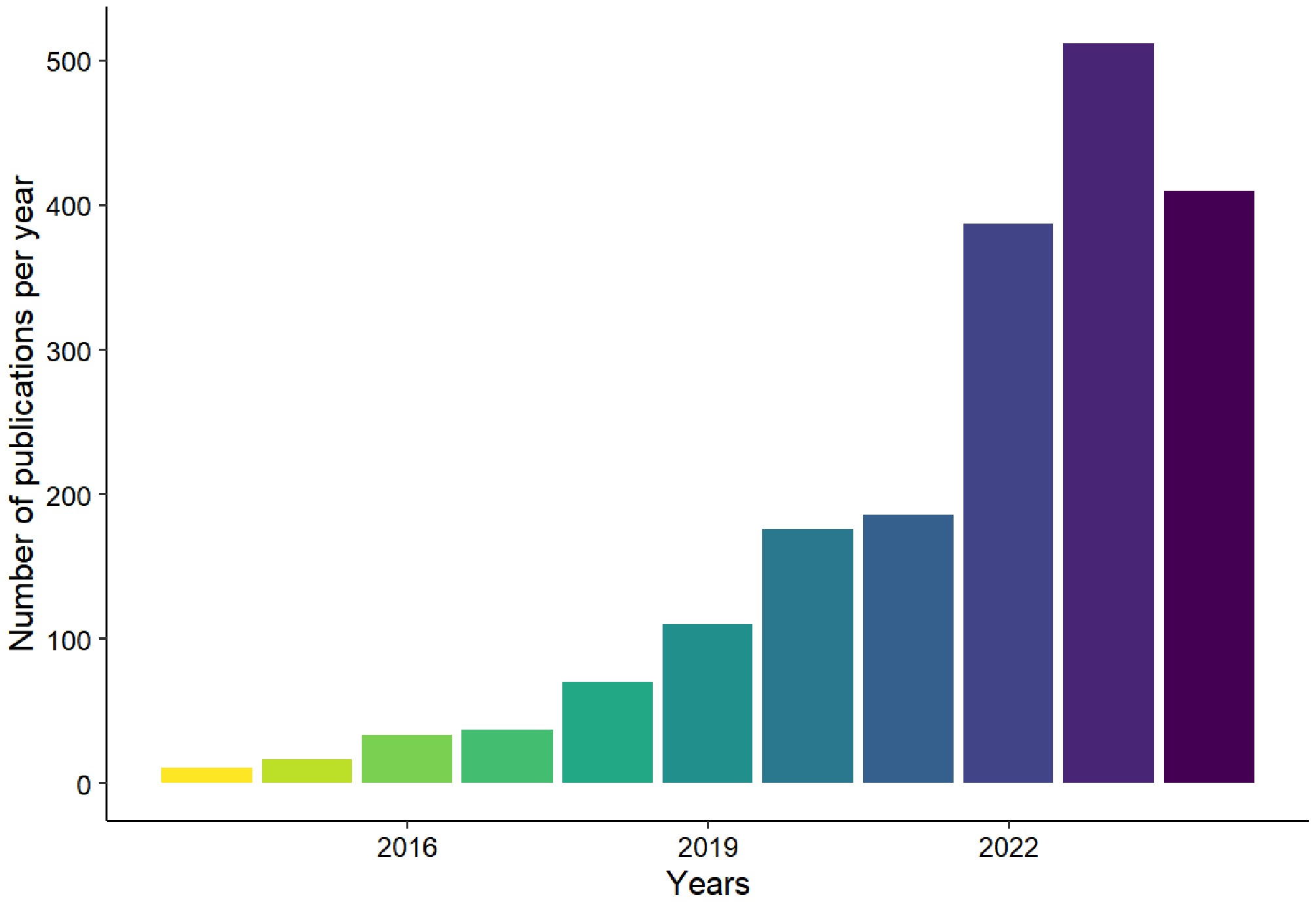
Figure 1.
Number of publications per year related to smart forestry
To meet this growing need, Maximum Academic Press has officially launched Smart Forestry, a new open-access journal dedicated to advancing science and technology underpinning precise forest monitoring, sustainable management, ecological restoration, and resource utilization. The journal’s mission is to establish a global platform that brings researchers, practitioners, and policymakers together to share innovative research, foster interdisciplinary collaboration, and co-develop solutions for forest management and sustainability. In alignment with global sustainability goals, Smart Forestry promotes practices that balance ecological integrity, economic viability, and social equity.
Unlike traditional forestry journals, which focus primarily on stand-level dynamics and silviculture, Smart Forestry supports research that integrates digital technologies, such as AI, the IoT, big data, and remote sensing, with forest science and management practices. The journal emphasizes reproducible, data-driven studies and applied innovations in forestry, laboratory science, and policy to promote sustainable forest monitoring, management, and ecological restoration. The journal accepts various article types, including the following:
• Original Research: Studies based on open, reproducible workflows involving AI, sensor networks, UAVs, or other smart technologies for forest science and management;
• Reviews: Comprehensive syntheses of recent advances, identifying knowledge gaps and offering future research directions across pertinent scientific and technological domains;
• Case Notes: Reports on real-world implementations of smart forestry tools and technologies, emphasizing measured outcomes, operational insights, and implementation challenges;
• Data and Software Descriptions: Comprehensive documentation of curated datasets, databases, or software tools that are relevant to smart forestry (these include metadata, data structures, access protocols, novel software designs, functionality, and applications, and, where applicable, open-source code to ensure transparency, reproducibility, and reusability);
• Policy Briefs: Concise, evidence-based summaries designed to inform policy development and decision-making at local, national and international levels;
• Methods and Protocols: Step-by-step guides introducing emerging tools, data collection protocols, and computational workflows to support adoption and replication by the research community.
Smart Forestry also embraces the grand challenges that are poised to shape forest science and management over the next decades. Can AI reliably forecast wildfires' behavior 10 days in advance with actionable accuracy? Can models quantify species-specific responses to climate change at scale? How might real-time data from satellites, UAVs, and IoT devices be integrated into a dynamic digital twin of a living forest, enabling virtual testing of management interventions? These challenges drive our mission to lead interdisciplinary innovation.
Driven by this vision, Smart Forestry is equally committed to scientific rigor, technological innovation, and global impact. All submissions undergo a rigorous single-blind peer review process to uphold high standards of quality and research integrity. The journal prioritizes novel contributions with transformative potential to advance the future of forestry development.
Published under the Creative Commons Attribution (CC BY) 4.0 license, Smart Forestry ensures that all content remains openly accessible to readers and stakeholders worldwide. Beyond publishing, the journal actively engages its community through webinars, workshops, symposia, and strategic partnerships to foster interdisciplinary dialog and real-world collaboration.
The journal's leadership team reflects its interdisciplinary mission. Editor-in-Chief Huaiqing Zhang and Executive Editor Yanjie Li are active, frontline researchers with expertise spanning AI, forest modeling, remote sensing, ecological informatics, genomics, and forest phenomics, ensuring coverage from technological innovation to on-the- ground application. To support the journal’s role in shaping real-world decisionmaking, the team also includes experts in environmental policy, forest governance, sustainability science, and socio-ecological systems. This diversity ensures a holistic editorial perspective that bridges data science, ecological understanding, and institutional relevance.
Over the next three years, Smart Forestry aims to:
• Publish 30 high-quality articles annually;
• Curate special issues focused on transformative and emerging topics;
• Establish partnerships with leading academic institutions, forestry organizations, and technology firms;
• Promote inclusivity and representation in both its content and contributor base.
The inaugural issue will feature contributions from internationally recognized experts and early adopters in the field of smart forestry, setting the tone for the journal’s long-term role as a key voice in forestry innovation.
In alignment with these strategic goals, Smart Forestry also aspires to cultivate a vibrant, inclusive scholarly community. More than just a journal, Smart Forestry is a community-driven platform dedicated to fostering multidisciplinary innovation and collaboration in forestry science and technology. We welcome researchers, practitioners, policymakers, and community stakeholders to contribute by submitting manuscripts, guest-edit special issues, and engage in a global network dedicated to advancing technologies and promoting high-quality and sustainable development in forestry.
HTML
-
The authors declare that they have no conflict of interest.
- Copyright: © 2025 by the author(s). Published by Maximum Academic Press, Fayetteville, GA. This article is an open access article distributed under Creative Commons Attribution License (CC BY 4.0), visit https://creativecommons.org/licenses/by/4.0/.
Li Y, Wei H, Zhang H. 2025. Inaugural Editorial: Smart Forestry, an academic journal for innovation in future forestry. Smart Forestry 1: e001 doi: 10.48130/smartfor-0025-0001


|