













-
Gastrointestinal cancers were the third most commonly diagnosed cancers worldwide in 2020, accounting for 19.29 million new cases[1]. In the population aged 40 and above, the lifetime risk for gastrointestinal cancer incidence and mortality continues to be substantially higher[2]. Nevertheless, advances in medical technology have lengthened steadily the overall survival of cancer patients. Survivors often face continuing psycho-social issues such as fear of cancer recurrence (FCR)[3] and depression[4], which can affect their quality of life[5].
FCR is defined as 'fear, worry, or concern related to the possibility of cancer returning or progression'[5,6]. Studies indicate a high prevalence of FCR. Study showed that 54.52% and 13.76% of cancer survivors reported moderate and high levels, respectively[7]. Similarly, among cancer survivors in Singapore, the prevalence of clinical and severe FCR was 43.6% and 32.1%, respectively[8]. Previous research has confirmed a significant correlation between FCR and depression among cancer survivors[9]. Specifically, higher levels of FCR correlate with more severe depression among middle-aged stomach cancer survivors[10]. Furthermore, one of the independent risk factors for depression among cancer patients is FCR[11]. The prevalence of depression among survivors of gastrointestinal cancer who are middle-aged and elderly ranges from 15.36% to 68%[12−14]. Depression adversely affects cancer survivors, reducing treatment compliance, affecting quality of life[15], and increasing suicide risk[16]. Given that FCR is a significant contributing factor to depression[11]; it cannot be ignored.
Cancer acts as a significant stressor, adversely affecting both the health of patients and the well-being of their families. In China, where younger family members often face substantial financial pressures from medical costs, this can limit their capacity to support middle-aged or elderly patients in managing psychological distress, such as FCR and depression. In these situations, the patient's spouse frequently becomes the primary caregiver, playing a pivotal role in the rehabilitation process. Reflecting this reality, research on coping mechanisms in gastrointestinal cancer is increasingly shifting from an individual focus to dyadic coping (DC)[17,18]. DC refers to the process of individual stress from one partner transferring to the other, and is a joint process between couples[19]. Previous studies indicate that positive DC not only helps cancer patients and their spouses in adjusting to and coping with the multifaceted challenges, but also alleviates perceived stress and enhances their psychological health[17,20]. Studies indicate that partners' perceptions of negative DC are associated with depression[21], and DC is a negative predictor of depression in pancreatic cancer patients[22]. Furthermore, DC is also associated with depression and FCR[23]. However, the relationships and pathways among FCR, DC, and depression in gastrointestinal cancer survivors remain unclear. Given the potential variation across cancer types, findings from general cancer populations may not be directly generalizable to gastrointestinal cancer survivors.
Therefore, this research aimed to determine the relationships between FCR, DC, and depression among middle-aged and elderly gastrointestinal cancer survivors. A hypothetical relationship is proposed, in which depression is affected by FCR, and DC may play a mediating role.
-
The study followed the Strengthening the Reporting of Observational Studies in Epidemiology checklist for cross-sectional studies (Supplementary Table S1)[24]. A convenience sampling method from February 2022 to June 2024. A total of 245 middle-aged and older patients with gastrointestinal cancer were recruited from the department of gastrointestinal surgery, Oncology (I), and Oncology (II) of tertiary grade-A hospitals in Jiaxing, China. The fifth author was responsible for recruiting research participants through paper posters placed in the operating room and the above three departments.
Participants
-
The eligibility criteria: (i) had a diagnosis of gastrointestinal tumors through gastroscopy and clinical pathology examination; (ii) were ≥ 45 years old[25]; (iii) were married; (iv) had good reading and communication skills and clear awareness; and (v) had a primary school education or above. The exclusion criteria: (i) suffering from cognitive impairments or psychological or mental disorders, and (ii) severe complications.
Data collection
-
Two graduate nurses were rigorously trained as research investigators. Data was collected using a standardized data collection form. A nurse who was fluent in the local dialect explained the study's purpose and procedures to participants using a standardized guide, obtained informed consent, and administered the questionnaires. The questionnaires were completed independently and anonymously by participants in a face-to-face setting within three designated wards. Approximately 30 min were needed for completion of each questionnaire. All questionnaires were distributed and checked on the spot, with immediate verification for completeness; any missing information was promptly supplemented. After the patients completed the questionnaires, small gifts were given to participants as a token of appreciation.
The demographic and clinical questionnaire
-
Demographic data were obtained through a purpose-designed questionnaire based on the research aims and existing literature, addressing gender, age, education, occupation, residence type, and treatment approach.
Fear of Progression Questionnaire-Short Form (FoP-Q-SF)
-
Mehnert developed the scale for assessing FCR in cancer patients[26]. Wu Qiyun translated and revised it in China in 2015[27]. Its Cronbach's alpha is 0.833. The scale is structured into two dimensions (physical health and social family), containing 12 items in total. It uses a 5-point Likert scale (1 = never, ..., 5 = always), with a total score ranging from 12 to 60 points. Stronger FCR is corresponded to by higher scores. A score of ≥ 34 is indicative of clinically significant psychological dysfunction. Its Cronbach's α was 0.755 in the study.
Chinese version of the dyadic coping inventory
-
Boddenman developed the original scale[28], which was translated by Xu et al.[29]. The Cronbach's α coefficient ranged from 0.51 to 0.80. It consists of six dimensions: stress communication (Items 1, 4, 9, 16, 17, 18, 19, and 24), support coping (Items 2, 3, 5, 6, 8, 13, 20, 21, and 23), empowerment coping (Items 12, 14, 28, and 30), collaborative coping (Items 31, 32, 33, 34, and 35), negative coping (Items 7, 10, 11, 15, 22, 25, 26, and 27), and coping quality evaluation (Items 36 and 37). A 5-point scale is used, scored from 1 (rarely) to 5 (very frequently). Negative coping support is reverse-scored, and two items from the coping quality evaluation dimension were excluded from the total score calculation. The total score varies between 35 and 175 points, with a normal range of 111–145 points. A higher score indicates more positive dyadic coping strategies among spouses. Its Cronbach's α was 0.712 in the study.
Hospital Anxiety and Depression Scale (HADS)
-
Zigmond & Snaith developed the scale[30]. In 1993, it was translated and introduced by the Chinese scholar Ye Weifei[31], and has been widely used among various hospitalized patients[32]. Two subscales, HADS-A and HADS-D, are included to assess anxiety and depression, respectively. In this study, the depression subscale was used, with a Cronbach's α coefficient of 0.790. There are a total of 7 items, with scores anchored by 0 for 'not at all', and 3 for 'very much' of each item; a total score that lies between 0 and 7 indicates a normal range, 8 and 10 suggests the possible presence of depression, and 11 and 21 indicates the potential presence of significant depression.
Ethical considerations
-
The study obtained approval from the Ethics Committee of the Jiaxing First Hospital's Medical (LS2021-KY-075) and was conducted in adherence to the ethical principles of the Declaration of Helsinki. Before data collection, all participants were fully informed about the research purpose, significance, and procedures. They were assured of anonymity (with personal identifiers replaced by unique codes) and that data would be used solely for academic purposes. Moreover, participants were informed that their medical care and rights would be unaffected by their decision to participate. They were informed of their freedom to refuse or withdraw from the study at any time. Written informed consent was secured from all participants prior to their inclusion in the study.
Statistical analysis
-
Data were managed and analyzed using the same methodology as described in a previous publication[33]. Prior to conducting the main analysis, missing values, outliers, and normality were checked, and 16 incomplete data sets were excluded. The analytical procedure was as follows: first, to assess common method bias by Harman's single-factor test; to compare differences in depression scores across general demographic characteristics by T-tests and ANOVA; then, the Pearson correlation analysis was used to explore associations between FCR, DC, and depression; finally, mediation analysis was carried out using the bootstrap method[33]. Data integrity was verified through re-examination of the primary data set before finalizing the results.
Sample size: Following the rule of thumb of 5–10 subjects per variable, with the aim of ensuring adequate statistical power for the analyses[34]. There were 19 dimensions in the study. We used the number of scale dimensions rather than individual items. The initial sample size was estimated to range from 95 to 190 patients. Accounting for an anticipated attrition rate of 20%, this was adjusted upwards to a required range of 114 to 228 patients.
-
The variance explained by the largest factor was 34.32%. Ten patients declined participation. Two hundred and thirty five questionnaires were distributed. Entries with missing responses on the scale exceeding 20%[35] were excluded (n = 24). The final sample consisted of 211 participants with valid questionnaire data. Among the patients, 63.98% were males, 36.02% were females, and the average age was 62.45 ± 6.45 years old. The data in Table 1 showed that participants with different living types (F = 5.074; P = 0.002), occupations (F = 4.540; p = 0.004), residential types (F = 6.258; P = 0.002), and duration of disease diagnosis (t = −4.108; p = 0.001) had significantly different depression scores.
Table 1. Characteristics of participants' data.
Variable Population size N (%) Depression (Mean ± SD) t/F p Gender t = −1.770 0.078 Male 135 (63.98) 18.31 ± 1.68 Female 76 (36.02) 18.75 ± 1.82 Age (years) 45−59 74 (35.07) 18.62 ± 1.32 t = 0.936 0.350 ≥ 60 137 (64.93) 18.39 ± 1.93 Educational level Primary and below primary school 114 (54.03) 18.47 ± 1.70 F = 1.466 0.225 Junior school 66 (31.28) 18.23 ± 1.68 High school 25 (11.85) 19.08 ± 1.04 Living types College 6 (2.84) 18.50 ± 1.52 Alone 10 (4.74) 18.60 ± 1.75 F = 5.074 0.002** With spouses 180 (85.30) 16.79 ± 1.05 With grandchildren 14 (6.64) 18.30 ± 1.64 With children 7 (3.31) 18.71 ± 0.76 Occupations Worker 35 (16.59) 17.97 ± 1.20 F = 4.540 0.004** Farmer 61 (28.91) 18.20 ± 2.17 Teacher 8 (3.79) 20.13 ± 0.30 Others 107 (50.71) 18.66 ± 1.49 Residential types Rural area 61 (28.90) 18.48 ± 1.78 F = 6.258 0.002** Town 70 (33.18) 17.94 ± 2.01 City 80 (37.91) 18.93 ± 1.29 Annual income surplus (in RMB) ≤ 3,000 324 (55.92) 18.53 ± 1.76 F = 2.594 0.077 3,001−4,000 63 (29.86) 18.11 ± 1.86 > 4,000 35 (16.59) 18.91 ± 1.29 Treatment approach Surgical operation 166 (78.67) 18.39 ± 1.78 F = 0.689 0.560 Radiotherapy 8 (3.79) 18.50 ± 1.85 Chemotherapy 29 (13.74) 18.86 ± 1.64 Radiotherapy and chemotherapy 8 (3.79) 18.75 ± 1.04 Length of disease diagnosis < 3 months 147 (69.67) 18.16 ± 1.74 t = −4.108 0.001** > 3 months 64 (30.33) 19.19 ± 1.53 t, t test; F, F-test; p, p value; * p < 0.05; ** p < 0.01; SD, standard deviation Descriptive and correlation analyses of variables
-
The mean scores for FCR, DC, and depression were 25.25 ± 6.54, 129.56 ± 20.53, and 18.47 ± 1.74, respectively. Pearson correlation analysis indicated significant negative associations of FCR with DC (r = −0.390; p = 0.001), and of DC with depression (r = −0.408; p = 0.001), while a significant positive association was observed between FCR and depression (r = 0.431; p = 0.001).
Mediating analyses of variables
-
Table 2 and Fig. 1 showed that after controlling for covariates, such as living types, residential types, duration of disease diagnosis, and occupations, the mediation analysis (Model 4) demonstrated a positive effect of FCR on depression (β = 0.083, SE = 0.017, t = 5.027, p = 0.001), a significant negative effect of FCR on DC (β = −1.241, SE = 0.204, t = −6.090, p = 0.001), and DC had a significant negative influence on depression (β = −0.023, SE = 0.004, t = −5.161, p = 0.001).
Table 2. Mediating analyses of all variables.
Items Beta/effect Standard error t p 95% confidence interval LLCI ULCI Path way Fear of cancer recurrence → depression 0.083 0.017 5.027 0.001** 0.050 0.115 Fear of cancer recurrence → dyadic coping −1.241 0.204 −6.090 0.001** −1.643 −0.840 Dyadic coping → depression −0.023 0.004 −5.161 0.001** −0.031 −0.014 Fear of cancer recurrence → dyadic coping→depression 0.028 0.008 0.015 0.045 Effects Direct effect 0.083 0.017 5.027 0.001** 0.050 0.115 Indirect effect 0.028 0.008 0.015 0.045 Total effect 0.111 0.015 7.352 0.001** 0.081 0.141 ** p < 0.01; Unstandardized regression coefficients (Beta) in parentheses are presented; Based on 10,000 bootstrap samples. 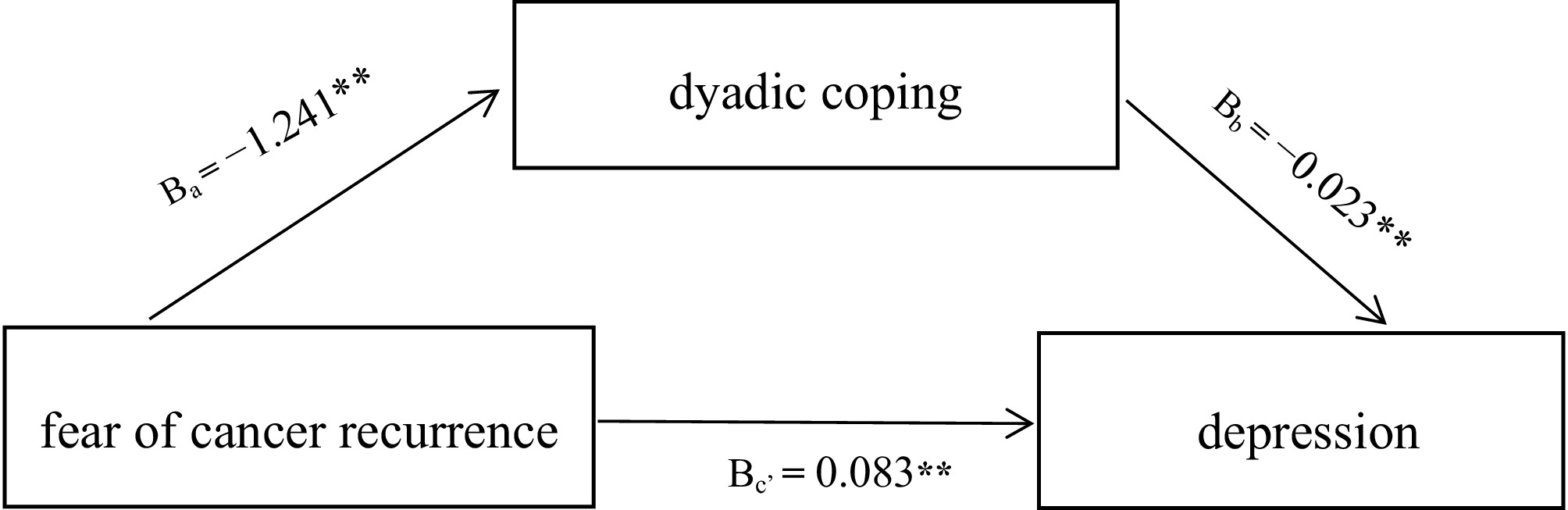
Figure 1.
Mediating model of fear of cancer recurrence, dyadic coping and depression. Note: ** p < 0.01. (a) Direct effect of fear of cancer recurrence on dyadic coping; (b) direct effect of dyadic coping on depression; (c') direct effect of fear of cancer recurrence on depression; (a*b) indirect effect of fear of cancer recurrence on depression via dyadic coping.
As displayed in Table 2, both the total (effect = 0.111, SE = 0.015, t = 7.352, p = 0.001) and direct (effect =0.083, SE = 0.017, t = 5.027, p = 0.001) effects of FCR on depression were statistically significant. Furthermore, the indirect effect was 0.028 (SE = 0.008, 95% confidence interval: 0.015−0.045), accounting for 25.23% of the total effect (0.111). The absence of zero within the 95% confidence interval indicated a significant indirect effect.
-
Several findings were identified in the study. First, the levels of FCR and depression were high among middle-aged and elderly survivors of gastrointestinal cancer. Second, FCR was negatively associated with DC, whereas it showed a positive association with depression. The most important thing is that DC mediates between FCR and depression.
The study showed that the levels of FCR (25.25 ± 6.54) and depression (18.47 ± 1.74) among middle-aged and elderly survivors with gastrointestinal cancer were lower than those reported previously[8,13] (59.5 ± 30.4 and 37.73 ± 9.15, respectively). The level of depression remained elevated. This difference may be related to the measuring tools. However, it is also likely attributed to the long-term psychological impact of cancer, including the FCR, body image problems due to treatment, and the stresses of prolonged disease treatment. Furthermore, our results revealed that participants' living types, gender, residential types, annual income surplus, and length of disease diagnosis were influencing factors of FCR, DC, and depression, respectively. Survivors living with spouses had higher levels of DC and lower levels of depression. A possible explanation is that spousal support serves as the main support for cancer survivors[36]. Therefore, co-residence with spouses enhances survivors' perceived spousal support, which in turn boosts their disease coping ability and alleviates their depression. Accordingly, such survivors demonstrated higher levels of DC and lower levels of depression. Furthermore, the study found that female patients reported lower perceived DC levels compared to their male counterparts. This gender disparity might be attributed to the traditional Chinese cultural context, where males tend to demonstrate less communicative willingness, potentially resulting in female patients' diminished perception of DC. Survivors who lived in cities exhibit higher levels of DC than those who lived in rural areas. This disparity may be attributed to distinct interpersonal communication patterns and familial cultural norms. Urban couples tend to communicate more openly about emotional needs, which facilitates direct and proactive support from partners. In rural settings, by contrast, cultural emphasis on self-reliance and family solidarity may promote a more implicit form of support that is expressed through actions rather than verbal acknowledgment, which may foster more implicit support dynamics, where assistance is assumed or conveyed through actions rather than verbal expression. The culturally rooted support style is less measured by the DC tool. Moreover, survivors in rural areas with low household incomes face dual burdens of the disease itself and its associated financial costs. Objective financial burden and subjective economic distress, referred to as financial toxicity[7], can affect survivors' active communication with their partners. Consequently, the lower DC scores were observed in rural survivors. With regard to the duration of disease diagnosis, consistent with a previous study[11], survivors who were diagnosed for less than 3 months had higher levels of depression.
Our study found that FCR was positively associated with depression, consistent with prior evidence[11, 37]. FCR commonly manifests as excessive self-examination, hypervigilance, and a heightened focus on somatic changes. Furthermore, individuals may misinterpret benign physical sensations, such as chest tightness or pain, as signs of disease progression[11]. Many gastrointestinal cancer survivors experience disease recurrence, which leads them to lose confidence in subsequent treatment[38,39]. The adverse reactions associated with cancer and its treatments have resulted in a prolonged ordeal of physical and psychological suffering for survivors with gastric cancer, engendering psychological trauma and ensnaring them in a protracted state of FCR, which may exacerbate depression in cancer survivors[11]. In addition, the FCR was negatively correlated with DC. This finding was similar to that of the study by An et al., which demonstrated that patients' DC was significantly associated with FCR[4]. In addition, DC was negatively related to depression, which was similar to the findings of the study by Li et al.[22], verifying hypothesis 3. A possible reason for this may be that spousal communication about the disease serves to share cognitive and emotional burdens, thereby lowering stress susceptibility. Furthermore, partner-supported DC, in turn, enables patients to navigate illness uncertainty and cultivates beneficial cognitive shifts[40,41].
The result showed FCR exerted both direct and indirect effects on depression, with the latter being mediated by DC. These results not only align with our initial hypotheses but also converge with the previous studies[22, 42]. Within transactional models of stress[42,43], coping style serves as a key mediator in determining how individuals psychologically respond to and are affected by stressful events. As a potent psychosocial stressor, FCR can be addressed through DC, which provides a critical resource for stress management. During cancer treatment, spouses provide primary support for patients[44]. By engaging in the process By engaging in the coping process of gastrointestinal cancer survivors, they provide informational and emotional support, which can help alleviate survivors' depression[45]. Similarly, studies have shown that one's coping style has a positive impact not only on his or her own psychological health but also on his or her partner's psychological health during the process of coping with cancer together[17, 20]. In gastrointestinal cancer survivors, DC is a mediator of the relationship between FCR and depression. These findings suggest that psychologically qualified nurses/psychotherapists should assess the coping types of spouses and tailor interventions such as coping skills training[46] and cognitive existential couples therapy[47] to improve gastrointestinal cancer survivors' DC.
Limitations of the study
-
Several limitations exist in our study. First, the sample, drawn from a single institution in Zhejiang Province, may restrict the generalizability of the findings. Therefore, future studies could employ multi-center designs to improve this. Second, bias may be introduced because of the sampling strategy. Future studies could adopt a variety of recruitment strategies. Third, this study focused only on the relationships among FCR, DC, and depression through a cross-sectional study design. Although DC did not fully mediate this relationship, future longitudinal studies could explore the pathways involved and a broader array of other potential mediators, like behavioral factors.
-
The results provided support the study's hypotheses. Among middle-aged and elderly survivors of gastrointestinal cancer, DC served as a mediator between fear of FCR and depression. Furthermore, FCR exerted a negative effect on DC; it showed a positive direct effect on depression, whereas DC functioned as a protective factor. These findings offer preliminary evidence to inform hospital management and the design of targeted interventions aimed at alleviating depression in patients with gastrointestinal cancer.
The AI language editing tool Tencent Yuanbao was used for English grammar checks and language polishing on certain sentences. All the authors carried out line-by-line review and verification of the accuracy of professional terminology and scientific expressions in each language version edited by the tool.
-
The study was conducted in accordance with the Declaration of Helsinki and was the first research part of a project, which was approved by the Ethics Committee of the Jiaxing First Hospital's Medical (LS2021-KY-075) on 17th May 2021.
-
The authors confirm their contributions to this study as follows: Conceptualization: Yang S, Zhu Z, Song T; methodology, funding acquisition: Yang S, Zhu Z; formal analysis: Yang S, Song T; supervision: Zhu Z, Wang R; project administration: Yang S; Data curation: Wu M, Wang R; methodology: Shen Z; writing − original draft: Yang S; writing − review and editing: Yang S, Zhu Z, Song T, Wu M, Shen Z. All authors reviewed the results and approved the final version of the manuscript.
-
The data underlying the findings are available from the corresponding author upon reasonable request.
-
All authors declare that they have no conflicts of interest.
-
accompanies this paper online at: https://doi.org/10.48130/ejcc-0026-0003.
- Supplementary Table S1 STROBE Statement—Checklist of items that should be included in reports of cross-sectional studies.
- Copyright © 2026 by the author(s). European Journal of Cancer Care by Maximum Academic Press on behalf of John Wiley & Sons Ltd. This is an open access article under the terms of the Creative Commons Attribution License, which permits use, distribution and reproduction in any medium, provided the original work is properly cited.
-
About this article
Cite this article
Yang S, Zhu Z, Song T, Wu M, Wang R, et al. 2026. Fear of cancer recurrence and depression among middle-aged and elderly survivors with gastrointestinal cancer: a mediation of dyadic coping cross-sectional study in China. European Journal of Cancer Care 2026: e001 doi: 10.48130/ejcc-0026-0003 

Fear of cancer recurrence and depression among middle-aged and elderly survivors with gastrointestinal cancer: a mediation of dyadic coping cross-sectional study in China
- Received: 20 March 2025
- Revised: 28 August 2025
- Accepted: 21 May 2026
- Published online: 26 May 2026
Abstract: Middle-aged and elderly survivors with gastrointestinal cancer experience negative emotions such as depression and fear of cancer recurrence. The patient's spouse is the primary caregiver, playing a pivotal role in coping with depression and fear of cancer recurrence among middle-aged and elderly survivors of gastrointestinal cancer. However, the relationships and pathways among fear of cancer recurrence, dyadic coping, and depression in gastrointestinal cancer survivors remain unclear. We conducted a cross-sectional study to investigate the mediating role of dyadic coping in the relationship between negative emotions. From February 2022 to June 2024, 235 middle-aged and elderly gastrointestinal cancer survivors were recruited from a hospital in China. Participants were investigated with a demographic and clinical questionnaire, the Dyadic Coping Inventory, the Fear of Progression Questionnaire-Short Form, and the Depression Subscale of the Hospital Anxiety and Depression Scale. The results showed that fear of cancer recurrence affected depression through dyadic coping. The direct effect was 0.083 (SE = 0.017, 95% confidence interval: 0.050−0.115). The indirect and total effects were 0.028 (SE = 0.008, 95% confidence interval: 0.015−0.045) and 0.111 (SE = 0.015, 95% confidence interval: 0.081−0.141), respectively. The mediating effect of dyadic coping accounted for 25.23% of the relationship in negative emotions. The fear of cancer recurrence affects depression through dyadic coping. Thus, when formulating interventions to alleviate depression in middle-aged and elderly gastrointestinal cancer survivors, the role of dyadic coping should be taken into consideration.