












-
The global effort to limit warming to 1.5 °C is quietly initiating a critical conflict over land between carbon sequestration and food production. While ambitious climate pledges heavily rely on land-based CDR strategies—particularly afforestation and reforestation—a study by Gao et al.[1] in Nature Climate Change reveals that these measures may carry a significant, overlooked socioeconomic cost. Their findings project that, under a 1.5 °C pathway, current climate commitments could lead to a 12.8%[1] reduction in global cropland by 2100, exposing a fundamental tension between climate mitigation and global food security.
This impending crisis is characterized by severe spatial inequality[2]. Nations in the Global South are disproportionately affected, facing an expected 13.0%[1] cropland loss, with 81%[1] of the most impacted countries located in this region. South America is projected to experience the most severe decline at 23.7%[3]. The decline in total cropland can be primarily attributed to the projected reduction in low-density and medium-density cropland areas, which are expected to decrease by 52.3% and 44.6%, respectively. In Europe, cropland area is projected to decline by 14.9%, corresponding to an absolute loss of 440,000 km2, the most significant among all regions[1] (Fig. 1).
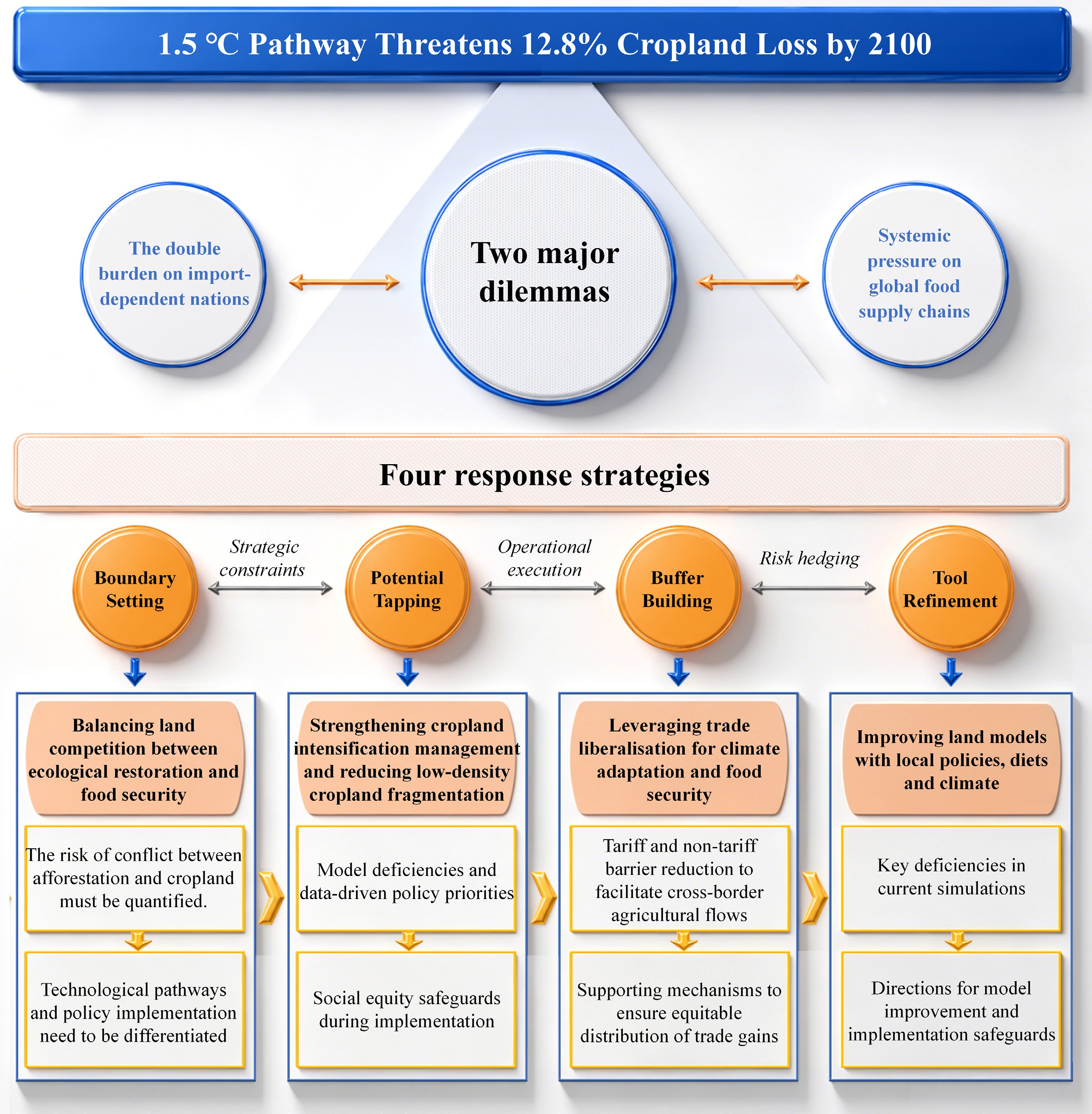
Figure 1.
Conceptual framework.
Using integrated assessment modeling and high-resolution land system simulations, Gao et al.[1] further uncover cascading risks to global food security:
1. The double burden on import-dependent nations: Countries like Vietnam and South Korea already rely heavily on food imports, and their import capacity is expected to decrease by 14.1% and 14.4%[1], respectively, as the export potential of major agricultural product suppliers declines. This creates a dangerous 'domestic production loss and international supply shortage' trap.
2. Systemic pressure on global food supply chains: The simultaneous contraction of cropland and export capacity in key agricultural exporting countries—including the United States (−9.6%), Brazil (−25.0%), and Argentina (−3.7%)[1]—threatens to destabilize global food supply at its source, potentially elevating food prices and intensifying hunger risks.
This research identifies a fundamental shift in the drivers of global land-use change: the primary cause of future cropland loss is transitioning from urbanization to ecological restoration. Large-scale afforestation, promoted as an essential negative emissions technology, is emerging as a direct competitor to agriculture for finite land resources[4].
To address this dilemma, the author proposes the following strategies:
1. Balancing land competition between ecological restoration and food security
Under the 1.5 °C temperature control target, the demand for negative emissions (primarily relying on afforestation and reforestation) intensifies the conflict between ecological land and cropland, potentially leading to substantial cropland loss[5,6]. Based on empirical assessments of national-scale land carrying capacity, countries are recommended to quantify the 'land gap' risk when formulating their climate commitments, and to prioritize the deployment of negative emission technologies that do not rely on land[7,8]. At the implementation level, differentiated national circumstances between developed and developing countries should be taken into account, so as to avoid a one-size-fits-all policy of converting farmland to forests that could impose excessive shocks on vulnerable agricultural regions.
2. Strengthen cropland intensification management and reduce low-density cropland fragmentation
Current integrated assessment models (e.g., GCAM) often overlook cropland density and fragmentation, leading to underestimates of cropland loss (GCAM projects a 10.0% decrease, whereas simulations accounting for density project a 12.8% decrease). Policy design should be based on high-resolution land use data, prioritize the protection of low-density cropland, and improve output per unit area and reduce fragmentation through territorial planning[9]. In the implementation process, technical subsidies and retraining programs should be provided to affected small-scale farmers in order to alleviate social equity concerns that intensification might bring.
3. Leverage international trade liberalization to adapt to climate change and secure food supply in the Global South
Cropland loss will weaken the export potential of major agricultural exporters and exacerbate hunger risks in the Global South. Drawing on empirical analyses of historical trade flows and climate vulnerability, we recommend a substantial reduction in both tariff and non-tariff barriers to facilitate the cross-border movement of agricultural products[10]. Additionally, supporting measures should include the establishment of international emergency food reserves and price stabilization funds to ensure that the gains from trade liberalization are shared fairly among low-income food-deficit countries, and not only among major exporters.
4. Improve land system modeling by incorporating local policies, dietary patterns, and extreme climate factors
Current simulations do not fully consider the cropland protection policies of various countries (e.g., China's cropland 'red line'), changes in dietary patterns, nature-based solutions (e.g., biomass), and extreme climate events[11,12]. Future policy formulation should be based on multi-source, high-resolution spatial data and include uncertainty analysis of models. In terms of monitoring during implementation, periodic validation and updating mechanisms should be established, and the fairness impacts of land distribution on different population groups (such as farmers, herders, and forest dwellers) under alternative scenarios should be openly evaluated, thereby providing a credible scientific foundation for decision-making, including the optimization of protected areas.
The research finally stresses that excessive dependence on terrestrial CDR for climate mitigation entails significant systemic risks. It issues an unambiguous warning—without careful management of land-use trade-offs, regulatory enforcement during implementation, and equitable redress mechanisms, well-meaning climate initiatives could unwittingly shake the bedrock of the world's food supply chain[8]. Therefore, the fundamental and more sustainable and resilient way forward lies in accelerating direct decarbonization of the energy sector while curbing dependence on land-based carbon sinks.
HTML
-
Not applicable.
-
The authors confirm their contributions to the paper as follows: Xiaoqian Chen: formal analysis, software, writing − original draft, visualization; Shaokun Li: conceptualization, resources, writing − original draft, writing − review and editing; Bin Tu: resources; Lei Wang: formal analysis; Wenxi He: writing − review and editing; Hong Yang: writing − review and editing. All authors reviewed the results and approved the final version of the manuscript.
-
Data sourced from Gao et al.[1]; data retrieval address: https://doi.org/10.1038/s41558-025-02294-1.
-
This study was supported by the Geological Survey Projects of the China Geological Survey (DD202308008).
-
The authors declare that they have no known competing financial interests or personal relationships that could have appeared to influence the work reported in this paper.
-
Full list of author information is available at the end of the article.
- Copyright: © 2026 by the author(s). Published by Maximum Academic Press, Fayetteville, GA. This article is an open access article distributed under Creative Commons Attribution License (CC BY 4.0), visit https://creativecommons.org/licenses/by/4.0/.
Chen X, Li S, Tu B, Wang L, He W, et al. 2026. Ambitious climate pledges threaten global cropland: a 12.8% reduction projected by 2100 under a 1.5 °C pathway. Environmental and Biogeochemical Processes 2: e015 doi: 10.48130/ebp-0026-0010


|