










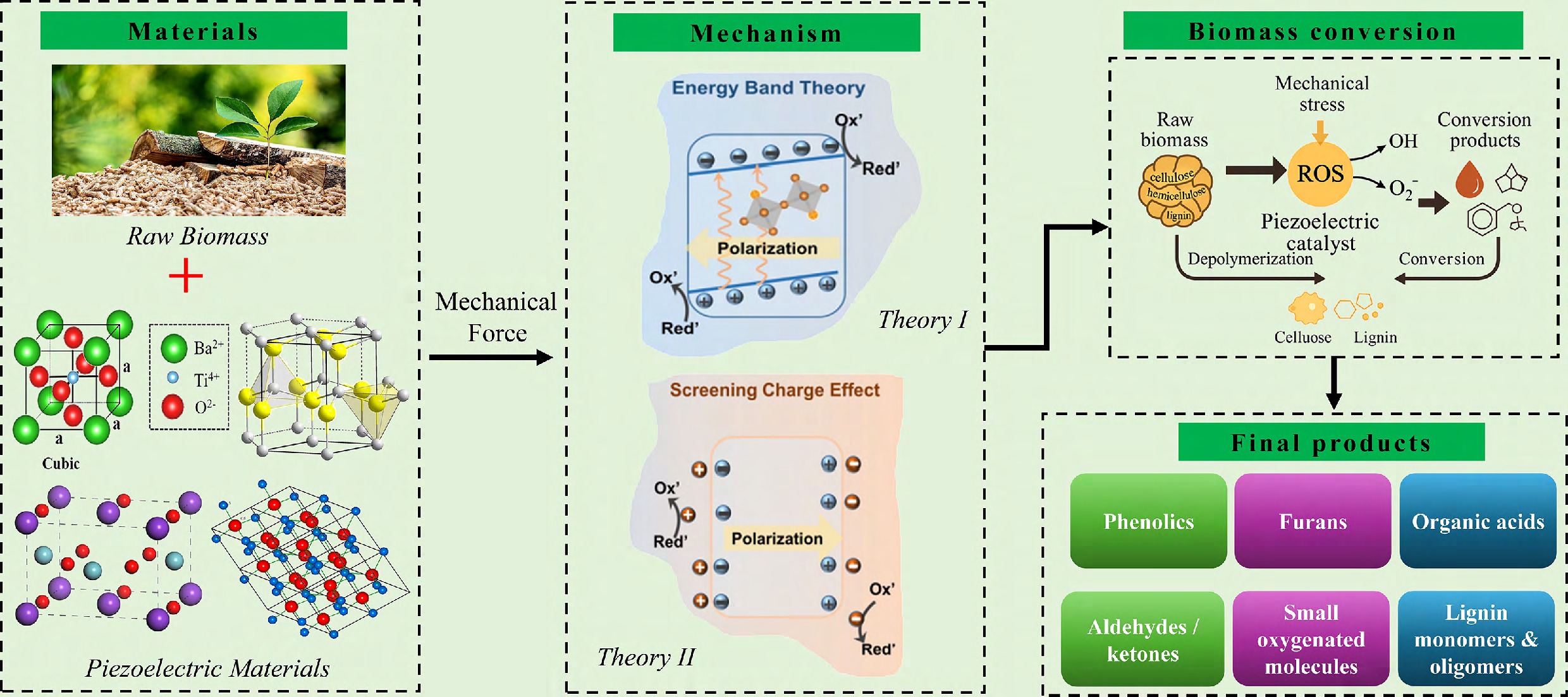


-
Biomass is organic material obtained from various sources, including agricultural residues (straw, husks, and stalks), forest wastes (hardwood, softwood, and grasses), and aquatic biomass (algae). It offers an encouraging alternative that is carbon-neutral and environmentally harmless[1,2]. The transformation of biomass has become a major concern in the framework of renewable energy and chemical manufacturing due to its enormous potential to substitute fossil fuels and reduce environmental contamination. With increasing energy demand, the environmental effects of fossil fuels have become more pronounced[3]. Energy is one of the critical strategic assets for national development. In order to achieve sustainability, countries are turning to renewable resources like solar power, wind power, hydropower, and biomass to minimize environmental effects and reliance on fossil fuels. Of these, biomass is the only one that can be used to produce liquid fuels and chemical feedstocks continuously, and is the fourth-largest global source of energy after oil, coal, and natural gas[4,5]. Compared with fossil fuels, biomass is mainly made of lignocellulosic materials, including cellulose, hemicellulose, and lignin, which are renewable feedstocks in the manufacture of biofuels and value-added chemicals[6,7]. Nevertheless, the decomposition and conversion of these components are significantly hindered due to the structural complexity[8]. Lignocellulosic biomass is rich in carbon, hydrogen, and oxygen, thus providing abundant chemical bonds and functional groups that can undergo various reactions; it has immense potential to optimize the global energy structure, eliminate reliance on fossil fuels, and alleviate environmental pollution[9,10].
Agricultural wastes like corn stalks, rice and wheat straw, sorghum straw, chaff, corn cobs, and bagasse normally have 25%–45% cellulose, 12%–36% hemicellulose, and 6%–25% lignin. Corn stalks and wheat straw have rather high cellulose contents (35%–39.6% and 35%–39%) and could be promising raw materials in the production of biofuels. Rice and sorghum straws have average cellulose (about 29.2%–35%), but are relatively higher in lignin (17%–21%), potentially slowing down enzyme hydrolysis and conversion ratio. Chaff and bagasse exhibit wide compositional scopes, which are associated with the variability of their sources and processing conditions; bagasse especially has a very broad cellulose range (25%–45%) and higher lignin content (15%–25%), which means a high level of structural rigidity. Corn cobs are characterized by a balanced composition, with cellulose (33.7%–41.2%) and hemicellulose (31.9%–36%) in high ratios, while lignin (6.1%–15.9%) is at a low ratio, which makes the process easier. Overall, these agricultural byproducts are rich in renewable lignocellulosic materials; their feasibility in bioenergy and biochemical production relies on their fiber content[11,12]. The lignocellulosic composite structure of the plant cell wall is depicted in Fig. 1.
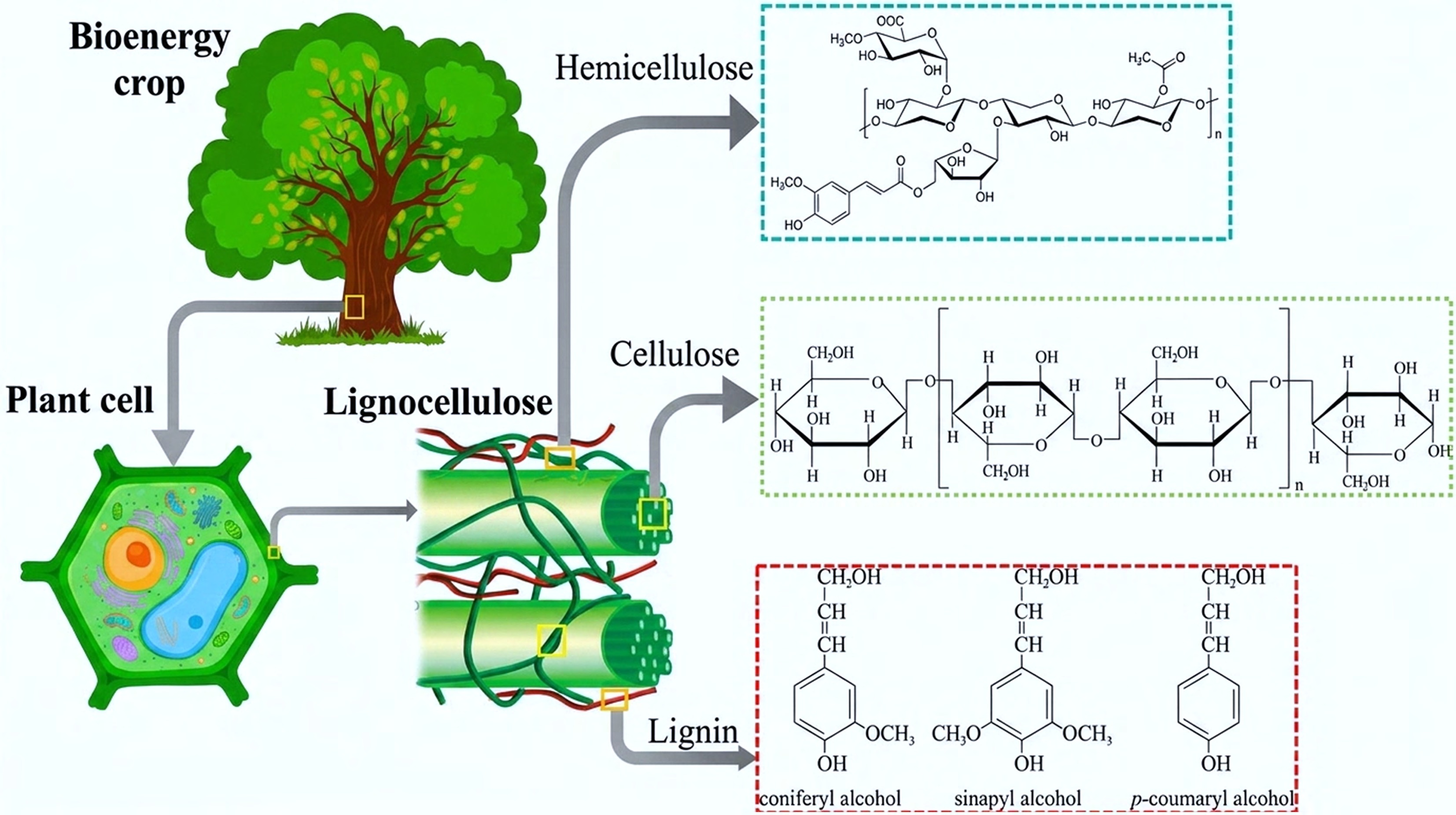
Figure 1.
Lignocellulose framework in plant cell walls[13].
Direct combustion, thermochemical conversion, and biochemical conversion are three main pathways that can be used to convert lignocellulose into energy and useful chemicals. Direct combustion produces electricity, but its capacity is limited by the abundance of oxygen and the relatively low calorific content of biomass. Thermochemical processes, including gasification, pyrolysis, and hydrolysis, are used to break down the complex lignocellulosic structure into gases, oils, and small molecules. Recent advances in biomass thermochemical conversion have also focused on microwave-assisted technologies, which enable rapid and volumetric heating. For instance, microwave-assisted heating has demonstrated significantly enhanced heating efficiency and temperature uniformity, improving reaction kinetics and energy utilization[14,15]. In addition, microwave-assisted pyrolysis and gasification have shown improved product yields and selectivity, and reduced tar formation compared to conventional processes[16,17]. With gasification, biomass is converted to combustible gases such as carbon monoxide, hydrogen, and light hydrocarbons, whereas pyrolysis yields bio-oil, char, and gas under low-oxygen conditions. Hydrolysis is a chemical reaction in which aqueous media and catalysts are used to break the polymeric constituents into intermediates. Conversely, biochemical conversion involves microorganisms and enzymes to selectively break down lignocellulose to biofuels such as methane and ethanol through a fermentation process[18]. The conventional catalytic transformation of biomass remains mostly thermochemical in nature; it is long-established, but has several drawbacks, such as high energy requirements, catalyst deactivation, and poor selectivity, often resulting in the generation of unwanted byproducts[19,20]. Furthermore, such processes tend to require complex downstream separation steps, which further reduce the overall efficiency and increase the cost of operation. Therefore, there is growing pressure to come up with more effective and selective catalytic methods that consume less energy and increase reaction selectivity to meet the inherent limitations of traditional thermochemical techniques[20]. In this context, recent studies have also emphasized improving the thermodynamic and energy efficiency of biomass conversion processes to reduce environmental impacts and enhance sustainability[21]. The dominant technologies of biomass conversion are summarized in Fig. 2.
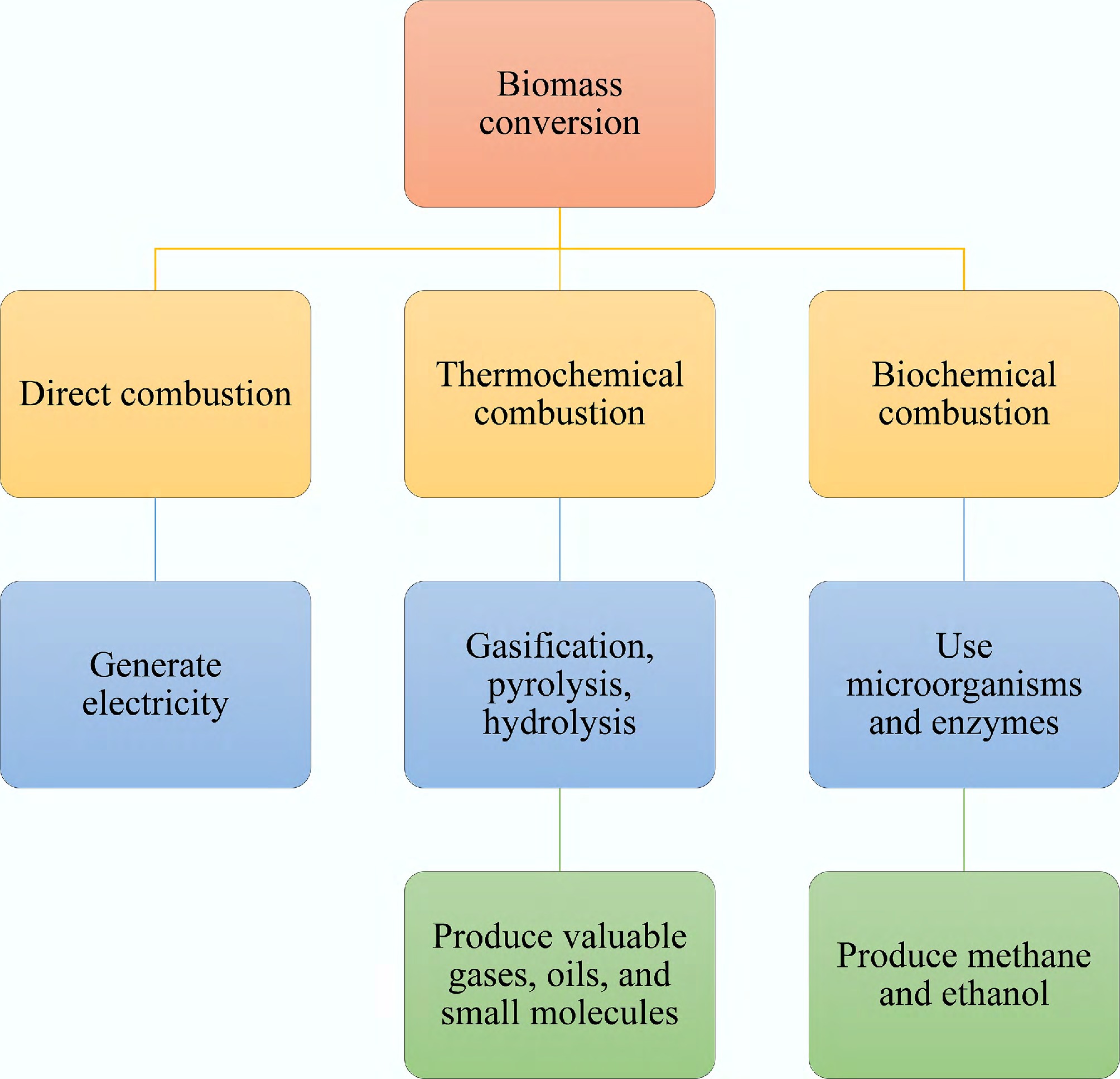
Figure 2.
Overview of biomass conversion technologies[22].
Piezocatalysis has proved to be a promising alternative in this regard, particularly in comparison with recently developed advanced thermochemical approaches such as microwave-assisted conversion technologies. The field has undergone tremendous growth over the last 16 years, with initial discoveries emerging into a wide range of environmental and energy applications. Figure 3 outlines the major milestones in this development, highlighting improvements in material engineering, mechanistic understanding, and functional applications between 2010 and 2025. Piezocatalysis uses the piezoelectric nature of a material to convert mechanical energy into chemical energy, thus catalyzing a reaction without the need to add any external energy, e.g., light or electricity[23,24].
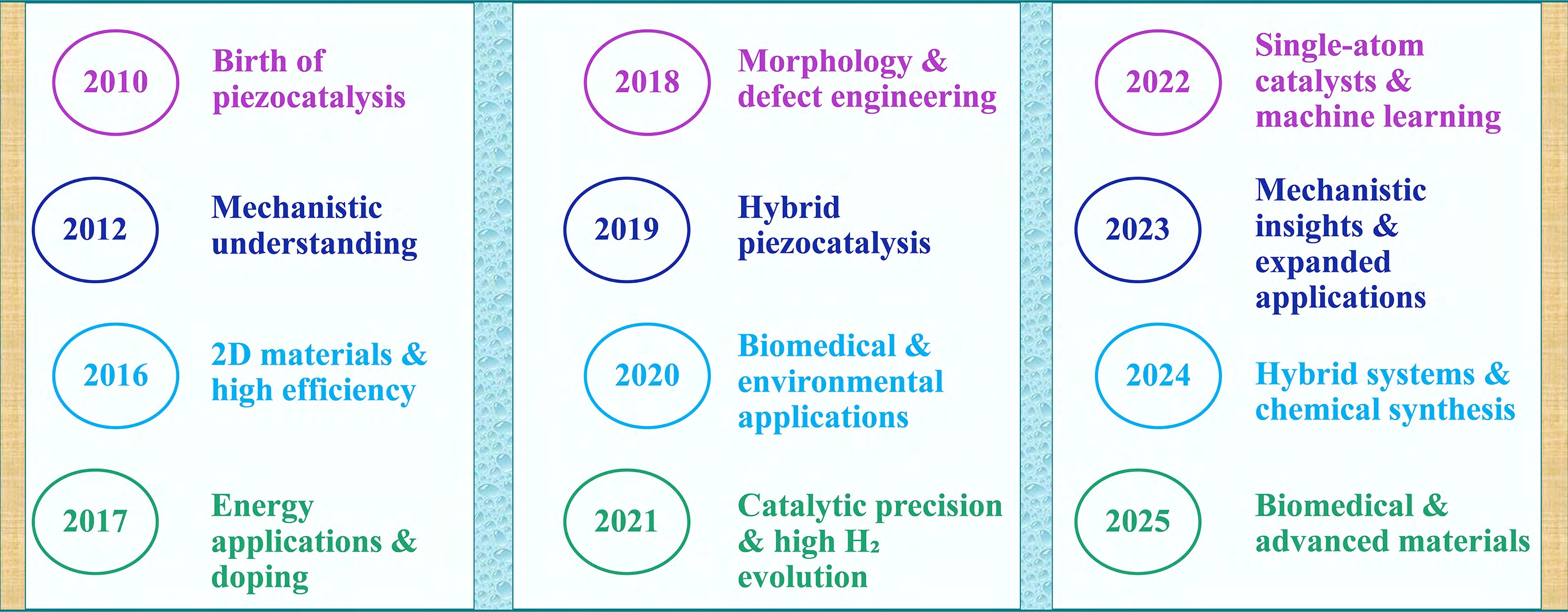
Figure 3.
Piezocatalysis milestones from 2010 to 2025, covering materials, mechanisms, and applications[23].
The piezoelectric effect, which Jacques and Pierre Curie first reported in 1880, is the appearance of positive and negative charges on the surface of opposing faces of a material under the action of a mechanical force (MF) on the material across its asymmetric axis, and vice versa. As a result, piezoelectric materials have the ability to produce an electric field (E) when subjected to mechanical deformation. From the perspective of catalytic functionality, piezocatalysis can be further classified into direct piezocatalysis and coupled piezo-assisted catalysis (e.g., piezo-photocatalysis and piezo-electrocatalysis).
In our view, this functional classification is more relevant for biomass conversion systems, as it highlights the role of piezo-induced charge carriers in driving specific reaction pathways and synergistic catalytic effects. The induced charges have opposite polarity depending on the direction of the applied MF. Although all ferroelectric materials are piezoelectric, the relation is not necessarily true in the opposite way. Ferroelectric materials exhibit an intrinsic polarization (Ps) that may be reversed by an exogenous E (Fig. 4). The appearance of the Ps leads to the emergence of positive and negative charges on the polarized surfaces that are bound, which attracts mobile charges to screen the polarization. In contrast, pyroelectric materials have temperature dependencies of internal polarization, and can only remain in a polarized state below the Curie temperature (Tc). In this temperature regime, the changes in temperature alter the internal polarization. During the production of piezoelectric materials, the positive cationic centers and the negative anionic centers move in opposite directions under strain, and hence create polarized dipole charges. As piezoelectrics do not have inherent polarization, a stimulus in the form of MF or a change in temperature is required to cause polarization, which subsequently induces an E and generates opposing surface charges[25].
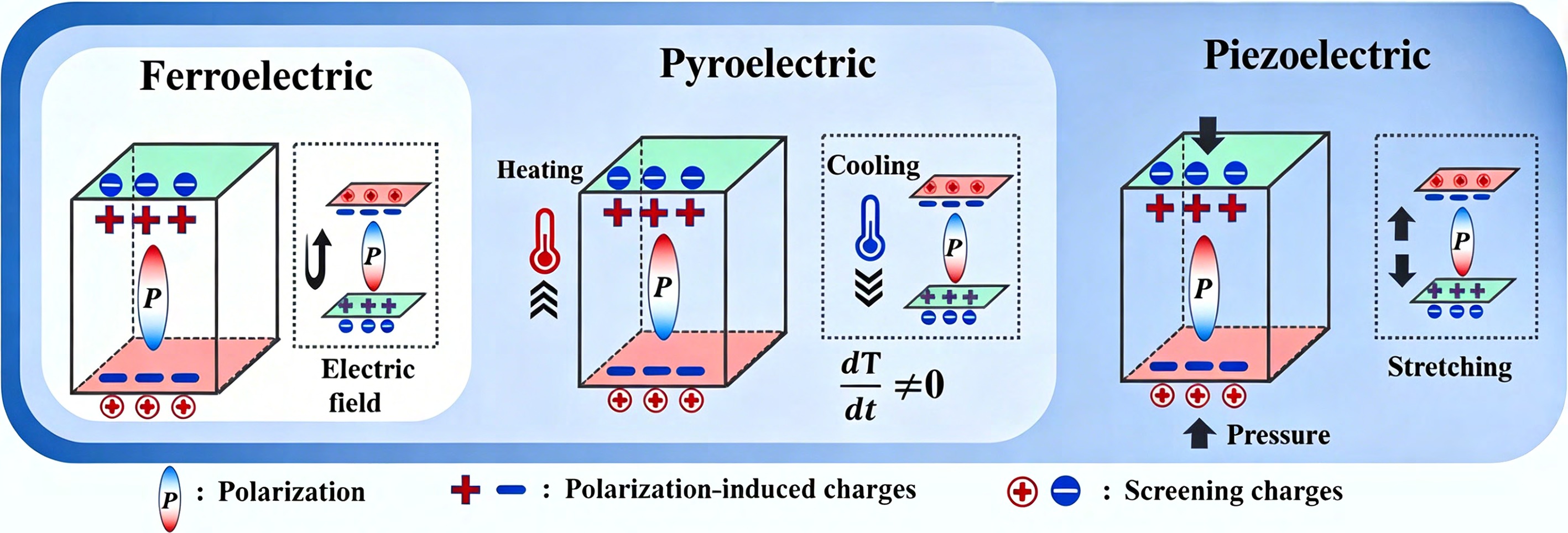
Figure 4.
Polarization-induced charge behavior in ferroelectric, pyroelectric, and piezoelectric materials below Tc[26].
It works by using piezopotential, which is a surface electric potential that appears when piezoelectric materials are under mechanical stress. This process aids in the separation of charge carriers and opens the door to a wide range of chemical reactions. Previous studies have demonstrated that the piezopotential can effectively promote charge separation and suppress electron–hole recombination, thereby enhancing catalytic efficiency and redox reaction kinetics[21]. These findings provide important experimental support for the application of piezocatalysis in complex biomass conversion processes.
Piezocatalysis has also become a promising approach to catalyzing chemical transformations needed in biomass conversion, such as degrading organic pollutants, converting water to hydrogen, and reducing carbon dioxide[19,23]. It can convert mechanical energy (vibrations, stirring, or environmental forces including wind and ocean waves) into electrical energy, which makes it a very sustainable and energy-conserving alternative to traditional high-temperature high-pressure processes[19]. Piezocatalytic materials, such as barium titanate (BaTiO3), zinc oxide (ZnO), and newly developed systems such as graphene and transition metal dichalcogenides, provide an alternative pathway that improves biomass conversion processes without compromising the energy efficiency[23,24]. Using mechanical energy, these materials reduce the environmental impact of biomass conversion and offer a cleaner and less energy-intensive alternative to conventional catalytic transformations.
Compared with conventional thermochemical and photocatalytic approaches, piezocatalysis offers several distinct advantages in biomass conversion, including: (i) utilization of ubiquitous mechanical energy sources; (ii) operation under ambient conditions; and (iii) reduced dependence on external energy input. Experimental studies have reported improved selectivity and reduced byproduct formation in piezocatalytic systems, particularly in lignocellulosic biomass depolymerization and model compound degradation[7, 9,11]. These advantages make piezocatalysis a highly promising pathway for sustainable biomass valorization.
The current advances in piezocatalytic materials have broadened the perspectives of piezocatalysis in converting biomass. BaTiO3, ZnO, and other hybrid compounds have been investigated due to their higher piezoelectricity and the ability to undergo biomass conversion reactions[19]. Piezocatalysis allows reactions to occur under ambient conditions, and at the same time increases selectivity and efficiency to generate valuable chemicals and biofuels using less energy. In addition, it can be combined with other catalytic processes, like photocatalysis, to enhance the overall catalytic activity, thus providing a more robust biomass conversion system[23]. The ability to work under mild conditions and avoid the use of high temperatures or external power sources is one of the main benefits of piezocatalysis in biomass conversion. This property boosts the application of piezocatalysis to sustainable chemical production and biomass processing since it reduces environmental footprints and operational expenses in comparison with traditional processes[24]. Additionally, piezocatalytic scalability and piezoelectric material abundance represent a beneficial route to large-scale biomass conversion, thereby leading to the development of more sustainable energy systems.
Several extensive reviews have covered different aspects of piezocatalysis. Regarding mechanistic elucidation, Wang et al. have reviewed in detail two theories applicable to piezocatalysis: the energy band theory and the effect of screening charges[27]. Bößl et al. presented an overview of the main fundamentals in terms of piezoelectricity, electrochemistry, and sonochemistry[28], Qian et al. examined the coupled piezo-electro-chemical processes of piezoelectric materials[29], and Chen et al. highlighted the facilitative influence of polarization, such as macroscopic, piezoelectric, ferroelectric, and surface polarization, in photocatalysis[30]. In terms of application; Liu et al. reviewed piezocatalytic environmental remediation[31]; Ali et al. aimed at bacterial inhibition, and organic pollutants degradation[32]; Jiang et al. summarized piezoelectricity-enhanced photocatalytic environmental uses[33]; Liang et al. gave an overview of piezocatalytic and piezo-photocatalytic pollutant removal[34]; Mamba et al. surveyed heterogeneous advanced oxidation reactions with stoichiometric ABO3 nanostructured perovskites[35], while Chen et al. reviewed achievements in piezocatalytic medicine, such as tissue repair, tumor treatment, and biosensing[36].
While these reviews provide valuable insights into piezocatalysis, most of them primarily focus on specific aspects such as mechanisms or environmental applications, with limited attention to biomass conversion systems. Moreover, a critical comparison reveals that existing studies often lack a systematic evaluation of material performance, reaction pathways, and scalability challenges. In our view, a key common limitation across these works is the insufficient integration of fundamental piezoelectric properties with catalytic performance in complex biomass systems. This highlights the necessity of a more targeted and application-oriented analysis, which is addressed in the present review.
Regardless of this development, there is no in-depth explanation of the effect of classical piezo/ferroelectric physics on piezocatalytic performance. Therefore, this review aims to provide a comprehensive summary of piezocatalysis, especially its use in biomass conversion. To fill this gap, the scope of this study is to provide a general overview of piezocatalysis, especially with regard to its use in biomass conversion. It will also discuss the recent developments in piezocatalytic materials, including material design innovations, performance improvements, and emerging applications. Through analysis of these advances, this review will prove the potential of piezocatalysis to transform biomass and also give perspectives on how piezocatalysis can be used in the future as a sustainable technology in bio-renewable energy generation and environmental cleanup.
-
Piezoelectric materials have the capacity to convert mechanical energy into electrical energy and vice versa, a process known as the direct and converse piezoelectric effects. When mechanical stress is applied to a non-centrosymmetric crystal, a macroscopic electric displacement D is observed in the direct effect, and a mechanical strain S is observed in the converse effect when an external E is applied. The relations are quantitatively expressed by the following equations:
$ {D}_{k}={d}_{kij}{T}_{ij} $ (1) $ {S}_{ij}=d_{kij}^{*}{E}_{k} $ (2) In this case, D refers to the electric displacement (C m−2), S is the mechanical strain (dimensionless), T is the applied mechanical stress (N m−2), and E is the applied E (V m−1). The piezoelectric charge and strain coefficients are represented by the coefficients of
$ {d}_{ijk} $ $ d_{kij}^{*} $ In view of the fact that both stress and strain are symmetric rank-2 tensors, we can abbreviate their components using Voigt notation, thus transforming the 3 × 3 × 3 tensor
$ {d}_{ijk} $ $ {d}_{km} $ $ \left({d}_{km}\right)=\left(\begin{array}{ccccccc} {d}_{11}\,\,\,\,{d}_{12}\,\,\,\,{d}_{13}\,\,\,\,{d}_{14}\,\,\,\,{d}_{15}\,\,\,\,{d}_{16}\\ {d}_{21}\,\,\,\,{d}_{22}\,\,\,\,{d}_{23}\,\,\,\,{d}_{24}\,\,\,\,{d}_{25}\,\,\,\,{d}_{26}\\ {d}_{31}\,\,\,\,{d}_{32}\,\,\,\,{d}_{33}\,\,\,\,{d}_{34}\,\,\,\,{d}_{35}\,\,\,\,{d}_{36} \end{array}\right) $ (3) The strain–charge relations combine the mechanical, dielectric, and piezoelectric reactions of the substance:
$ \{S\}=\left[{s}^{E}\right]\{T\}+\left[{d}^{t}\right]\{E\} $ (4) $ \{D\}=[d]\{T\}+\left[{\varepsilon }^{T}\right]\{E\} $ (5) where,
$ {s}^{E} $ $ {\text{ε}}^{T} $ In practice, the electromechanical response of piezoelectric materials is described by different coefficients that reflect different mechanical and electrical boundary conditions. The piezoelectric charge coefficient d is the measure of the electric displacement caused by a unit applied stress of short-circuit, mechanically free conditions, which is expressed as:
$ {d}_{ij}={\left(\dfrac{\partial{D}_{i}}{\partial{T}_{j}}\right)}_{E}={\left(\dfrac{\partial{S}_{j}}{\partial{E}_{i}}\right)}_{T} $ (6) Typically, the piezoelectric charge coefficient (d33) ranges from about 10 pC/N for ZnO to over 300 pC/N for PZT-based materials, indicating significant variation in charge generation capability depending on material composition. Correspondingly, the generated piezopotential can reach several millivolts to volts under moderate mechanical stress, which is sufficient to drive surface redox reactions. The piezoelectric voltage coefficient g is used to measure the E induced in open-circuit conditions that are mechanically free:
$ {g}_{ij}=-{\left(\dfrac{\partial{E}_{i}}{\partial{T}_{j}}\right)}_{D}={\left(\dfrac{\partial{S}_{j}}{\partial{D}_{i}}\right)}_{T} $ (7) Piezoelectric stress coefficient e is used when mechanically clamped, short circuited conditions are used:
$ {e}_{ij}={\left(\dfrac{\partial{D}_{i}}{\partial{S}_{j}}\right)}_{E}=-{\left(\dfrac{\partial{T}_{j}}{\partial{E}_{i}}\right)}_{S} $ (8) while the piezoelectric stiffness coefficient h is used in open-circuited, mechanically clamped conditions:
$ {\text{h}}_{ij}=-{\left(\dfrac{\partial{E}_{i}}{\partial{S}_{j}}\right)}_{D}=-{\left(\dfrac{\partial{T}_{j}}{\partial{D}_{i}}\right)}_{S} $ (9) All these coefficients characterize the electromechanical behavior of the material and determine the extent and direction of surface polarization. This polarization plays a central role in the piezocatalysis process, where it contributes to the separation of electron holes and the formation of reactive oxygen species (ROS), including hydroxyl (•OH) and superoxide (•O2−) radicals. The species are important in biomass conversion through selective oxidation, depolymerization, and reforming of biomass-derived molecules under mild, light-free conditions, thus allowing green and sustainable catalytic procedures[20].
Key materials in piezocatalysis
-
The piezocatalytic use of a wide range of materials has been explored so far, including conventional piezoelectric ceramics and semiconductors, emerging two-dimensional (2D) materials, and polymeric systems. Heterojunction construction has also been reported to improve piezo-photocatalytic efficiency[37]. These materials facilitate the transformation of mechanical energy into chemical energy and form reactive species that allow biomass conversion under moderate and light-free conditions.
Wurtzite-type semiconductors
-
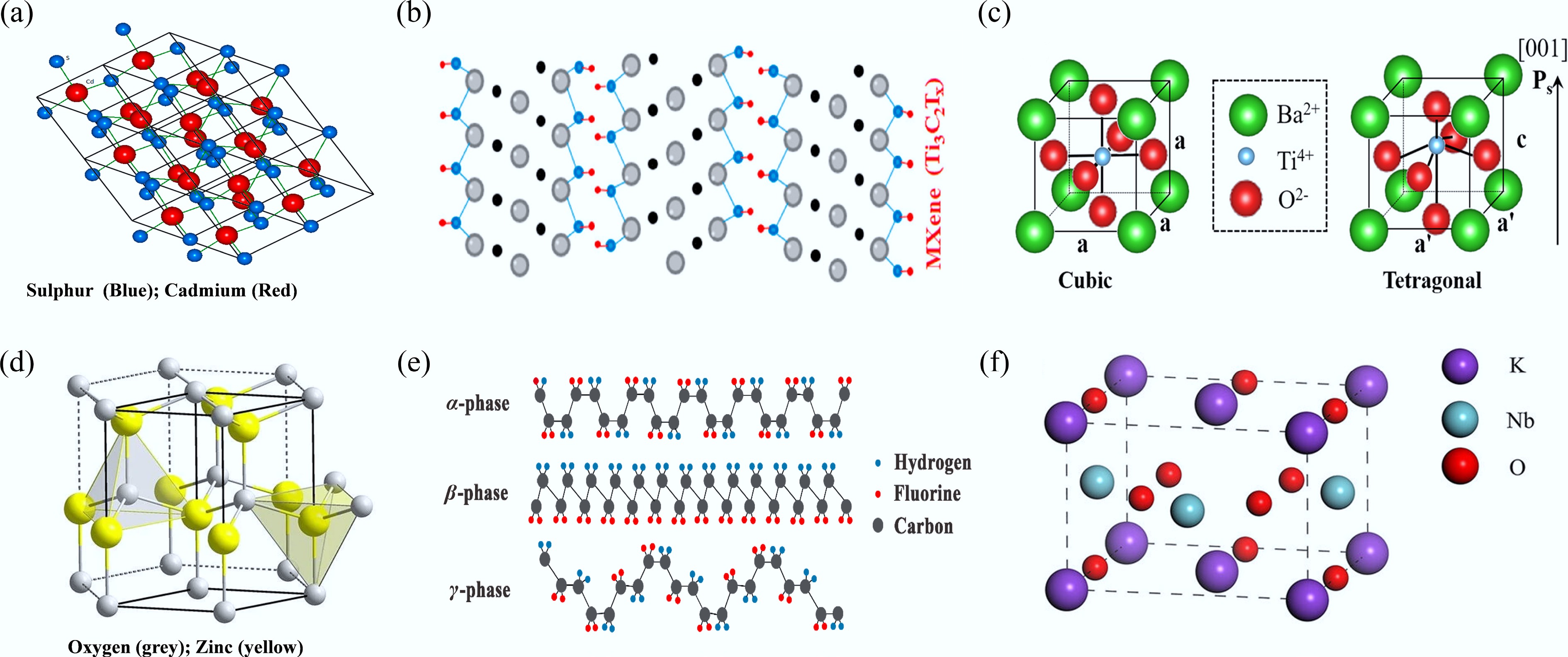
Zinc oxide (ZnO) and other semiconductors in the wurtzite family, such as gallium nitride (GaN), indium nitride (InN), as well as cadmium sulfide (CdS) and cadmium selenide (CdSe), have strong piezoelectric properties because of their crystallographic asymmetry[38]. The most common of these is CdS, a prototype piezoelectric semiconductor which has received significant interest in terms of its piezo-photocatalytic capabilities[39]. However, pure CdS has the disadvantage of rapidly recombining photogenerated carriers and polarized charges, which minimizes its potential catalytic activity (Fig. 5a)[40]. These semiconductors create electron–hole pairs under mechanical stress to generate ROS such as •OH and •O2− which enable oxidative depolymerization and selective oxidation of biomass-derived molecules to convert biomass to useful and sustainable products.
MXenes
-
The new type of 2D transition metal carbides and nitrides is called MXenes (Ti3C2Tx), which have become promising catalyst supports due to their high electrical conductivity, large specific surface area, and high density of surface terminations, as well as good chemical stability. It contains numerous active sites that can be attributed to its large surface area[41] and effective electron transport chain that is promoted by excellent conductivity (Fig. 5b)[42]. In the piezocatalytic conversion of biomass, it allows highly efficient charge separation and transfer of piezoelectric substances, which improves the formation of reactive radicals and improves the overall catalytic activity.
ABO3-type perovskites
-
The classical piezoelectric materials are ABO3-type perovskites, with A being a rare-earth or alkaline-earth metal, and B a transition metal. They contain barium titanate (BaTiO3) and lead zirconate titanate (Pb[Zr1−xTix]O3, PZT). As a typical ABO3 perovskite ferroelectric, BaTiO3 has a Tc of 120 °C. It has a crystal structure with Ti4+ ions bonded with six O2− ions to create TiO6 octahedra and with Ba2+ ions bonded on the corners of the unit cell[43]. Its spontaneous polarization is attributed to the movement of Ti4+ and O2− ions. It is centrosymmetric in the cubic phase (Pm3m) and is therefore non-piezoelectric. On the other hand, the Ti4+ ion moves out of the center in the tetragonal (P4mm) phase, producing a net dipole moment and a macroscopic polarization along the [001] axis (Fig. 5c)[44]. The elevated polarization enables such materials to efficiently produce reactive radicals under the influence of MF, which facilitates selective oxidation and depolymerization of biomass molecules.
Wurtzite piezoelectric materials
-
Wurtzite materials are hexagonal (P63mc) and have a tetrahedral AB-type composition. ZnO can be taken as an example. Zn2+ and O2− ions are arranged in the crystal lattice in such a way that both are stacked along the c-axis, and the centroids of both are the same in the unstressed form; therefore, no polarization is detected. When an external force is applied, the centers of negative and positive charges will be separated, leading to the polarization of the dipole and the generation of piezoelectric potential (Fig. 5d)[43]. This polarization contributes to the generation of reactive radicals that may be used in the reactions of biomass conversion, like lignin depolymerization or sugar oxidation.
Piezoelectric polymers
-
Some piezoelectric polymers are flexible due to the asymmetry of the molecular structures and oriented dipoles. Polyvinylidene fluoride (PVDF) is based on the structure of (-CH2-CF2-) monomers and has three polymorphs, namely α, β, and γ[45]. Dipoles in the β phase are oriented parallel to each other, and the maximum dipole moment per unit cell is obtained with better piezoelectric properties; the γ phase also helps in polarization (Fig. 5e)[46]. PVDF and copolymer forms like Poly (vinylidene fluoride–trifluoroethylene) (PVDF-TrFE) are used in piezocatalytic devices comprising flexible materials to produce radicals and generate moderate and effective biomass transformation under mechanical stimulation.
Other piezoelectric oxides and compounds
-
Other prominent piezoelectric compounds are alkali metal niobates, including potassium niobate (KNbO3), sodium potassium niobate ([Na1−xKx]NbO3), silver niobate (AgNbO3), and bismuth ferrite (BiFeO3) (Fig. 5f). These materials enable further opportunities to design high-performance piezocatalytic systems because of their inherent polarization, tunable electronic structures, and chemical stability, and they allow efficient radical-involved reactions to convert biomass.
In order to have a general overview, Table 1 summarizes the most important piezoelectric materials that have been reported to be used in piezocatalysis studies, their crystal structures, interesting properties, and applicability in the biomass conversion processes, such as the production of ROS in the presence of MF. These quantitative parameters (e.g., piezoelectric coefficient d33 and spontaneous polarization) directly influence the magnitude of the piezopotential and charge separation efficiency, thereby governing the catalytic performance of piezoelectric materials.
Table 1. Piezoelectric materials used in piezocatalysis and their significance for biomass conversion[7,10,24−32]
Sr No. Material Crystal structure Key features Key piezoelectric parameters Relevance to biomass conversion 1 BaTiO3 Perovskite (ABO3) High Tc = 120 °C, spontaneous polarization d33: 190–300 pC/N;
Tc: 120 °CStrong piezoelectric polarization enhances ROS generation, promoting oxidative degradation of biomass polymers 2 Pb(Zr1−xTix)O3 (PZT) Perovskite (ABO3) Tunable piezoelectric properties, high electromechanical coupling coefficient d33: 300–600 pC/
N; kp ≈ 0.6–0.7Efficient electron–hole separation drives selective oxidation and depolymerization of biomass compounds 3 KNbO3 Perovskite (ABO3) Lead-free, high piezoelectric response d33: 80–160 pC/N Facilitates ROS-mediated biomass conversion while avoiding toxic lead content 4 (Na1−xKx)NbO3 (NKN) Perovskite (ABO3) High mechanical strength, lead-free d33: 100–250 pC/N Facilitates ROS-mediated biomass conversion while avoiding toxic lead content 5 AgNbO3 Perovskite (ABO3) High piezoelectric activity, lead-free d33: 50–100 pC/N Promotes generation of ·OH and ·O2− radicals for biomass depolymerization 6 BiFeO3 Perovskite (ABO3) Multiferroic properties, high polarization Ps: 50–90 μC/cm² Combines piezoelectric and ferroelectric properties to efficiently degrade biomass molecules 7 ZnO Wurtzite (hexagonal) High surface area, UV-active, piezoelectric d33: 10–12 pC/N;
BG: 3.2 eVGenerates ROS under mechanical stimulation; high surface area facilitates biomass adsorption and oxidation 8 GaN Wurtzite (hexagonal) High thermal stability, piezoelectric d33: 3–5 pC/N Mechanically induced polarization produces ROS for biomass depolymerization under stress 9 CdS Wurtzite (hexagonal) Visible light absorption, piezoelectric BG: 2.4 eV;
d33: 5–10 pC/NMechanically induced polarization produces ROS for biomass depolymerization under stress 10 CdSe Wurtzite (hexagonal) Narrow bandgap, piezoelectric BG: 1.7 eV Generates ROS efficiently for oxidative cleavage of biomass molecules 11 Ti3C2Tx 2D (hexagonal) High conductivity, hydrophilic surface, tunable surface chemistry Conductivity:
103–104 S/mGenerates ROS efficiently for oxidative cleavage of biomass molecules 12 PVDF Polymer (ferroelectric) Flexible, high piezoelectric response
in β-phased33: 20–30 pC/N Mechanically flexible ROS generation, enabling biomass depolymerization in dynamic setups 13 PVDF-TrFE Polymer (ferroelectric) Enhanced piezoelectric properties, flexible d33: 30–40 pC/N Mechanically flexible ROS generation, enabling biomass depolymerization in dynamic setups 14 Bi0.5Na0.5TiO3 Perovskite (ABO3) Lead-free, high piezoelectric response d33: 60–120 pC/N Efficiently generates ROS for selective oxidative depolymerization of biomass 15 SrTiO3 Perovskite (ABO3) High dielectric constant, piezoelectric Relative permittivity
(εr): 300Enhances electron–hole separation, producing ROS for biomass oxidation 16 Bi4Ti3O12 Layered Perovskite High polarization, photocatalytic activity Ps: 50 μC/cm² Combines piezoelectric and photocatalytic effects to degrade biomass molecules efficiently 17 Bi4NbO8X
(X = Cl, Br)Layered Perovskite High polarization, photocatalytic activity BG: 2.5–3.0 eV Promotes ROS generation under mechanical stress for biomass depolymerization 18 Bi0.5Na0.5TiO3-BaTiO3 Perovskite (ABO3) Solid solution, high piezoelectric response, lead-free d33: 150–250 pC/N Synergistic properties of BNT and BaTiO3 enhance ROS production, facilitating efficient biomass conversion Bi0.5Na0.5TiO3: bismuth sodium titanate (BNT), SrTiO3: strontium titanate, Bi4Ti3O12: bismuth titanate, Bi4NbO8X: bismuth niobium oxyhalides, Bi0.5Na0.5TiO3-BaTiO3: bismuth sodium titanate–barium titanate (BNT-BT); BG: bandgap. Mechanism of piezocatalysis
-
At present, there are two major theories explaining the process of piezocatalysis: the energy band theory and the screening charge effect (Fig. 6)[51]. The catalytic behavior in the energy-band theory is determined by the intrinsic conduction band (CB) and the valence band (VB) levels, and piezopotential is a driving force that tilts the levels to allow the electrons and holes to enter the redox reaction. On the other hand, the screening charge effect focuses on the influence of externally induced screening charges whereby piezopotential directly regulates the reactivity of the material and should be equal to or larger than the Gibbs free energy change of the reaction. Though both theories are useful in the interpretation of piezocatalytic effects in classical reactions, including water oxidation and dye degradation, they are different in their focus: one of them is the modulation of reaction pathways, and the other is the increase in catalytic efficiency.
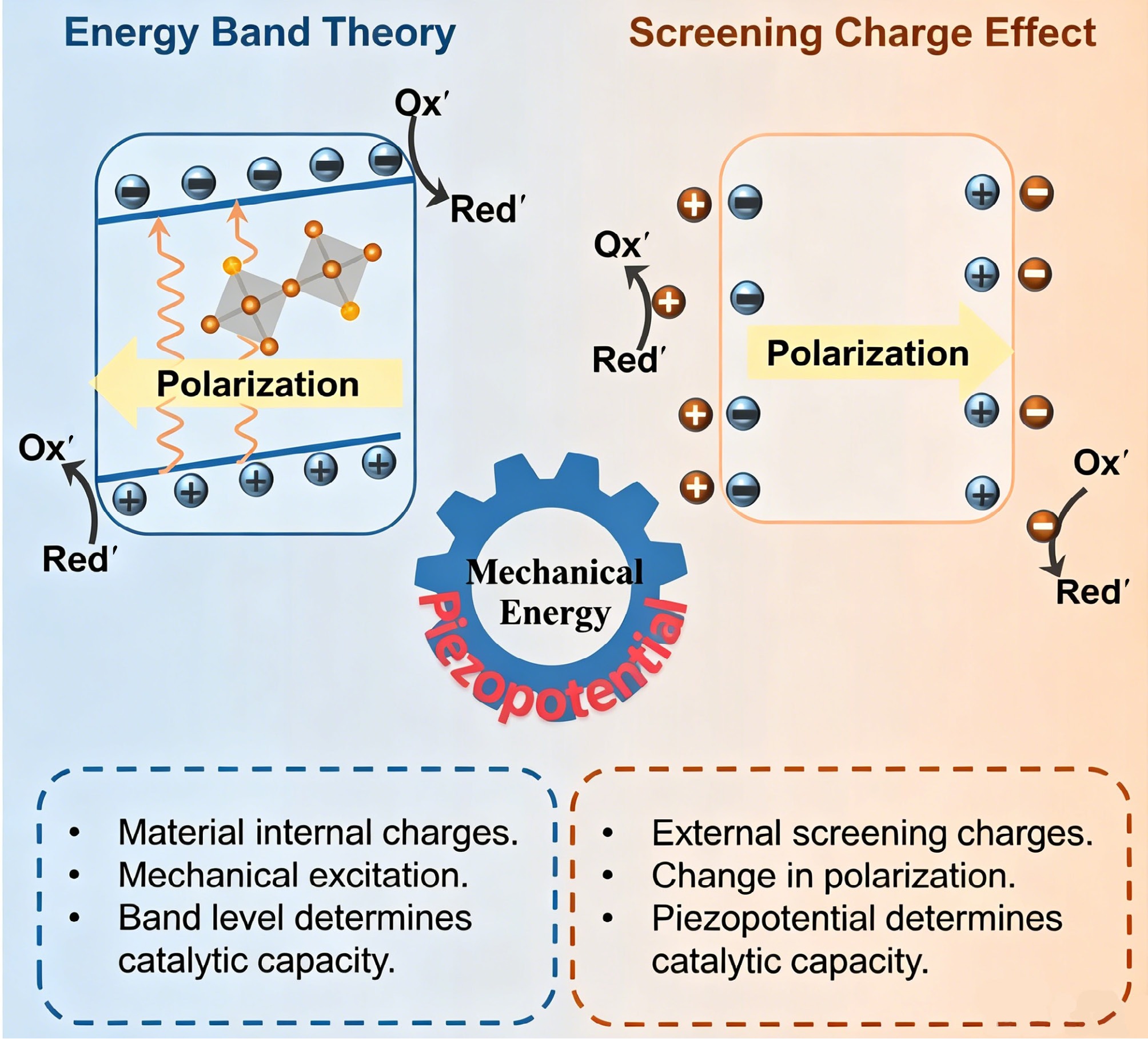
Figure 6.
Illustration of energy band and screening charge effect mechanisms in piezocatalysis[27].
Energy band theory
-
The polarization variations in piezoelectric materials in the energy band theory adjust the band structure and increase the redox ability. Mechanical strain creates a piezopotential, which creates an intrinsic electric field, tilting the energy bands and causing charge carriers. The magnitude of the piezopotential typically ranges from about 0.01 to 1 V, depending on the applied strain and the material properties, which can be comparable to or exceed the redox potential required for generating ROS such as •OH (~2.4 V vs NHE) under localized conditions. The electrons of the CB are used in reduction, and the holes of the VB are used in oxidation. Figure 7 shows that the piezopotential (φP) causes the positions of the bands to change to match the redox potentials of O2/•O2− and H2O/•OH, thus favoring these reactions. The source of free charge carriers in piezocatalysis is controversial. The electrons in the VB can be excited to the CB by ultrasound, either by the collapse of cavitation bubbles under high pressure or by localized hot spots created during cavitation. Vacancies of oxygen or sulfur in transition metal oxides are also known to generate defects, which add extra electrons and improve the performance with defect engineering[52−55].
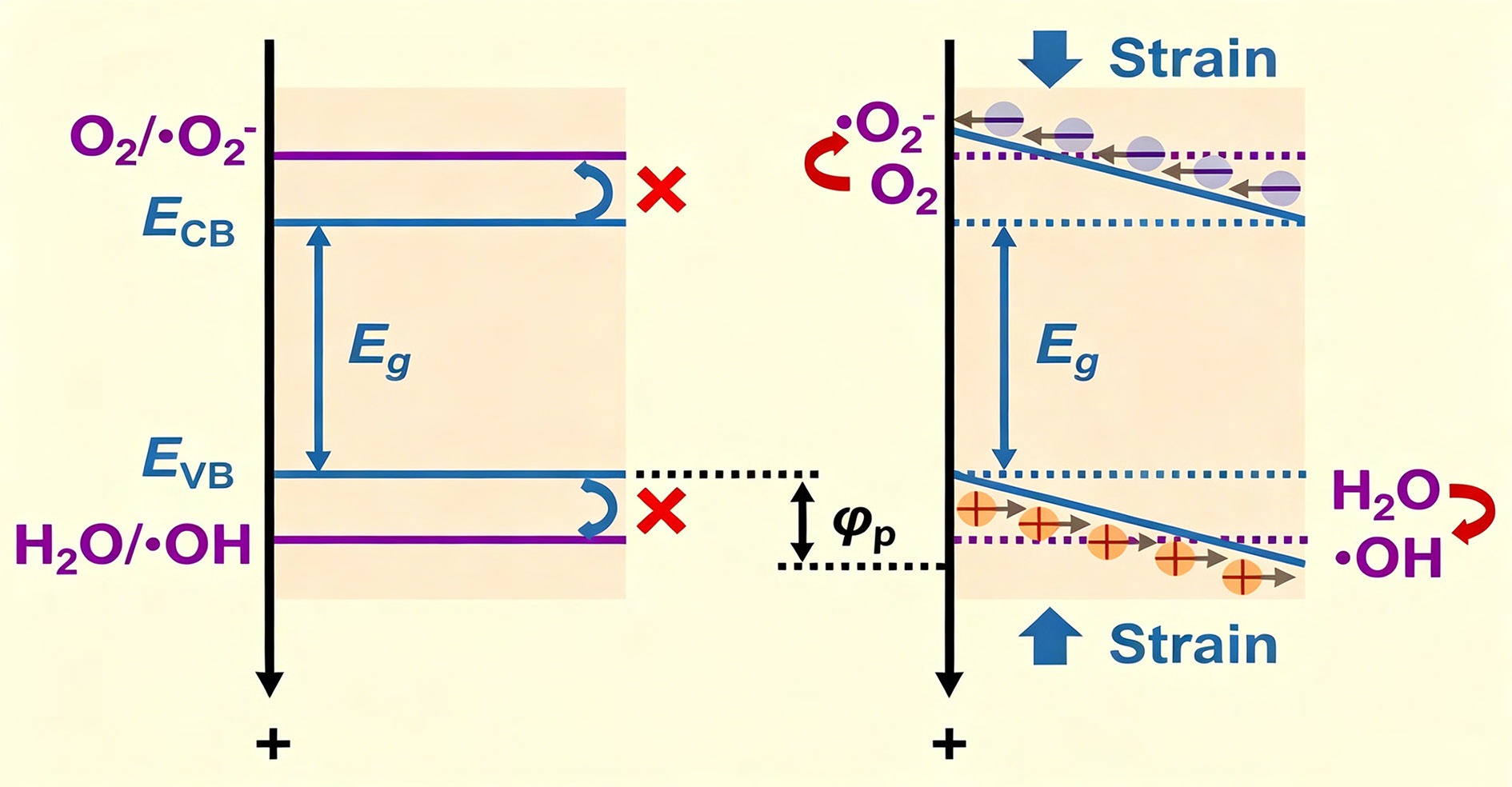
Figure 7.
Schematic illustration of the piezocatalytic energy band mechanism involving O2 reduction and H2O oxidation, showing the roles of ECB, EVB, Eg, and piezopotential (φP)[20].
In solution, a strained piezoelectric material acts similarly to a charged capacitor with piezopotential-driven charges dissipated through capacitive and Faradic processes. The capacitive process filters the surface charges, whereas the Faradaic transfer triggers the redox surface reaction. Nevertheless, in imperfect insulators, the charge buildup may cancel the internal field, limiting catalytic performance. As a result, dynamic charge separation can only be maintained by alternating mechanical stimuli, especially ultrasound. Although ultrasound augments piezocatalysis by synergistic sonochemical interactions, carrier recombination has been found to be a limiting factor; thus, it is essential to balance strain amplitude, frequency, and duration to achieve optimal performance[56].
Screening charge effect
-
The screening charge effect highlights the contribution of surface charges instead of internal carriers to piezocatalysis. Piezoelectric fields generated by mechanical stimulation change the electrostatic properties of the surface, thus changing the screening provided by external species. BaTiO3 is used to exemplify this model; surface-bound charges are neutralized by screening charges, and electrostatic neutrality is achieved (Fig. 8a)[57,58]. The density of bound charge changes under mechanical stress, propelling the migration of the screening charges reacting with local species (e.g., H2O) to produce ROS such as ·OH and ·O2− (Fig. 8b). Screening charges are constantly changed until the highest strain is achieved (Fig. 8c), and the higher polarization supplements the bound charge density, thus involving more screening charges in the ROS generation (Fig. 8d). The piezopotential controls the effectiveness of such redox reactions, both in the availability of charges and in the screening charge density. The surface screening charge density is proportional to the piezopotential, which can be written as:
$ {\sigma }_{\text{s}}=\dfrac{{d}^{*}P}{{\varepsilon }_{r}\left({\delta }_{1}+{\delta }_{2}\right)+d} $ (10) Here, d is the material thickness; δ1 and δ2 are the thicknesses of the screening layers. The equation indicates that the polarization is directly proportional to the catalytic performance. Quantitatively, an increase in piezopotential or dielectric constant can significantly enhance surface charge density, thereby increasing the number of active sites available for redox reactions. For instance, higher polarization intensity has been correlated with improved degradation efficiencies exceeding 80%–90% in typical organic pollutant systems under optimized conditions.
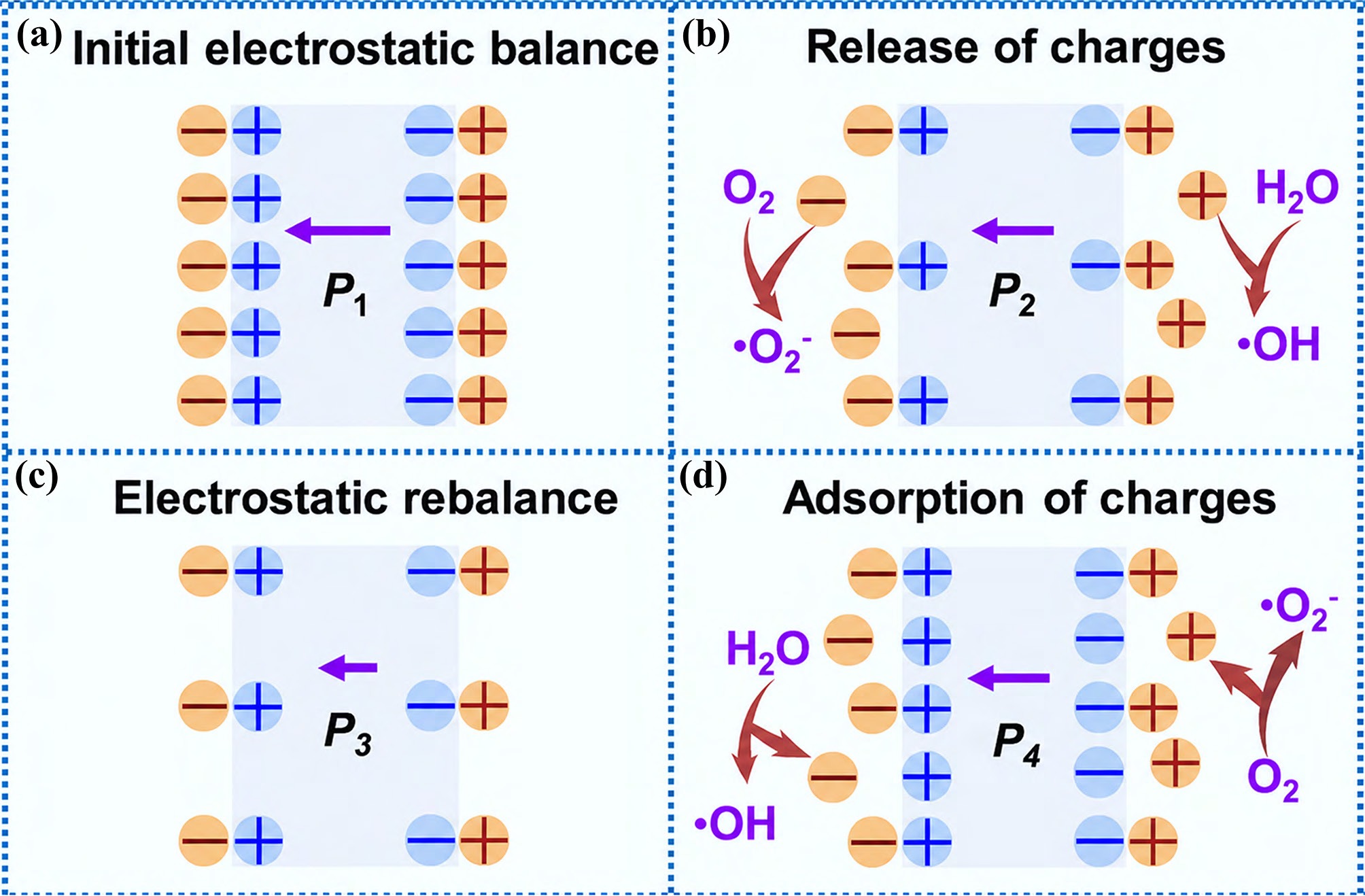
Figure 8.
Illustration of the screening charge effect in piezocatalysis: (a) initial electrostatic balance of polarized material; (b) release of screening charges forming ROS under compression; (c) rebalanced state after charge minimization; (d) charge adsorption from electrolyte upon strain release[20].
Biomass piezocatalytic conversion
-
Piezocatalytic conversion of biomass uses piezoelectric materials in order to induce chemical conversion under mechanical stress. In contrast to traditional energy band theory, where the bulk charge separation and migration of electron–hole pairs are used to cause redox reactions, the screening charge mechanism highlights the importance of charge processes on the surface. Piezoelectric polarization is produced by mechanical deformation, oscillating between the density of surface screening charges, which adsorb and release cyclically, to generate ROS, including •OH and •O2−. These ROS directly promote the depolymerization of biomass components such as cellulose and lignin, as well as their oxidation. To improve the polarization of piezoelectric materials, surface charge density and catalytic efficiency can be optimized, which makes the screening charge mechanism especially effective in converting biomass at surfaces as opposed to bulk-centrally oriented energy-band models (Fig. 9a).
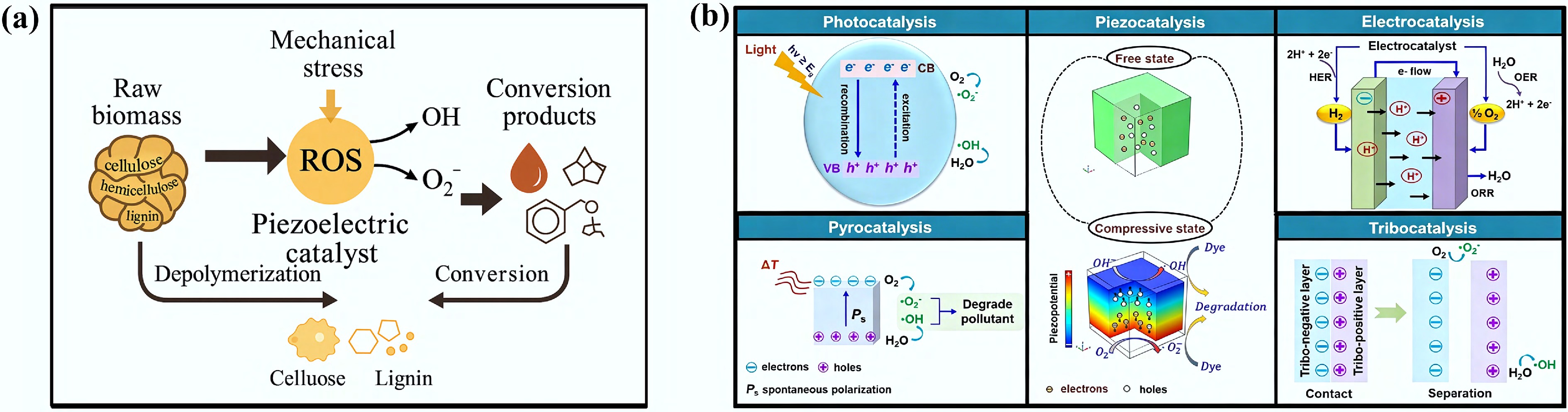
Figure 9.
Schematic illustration of the: (a) energy band and screening charge mechanisms in piezocatalytic biomass conversion; (b) mechanism of five catalytic technologies (photocatalysis, piezocatalysis, electrocatalysis, pyrocatalysis, and tribocatalysis)[20].
Different mechanical stimulation methods, including high-frequency ultrasonication, low-frequency shear forces (e.g., magnetic stirring), fluid-induced stress, and periodic mechanical deformation (e.g., bending or vibration), can significantly influence the generation and distribution of piezopotential in piezoelectric materials[16]. Ultrasonic irradiation is the most commonly employed approach, as it can generate intense localized pressures through acoustic cavitation, thereby inducing strong and periodic deformation of piezoelectric structures. For example, ultrasonic frequencies in the range of 20–100 kHz can generate local pressures up to about 108 Pa during cavitation bubble collapse, producing sufficient mechanical deformation to induce strong piezopotential and enhance catalytic activity[4,16]. The frequency and power of ultrasonication play a critical role, with optimal catalytic performance often observed near the resonant frequency of the material due to maximized vibration amplitude and charge separation efficiency.
In contrast, low-frequency mechanical stimulations such as stirring or fluid flow typically generate weaker MF, which may be insufficient to induce significant piezopotential unless structural design strategies (e.g., porous architectures or flexible substrates) are employed to amplify stress concentration. Additionally, periodic mechanical deformation methods, such as bending or oscillation, have been shown to produce stable and controllable piezoelectric outputs, which can effectively drive charge carrier migration and redox reactions. These approaches are particularly advantageous for device-level applications where continuous and directional mechanical input is available. In addition, the mechanisms of five catalytic technologies (photocatalysis, piezocatalysis, electrocatalysis, pyrocatalysis, and tribocatalysis) are illustrated in Fig. 9b, highlighting their energy conversion pathways, charge carrier dynamics, and reactive species generation for biomass conversion applications.
From our perspective, the selection of mechanical stimulation methods is not only a matter of energy input but also a key factor governing the efficiency of charge separation, reaction kinetics, and overall catalytic performance. Therefore, a systematic understanding of these stimulation modes is essential for optimizing piezocatalytic systems, particularly in practical biomass conversion processes.
-
Piezocatalysis provides a new sustainable pathway for biomass valorisation to transform mechanical energy into chemical driving forces to improve depolymerisation, oxidation, and selective transformation of biomass components. It involves the piezoelectric effect of functional materials to produce surface charges and ROS in response to mechanical stimuli (ultrasound, vibration, or stirring) to permit the use of efficient surface-mediated reactions without harsh chemicals or extreme conditions.
Biomass-derived chemical organic synthesis
-
Piezocatalysis has been demonstrated to be effective in a wide variety of biomass-related processes. Piezoelectric materials can be used to speed up the rate of organic synthesis with platform chemicals derived from biomass, such as aldehydes, acids, and polyols, to selectively produce high-value intermediates under mild conditions. As an example, the oxidative cleavage of lignocellulosic polymers can be assisted using piezoelectric nanocomposites, which promote the conversion of lignin, cellulose, and hemicellulose to platform molecules, including furfural, 5-hydroxymethylfurfural, levulinic acid, and 3-hydroxypropionic acid, which can be used as the building blocks of biofuels, resins, and biodegradable polymers[59].
Resource recovery and precious metal extraction
-
In the context of biomass conversion, resource recovery is an important complementary aspect, particularly in integrated biorefinery systems where biomass feedstocks and processing streams often contain trace metals, catalytic residues, or valuable inorganic components. The ability to selectively recover these resources not only enhances process sustainability but also improves overall economic feasibility. Therefore, extending piezocatalytic applications to resource recovery provides an additional dimension to biomass valorization. MoS2 nanoflowers with defects have also been utilized as piezo-photocatalysts to extract gold, offering an environmentally friendly, safer alternative to cyanidation[60]. This highlights the ability of catalysis via MF to selectively and effectively extract desirable elements from complex matrices. In biomass-related systems, such selective extraction strategies can be applied to recover valuable metals from biomass-derived waste streams, ash residues, or catalytic systems used during conversion processes. This demonstrates that piezocatalysis is not only effective in transforming biomass into fuels and chemicals but also plays a role in closing the material loop by enabling the efficient recovery of valuable resources, thereby supporting the development of sustainable and circular biomass utilization frameworks.
Dewatering and treatment of sludge
-
Piezocatalysis is also known to improve the sludge dewatering and treatment processes. As an example, piezo-dewatering decreased the moisture content of sludge from 96.7% to 63.9% and decreased the weight of sludge from 50 to 3.2 g, as compared to the conventional pressure-filtration process[61]. It relies on the piezo-induced polarization and ROS formation that enhance the process of water expulsion and structural change of biomass matrix, and thus proves to be useful in wastewater and waste-biomass management.
ROS-mediated surface reactions
-
Mechanistically, piezocatalysis improves the conversion of biomass by increasing the rate of electron–hole separation, ROS formation (•O2−, •OH, H2O2), and improving surface-mediated redox reactions. These reactive species have the ability to selectively oxidize biomass polymers or break bonds, facilitating depolymerization and enhancing the yields of platform chemicals. Piezocatalysis offers an alternative to harmful chemical reagents by working under mild conditions and therefore offers a green, sustainable biomass conversion method[61].
Comprehensively, the integration of piezocatalysis in biomass conversion is an attractive approach to sustainable chemical production, bridging the gap between mechanical energy collection and chemical valorization, and providing the possibility to produce high-value products from waste and renewable materials.
Environmental remediation
-
Piezocatalysis has shown great potential in cleaning the environment by converting a wide range of pollutants using ROS-mediated reactions. Its application in the degradation of dyes, antibiotics, pollutants, and wastewater disinfection is discussed in the following subsections.
Dye degradation
-
Organic dyes, which are widely found in industrial effluents, are highly hazardous to the environment due to their recalcitrance and toxicity, and more than 10,000 varieties of organic dyes are known[62]. Advanced oxidation processes (AOPs) are effective dye removal strategies that are based on the formation of ROS (•OH and •O2−), which oxidatively cleave dye molecules[63,64]. Mechanically induced piezoelectric potentials in piezocatalytic systems are used as extended electric fields, which facilitate interfacial charge separation and band bending, and in turn increase the generation of ROS and the rate of dye degradation. Liu et al. prepared three different nanostructures of BaTiO3 nanocubes (NCs), nanoparticles (NPs), and nanofibers (NFs) through hydrothermal synthesis, sol-gel calcification, and electrospinning, respectively[65]. Among them, the BaTiO3 NFs exhibited better piezocatalytic activity, which was attributed to their high specific surface area and good mechanical deformation response. The degradation of dye under ultrasonic vibration was applied under the influence of the •OH and •O2− radicals, which was confirmed using electron spin resonance (ESR) measurements. The piezoelectric degradation of dye with piezoelectric materials is a mechanistic process that can be summarized as follows[65,66]:
$ \text{Piezoelectric materials}\xrightarrow{\text{Mechanical energy}}\text{Strain of piezoelectrics →}\left({\text{e}}^-+{\text{h}}^+\right) $ (11) $ \text{Reduction:}\; \text{e}^-+\text{O}_2\to{\text •}\rm{O}_2^- $ (12) $ \text{Oxidation:}\;{\text{h}}^+ + {\text{OH}}^- \to {{\text •} {\rm{OH}}} $ (13) $ \rm\left({{\text •} OH \;or \; {\text •} O}_{2}^-\right)+ Dye \to Degradation $ (14) Antibiotics degradation
-
Antibiotics are widespread pollutants that pose ecological and human health hazards, such as disturbance of natural bacterial communities, teratogenicity, and multi-organ damage. Similar to the degradation of dyes, ROS are at the center of the piezocatalytic degradation of antibiotics. As an example, flower-like Fe@MoS2 powders prepared by mechanochemical ball-milling exhibited effective tetracycline degradation, which was supported by 3D excitation–emission matrix fluorescence spectra[67]. The breakdown mechanism involves demethylation, ring-opening, decarboxylation, and dihydroxylation, which ultimately produce CO2, H2O, and lower-molecular-weight compounds. Fe@MoS2 exhibits a strong piezo-activity due to its few-layered structure and semi-metallic characteristics, and the key active species in the process are found to be the ·OH and singlet oxygen(1O2) radicals.
Pollutant degradation
-
Industrial processes have introduced numerous pollutants, such as organic dyes, agricultural chemicals, antibiotics, and heavy metals. Piezocatalysis makes use of mechanical vibration to create piezoelectric charges that create ROS to break down contaminants. This process has been investigated in more than 150 studies with the help of piezoelectric perovskites and transition metal dichalcogenides. The order of increasing pollutant removal is as follows: coupling with other reactions (49.19) > morphology control (9.39) > additional energy harvesting (7.18) > polarization treatment (5.59) > cocatalyst loading (4.71) > composite design (3.36) > other methods. Morphology control, such as the conversion of nanoparticles into nanosheets or nanowires, enhances degradation through the maximization of piezoelectric properties, charge separation, and surface area. Photocatalytic coupling is found to enhance ROS generation, whereas polarization treatment and cocatalyst/composite approaches have moderate effects, mostly through the effect on surface charge transport. Other parameters, like frequency of vibration, also influence activity. Together, these strategies guide the development of effective piezocatalysts to be used in the effective disposal of pollutants[3].
Wastewater disinfection
-
Piezocatalysis has been widely studied as an ROS-based environmental remediation method, which involves pollutant degradation and microbial inactivation. Doped materials, mechanical stimulation, and light irradiation increase the production of •O2−, •OH, and H2O2[66,68]. As an example, Bi4NbO8Cl and Bi4NbO8Br yielded •O2− levels of 90 and 98.7 μmol h−1 g−1, respectively, significantly higher than the level obtained by pure piezocatalysis[62]. These ROS have been used in the disinfection of wastewater, such as the inactivation of E. coli and S. aureus, and medical wastewater treatment, where bacterial survival has decreased to 2.86% in 6 h[69,70]. In addition to microbial control, the oxidation of pollutants by ROS generation enables the oxidative breakdown of pollutants, highlighting the flexibility of piezocatalysis in environmental remediation.
Energy applications
-
Piezocatalysis has become a viable approach to sustainable energy generation, allowing the conversion of a large number of mechanical resources into fuels and value-added chemicals through mechanical-energy-controlled reactions. The following subsections refer to its use in hydrogen production, greenhouse recycling, and the piezocatalytic production of energy carriers.
Hydrogen production
-
Hydrogen, a carbon-neutral and high-energy-density fuel (approximately 286 kJ mol−1), is an attractive alternative to fossil fuels. It can be used in transportation, construction, and manufacturing. The photocatalytic water splitting technique is one of the sustainable production methods that only needs semiconductors and light. The reaction involving overall water-splitting generates hydrogen (H2) and oxygen (O2) is as follows:
$ \rm Reduction:\;4H^+ + 4e^- \to 2H_{2} $ (15) $ \rm Oxidation:\;2H_2O + 4h^+ \to 4H^+ + O_2 $ (16) $ \rm{O}verall\; water\; splitting:\; 2H_2O\to2H_2+O_2 $ (17) BaTiO3, Bi0.5Na0.5TiO3, ZnO microfibers, V-doped sodium niobate (NaNbO3), and C-doped KNbO3[71−76] are piezoelectric semiconductors that have been designed to generate H2 efficiently. The pH-controlled etching of sodium borohydride (NaBH4) to create mesoporous b-BaTiO3 nanoparticles is characterized by alternating layers of barium oxide (BaO) and titanium dioxide (TiO2), and inhomogeneous surface layers. Transmission electron microscopy (TEM) established the perovskite structure and TiOx surface reconstruction. Computational models indicate a localized electric potential up to 1.6 V, which is enough to split water in general, with H2 production rates of 159 μmol g−1 h−1. The lower H2 and O2 evolution rates in the presence of ultrasonication and illumination are explained by lower H+/OH− absorption due to increased charge separation. Performance is also increased by phase and strain engineering. BaTiO3 nanoparticles (~10 nm) with high electromechanical coefficients were hydrothermally synthesized (655 μmol g−1 h−1 of H2) at a high concentration (5 mg L−1) and in 10% methanol/water (MeOH/H2O)[71,77]. Surface area and activity are enhanced by non-centrosymmetric phases and decreased particle size. The temperature plays a major role, as barium strontium titanate (BaxSr1−xTiO3) pellets reach 3,590 μmol g−1 h−1 at 40–42 °C just below the Curie point, due to changes in polarization during stress[78].
Recycling of greenhouse gases
-
Global warming is driven by greenhouse gases like carbon dioxide (CO2), methane (CH4), and nitrous oxide (N2O), catalyzing the valorization of CO2 through thermocatalytic, photocatalytic, electrocatalytic, and piezocatalytic reactions[79,80]. Piezocatalysis is especially appealing because of the mild conditions, the lack of sacrificial reagents or light, and the use of mechanical energy; the design of catalysts is critical in terms of activity and selectivity. Carbon monoxide (CO) was generated at 438 μmol g−1 h−1 by lead-free lithium-doped potassium sodium lithium niobate (K0.05Na0.05Li0.05NbO3 [KNLN])[81]. Cobalt–nitrogen–carbon-modified barium titanate (Co–N–C@BaTiO3) piezocatalysts obtained a 93.8% CO selectivity and 261.8 μmol g−1 h−1 under 50 kHz ultrasonication with piezoelectric resonance[82]. Niobium-doped lead zirconate titanate–nickel (Nb-doped PZTN) powders exhibited 789 μmol g−1 h−1 due to increased polarization around their Curie point[83]. Methane conversion was also aided through piezocatalysis. Hydroxyapatite (HAp) reacted with CH4 through ultrasound-induced surface charges[84], generating methanol, ethanol, and 2-propanol at 84.4, 43.2, and 9.6 μmol g−1 h−1, respectively, without the formation of CO/CO2 byproducts. The process is associated with the cleavage of C–H bonds, and the enhancement of C–C coupling by the action of the •OH radicals. HAp exhibits stable performance regarding cycling.
Piezocatalytic generation of energy carriers
-
Piezocatalysis provides viable solutions to the generation of energy-related chemicals. Ammonia (NH3), which is one of the promising energy carriers, can be produced through piezocatalytic fixation of nitrogen, thus avoiding the energy-intensive Haber–Bosch process[85]. Dai et al.[86] found that NH3 formation showed a 7.4-fold increase when potassium tantalate niobate (KTa0.75Nb0.25O3 [KTN]) was added to copper (II) sulfide (CuS), and increased even more to 212.2 μmol g−1 h−1 when simulated sunlight was used. The rate of NH3 production by the bismuth sulfide/potassium tantalate niobate (Bi2S3/KTN) heterojunction composite was 581 μmol g−1 h−1[87]. Moreover, piezocatalytic CO2 reduction has been achieved with BaTiO3 nanofibers and lithium-doped potassium sodium niobate ([K0.5Na0.5]0.97Li0.03NbO3 [Li-doped KNN]) under vibrational excitation, which produced high selectivity of CO and hydrocarbons[88]. Mechanical stress causes a piezo-potential that causes the transfer of electrons and enables such reactions to occur.
Biomedical and biotechnological applications
-
ROS are oxygen-containing molecules that are generated and regulated in a constantly changing biological system[89]. At physiological levels, they do not affect the normal cellular functions such as metabolism, proliferation, and apoptosis[90,91]. But their excess can destabilize redox homeostasis and initiate oxidative stress and irreversible damage to DNA, proteins, and lipids, which culminates in cell apoptosis or necrosis[92]. By utilizing this property, piezocatalysis can achieve controlled levels of ROS, which can be used in tumor therapy, antibacterial therapy, tissue regeneration, Alzheimer's disease therapy, tooth whitening, and other biomedical applications. The biomedical potential of piezocatalysis is also highlighted by the process of ROS generation, which helps in sterilization, wound healing, and disease treatment.
Case studies on piezocatalysis
-
The field of piezocatalysis and biomass conversion intersection is a relatively new field, but a number of case studies can provide valuable understanding of its existing and future applications. The nearest biomass-related case study would be the one conducted by Feng et al.[61], who used under-mechanical-pressure BaTiO3 to improve the dewatering of sewage sludge. Under this system, piezo-induced charges and ROS destabilized extracellular polymeric materials in the sludge, resulting in drastic decreases in moisture content and sludge volume. This work shows that piezocatalysis has the ability to alter real and heterogeneous biomass matrices under relatively mild conditions and is therefore a promising technology in the pretreatment and conditioning of wet biomass and biowaste streams. Additional studies on engineered biochar and activated carbons made of agricultural residues[19,56] and nanotechnology-powered lignocellulose conversion also suggest that biomass itself can be converted into useful catalyst supports, providing a sustainable foundation for future piezo-hybrid catalysts.
In addition to direct biomass feeds, a sequence of piezocatalytic systems have been tested with biomass-like model compounds that act as mechanistic proxies of lignin and other biopolymers. Examples include SnS2/carbon nanofibre membrane systems to oxidize bisphenol A; BaTiO3 and BaTiO3@TiO2 structures to oxidize dyes and aromatic degradation; Au/BiVO4 to oxidize chlorophenol; Fe@MoS2 to oxidize tetracycline; and BaTiO3/Ag3PO4 or Cu3B2O6 to oxidize heterocyclic organics. The case studies, along with new developments in piezocatalytic CO2 reduction[26,81], exemplify bond breaking and redox activities that can be highly applicable to biomass depolymerization and carbon cycle management, although not yet to real lignocellulosic feedstocks. Overall, Table 2 illustrates the evidence-of-concept viability of piezocatalysis for biomass-related systems, as well as the evident potential of future studies on the direct conversion of lignocellulosic biomass and its major intermediates. The reported performance metrics indicate that piezocatalytic systems generally achieve higher degradation efficiencies and faster reaction kinetics compared to conventional catalytic or non-catalytic processes. This highlights the significant potential of piezocatalysis for efficient biomass conversion under mild conditions.
Table 2. Case studies demonstrating the application of piezocatalysis in biomass conversion
Sr. No. Authors Year Study Research aim Materials used Conditions Methodology Performance metrics Key findings Areas of application Ref. 1 El-Fawal et al. 2025 Biomass conversion and engineered biochar To evaluate the catalytic role of engineered biochar in biomass conversion Biomass residues; engineered biochar Pyrolysis routes Review — Highlights biochar as catalytic support relevant to piezo-catalysts Biomass-derived catalyst supports [19] 2 Xin et al. 2025 MXene–Co PMS activator To activate PMS for oxidation of organic biomass-like matter Ti3C2MXene-Co Aqueous oxidation PMS activation tests ~90% degradation efficiency Strong oxidation relevant to biomass depolymerization Biowaste oxidation [41] 3 Feng et al. 2022 Piezocatalytic sludge dewatering To evaluate piezoelectric BaTiO3 for EPS disruption in biomass (sludge) BaTiO3; sewage sludge Pressure
0.3–0.6 MPaEPS oxidation, EPR Moisture: 96.7% → 63.9% Moisture reduced from 96.7% to 63.9%; strong piezo-oxidation Biomass waste management [61] 4 Liao et al. 2022 Cu3B2O6 piezocatalysis To study polarization-induced ROS for organic oxidation Cu3B2O6 Ultrasonic vibration Piezocatalytic degradation ~85%–95% removal Breaks C–C and C–H bonds similar to biomass depolymerization Biomass-like organic breakdown [69] 5 Fu et al. 2022 BaTiO3@TiO2 nanofibers To enhance dipole alignment for stronger piezo-activity BaTiO3@ TiO2 nanofibers Ultrasonic + light Piezophotocatalysis ~95% degradation High degradation of aromatic organics (biomass analogues) Aromatic biomass compound oxidation [90] 6 Phuong et al. 2022 Lead-free piezocatalytic CO2 reduction CO2 → fuels via piezoelectric particulates Lead-free ferroelectrics Ultrasonication CO2 reduction CO yield improvement (~2–3 times) Efficient carbon conversion relevant to biomass–CO2 cycles Bioenergy and carbon cycling [81] 7 Tian et al. 2021 Piezocatalytic BPA degradation To oxidize BPA (lignin-like aromatic) SnS2/CNF membrane Ultrasonication Piezocatalytic oxidation ~90% removal High removal of BPA, similar to lignin monomer oxidation Biomass-derived phenolic depolymerization [53] 8 Shi et al. 2021 Piezocatalytic foam for organic degradation To create foam-based piezocatalytic oxidation system Piezo-active foam Ultrasonic vibration Organic degradation ~80–90% removal Efficient degradation of complex high-MW organics Biowaste treatment [54] 9 Meng et al. 2020 Fe@MoS2 piezocatalyst To degrade complex antibiotic molecules resembling biomass organics Fe@MoS2 Mechanical vibration Piezocatalysis ~85% degradation Strong oxidation of complex organic molecules Organic biowaste [67] 10 Liu et al. 2020 BaTiO3 morphology for dye degradation To investigate morphology–activity relationships BaTiO3 nanostructures Ultrasonication Kinetics and degradation tests ~90% dye removal Efficient breakdown of dyes (biomass aromatic analogs) Biomass-related aromatic conversion [65] 11 Wei et al. 2019 Au/BiVO4 bifunctional piezocatalysis To degrade chlorophenols (lignin-derived) Au/BiVO4 Ultrasonication Piezocatalysis ~92% removal High degradation of chlorophenols resembling lignin fragments Lignin model molecule conversion [55] 12 Lan et al. 2019 BaTiO3/Ag3PO4 piezophotocatalysis To degrade N-heterocyclic organics BaTiO3/Ag3PO4 Light + vibration Piezophotocatalysis ~93% degradation Efficient breakdown of heterocyclic organics Biowaste and agrochemical residues [92] 13 Sankaran et al. 2021 Nanotechnology in lignocellulose conversion To apply nanomaterials for biomass breakdown Nanostructures; biomass Various Review — Demonstrates nanomaterial efficacy in depolymerizing biomass Lignocellulosic biomass valorization [13] 14 Sudrajat et al. 2023 Review on piezoelectric photocatalysis To summarize mechanism, materials, and applications ZnO, BaTiO3, BiFeO3, MoS2 composites Light + mechanical stress (ultrasound/
vibration)Review — Piezoelectric field improves charge separation and boosts performance Water treatment, pollution control, hydrogen production [26] 15 Demirbas et al. 2009 Biomass-derived activated carbon To evaluate agricultural biomass conversion into catalysts Agricultural biomass Pyrolysis Review — Biomass-derived carbon widely used as catalytic support Biochar-supported piezo-catalysts [62] 16 Ren et al. 2025 Defect-engineered piezocatalysis To enhance piezocatalytic activity via defect engineering (K,Na)NbO3 (KNN) Ultrasonic vibration Piezocatalytic degradation Rate constant increased by 1.3–4.4× vs pristine Oxygen vacancies significantly enhance charge separation and ROS generation Organic pollutant degradation (biomass analogues) [93] 17 Zhao et al. 2025 Al-doped BCZT piezocatalyst To improve degradation efficiency via doping Al3+-doped BCZT Ultrasonication Piezocatalytic degradation 84.2% degradation in
70 minDefect engineering improves catalytic efficiency compared to undoped materials Organic pollutant degradation [94] 18 Park et al. 2025 PVDF-based piezocatalysis To evaluate energy-efficient degradation system PVDF/AC-NaCl composite Fluid flow/mechanical stimulation Piezocatalytic degradation 99.53% degradation efficiency Lower energy consumption compared to conventional AOPs Water treatment/
biomass-like organics[95] 19 Ran et al. 2024 Defect-mediated piezocatalysis To enhance ROS generation via dynamic defects Defect-engineered catalyst Mechanical vibration H2O2-assisted piezocatalysis Enhanced in-situ H2O2 generation Dynamic defects improve catalytic activity and reaction pathways Environmental remediation/
biomass analogues[96] 20 Lu et al. 2024 Borate-based piezocatalysis To evaluate pharmaceutical degradation efficiency CaZn2(BO3)2 Ultrasonication Piezocatalytic degradation 100% (ibuprofen), 83.8% (CBZ) in
36 minHigh degradation efficiency with fast kinetics compared to conventional systems Pharmaceutical/
biomass-derived pollutants[97] -
Piezocatalytic materials face problems concerning mechanical and chemical stability in the presence of a reaction. The degradation of many piezoelectric ceramics and 2D materials, including transition metal dichalcogenides (TMDCs), graphene, and graphitic carbon nitride (g-C3N4), is observed under long-term mechanical vibration or under high-power ultrasonic stimulation. In hybrid piezo-photocatalysts, the piezo-photocatalyst bond tends to deteriorate with time, leading to poor cyclic stability and performance. Moreover, the piezoelectric properties of ferroelectric materials, including KNN and BNT, are temperature-sensitive and have a direct effect on the catalytic efficiency. These concerns restrict the longevity of the materials in the continuous or industrial level of converting biomass.
Scalability
-
Enhancing piezocatalytic systems on a large scale is a big challenge. Recent synthesis strategies of highly developed piezocatalysts are hydrothermal processing, chemical vapor deposition, and exfoliation, which are unable to generate uniform monolayers or defect-engineered materials at large scales. Laboratory studies that are based on experimental procedures usually use high-frequency ultrasonic irradiation, which does not simulate the low-frequency mechanical energy of natural or industrial biomass processing conditions. The lack of standardization of the dosage of catalysts, the volume of the reactor, and the mechanical energy input makes inter-study comparisons difficult, and the overall transfer of piezocatalysis to the industrial level even more problematic.
Economic viability
-
It is still unclear whether piezocatalysis is economically viable. The complex and expensive synthesis of advanced materials like TMDCs, bismuth layered structures, and hybrid composites is required. The energy and material costs are increased by the optimization of the operational parameters, such as ultrasonic power and duration. In comparison with conventional catalytic techniques, piezocatalysis should be able to balance the performance of materials, power consumption, and stability over the long run to justify its application on a large scale to convert biomass.
-
Piezocatalysis has become a new frontier in catalytic science, applying mechanical energy to catalyze chemical reactions with applications in environmental remediation, renewable energy generation, and biomass conversion. In recent years, significant progress has been achieved specifically in the application of piezocatalysis for biomass conversion, including lignocellulosic depolymerization, selective oxidation of biomass-derived platform molecules, and hydrogen generation from biomass-related substrates. Recent studies have demonstrated that piezocatalytic systems can effectively enhance charge separation and reaction selectivity under mild conditions, making them particularly suitable for complex biomass transformation processes. Furthermore, emerging research on carbon-based and hybrid piezocatalysts has shown promising potential for improving catalytic efficiency and stability in biomass valorization systems[98]. The development of piezoelectric and ferroelectric materials, such as TMDCs, bismuth layered structures, wurtzite-based semiconductors, graphene, g-C3N4, and metal-organic frameworks (MOFs), has greatly increased the range of piezocatalysts. The material design techniques that include defect engineering, doping, morphology control, polarization modulation, and heterostructure formation have shown significant enhancement of catalytic performance, stability, and reusability. In spite of these developments, there are still a number of challenges. Continuous mechanical stimulation of piezocatalysts is a key issue in determining their mechanical and chemical stability, especially in hybrid systems with piezoelectric and photocatalytic capabilities. The methods of synthesis of monolayer or defect-engineered materials are not scalable, which limits their application in industry, and no standard operational parameters exist to compare results. In the context of biomass conversion, additional challenges arise from the inherent complexity and heterogeneity of biomass feedstocks, which can affect catalytic efficiency, selectivity, and reproducibility. Issues such as catalyst fouling, intermediate byproduct formation, and mass transfer limitations in solid–liquid systems require further systematic investigation. Moreover, economic feasibility, particularly in biomass conversion, should be closely considered to make sure that it is cost-effective compared to traditional catalytic processes.
Future studies must be aimed at designing new piezoelectric materials with better characteristics and responsiveness to low-frequency mechanical energy, applicable in nature and industry. To achieve maximum efficiency, selectivity, and radical generation, process optimization, such as reactor design and the control of operational parameters, is vital. Piezocatalytic systems incorporated into biorefinery systems have the potential to improve sustainability, energy use, and biomass use. In particular, the integration of piezocatalysis into biomass conversion pathways offers promising opportunities for developing low-energy and high-selectivity processes for the production of biofuels and value-added chemicals. Future research should focus on coupling piezocatalysis with pretreatment and downstream processing technologies in biorefineries to enable continuous and scalable biomass valorization. Also, by integrating piezopotential with other complementary catalytic methods and better understanding the interactions between piezopotential, charge dynamics, and reaction kinetics, it will become possible to rationally design better catalytic systems. In general, further interdisciplinary work between material science, catalysis, and process engineering will lead to further developments in the fundamental knowledge of piezocatalysis and its practical implementation. The potential of the technology is likely to be fully unlocked through the systematic production of durable, efficient, and scalable piezocatalysts, especially in sustainable chemical processes such as biomass conversion, hydrogen production, and the removal of pollutants. From a broader perspective, the advancement of piezocatalysis in biomass conversion will depend on bridging the gap between laboratory-scale studies and industrial implementation. This includes the development of robust reactor systems, optimization of mechanical energy utilization, and techno-economic assessments to evaluate feasibility at scale. With continued progress, piezocatalysis is expected to play a transformative role in enabling sustainable, carbon-neutral biomass conversion technologies.
We are thankful to the Editor and reviewers for their helpful and constructive suggestions to improve the quality of this manuscript. All the authors and co-authors agreed to publish the final version of this manuscript.
-
Not applicable.
-
The authors confirm their contributions to the paper as follows: Neyha Rubab Syed: conceptualization, writing-initial draft; Bo Zhang: conceptualization, supervision; Chaoyu Ren: visulization and validation; Desta Getachew Gizaw, Roger Ruan: refine the initial draft. All authors reviewed the results and approved the final version of the manuscript
-
The datasets generated during and/or analyzes during the current study are available from the first/corresponding author on reasonable request.
-
The authors declare no conflict of interest.
-
Full list of author information is available at the end of the article.
- Copyright: © 2026 by the author(s). Published by Maximum Academic Press, Fayetteville, GA. This article is an open access article distributed under Creative Commons Attribution License (CC BY 4.0), visit https://creativecommons.org/licenses/by/4.0/.
-
About this article
Cite this article
Syed NR, Zhang B, Ren C, Gizaw DG, Ruan R. 2026. Fundamentals, advances, and perspectives of piezocatalysis for biomass conversion. Sustainable Carbon Materials 2: e032 doi: 10.48130/scm-0026-0022 

Fundamentals, advances, and perspectives of piezocatalysis for biomass conversion
- Received: 19 January 2026
- Revised: 25 March 2026
- Accepted: 20 April 2026
- Published online: 15 September 2026
Abstract: Biomass is a natural source of renewable carbon-neutral energy that has significant potential in sustainable energy and chemical production. However, the complex lignocellulosic structure hinders effective conversion through conventional thermochemical and biochemical approaches that, as a rule, require high-energy input and produce unnecessary byproducts. Piezocatalysis has also been a promising alternative, whereby mechanical energy is converted into chemical energy using piezoelectric materials, and thus, reactions under mild conditions that are environmentally friendly take place. Recent developments in materials like BaTiO3, ZnO, and g-C3N4, and methods such as doping, defect engineering, and heterostructure construction have significantly enhanced catalytic performance. Regardless of these improvements, there are still serious issues with the stability of the materials and the scaling and streamlining of the process. This review examines the fundamentals, key materials, and novel applications of piezocatalysis for biomass conversion and outlines the future directions for integrating sustainable catalysis into renewable energy and biorefinery systems.