








Search
2020 Volume 7
Article Contents
RESEARCH ARTICLE   Open Access    

The Early Decline of α-Fetoprotein and Des-γ-Carboxy Prothrombin Predicts the Response of Hepatic Arterial Infusion Chemotherapy in Hepatocellular Carcinoma Patients

More Information
  • Corresponding author: Shumpei Yamamoto Department of Gastroenterology and Hepatology Okayama University Graduate School of Medicine, Dentistry, and Pharmaceutical Sciences, Okayama 700-8558 (Japan) ysyunpei@hotmail.com 
  • Introduction: Molecular targeting drugs are recommended as second-line treatment for intrahepatic advanced hepatocellular carcinoma (HCC). However, in Asia, hepatic arterial infusion chemotherapy (HAIC) is also considered as a second-line treatment because it improves the survival of responders. The aim of this study was to predict responders and non-responders to HAIC with low-dose cisplatin plus 5-fluorouracil (LFP) using tumor markers.
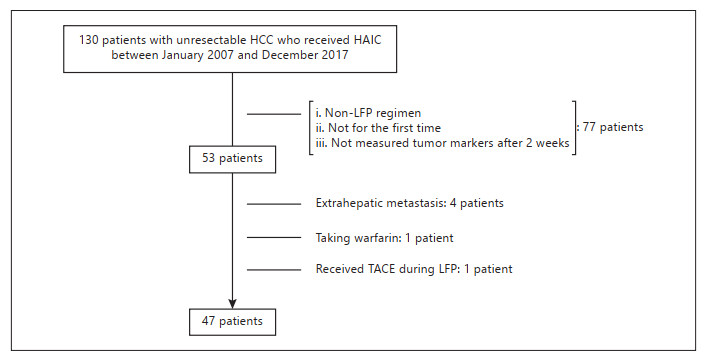
    Objective and Methods: The data of 47 patients who received LFP for the first time in our hospital were analyzed retrospectively. We evaluated the association between treatment response by Response Evaluation Criteria in Solid Tumors and the changing ratio of the serum concentration of α-fetoprotein (AFP), Lens culinaris agglutinin-reactive fraction of AFP (AFP-L3), and des-γ-carboxy prothrombin (DCP) 2 weeks after LFP initiation.
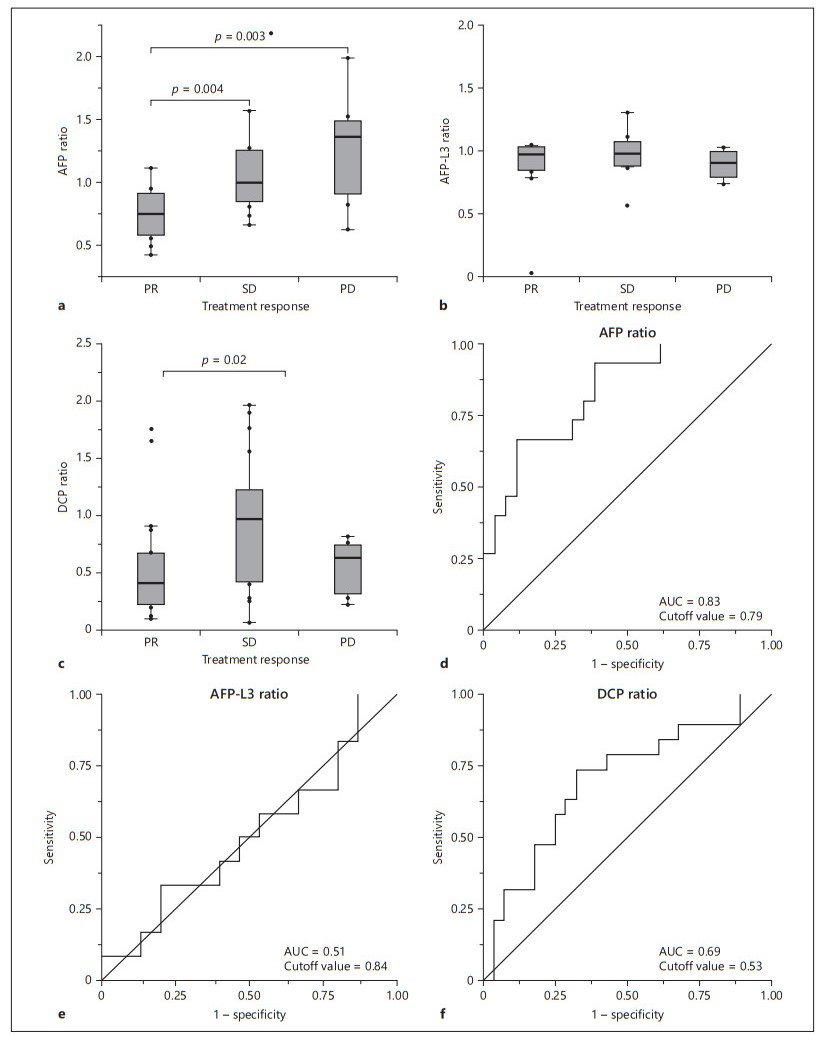
    Results: The number of patients showing a complete response (CR), a partial response (PR), stable disease (SD), and progressive disease (PD) was 0 (0%), 20 (43%), 18 (38%), and 9 (19%), respectively. The AFP ratio showed significant positive correlations for PR vs. SD (p = 0.004) and PR vs. PD (p = 0.003). The DCP ratio correlated significantly for PR vs. SD (p = 0.02). The optimal cutoff values for responders were 0.79 for the AFP ratio and 0.53 for the DCP ratio. Prediction using both or either cutoff value showed 93% sensitivity, 53% specificity, a 94% negative predictive value, and a 57% positive predictive value.
    Conclusion: Optimal cutoff values for AFP and DCP ratios enable prediction of nonresponders to HAIC with LFP. This simple and early assessment method allows the use of HAIC and molecular targeting drugs for HCC treatment.
  • Cite this article

    Shumpei Yamamoto, Hideki Onishi, Akinobu Takaki, Atsushi Oyama, Takuya Adachi, Nozomu Wada, Masahiro Sakata, Tetsuya Yasunaka, Hidenori Shiraha, Hiroyuki Okada. 2020. The Early Decline of α-Fetoprotein and Des-γ-Carboxy Prothrombin Predicts the Response of Hepatic Arterial Infusion Chemotherapy in Hepatocellular Carcinoma Patients. Gastrointestinal Tumors. 7:41 doi: 10.1159/000506941
    Shumpei Yamamoto, Hideki Onishi, Akinobu Takaki, Atsushi Oyama, Takuya Adachi, Nozomu Wada, Masahiro Sakata, Tetsuya Yasunaka, Hidenori Shiraha, Hiroyuki Okada. 2020. The Early Decline of α-Fetoprotein and Des-γ-Carboxy Prothrombin Predicts the Response of Hepatic Arterial Infusion Chemotherapy in Hepatocellular Carcinoma Patients. Gastrointestinal Tumors. 7:41 doi: 10.1159/000506941

Figures(3)  /  Tables(2)

Article Metrics

Article views(766) PDF downloads(547)

Research Article   Open Access    

The Early Decline of α-Fetoprotein and Des-γ-Carboxy Prothrombin Predicts the Response of Hepatic Arterial Infusion Chemotherapy in Hepatocellular Carcinoma Patients

  • Corresponding author: Shumpei Yamamoto Department of Gastroenterology and Hepatology Okayama University Graduate School of Medicine, Dentistry, and Pharmaceutical Sciences, Okayama 700-8558 (Japan) ysyunpei@hotmail.com 
Gastrointestinal Tumors  7 Article number: 10.1159/000506941  (2020)  |  Cite this article

Abstract: 

Introduction: Molecular targeting drugs are recommended as second-line treatment for intrahepatic advanced hepatocellular carcinoma (HCC). However, in Asia, hepatic arterial infusion chemotherapy (HAIC) is also considered as a second-line treatment because it improves the survival of responders. The aim of this study was to predict responders and non-responders to HAIC with low-dose cisplatin plus 5-fluorouracil (LFP) using tumor markers.
Objective and Methods: The data of 47 patients who received LFP for the first time in our hospital were analyzed retrospectively. We evaluated the association between treatment response by Response Evaluation Criteria in Solid Tumors and the changing ratio of the serum concentration of α-fetoprotein (AFP), Lens culinaris agglutinin-reactive fraction of AFP (AFP-L3), and des-γ-carboxy prothrombin (DCP) 2 weeks after LFP initiation.
Results: The number of patients showing a complete response (CR), a partial response (PR), stable disease (SD), and progressive disease (PD) was 0 (0%), 20 (43%), 18 (38%), and 9 (19%), respectively. The AFP ratio showed significant positive correlations for PR vs. SD (p = 0.004) and PR vs. PD (p = 0.003). The DCP ratio correlated significantly for PR vs. SD (p = 0.02). The optimal cutoff values for responders were 0.79 for the AFP ratio and 0.53 for the DCP ratio. Prediction using both or either cutoff value showed 93% sensitivity, 53% specificity, a 94% negative predictive value, and a 57% positive predictive value.
Conclusion: Optimal cutoff values for AFP and DCP ratios enable prediction of nonresponders to HAIC with LFP. This simple and early assessment method allows the use of HAIC and molecular targeting drugs for HCC treatment.
  • About this article
    Cite this article
    Shumpei Yamamoto, Hideki Onishi, Akinobu Takaki, Atsushi Oyama, Takuya Adachi, Nozomu Wada, Masahiro Sakata, Tetsuya Yasunaka, Hidenori Shiraha, Hiroyuki Okada. 2020. The Early Decline of α-Fetoprotein and Des-γ-Carboxy Prothrombin Predicts the Response of Hepatic Arterial Infusion Chemotherapy in Hepatocellular Carcinoma Patients. Gastrointestinal Tumors. 7:41 doi: 10.1159/000506941
    Shumpei Yamamoto, Hideki Onishi, Akinobu Takaki, Atsushi Oyama, Takuya Adachi, Nozomu Wada, Masahiro Sakata, Tetsuya Yasunaka, Hidenori Shiraha, Hiroyuki Okada. 2020. The Early Decline of α-Fetoprotein and Des-γ-Carboxy Prothrombin Predicts the Response of Hepatic Arterial Infusion Chemotherapy in Hepatocellular Carcinoma Patients. Gastrointestinal Tumors. 7:41 doi: 10.1159/000506941

Catalog

    /

    DownLoad:  Full-Size Img  PowerPoint
    Return
    Return