







Search
2023 Volume 10
Article Contents
RESEARCH ARTICLE   Open Access    

A Retrospective Study of Clinical Outcomes for Patients with Esophageal Cancer Who Were Treated with Radiotherapy Alone

More Information
  • Introduction: Patients with esophageal cancer who are in a poor general condition receive radiotherapy alone, but outcomes are often unsatisfactory. The aim of this study was to clarify recent outcomes of radiotherapy alone for esophageal cancer.
    Methods: Patients who underwent 50 Gy or more of radiotherapy without chemotherapy were retrospectively reviewed. Endpoints were overall survival (OS), disease-specific survival (DSS), local control (LC), and progression-free survival (PFS). Survival curves were drawn using the Kaplan-Meier method, and predictors were analyzed using the Cox proportional hazards model.
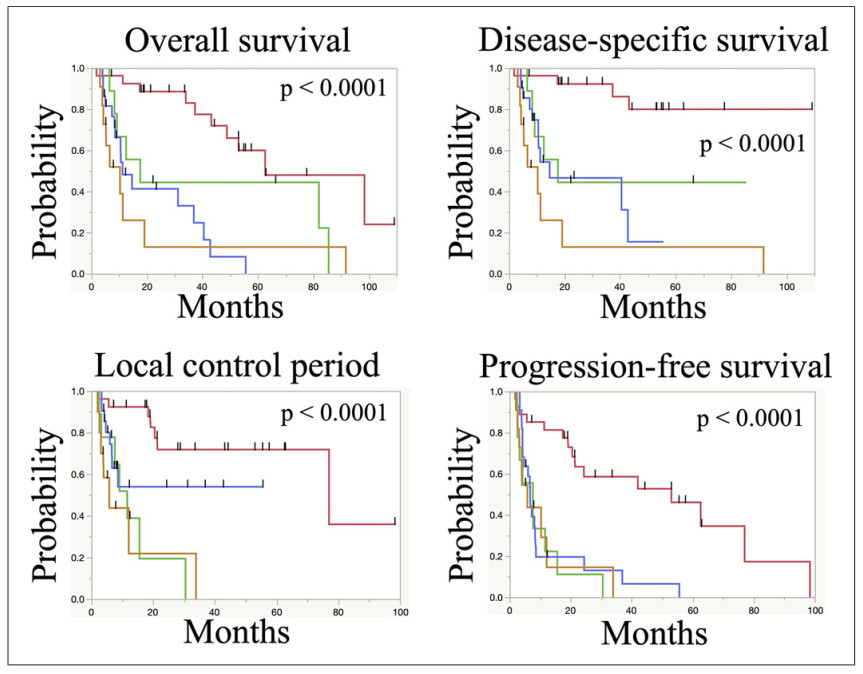
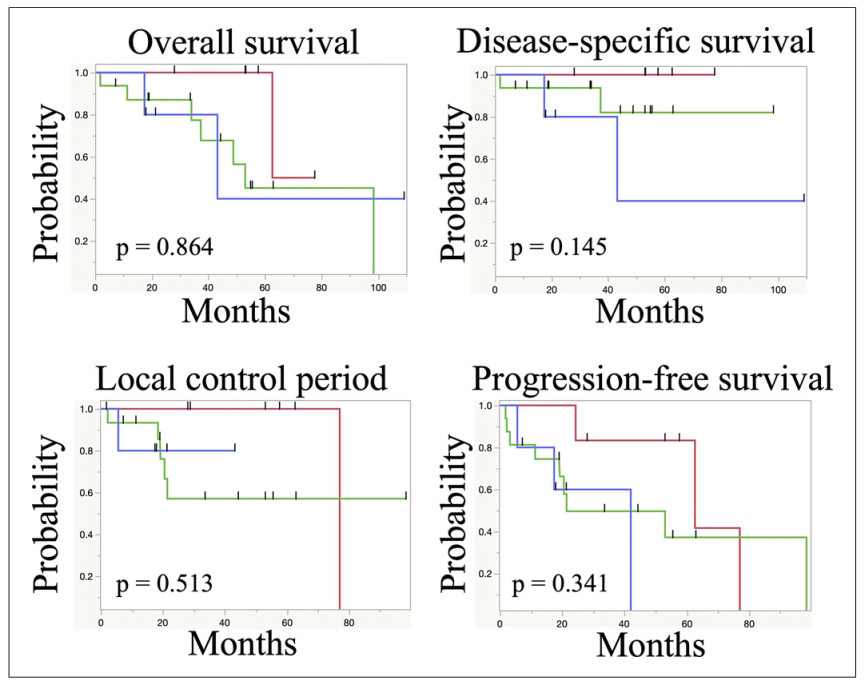
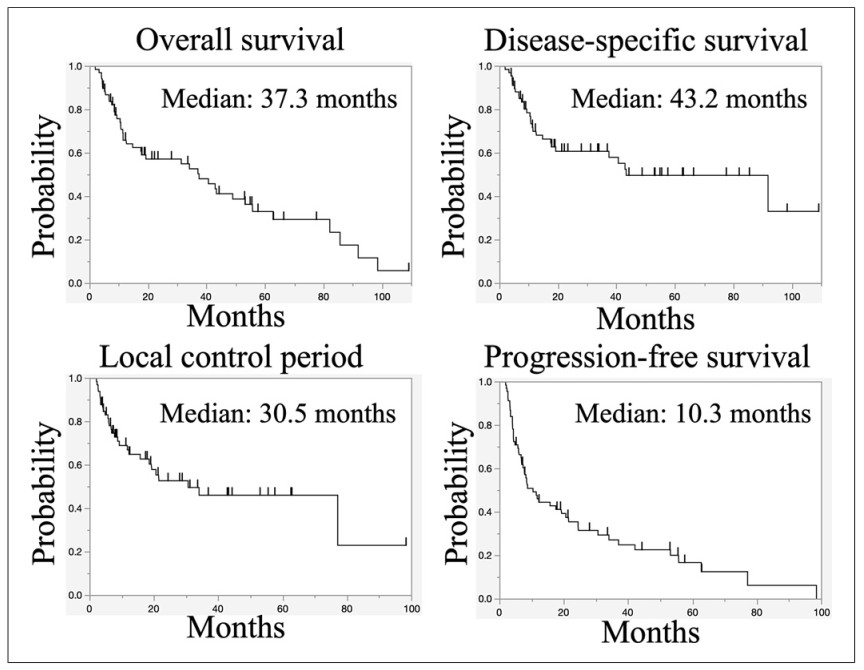
    Results: Sixty-nine patients were included. The median follow-up period was 17.9 months. The 5-year OS, DSS, LC, and PFS rates were 33.2%, 49.8%, 46.2%, and 16.8%, respectively. In the multivariate Cox proportional hazard model, clinical stage was a significant predictor for OS (hazard ratio [HR]: 4.42, 95% confidence interval [CI]: 1.80–11.17, p = 0.001), DSS (HR: 2.08, 95% CI: 1.43–3.12, p = 0.0001), LC (HR: 1.86, 95% CI: 1.28–2.74, p = 0.001), and PFS (HR: 1.65, 95% CI: 1.25–2.18, p = 0.0004). Radiation dose was a significant predictor for LC (HR: 0.87, 95% CI: 0.78–0.97, p = 0.018) and tumor location was a significant predictor for PFS (HR: 1.55, 95% CI: 1.10–2.19, p = 0.018). In subgroup analysis, the 5-year OS, DSS, LC, and PFS rates for stage Ⅰ were 60.0%, 80.0%, 71.9%, and 46.1%, respectively.
    Conclusions: Stage, radiation dose, and tumor location are significant predictors for outcomes. Patients with stage Ⅰ esophageal cancer can be cured by radiotherapy alone.
  • Cite this article

    Noriyoshi Takahashi, Rei Umezawa, Takaya Yamamoto, Kazuya Takeda, Yu Suzuki, Keita Kishida, So Omata, Yuta Sato, Hinako Harada, Yasuhiro Seki, Keiichi Jingu. 2023. A Retrospective Study of Clinical Outcomes for Patients with Esophageal Cancer Who Were Treated with Radiotherapy Alone. Gastrointestinal Tumors. 10:173 doi: 10.1159/000539173
    Noriyoshi Takahashi, Rei Umezawa, Takaya Yamamoto, Kazuya Takeda, Yu Suzuki, Keita Kishida, So Omata, Yuta Sato, Hinako Harada, Yasuhiro Seki, Keiichi Jingu. 2023. A Retrospective Study of Clinical Outcomes for Patients with Esophageal Cancer Who Were Treated with Radiotherapy Alone. Gastrointestinal Tumors. 10:173 doi: 10.1159/000539173

Figures(3)  /  Tables(3)

Article Metrics

Article views(1707) PDF downloads(1107)

Research Article   Open Access    

A Retrospective Study of Clinical Outcomes for Patients with Esophageal Cancer Who Were Treated with Radiotherapy Alone

Gastrointestinal Tumors  10 Article number: 10.1159/000539173  (2023)  |  Cite this article

Abstract: 

Introduction: Patients with esophageal cancer who are in a poor general condition receive radiotherapy alone, but outcomes are often unsatisfactory. The aim of this study was to clarify recent outcomes of radiotherapy alone for esophageal cancer.
Methods: Patients who underwent 50 Gy or more of radiotherapy without chemotherapy were retrospectively reviewed. Endpoints were overall survival (OS), disease-specific survival (DSS), local control (LC), and progression-free survival (PFS). Survival curves were drawn using the Kaplan-Meier method, and predictors were analyzed using the Cox proportional hazards model.
Results: Sixty-nine patients were included. The median follow-up period was 17.9 months. The 5-year OS, DSS, LC, and PFS rates were 33.2%, 49.8%, 46.2%, and 16.8%, respectively. In the multivariate Cox proportional hazard model, clinical stage was a significant predictor for OS (hazard ratio [HR]: 4.42, 95% confidence interval [CI]: 1.80–11.17, p = 0.001), DSS (HR: 2.08, 95% CI: 1.43–3.12, p = 0.0001), LC (HR: 1.86, 95% CI: 1.28–2.74, p = 0.001), and PFS (HR: 1.65, 95% CI: 1.25–2.18, p = 0.0004). Radiation dose was a significant predictor for LC (HR: 0.87, 95% CI: 0.78–0.97, p = 0.018) and tumor location was a significant predictor for PFS (HR: 1.55, 95% CI: 1.10–2.19, p = 0.018). In subgroup analysis, the 5-year OS, DSS, LC, and PFS rates for stage Ⅰ were 60.0%, 80.0%, 71.9%, and 46.1%, respectively.
Conclusions: Stage, radiation dose, and tumor location are significant predictors for outcomes. Patients with stage Ⅰ esophageal cancer can be cured by radiotherapy alone.

  • About this article
    Cite this article
    Noriyoshi Takahashi, Rei Umezawa, Takaya Yamamoto, Kazuya Takeda, Yu Suzuki, Keita Kishida, So Omata, Yuta Sato, Hinako Harada, Yasuhiro Seki, Keiichi Jingu. 2023. A Retrospective Study of Clinical Outcomes for Patients with Esophageal Cancer Who Were Treated with Radiotherapy Alone. Gastrointestinal Tumors. 10:173 doi: 10.1159/000539173
    Noriyoshi Takahashi, Rei Umezawa, Takaya Yamamoto, Kazuya Takeda, Yu Suzuki, Keita Kishida, So Omata, Yuta Sato, Hinako Harada, Yasuhiro Seki, Keiichi Jingu. 2023. A Retrospective Study of Clinical Outcomes for Patients with Esophageal Cancer Who Were Treated with Radiotherapy Alone. Gastrointestinal Tumors. 10:173 doi: 10.1159/000539173

Catalog

    /

    DownLoad:  Full-Size Img  PowerPoint
    Return
    Return