













-
In recent years, the competition for grains between humans and livestock has become increasingly prominent, raising major concerns regarding global food security[1,2]. The rapid population growth and the increasing demand for animal protein, projected to rise by nearly 70% by 2050, have further intensified the pressure on the already-limited agricultural resources[3,4]. Pigs, as the world's primary source of meat protein, hold critical agricultural value in this context[5]. A large amount of corn, soybeans[6], and other staple food crops are converted into animal feed, which reduces their direct human consumption and leads to an increase in food prices[7]. In addition, climate change and land-use constraints threaten the stability of the food supply system[8]. These challenges highlight the urgent need to identify sustainable alternatives to traditional feed ingredients[9]. Developing novel feed resources that do not compete with human food consumption is considered an effective strategy to mitigate feed-food competition, improve feed efficiency, and enhance the sustainability of livestock production[10]. Against this background, emerging biotechnologies offer promising solutions to address feed-food competition[11].
In response to these challenges, synthetic biology has emerged as a powerful approach to improve the sustainability of livestock production and food security[12]. Engineered microorganisms can be optimized as chassis for producing lipids, proteins[13], and other valuable nutrients, thereby alleviating feed-food competition and supporting more efficient animal production systems[14]. The use of synthetic biology tools, including CRISPR-Cas9 and pathway optimization, allows for the rewiring of microbial metabolism to achieve high titers and conversion rates[15]. Furthermore, the adoption of alternative feedstocks such as lignocellulosic biomass and industrial by-products enhances the economic and environmental feasibility of microbial lipid production[16]. This innovative approach not only mitigates pressure on traditional feed resources but also paves the way for more resilient and sustainable agri-food systems. Within this context, several bacterial chassis have attracted particular interest as promising candidates for developing next-generation feed lipid sources.
Rhodococcus opacus PD630 (PD630) is a Gram-positive, oleaginous bacterium that has been extensively studied for its remarkable capacity to accumulate intracellular lipids, particularly triacylglycerols (TAGs)[17−19]. Under nutrient-limited conditions, PD630 can direct a significant proportion of its carbon flux toward lipid biosynthesis, with the lipid content reaching up to 76% of its cell dry weight[20]. This unique metabolic feature makes PD630 one of the most efficient microbial lipid producers identified to date[21]. The strain was originally isolated through targeted screening programs aimed at identifying microorganisms with high oil-producing potential, with PD630 standing out because of its robust growth, broad substrate utilization spectrum, and strong tolerance to environmental stress[22,23]. Moreover, PD630 is characterized by a relatively high biomass yield[24] and a well-annotated genome[25], providing a solid foundation for metabolic engineering and synthetic biology. In addition to lipid accumulation, PD630 has also been reported to degrade aflatoxin B1, further broadening its potential as a microbial production platform[26]. Evidence also indicates that this strain is capable of utilizing low-cost renewable feedstocks such as lignocellulosic hydrolysates and industrial waste gases, significantly enhancing its economic feasibility for large-scale applications[27]. Owing to these properties, PD630 has become a representative model chassis for developing sustainable lipid production platforms and is increasingly being explored as a promising candidate for generating alternative feed lipids.
The abovementioned characteristics highlight the great potential of PD630 as a microbial resource for feed applications. Through advances in synthetic biology and gene editing technologies, it is now possible to reprogram PD630 and related oleaginous bacteria to efficiently produce feed-relevant components such as lipids, amino acids, and other nutrients[28]. By incorporating these engineered microbial products into novel feed formulations, livestock diets can be optimized to reduce dependence on conventional grain-based ingredients[29]. In this study, lipids from PD630 were evaluated as alternative feed sources, providing experimental evidence for their feasibility in animal nutrition. Importantly, the utilization of microbial feed components may help alleviate the long-standing issue of competition for grains between humans and livestock[30]. Thus, the application of microbial platforms engineered through synthetic biology in feed development represents a viable strategy to enhance the sustainability of livestock production and achieve global food security.
-
A total of 48 male finishing pigs with similar initial body weights (average weight 90.0 ± 5 kg, Duroc × Landrace × Yorkshire cross, provided by Shaanxi Runmin Kangyuan Co., Ltd.) were randomly assigned to two groups with four replicates and six pigs each. The control group (CON) was fed a corn-soybean meal-type basal diet, and the experimental group was fed with a basal diet that replaced the lipid in the feed with 0.85% PD630 (PD630 ≥ 1 × 10⁸ CFU/g). Pigs were provided feed twice per day (at 7:00 and 14:00), with free access to feed and water, and the barn was maintained clean daily. The barn temperature was controlled at 24 ± 2 °C, with 60%–68% humidity throughout the trial period. The total experimental period was 30 d. The average final body weights of the pigs in the PD630 and CON groups were 116.83 ± 9.63 kg and 117.50 ± 8.45 kg, respectively. The animal experiment was approved by the Animal Care and Use Committee of Northwest A&F University (permit number: DK2024001) and all experimental procedures conformed to the institutional guidelines for animal study. All efforts were made to minimize suffering.
Sample collection
-
At the end of the 30-day experimental period, six pigs were randomly selected from each group (n = 6 per group), with similar body weights and health status to ensure representativeness. These pigs were humanely slaughtered following standard operating procedures. The selected animals were used for carcass trait evaluation, meat quality analysis, and subsequent molecular. Blood samples were collected for serum preparation. Following electrocution and exsanguination, the pigs were eviscerated with a sterile scalpel, and the duodenal contents were carefully sampled and transferred into sterile 1.5 mL cryogenic tubes for subsequent analysis. The longissimus dorsi muscle (LDM) was then excised from the left side of each carcass between the 3rd and 4th thoracic vertebrae. Approximately 200 g of muscle tissue was collected to analyze the amino acid composition, flavor nucleotides, and long-chain fatty acid profiles. All samples were immediately frozen in liquid nitrogen and stored at −80 °C until further analysis.
Meat quality analysis
-
The pH of the LDM was measured 24 h postmortem using a portable pH meter (Mettler Toledo S2-Food Ki, Mettler Toledo, Columbus, OH, USA). Meat color parameters, including L* (lightness), a* (redness), and b* (yellowness), were determined 24 h after slaughter using a meat colorimeter (CR-410, Konica Minolta Sensing Inc., Osaka, Japan).
Serum biochemical index testing
-
After incubation at 4 °C for 3 h, blood samples were centrifuged at 3,000 × g for 10 min to separate the serum. The obtained serum samples were subsequently transferred to the laboratory of the College of Animal Science and Technology, Northwest A&F University, for biochemical parameter analysis.
Determination of triglyceride (TG) content
-
Approximately 1 g of LDM tissue was weighed and mixed with nine volumes of PBS. The mixture was homogenized and centrifuged at 13,000 rpm for 25 min at 4 °C. The supernatant was collected and used to determine the TG content following the kit instructions (Jiancheng Biotech, Jiangsu, China). Absorbance was measured at 500 nm using a microplate reader to calculate the TG concentration.
Quantitative real-time polymerase chain reaction (qPCR) analysis
-
Total RNA from LDM was isolated with TRIzol and reverse-transcribed (Mei5bio). qPCR used 2X M5 HiPer Dual SYBR Green qPCR SuperMix with beta-actin as the internal reference. Cycling: 95 °C 30 s; 40 cycles of 95 °C 1 min/60 °C 30 s; meltcurve, 95 °C 15 s/60 °C 1 min/95 °C 15 s. Primers are in Supplementary Table S1.
Nucleic acid extraction and polymerase chain reaction (PCR) amplification
-
Porcine colonic content samples were collected, and total bacterial genomic DNA was isolated using the FastDNA™ SPIN Kit (MP Biomedicals, USA). DNA quality was verified by 1% agarose gel electrophoresis. The concentration and purity of the extracted DNA were measured using a NanoDrop 2000 spectrophotometer (Thermo Scientific, USA). The V3–V4 hypervariable regions of the bacterial 16S rRNA gene were then amplified using primer pairs 338F (5′-ACTCCTACGGGAGGCAGCAG-3′) and 806R (5′-GGACTACHVGGGTWTCTAAT-3′) with a T100 Thermal Cycler PCR system (Bio-Rad, USA).
Fecal microbiota profiling and data analysis
-
The genomic DNA extracted using the FastDNA SPIN Kit described above was used for 16S rRNA gene sequencing. DNA quality and concentration were assessed using a NanoDrop 2000 spectrophotometer (Thermo Scientific, USA). The V3–V4 hypervariable regions of the bacterial 16S rRNA gene were amplified using primers 338F/806R with barcodes. PCR products were verified by agarose gel electrophoresis, pooled in equimolar amounts, purified, and used for library construction. Paired-end sequencing (PE250) was performed on an Illumina platform. Raw reads were quality-filtered using fastp and trimmed with cutadapt. Clean reads were merged using USEARCH, and chimeras were removed. Amplicon sequence variants (ASVs) were generated using DADA2 and taxonomically classified against the SILVA database (confidence threshold 0.8). Chloroplast and mitochondrial sequences were excluded prior to downstream analyses. Alpha diversity indices were calculated based on the ASV table, and beta diversity was assessed using Bray–Curtis distances and visualized by PCoA. Differences in microbial community composition between groups were tested using PERMANOVA, and LEfSe analysis was performed with an LDA score threshold of > 2.0 for significance.
The raw sequencing data have been deposited in the NCBI Sequence Read Archive (SRA) under accession number PRJNA1431005.
Strains, primers, and plasmids
-
The test strains were PD630, Fusarium moniliforme (F. moniliforme), and Pythium aphanidermatum (P. aphanidermatum), provided by Beijing Beina Chuanglian Biotechnology Research Institute and Qingdao Huizao Biotechnology. PD630 was preserved in 20% (v/v) glycerol at −80 °C. F. moniliforme and P. aphanidermatum were cultured to obtain spores, which were then suspended in 10% (v/v) glycerol and stored at −80 °C. All experimental plasmids were purchased from GenScript Nanjing Biotechnology Co., Ltd. The plasmids and primers used are listed in Supplementary Table S2.
Culture conditions
-
PD630 (wild-type and recombinant strains) was cultured in nutrient broth (NB) medium, whereas other bacterial strains were grown in Luria-Bertani (LB) medium. For seed cultures, a 0.2% (v/v) inoculum of PD630 was transferred into 50 mL NB and incubated at 30 °C with shaking at 160 rpm for 24 h. This seed culture was then used to inoculate 100 mL of fermentation medium at 1% (v/v). Fermentation was carried out under the same conditions (30 °C, 160 rpm).
Media composition
-
LB medium was prepared with 10 g/L tryptone, 5 g/L yeast extract, and 10 g/L NaCl in distilled water. The pH was adjusted to 7.0–7.2 with NaOH or HCl before sterilizing by autoclaving at 121 °C for 15 min. The NB medium contained 3.0 g/L beef extract, 10.0 g/L peptone, and 5.0 g/L NaCl, adjusted to pH 7.4 ± 0.2. Both LB and NB media were prepared at 18 g/L in 250 mL Erlenmeyer flasks (50 mL working volume) and sterilized at 121 °C for 15 min. The fermentation medium was composed of (per liter) glucose 12 g, KH2PO4 1.5 g, Na2HPO4·12H2O 9 g, urea 0.6 g, FeNaEDTA 5 mg, MgSO4·7H2O 0.5 g, CaCl2·2H2O 20 mg, MnCl2·4H2O 0.05 mg, CoCl2·6H2O 0.2 mg, H3BO3 0.3 mg, Na2MoO4·2H2O 2 mg, ZnSO4·7H2O 0.1 mg, NiCl2·6H2O 0.02 mg, and CuCl2·2H2O 0.01 mg. The fermentation medium was sterilized by autoclaving at 121 °C for 15 min.
Plasmid construction
-
Using primers FM-F and FM-R, PA-F and PA-R, the corresponding desaturase genes were amplified from wild-type F. moniliforme and P. aphanidermatum, respectively. After codon optimization, they were cloned into the EcoRI/HindIII sites of PACYC and PAG1, respectively, to construct plasmids PACYC-FM and PAG1-PA.
Preparation of competent cells and electroporation
-
To obtain electrocompetent cells, PD630 was initially grown in seed medium at 28 °C with shaking at 200 rpm for 48 h. The resulting culture was then inoculated (initial OD660 = 0.05) into 100 mL NB supplemented with 8.5 g/L glycine and 10 g/L sucrose (10 g/L peptone, 5 g/L NaCl, and 3 g/L beef extract, pH 7.2). The cells were cultured at 28 °C and 200 rpm until OD660 reached 0.5, then harvested by centrifugation (8,000 rpm, 20 min, 4 °C), washed twice with ice-cold deionized water, and concentrated 50-fold to generate electrocompetent cells.
For plasmid introduction, 200 μL of electrocompetent cells was combined with 1 μg plasmid DNA and transferred into a 0.2 cm electroporation cuvette. After incubation on ice for 10 min, electroporation was done using a single pulse at 10 kV/cm. The cells were immediately mixed with 800 μL of LBHIS recovery medium (per liter: 5 g tryptone, 5 g NaCl, 2.5 g yeast extract, 18.5 g brain heart infusion powder, and 91 g sorbitol) and incubated at 28 °C and 200 rpm for 4–5 h. Subsequently, 100 μL of the culture was spread on a solid selective medium supplemented with the appropriate antibiotic. Colonies were obtained after incubation at 28 °C for 2–4 d.
Measurement of growth cell biomass
-
The cell density of PD630 cultures was measured spectrophotometrically at 660 nm (OD660). A blank containing the same culture medium without bacterial inoculation was used as a reference. To ensure measurement accuracy, culture samples were diluted when the absorbance exceeded 0.8 to maintain the OD660 values between 0.2 and 0.8. For dry cell weight (DCW) determination, a defined volume of fermentation broth (V) was centrifuged at 8,000 rpm for 5 min at 4 °C. The cell pellet was washed two to three times with deionized water to remove residual medium, then transferred into a pre-weighed glass tube and dried at 70 °C to constant weight (M). After freeze-drying at −50 °C for 24 h, the final dry weight was recorded as M1. The DCW (g/L) was calculated using the equation DCW (g/L) = (M1−M) / V.
Lipid extraction
-
Approximately 20–60 mg of lyophilized cells were placed in a 10 mL glass tube, followed by the addition of 4 mL of 3 mol/L HCl and 2 mL n-hexane. The mixture was vortexed vigorously for 30 s to achieve thorough homogenization, then incubated in a boiling water bath for 5 min with occasional agitation. If any solvent evaporation was observed, 0.5 mL n-hexane was supplemented to restore the volume. After cooling to ambient temperature, the samples were centrifuged at 7,000 rpm for 5 min to allow phase separation. The upper hexane phase containing lipids was carefully transferred to a new tube. The residual aqueous layer was subjected to additional extraction with 2 mL n-hexane under identical conditions; this step was repeated two to three times until the hexane phase appeared colorless. All organic extracts were pooled, evaporated under nitrogen, and dried at 70 °C to eliminate the remaining solvent, resulting in the final lipid extract.
Gas chromatography (GC) analysis
-
Fatty acids were converted into their methyl ester derivatives following the GB 5009.168-2016 protocol using boron trifluoride (BF3) as the methylation reagent. The generated fatty acid methyl esters (FAMEs) were subsequently determined by gas chromatography coupled with a flame ionization detector (GC-FID). Separation was performed using an HP-88 capillary column (100 m × 0.32 mm internal diameter, 0.22 μm film thickness). The injector and detector temperatures were maintained at 250 and 270 °C, respectively. A 2 μL sample was introduced under split conditions (20:1), with nitrogen serving as the carrier gas. The oven temperature program was started at 180 °C and held for 5 min, then increased at 2 °C/min to 220 °C and maintained for 20 min. Fatty acids were identified by matching the retention times with those of a standard mixture containing 37 FAME components, and their relative abundances were calculated using peak area normalization with appropriate mass correction factors.
Statistical analysis
-
Experimental data were initially organized using Microsoft Excel. Statistical comparisons between groups were conducted using unpaired t-tests in Prism 7.04 (GraphPad, La Jolla, CA, USA). Results are presented as mean ± SEM. Differences were considered statistically significant at p < 0.05.
-
To systematically investigate the enhancement of specific fatty acid profiles in PD630, we carried out a series of metabolic engineering interventions along with bioprocess development. The host strain PD630 was selected as the chassis organism. An expression vector was constructed through standard molecular cloning strategies and introduced into the host by electroporation, yielding a metabolically engineered strain. Subsequently, monoclonal colonies were isolated on solid medium, and strains capable of stable expression were screened. Finally, glucose was used as the carbon source to carry out fermentation for microbial lipid production (Fig. 1a).
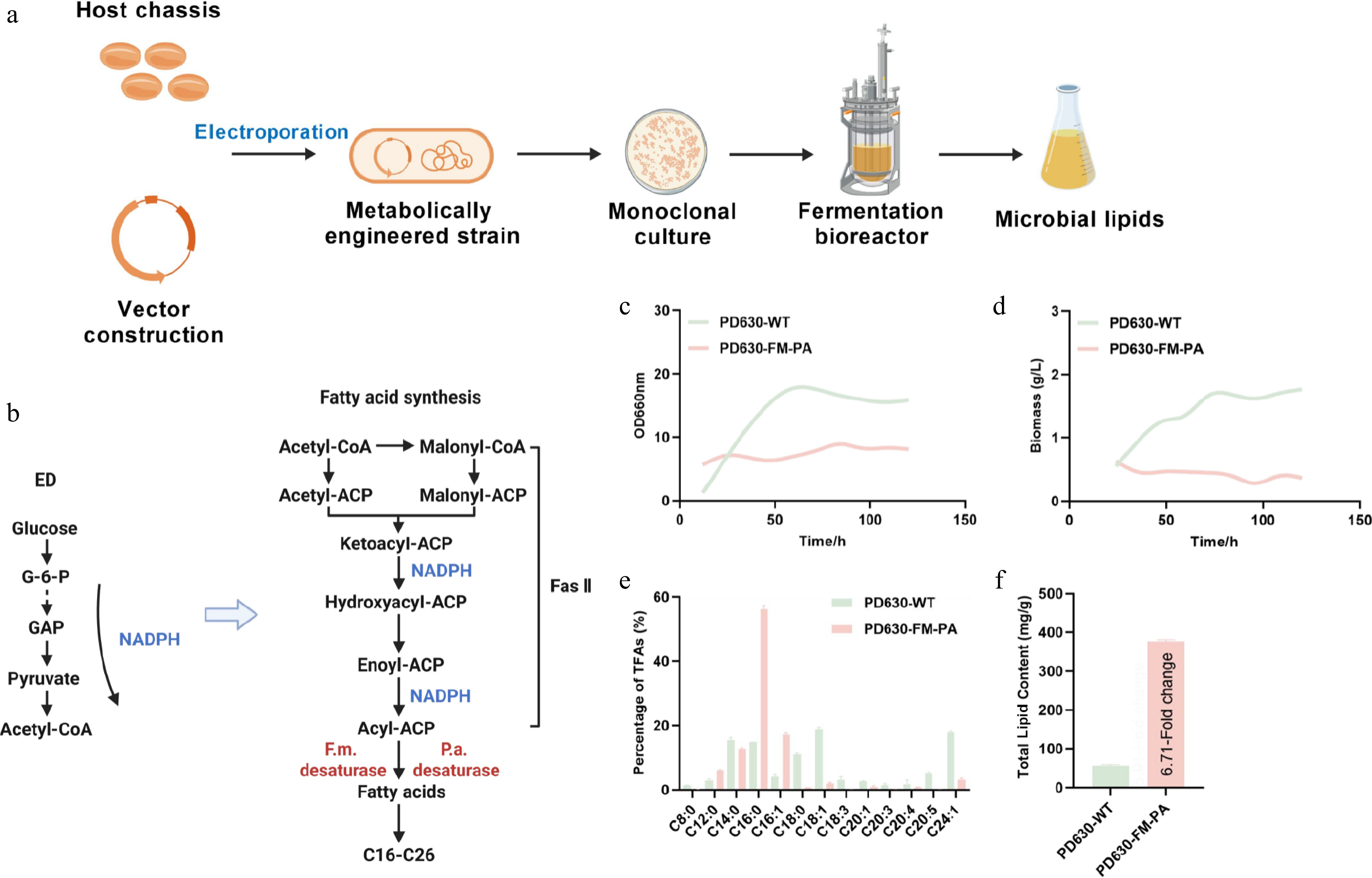
Figure 1.
Schematic workflow for constructing the engineered strain and for microbial lipid production. (a) Schematic diagram of the genetic engineering and fermentation process for microbial lipid production. (b) Proposed pathway for fatty acid biosynthesis from the glucose in PD630. Abbreviations: ED, Entner-Doudoroff pathway; G-6-P, glucose-6-phosphate; GAP, glyceraldehyde-3-phosphate; ACP, acyl carrier protein. (c) Growth curves of wild-type and engineered PD630 strains. (d) Biomass production of wild-type and engineered PD630 strains. (e) Fatty acid composition (relative abundance, %) and absolute content of wild-type and engineered PD630 strains. (f) Total lipid content of wild-type and engineered PD630 strains. Data are presented as the mean ± sem (n = 3). The three biological replicates represent independent PD630 bacterial samples used for molecular analysis.
In this study, fatty acid biosynthesis in PD630 is mainly mediated by the fatty acid synthase (FAS) system. Acetyl-CoA, derived from the Entner-Doudoroff pathway, pyruvate decarboxylation, and β-oxidation of fatty acids, is carboxylated to malonyl-CoA by acetyl-CoA carboxylase (ACC). The FAS complex then catalyzes a cyclic series of reactions—reduction, dehydration, and another reduction—to sequentially extend the acyl chain by two carbons per cycle. This process ultimately generates saturated fatty acids (SFAs) with chain lengths typically between C16 and C26. In this process, we introduced fatty acid desaturases from wild-type F. moniliforme and P. aphanidermatum into the fatty acid metabolic pathway of PD630, which enhanced the activity of the FAS II system and improved precursor utilization efficiency. As a result, the engineered strain exhibited a marked increase in total fatty acid content compared with the wild type (Fig. 1b).
Growth characteristics and fatty acid production of PD630
-
The growth curve of the wild-type PD630 displayed a typical S-shaped pattern, reaching the stationary phase at around 60 h. In contrast, the engineered strain showed no clear logarithmic growth phase (Fig. 1c). The biomass trend of PD630 paralleled its growth curve, while the engineered strain exhibited a lower biomass (Fig. 1d). Using glucose as a carbon source, PD630 mainly produced palmitic acid (C16:0) and oleic acid (C18:1). After engineering, the palmitic acid content and proportion increased significantly (p < 0.05), while oleic acid proportion decreased, with a slight reduction in its absolute content (Fig. 1e). Overall, the total fatty acid content in the engineered strain increased by 5.71-fold compared to the control (p < 0.05) (Fig. 1f).
Nutritional characteristics of PD630 and algorithm performance
-
The engineered PD630 used in this study exhibited the following nutritional properties: lipid content of 380.9 mg/g, cell dry weight of 0.37 g/L, and total protein content of 1.16 g/L. The amino acid composition is provided in Supplementary Table S3. The particle swarm optimization (PSO) and ant colony optimization (ACO) algorithms were applied to design novel feed formulations. The objective function values across 100 iterations showed that the ACO algorithm rapidly converged to a near-optimal solution within approximately 10 iterations, while the PSO algorithm required around 40 iterations to stabilize (Fig. 2a). During the execution of the PSO algorithm, the proportions of corn, soybean meal, and PD630 biomass gradually stabilized at approximately 41%, 25%, and 12%, respectively, while that of vegetable oil remained close to zero. This indicated that the PSO algorithm found a balance allowing PD630 to effectively replace part of the corn and vegetable oil (Fig. 2b).
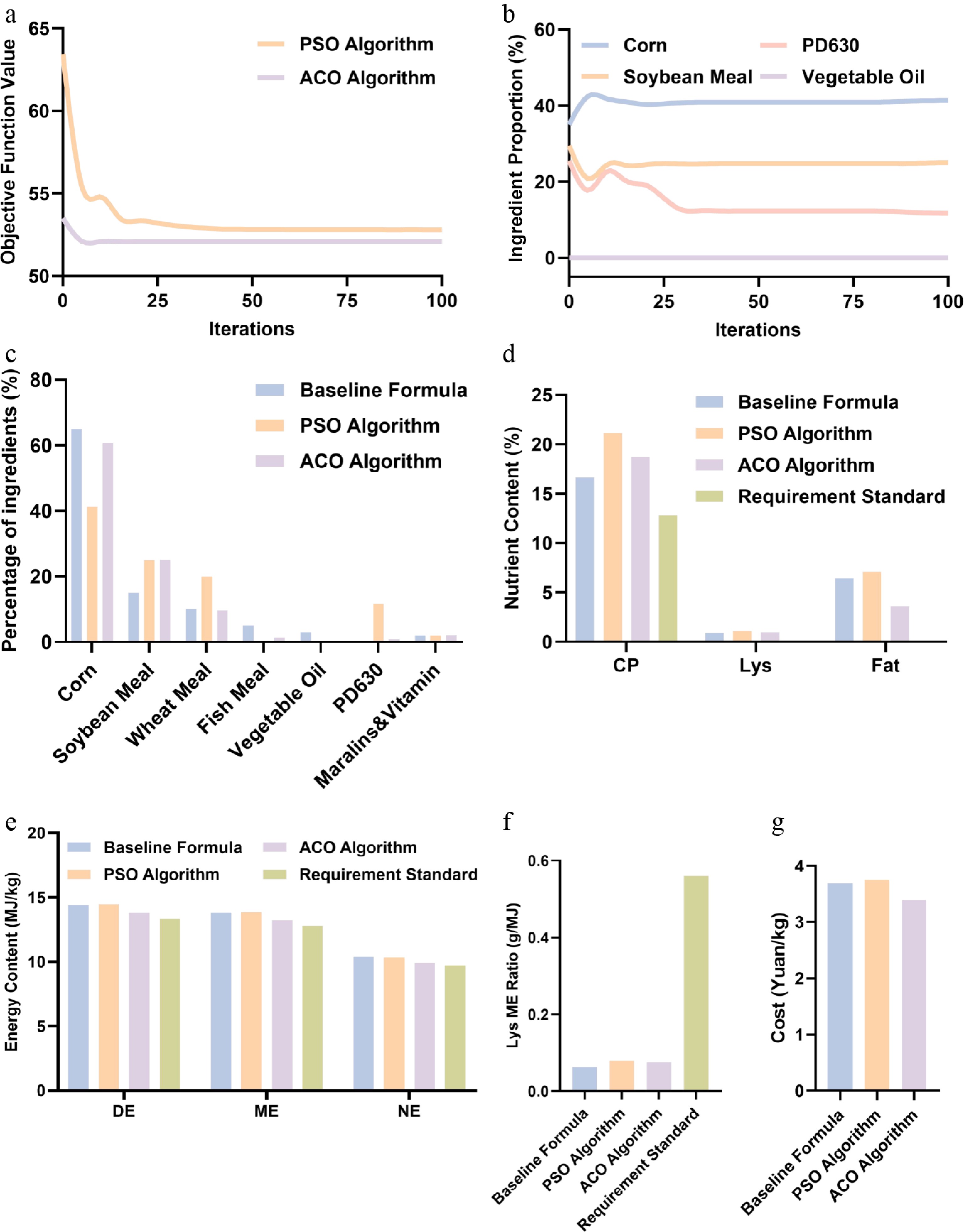
Figure 2.
Optimization of finishing pig feed formulations using PSO and ACO algorithms. (a) Comparison of convergence processes between PSO and ACO algorithms. (b) Variation in raw material proportions during the optimization process. (c) Feed composition in PSO and ACO algorithms. (d) Nutrient profiles of PSO and ACO algorithms. (e) Energy values (DE, ME, NE) of the ACO algorithm. (f) Lysine-to-ME ratio in PSO and ACO algorithms. (g) Comparison of feed cost among baseline, PSO, and ACO algorithms.
The addition of PD630 led to significant changes in feed composition. In the PSO algorithm, PD630 (11.71%) completely replaced vegetable oil (from 3% to 0) and fishmeal (from 5% to 0). In the ACO algorithm, although the proportion of PD630 was lower (0.85%), it still largely replaced vegetable oil (from 3% to 0.13%), demonstrating that PD630 can serve as an effective substitute for vegetable oil in finishing pig feed (Fig. 2c).
The nutrient profiles of the feed also changed with the addition of PD630. In the PSO algorithm, the higher proportion of PD630 increased the crude protein (CP) content markedly (from 16.63% to 21.18%) (p < 0.05), accompanied by a slight rise in fat content (from 6.42% to 7.10%). In contrast, the ACO algorithm required a lower proportion of PD630 while still increasing the CP content (to 18.74%); however, the fat content was significantly reduced (to 3.59%) (p < 0.05) (Fig. 2d).
Energy balance, amino acid adequacy, and feed cost optimization
-
The optimal formula designed by the ACO algorithm met or exceeded the minimum requirements for digestible energy (DE), metabolizable energy (ME), and net energy (NE) (Fig. 2e). However, the lysine ME ratio did not meet the required standard, indicating the need to either adjust this requirement or supplement synthetic lysine in practical applications (Fig. 2f). Compared with the PSO algorithm, the ACO algorithm reduced the feed cost to 3.39 CNY/kg, which was about 8% lower than that obtained by the baseline formula, while maintaining the main ingredient structure with only minor adjustments. Overall, the optimal ACO-derived formulation containing 0.85% PD630 demonstrated its potential as a partial substitute for vegetable oil, while improving the feed protein content and reducing the cost (Fig. 2g). The detailed composition and nutrient levels of the experimental diets are presented in Supplementary Table S4.
Serum biochemical parameters and safety assessment
-
Serum biochemical indices provide a direct reflection of the health status of pigs. In this study, the serum biochemical parameters of finishing pigs were measured, and the results are presented in Supplementary Table S5. No significant differences were observed between groups in liver function indicators (alanine aminotransferase, aspartate aminotransferase, alkaline phosphatase) or lipid metabolism indices (total cholesterol, high-density lipoprotein, low-density lipoprotein, etc.) (p > 0.05). These findings indicate that dietary substitution with engineered microbial lipids has no adverse effects on the health of finishing pigs.
Growth performance and carcass traits
-
To investigate the effects of lipids from engineered PD630 as a substitute for dietary lipids on the growth performance and carcass traits of finishing pigs, the growth performance and carcass characteristics of finishing pigs were measured. The results are presented in Tables 1 and 2. The substitution of dietary lipids with engineered strains had no significant impact on the growth performance of finishing pigs, with no notable changes in final body weight, average daily gain (ADG), average daily feed intake (ADFI), or feed conversion rate (FCR) (p > 0.05). However, the substitution significantly affected the backfat thickness and markedly increased the dressing percentage (p < 0.05). These results indicate that replacing dietary lipids with engineered strains has no effect on the growth performance of finishing pigs but enhances their carcass traits.
Table 1. Effects of lipids from engineered PD630 (as a substitute for dietary lipids) on the growth performance of finishing pigs.
Items Con PD630 p-Value ADG, kg/d 0.56 ± 0.04 0.6 ± 0.07 0.397 ADFI, kg/d 3.19 ± 0.07 3.22 ± 0.05 0.892 FCR 5.70 ± 0.14 5.37 ± 0.09 0.992 ADG = average daily gain; ADFI = average daily feed intake; FCR = feed conversion rate. Data are presented as the mean ± sem (n = 6 pigs per group, randomly selected for slaughter). Table 2. Effects of lipids from engineered PD630 (as a substitute for dietary lipids) on the carcass characteristics of finishing pigs.
Items Con PD630 p-Value Carcass weight, kg 82.67 ± 6.47 86.45 ± 2.10 0.299 Backfat thickness, cm 1.93 ± 0.22 2.70 ± 0.27 0.001 Dressing percentage, % 68.00 ± 1.26 72.00 ± 0.41 0.037 Data are presented as the mean ± sem (n = 6 pigs per group, randomly selected for slaughter). Muscle fiber morphology and protein metabolism
-
Hematoxylin and eosin (H&E) staining of muscle cross-sections revealed that dietary lipids from PD630 promoted an increase in the cross-sectional area of muscle fibers compared with the control diet (p < 0.05) (Fig. 3a, b). Moreover, the TG content in the LDM showed no significant difference between the two groups (p > 0.05) (Fig. 3c). To further explore the underlying mechanism, we analyzed the expression of genes related to muscle protein synthesis and degradation. The mRNA levels of MYOD and MYOG, both associated with muscle protein synthesis, were significantly upregulated in pigs fed diets containing lipids from PD630 (p < 0.05) (Fig. 3d). Conversely, the expression of protein degradation-related genes including TRIM63, FBXO30, FBXO32, UBB, and CTSL was significantly downregulated (p < 0.05) (Fig. 3e).
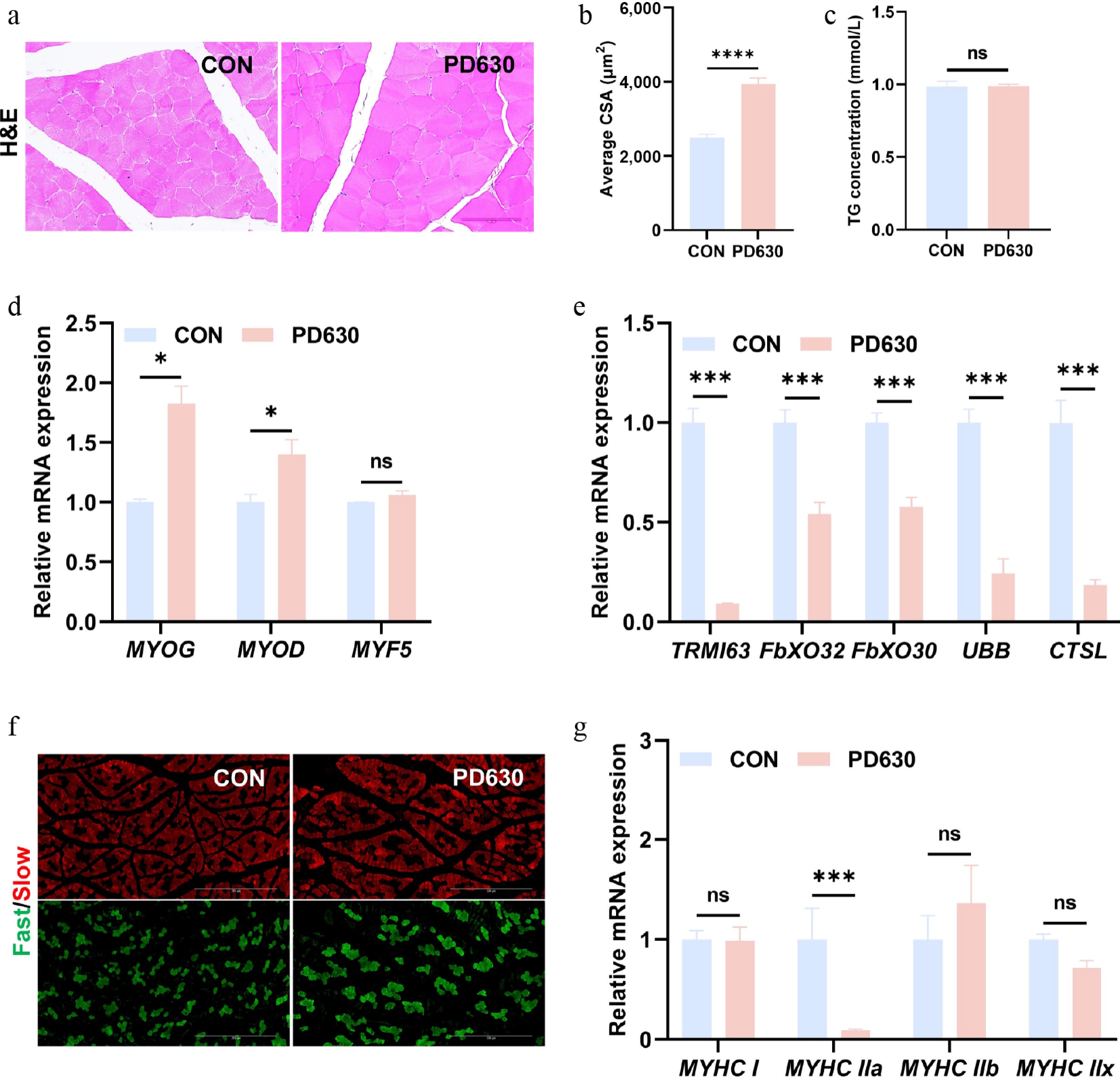
Figure 3.
Effects of lipids from engineered PD630 on muscle fiber type and morphology in the longissimus dorsi muscle of finishing pigs. (a) Representative images of muscle paraffin sections; scale bars, 150 μm. (b) Quantification of muscle fiber cross-sectional area. (c) Triglyceride content in the longissimus dorsi muscle. (d) Protein synthesis genes. (e) Protein degradation genes. (f) Immunofluorescence staining of fast (green) and slow (red) myofibers; scale bars, 200 μm. (g) Myofiber-type markers. Data are presented as the mean ± sem (n = 3). Three samples were randomly selected from the six slaughtered pigs in each group for subsequent molecular analysis.
Muscle fiber type composition
-
Immunohistochemical staining and molecular analyses revealed a tendency for an increased proportion of type I (slow muscle) fibers and a decreased proportion of type II (fast muscle) fibers in the PD630 group compared with the control group (Fig. 3f, g). At the transcriptional level, diets containing lipids from PD630 tended to show decreased MyHC IIa expression, whereas MyHC I expression remained unchanged (Fig. 3g). These results suggest that supplementation with lipids from PD630 may promote a shift in muscle fiber composition from fast-twitch to slow-twitch fibers.
Intramuscular fat deposition and fatty acid composition
-
The contents of fatty acids in LDM were measured to evaluate the impact of dietary lipids from PD630 on intramuscular fat composition. As shown in Table 3, no significant differences were observed between the PD630 and control groups in the overall proportions of SFAs, monounsaturated fatty acids (MUFAs), and polyunsaturated fatty acids (PUFAs) (p > 0.05). These results indicate that dietary substitution with lipids from PD630 did not significantly alter intramuscular fat deposition or fatty acid composition. The absence of a corresponding change in muscle fatty acid composition, despite the altered fatty acid profile of the engineered microbial lipid, may reflect the relatively short 30-day feeding period, delayed intramuscular lipid deposition, and metabolic regulation through endogenous fatty acid synthesis.
Table 3. Effects of lipids from engineered PD630 (as a substitute for dietary fat) on the fatty acid composition in the muscle of finishing pigs (% of total fatty acids).
Item Con PD630 p-Value C6:0 0.01 ± 0.00 0.02 ± 0.01 0.589 C8:0 0.02 ± 0.00 0.02 ± 0.01 0.792 C10:0 0.15 ± 0.01 0.16 ± 0.0 0.789 C12:0 0.13 ± 0.01 0.13 ± 0.01 0.984 C13:0 0.03 ± 0.002 0.02 ± 0.001 0.578 C14:0 1.50 ± 0.09 1.50 ± 0.21 0.886 C14:1 1.25 ± 0.07 1.22 ± 0.14 0.866 C15:0 1.26 ± 0.35 1.27 ± 0.6 0.975 C16:0 13.10 ± 0.55 12.80 ± 1.37 0.751 C16:1 3.04 ± 0.20 2.74 ± 0.54 0.276 C17:0 0.72 ± 0.12 0.82 ± 0.23 0.433 C18:0 12.59 ± 1.45 13.88 ± 2.84 0.385 C18:1n-9 41.47 ± 1.64 43.10 ± 7.20 0.844 C18:2n-6 19.72 ± 1.72 17.50 ± 1.02 0.610 C18:3n-3 0.46 ± 0.03 0.47 ± 0.02 0.877 C18:3n-6 0.13 ± 0.01 0.17 ± 0.01 0.544 C20:0 0.65 ± 0.07 0.76 ± 0.20 0.260 C20:3n-3 1.78 ± 0.62 1.76 ± 0.21 0.876 C20:3n-6 0.67 ± 0.08 0.67 ± 0.03 0.976 C20:5n-3 (EPA) 0.31 ± 0.05 0.39 ± 0.03 0.387 C22:0 1.07 ± 0.04 1.09 ± 0.21 0.958 C22:1n-9 3.26 ± 0.30 2.57 ± 0.30 0.245 Data are presented as the mean ± sem (n = 3). Three samples were randomly selected from the six slaughtered pigs in each group for subsequent molecular analysis. Amino acid composition in LDM
-
In contrast to the above observation, the amino-acid profile of LDM was markedly affected by PD630 supplementation. As presented in Table 4, diets containing lipids from PD630 showed significantly higher levels of several individual amino acids, such as proline, as well as an overall increase in the total amino-acid content (p < 0.05). Notably, both essential amino acids and flavor-related amino acids were elevated (p < 0.05), suggesting an improvement in the nutritional value and sensory properties of meat.
Table 4. Effects of lipids from engineered PD630 (as a substitute for dietary fat) on the amino acid composition in the muscle of finishing pigs (% of meat weight).
Item Con PD630 p-Value Aspartic 2.00 ± 0.03 2.15 ± 0.02 0.032 Threonine 1.01 ± 0.02 1.18 ± 0.01 0.017 Serine 0.82 ± 0.01 0.88 ± 0.01 0.026 Glutamine 3.06 ± 0.06 2.94 ± 0.04 0.128 Proline 1.67 ± 0.03 2.25 ± 0.02 0.001 Glycine 0.87 ± 0.02 0.93 ± 0.01 0.038 Alanine 1.15 ± 0.02 1.14 ± 0.01 0.666 Cysteine 0.11 ± 0.01 0.12 ± 0.00 0.045 Valine 1.05 ± 0.02 1.01 ± 0.01 0.065 Methionine 0.58 ± 0.00 0.62 ± 0.01 0.008 Isoleucine 0.99 ± 0.01 0.98 ± 0.01 0.570 Leucine 1.76 ± 0.03 1.89 ± 0.01 0.009 Tyrosine 0.77 ± 0.01 0.75 ± 0.01 0.082 Phenylalanine 1.06 ± 0.02 1.14 ± 0.01 0.011 Lysine 1.88 ± 0.0 2.01 ± 0.02 0.007 Histidine 0.98 ± 0.02 0.95 ± 0.00 0.327 Arginine 1.34 ± 0.01 1.30 ± 0.03 0.102 TAA 21.21 ± 0.35 22.83 ± 0.18 0.008 EAA 10.6 ± 0.14 11.17 ± 0.04 0.030 EAA = essential amino acids; TAA = total amino acids. Data are presented as the mean ± sem (n = 3). Three samples were randomly selected from the six slaughtered pigs in each group for subsequent molecular analysis. Intestinal morphology
-
Dietary composition can influence intestinal morphology in finishing pigs. As shown in Fig. 4a–d, no significant differences were observed between the PD630 group and the control group in villus height or crypt depth of the duodenum (p > 0.05). These findings indicate that dietary substitution with lipids from engineered PD630 did not affect intestinal morphology.
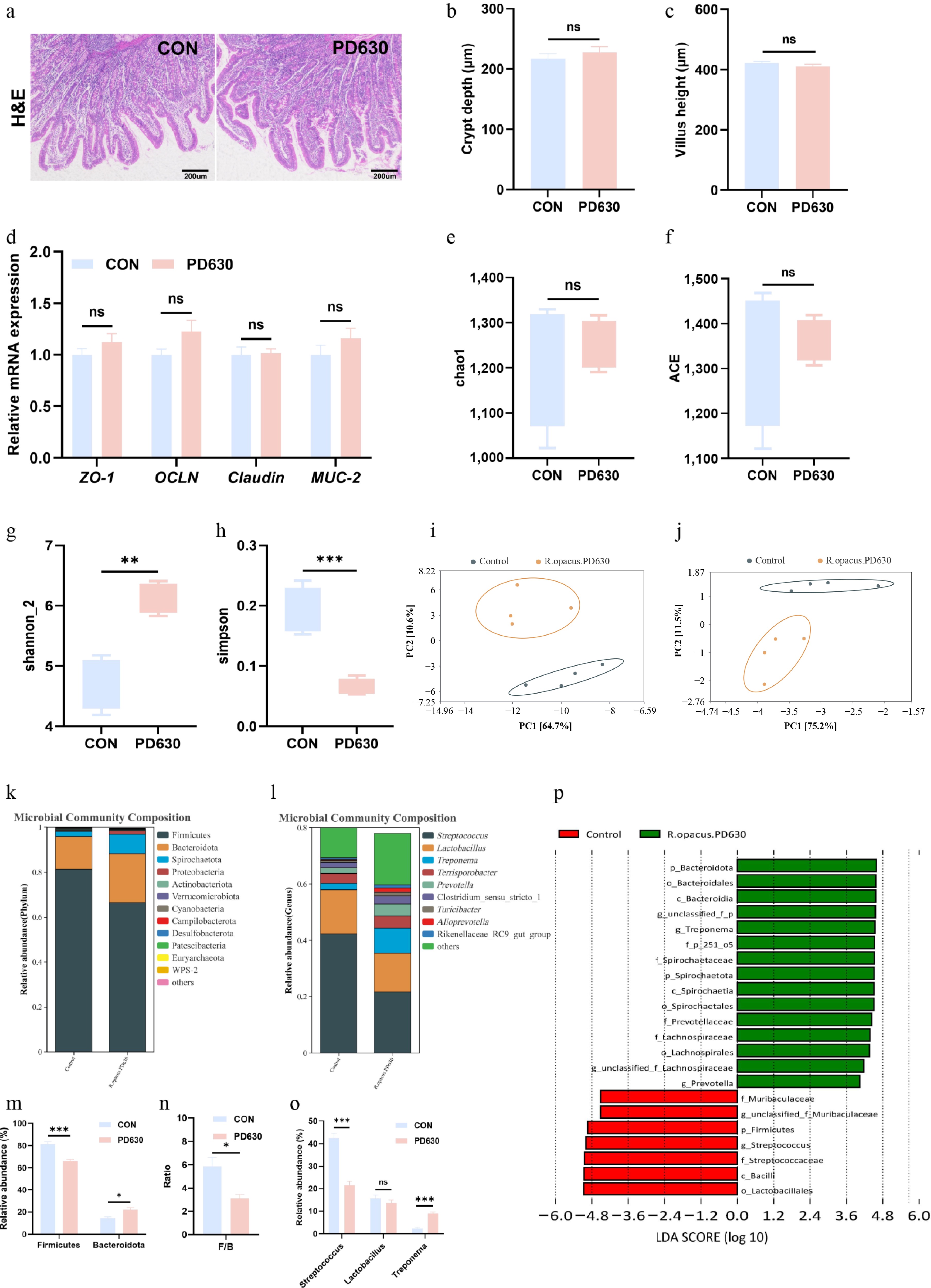
Figure 4.
Effects of lipids from engineered PD630 on intestinal morphology in finishing pigs. (a) Duodenal intestine H&E staining; scale bars, 200 μm. (b) Crypt depth (μm) (n = 3). (c) Villus height (μm) (n = 3). (d) Relative mRNA expression of intestinal barrier-related genes in the duodenum (n = 3). (e) Alpha diversity index: Chao1 (n = 4). (f) Alpha diversity index: ACE (n = 4). (g) Alpha diversity index: Shannon (n = 4). (h) Alpha diversity index: Simpson (n = 4). (i) Beta diversity analysis at the phylum level (n = 4). (j) Beta diversity analysis at the genus level (n = 4). (k) Relative abundances of dominant bacterial phyla (n = 4). (l) Relative abundances of dominant bacterial genera. (m) Relative abundances of Firmicutes and Bacteroidota at the phylum level (n = 4). (n) Firmicutes/Bacteroidota (F/B) ratio (n = 4). (o) Relative abundances of representative bacterial genera (Streptococcus, Lactobacillus, and Treponema) (n = 4). (p) LEfSe analysis of differentially enriched taxa. Data were presented as the mean ± sem. Three or four samples were randomly selected from the six slaughtered pigs in each group for subsequent molecular analysis.
Duodenal microbial diversity
-
Alpha diversity analysis was conducted to evaluate the species richness and diversity of duodenal microbiota. No significant differences were observed in Chao1 and ACE indices between the PD630 group and the control group (p > 0.05), indicating that the total number of microbial species remained stable (Fig. 4e–f). In contrast, both Shannon and Simpson indices differed significantly between the groups (p < 0.05), demonstrating that using lipids from PD630 as a feed source altered community evenness and the composition of the dominant species (Fig. 4g, h). Beta diversity was analyzed to evaluate the differences in microbial community composition between groups, reflecting species turnover and community shifts along environmental gradients. At both the phylum level (Fig. 4i) and the genus level (Fig. 4j), clear overall differences were observed in microbial community structures between the control and PD630 groups.
Microbial community composition and enriched taxa
-
Lipids from PD630 altered the composition of the duodenal microbiota. At the phylum level, the microbial communities in both the control and PD630 groups were mainly dominated by Firmicutes, Bacteroidota, Spirochaetota, and Proteobacteria, although their relative abundances differed between groups. Firmicutes remained the most abundant phylum in both groups but showed a decrease in the PD630 group. In contrast, Bacteroidota displayed an increasing trend, while Spirochaetota and Proteobacteria also exhibited changes in relative abundance compared with the control group (Fig. 4k).
At the genus level, the dominant genera in both groups included Streptococcus, Lactobacillus, and Treponema, although their relative distributions differed between treatments (Fig. 4l). Notably, Streptococcus abundance decreased in the PD630 group, while Treponema showed an increasing trend. In addition, the relative abundance of Prevotella was significantly higher in the PD630 group than in the control group (p < 0.05).
To further characterize the changes in dominant phyla, the relative abundances of Firmicutes and Bacteroidota were compared between groups. The results showed that Firmicutes abundance was reduced, whereas Bacteroidota abundance was significantly increased in the PD630 group compared with the control group (Fig. 4m). Consistently, the Firmicutes/Bacteroidota (F/B) ratio was significantly lower in the PD630 group (Fig. 4n), indicating a shift in the microbial community structure.
At the genus level, further comparison of representative taxa revealed that the relative abundance of Streptococcus was significantly reduced in the PD630 group, whereas Treponema abundance was significantly increased, while Lactobacillus showed a slight decrease compared with the control group (Fig. 4o). The relative abundance of Prevotella was also significantly increased in the PD630 group (p < 0.05).
LEfSe analysis was performed to identify significantly enriched taxa between groups. A total of seven taxa were significantly enriched in the control group and fifteen in the PD630 group. In the control group, biomarkers included o_Lactobacillales, c_Bacilli, f_Streptococcaceae, and g_Streptococcus. In the PD630 group, enriched taxa included p_Bacteroidota, o_Bacteroidales, and c_Bacteroidia (Fig. 4m).
-
To enhance lipid biosynthesis, PD630 was genetically engineered and evaluated for its potential as a sustainable feed ingredient. The engineered strain significantly increased the fatty acid content, which enabled its effective replacement of conventional lipid sources in optimized feed formulations while reducing the cost. Feeding trials confirmed that diets containing lipids from PD630 maintained the growth performance and health of finishing pigs while improving carcass traits, muscle amino-acid composition, and fiber characteristics. Collectively, these findings highlight PD630 as a promising microbial platform for sustainable livestock production.
Engineered PD630 exhibits high lipid accumulation and inherent mycotoxin-degrading capacity, supporting its use as a microbial chassis
-
A comprehensive evaluation of PD630’s physiological and metabolic characteristics reveals several advantages that support its application as an efficient microbial chassis: (1) Compared with the wild type, the OD value of the engineered PD630 strain was decreased, possibly due to the enlarged cell volume resulting from higher intracellular lipid accumulation. Under the same culture volume, this enlargement may have reduced the total cell numbers, thereby limiting measurable OD values[31]. Such growth constraints could likely be alleviated under large-scale fermentation conditions, where better oxygen transfer and spatial dispersion promote cell proliferation. (2) PD630 was chosen as the chassis cell because of its high single-cell oil content (approximately 80%), while other oleaginous microorganisms such as Y. lipolytica only have approximately 50%[32,33]. (3) Beyond its lipid productivity, PD630 can degrade mycotoxins such as deoxynivalenol and aflatoxin B1, suggesting additional detoxification benefits when incorporated into feed[26], thereby enhancing feed safety and nutritional value. In conclusion, these physiological and metabolic traits collectively demonstrate that PD630 is a robust and versatile microbial chassis, characterized by exceptional lipid accumulation, intrinsic detoxification capacity, and a strong potential for scalable industrial application. The lipid content obtained here (380.9 mg/g dry biomass) was lower than the maximum value reported under nutrient-limited lipid-accumulation conditions. This difference likely reflects the use of the present cultivation medium and conditions, which were not optimized specifically for maximum lipid accumulation.
PSO and ACO optimization algorithms enhance feed formulation efficiency and cost-effectiveness
-
To achieve efficient formulation design, PSO and ACO algorithms were applied to balance nutrition and cost. These bioinspired computational tools provide an effective alternative to conventional linear programming approaches by allowing simultaneous optimization of multiple nutritional and economic parameters[34]. (1) In contrast to machine learning methods such as random forests that are designed for classification and regression tasks, PSO and ACO demonstrate distinct yet complementary strengths in direct cost-nutrient trade-off analysis for feed formulation. In the present optimization, ACO reached a near-optimal solution within approximately 10 iterations, whereas PSO required approximately 40 iterations. PSO nevertheless showed strong global search capability, making it suitable for optimizing continuous parameters such as nutrient ratios[35], while ACO excels in discrete combinatorial optimization through adaptive search behavior, effectively minimizing the cost while maintaining nutritional adequacy[36]. (2) In our study, the ACO algorithm reduced the feed cost to 3.39 CNY/kg, approximately 8% lower than the baseline, outperforming not only conventional methods but also other common heuristic algorithms such as the genetic-algorithm implementation evaluated under the same model constraints in this study, in terms of convergence speed and model-estimated cost efficiency under the same constraints. Together, these findings demonstrate that PSO and ACO represent powerful tools for intelligent, artificial intelligence-driven feed formulation, providing a foundation for the advancement of precision livestock nutrition.
Microbial lipids from PD630 provide sustainable, cost-efficient, and environmentally friendly alternatives to conventional feed fats
-
Alternative lipid sources have gained increasing attention as sustainable substitutes for conventional feed fats, offering nutritional, economic, and environmental advantages. (1) Several alternative lipid sources can replace soybean oil or fish oil in animal diets while supporting equivalent growth performance. Examples include palm kernel meal, copra meal, and insect oils[37]. Similarly, PD630 microbial lipids also maintain animal growth. They additionally degrade mycotoxins, supporting gut health and production stability. (2) Insect meals and plant by-products can reduce feed costs by 5%–20%[38]. Under the feed-formulation optimization assumptions used in this study, inclusion of PD630 microbial lipids reduced the model-estimated feed cost by approximately 8%; this estimate did not include industrial fermentation, downstream recovery, or processing costs. (3) Insect-derived feeds, in particular, have been reported to lower greenhouse gas emissions by up to 70%, reduce land use by 80%–90%, and cut water demand by approximately 60% compared with traditional feed sources[39]. Similarly, PD630 microbial lipids offer land-independent, low-carbon, and scalable production from inexpensive carbon substrates, providing enhanced sustainability and resilience for future feed systems. In conclusion, lipids from PD630 not only match the nutritional and growth performance of conventional and alternative lipid sources but also provide distinct economic and environmental advantages through cost reduction, resource independence, and sustainable large-scale production potential.
Gut microbiota remodeling induced by PD630 lipids supports intestinal health and muscle development
-
At the microbial level, dietary inclusion of lipids from PD630 substantially reshaped the gut microbiota composition of finishing pigs. (1) The bacterial community shifted from a fermentation-dominant structure in the control group, characterized by Firmicutes prevalence, to a polysaccharide-degrading community dominated by Bacteroidota in the PD630 group. This transition indicates the enhanced potential of PD630 for complex carbohydrate utilization and short-chain fatty acid (SCFA) production, which may support improved nutrient absorption and intestinal homeostasis[40], implying a potential gut–muscle axis that warrants further investigation. Direct mechanistic links were not assessed in the present study. (2) In addition, the increased abundance of Prevotella and Treponema, together with the reduced abundance of Streptococcus, suggests a beneficial modulation of the gut ecosystem[41]. These microbial taxa are commonly associated with fiber degradation, SCFA generation, and anti-inflammatory functions, which may indirectly promote muscle growth and metabolic efficiency. Collectively, these microbial changes reflect improved intestinal functionality and a more balanced gut environment, potentially linking gut microbial modulation to the enhancement of muscle fiber morphology observed in pigs fed lipids from PD630.
Limitation and future scope
-
Despite the promising findings, this study has several limitations that warrant consideration. (1) The fermentation of PD630 was conducted under laboratory-scale conditions, and large-scale industrial fermentation was not achieved. Consequently, parameters such as oxygen transfer efficiency, substrate utilization dynamics, and lipid yield stability under pilot or commercial conditions remain to be verified. (2) Although the study confirmed the safety and growth-maintaining effects of lipids from PD630, further evaluation is needed to determine their impacts on nutrient digestibility, immune function, and meat flavor under varied dietary formulations. (3) While PD630 exhibited mycotoxin-degrading potential, the detoxification efficacy within actual feed matrices and the stability of degradation products have not yet been fully characterized. (4) Additionally, the observed muscle fiber hypertrophy, while contributing to increased muscle mass, may necessitate further optimization of the lipid composition to fine-tune the muscle fiber characteristics for ideal meat quality.
-
This study demonstrates that engineered PD630 is a promising microbial lipid source for sustainable livestock nutrition. Machine learning-based optimization using PSO and ACO algorithms enabled the formulation of cost-efficient, nutritionally balanced diets in which PD630-derived lipids effectively replaced conventional fat sources. Feeding trials confirmed that PD630 lipid substitution maintained growth performance and serum biochemical stability while improving carcass quality, enhancing muscle fiber development, and beneficially modulating gut microbiota composition. Collectively, these findings highlight the potential of PD630 microbial lipids as a scalable, eco-friendly alternative to traditional feed fats, contributing to the advancement of precision and sustainable animal production.
The authors would like to express their sincere gratitude to Qian Li for her assistance in microbial culture and fermentation experiments, and to Nana Li for her valuable help in sample preparation and chemical analysis. The authors also thank Chuxiong Zhang for his guidance on data processing and visualization, Jiahe Huang for providing technical support during the feeding trials, and Ruolan Huang for her contributions to manuscript editing and language polishing.
-
All procedures were reviewed and preapproved by the Committee on the Ethics of Animal Experiments and the Animal Care and Use Committee of Northwest A&F University (identification number: DK2024001, approval date: March 10, 2024). The research followed the "Replacement, Reduction, and Refinement" principles to minimize harm to animals. Detailed information on the housing conditions, daily care, and monitoring procedures was provided to ensure animal welfare, and all efforts were made to minimize stress and discomfort during the experiment.
-
The authors confirm their contributions to this study as follows: conceptualization, methodology, investigation, writing – original draft: Han W, Jia F; data curation: Han W, Wang W, Liu W; formal analysis: Jia F, Wang W, Cao J, Ren W; visualization: Wang W, Song X, Cao J, Liu W; validation: Wei B; resources: Wei B, Huang Y; methodology: Li S, Huang Y; writing – review and editing: Li SS, Li SQ, Ren W, Xia B; data processing, software: Song X; investigation, data validation: He Z; data analysis: Li S; supervision, project administration, funding acquisition: Xia B. All authors reviewed the results and approved the final version of the manuscript.
-
The datasets generated and analyzed during the current study are not publicly available due to institutional data management policies, but are available from the corresponding author on reasonable request.
-
The authors declare that they have no conflict of interest.
-
accompanies this paper online at: https://doi.org/10.48130/animadv-0026-0010.
-
# Authors contributed equally: Wenlong Han, Fengjuan Jia
- Supplementary Table S1 Primer sequences used for qPCR.
- Supplementary Table S2 Primer sequences.
- Supplementary Table S3 Amino acid composition and classification of engineered PD630 (% of PD630 dry weight).
- Supplementary Table S4 Composition and nutrient levels of experimental diets.
- Supplementary Table S5 Effects of lipids from engineered PD630 as a substitute for dietary fat on serum biochemical parameters of finishing pigs.
- Copyright: © 2026 by the author(s). Published by Maximum Academic Press on behalf of Nanjing Agricultural University. This article is an open access article distributed under Creative Commons Attribution License (CC BY 4.0), visit https://creativecommons.org/licenses/by/4.0/.
-
About this article
Cite this article
Han W, Jia F, Wang W, Wei B, Li S, et al. 2026. Engineered microbial lipids from Rhodococcus opacus PD630 as a non-grain feed source for pigs. Animal Advances 3: e026 doi: 10.48130/animadv-0026-0010 

Engineered microbial lipids from Rhodococcus opacus PD630 as a non-grain feed source for pigs
- Received: 22 January 2026
- Revised: 10 April 2026
- Accepted: 14 April 2026
- Published online: 15 September 2026
Abstract: Feed-food competition poses a major challenge to sustainable livestock production. This study investigated engineered Rhodococcus opacus PD630 lipids as alternative lipid sources in pig feed. The PD630 strain was genetically modified to enhance fatty acid synthesis, resulting in higher lipid yields. Lipids derived from PD630 were used to replace traditional feed lipids in the diet of finishing pigs. The growth performance and serum biochemical indices were unaffected, whereas carcass traits, including dressing percentage and backfat thickness, were significantly improved. The treated group exhibited increased muscle amino-acid levels and fiber cross-sectional area, accompanied by upregulated expression of MYOD and MYOG and downregulated expression of TRIM63 and FBXO32. Gut microbiota analysis revealed higher Prevotella and lower Streptococcus abundance without morphological changes. These findings demonstrate that 0.85% PD630 supplementation can safely partially replace traditional feed lipids while enhancing the meat quality and alleviating feed-food competition.