













-
In recent years, the prevalence of metabolic diseases, such as Type 2 diabetes mellitus, obesity, and nonalcoholic fatty liver disease, has been steadily rising[1]. Dietary intervention is considered a safer approach for preventing and managing metabolic diseases compared with drug therapy. It offers a more natural and holistic method for weight management and overall health improvement, without the potential side effects associated with medications. For example, studies have shown that a low glycemic index (GI) diet may be more effective in controlling glycated hemoglobin A1c (HbA1c) and fasting blood glucose in patients with Type 2 diabetes[2], and may also reduce hepatic fat mass in patients with nonalcoholic fatty liver disease[3].
Rice, a staple food crop that has played a vital role in the long-term evolution of humanity, especially in Asia, is an ideal and efficient entry point for dietary intervention. Resistant starch (RS), also known as indigestible or anti-enzymatic starch, is a unique form of dietary fiber. Unlike regular starch, it is not easily digested or utilized by amylase in the small intestine. Instead, it travels to the colon, where it is fermented by beneficial microorganisms. This fermentation process produces short-chain fatty acids, lactic acid, and other substances that are advantageous for the body's health[4]. Most natural rice varieties contain only limited amounts of resistant starch[5]. However, with the advancements in agricultural technology and breeding techniques, new rice varieties with high RS content have been developed[5,6]. These high-RS rice varieties represent a valuable resource for the development of novel dietary fibers. They offer a promising avenue for enhancing the nutritional value of rice and promoting healthier dietary options, particularly in regions where rice is a predominant food source.
In this study, we characterized the features of a high-RS rice in vitro, and investigated its in vivo effect by employing two model organisms, Drosophila and mouse. Drosophila melanogaster was chosen for its short reproductive cycle, well-defined genetic background, ease of manipulation, conserved metabolic pathways, and, critically, the availability of a powerful genetic toolkit that enables precise phenotypic investigation of its metabolic responses[7,8]. The mouse was selected as a well-studied mammalian model of severe obesity and metabolic dysfunction, characterized by leptin deficiency, hyperphagia, insulin resistance, dyslipidemia, and hepatic steatosis, closely mimicking key aspects of human metabolic syndrome[9,10]. The high-RS rice was found to have a lower GI value, and when rice flour was provided as the sole dietary source, adult flies fed RS1 survived starvation for a shorter time. Furthermore, in a larval model of sugar intolerance (the Drosophila mlx mutant), high-RS rice significantly alleviated the developmental defects associated with glycolipid metabolism disorder, while high-RS rice was found to regulate lipid metabolism in B6-ob mice and exerted an ameliorative effect on their obesity. Our study provides a scientific theoretical basis for using high-RS rice in the prevention and management of obesity and related metabolic diseases.
-
The high-RS rice cultivar RS1 was provided by the Institute of Germplasm Resources and Biotechnology, Jiangsu Academy of Agricultural Sciences. Regular rice purchased from Shandong Yongsheng Food Co. Ltd was used as a control in this study.
Animals
-
Oregon R (OR) wild-type Drosophila melanogaster was obtained from Bloomington Drosophila Stock Center. The mlx mutant was gifted by Prof. Hietakangas. Drosophila specimens were reared in an incubator under a constant temperature and humidity with a light–dark cycle of 12 h, an ambient temperature of 25 °C, and a humidity of 70%.
Thirty-six male obese mice (B6/JGpt-Lepem1Cd25/Gpt), each 5 weeks old, were acquired from Yaoheng Biotechnology Co. Ltd. The mice were acclimated to the environment for 7 d at the Animal Experiment Center of Nanjing Agricultural University. After 7 d, they were divided into two groups according to body weight, namely the control rice group (CR) fed a maintenance diet containing 25% common rice, and the high-RS rice group (RS1) fed a maintenance diet containing 25% high-RS rice, with six replicates per group and three mice per replicate. The experimental period lasted for 12 weeks, during which the mice had ad libitum access to food and water and were maintained under a 12-h light–dark cycle, with an environmental temperature of 23 ± 2 °C and 50% ± 10% humidity. The maintenance diet was produced by Jiangsu Xietong Biotechnology Co. Ltd. At the end of the experiment, the mice were fasted for 12 h before sampling. One mouse with average body weight was selected from each replicate for subsequent analyses.
Analysis of rice composition
-
The rice (n = 4) samples were analyzed using AOAC methods for the content of ether extract (EE), crude fiber (CF), and gross energy (GE)[11].
In vitro glycemic index (GI) determination in rice
-
The in vitro GI of rice was detected according to the method described by Englyst et al. in an in vitro digestion model[12]: to a 50 mg sample (particle size < 70 mesh), we added 1 mL of a 0.05 M hydrochloric acid–guar gum solution (5 g/L guar gum in 0.05 M HCl) and 5 mg of proteinase K. The mixture was then incubated on a shaker (150 rpm at 37 °C) for 30 min to simulate the gastric digestion phase. Subsequently, 2 mL of 0.5 M sodium acetate (pH 5.2) was added, and the mixture was incubated on a shaker (150 rpm at 37 °C) for 5 min. Following this, 0.5 mL of a mixed enzyme solution (as described later) was added, mixed thoroughly, and placed on a shaker (150 rpm at 37 °C) to simulate the intestinal digestion phase. At 30, 60, 90, 120, 150 and 180 min, 50 μL of the digested solution was mixed with 0.5 mL of 50% ethanol and centrifuged (a 8,000×g) for 10 min. The digested solution was then mixed with 0.5 mL of an enzyme mixture (see the section below). The glucose content in the supernatant of the mixture was determined, and the glucose standard curve was plotted using a glucose assay kit (GAGO20, Sigma-Aldrich) according to the manufacturer's instructions.
To prepare the enzyme mixture, we added ɑ-amylase 0.72 g to 6.4 mL of H2O and mixed them for 5 min. The mixture was centrifuged at 1,500×g for 10 min, and then 4.32 mL of the supernatant was transferred to a 15-mL centrifuge tube. We dilute 0.512 mL of amyloglucosidase to a final volume of 0.64 mL, and then pipetted 0.48 mL of this dilution into the ɑ-amylase tube. Finally, 0.32 mL of invertase (1 mg/mL) was added to the tube.
Calculation of the in vitro glycemic index (GI): the mass of glucose after hydrolysis of each sample was based on the glucose standard curve and the measured absorbance, and then the hydrolysis rate (HR) was calculated using the following formula:
$ {\rm {HR}}\;({\text{%}})=m_G \times \dfrac{7}{0.1}\times \dfrac{1.1}{01}\times \dfrac{1}{1000} \times \dfrac{50}{m_d} \times \dfrac{162}{180} $ where, mG represents the mass of glucose (mg), 7/0.1 is the volume correction factor for different hydrolysis times, 1.1/1 is the volume correction value for the glucose oxidase-peroxidase (GOPOD) assay step, 1/1000 is the conversion factor for glucose mass, md is the dry mass of the sample (mg), and 162/180 converts the free D-glucose obtained from starch to the dehydrated D-glucose factor present in starch. A curve of the hydrolysis rate of the sample was plotted, based on hydrolysis time and hydrolysis rate. The area under the curve (AUC) was obtained by integrating the hydrolysis rate curve using Origin software, and the hydrolysis index (HI) was calculated according to the following formula:
$ \mathrm{HI}\;({\text{%}})=\dfrac{A U C_{1}}{A U C_{0}} \times 100 $ where, AUC1 represents the area under the hydrolysis rate curve for the starch in the sample, and AUC0 is the area under the hydrolysis rate curve for the standard white bread. Finally, the predicted in vitro GI was calculated by substituting the HI into the following formula:
$ \mathrm{GI}=0.862 \mathrm{HI}+8.189 $ Drosophila survival assay
-
To explore the relationship between rice-based nutrient supply and Drosophila's survival, a restricted feeding assay was performed using 3%, 5%, and 10% rice flour suspensions (rice flour sieved through a 70-mesh screen and prepared with reverse osmosis [RO] water). Initially, 12 female and 8 male flies were placed in standard food vials for 2 d to propagate the population. Male flies that eclosed within 12 h were collected, grouped as 20 flies per replicate, and pre-cultured in 8–10 replicates for 3 d. These flies were then transferred to vials containing filter paper and a rice flour suspension. Mortality was recorded every 8 h, and the vials were replenished with fresh suspension every 12 h. The suspension was supplemented as needed, depending on the filter paper's dryness.
Drosophila pupation assay
-
Oregon R wild-type and mlx homozygous mutant larvae were used as the research subjects. The diet consisted of 2% yeast + 40% rice flour. Rice flour was sieved through a 70-mesh screen, then the feed was prepared by adding 0.6 g agar and 1.2 g yeast to 60 mL RO water, heating the mixture, then adding 24 g rice flour, calcium propionate, and a methyl paraben solution. The experiment included five replicates, with 50 first-instar larvae placed in each replicate. Pupation numbers were recorded every 24 h, and the pupation rate was calculated as the ratio of pupated larvae to the initial larval number.
Determination of the organ index
-
Liver, kidney, spleen, and epididymal fat were collected from mice. The organs were rinsed with saline and weighed after absorbing the surface water. The organ index was calculated using the following formula: Organ index (mg/g) = Organ weight (mg)/Body weight (g).
Morphologic observations of liver and fat
-
Portions of epididymal adipose tissue and liver tissue wereimmersed in 4% paraformaldehyde and fixed at room temperature. Subsequently, they were sent to Sevier Biotechnology Co., Ltd. Upon arrival at the company, the adipose tissue was stained with hematoxylin and eosin (H&E), and the liver tissue was stained with Oil Red O. The stained sections were observed under a virtual microscope, and the images were subsequently analyzed.
Blood lipid and liver enzyme measurement
-
Lipid indices and liver enzymes were measured using fasting serum samples from mice, with blood collected from the orbital sinus after anesthesia. The levels of triglycerides (TG), total cholesterol (TC), high-density lipoprotein-cholesterol (HDL-C), and low-density lipoprotein-cholesterol (LDL-C) were measured to evaluate the status of dyslipidemia. Moreover, to assess liver function, alanine aminotransferase (ALT) and aspartate aminotransferase (AST) were measured as marker enzymes. All the tests were performed in an automated biochemical analyzer (BX-4000, Sysmex).
Reverse transcription quantitative polymerase chain reaction
-
Total RNA was extracted using Trizol (R411-01, Vazyme) from the liver according to the manufacturer's instructions, which was reverse transcribed to cDNA by SuperMix for quantitative polymerase chain reaction (qPCR) (+gDNA wiper) (RR036A, TAKARA). The quantitative reaction system was prepared with SYBR qPCR Master Mix reagent (Q711-02, Vazyme) following the standard operating procedures. The qPCR was performed using the QuantStudio 7 Flex Real-Time Fluorescence PCR System (ViiA7, Applied Biosystems). All gene expression levels were normalized to GAPDH, and the results were expressed as the fold change in mRNA expression. The primer sequences for qPCR were listed in Table 1.
Table 1. List of primers column headings.
Gene name Primer strand Primer sequence FASN Forward 5′- GGCCCCTCTGTTAATTGGCT-3′ Reverse 5′- GGATCTCAGGGTTGGGGTTG-3’ ACACA Forward 5′- GCGTCGGGTAGATCCAGTTT-3′ Reverse 5′- GACACCCTTCTCCTGCATCC-3’ SREBP-1c Forward 5′- GACATCGCAAACAAGCTGAC-3′ Reverse 5′- GGATGAGGTTCCAAAGCAGAC-3’ PPARα Forward 5′- TTGAGTCATGGGCTTTCGGG-3′ Reverse 5′- CTTACTGGCAGTCCCACGAG-3′ CPT1A Forward 5′- TCCTGGCAGATACACCAACG-3′ Reverse 5′- CCCATTACTTGAGACCCCCG-3′ GAPDH Forward 5′- GTGTTCCTACCCCCAATGTG-3′ Reverse 5′- ATTGTCATACCAGGAAATGAGCTT-3 Statistical analysis
-
Microsoft Excel and GraphPad Prism 8.0 were used for statistical analysis. Normality and homogeneity of variance were assessed prior to parametric testing. Survival differences between groups were analyzed by the log-rank test. The results are presented as the mean ± standard error of the mean (SEM). Differences between groups were analyzed using the independent samples t-test, and multiple-comparison correction was applied for analyses involving multiple genes in Fig. 4e. A p-value less than 0.05 was considered statistically significant.
-
Previously, we developed a rice cultivar with a high RS content, named RS1, which contained 8.56% RS. We then determined the starch content, crude fat, and crude fiber of this high-RS rice in comparison with regular rice (CR) from Shandong Yongsheng Food Co. Ltd., all of which showed no significant difference (Fig. 1a–c, Table 2). The two types of rice also possessed a comparable level of total energy as measured by a calorimeter (Fig. 1d, Table 2). However, an in vitro digestion method revealed that the RS1 rice had a GI of 57.60, which was remarkably lower than that of the CR, i.e., 85.54 (p < 0.001), which generally is categorized as a high-GI food (Fig. 1e, Table 2; Supplementary Table S1).
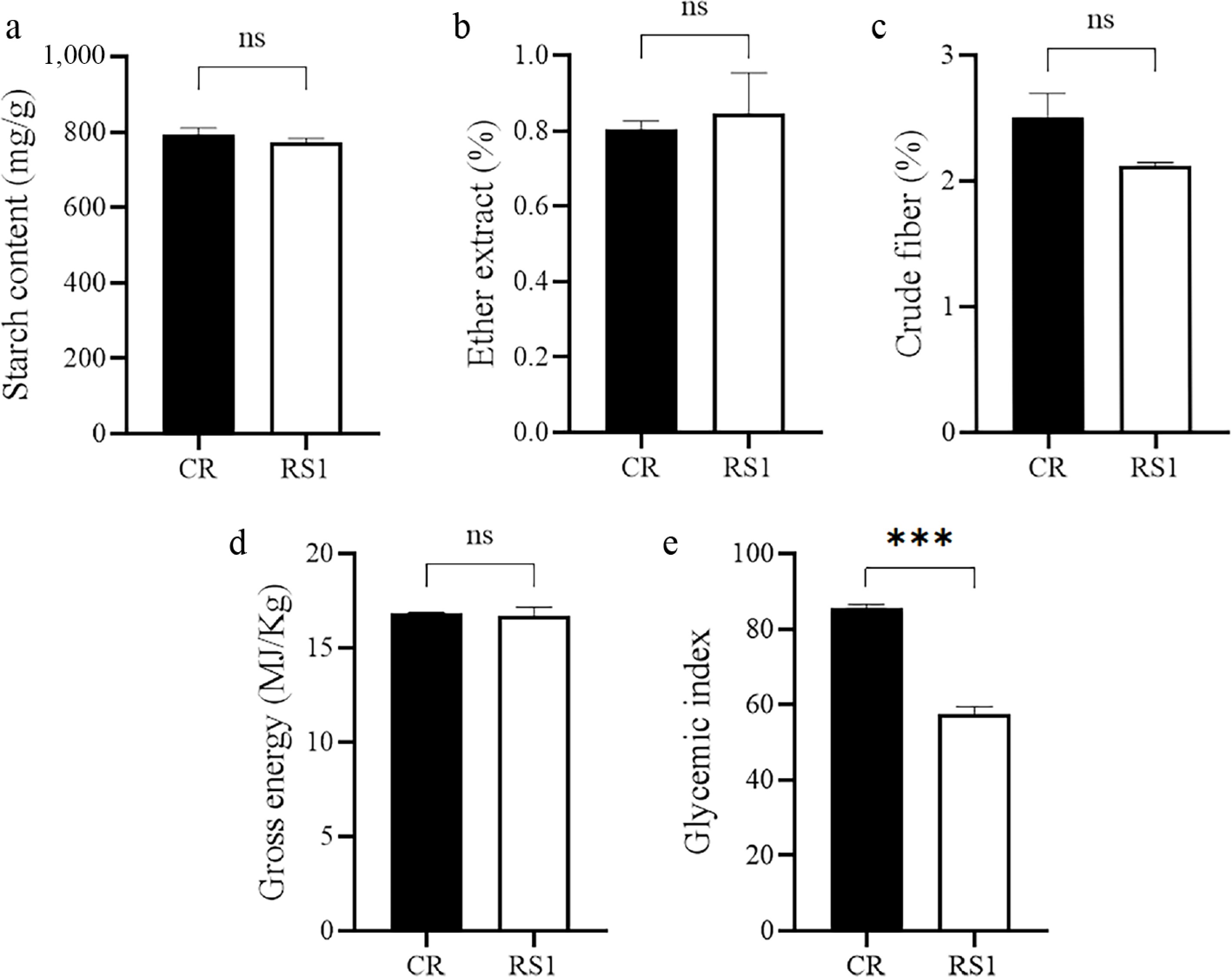
Figure 1.
Nutritional indicators of rice. (a) Starch content of rice. (b) Ether extract of rice. (c) Crude fiber content of rice. (d) Gross energy of rice. (e) In vitro glycemic index (GI) of rice. Data are expressed as the mean ± SEM (n = 3). *** p < 0.001, ns p > 0.05. CR, control rice; RS1, high-RS rice.
Table 2. Nutritional features of rice and effects of different rice on serum biochemical indices and organ indices in mice.
CR RS1 p-Value Starch content (mg/g) 794.60 ± 29.54 771.55 ± 20.84 0.3378 Ether extract (%) 0.81 ± 0.07 0.84 ± 0.10 0.64 Crude fiber (%) 2.50 ± 0.20 2.12 ± 0.02 0.08 Gross energy (MJ/kg) 16.83 ± 0.11 16.68 ± 0.85 0.79 GI 85.54 ± 1.58 57.60 ± 2.58 0.0006 Organ indices Liver (mg/g) 81.12 ± 6.69 76.39 ± 4.42 0.0211 Epididymal fat (mg/g) 48.91 ± 8.86 41.71 ± 6.82 0.0103 Spleen (mg/g) 1.66 ± 0.23 1.65 ± 0.27 0.8853 Kidney (mg/g) 6.95 ± 0.81 6.65 ± 0.52 0.1977 Serum biochemical indices ALT (U/L) 329.04 ± 71.12 273.44 ± 52.65 0.0791 AST (U/L) 94.47 ± 15.00 65.54 ± 22.80 0.0004 TG (mmol/L) 0.98 ± 0.16 0.78 ± 0.09 0.007 CHOL (mmol/L) 6.74 ± 0.43 6.132 ± 0.64 0.0325 LDL-C (mmol/L) 1.79 ± 0.47 1.42 ± 0.16 0.0469 HDL-C (mmol/L) 3.19 ± 0.26 3.66 ± 0.48 0.022 Data are expressed as the mean ± SEM. Effects of RS1 rice on survival under nutrient restriction and development disorders associated with sugar metabolism defects in Drosophila
-
We deprived the wild-type adult flies (Oregon R, OR) of other nutrient sources by providing rice flour and water as the sole dietary source. Overall, flies fed on CR survived better than those on RS1, and the difference caused by the two types of rice became more pronounced as the concentration of rice flour increased (Fig. 2a–c; Supplementary Table S2), suggesting that RS1 rice may provide less available energy under these conditions; however, food intake was not directly measured and differences in palatability, particle size, settling rate or suspension stability of the rice flour, as well as direct effects of resistant starch on gut physiology or osmotic balance, could not be excluded. It is well known that mlx is a key regulator involved in the transcriptional response to dietary sugar. Fly larvae lacking mlx show strikingly reduced survival on a diet with moderate or high levels of sucrose, glucose, and fructose[13,14]. To further test the effect of RS1 rice on animals' sugar metabolism, OR and mlx mutants were cultured from first instar larvae on food supplemented with rice flour. Upon feeding with CR, wild-type larvae had a pupation rate of nearly 75%, whereas mlx had a pupation rate of less than 25% (Fig. 2d, e; Supplementary Tables S3 and S4). RS1 had no significant effect on the pupation rate of OR larvae (p > 0.05) (Fig. 2d; Supplementary Table S3). However, it significantly improved the pupation rate of mlx mutant larvae (p < 0.01) (Fig. 2e; Supplementary Table S4), suggesting that RS1 is less deleterious to sugar-intolerant Drosophila compared with regular rice.
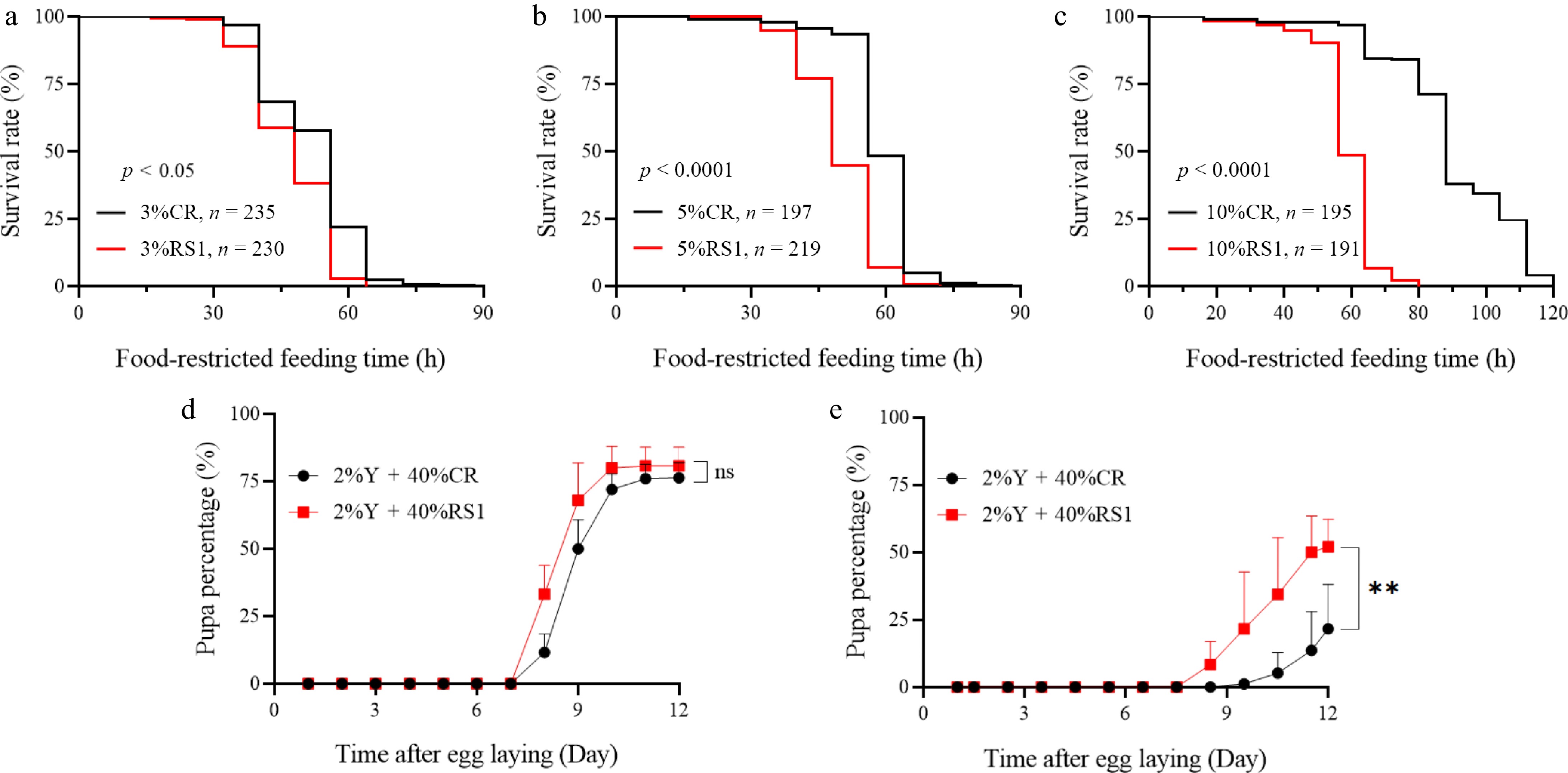
Figure 2.
Effects of RS1 rice on the survival and growth of Drosophila melanogaster. (a)–(c) Survival curves of wild-type adult flies fed restrictively with different concentrations of a rice flour suspension, where n represents the number of fruit flies (n ≥ 190). (d), (e) Growth curves of wild-type larvae (d) and mlx larvae (e) on diets supplemented with rice flour. RS1 rice had a significant effect on the final pupation rate of mutant larvae. Data are expressed as the mean ± SEM (n = 5). Survival curve comparisons were performed using the log-rank test. ** p < 0.01, ns p > 0.05. CR: control rice; RS1: high-RS rice.
Effects of RS1 rice on hepatic lipid metabolism in obese mice
-
On the basis of our observations in Drosophila, we further moved on to study the effects of RS1 rice in mammals. Six-week-old male obese mice were fed either the RS1 rice or regular rice. Food intake and water intake were measured weekly throughout the 12-week treatment period. Neither parameter differed significantly between the CR and RS1 groups at any time point (Fig. 3a, b; p > 0.05; Supplementary Table S5, S6). The RS1 diet therefore did not reduce food or water consumption. Measurements of organ weights (liver, epididymal fat, spleen, and kidney) showed that the liver and epididymal fat indices in the RS1 group were significantly lower than those in the CR group (p < 0.05) (Fig. 4a, Table 2; Supplementary Table S7). There was no significant difference in the spleen index and kidney index between the two groups (p > 0.05) (Fig. 4a, Table 2; Supplementary Table S7). Although there was no significant difference in ALT, AST levels were significantly lower in the RS1 group than in the CR group (p < 0.01) (Fig. 4b, Table 2; Supplementary Table S8). This suggests feeding on high-RS rice can alleviate liver damage in obese mice. Lipid profiles showed that serum levels of TG, CHOL, and LDL-C were significantly lower in the RS1 group (p < 0.05), whereas HDL-C levels were higher compared with CR (p < 0.05) (Fig. 4c, Table 2; Supplementary Table S8). These findings indicate that the intake of RS1 rice reduces blood lipids and decreases the efficiency of cholesterol accumulation in the peripheral tissues of obese mice.
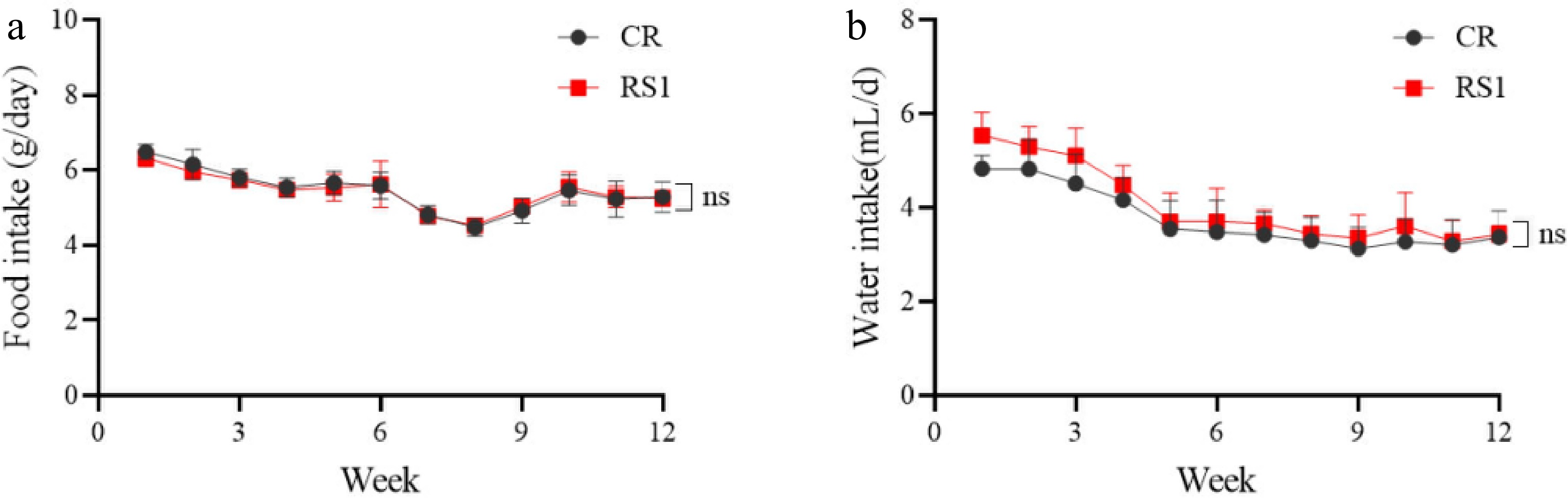
Figure 3.
Effects of rice diets on food and water intake in obese mice. (a) Weekly food intake (g/day). (b) Weekly water intake (mL/day). Intake was recorded weekly for each cage throughout the 12-week intervention. Data are expressed as the mean ± SEM (n = 6 cages per group, three mice per cage). CR: control rice; RS1: high-RS rice.
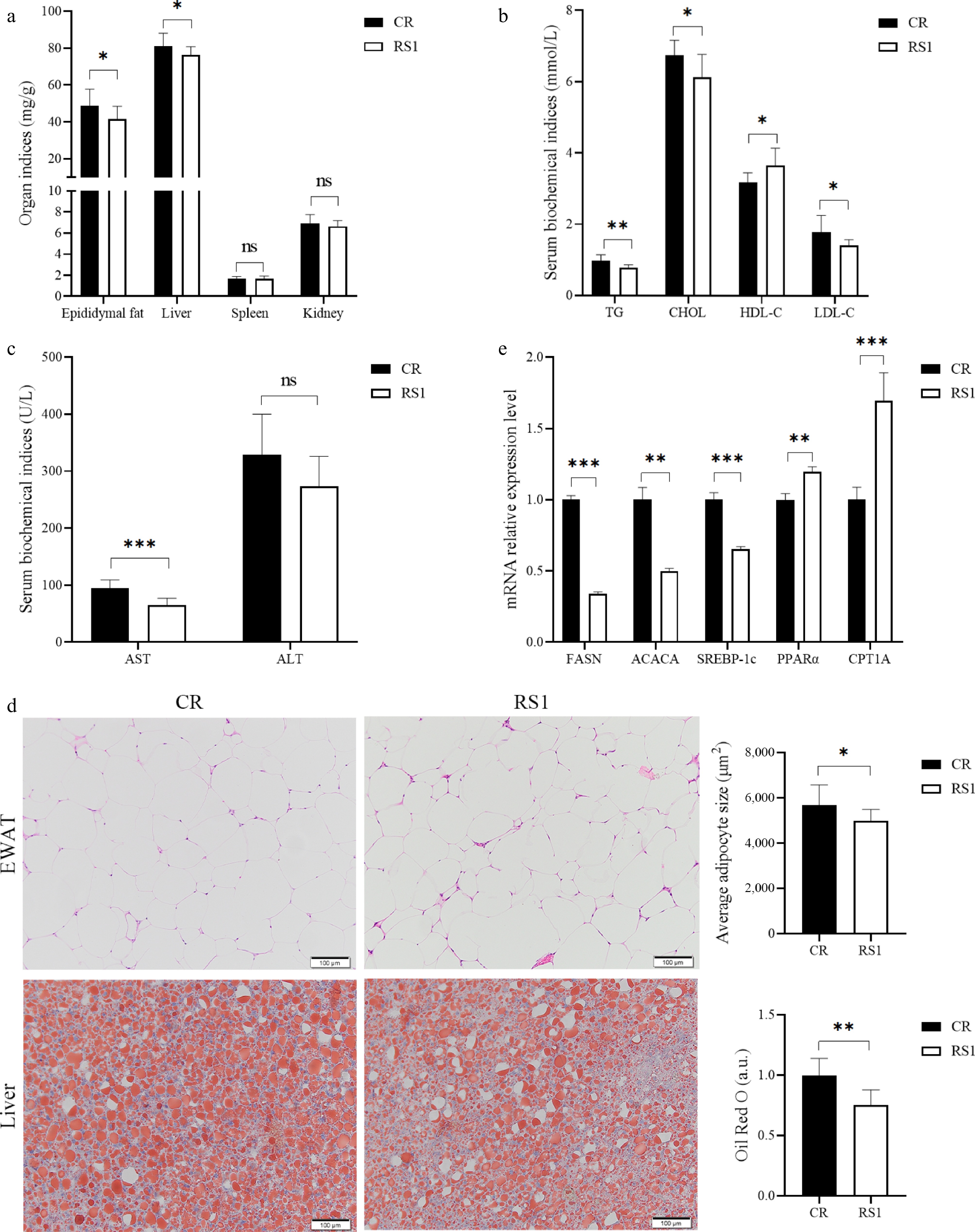
Figure 4.
Effects of rice diets on liver injury, lipid accumulation, and metabolism in obese mice. (a) Organ indices of epididymal fat, liver, spleen, and kidney (n = 6). (b) Liver function indices (n = 6). (c) Analysis of serum lipids (n = 6). (d) Morphologic observation of the liver and epididymal fat (n = 6). (e) mRNA expression of lipid metabolism-related genes in liver tissues of obese mice was measured by reverse transcription–qPCR; gene expression analyses were performed on five of the six replicates per group (n = 5). Data are expressed as the mean ± SEM. * p < 0.05, ** p < 0.01, *** p < 0.001, ns p > 0.05. CR: control rice; RS1: high-RS rice. Six biological replicates per group were examined. Representative images were selected to reflect the median histological phenotype, and additional histological images are provided in the supplementary files. No cropping, assembly, or adjustments to brightness and contrast were applied to any of the figures.
Enlarged adipocyte morphology is also an important histological feature of obesity. H&E staining of epididymal adipocytes showed that the size of the adipocytes was significantly smaller in the RS1 group compared with the CR group (p < 0.05) (Fig. 4d; Supplementary Fig. S1). The smaller size of the adipocytes suggests that RS1 rice may reduce the hypertrophy and compactness of adipocytes. As illustrated by Oil Red O staining of liver tissues, lipid droplets were widely distributed, and lipid deposition was severe in the liver of both groups of obese mice. However, statistical analysis showed that the relative infiltration area of lipid droplets in the RS1 group was significantly smaller than that in the CR group (p < 0.01) (Fig. 4d; Supplementary Fig. S2). Furthermore, we examined the mRNA levels of SREBP-1c, FAS, and ACACA, which are genes involved in lipid synthesis, as well as PPARɑ and CPT1A, which are involved in lipolysis. The results showed that the expression levels of FASN, ACACA, and SREBP-1c in the RS1 group were significantly lower (p < 0.01) (Fig. 4e). In contrast, the relative mRNA expression levels of PPARα and CPT1A significantly increased (p < 0.01) (Fig. 4e; Supplementary Dataset 1). These results suggest that RS1 rice, as a dietary intervention, can improve the lipid profiles of obese mice.
-
GI reflects the ability of food to raise post-prandial blood glucose. The nutritional field classifies foods into three categories according to their GI values: low GI (< 55), medium GI (55–70), and high GI (> 70)[15]. Our results showed that the RS1 rice used in this study is a medium-GI food. High-GI diets are associated with an increased risk of metabolic disorders and chronic diseases. For example, high-GI diets have been shown to hinder body weight reduction and are unfavorable for cardiovascular health improvement[13,16]. In contrast, low-GI diets effectively control glycated hemoglobin (HbA1c) and fasting blood glucose in Type 2 diabetes patients and have been associated with reduced hepatic fat in nonalcoholic fatty liver disease[2,17]. Notably, our results show that RS1 rice (GI = 57.6) is a medium-GI food, significantly lower than the control rice (GI = 85.54, a high-GI food). This moderate GI profile suggests that RS1 rice may offer greater potential benefits for metabolic health as a long-term dietary component, particularly when compared with high-GI alternatives.
RS1 rice can ameliorate developmental disorders of sugar-intolerant Drosophila
-
The mondo-mlx complex shows a high degree of functional conservation between flies and mammals[18]. Interfering with the function of this complex severely affects Drosophila's energy metabolism, rendering animals highly intolerant to sugars in their diet[18]. In this study, we incorporated 40% rice flour into the larval diet, resulting in a relatively high carbohydrate content. Under this experimental setting, we found that RS1 rice did not substantially affect the final pupation rate of OR larvae, but it significantly enhanced the pupation rate of mlx mutant larvae (Fig. 2d, e). This highlights the potential benefits of RS1 rice on the growth of Drosophila with a defective sugar metabolism. We speculate that this effect is because the starch in RS1 rice is more resistant to being broken down by amylase, resulting in fewer monosaccharides being produced during digestion, which is consistent with, but not conclusively demonstrated by, the shorter starvation survival of wild-type flies fed RS1 rice as the sole food source (Fig. 2a–c), since food intake was not directly measured and alternative explanations (palatability, the physical properties of the flour suspension, and direct effects of resistant starch on gut physiology or osmotic balance) were not excluded.
RS1 rice regulates lipid metabolism in the liver of obese mice
-
The liver is the primary organ responsible for lipid metabolism in mammals, playing a key role in the synthesis and transport of endogenous lipids. An imbalance between lipid synthesis and catabolism, such as increased lipogenesis and reduced fatty acid β-oxidation can lead to hepatic lipid accumulation and liver damage[17,19]. In this study, a 25% RS1 rice diet fed to obese mice reduced the relative liver weight, decreased lipid droplet accumulation, and significantly lowered blood levels of AST, whereas ALT showed only a non-significant trend towards a reduction (Table 2). Consistently, RS1 rice reduced lipid accumulation in the blood of obese mice and enhanced the body's ability to lower blood cholesterol levels (Fig. 4c, Table 2). Taken together, these findinds suggest that RS1 can alleviate hepatic steatosis, reduce liver damage, and protect the liver in obese mice. These data should, however, be interpreted with caution: although food intake and water intake did not differ between the two groups (Fig. 3), the body-weight trajectory, feed efficiency and functional endpoints of glucose metabolism were not determined, so no conclusion can be drawn regarding glucose homeostasis or insulin sensitivity.
Yingsen Liu et al. demonstrated that RS corn reduced the mRNA expression of SREBP-1c and FAS in broilers, inhibiting fat synthesis and improving lipid metabolism disorders[20]. Similarly, in this study, RS1 rice downregulated hepatic mRNA levels of lipogenic genes (SREBP-1c, FASN, and ACACA) and upregulated fatty acid oxidation genes (PPARα and CPT1A) (Fig. 4e). These transcriptional changes correlate with improved serum lipid profiles and reduced hepatic lipid accumulation in RS1-fed obese mice (Fig. 4c, d). These findings collectively demonstrate that dietary intervention with RS1 rice modulates hepatic lipid homeostasis and is associated with transcriptional changes in lipogenic and fatty acid oxidation genes.
-
Several limitations of this study should be acknowledged. First, in the Drosophila restricted-feeding assay, food intake was not measured; therefore, the shorter starvation survival of RS1-fed flies could reflect differences in palatability, feeding behavior, or suspension properties rather than energy content alone. Second, the improved final pupation rate of mlx larvae was assessed without data on larval intake, body weight, or trehalose/glucose levels, so the interpretation of this phenotype can not be conclusively attributed to an improved metabolic outcome. Third, in the mouse study, body weight trajectories, and glucose metabolism endpoints (e.g., fasting glucose, insulin, and glucose tolerance) were not assessed; consequently, no conclusion can be drawn regarding glucose homeostasis or insulin sensitivity. Finally, the proposed link between the resistant starch content of RS1 rice and its physiological effects remains correlative, as residual resistant starch after digestion, short-chain fatty acid production, gut microbiota composition, and starch fine structure were not measured.
-
In summary, RS1 rice is similar to regular rice in terms of total energy, starch content, crude fat, and crude fiber content, but it possesses medium-GI properties and provides a lower energy supply. Replacing regular rice with RS1 rice in the diet can improve developmental disorders in sugar-intolerant Drosophila, and reduce lipogenesis, alleviate liver function damage, and promote hepatic lipid metabolism in obese mice. This RS1 rice represents a new type of dietary fiber with potential applications. Further research is needed to explore its additional functions and underlying mechanisms.
This work was supported by the National Key R&D Program of China (2018YFC1200201), the National Natural Science Foundation of China (No. 31701229), and the Fundamental Research Funds for the Central Universities (JSJL2023006).
-
All procedures were reviewed and preapproved by the Institutional Animal Care and Welfare Ethics Committee of Nanjing Agricultural University, Nanjing, China (identification number: NJAU.No20221115216; approval date: November 15, 2022). The research followed the 'replacement, reduction, and refinement' principles to minimize harm to the animals. This article provides details on the housing conditions, care, and pain management used for the animals, ensuring that the impact on the animals was minimized during the experiment.
-
The authors confirm their contributions to the paper as follows: performed the experiments, analyzed the data, and wrote the manuscript: Hu L; performed the experiments and analyzed the data: Niu Z; performed the experiments and analyzed the data: Huang J; analyzed the data: Cai Y; conceived and designed the experiments, and revised the manuscript: Wang Y; provided the RS1 rice cultivar, designed the experiments and analyzed the data: Zhang Y; designed the experiments, supervised the work, analyzed the data, and wrote the manuscript: Zhang W; designed the experiments and revised the manuscript: Wang P. All authors reviewed the results and approved the final version of the manuscript.
-
The datasets generated and/or analyzed during the current study are available from the corresponding author on reasonable request.
-
The RS1 rice cultivar used in this study was provided by the Institute of Germplasm Resources and Biotechnology, Jiangsu Academy of Agricultural Sciences, with which co-author Yunhui Zhang is affiliated. The authors declare no other competing interests.
-
accompanies this paper online at: https://doi.org/10.48130/animadv-0025-0040.
- The supplementary files can be downloaded from here.
- Copyright: © 2026 by the author(s). Published by Maximum Academic Press on behalf of Nanjing Agricultural University. This article is an open access article distributed under Creative Commons Attribution License (CC BY 4.0), visit https://creativecommons.org/licenses/by/4.0/.
-
About this article
Cite this article
Hu L, Niu Z, Huang J, Cai Y, Wang Y, et al. 2026. Intervention effects of a novel high-resistant starch rice variety on animal models with defects in glycolipid metabolism. Animal Advances 3: e031 doi: 10.48130/animadv-0026-0027 

Intervention effects of a novel high-resistant starch rice variety on animal models with defects in glycolipid metabolism
- Received: 04 March 2025
- Revised: 27 August 2026
- Accepted: 29 September 2026
- Published online: 23 November 2026
Abstract: This study investigated the metabolic benefits of a high-resistant starch rice variety (RS1 rice) using Drosophila melanogaster and obese mouse models. Comparative nutritional analysis revealed that RS1 rice shares a similar starch, crude fiber, and energy content with regular rice (CR) but exhibited a significantly lower glycemic index (GI) (57.6 vs 85.5, p < 0.001). In Drosophila, wild-type adult flies fed RS1 rice showed a shorter starvation survival time than those fed CR under nutrient deprivation; although food intake was not directly measured, this pattern is consistent with reduced energy availability. Conversely, RS1 rice significantly enhanced the pupation rate of sugar-intolerant mlx mutant larvae (25%–45%, p < 0.01), suggesting that it reduces the metabolic burden in sugar-sensitive organisms. In obese mice, dietary RS1 rice ameliorated hepatic steatosis by reducing liver fat accumulation and adipocyte hypertrophy. Serum lipid profiles improved, with decreased triglycerides, cholesterol, and low-density lipoprotein cholesterol (LDL-C), alongside elevated high-density lipoprotein cholesterol (HDL-C) (p < 0.05). Liver function markers, including aspartate aminotransferase (AST), were significantly reduced (p < 0.01). Mechanistically, RS1 rice downregulated hepatic lipogenic genes (SREBP-1c, FASN, and ACACA) and upregulated fatty acid oxidation genes (PPARα and CPT1A), indicating enhanced lipid catabolism. These findings demonstrate that RS1 rice, as a medium-GI food, mitigates developmental defects in sugar-intolerant Drosophila and alleviates obesity-related metabolic dysregulation in mammals by balancing lipid synthesis and oxidation. This study highlights RS1 rice's potential as a dietary component for improving lipid metabolism and alleviating hepatic steatosis in obesity models.
