











-
Biochar is increasingly recognized as a heterogeneous carbon-based material whose properties and functional behavior are strongly governed by feedstock origin and thermochemical processing conditions. Rather than representing a single material class, biochar comprises a spectrum of engineered carbon materials with distinct structural, chemical, and surface characteristics. These differences determine how biochar interacts with environmental systems, particularly in soils where biological, chemical, and physical processes are tightly coupled. This is particularly relevant for biochar application in soils, where interactions with native organic matter and microbial processes strongly influence observed outcomes.
Material characterization of biochar commonly relies on static physicochemical descriptors, including elemental ratios such as the molar H/Corg ratio, which is widely used as a proxy for aromaticity and resistance to degradation, with lower values typically associated with highly condensed carbon structures formed at higher pyrolysis temperatures (> 500 °C)[1]. Typical H/Corg values for biochar range from approximately 0.2 to 0.7, depending on feedstock and pyrolysis conditions, with lower values indicating higher aromaticity and structural condensation. While such descriptors provide valuable insight into intrinsic material properties, they do not capture how biochar behaves once deployed in complex environmental systems.
A key limitation of these descriptors is that they implicitly assume functional equivalence among materials that meet similar thresholds. In practice, biochar performance is strongly influenced by feedstock composition, which governs the distribution of labile carbon fractions (e.g., water-extractable or easily mineralizable carbon pools), nutrient availability, and surface functional groups. These fractions vary substantially with feedstock and pyrolysis conditions and are generally lower in high-temperature lignocellulosic biochars compared to nutrient-rich or less-condensed biochars[2,3]. These characteristics directly control interactions with soil microbial communities and native soil organic matter (SOM), leading to divergent system-level responses.
This raises a fundamental materials science question: Can biochars with similar intrinsic descriptors be expected to deliver equivalent functional performance in real environments? Increasing evidence suggests that this assumption does not hold. Biochar–soil interactions are dynamic, involving biological feedback and physicochemical transformations that evolve over time. More broadly, this challenge reflects a general limitation in materials science, where material performance emerges from interactions with complex environments rather than intrinsic composition alone.
This perspective argues that static material descriptors are insufficient to describe biochar performance. Instead, a shift towards performance-oriented evaluation is required—one that explicitly accounts for feedstock-dependent behavior and time-dependent processes such as priming effects and aging. By reframing biochar as a functional material rather than a static carbon carrier, a more accurate and application-relevant understanding of its behavior can be achieved.
Biochar exhibits a wide range of physicochemical properties, including variability in aromaticity, porosity, surface functional groups, and nutrient content, depending on feedstock and pyrolysis conditions[1]. These properties underpin its diverse applications in soil improvement, carbon management, and environmental remediation. However, translating these intrinsic properties into predictable functional outcomes remains a challenge, particularly in soil systems where biological and environmental interactions play a dominant role.
The objective of this perspective is to examine how feedstock-dependent properties and time-dependent processes influence biochar performance in soils, and to discuss how these dynamics can be better integrated into biochar evaluation frameworks.
-
Static descriptors such as the H/Corg ratio are grounded in well-established relationships between aromaticity and resistance to chemical and microbial degradation[1,4]. Biochars produced at higher pyrolysis temperatures typically exhibit increased aromatic condensation, reduced labile carbon content, and enhanced structural stability. These properties are often interpreted as indicators of long-term persistence. However, these descriptors primarily characterize the stability of the biochar carbon itself and do not account for its influence on surrounding organic matter pools. In soil systems, biochar interacts with microbial communities, mineral surfaces, and organic substrates, leading to feedback mechanisms that extend beyond intrinsic material stability.
One of the most important of these mechanisms is the priming effect, whereby biochar alters the rate of decomposition of native soil organic matter[5]. This process is highly dependent on feedstock-derived properties. Biochars produced from lignocellulosic feedstocks (e.g., wood), typically characterized by high aromaticity and low labile carbon content, tend to limit microbial stimulation and are often associated with neutral or negative priming[5,6]. In contrast, biochars derived from nutrient-rich feedstocks such as sewage sludge, manure, or organic residues frequently contain higher levels of labile carbon and nutrients. These materials can stimulate microbial activity, enhance enzyme production, and accelerate SOM mineralization, resulting in positive priming[2,7]. This feedstock dependence has also been highlighted in broader syntheses of biochar applications and trade-offs[3,6,8]. These contrasts, which are conceptually illustrated in Fig. 1, indicate that materials with similar intrinsic descriptors may induce fundamentally different functional outcomes. These observations suggest that physicochemical similarity does not necessarily imply equivalent behavior in complex environmental systems.
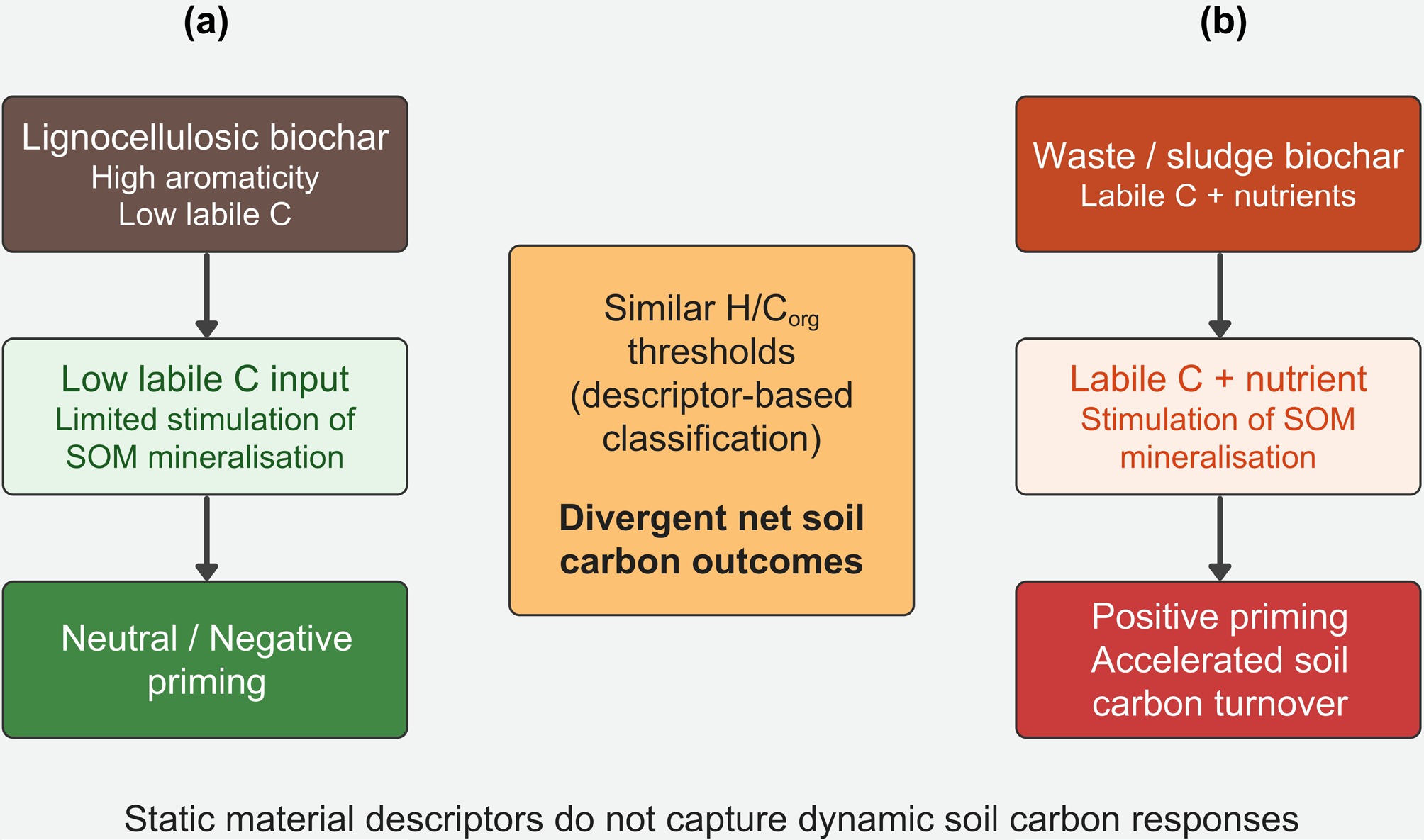
Figure 1.
Conceptual representation of feedstock-driven divergence in soil carbon dynamics despite similar descriptor thresholds. Biochars derived from lignocellulosic feedstocks (e.g., wood; [a]), characterized by high aromaticity and low labile carbon content, tend to limit stimulation of soil organic matter (SOM) mineralization and are commonly associated with neutral or negative priming, favoring soil carbon preservation. In contrast, biochars derived from (b) nutrient-rich waste or sludge provide labile carbon and nutrients that can stimulate SOM mineralization and are often associated with positive priming, leading to accelerated soil carbon turnover. Despite meeting similar physicochemical descriptor thresholds (e.g., H/Corg), these materials may result in divergent net soil carbon outcomes, highlighting the importance of complementing descriptor-based evaluation with performance-oriented interpretation.
Reported priming effects vary widely depending on biochar feedstock, pyrolysis conditions, and soil properties, with negative priming reductions of up to 30% (or greater) frequently observed for lignocellulosic (e.g., hardwood/wood) biochars, while positive priming increases of 10%–50% (and up to 90% in some cases) have been reported for nutrient-rich or non-lignocellulosic (e.g., manure-based, grass-derived, or legume-derived) biochars[9−11].
-
Feedstock composition is a primary determinant of the chemical, structural, and functional properties of biochar. Differences in biochemical composition, including lignin, cellulose, and nutrient content, lead to distinct material characteristics following pyrolysis[2]. Lignocellulosic feedstocks, rich in lignin and cellulose, generally produce biochars with highly aromatic structures and low labile carbon fractions, whereas manure- and sludge-derived feedstocks typically yield biochars with higher ash content, greater nutrient availability, and increased proportions of labile carbon[2]. These compositional differences directly influence microbial activity, nutrient cycling, and interactions with soil organic matter, ultimately shaping biochar functionality in soil systems. In addition to feedstock effects, biochar properties evolve through aging processes. Aging involves surface oxidation, the formation of oxygen-containing functional groups, and changes in porosity and surface chemistry, often increasing polarity and reactivity over time. These transformations can significantly alter biochar reactivity, affecting interactions with water, nutrients, and microbial communities[8]. Aging processes can occur over timescales ranging from months to years, with rapid initial oxidation often observed shortly after soil application, followed by slower long-term transformations that influence stability and reactivity.
Importantly, aging does not occur uniformly across all biochars[12]. Feedstock origin and production conditions influence the rate and direction of these transformations. For instance, biochars with initially low surface functionality may develop increased polarity and reactivity over time, while others may experience pore blockage or structural alteration that limits accessibility[13].
The combined influence of feedstock-dependent properties and aging processes reinforces the limitation of static descriptors. Material behavior is not fixed at the point of production but evolves through interactions with environmental conditions. As a result, evaluating biochar solely based on initial physicochemical properties provides an incomplete representation of its functional performance.
-
The divergence between intrinsic material properties and observed system-level behavior has important implications for how biochar is evaluated and applied. Materials that appear similar based on static descriptors may exhibit fundamentally different functional responses when interacting with soil systems.
This variability arises from the coupling between material properties and environmental context. Soil type, climate, moisture conditions, and management practices all influence biochar–soil interactions. Consequently, biochar performance cannot be predicted solely from intrinsic properties but must be understood as an emergent outcome of material–environment interactions. While feedstock identity is a primary determinant of biochar properties, environmental factors such as soil texture, climate, and management practices can modulate biochar behavior, indicating that feedstock alone may not fully predict performance outcomes.
From a biochar design and application perspective, this variability can be viewed as an opportunity rather than a limitation, as it enables the design of biochars with targeted functional properties tailored to specific applications, such as enhancing soil fertility or promoting carbon retention. Feedstock selection and thermochemical processing can be used to engineer biochars with targeted functional properties. For example, high-temperature lignocellulosic biochars may be optimized for carbon retention by minimizing priming effects, while nutrient-rich biochars may be designed to enhance soil fertility and biological activity.
This shift in perspective moves biochar research away from universal classification based on stability thresholds towards application-specific material design. In this framework, biochar is not evaluated as a uniform product but as a tunable material whose performance can be tailored to specific environmental functions.
Several practical indicators can support performance-oriented evaluation, including measurements of labile carbon fractions (e.g., water-extractable carbon), microbial respiration assays, and short-term incubation experiments. These metrics can provide insights into biochar–soil interactions and help distinguish between materials with similar intrinsic properties but different functional behaviors.
From a practical perspective, a minimal set of indicators can support performance-oriented evaluation of biochar in soil systems (Table 1). These include intrinsic descriptors such as the H/Corg ratio, labile carbon measurements (e.g., water-extractable carbon), biological response indicators (e.g., microbial respiration), and basic soil context parameters. The relative importance of these indicators depends on the intended application, for example, prioritizing carbon retention vs soil fertility. Together, this minimal set provides a more functionally relevant basis for interpreting biochar performance than reliance on static descriptors alone.
Table 1. Indicative set of function-oriented indicators for interpreting biochar performance in soil systems.
Indicator What it captures Example method When it matters most H/Corg (molar ratio) Intrinsic aromaticity/structural stability Elemental analysis Carbon retention-focused applications Labile carbon fraction Potential for microbial stimulation/short-term reactivity Water-extractable C Early-stage soil responses, priming Microbial/respiration response Priming effects on SOM mineralization Incubation/CO2 flux Assessing carbon turnover impacts Soil context parameters Modulation of biochar behavior Texture, SOM content Site-specific performance interpretation The indicators reflect key dimensions of biochar–soil interactions discussed in this perspective and are intended as a minimal, illustrative guide rather than a prescriptive framework. Advancing this approach requires the integration of static descriptors with dynamic performance indicators[1,4]. Metrics that capture labile carbon fractions, nutrient availability, and biological responses could complement traditional physicochemical parameters, enabling more accurate prediction of material behavior across different contexts[14,15]. Future work should also explore how regulators and certification bodies can progressively integrate performance-oriented indicators into biochar evaluation frameworks, ensuring alignment between scientific understanding and practical implementation.
-
This perspective highlights that feedstock-dependent properties, priming effects, and aging processes collectively determine biochar performance in soil systems, and that these factors are not captured by static descriptors alone. Biochar is a diverse class of carbon-based materials whose behavior in soil systems is strongly governed by feedstock origin, production conditions, and environmental interactions. While static physicochemical descriptors such as the H/Corg ratio provide valuable information on intrinsic stability, they do not capture the dynamic processes that determine real-world behavior.
Evidence shows that feedstock-dependent priming effects and time-dependent aging processes can lead to divergent outcomes in soil systems, even among materials with similar intrinsic properties. This highlights a fundamental limitation in descriptor-based evaluation approaches. Moving towards performance-oriented frameworks that integrate intrinsic properties with dynamic responses will enable a more accurate understanding of biochar behavior. Such an approach supports the development and application of biochar as a functional material tailored to specific environmental conditions and use contexts, rather than interpreted solely through static material descriptors.
-
During the preparation of this manuscript, the author utilized AI-assisted tools, including ChatGPT (OpenAI) to improve readability and edit the text, and Grammarly for grammar checking. After using these tools, the author conducted a thorough review and editing of the manuscript.
-
The author confirms sole responsibility for all aspects of this study and approved the final version of the manuscript.
-
Data sharing not applicable to this article as no datasets were generated or analyzed during the current study.
-
This research did not receive any specific grant from funding agencies in the public, commercial, or not-for-profit sectors. The author confirms that this research did not benefit from any institutional open-access publishing agreements.
-
The author declares that there are no known competing financial interests or personal relationships that could have appeared to influence this article.
-
Full list of author information is available at the end of the article.
- Copyright: © 2026 by the author(s). Published by Maximum Academic Press, Fayetteville, GA. This article is an open access article distributed under Creative Commons Attribution License (CC BY 4.0), visit https://creativecommons.org/licenses/by/4.0/.
-
About this article
Cite this article
Gholamahmadi B. 2026. Understanding feedstock-dependent biochar performance beyond static material descriptors. Biochar X 2: e016 doi: 10.48130/bchax-0026-0014 

Understanding feedstock-dependent biochar performance beyond static material descriptors
- Received: 05 April 2026
- Revised: 28 April 2026
- Accepted: 08 May 2026
- Published online: 02 June 2026
Abstract: Biochar is increasingly recognized as a multifunctional carbon material with important roles in soil improvement, environmental remediation, and carbon removal. However, its classification and evaluation commonly rely on static material descriptors, particularly the molar H/Corg ratio, to infer stability and long-term performance. While such descriptors provide useful information on aromaticity and intrinsic recalcitrance, they do not adequately capture how biochars derived from different feedstocks behave in real soil environments. Emerging evidence shows that feedstock identity governs functional performance through differences in labile carbon fractions, nutrient content, and interactions with native soil organic matter, including priming effects. In addition, biochar properties evolve through aging processes such as surface oxidation and functional group development, further influencing reactivity and stability. These dynamic responses mean that biochars meeting similar physicochemical thresholds cannot be assumed to be functionally equivalent materials. This perspective highlights an important dimension of biochar science that is not fully represented by descriptor-based approaches: feedstock-dependent and time-dependent performance in soil systems. Moving beyond static descriptors towards performance-oriented evaluation frameworks could strengthen the scientific basis for biochar assessment and support more function-specific design and application.
-
Key words:
- Biochar /
- Feedstock effects /
- Priming effect /
- Aging /
- Soil organic matter /
- Carbon dynamics /
- Material descriptors